CERTAIN theater-going people are asking the press of the country to assist them in elevating the “moral tone” of the stage. The “bad-woman” character it is affirmed is becoming altogether too popular in the theaters everywhere. So the press is asked to raise its voice against the evil, and the better class of the women are to insist on driving out the “bad-woman” actresses. To this end the “better class” are urged to attend the theater and frown upon anything that savors of lewdness.
Managers of theatrical troupes and actors and actresses are quite long-headed in this seeking to have the “better class” join them in making the theater not only more popular, but to appear highly refined and moral. And of course when the “best of the people” attend, they can be persuaded that the “bad-woman” plays, like nude art, are all right if only viewed through “educated and pure eyes.” Surely the leader of the hosts in sin is very cunning, if he may not be called wise. He seeks to familiarize people with sin, and then his next step is to persuade them that the evil is not so bad after all if man only keeps pure while he deliberately sits down to admire it for awhile, but of course always “above being corrupted by it.”
Against these sophistries of Satan the Word of God furnishes most excellent and unmistakable instruction. The Bible says of the Lord, “Thou art of purer eyes than to behold evil, and canst not look on iniquity.” The eyes of the one who is perfectly pure and holy do not behold the evil, no, not even with the thought of elevating it; for evil can not be elevated. The only thing to do with it is to destroy it. And since the history of the stage shows that it has been devoted almost entirely to presenting the various passions of mankind, and that, too, in a way that tends to destroy the keen sense of true morality, the best thing for the “better class,” and every other class, to do is to simply let the stage alone.
One of the saddest commentaries on these times lies in the fact that professed Christian people are ready to join in trying to purify the stage. Men have not learned the real and elevating joys of a Christian life when they still find pleasure and amusement in watching the unchaste, or silly, or blood-curdling acts of tragedy and comedy.
There is earnest work in these times for Christians. We are living in days that try men’s souls. And he who professes Christ should see the destruction that is threatening our world, and earnestly join with his Master in saving man from the ruin. While engaged in such an important work, he will not be casting longing eyes at the stage; neither will he assist Satan in making it more popular by trying to refine it.
T.
Industry
By Rev. A. H. Stephens
Industry.—Eternal industry is the price of success in the kingdom of grace. God is saying to the modern church that territory shall be hers, which she measures off with the soles of her feet.—Rev. A. H. Stephens.
The Individual
By Rev. B. Ezra Ely, Jr.
The Individual.—Let not one of us think for a moment that he is not welcome to Christ. Nay, He would draw all to Him. We have but to yield ourselves to His attraction, and we shall find ourselves getting ever nearer.—Rev. B. Ezra Ely, Jr.
KILLING THE MOTHER BIRD.
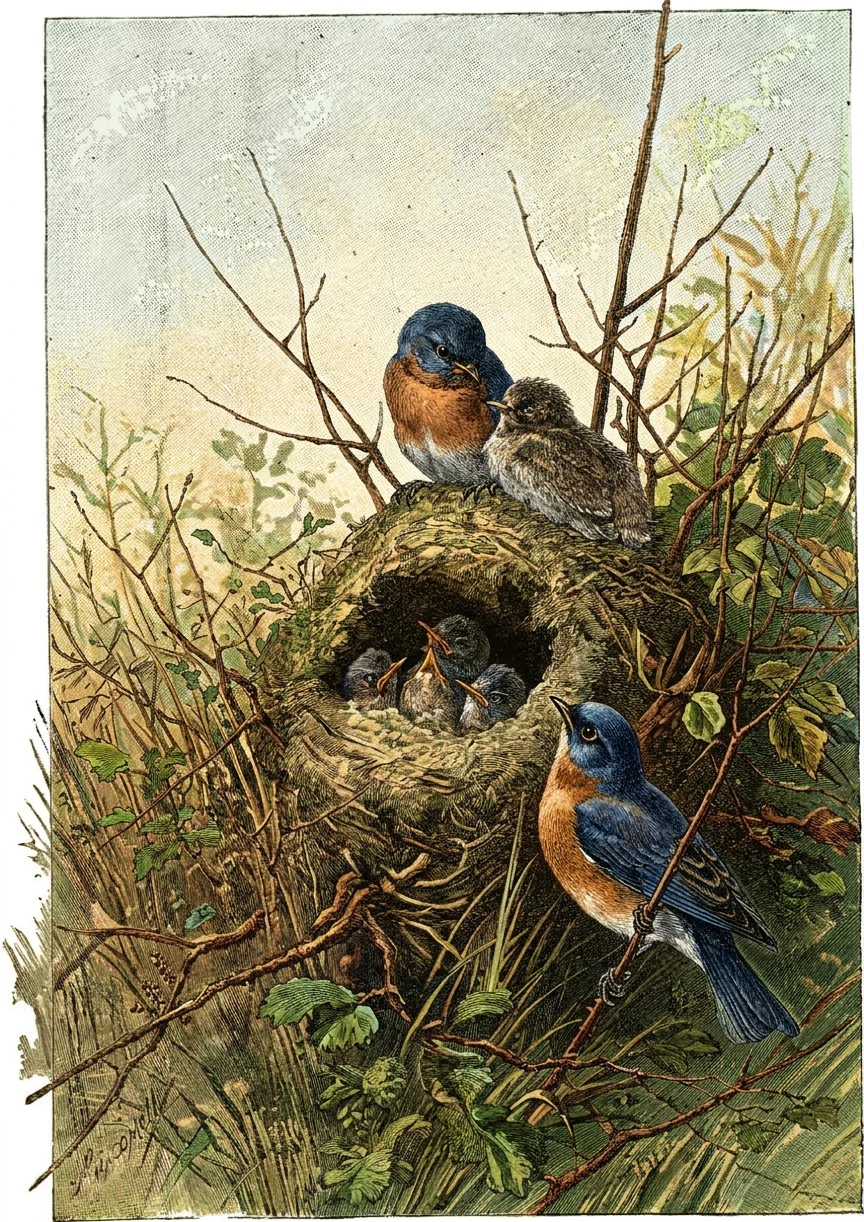
IT was a beautiful June day; the sun was shining brightly, and the soft summer air, laden with the sweet odor of flowers, was kissing with tender touch the leaves as it moved them to and fro; the earliest apples had ripened and hung invitingly from the boughs; the happiest season in the life of birds had come, which was shown not only by their merry and cheery notes of song, but by the loving care with which they were feeding their young.
Down in the orchard were some children enjoying with delight the pleasant morning scene. The bright sunshine, the ripe fruit, the soft air, the twitter of birds, the hum of bees, all made them bright and happy.
“Look out, boys! here comes a bluebird with a worm in her mouth. Let us watch her and find her nest,” cried one, as the mother bird flew by with a nice morsel in her beak for her young ones in their little home nest. “Yes, yes, there she goes; she’s gone into the hollow of the old apple tree. Listen to them as they are crying while she is feeding them. Now give me a push up the tree and I will get them out.”
The boy climbed up the tree and frightened away the old mother bird, that alighted on a tree close by and with pitiable cries flew to and fro trying to protect and save her little brood, but was afraid to venture nearer. It was enough to touch the hardest heart to hear her cries of distress and to see her pain.
But a merciless hand was thrust into the little nest, and out was drawn a poor little bird, fluttering and screaming with fright; its cries of distress pierced the mother bird’s heart, and she, wild with pain, flew at the boy and seemed to entreat him for her poor offspring; but he cried to his companions, “Get a stick; get a stick, boys, and when she flies down to her bird, you can knock her over and catch her.”
In an instant it was done, and as the poor bird in her grief and distress flew to try to help her young one, a blow was aimed at her, and the poor bird’s pain was over, for it killed her dead. The boys picked her up, and looked at her; there she was, a poor dead mother bird, killed while trying to save the little one that she loved so well.
There was a moment of silence as the boys held the dead bird in their hands; it was a painful scene. One said as he held the dead bird in his hands and looked at the limp, lifeless form: “What shall we do with the young bird? If we put it back in the nest, it will die, and so will the others; for there is no one to feed them now. I will put it back into the nest, anyhow.” And he put it back into the nest, and as he did so the young ones in the nest cried out for joy, for they were hungry, and thought it was the mother bird come to them with food. But they were never to hear her loving chirp again—no more to be warmed by her soft breast and sheltering wings. That night, through cold and hunger, they died.
The boys did not stay in the orchard much longer. The sun had lost its brightness, the fruit its sweetness, the air its soft caress; their consciences accused them of meanness and cruelty, and nothing seemed pleasant to them now.
Did not the great God who made heaven and earth make them conscious that the bird was His bird—that in wanton cruelty they had taken the life of a little creature that He cared for and for whose preservation He had given a law (Deut. 22:6, 7) to His people? Was not the shade that came over their spirits caused by His displeasure at their cruelty?
They were enjoying the beautiful summer morning which God had sent, eating the delicious fruit which grew on His trees, and repaying His kindness by killing His mother bird.—Our Dumb Animals.
THE LADY AND THE BIRD.
A million bobolinks killed last year? Four million other birds slaughtered in the same year—and for what?—That their torn and distorted bodies might be flaunted in the headgear of American womankind!
These are no guesswork figures, but the official report of the Audubon Society of Massachusetts. And what does it mean?—It means five million voices stilled in nature’s avian choir; five million flashes of cheeriness and gladness taken from human life; and millions of other young lives doomed to starvation or prey in order that the plumaged corpse of the murdered mother bird may be rent by a milliner and jammed in hideous shapelessness in milady’s hat!
Ah, milady, is there no efficacy in these desolating figures? Is there no mercy in your heart, no conscience in your make-up, no sentiment in your soul? Can you enjoy the finest opera when you think that the killing of the birds with which you and your sisters are crowning your beauty, is gradually silencing the grand oratorio of the forest and the fields?
A birdless country! a voiceless forest! what a desolation it would be! And yet that is just what this country is coming to if the song-birds of our land are to be killed off at the rate of five millions a year in order to gratify feminine vanity and keep woman “in style.”
What a gruesome, hideous, conscienceless “style” it is that murders melody and silences the lark that sings from heaven’s gate!
—Mail and Express.
THE MERCHANT'S LUNCHEON.
By Frances Amory
A RICH merchant sat at the desk in his office, alone. He leaned back in his chair, and drew a long, hard breath, quite like a sigh; for he had been struggling all day with difficult business problems, and he was weary in body and mind. Some people think a rich man never has anything to do; but they little know how hard he often has to work, first to gain and then to keep his riches. It was long past the luncheon hour, and it suddenly occurred to this man that he was faint and hungry; yet he was not ready to leave his work, and was about to return to his calculations when he caught sight of a little brown package lying on a shelf near by.
It was the package of luncheon which his little office boy brought with him every day, and to-day the boy, having been sent on some distant errand, had not yet had time to partake of it. The merchant arose from his seat, took down the package, and looked carefully at it. Just such packages had his own beloved mother tied up for him when he himself, a poor office boy, first began the career which had brought him to his present splendid position. Slowly he untied the string and opened the package. Two nice sandwiches of fresh homemade10bread, with a little cold meat between, a piece of old-fashioned-looking pie, and, O, a genuine New England doughnut! Tears rose to the eyes of the rich man as memory carried him back to the days of his boyhood, and to the loving deeds of that dear mother. Here was the very luncheon she had often prepared for him. And after a few moments he ate it up, every crumb, with far more enjoyment than an elaborate dinner would have given him, and then, refreshed and comforted, he returned to his work.
Soon after, the belated boy came in, and, after reporting to his master, he was surprised to hear him say, “Have you had any luncheon to-day, my boy?” The boy replied in the negative, with a glance at the shelf, when the gentleman said, with a smile, “Yes, it is gone; I have eaten it up.” Then, handing the astonished boy a five-dollar bill, he said: “Go out now and get some luncheon; but I want to thank you for the best one I have had for many a long year. And don't you forget, my boy, to be thankful that you have something which I lost long ago, and that is, a good mother.”—Frances Amory, in the Independent.
A LITTLE SERMON.
By Adelaide Anne Procter
Be strong to hope, O heart!
The day is bright,
The stars can only shine
In the dark night.
Be strong, O heart of mine!
Look toward the light.
Be strong to bear, O heart!
Nothing is vain;
Strive not; for life is care,
And God sends pain;
Heaven is above, and there
Rest will remain.
Be strong to love, O heart!
Love knows not wrong;
Didst thou love creatures even,
Life were not long;
Didst thou love God in heaven,
Thou wouldst be strong.
—Adelaide Anne Procter.
PENANCE FOR SIN IN JAPAN
By W. C. Grainger
Vital Principles.
Like all other man-made religions, the pagan systems of Japan look to no higher power for deliverance from sin than to man himself. The sinner, acting under instructions from the priest, becomes his own saviour. Doing penance for sin is a common practise.
Last January while out walking one evening, I was attracted by an unusual jingling of bells behind me. As they were rapidly approaching, I looked round for fear I might be in danger of being run over. Instead of seeing a vehicle or a troop of cavalry, I saw a squad of young men dressed in thin white cotton shirts and drawers, with small bells attached to their belts. Traveling in a brisk trot, they soon passed out of my sight; but there being such a contrast between their dress and the weather, my curiosity was aroused to know what it all meant. On making inquiry I learned that they were doing penance, and traveled in squads for company. It seems that a period of about six weeks at the beginning of the year is set apart for general self-abnegation and punishment—a period corresponding closely to the Catholic season of Lent.
The people confess their sins to the priests, and the priests prescribe the punishments, which are various and graded according to the nature of the offense or degree of guilt. Giving up for a certain period some luxury, as tea, tobacco, or wine; fasting for a certain length of time; walking back and forth barefoot on the rough stones between the gate and the temple so many hours; going barefoot from shrine to shrine to worship so often, etc., are among the remedies prescribed for sin.
About the severest punishment of which I have learned is that which came under my notice last January. I have been told that young men go to wells and dash buckets of water upon themselves, and in their thin clothes, dripping wet, go through the cold from shrine to shrine to obtain absolution from their sins.
The natural man would rather do something11to save himself than to receive salvation as a gift. If he could only make satisfaction for his sins by self-inflicted punishment, there is scarcely a man, I dare say, who would not gladly pay the penalty, however severe it might be, if he could only be allowed to continue in the indulgence of sin. Penance is like paying a debt. A man at the close of the year on settling with his creditors feels free to contract other debts, to be settled at the end of the next year. So it is with the sinner. He looks on his sins as a kind of debt. If he satisfies his conscience by doing penance, he feels free to go on as usual and commit sins to be atoned for at the next settling season. At any rate, that is the way the matter seems to be regarded over here.
Deliverance from sin through Jesus Christ can be obtained as a free gift. But it not only requires an acknowledgment but an abandonment of sin. The difficulty lies in forsaking sin. When teaching God’s Ten Commandments to my classes, the remark is often made by the pupils, “I think it would be very hard to obey these commandments,” or, “I think it would be impossible to keep this law.” Leaving God out of the reckoning, it would be impossible. “But with God all things are possible.”
He who has said to do, will give the power to do. He not only can make us free from the sins of the past, but can give us the ability to overcome the temptations of the future.
These people are not so very different from unconverted people of so-called Christian lands. All act on the same principle. The differences are chiefly individual. It requires less to satisfy the consciences of some than others. Some men, often professed Christians, after spending the greater part of their lives in violation of the tenth commandment, feel that they have done something truly meritorious if they devote a few thousands of their ill-gotten gains to establishing a charitable or educational institution. Others whose consciences are more hardened think to atone for their sins by making provisions in their wills for the outlay of a few thousands in charity after they are dead. The Pharisees in the days of Christ thought that by giving more careful attention to the traditions of the elders, they could make compensation for setting aside the commandments of God.
Many professed Christians to-day act in a similar way. They zealously perform self-imposed duties—things more in harmony with their own carnal natures—to satisfy their consciences for refusing to do what the Lord has required. All such are idolaters, for the Word of God says that covetousness is idolatry, and again, “Whosoever shall keep the whole law, and yet offend in one point, he is guilty of all.”
The pagan, the Catholic, and the Protestant, who choose to follow a way that is contrary to the commandments of God, are serving the same master, and will meet the same fate unless by sincere repentance and faith they find deliverance through Jesus Christ. He does not save people in their sins, but from their sins.
From early spring to the beginning of winter, religious feasts are very frequent. All temples and shrines, like our Catholic Churches, are dedicated to dead heroes. The birthday of the hero is the time usually selected for the festival. These occasions are apparently anticipated with great pleasure, especially by the women and children. The streets for several blocks around are at night illuminated with Chinese lanterns. The image of the hero is carried in state through the streets, amid the shouts of the people. It is a time of great rejoicing.
Last Sunday, April 17, a feast was held at Shiba temple, near our place, in Shiba park, which was attended by many thousands of people. It reminded me of a Fourth of July celebration in one of our large cities. These are times of ingathering for the priests; for I understand that all are expected to drop a coin into the temple treasury. If so, the priests of Shiba temple must have received a cart-load of coppers last Sunday.
We are doing what we can to turn people from these vanities to the service of the living God, the Creator of the heavens and the earth. The field is so large and the work so great that were it not for the promise of the Saviour, “Lo, I am with you alway, even unto the end of the world,” we should feel that it were a hopeless task. Not so, however; for the Word of God says that the last message shall gather from every nation, tongue, and people. We know that God has a people here, and with His assisting grace we shall endeavor to find some of them.
A Japanese Pilgrim.
W. C. GRAINGER.
The Wicked Overdraw Check.
A TRUE HORSE STORY.
On Madison Street one day I paused to pat the nose of a beautiful horse which stood by the curb, and commiserate his misfortune, for this beautiful animal, tho sleek of coat and shapely in body and limb, was apparently suffering most excruciating torture. His head had been checked inhumanely high, and the cruel bit, drawing tightly in his mouth, disfigured an animal face of unusual charm and intelligence. I was just fancying that the horse had begun to understand and appreciate my words of sympathy, when the lady who sat in the carriage holding the reins fumbled in her pocket, produced a lump of white sugar, and asked me to give it to the horse.
“He is very fond of sugar,” she explained, “and I have quite won his heart by feeding it to him. I always carry sugar in my pocket while out driving, and give him a lump at every opportunity. I never knew a horse to be so fond of sugar. Will you please give him another lump?”
“Certainly,” I replied; “I see that you are quite as fond of the horse as he is of sweets.”
“Yes, I think everything of him.”
“Then why do you torture him?”
“Torture my Prince?”
“Yes, that is just what you are doing. Do you know that the poor animal suffers agony because his head is checked so unnaturally high? His neck is drawn out straight, producing a most ungraceful angle; he holds his head awkwardly; the bit is hurting his mouth; and that graceful curvature of neck and carriage of head which are in his nature are now entirely lost. Why do you check him so high?”
She didn’t know. She was not aware that high checking was a source of pain to horses, nor that it destroyed their natural beauty. She was amazed at the discovery.
“May I trouble you to unloosen his check?” she asked.
When the strap was unsnapped, the horse immediately lowered his head, straightened the cramps out of his handsome neck, shook himself to make sure that he had actually been released from bondage, and then looked round with such a grateful, delighted expression in his intelligent eyes that his mistress declared no more checking straps should be used upon him.—Chicago Herald.
TAKE IT TO YOURSELF.
By Emma Rood Tuttle
[From an address.]
No one would think of beating or whipping an overloaded man if he should fall beneath his burden; but we often see horses beaten when they fall in the harness or strain to pull an overloaded wagon. No one would strike a man because he could not stand upon an icy road; but the smooth-shod or barefoot horse which slips or fails to pull his load on the icy street is often cut with the driver's whip. If you want a man not to stumble you would never dream you could prevent it by “checking him up” so he could see nothing but the sky above him.
If a man has severe labor to perform, we know he must have ample food, plenty of drink, sleep, and shelter. But how often are all such needs disregarded when animals labor! People too often forget that the needs of man and beast are the same in all the essentials for health and comfort.
The labor of animals has always been claimed without dispute; but now another claim is made upon them, which it chills my blood to talk about; but I put my sensitiveness under my feet and regretfully trample upon yours, because it is necessary that you know some very horrible things, that you may aid in repressing them.
The demand made upon animals is this: they are seized—and even raised, perhaps, by thousands—for vivisection. Our American colleges are practising it, and even our public schools have attempted it in many places.—Emma Rood Tuttle.
AS OTHERS SEE US.
A CHINAMAN living near Shanghai has been interviewed by the Frankfurter Zeitung, and, among other things, says concerning the “barbarian” Europeans: “They certainly do not know how to amuse themselves. You never see them enjoy themselves by sitting quietly upon their ancestors’ graves. They jump around and kick balls as if they were paid to do it. Again you will find them making long tramps into the country; but that is probably a religious duty, for when they tramp, they wave sticks in the air, nobody knows why. They have no sense of dignity; for they may be found walking with women. They even sit down at the same table with women, and the latter are served first. Yet the women are to be pitied, too. On festive occasions they are compelled to appear almost naked before every man who likes to look at them, and they are dragged around a room to the accompaniment of the most hellish music.”
HE LEADS.
I CAN not always trace the onward course
My ship must take;
But, looking backward, I behold afar
Its shining wake
Illumined with God's light of love, and so
I onward go,
In perfect trust that He who holds the helm
The course must know.
I can not always see the plan on which
He builds my life;
For oft the sound of hammers, blow on blow,
The noise of strife,
Confuse me till I quite forget He knows
And oversees,
And that in all details, with His good plan
My life agrees.
I can not always know and understand
The Master's rule;
I can not always do the tasks He gives
In life's hard school;
But I am learning with His help to solve
Them, one by one,
And, when I can not understand, to say,
“Thy will be done.”
—The Advance.
OUR WORK AND WORKERS.
The 15th inst. was the day set for the dedication of the church at Hamilton, Mo.
Three candidates were baptized at Village Creek, Iowa, April 30, by Brother Swedberg.
On the 30th ult. Brother H. M. J. Richards baptized four candidates at Winterset, Iowa.
Brother N. L. McClintock reports the addition of four members to the church at Allbaton, Iowa.
Brother J. S. Hart reports the baptism of one candidate at Storm Lake, and one at Algona, Iowa.
Seven converts are noted by Brethren F. A. Washburn and W. A. Gosmer at Hastie, Iowa.
The company of believers at Macksburg, Iowa, are planning to erect a new house of worship this year.12
Brother V. Thompson recently spent a Sabbath and Sunday at Blair, Neb., and baptized two candidates.
A Scandinavian Sabbath-school was organized at Cambridge, Wis., April 23. This school is the result of the canvassing work.
The Missouri Conference is to have a larger corps of laborers this year than ever before. This ought to be the case in every conference.
An increasing interest is reported in the work conducted by Brother A. A. Meyer at Morsey, Mo., and a Sabbath-school has been organized.
The workers in the Life-saving Mission at Topeka, Kansas, are soon to begin a philanthropic work among the needy people of that city, so says the Worker.
Seven members were added to the church in Birmingham, Iowa, the first week of this month. Circumstances prevented others from attending who desired to be baptized.
Of the Kansas City Mission, Brother W. A. Hennig says: “Every bed we have is occupied every night; many more sleep on the floors. We need at least one hundred more beds, and must have them ready by fall.”
It is gratifying to learn that our good church paper, the Review and Herald, has increased its subscription list by nearly three thousand in the last six months. From this should come a much enlarged missionary spirit, and increased circulation of our missionary publications.
Brother O. E. Jones reports a good work at Guide Rock, Neb. Meetings were held in the Baptist Church. Of those who accepted the truths presented one was the leading physician of the place, who bore all the expense of the meeting. A company and Sabbath-school were organized.
The Outlook, a Methodist paper published in Lincoln, Neb., gives our work this commendatory notice: “The rescue mission on South Ninth Street is under the care of the Adventist Church. This means a good administration, with all their bills met. This denomination builds churches, and pays for them; builds colleges and sanitariums, and pays for them. Its people, with but few exceptions, are among the poor, yet the system of tithing, the one-tenth to the Lord, gives them a financial strength unknown in most other churches. . . . The rescue work they are undertaking is worthy of our assistance, as a Christian people.”
The missionary boat Morning Star, owned and managed by Brother J. E. White, is now located at Yazoo City, Miss. This itinerant mission is carried on expressly for the benefit of the colored people of the south, and its first permanent monument was a church and school at Vicksburg. The latest enterprise in this connection is a monthly journal devoted to the special work of the mission. It is printed and published on the boat, is entitled, The Gospel Herald, and is furnished at the low price of twenty-five cents a year. We might say more about it, but it is so cheap that you would better send twenty-five cents and get it for yourself, and then you will know all about it, and about the good work the money and the paper are designed to assist. Address, Gospel Herald Publishing Co., Yazoo City, Miss.
FISHING VERSUS WINNING.
John G. Woolley does not believe that the words of Jesus, “I will make you fishers of men,” refer to anything more than change of employment, not to methods; and he is right. The Lord by that did not mean that man should use fisherman’s methods, but rather that they should seek to save men; and yet political workers in the church use the expression to justify unchristian methods. Here is a part of what Mr. Woolley says in the Voice: we do not believe in his seeming hope in politics, but he utters a lot of Gospel truth:—
Nothing could be more insidiously demoralizing to a Christian disciple than to think of “the work of God” as fishing and of himself as a fisherman. For if a man adopts an occupation or a name, as fairly descriptive of his work, or of himself, he will inevitably—however innocently or unconsciously—conform more or less to its associated characteristics.
It is impossible to think seriously of the parable of the good fisherman. “The shepherd giveth his life for the sheep.” But not the fisherman, not he! His fundamental idea is to take the fish’s life for the fisherman.
The shepherd knoweth his sheep. Not so the fisherman. He banks on “luck,” and “all’s fish that comes to his net.”
The sheep hear the shepherd’s voice and follow him. Not so the fisherman. His art is to deceive the fish and haul him out to certain death, and string him, and take him home to fry.
And, above all, “the sin which doth so easily beset” a fisher of fish is lying about what he has caught. There is something about the business that makes a man oblivious to weights and measures.
And I reckon that not a little of the present terrible and terribly just reproach of the church is due to the process, long continued, of adjusting the traits and the language of a superstitious, selfish, cruel, demoralizing sport to the ministry of souls.
Of course I do not intend to disparage the work of fishermen in general. It is for the most part honorable, useful, necessary; but at its best is antipodal to the work of “winning souls.”
In the one case, you “slip up” and throw in your baited hook, or push out and “cast the net.” In the other, you simply lift up Christ and trust Him to draw all men unto Him.
I believe thoroughly in evangelistic effort, but my hope is in the Word of God, and not “the net.” Souls of men can not be taken with a net. We have tried that and have “had luck,” such as it was. But the effect upon us has been bad. We have had our imagination excited; we have lost the habit of discrimination; we have grown ambitious for quantity rather than quality; we have filled the church with unprofitable and unusable material, until she sinks, and will go to the bottom unless we heave the bulk of her cargo overboard—back into the sea.
We have fished with a vengeance! and just look at our fish!—sunfish, weakfish, bluefish, codfish, dogfish, devilfish, eels, suckers, bloaters, flounders, wall-eyed pike, bullheads. And on election day, the only time in the year when every fish counts, we never land, but “lie to” and pray God to save all the fish in the sea, while our own cargo rots under our noses.
That will look bad in print, I know, but I shall be acquitted by those who take the trouble to think about it. We have filled the church with the bodies of men whose souls are not saved or even bettered by their church-membership. And they would be better men if they were back in the world, soul and body together—and the church would be better. And a wilfully unclean Christian professor is a spoiled fish—as certainly as a pickerel long dead upon the sand.
Let us stop fishing and “preach the Word; be instant in season, out of season; reprove, rebuke, exhort with all long-suffering and doctrine.” This country—this world—has got to be saved, and it will be, but a church that votes for homicide—“and prosperity”—every four years will never save it.
I do not mean to belittle the crisis of last November. I do not mean to denounce all men who voted against Jesus then. To their own Maker they must stand or fall. I know how hard it is to face sure defeat and vote upon the losing side. I know it will cost to cleanse the church, and that while we do it the wicked will flourish like a bay tree, and sin run rampant worse than ever in some places. But if we really want to win souls, let us look straight into God’s face, and say with him of old in like perplexity, “O our God, wilt Thou not judge them! for we have no might against this great company that cometh against us; neither know we what to do; but our eyes are upon Thee.”
Delicious Bromose
The New Nut Food
The Food that
Is all food
Delicious, healthful, easy to digest. Makes double the rich blood of ordinary food.
A Perfect Food for Children.
Thin people gain two pounds a week on a half Bromose diet.
Our Booklet, “NUT FOODS,” free, tells all about our Nut Products.
A Luncheon of Bromose for a 4c Stamp. Seven Samples for 25c. Full line of samples, 50c
SANITAS NUT FOOD CO., Battle Creek, Mich.
When you write, please mention the SIGNS OF THE TIMES.