THE CHRISTIANITY OF CHRIST AND THE CHRISTIANITY OF THE CRUSADES
Page 1
The American Sentinel
Mar 26, 1896
Pacific Press Publishing Company · New York · Mar 26, 1896
THE CHRISTIANITY OF CHRIST AND THE CHRISTIANITY OF THE CRUSADES.
The Christianity of the Crusades was the gospel of revenge, of force, of the sword: it was the National Reform movement of that era.
Europe was already “Christian,” having been made so largely by the sword; and what was more natural than that men believing in national “Christianity” should regard carnal weapons as the most potent means of establishing even the kingdom of the Prince of Peace?
But the Christianity of the Crusades was not in any sense the Christianity of Christ. When the people sought to take Christ by force to make him King, he hid himself from them.
When Peter drew a sword in defense of his Master, Jesus said: “Put up again thy sword into his place: for all they that take the sword shall perish with the sword.”
When arraigned before Pilate as one guilty of speaking against Cæsar, Christ said: “My kingdom is not of this world: if my kingdom were of this world, then would my servants fight; . . . but now is my kingdom not from hence.”
And finally, the great apostle to the Gentiles wrote: “For though we walk in the flesh, we do not war after the flesh: for the weapons of our warfare are not carnal, but mighty through God to the pulling down of strongholds; casting down imagination, and every high thing that exalteth itself against the knowledge of God, and bringing into captivity every thought to the obedience of Christ.”
This is the Christianity of Christ. Its fundamental law is: “Thou shalt love the Lord thy God with all thy heart, and with all thy soul, and with all thy mind;” and, “Thou shalt love thy neighbor as thyself.” Its one undeviating rule of human conduct is: “All things whatsoever ye would that men should do to you, do ye even so to them.”
Christ himself came not into the world to condemn the world, “but that the world through him might be saved.” His ministers are ambassadors of peace. Says the apostle: “God was in Christ reconciling the world unto himself, not imputing their trespasses unto them; and hath committed unto us the word of reconciliation. Now then we are ambassadors for Christ, as though God did beseech you by us: we pray you in Christ’s stead be ye reconciled to God.”
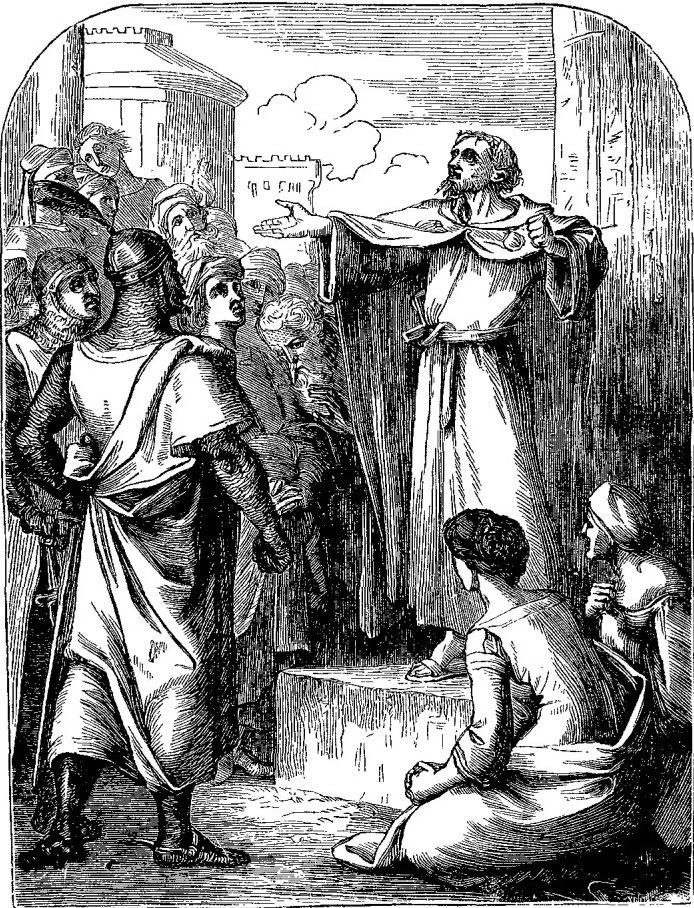
Peter the Hermit, the Typical National Reformer of the 11th Century,
Preaching the Crusades.
Such is the Christianity of Christ, of the Gospels, of the Acts, of the Epistles; and such the relation that its ministers should sustain toward all men. But such is not the Christianity of the Crusades. The Saviour said: “Love your enemies; do good to them which hate you, bless them that curse you, and pray for them which despitefully use you.” But the Christianity of the Crusades taught the very opposite of all this.
Peter the Hermit, the great apostle of the Crusades, appealed to passion, prejudice, love of conquest, and hope of temporal and eternal reward. He exhorted his hearers to be revenged on the hated infidels, and assured them that they would at the same time acquire great spiritual “merit”!
Mounted on a mule, the Hermit carried his “gospel” of hate everywhere. In his so-called preaching this man pictured the profanation of the holy places. Pantomime often supplied the lack of words. Depicting the scenes he had witnessed, he displayed a crucifix he had brought with him from Jerusalem, and smiting his breast with it until the blood flowed, he exhorted his auditors to purge the Holy City of the hated Turk.
“For many years,” says Ridpath, “the fanatical religious sentiment of the West had prescribed a pilgrimage to some holy place as the best balm for an inflamed conscience. The morbid soul of the Western Frank saw in the sandal-shoon and scallop-shell of the pilgrim the emblems and passport of a better life. He who had sinned, he who had consumed his youth in lawlessness and passion, he who had in his manhood done some bloody deed for which he was haunted by specters, he who had forgotten the ties of kindred and stopped his ears to the entreaties of the weak, must ere the twilight faded into darkness, find peace and reconciliation by throwing off the insignia of human power and folly and going barefoot to the holy places of the East. And what other spot so sacred, so meritorious, as the scene of the crucifixion and burial of Christ?”
The Crusades afforded an opportunity to do penance and to get renown and even wealth at one and the same time. “To destroy the hated Turk,” says the historian, “and eradicate his stock from the earth, was98regarded as the one work worthy of the praise of men and the favor of heaven.”
The Council of Clermont assembled in the autumn of 1095. On the tenth day of the Council, Pope Urban II., who had crossed the Alps to be present, ascending a throne, said: “Christian warriors, rejoice! for you who without ceasing seek vain pretext for war have to-day found true ones; you are not now called to avenge the injuries of men, but injuries offered to God. It is not now a town or castle that will reward your valor, but the wealth of Asia, and a land flowing with milk and honey. If you triumph over your foes, the kingdoms of the East will be your heritage. If you are conquered, you will have the glory of dying where Christ died. . . . Gird your swords to your thighs, ye men of might. It is our part to pray, yours to do battle; ours—with Moses—to hold up unwearied hands, yours to stretch forth the sword against the children of Amalek.”
The response to this appeal was just such as might have been expected. From the lips of that mighty throng burst the cry, Dieu le Veut! Dieu le Veut! and answering back, the “successor of St. Peter,” the self-styled Vicar of the Son of God, said, “God indeed wills it. Go forth, brave warriors of the cross, and let ‘God wills it,’ be your watchword and battle-cry in the holy war.”
The Red Cross.
“As soon,” says Ridpath, “as the loud cry of Dieu le Veut was hushed at a gesture from the pope, one of the cardinals arose and pronounced a form of confession for all those who would enlist in the holy enterprise. Thereupon, Adhemar, bishop of Puy, came forward and received from the hands of Urban one of the red crosses which had been consecrated for the occasion. Knights and barons crowded around the seat of his holiness to receive the sacred badge and to take the oath of loyalty to Christ. The cross of red cloth was then stitched upon the right shoulder of the mantle, and the wearer became a soldier of the cross—a Crusader.”
“From Scandinavia to the Mediterranean the Crusade was preached with a fiery zeal that kindled a flame in every village. In accordance with a canon of the Council of Clermont the taking of the cross was to be accepted in lieu of all the penances due to the church. The license thus granted was in the nature of a plenary indulgence and became one of the most powerful incitements to the cause. . . . All the warlike lusts of the age were set at liberty under the sanction of religion and retributive justice.”
“Those who were in debt gladly threw off the burden by assuming the cross. The creditor might no longer menace or disturb those who had become the soldiers of Christ. Offenders and criminals also found the day auspicious. No prison wall might any longer restrain him who took the sword against the infidel. Over the thief and the murderer on whose right shoulders appeared the sacred emblem of the holy war the church threw the ægis of her protection. All manner of crime was to be washed white in the blood of the sacrilegious Turks.”
Massacre, Pillage and Burning.
Very naturally the movements of large bodies of such men were attended with every sort of excess. The Crusaders “swept through the German territories,” says Ridpath, “like an army of devouring locusts, until through sheer waste of resources they were obliged to divide into smaller masses.” Pillage marked the track of the Crusading hosts; and if they met opposition, massacre too often followed, and this before they had opportunity to cross swords with the infidel Turks. Semlin, in Austria-Hungary, suffered all the horrors of massacre, pillage and burning, at the hands of men made “soldiers of the cross,” by papal decree, and by adopting and wearing a badge.
“One band numbering about twenty thousand, commanded by Walter the Penniless, of Burgundy, pressed forward through Hungary and Bulgaria in the direction of Constantinople. It is said of this advanced host that there were only eight horsemen in the whole number. The rest of the wretched mob proceeded on foot, generally marching without shoes and hundreds falling by the wayside through exposure, disease, and famine. Nothing but the tolerance and friendly disposition of Carolman, king of the Hungarians, saved the miserable vanguard from entire destruction. In Bulgaria, however, the lieutenant of the Eastern Emperor looked with less favor upon the lawless horde that had been precipitated into his kingdom. The Crusaders were quickly cut off from supplies and were obliged to have recourse to violence, but they now found themselves opposed by a race as savage as themselves.
“The Bulgarians took up arms to defend their country from destruction. The track of Walter and his army was marked with blood and fire. The Crusaders were cut off day by day until at the confines of the country only Walter and a few followers remained to make their way through the forests to Constantinople.”
The Sack of Semlin.
“Meanwhile the second division of the host, numbering about forty thousand men, women and children, under the command of Peter the Hermit himself, pressed on in the same direction taken by Walter. Their march was promoted through Hungary by the favor of king and people. The wants of the vast multitude were supplied, and friendly relations were maintained, as far as the city of Semlin. Here on the walls were displayed some of the spoils which had been taken two months previously from Walter and his savages. On seeing these tokens of their friends’ overthrow the Crusaders broke into ungovernable rage, and fell furiously upon the offending city. The ramparts were scaled, thousands of the people were butchered, and Semlin suffered all the horrors of pillage and burning.”
True, these things were committed by an unorganized mob that never actually reached Palestine. But the regular Crusaders were little better. Having cast away the gospel bands from them to the extent of entering upon war for the furtherance of the gospel, why should they stop short of any excess?
Of the host that besieged and finally captured Antioch, Ridpath says: “One of the chief incentives to the uprising had been the license freely offered by the Church to all who should be victorious over the infidel. To them restraint should be unknown. The maidens of Greece and the dark-eyed houris of Syria, were openly named as a part of the reward due to them who should hurl the Turk from his seat on the tomb of Christ; and the Crusader in his dreams saw the half-draped figures of Oriental beauties flitting in the far mirage. Before the walls of Antioch the men of the West sat down to enjoy whatever the land afforded. The god of license became the favorite divinity. All restraint was cast aside. Every village in the surrounding country was recklessly pillaged, and the camp of the Crusaders was heaped with spoils. Then the armed warriors gave themselves up to feasting and love-making with the Syrian damsels. Bishops of the Church wandered wantonly through the orchards and lay on the grass playing dice with Cyprians.”
The Slaughter at Jerusalem.
And finally, when Jerusalem was taken by the professed followers of the Prince of Peace, indiscriminate slaughter followed. “Blood,” says the historian, “flowed in the gutters, and horrid heaps of the dead lay piled at every corner. None were spared by the frenzied Christians, who saw in the gore of the infidels the white way of redemption. Ten thousand dead, scattered through the city, gave token of the merciless spirit of the men of the West. Another ten thousand were heaped in the reeking courts of the great mosque on Mount Moriah. ‘God wills it,’ said the pilgrims. The indiscriminate butchery of the Saracens was carried out by the rank and file of the Crusading army. In this bloody work they needed no incentive—no commander. Each sword flamed with hatred until it was cooled in the dripping life of the enemies of Christ.”
Such were the deeds done and the scenes enacted in the era of the Crusades in the name of Christianity. And what was accomplished? Absolutely nothing for either true religion, or genuine civilization; and worse still, Christianity became with millions of the human race a hissing and a by-word. Henceforth it was to be judged, not by the sublime precepts of its Founder, not by the spiritual truths which he taught, or by the spiritual power he had promised, but by the sack of Antioch, by the massacre at Jerusalem, by the rivers of blood that everywhere flowed in the track of the Crusaders.
And who was to blame? Who but the leaders in religious thought? Who but the religious teachers of the day? Suppose that instead of preaching the Crusades, Peter the Hermit had preached the gospel of the Son of God. Suppose that, like the apostle, he had been an ambassador of peace and not of war, how different might have been the history of the eleventh and twelfth centuries; yea, of all subsequent time!
“PROTECTING” RELIGIOUS LIBERTY.
THE Christian Advocate, of February 20, commenting upon the provisions of the New York State Sunday law, says: “Section 264 protects religious liberty in the following: ‘It is a sufficient defense to prosecution for work and labor on the first day of the week that the defendant uniformly keeps another day of the week as holy time, and does not labor on that day, and that the labor complained of [Sunday labor] was done in such a manner as not to interfere with or disturb any other person in observing the first day of the week as holy time.’”
If religious liberty in the State of New York had no better protection than this, we think it would not long survive.
By the provisions of this section, but two classes of citizens are considered as entitled to religious liberty; namely, those who observe Sunday, and those who uniformly keep another day of the week as holy time. All other classes may whistle for their religious liberty, but never get it so far as the law is99concerned. Yet it is a fundamental principle of our system of government that all men have equal rights. The Sunday “law” denies to certain classes of citizens what the Creator has freely given them.
But this is not all that is wrong with this “protective” provision. In order to be entitled to its benefits, the individual must uniformly keep another day as holy time. If he ceases to do this, he falls at once without the provisions of the section, and becomes liable under the law. More than this: he is required to observe the day as holy time. This is more than is required of the Sunday observer, he being merely obliged to abstain from Sunday labor.
The law declares that every citizen of the State shall regularly observe some day of the week as a day of rest. If he chooses Sunday, he is obliged to refrain from secular labor; if his choice falls on any other day, he is obliged to observe it as holy time. In any case, his religious observance of the day is under legal compulsion. And compulsion is not liberty, but the opposite.
This “exemption clause” of the “law” shows conclusively that the statute is religious in character, and not civil. It exempts from the penalty for Sunday labor such persons as uniformly keep another day of the week as holy time. That is to say, the law annuls itself, in the case of such individuals, in everything except that which pertains to religion. They may do secular work on Sunday, but they must observe another day of the week as “holy time.” They must observe the day religiously; this the “law” demands.
We willingly recognize in the provisions of the section an honest attempt to combine justice with a Sunday “law.” But the two will not unite; and hence some very curious features of the “law.” It prohibits secular labor on Sunday on the part of any of its citizens, and yet leaves all free to escape from its prohibition by the avenue of regard for some other day. It accepts in lieu of abstinence from secular work on Sunday, a religious regard for another day of the week, which it does not claim will be of any possible utility or value to the State; in other words, it exchanges what it assumes to be of value, for nothing. It exempts the very class who have the strongest objections to obeying it,—namely, those who regard another day of the week as sacred; it makes an act which is the most contrary to its requirements—the observance of another day—a valid ground for noncompliance with the same. Such are some of the anomalous features of a Sunday “law” when enacted with, it may be, the best motives and an honest desire to protect religious liberty.
Such a “law” falls very far short of constituting a safeguard to religious freedom.
THAT HEARING AGAIN.
By Editor
As reported in these columns last week, the hearing on the 11th inst., before the Judiciary Committee of the House on the so-called “Christian” amendment to the Constitution, was an occasion of unusual interest. The impression received by those present was that the advocates of the measure succeeded in convincing the committee that the proposed amendment was not only unnecessary, but that it was mischievous and wrong. The Christian Statesman, however, takes a more hopeful view of the situation, more hopeful from its standpoint, and while admitting that “a possible and even a probable result of the work done may be the holding back of the report of the committee until next year,” finds even in this delay “an opportunity for a wider circulation of petitions, and a more emphatic expression of the ‘Christian’ sentiment of the country.”
The Statesman makes a great deal of the fact that the Christian ministers who opposed the amendment were compelled to do so side by side with prominent infidels and free-thinkers. “It is seen now more clearly than ever before,” remarks the Statesman, “that the enemies of Christ and his religion are consistent opponents of this amendment. Infidelity and atheism are simply revealing their true inwardness when they utter their characteristic denunciations of the amendment.” “Let the lines be more and more clearly drawn,” says the Statesman. “This campaign has done much to clear the atmosphere.
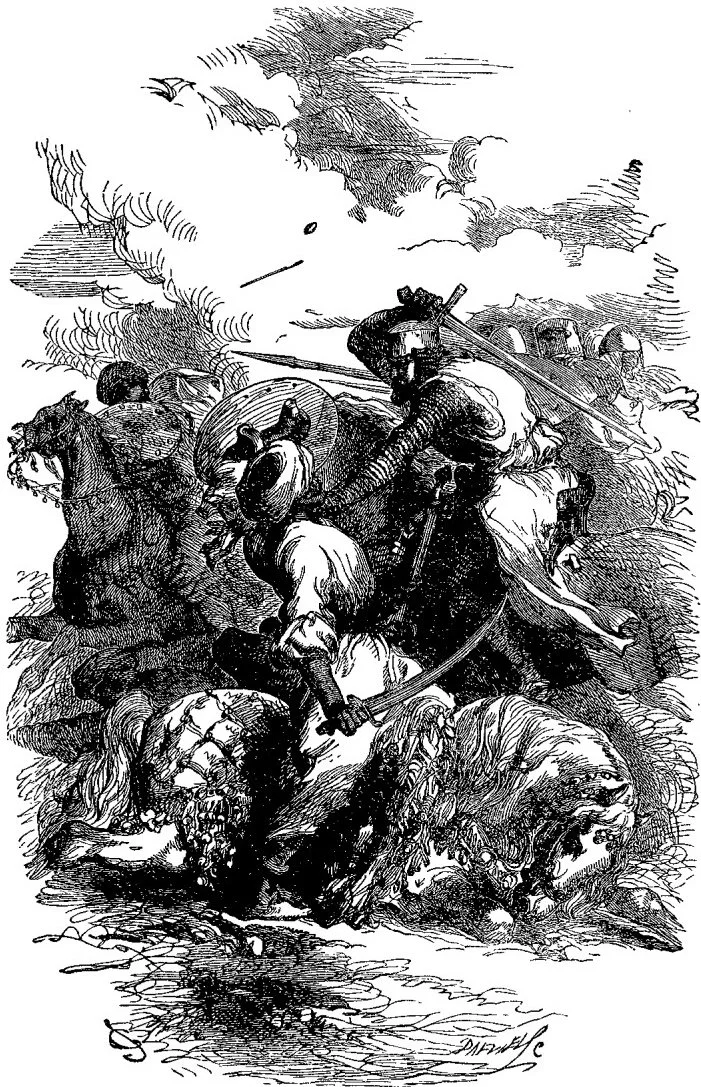
“Christian” Warfare in the 11th Century.
Another campaign will show the followers of Christ, very generally throughout the nation, that if they oppose the ‘Christian’ amendment they must do so in company of the hosts of infidelity, spiritualism, atheism, and all the other forces of evil that are cursing our country.”
It is to such “arguments” that the Statesman resorts in this its hour of humiliating and crushing defeat. According to this we are left to infer that a Christian has no right to claim liberty of conscience if an infidel does the same thing! It is simply a repetition of the old cry: “This man receiveth sinners and eateth with them;” and, “Behold a gluttonous man and a winebibber, and friend of publicans and sinners.”
It is in vain, however, that the Statesman and its partisans assume to be the Christian people. The amendment which they are urging is the very opposite of Christian. It would destroy and take away from men the very liberty which Christianity gives.
RELIGION AND LAW IN MASSACHUSETTS.
THE legislators of Massachusetts are wrestling with the following proposed amendment to the constitution of that State:—
No law shall be passed respecting an establishment of religion or prohibiting the free exercise thereof, nor shall the state or any county, city, town, village or other civil division, use its property or credit or any money raised by taxation, or otherwise, authorize either to be used for the purpose of founding, maintaining or aiding by appropriation, payment for services, expenses or in any other manner, any church, religious denomination, or religious society, or any institution, society or undertaking which is wholly or in part under sectarian or ecclesiastical control.
Thursday, March 12, the committee having the amendment in charge gave a hearing upon it, concerning which the Boston Daily Globe of that date says: “The amendment appeared innocent enough at this, its second hearing, to the committee, and to the gentlemen who were the immediate cause of its introduction, but before the hearing was over, and after the first three witnesses had departed, the committee had its eyes opened very wide to the possibilities of the proposed amendment, and the variety of interpretations which could be placed on it; not the least of which was the entire abolishment of all Sunday laws. So that the Christian gentlemen who have introduced the amendment have, innocently enough, given free thinkers, Mahometans, Buddhists, and, in fact, every phase of religious thought something to fight for, and to urge, providing they look at it in the same light as did Rev. George E. Fifield of South Lancaster and Rev. Frederick C. Gilbert of Everett, at the hearing this morning.
“The claim these two latter gentlemen made was that the amendment was a very good and necessary thing, because it would separate once for all, in Massachusetts, Church and State, even to the recognition of any particular day as a day of worship, because they maintained that the legal recognition of the present Sunday was in itself a recognition of Christianity, and they did not think that good Christians needed any such assistance from the government—they would observe the Sabbath whether there was a law or not.
“Mr. Fifield said it was a poor kind of religion that needed assistance from any government. Christianity had its birth without governmental sanction, and its growth was not due to any governmental assistance. The God he worshiped did not need the assistance of any government. He quoted from the fathers of the Constitution to prove that it was their intention to not even recognize Christianity so as to prevent entirely any possibility of the union of Church and State.
Mr. Gilbert, who is a Seventh-day Adventist, but who was formerly a Jew, and is now working among the Hebrews of this vicinity, thought the proposed amendment would give the Jew, who observed Saturday as a day of worship, an opportunity to do business on Sunday, and the members of other religions an opportunity to observe their particular days of worship with the same results. He did not see anything wrong in that, and thought it would be a good thing for all. It100would give everybody the same opportunity that the Sunday worshipper now enjoyed, and he thought that was an equitable proposition.
“When asked whether he thought saloons should be permitted to do business on Sundays, he said if the State thought the saloons were a good thing six days a week, then they were certainly good things for the seventh day; but if saloons were not good, then they should be abolished altogether.”
The Globe thinks that the gentlemen who proposed the amendment had in view only “the latter part, which refers to the use of State funds for sectarian purposes, but in order to give the thing an air of ‘freedom,’ the first lines were inserted as a sort of meaningless ‘glittering generosity,’ a sort of feather from the eagle, to make it soar. But it is this part of the amendment that will make trouble for the law, as it is a direct blow at the Sunday holiday as at present observed.”
BEHIND PRISON BARS FOR CONSCIENCE’ SAKE.
March 13, Tennessee imprisoned another man for conscience’ sake.
This victim of an unjust “law” is J. W. Lewis, a Seventh-day Adventist, of Lake County, Tenn. The place of his imprisonment is Tiptonville.
He was indicted on the technical charge of “nuisance,” the gist of his offense being “secular labor on Sunday.”
The trial was before His Honor, Judge Swiggert, who has had quite a large experience in such cases.
That the judge did not regard the offense as a serious one is evident from the fact that he imposed only a nominal fine—one dollar; but the costs were heavy, amounting to $60.46, making a total, fine and costs, of $61.46.
Under the law of Tennessee, fifteen dollars of this cannot be satisfied by imprisonment; so that in this case the imprisonment, at twenty-five cents per day, will be for one hundred and eighty-six days.
As usual in such cases, the work for which Mr. Lewis is thus imprisoned, was ordinary private work, of such a nature as not to attract undue attention; and the evidence showed plainly that nobody was disturbed or annoyed by it, except as some may have suffered that sort of mental annoyance due to an unwillingness that others should enjoy equal rights and privileges with themselves.
The animus of the prosecution was plainly shown in the speech of the prosecuting attorney to the jury. The attorney who, by the way, bears the same name as the defendant in this case, addressed the jury substantially as follows:—
Our sabbath is the very foundation of our moral government. One man’s conscience may lead him to keep one day, another man’s conscience may lead him to keep another day, and so on until we have no sabbath. Gentlemen of the jury, we cannot let things go on in this way.
These Adventists are like the Mormons. One man’s conscience may require him to have twenty wives, another man’s conscience may require him to take every good woman in the community. Gentlemen of the jury, this work must be stopped.
Every civilized nation regards our sabbath. If these Adventists are permitted to go on in this way, everybody may take his gun and go hunting on Sunday. The saloon-keeper may open his saloon and sell whiskey on Sunday. Our sabbath was kept by God Almighty himself, and shall these Adventists be permitted to override this sacred institution!
All civilized nations keep this day. The most wicked man among us, the man who gambles and gets his neighbor’s money until Saturday night, feels a holy awe as the holy day is approaching, and he now lays aside his work to keep his reputation.
An Adventist’s conscience leads him to build houses on the sabbath, another’s conscience leads him to open a saloon and sell whiskey on the sabbath, another’s conscience may lead him to open his store and sell goods on that day, if there is the biggest rush then. Gentlemen, this work must be stopped to save our country from going to ruin.
The constitution of the State of Tennessee provides “that no human authority can in any case whatever control or interfere with the rights of conscience; and that no preference shall ever be given by law to any religious establishment or mode of worship.” But it is as plain as anything can be that if Attorney-General J. W. Lewis, who prosecuted this case, understands the purpose of this “law” under which Adventist J. W. Lewis is at present undergoing imprisonment, it is for the purpose of compelling the observance of a religious institution. The plea is too plainly religious to be mistaken; but it is no more religious in its terms than the “law” is in its intent. The truth is that the constitutional guarantee of freedom of conscience in Tennessee is overridden in the interests of Sunday sacredness, and J. W. Lewis is to-day undergoing imprisonment in Lake County, Tenn., simply and only because he has offended against a statute-entrenched religious institution. It is a matter of evidence in the case that he injured no one; that he interfered with no one; that he trenched upon the rights of no one; that the nuisance of which he was convicted was simply a legal fiction.
There were four other cases before the court on this occasion, but they were continued until the July term, at the request of the defendants.
THE CREATOR'S SUNDAY LAW.
The only good law for Sunday that was ever made, was enacted by the Creator. It is the only good law of the kind that can ever be made.
Let it not be thought strange that the Creator enacted a law for the first day of the week. He has created all things, and he has law for everything that he has made; he set nothing adrift after he created it, to float about subject to no rule of guidance, no defined purpose of utility, amidst the rest of his creation. He has a law for the earth, a law for the tree and flower, a law for every operation of nature. “He sendeth forth his commandment upon earth; his word runneth very swiftly. He giveth snow like wool; he scattereth the hoar frost like ashes. He casteth forth his ice like morsels; who can stand before his cold? He sendeth out his word, and melteth them: he causeth his wind to blow, and the waters flow.” Ps. 147:15-18. He has law for the beings he has made, both man and beast. And he has law for the days of the week.
The fourth commandment not only states the law of the Sabbath, but of the other days of the week as well, so far as concerns man's relation to them. That it makes so brief mention of them in comparison with the Sabbath is due to the preeminence of the latter. The commandment says: “Remember the Sabbath day to keep it holy; six days shalt thou labor and do all thy work, but the seventh day is the Sabbath of the Lord thy God; in it thou shalt not do any work.” Every word of the Creator is law. The sentence, “Six days shalt thou labor and do all thy work,” is law, as much as is any other divine pronouncement; not, indeed, in the sense of prohibiting all rest or recreation upon any other day than the seventh, but as distinguishing between man's relation to it and his relation to the Sabbath. It is the law of their character as related to mankind. They are the working days; the Sabbath is the rest day.
The Creator's law for Sunday therefore is, that it is one of the six common days upon which man may labor and perform his work. That is the law as it stands in the divine code to-day.
Man, it is true, has enacted a different “law.” He has made a statute which sets forth the first day of the week, instead of the seventh, as the weekly rest day. But can man with his enactments set aside the decree of the Eternal? Can a man-made statute have any force, as opposed to the law of the Almighty?
Shall we observe the Creator's law for Sunday, or man's?