Under this heading, Rev. Thomas L. Poulson contributes an able article in the New York Christian Advocate, of Dec. 12, 1895, showing conclusively the propriety of prohibition, both from the standpoint of political economy and from that of justice. We present some extracts from the article, in justification of a policy which the SENTINEL has always advocated, and upon which it would lay special emphasis to-day, in view of the compromise which is being made by the friends of prohibition with the forces of evil. Let the reader bear in mind, as he peruses Mr. Poulson’s statements, that the prohibition cause is now, to all human appearance, about to suffer shipwreck upon the rock of Sunday legalization. Let the friends of prohibition who may read this, consider with whom the compromise is being made which establishes the saloon upon a legal basis, so that it may lawfully engage in its terrible business during six days in every week. It is with the devil; and in a compromise with him, he never loses. The loss is all on the other side; and it is a total loss, while the devil gains all he asks. Right can never compromise with wrong, either legally or otherwise. Mr. Poulson says:—
A consensus of experience has taught that the liquor traffic not only propagates disorder and destroys peace, but that it also imposes an enormous amount of needless expense both upon government and individual citizens. This it does in many ways.
1. A small revenue is raised from license to those who pocket the profits, which necessitates the levying of a heavy tax on the balance of the community for the support of paupers, and the arrest, trial, conviction, and punishment of criminals, created by the authorized sale of liquor. An annual income of about thirty millions from licenses and taxes is offset by an enforced expenditure of about ten hundred millions to repair the actual damage wrought by the licensed traffic. This “penny wise and pound foolish” policy is too trivial to engage the serious attention of full-grown men.
2. The licensed traffic is the occasion of the annual consumption by working people in this country of about two hundred millions of their hard-earned wages for intoxicants, to the infinite material detriment of themselves and their families, to say nothing of the large amount foolishly and wickedly squandered in other directions while these sottish victims are under the witchery of drink.
3. The traffic is the indirect cause of thousands of bad debts, whereby hundreds of thousands of dollars are annually lost to many who do not themselves indulge in drink.
4. The traffic is the source of idleness, and thus causes an immense waste of time and labor, which are money.
5. It impoverishes the people, hinders the improvement of property, and lessens its taxable value.
6. It compels the exoneration of the drink victims from taxation, by which thousands are annually lost to the State and nation, or advanced by sober taxpayers.
7. By careful computation and close observation it101is discovered that each dollar spent for intoxicating drinks coerces the disbursement of another similar sum. That is, if eight hundred millions are spent for drink, another eight hundred millions must be expended to meet the exigencies occasioned by the outlay of the first amount.
This financial holocaust is not only unnecessary, but it is outrageous and ruinous. It is just so much invested to generate brutish intemperance and crime, to manufacture and multiply paupers, and to render the people wretched. It is a price paid for broken hearts; it is making chattels of beggars and orphaned children and widowed and abused women, and a pestiferous moral junk shop of society. It is putting a premium on vice and discounting virtue. All this is the legitimate fruit of that incomparable anomaly ycleped the license system, in the name of good government.
It is impossible to make a minute or exact estimate of the amounts or methods by which the liquor traffic imposes useless and cruel pecuniary burdens on the people.
The facts to which we have adverted constitute, in our judgment, an overwhelming argument in favor of prohibition on the single score of political economy.
Suppose such a law would only prevent one half the drinking, would it not thus save one half the outlay for drink, or many millions each year? Is not this one consideration a sufficient economic reason for prohibition?
License implies and requires the protection of the authorized vendor, and the consequent oppression of society for his benefit. Nearly all legislation on this subject for the five hundred years of thus dealing with the traffic has been against the people and for the protection of the wicked business. Government cannot license without protection. License relieves the seller of all lawful responsibility for the paupers made, the crimes committed, the property destroyed, and the lives lost by his otherwise lawless acts. It is manifest injustice and heartless despotism for the State to hold the licensed seller in any way amenable for the direct and inevitable results of his business, well known in advance, and for which it has deliberately sold him legal immunity. Society is utterly defenseless, so far as civil law is concerned, against the flagrant wrongs inflicted upon it by the licensed sale of intoxicating liquors, and must continue to suffer the manifold evils of the system while it abides.
Prohibition reverses the unnatural order of the license system by protecting society in advance, by the proverbial ounce of prevention, which is declared to be better than the pound of cure. We believe this to be the only effective method by which we can successfully cannonade error and canonize truth.
No person can be constitutionally licensed to do anything that is prejudicial to the public welfare. The very genius and intention of government are invaded and inverted by such a monstrous proposition. We therefore declare it to be our solemn conviction that no greater outrage was ever perpetrated, and no more fearful tragedy enacted under any form of government known in this world, than that of the licensed sale of intoxicating beverages.
Prohibition is not a new proposition among human institutions. It originated in this country almost with our national birth. The Continental Congress passed a resolution on Feb. 27, 1777, six months and twenty-three days after the Declaration of Independence was issued, recommending “the several States to prohibit the pernicious practice of distilling.”
Direct prohibition of the liquor traffic has been in vogue in many of the States, from time to time, from that day to this, and successfully enforced.
Prohibition of the liquor traffic proposes no new principle of law. Ninety-nine out of every one hundred are prohibited under the present license system. The right of search is recognized under all forms of criminal law. The destruction of property illegally or harmfully held is demanded by laws in almost universal existence—such as impure food, vicious beasts, burglars’ tools, etc.
Prohibition of the liquor traffic invades no vested rights. All rights under good government come from one or more of three sources, namely, natural, common, or statute laws.
Natural law, says Blackstone, requires “a man to live honestly, hurt nobody, and render to every man his due.” A liquor seller necessarily violates these three fundamental limitations of government, and in the nature of the case is an outlaw, even though he sells under a license. Common law, says the same author, requires a man not to use his own property to the injury of another, the consent of the second party being no mitigation of the offense. A renter of his house for a saloon, as well as the seller of strong drink, directly transgresses this common compact of government, consent of the victims not lessening the degree of guilt. So we see the modern saloon could not exist under natural or common laws. Statutory law, in direct contravention of both natural and common laws, gives the legal right to sell. But such a privilege is, of course, held by the decree of the legislature, and can be revoked at its option. When such revocation occurs, no legal right to sell liquors remains, and therefore no right could possibly be invaded or withheld by abolishing all license laws.
Let it be remembered that prohibition and the Sunday excise law are incompatible. Acceptance of one means the surrender of the other. Shall we by “law” exalt a religious institution at such a sacrifice as the surrender of prohibition? Shall we gain in the contest with the saloon by investing it with respectability as a Sunday-keeping and law-abiding institution? The saloon has shown its willingness to keep Sunday; but it is the same death-dealing institution still. Let us have prohibition; and let Sunday and all other religious institutions be left to stand on their own merits.
THE PAPACY.
The word “papacy” is derived from “papa,” and designates that religious system in which the church acknowledges a visible earthly head. This head is called the papa, or pope.
It is obvious that this system demands for the church a human source of authority in spiritual affairs; otherwise her visible, earthly head would be such only in name. This demand is met in the pope’s claim to infallibility, when speaking “ex-cathedra.” Infallibility must, of course, pertain to the church’s spiritual head.
Hence it is equally obvious that this system dispenses with the Scriptures; for they claim to be the source of all authority in questions of religious belief and practice. “To the law and to the testimony; if they speak not according to this word, it is because there is no light in them,” Isa. 8:20. “All scripture is given by inspiration of God, and is profitable for doctrine, for reproof, for correction, for instruction in righteousness; that the man of God may be perfect, thoroughly furnished unto all good works.” 2 Tim. 3: 16, 17.
If the church should appeal to the law and to the testimony for knowledge upon every religious question, she would acknowledge as her head the Author of that word, who is Christ. There would be in this no recognition of any visible head on earth. The papal system demands that there should be another “word,” equal in authority to that given through the prophets and apostles. But two such words cannot stand together in truth; for they deny each other. The Scriptures deny that any spiritual authority exists in any word other than the word of God; and the pope’s word, by claiming to be infallible, contradicts scripture; and this contradiction appears in the very fact that by the scriptural doctrine that all questions are to be determined by the law and the testimony, the pronouncements of the pope are superfluous.
It is not strange, therefore, that the papal power should look with no great favor upon the Word of God as a guide for the people, and should commit the copies of that Word to the flames whenever she has a favorable opportunity to do so.
The papal antagonism to the Bible is simply a necessary part of the antagonism of the papal system to Christianity, in respect to the church’s head. For the Word of God declares that Christ is the head of the church, which is his body. Eph. 5:23; Col. 1:18. The body cannot have two heads; the church of Christ is not a monstrosity. That church, which acknowledges a visible earthly head, denies by that very act the invisible, divine head, which is Christ. That system of religion is antichrist.
Another thing demanded by the papal system is the union of the church with the State. The word of God has in it the power of God. By his word all things were created. It has all power in itself, so that it needs no other support. But the word of man is powerless in itself; it must have support to make it effectual. That support must be the power of man; and the highest form of that power is represented in the State.
The thing produced by the union of the papal system of paternalism in religion, with the State, is designated in the Scriptures as “the beast.”
RELIGIOUS PERSECUTION.
By George B. Wheeler
[George B. Wheeler in Boston Standard.]
The cause of all the religious persecution that ever existed has been the attempts to compel religious conformity by law, and it is the rise of this spirit that is causing the revival of persecution in different parts of the world. In this country, and by Protestants, it is enforcing conformity by law to the observance of Sunday as a sacred day by abstaining from both labor and amusements on that day. This has already resulted in outrageous persecution for conscience’ sake in several States, instigated by Protestants and approved by many leading Protestant religious papers and clergymen. The history of the past shows abundantly that another feature of this persecuting spirit is that civil reasons are always ascribed as the motive, and never religious reasons. It is so even now.
In New England the rise of this spirit enforcing religious conformity by law in the observance of Sunday as a sacred day finds expression in the New England Sabbath Protective League, formed for the purpose of defending the “sabbath” against encroachments upon its sacredness by business and pleasure, and to maintain a proper observance of the Lord’s day by legislation.
The principle involved in this is a direct blow at the liberties of the people. It takes away the individual’s right of private judgment in a matter that pertains to his own good, which right lies at the basis of his liberties; and says to him, you must keep Sunday sacred by abstaining from both work and amusements for your own good. If you differ from us in your belief as to the sacredness of the day and its necessity for your good, that makes no difference, we shall compel you to lay aside your judgment and put ours in the place of it.
In this movement the State at the behest of the church practically confiscates one-seventh of every individual’s natural right to his time, to do whatever may in his judgment contribute most to his happiness, so far as he does not infringe on the equal rights of his neighbor. And if it has the right to do that, it has the right to take two-sevenths, or to take the whole of his time and reduce him to slavery, because that principle is recognized.
To illustrate, suppose the Roman Catholic hierarchy should get control of this commonwealth, as many fear, and should pass a law that no one shall desecrate any of their holy days (over 200 in number) by engaging in either labor or amusement on them: would Protestants acquiesce and acknowledge the principle to be just? No; they would look upon it as an outrageous assault upon their102liberties. If that is so in one case it certainly is in the other.
When the New England Sabbath Protective League seeks for legislation providing that employers shall give their workmen a release from labor one day in seven, without designating the day, or infringing on their natural right to engage in anything that may contribute to their happiness, so long as they are civil, then, and then only, will the public be convinced that they are seeking the welfare of the workman only, as they claimed in Music Hall at the annual meeting recently; and not that they are seeking enforced conformity in the observance of a religious institution by law.
The Roman Catholic hierarchy and these Protestant Sabbath leagues claim to be intensely patriotic, but the fact is that there is nothing more impatriotic or un-American than the upholding of the principle of religious conformity by law, which is as a dagger aimed at the very vitals of our liberties.
THE ARMENIANS—WHO THEY ARE, ETC.
By James D. Barton
[By James D. Barton, D. D., Secretary of the American Board, in the Independent, March 5.]
ACCORDING to Armenian histories, the chief of the Armenians was Haik, the son of Togarmah, the son of Gomer, the son of Japheth, the son of Noah. It is an interesting fact that the Armenians to this day call themselves Haik, their language “Haiaren,” and their country “Haiasdan.” “Armenia” and “Armenian” are words which cannot be spelled with Armenian characters or easily pronounced by that people. That name was given them and their country by outside nations because of the prowess of one of their kings, Aram, the seventh from Haik.
Probably this people is composed of the resultant of strong Aryan tribes overrunning and conquering the country now occupied by the Armenians, and which was then possessed by primitive Turanian populations. Subject to the vicissitudes of conquest and invasion the borders of Armenia have fluctuated. Lake Van has always been within the kingdom, and the capital has usually remained during their highest prosperity at the city of Van. They have had a long line of
Kings of Valor and Renown.
They were an independent nation but with varying degrees of power until A. D. 1375, when they became completely a subject people. Since that time their country has been under the governments of Russia, Persia, and Turkey, far the larger portion being in Turkey. During the years of their greatest prosperity, from 600 B. C. to about 400 A. D., this nation played a prominent part in the wars of the Assyrians, Medes, Persians, Greeks and Romans.
There are, perhaps, from two and a half to three millions of Armenians in Turkey, Russia, and Persia. In the absence of accurate records we must be content with a mere estimate, based upon observations and inadequate government returns. In no extended district do they comprise a majority of the inhabitants. They are everywhere mingled with and surrounded by Kurds and Turks. The Armenians are forbidden to carry or possess arms under severe penalties, while the other races are armed, many of them by the government.
Armenian histories relate that, soon after the resurrection of Christ, Abgar, the King of Armenia, with his court accepted Christianity. This was short-lived however; but in the third century, A. D., under the leadership of Gregory the Illuminator, the Armenian people, as a nation, became Christian. This was
The First Nation to Adopt Christianity as a National Religion.
The church was called “Gregorian” by those outside, but “Loosavochagan” by the Armenians, the word meaning “Illuminator,” the name given to Gregory. The Gregorians and Greeks worked in harmony in the great councils of the church until 451. At the fourth Ecumenical Council, which met at Chalcedon that year, the Gregorian Church separated from the Greek upon the so-called Monophysite doctrine, the former accepting and the latter rejecting it. Since then the Gregorian Church has been distinctly and exclusively an Armenian national Church.
The organization and control of the church is essentially episcopal.
The Spiritual Head is a Catholicos;
but in addition to him there is a Patriarch, whose office bears largely upon the political side of the national life as related to the Ottoman Government. There are three of the former residing in the order of their importance at Echmiadzin, in Russia, Aghtamar, on an island in Lake Van, and at Sis in Cilicia, each with his own diocese. There are two of the latter residing at Constantinople and Jerusalem. There are nine grades of Armenian clergy.
The Bible was translated into their language in the middle of the fifth century. Owing to a change in the spoken tongue the Bible became a dead book to the people, although it was constantly read at their church services. As the priests scarcely ever understood the Scripture which they read, Christian doctrines were kept alive by oral teachings; but the restraint upon life which pure Christianity exercises was largely removed. They blindly accept the Bible as the Word of God. They have many large, fine churches, some of which are several hundred years old.
This nation has suffered great persecutions for its faith during the last eleven centuries, but with wonderful patience and endurance has clung to the old beliefs and forms of worship. Mission work was begun among them for the purpose of introducing into the church the Bible in the spoken language of the people, in order that its teachings might reform the church and the nation.
The Armenian Nature is Essentially Religious.
Born into the Church, its customs, traditions and teachings have large influence over the life. Although much of their teachings and many of their customs are based upon mere traditions and are not in accord with the enlightened, educated Christianity of the West, nevertheless the fact that during the last few months thousands among them have deliberately chosen death, with terrible torture, to life and Islam, shows that among them exists much essential Christian faith. It must not be overlooked that the old church has been greatly enlightened and elevated by the mission schools and colleges planted in their country, and the evangelistic work carried on among them. They, too, in imitation of the evangelical branch of their nation, have organized schools, accepted the Bible in the spoken language, and introduced into their church worship many of the methods of Christian instruction used by the Christian Church all over the world.
The Armenians’ greatest enemy outside of Islam is
Their Incompatibility of Character.
They cannot agree among themselves. “Haik voch miapan” (“Armenians cannot agree”) is one of their many proverbs. This is their national weakness. Owing to this fact, which led to internal jealousies and bickerings and strife, during the period of their most successful national life, they were weakened, then disrupted, and finally completely subjugated. This characteristic has constantly appeared in the management of their ecclesiastical affairs; and the Turks in order to control them have made great use of this weakness, playing one party off against another. The source of this national weakness lies in their jealousy of imagined or actual rivals. Suspicious of each other and jealous of competition, the race has been broken up into factions which has rendered impossible anything like a national growth or unity, and has made it easy for the ruling Turk to keep them in complete subjection. Many times the Armenians themselves have been the most effective instruments in the hands of their diplomatic rulers in checking national progress.
Owing to this fact, if for no other reason, a plan for a general revolution upon the part of the Armenians could lead only to exposure and failure. The most intelligent have from the first fully understood this, and have deprecated any agitation which must necessarily end in disaster. The advocates of revolution have almost invariably been men of narrow views and no leadership in the nation at large, who have, outside of Turkey, organized rival societies to collect money from credulous Armenians to the credit of their own personal bank account and for the injury of their protesting people in Turkey. This same characteristic would make it impossible to-day for the Armenians to be self-governing.
The Armenians are the most intelligent of all the peoples of Eastern Turkey.
The Armenians are the farmers, artisans, tradesmen and bankers of Eastern Turkey.
They Have Strong Commercial Instincts
and mature ability, and, being industrious withal, have made much progress in all these lines. In spite of the heavy restrictions placed upon them by the Turkish government, in the form of general regulations and excessive taxes, in some parts of Turkey the leading business operations are largely in their hands. In some sections of the vilayets of Harpût and Diarbekir, twenty-five years ago, the land was owned almost entirely by Moslems, but rented and farmed by Armenians. At that time the Armenians were not permitted to possess, to any extent, the soil. Lack of industry upon the part of the Mohammedans and the acquirement of property upon the part of the Armenians, largely by emigration to the United States, have led the Turks to sell their ancient estates to Armenians who are supplied with funds from their friends who are working in this country. The careful management of the property thus acquired led to the advancement of the proprietor farmer, while the one from whom the land was purchased was left without an income.
While the Turks in many of the principal cities where Armenians dwell, own most of the shops, the renters are largely Armenians. An intelligent Turkish Governor once told the writer that if the Armenians should suddenly emigrate or be expelled from Eastern Turkey, the Moslem would necessarily follow soon, as there were not enough commercial enterprise and ability coupled with industry103in the Turkish population to meet the absolute needs of the people.
The Armenian is domestic in his habits and aspirations and not military. In the early history of the race we do not find much written of their conquests. They did not go outside of their borders, as a general thing, to conquer their neighbors. While not lacking in physical courage and prowess in war when called to defend their country against invasion, they did not seek to conquer. Sometimes in driving back an aggressive foe they carried the war into his territory and levied upon it for injuries received; yet it never seems to have been their ambition to be a great nation ruling over conquered races.
Their Chief Ambition
appears to have been to possess in quiet their beloved fatherland, “hairenik,” where they might worship God according to the demands of their own national church. To-day they have no desire of conquest or ambition to rule. Their greatest wish is to be permitted to enjoy without fear the blessing of their simple domestic life, together with the privileges of worship and education and the opportunity to possess in peace the fruits of their frugal industry. The Armenian loves his children and is most closely attached to his home. When he emigrates it is only for the purpose of trade and gain. His heart’s affection centers in the old rude home to which he, if unprevented, will return to rejoin his loved ones. In all his native land the city or village of his birth is the dearest spot on earth.
The Armenians are most simple and frugal in their manner of life. Uncomplaining and generally cheerful, they continue their occupations, following in the footsteps of their fathers without desire for change. The son of the carpenter is a carpenter content with the adz and saw, and the shoemaker sticks to his last without a thought of being anything else so long as that trade serves him. The home life is patriarchal, the father ruling the household, and the sons bringing their wives to the paternal roof. In the event of the death of the father the oldest son takes his place at the head of the family. The aged are held in high esteem, and their counsel sought and honored. The women occupy inferior positions, the nation copying many customs in regard to them from the Turks among whom they live. They are not an immoral race, but are inclined to drink wine, which is a cheap product of their country.
CONSISTENCY AND THE CONSTITUTION.
[Jewish Spectator, March 13, 1896.]
The Rev. C. J. Oehlschlaeger, a Lutheran clergyman of Richmond, Va., being invited to open the Virginia Legislature with prayer, declined, saying in explanation: “I don’t believe in opening a promiscuous political body with prayer. The promiscuous character of the body makes it an unnatural union of Church and State. I, as a Christian, and any member of the body, as a Christian, can privately pray for the session, but the State which that body represents has nothing to do with prayer.” Whether “promiscuous” or not, any secular or legislative body, but more especially the House and the Senate of the United States, should not employ a chaplain, no matter what denomination he represents. The Constitution explicitly and emphatically declares the complete separation of Church and State, and any religious function or ceremony is entirely out of place in the public councils of state or nation. The salaries paid to chaplains are evidently a misappropriation of public funds, and the language those reverend gentlemen use to please political partisans frequently shocks the feelings of truly religious and highly cultured men and women.
Our Canadian Special.
By Editor
The next number of the Sentinel will be a Special treating on religious persecution in Canada. Extra copies will be furnished at the usual rates, $1 per hundred. Here are offers which will enable you to send this issue of the Sentinel to scores, yes, hundreds of your friends for the first cost of the paper, without the additional postage:—
Offer No. 1.
Send a list of the names and addresses of your friends, plainly written, and we will send copies of this issue of the Sentinel to any number of names for one and a quarter cents each.
Offer No. 2.
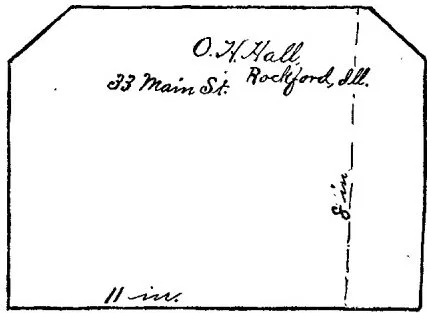
Send us wrappers, shaped and addressed similarly to the following cut, and we will send the Sentinel you desire to one hundred names for one dollar.
Wrappers of thin manilla paper are the best. Be careful to write the names and addresses plainly, and write them about an inch or an inch and a half from the edge. The wrappers should be about eight by eleven inches; with the corners clipped, as in cut. In mailing the wrappers to us, don't fold them but roll them.
FATHERS OF THE CATHOLIC CHURCH.
By Ellet Joseph Waggoner
BY E. J. WAGGONER.
History repeats itself, because human nature is the same in all ages of the world. Hence, he who would know
HOW TO AVOID ERROR IN THE FUTURE
must know how errors have developed in the past. The “Fathers of the Catholic Church” shows the condition of the heathen world at the time of Christ, briefly states the principles of ancient heathen philosophy, and shows how the adoption of these principles by prominent men in the Church, and the incautious lowering of the standard of pure Christianity, developed the papacy, which was simply a new form of paganism. The chapter on
SUN-WORSHIP AND SUNDAY
is alone worth the price of the book.
Fine English Cloth, Substantially Bound,
CONTAINS ABOUT 400 PAGES,
Will be Sent Post-paid for $1.00
PACIFIC PRESS PUBLISHING CO.,
39 Bond St., New York.
Oakland, Cal. Kansas City, Mo.
PUBLICATIONS ON THE SABBATH QUESTION.
The Abiding Sabbath. By A. T. Jones. No. 9 of the Bible Students’ Library. This is a review of two Sabbath “prize essays,” one of $500, and one of $1,000. It contains mighty arguments on the Sabbath question; 174 pages; price, 15 cents.
Is Sunday the Sabbath? No. 24 of the Library. A brief consideration of New Testament texts on the first day of the week; 8 pages; price, 1 cent.
Nature and Obligation of the Sabbath of the Fourth Commandment. By J. H. Waggoner. No. 54 of the Library. Clear and strong in argument; price, 10 cents.
Sunday; Origin of its Observance in the Christian Church. By E. J. Waggoner. No. 80 of the Library. The testimony given with reference to Sunday is wholly Protestant. All Protestants should read it; price, 15 cents.
Who Changed the Sabbath? No. 107 of the Library. What God’s Word predicted; what Christ says; what the papacy says; what Protestants say. A most convincing document; 24 pages; price, 3 cents.
“The Christian Sabbath.” No. 113 of the Library. A reprint of four articles in the Catholic Mirror, the organ of Cardinal Gibbons. What Catholics have to say to Protestants on the subject; 32 pages; price, 4 cents.
Christ and the Sabbath. By Prof. W. W. Prescott. The spiritual nature of the Sabbath, what true Sabbath keeping is, and the relation of Christ to the Sabbath in both creation and redemption. A most important tract. No. 14 of the Religious Liberty Library; 38 pages; price, 5 cents.
The History of the Sabbath. By John N. Andrews. A complete history of the Sabbath and first day of the week in religious life and thought, from the earliest ages to the present time, and especially during the Christian dispensation; 550 large octavo pages; price, cloth, $2.00; library binding, $2.50
THE RIGHTS of the PEOPLE
By Alonzo T. Jones
Or Civil Government and Religion
By Alonzo T. Jones.
An Up-to-Date Pamphlet on the Principles of Religious Liberty.
“THE RIGHTS OF THE PEOPLE” contains fifteen chapters, the following being a portion of the chapter headings:—
Christianity and the Roman Empire—What is due to God and What to Cæsar—The Powers That Be—How the United States Became a Christian Nation—What is the Nation?—Who Made the Nation?—Religious Right in the United States—Religious Right Invaded—The People’s Right of Appeal—National Precedent on Right of Appeal—Sunday-law Movement in the Fourth Century and Its Parallel in the Nineteenth—Will the People Assert and Maintain Their Rights?—Religious Rights in the States.
A Fine Edition on laid paper is also ready. It is neatly bound in cloth. Price One Dollar.
Address all orders to
PACIFIC PRESS PUB. CO., 39 Bond St., New York
19 W. Fifth St., Kansas City, Mo.
12th & Castro Sts. Oakland, Cal.
THE “CYCLONE” STILL WHIRLS
Sweeping Everything Clean Before It.
SEE WHAT THE PEOPLE SAY:
Milwaukee, Wis., Jan. 1, 1896. I feel qualified to give my hearty indorsement to the Coon Bros. Cyclone Washer. I believe it to be the best washer ever invented. It works easily, washing the clothes clean without wearing them and without the use of the washboard. It is a great labor-saving machine, and if you once use it you cannot get along without it. Mrs. J. DAVIS, 599 Washington.
YOUNG MAN WOMAN CULTIVATE YOUR MEMORY.
Procure a set of BIBLE EXERCISE CARDS containing precious texts on the PROMISES OF GOD and RULES FOR THE CHRISTIAN that every Christian should memorize. INTERESTING, INSTRUCTIVE, INSPIRING, 25c per set. Address, Wm. WARD SIMPSON, Battle Creek, Mich.
Committee Declines to Report Proposed Amendment
THE effect of the hearing upon the committee is indicated most unmistakably by the fact that at a meeting of the whole committee on the 17th inst., it was decided unanimously not to report the proposed amendment. Exit National Reform for 1896!
Three Adventist Ministers Lose Lord's Day Appeal in Ontario
We have received word from Toronto, Ont., that the appealed cases of the three Seventh-day Adventist ministers, A. O. Burrill, P. M. Howe, and William Simpson, convicted before a justice of the peace at Ridgetown, Ont., in December last, of violating the “Lord’s Day Act,” by working on Sunday, was argued in the Divisional Court in Toronto, March 16. Chief Justice Meredith presided, in company with Justices Rose and Street. The court gave its decision on the 17th, sustaining the action of the lower court, without costs. The defendants will accordingly be sent to serve out their sentences in jail, which are forty days each for ministers Howe and Simpson, and sixty days for Elder Burrill. Special attention will be given these cases in our next issue.
Next SENTINEL Issue Devoted to Canadian Religious Liberty
By Editor
THE next number of the SENTINEL will be devoted to the discussion of religious liberty in Canada. For terms for extra copies, see preceding page.
Ontario Sunday Labor Bill Targets Adventists
THE so-called Lord’s day Act of the Province of Ontario, like Constantine’s famous Sunday edict of A. D. 321, does not apply to agricultural laborers. A bill has been introduced into the Provincial Legislature at Toronto to extend the “law” so as to prohibit all secular labor, except works of necessity or mercy, on Sunday. The demand for the change in the “law” comes from the County of Essex, where there are quite a number of Adventists.
Mr. Crafts on the American Sabbath
Mr. Crafts, he of the “National Bureau of Reforms,” visited Baltimore recently, according to the Herald, of that city, and preached in the Second Presbyterian Church on the 15th inst., on his favorite theme, “The American Sabbath.” Among other things he said: “We are told that ‘the complicated civilization of the 19th century’ requires that sabbath observance and sabbath laws should be relaxed.” “But,” said he, “more than ever before we should see to it that neither ourselves nor others cause any Sunday work except of necessity or charity.”
Parliament Debates Sunday Opening of London Museums
For more than twenty years there has been a growing demand in London for the opening of the national museums and art galleries on Sunday. In 1874 the proposition was rejected by Parliament by a majority of more than two hundred votes. The opposition was largely on religious grounds. Last week the proposition was again before Parliament, and the vote was 178 in favor of Sunday opening, and only 93 against it. On this occasion organized labor united with organized religion in opposing Sunday opening until the assurance was given that it should not impose seven days’ work per week upon any attendant or employé.
Sunday Bill Opposed by District Commissioners, Backed by Crafts
NOTWITHSTANDING the adverse report on the Morse Sunday bill by the Commissioners of the District of Columbia, the National Bureau of Reforms and the Churchman's League are urging a favorable report on the substitute bill introduced on the 5th inst., at the instigation of W. F. Crafts, who has twice appeared before the commissioners, once on the 6th inst., and again on the 18th, to urge a favorable report upon the measure. It is said that his idea is that if a precedent can once be established for Sunday legislation of that character by Congress, it will obviate the necessity for any religious amendment to the Constitution.
Woman's National Sabbath Alliance Holds First Drawing-Room Meeting
On the evening of March 12, the first of a series of drawing-room meetings under the auspices of the “Woman’s National Sabbath Alliance,” was held in New York City, at the residence of Mrs. William E. Dodge. The president of the alliance, Mrs. Darwin R. James, presided, and stated the object of the new organization to be “an alliance of women throughout the country for the maintenance of the Scriptural law of Sabbath observance, and to enlist Christian women in organized resistance to the constantly increasing encroachments upon the sanctity of the sabbath through the Sunday newspapers, Sunday entertainments, and Sunday travel for pleasure or profit.”