We have shown that the other days here spoken of had a beginning and an end, This day has a beginning but no end.
Although this is ONE DAY, and has no end, yet there will be division of time. "For as the New Heavens and the New Earth, which I will make, shall remain before me, saith the Lord, so shall your seed and your name remain. And it shall come to pass, that from one new moon to another, and from one Sabbath to another, shall all flesh come to worship before me, saith the Lord." Isa. lxvi, 22, 23.
"And it shall be in that day, that living waters shall go out from Jerusalem; half of them toward the former sea, and half of them toward the hinder sea: in summer and in winter shall it be. And the Lord shall be King over all the earth: in that day shall there be one Lord, and his name one." Zech. xiv, 8, 9.
John had the same view of the water of life: "And he shewed me a pure river of water of life, clear as crystal, proceeding out of the throne of God and of the Lamb." Rev. xxii, 1. The throne is in the New Jerusalem on the New Earth. Zechariah saw the same living waters of life proceed from Jerusalem. He also saw it running from the fountain, east and west, where the sea formerly was. As the river of life is not in this earth, and as the earth is not made new until after the 1000 years, it necessarily follows that this prophecy applies to the day of eternity.
We have now passed through the subject of the different days spoken of in the Scriptures. In this we see a perfect harmony, and the strict order of heaven. God is a God of order, and his ways are not as the ways of man. He has measured the times, and set the bounds, and none will be able to remove them.
The gospel day is almost over. The 6000 years are nearly past. The great day of the Lord's wrath is near and hasteth greatly. The glorious Jubilee will soon begin, and the day of eternity in its time will appear. Reader, prepare to meet thy God.
The Conference
By Editor
Held March 12th, 13th, 14th and 15th, at the house of Bro. J. Thompson of Ballston, N. Y., was a meeting of special interest, and its beneficial effects will be seen upon the cause of truth.
As the appointment was given out at a late period, and the traveling bad, many did not attend that probably would have been present had it been otherwise. Brn. Bates, Rhodes, Holt, Wheeler, Day, Baker, Ingraham, Wyman, Churchill, Morse and Edson were present. We were happy to see Bro. Andrews also who arrived near the close of the meeting from his late tour in Michigan and Ohio.
The brethren came together with a desire to be benefited and to benefit each other. Not to establish any peculiar views of their own, but to be united in the TRUTH. The Spirit of truth was earnestly desired, and all united in asking God to give his Spirit to guide into all truth, and to "guide in judgment" while transacting business brought before the meeting. The Spirit of the Lord was with his servants during the entire meeting, and love and union prevailed. The business meetings were pleasant and free. All seemed willing to act, and ready to act in union, and to act now. The word was preached with freedom, and the examination of some points of doctrine touching the present message was conducted in harmony.
The brethren and sisters in the vicinity of the meeting also shared its benefits. Trials were happily removed, and the blessing of God followed. The last evening was a season of the wonderful outpouring of the Holy Spirit. In this meeting Bro. Thompson and his family, who had the labor and care of entertaining the brethren, were greatly blest.
Friday P. M. the 12th, the subject of publishing the paper was introduced. Several brethren spoke of the disadvantages of having it published as it has been, and of the propriety of having an office at the control of Sabbathkeepers. And after investigating the matter it was decided by a unanimous vote (1) that a press, type &c. should be purchased immediately, (2) that the paper should be published at Rochester, N. Y., (3) that Brn. E. A. Pool, Lebbeus Drew and Hiram Edson compose a Committee to receive donations from the friends of the cause to purchase the press, type &c., and to conduct the financial concerns of the paper, (4) that the brethren abroad be requested through the next number of the Review and Herald to choose agents in their churches to receive donations for the purpose of establishing the press, and carrying forward the publishing of the paper, and (5) that those donations that are immediately sent in, should be sent to Hiram Edson, Port Byron, N. Y. It was thought that Six Hundred Dollars would be sufficient to establish the press at Rochester.
Monday A. M. the 15th, the subject of holding Conferences in different parts of the field, especially where the brethren have but recently embraced the truth, was introduced, and investigated with much feeling. There seemed to be but one view of the subject, that small Conferences and many of them would prove a great blessing to the cause. And that those brethren who have recently embraced the Sabbath should not be neglected, but that they should have the labors of suitable brethren who shall hold such meetings with them.
It was thought that there should be two to travel in company in the state of New York and Canada West, and two to travel in New England and Canada East, whose work should be to hold Conferences. By a unanimous vote, Brn. Bates, Baker and Wheeler were chosen to see what two brethren would be responsible for Conferences to be held in New England and C. E., and Brn. Holt, Rhodes and Edson were chosen to see who would be responsible for Conferences to be held in the state of New York and C. W.
Bro. Joseph Baker of Lebanon, N. H. and Bro. Wm. S. Ingraham of Wolcott, Vt. decided to travel together and be responsible for Conferences in New England and C. E. And Bro. G. W. Holt of Oswego, N. Y., and some brother whose duty it may be to travel with him, will be responsible for Conferences to be held in New York and C. W.
The brethren who desire Conferences held with them are requested to make known their wants and wishes relative to Conferences to those who have decided to hold such meetings. Or if more convenient they will send in their requests, and have them published in the Review and Herald. Then those who hold Conferences can make their arrangements, and have their appointments also published.
Appropriate remarks were made by Bro. Bates relative to making preparations to entertain those who may assemble in Conferences, which were approved by those present. He pointed out the common error of providing many kinds of rich food, which is attended with unnecessary labor and expense, when plain food would be much better for the health, and easier prepared. He stated that it was too often the case that those who entertained the brethren assembled for Conferences were but little benefited themselves by reason of making unnecessary preparations, and having too much care and labor in waiting upon the brethren.
The Fairhaven Conference.
The Conference assembled at Fairhaven, Mass. Feb. 27th, appointed Brn. F. Wheeler, O. Davis, H. S. Gurney, E. L. H. Chamberlain, J. C. Day and O. Nichols a Committee to take into consideration the state of the cause.
For want of room we cannot give the entire report. The following is an extract from the report of the Committee which was unanimously adopted by the brethren assembled.
"Dear Brethren and Sisters, your Committee having endeavored in the fear of the Lord, and with an earnest desire to do his will, to take into consideration the subjects brought before this Conference, would submit the following report as their judgment.
We fully approve the course pursued by Bro. White in the management of the paper, and earnestly desire that his connection with the paper may still continue. And to relieve him from pecuniary difficulties, and to bring some of the burdens more directly upon the church at large, we recommend that the brethren in each place appoint some suitable person to look after the interests of the paper.
To have the charge of collecting money for the paper.
To see that the paper is sent to such as have an interest to examine the truths which it advocates.
To see that it is not sent to such as are not interested to receive it.
Also, that such brethren have a care to ascertain who there are in the church that are needy, and what ministering brethren require aid, and that they take such measures as the Lord may place at their command, they acting at all times subject to the church with which they have a connection. We do believe that such a course is necessary in order to distribute more equally the burdens necessarily falling upon us, and to bring us into a position in which we can act more efficiently. We do feel that it is time to act, and to act as a body. And to see that the burden be borne by us as a body, and not by a few individuals. It shall be the duty of those persons chosen to see to the interests of the paper to see that it be kept free from debt."
"Render to all their Dues."
DEAR BRO. WHITE: It was the arguments of J. B. Cook, more than those of any other writer, that convinced me that the third angel's message is now being given. I had a sympathy with the Advent people from the first, which increased as I saw them advance in the light of Divine Truth, casting away the fables of these last days, and finally, embracing all the commandments of God. This looked like the work of God. It bore the right kind of fruit.
But the "repairers of the breach" professed to be giving the third angel's message. This could not be admitted without acknowledging that the first and the second message were in the past. If I could find sufficient evidence, that the judgment hour cry was from Heaven, I could not deny the succeeding work, which follows down the same track of prophecy. While examining this matter, some of the writings of the above named individual fell into my hands, which were republished in the Advent Review. I will give some extracts for the benefit of those who have not seen these writings; but let all who can obtain them read the whole. They are excellent.
"There are no agencies adequate to give birth to predicted events, save such as God employs; consequently when they occur, we may know without a doubt, not only that they are a fulfillment, but also that God has done it. . . . When a predicted event does occur, we may know that it is a fulfillment of the prediction, and that God's Providence has interposed for its fulfillment. To such events there are no seconds, any more than a second birth, a baptism, or burial of Messiah. The chariot of Providence rolls by. The event looms up with God's seal impressed on it. It never recurs. . . . God in his word specifies each event. His people think in the Spirit by believing the word—they yield themselves up to his guidance, and the Providence of God concurs, then the event transpires. There will be nothing in all time like it. . . . There are no agencies which can counterfeit or derange the progressive fulfillment of the prophetic word. When the time arrives, each predicted event appears; and God's Providence must be recognized in it, or we be convicted as, so far, infidels."
If C. believes all this now, he must be strong in the third angel's message. His reasoning, compared with scripture testimony, was sufficient to justify faith in the first message while standing alone. But the third message has, not only all the evidence of the first, but the concurrent testimony of the first and second to make it doubly sure. The car of Providence has rolled down the track of prophecy, through the first and second messages to its third. "On this track it will roll, till it reaches the grand depot."
Let those who complain of being judged by Sabbathkeepers, read the following extract from the same article.
"The professing churches have taken their stand, denying that Providence is fulfilling prophecy, connected with the second Advent, (though they can neither deny the prophecies of such events, nor the facts of their occurrence,) must and will perish, as did the Jewish nation. All the evidence which God grants is given, when history testifies the truth of prophecy; consequently, if that be denied, Christ is denied, and "wrath to the utmost" will come on those who had till then, been his acknowledged people. By how much the Christian church has had greater light than the Jewish, by so much is their guilt greater, and their revealed damnation more dreadful. Matt. xxiv, 51. 1 Thess. v, 3; 2 Thess. ii, 10–12. Professing Adventists have no dispensation in their favor, but must see their flagrant folly, if they recognize prophetic fulfillment up to a certain point in our history, and then deny it in those events which are most manifestly, in time, order of sequence, and manner of occurrence, just what Jesus predicted."
May the Lord save all the honest.
ROSWELL F. COTTRELL.
Mill Grove, N. Y., March 10, 1852.
The Paper.
By Editor
This number closes the present volume, and is the last to be published at Saratoga Springs. To those friends who may wish to know the pecuniary condition of the paper we would say that $150 was raised at the Camden Conference, June 1851 to commence the present volume. This sum, with the receipts since that time, will only pay for this volume. We have been unwilling to receive large donations from those real friends of the cause who are ever ready to use their Lord's money as faithful stewards. And we have hoped that all the readers of the Review and Herald, who have had it placed in their hands, with other publications, who profess to love the truths it advocates, and who are able to do something for its support, however, small the sum, would gladly help in this work.
We do not speak of want. Having food and raiment we are content. But we wish to suggest the propriety of each having the pleasure of doing something, and sharing the blessing, instead of a few free-hearted souls doing the whole. In fact we cannot see how the paper can benefit such as are not ready to make an effort to sustain it. We cheerfully send the paper free of charge, and shall continue to do so, and hope these remarks will lead all who profess to believe and love the present truth to act their part in sustaining the publication of the paper and books.
We hope to issue the first number of the next volume by the first of May. And we would say to those who wish to help with their means that their assistance is needed now in commencing the paper at Rochester.
Will the brethren be interested to furnish matter for the paper, either original or selected. Let all be free to write.
THE LAW OF GOD ILLUSTRATED.
By Newell Mead
BY NEWELL MEAD.
"And the Lord said unto Moses, come up to me into the mount, and be there; and I will give thee tables of stone, and A LAW and commandments which I have written, that thou mayest teach them." Ex. xxiv, 12. "And he gave unto Moses, when he had made an end of communing with him upon Mount Sinai, two tables of TESTIMONY, tables of stone, written with the finger of God." Ex. xxxi, 18. "And he wrote upon the tables the WORDS of the covenant, the TEN COMMANDMENTS," Ex. xxxiv, 28. See also Ex. xxii, 15, 16; Deut. iv, 13; v, 22; ix, 9—11.
From these texts we learn that the law of God was the ten commandments, written on tables of stone by the finger of God. These tables of stone were put into the ark made purposely for them, and the ark was placed in the Most Holy Place of the earthly Sanctuary, within the second vail. This ark was called the ark of the covenant, and the two tables of stone, were called the tables of the covenant, because they contained the moral conditions of the covenant made in Horeb.
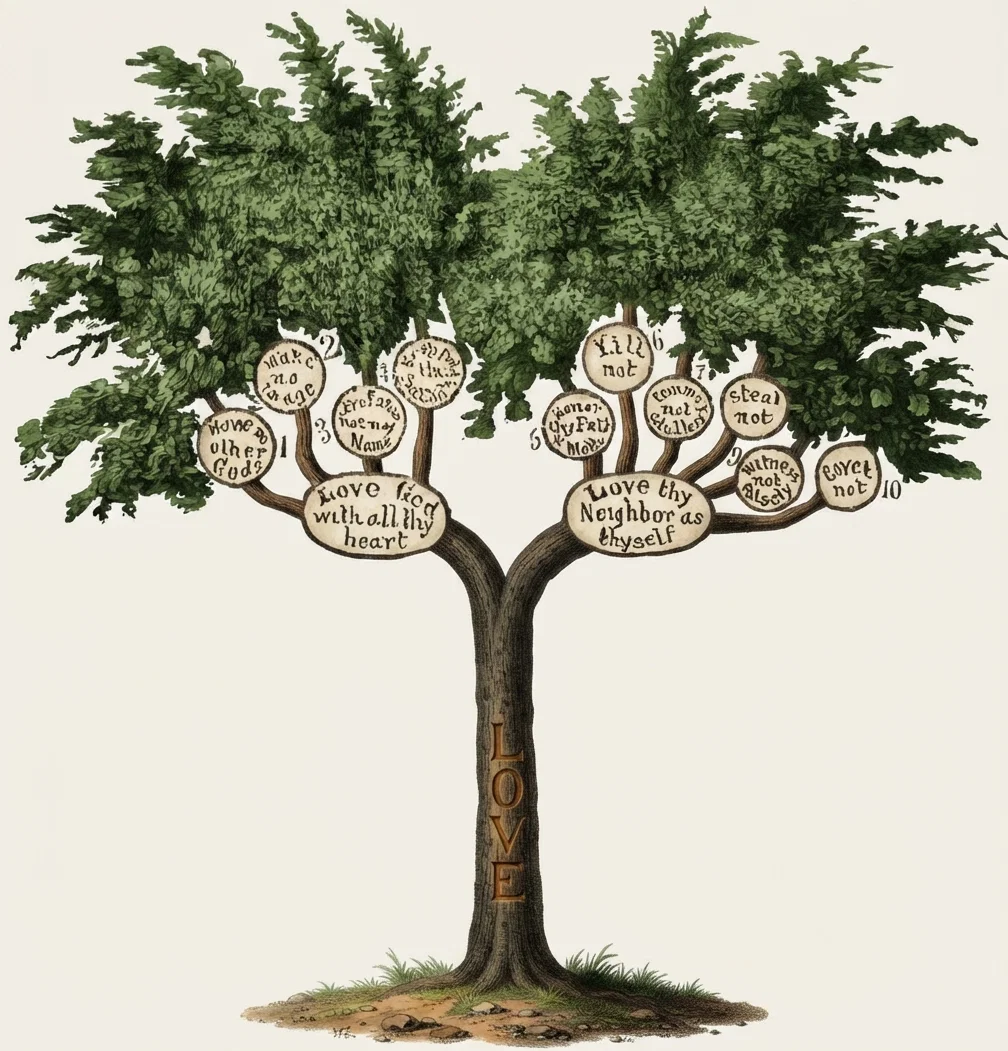
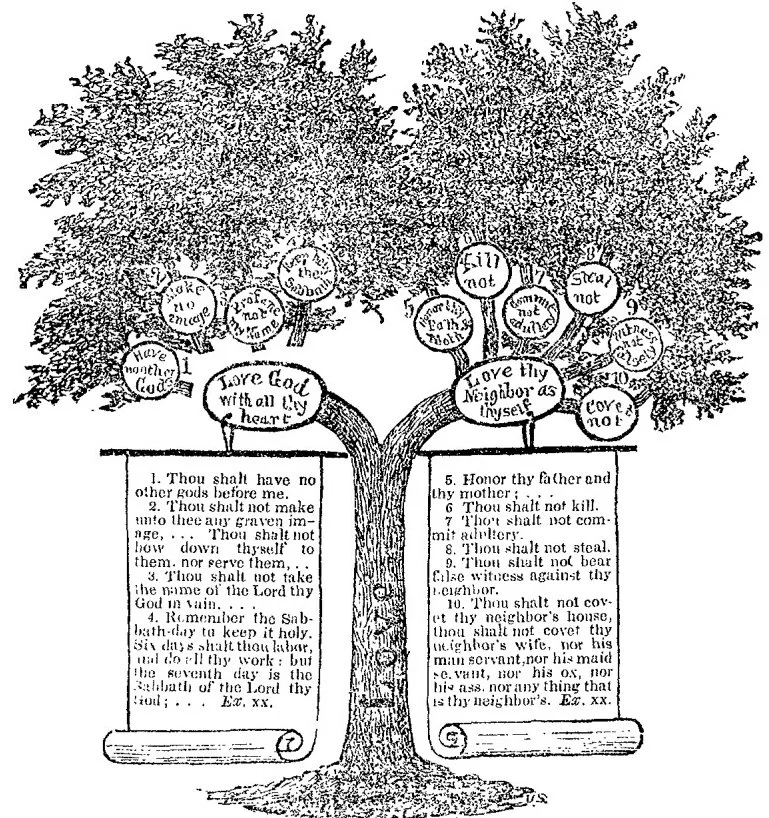
There were two tables of stone. One containing the first four of the ten precepts of God's law, which pointed out their duty to God; the other contained the last six precepts, pointing out their duty to each other. Then the law of God may be fitly represented by a tree with two large branches, and from these two.
ten small branches. One large branch represents love to God, the other, love to one another, [see Deut. vi, 5; Lev. xix, 18,] and the ten branches growing out of the two, represent the several articles of God's law as they are given in Ex. xx. The body of the tree represents the great source, or principle of LOVE out of which the ten precepts of the law grew; LOVE being the foundation of God's law, and the ten articles his form of government.
I will now illustrate the law of God, under the new covenant, as contained in the "ark of his testament" to be "seen" when "the temple of God" should be "opened in heaven," under the sounding of the seventh angel."
Jesus, in his sermon on the mount, says, "Think not that I am come to destroy the law or the prophets; I am not come to destroy, but to fulfill. For verily, I say unto you, till heaven and earth pass, one jot or one tittle shall in no wise pass from the law," &c. Fulfill, here means to obey, not to abolish. So James understood it; for he says, "If ye fulfill the royal law according to the scripture, thou shalt love thy neighbor as thyself." Chap. ii, 8. To fulfill the royal law according to the SCRIPTURE (the decalogue) can mean nothing else than to keep its precepts. Says Jesus, "I have kept my Father's commandments." John xv, 10.
It is said by some that Jesus, in fulfilling the law, released us from its obligation, and that we have nothing to do with it. But let it be understood that he mentions the prophets as well as the law; and if Jesus has released us from the law, he has from the prophets also, and we should have nothing to do with them any more than with the law. But it will be seen that we have to do with both. Let us see how Christ has illustrated this subject.
"Then one of them which was a lawyer asked him a question, tempting him, and saying, Master, which is the great commandment in the law? Jesus said unto him, thou shalt love the Lord thy God with all thy heart, and with all thy soul, and with all thy mind. This is the first and great commandment. And the second is like unto it, thou shalt love thy neighbor as thyself. On these two commandments, hang all the law and the prophets." Matt. xxii, 35—40.
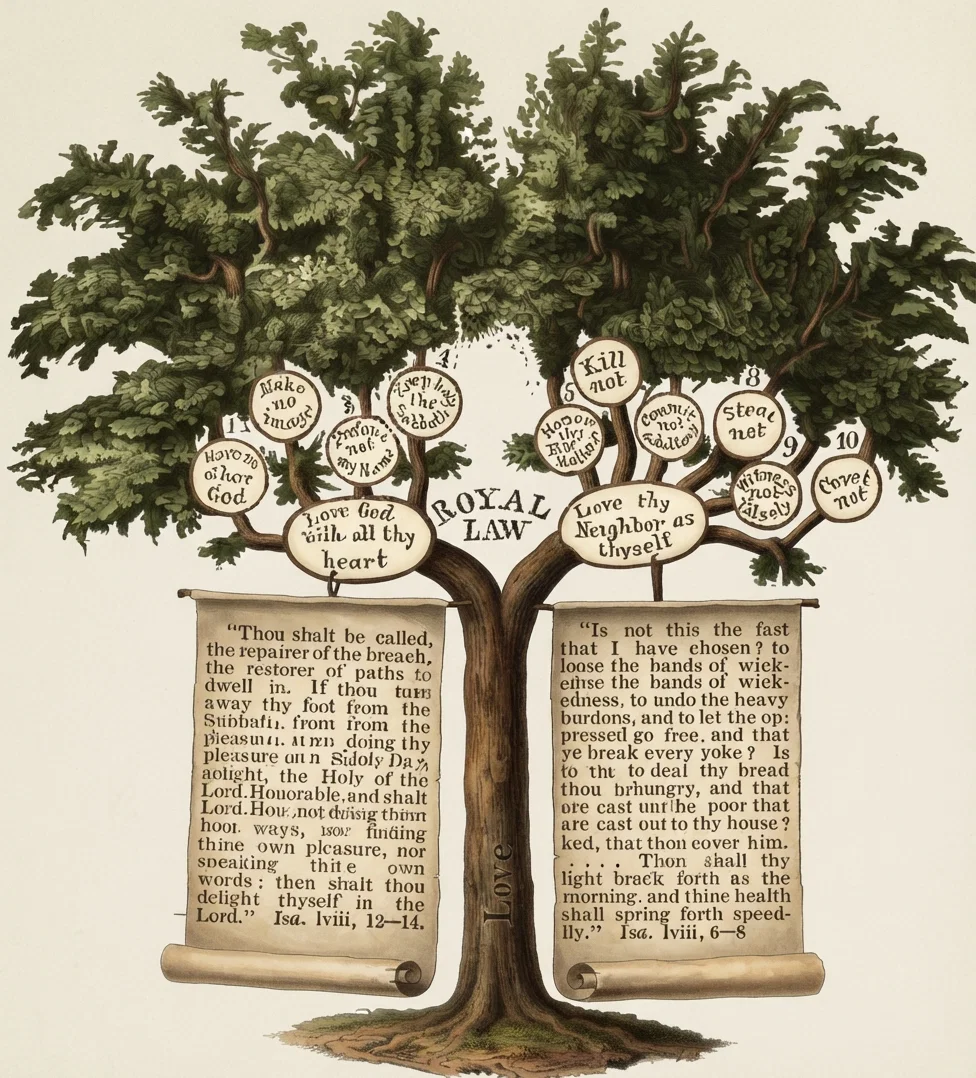
Now let the two great branches represent the two commandments mentioned by Jesus. And if God's law hangs on the two great commandments, let the two scrolls, which are hanging on the two branches, represent it. The two branches representing the two great commandments, and the scrolls representing the two tables of stone. Read the precepts written in the scrolls. Then we have the whole law here. The several precepts of the decalogue grow out of the two great commandments mentioned by Jesus. It cannot be otherwise; because they were given to secure our love to God, and our love to each other. Therefore, the whole law hangs on the principle of supreme love to God, and love to our neighbor as ourself.
It is thought by some that Jesus, in his reply to the lawyer, taught that the ten precepts of the royal law were then done away, and that two new commandments had been instituted in their place. There are several serious objections to this view.
First, in the two great commandments there is nothing new. God has always required of his people supreme love to their Creator, and love to one another. This the following texts prove.
"Hear, O Israel; the Lord our God is one Lord: and thou shalt love the Lord thy God with all thine heart, and with all thy soul, and with all thy might." Deut. vi, 4, 5. See Chap. x, 12. This is the first and great commandment quoted by Jesus.
"Thou shalt not hate thy brother in thine heart; thou shalt in any wise rebuke thy neighbor; and not suffer sin upon him. Thou shalt not avenge, nor bear any grudge against the children of thy people, but THOU SHALT LOVE THY NEIGHBOR AS THYSELF: I am the Lord." Lev. xix, 17, 18. Here is the second commandment quoted by Jesus.
Second, no one teaches that any change whatever took place in the law prior to the crucifixion or resurrection of Christ; then how absurd to suppose that Jesus taught that the ten precepts of the decalogue were then done away, and that the two had taken their place, at the time of his conversation with the lawyer!!
"Which is the great commandment in the law"? was the question of the lawyer; not what it would be in the next dispensation, after the crucifixion. "This is the first and great commandment," replied the Son of God. He did not teach that supreme love to God, and love to our neighbor were duties for the gospel dispensation alone. Therefore, the ten commandments THEN hang on supreme love to God, and love to our neighbor as ourselves, EVEN HAD hung there, and hang there now, as the scrolls hang upon the two great branches of the tree.
Christ speaks of the two great commandments; he also quotes precepts [Matt. xix, 18, 19.] that hang on the smaller of the two, viz: "Thou shalt love thy neighbor as thyself." Then we will represent the six commandments on the second table, as growing out of that one branch. We see in the figure that all the branches are joined on that side. But for the sake of the representation we will leave the branches on the other side disjoined. It is said that Christ110quoted those commandments that are binding, and as he omitted the fourth, we are not to keep the Sabbath. But it is a fact that he did not positively quote any of the first four commandments, represented by the disjoined branches.
But we are required to love God more than our neighbor. Love to him should be supreme, while we should love our neighbor as ourself. To love God supremely is the FIRST and GREAT commandment, therefore those precepts given to secure our supreme love to him must be obeyed, and the branches representing the first four commandments should be joined, not excepting the Sabbath branch. In the next illustration the branches are all joined. Said Jesus, "The Sabbath was made for man." If we reject the Sabbath commandment, and break off that branch, we may the other three, by which we show supreme love to God, and in fact love to God is utterly destroyed!!
In the third illustration we wish to show that the prophets also, hang on the two commandments mentioned by our Lord. They speak the Law from God. But for want of room we can quote from but one prophet, Isaiah, as is seen in the scrolls.
We shall now quote from the words of Christ, for we can find nothing better. "Thou shalt love thy neighbor as thyself?" None will deny that this is a gospel text purely. To love our neighbor is it not to feed the hungry, to clothe the naked, to undo the heavy burdens and to loose the bands of wickedness? And more, is it not the work under the gospel to break the tyrants yoke and let the bondman go free? Certainly, it is. Then we have brought a gospel text, and it is no more nor less than the law, on the second table of stone. Then we ask, has this all been fulfilled so that we have nothing to do with it? or, is it not now claiming a fulfillment? Then this prophet is not all fulfilled; but he still speaks this law as plainly as ever he did. Hear him:
"Is not this the fast that I have chosen, to loose the bands of wickedness, to undo the heavy burdens, and to let the oppressed go free, and that ye break every yoke," &c. Isa. lviii, 6. Does not this hang on the second great commandment? It certainly does; therefore, as Christ said, the prophets, as well as the law, hang on the great commandments. Then we can represent the prophet in the scroll hung on the second branch, or commandment. Read his words in the scroll.
Inasmuch as the words of the prophet hang on the second branch, they hang on the first branch. Hear Christ's words: "Thou shalt love the Lord thy God with all thy heart, and with all thy soul, and with all thy mind." If we love God we shall wish to honor his institutions, and obey him in all his requirements. Then hear what the Lord says by the same prophet from which we have quoted.
"And thou shalt be called, the repairer of the breach, the restorer of paths to dwell in, if thou turn away thy foot from the Sabbath, from doing thy pleasure on my holy day, and call the Sabbath a delight, the holy of the Lord, honorable; and shalt honor him, not doing thine own ways, nor finding thine own pleasure, nor speaking thine own words; then shalt thou delight thyself in the Lord; and I will cause thee to ride upon the high places of the earth, and feed thee with the heritage of Jacob thy father; for the mouth of the Lord hath spoken it." Isa. lviii, 12-14.
As the above from the prophet, spoken by the mouth of the Lord, is embraced in the first and great commandment, we will represent it in the scroll hanging upon the first of the two great branches of the tree. Now we may see how that the prophets, as well as the law of God, hang on the two great commandments mentioned by our Lord.
In ministering to the wants of the needy, and breaking every yoke, [Isa. lviii, 6, 7,] the Lord says our light shall break forth as the morning; and the glory of the Lord shall be our rere-ward. And if we draw out our soul to the hungry, and satisfy the afflicted soul, then shall our light rise in obscurity, and our darkness be as the noon-day. In doing this, the Lord has promised to guide us continually, and satisfy our soul in draught, and we shall be like a watered garden, and like a spring of water, whose waters fail not. Yet, still more God promises, if we are obedient, yea, he promises that they that shall be of us shall build the old waste places, and shall raise up the foundations of many generations; and shall be called the repairers of the breach. Then if we are to raise up the foundations of many generations, the foundation must have been thrown down; also, there must have been a breach made, in order to have one repaired. And what is this breach that has been made? Ah! the Prophet has informed us, "Thou shalt be called the repairer of the breach the restorer of paths to dwell in, if thou turn away thy foot from the Sabbath, from doing thy pleasure on my Holy Day, and call the Sabbath a delight, the Holy of the Lord, honorable," &c. Isa. lviii, 12, 13. Those that desecrate the Holy Sabbath and tread it underfoot are making a breach in God's holy law. Those that turn away their foot from treading it down, and keep it holy, and call it a delight, the Holy of the Lord, are repairing this breach in the law. It must be repaired by restoring the Sabbath of the Lord our God.
Dear reader, will you notice this fact; God says in the 12th verse that there is a breach made, but does not say in what. The next verse informs us that it is his law, one of the precepts of the decalogue is polluted, and he admonishes us to turn from this transgression of his holy law.
The Law and the Prophets
By R. R. Chapin
From Bro. Chapin.
Dear Bro. White: Would it not be as consistent for the editor of the "Harbinger" to head some articles, A portion of the prophets abolished, as to head some of his articles, "Seventh-day Sabbath abolished"? I think it can be clearly shown that he has as good ground to prove the abolition of a part of the prophets as a portion of the holy law of God. Jesus testified that he came to destroy neither, and warns us against thinking such a thing as the abolition of his Father's law or the prophets as follows: "THINK NOT that I am come to destroy the law or the prophets, &c. Matt. v, 17. Any one may understand from these words that the prophets are intimately connected with the law; and if one tittle of the law is abolished, then certainly a portion of the prophets are also gone.
For further proof see Matt. xxii. Here in answering the question of the lawyer, "Which is the great commandment in the law?" Jesus says, "Thou shalt love the Lord thy God with all thy heart, and with all thy soul and with all thy mind. This is the first and great commandment. And the second is like unto it, Thou shalt love thy neighbor as thyself. On these two commandments hang all the law and the prophets."
Now if the editor of the "Harbinger" would cease for a while to prove that a part of the law of God is abolished, and show what portion of the prophets are gone, I am certain, as soon as he can do this, he will succeed in getting many converts to his "seventh-day Sabbath abolished" theory.
In the law of God, the ten lively oracles, there are 302 words. The fourth oracle has the strength of 97 of these words, about one third of the whole. Paul uses this oracle to prove who the true God is, by declaring to the men of Athens that it is the God that made the world and all things therein, that he is Lord of heaven and earth.
"Whosoever therefore shall break one of these least commandments, and shall teach men so, he shall be called the least in the kingdom of heaven: but whosoever shall do and teach them, the same shall be called great in the kingdom of heaven."
"Who, what are they, that make 'the preaching of the law,' a character of reproach? Do they not see on whom the reproach must fall? on whose head it must light at last? Whosoever on this ground despiseth us, despiseth him that sent us. For did ever any man preach the law like him? even when he 'came, not to condemn but to save the world:' when he came purposely to 'bring life and immortality to light through the gospel?' Can any 'preach the law' more expressly, more rigorously, than Christ does in these words? And who is he that shall amend them? Who is he that shall instruct the Son of God how to preach? Who will teach him a better way of delivering the message which he hath received of the Father?
"Whosoever shall break one of these least commandments,' or one of the least of these commandments—These commandments, we may observe, is a term used by our Lord as equivalent with the law: or the law and the prophets, which is the same thing, seeing the prophets added nothing to the law; but only declared, explained, or enforced it, as they were moved by the Holy Ghost."
LETTERS.
By David Arnold
From Bro. Arnold.
DEAR BRO. WHITE: While reading the call for the friends to write and express their views on the subject of the Paper, I felt that perhaps it was my duty to express my views as a humble tribute to the cause I so much love.
While I review the wonderful work the Lord has wrought for me and mine, in bringing us to hear and love the everlasting gospel, leading us out from the influence of a fallen church, to receive with joy and gladness the third angel's message, I can but feel a prompting of soul to lend my feeble instrumentality to carry to others what has proved to me of such infinite value.
The scattering far and wide, to all "that have ears to hear" the present truth contained in the "commandments of God and the testimony of Jesus Christ," I fully believe is now the great work that engages the attention of the heavenly host, and for the accomplishment of which the mighty arm of the Lord is specially stretched out.
Shall we then who have been so signally favored of God as to be brought into the clear light of revelation which now shines through the "open door," join with the heavenly host as willing and obedient instruments on earth to carry forward this great work. Shall we unite our hearts, our tongues, our pens, our influence and our money too, to accomplish this last crowning work of carrying these sanctifying truths to every "jewel" that can be found and fitted for the "casket;" or shall we like misers rejoice that we are blest with these glorious truths, treasure them up in our hearts, lock up our purses (perhaps containing thousands) and leave the poor of the flock to sacrifice all these, and with their hard earnings by daily labor to carry forward this last work of salvation for the scattered and torn of God's people.
Let such be assured that they will not be "gathered with those who have made a covenant by sacrifice." Let it also be remembered that a mere surplus, after a gratification of all our wants cannot be a sacrifice such as Christ required of the young man in the gospel, and nothing less is required of us now, that we may "inherit eternal life."
In this matter three questions seem to be presented. First, shall we have a press, workmen, and office of our own, or at our control? Second, where shall it be located? Third, how often shall the paper be issued. Perhaps from my limited knowledge I am poorly fitted to give any advice on these points. I will however venture a few suggestions.
First. It appears to me that it would be pleasing to Him who "owns the cattle upon a thousand hills," to have his truth published from a press, by hands, and through an office that could be brought to bow in strict obedience to the fourth commandment.
Second. In reference to the location, a few considerations present themselves. It should be central so that each extremity of the field of labor can be reached with as little delay and expense as possible. It should also be ready of access to steam conveyances.
Third. To me it appears that the requirement to "exhort one another and so much the more as we see the day approaching," and the extended and extending demand for the present truth calls for a weekly issue of the paper.
Your brother in tribulation, praying for the prosperity of Zion,
DAVID ARNOLD.
Fulton, N. Y., March 7th, 1852.
Extracts of Letters.
Bro. Washington Morse of Royalton, Vt. writes Feb. 27th, 1852: I fully believe that the remnant here who are in the truth are growing stronger and stronger. Praise the Lord.
I have visited a number of towns in the east and south part of this state of late. I find some in every town that seem to be anxious to hear, and in some places I find them starving for spiritual bread. In some instances after I have presented the truth, while bowing down to pray with them, I have heard them weeping and sobbing aloud, and before leaving them they would beg of me to come and see them again.
O, my dear brother, how intensely I feel for the scattered jewels. Had I means I would travel much more extensively than I do.
New Converts Rejoice in Sabbath Light
Bro. Wm. G. Sheffield writes from New Shoreham, R. I. March 12th, 1852: "Myself and others in this place who have lately embraced the truth will soon get our contributions together and send them to you. I feel in duty bound to my Lord, who has showed me the light of the Holy Sabbath through the labors of Bro. Lothrop, to give something out of the means that he has blest me with, to spread the blessed light of the Sabbath before those that are in darkness on this subject.
"My wife and five children have all embraced the truth, and do rejoice in the light and glory of the Holy Sabbath. We have interesting meetings."