The Youth’s Instructor, Vol. 48, No. 1.

A DAY ON THE WHITE RIVER GLACIER

The Youth’s Instructor

Jan 4, 1900

Review and Herald Publishing Company · Battle Creek, Mich. · Jan 4, 1900

A DAY ON THE WHITE RIVER GLACIER
A few years ago, while myself and a companion were spending our vacation in the mountains of Oregon, we decided to make the acquaintance of the White River glacier. Some of our friends, attempting to dissuade us from our purpose, assured us that it was “only a gorge filled with ice,” and would in no way repay us for either the work or the danger attending a trip upon or across it. But we were determined to see it for ourselves; so we left camp early one morning with blankets, provisions, a life line, and a camera on our backs.
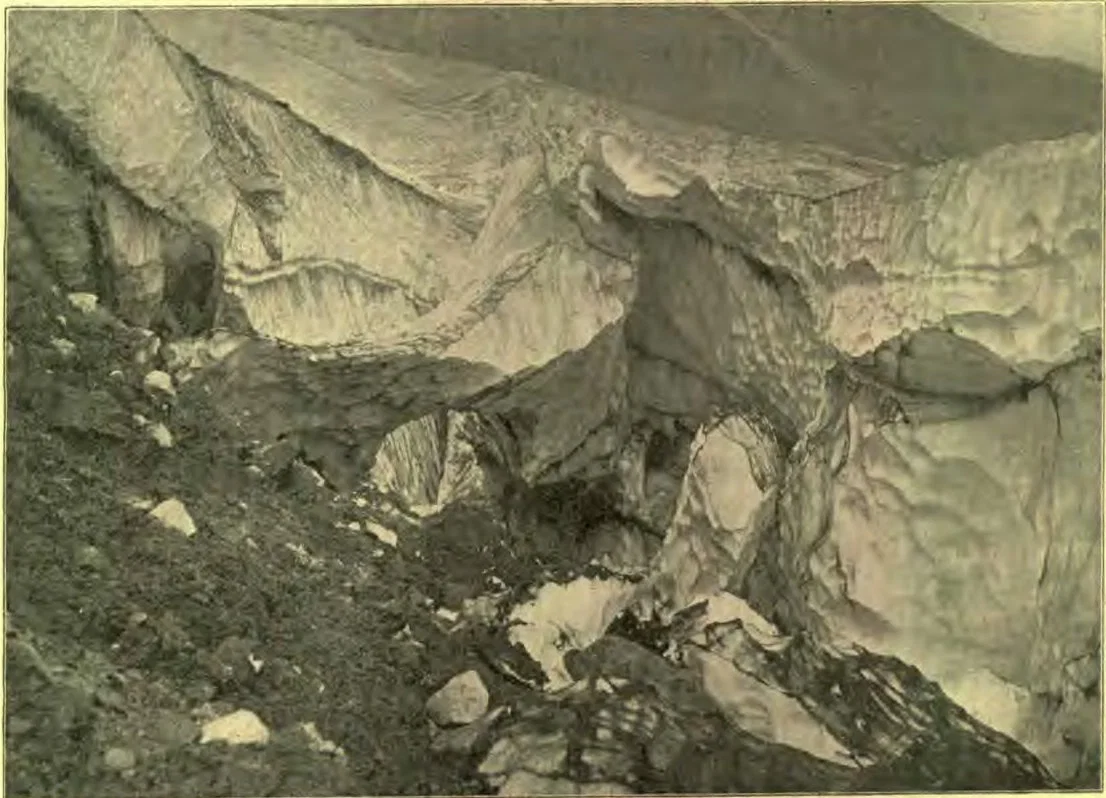
A BIT OF THE WHITE RIVER GLACIER.
That night we camped at timber line on Mt. Hood, within a mile of the glacier’s mouth. We were very tired from the long day’s tramp and the heavy packs we carried,—too tired to get supper or cut fir boughs for a bed; so we spread our blankets under a pine tree, where the earth was covered with two or three inches of dry pine needles, and went to bed hungry.
We slept too late next morning to see the sun rise; but when we did get up, we felt as fresh as if we had rested all the day before. My companion gave the mountain air credit for our wonderful refreshing; but I was inclined, from my experience at other times, to give the credit to going to bed with empty stomachs.
The day was before us, and the glacier near; so we took our time about getting breakfast, and then began leisurely to ascend the mountain. We climbed down one side and up the other of rocky cañons; waded through long stretches of sand; and scrambled over great boulders, which seemed to have been thrown into our path for no other purpose than to make progress difficult. Sometimes we would cross patches of snow that the late summer’s sun had not yet succeeded in melting. Then the walking was more easy.
About ten o’clock we reached the edge of the ravine in which the glacier flowed. In a moment the difficulties of the trip were forgotten in the admiration and awe inspired by the terrible, desolate grandeur of the scene that met our gaze. It was “only a gorge filled with ice;” but what a gorge! and what a mass of ice! From where we stood, the entire length of the glacier, as well as miles of the cañon below, could be plainly seen. At its head the glacier seemed little more than a stone’s throw in width, while at its mouth it was probably a quarter of a mile across. Its entire length was seamed and scarred in a wonderful manner. In some places the seams, or crevasses, as they are called, were so regular that they resembled the rolling waves of the sea. At other points great icebergs were thrown together in wild confusion. Sometimes one of these would fall with a terrible crash, followed by a low grumbling, grinding noise as the ice adjusted itself to the new position.
Years ago the glacier extended far below its present limits. Now the great ravine that it then cut out is empty, save for the turbid little White River, which bears away as water all the glacier’s ice. At its head one can readily vault across the White River, and it seems almost incredible that so much ice should yield so little water. But the motion of the glacier is so slow that it is measured in inches a month, while that of the river is reckoned in feet a second.
Where we stood, the sides of the ravine were too steep to make the descent to the surface of the ice practicable; so we followed the glacier about a mile up the mountain side until we found a more favorable place.
The photograph here reproduced shows a bit of the great ice river at the place where we reached it, and took our noonday lunch. At the edge of the glacier there is very little motion, so most of the peculiar formation here shown results from the melting of the ice.
After lunch we fastened the life line around our waists, and began to make our way out toward the middle of the glacier. The life line was about twenty feet long, and we walked far enough apart to keep it from touching the surface of the ice. As we were careful to avoid the most dangerous places, and take no unnecessary risks, it was not called into use; but had one of us lost his footing on a steep incline, or fallen into a crevasse, it might have been a life line indeed.
We spent several hours upon the glacier. Sometimes, as we crossed an ice-bridge, we would pause a moment to look into the dark and seemingly bottomless crevasse below. On the top the ice was as white as freshly fallen snow. A few inches below the surface, it was almost as clear as the natural or artificial product handled by the iceman. As the eye follows the walls of the crevasse downward, the ice assumes a greenish tint, which deepens until it is lost in the darkness below. When the direct rays of the sun creep into one of these crevasses, the walls sparkle and glisten like a great mass of emeralds, diamonds, and pearls. Such a sight (I saw several that day) always made me think of the foundation walls of the New Jerusalem, and wonder if the Creator had not left some of his great works that we might have a faint idea of the glory that awaits the faithful.
As we were leaving the glacier, we discovered an ice cave that led downward under the ice. We followed along the steep, rocky floor of the cave, toward the middle of the glacier, until we were in total darkness, and only gave up when our fingers became so numb from the terrible cold that we were no longer able to light matches to see our way. We had been in the cave only a few minutes, but nothing was ever more welcome to me than the sunlight and warm air that greeted us as we emerged from its icy gloom. We were soon warm again, but how our fingers did tingle and burn!
Just before sunset we reached our temporary camp, tired, indeed, but feeling well repaid for our visit to the “gorge filled with ice.”
J. Edgar Ross.

NO NEED HAVE THEY TO GO AWAY

A desert place; night comes apace; No food supply; — shall souls thus die, When God has sent the heavenly bread? “No need have they to go away;” God’s manna sweet give them to eat, And let the multitude be fed.
At home, abroad, on lonely road, Or crowded street where many greet, Perchance they hunger for life’s food. “No need have they to go away;” In love discreet give them to eat, And feed the suffering multitude.
Beyond the seas are feeble knees, In distant lands are trembling hands, The multitude is dying there. “No need have they to go away;” Yet time is fleet; give them to eat; The bread of life with them now share.
— American Friend.

BEREAN LIBRARY STUDY

Daniel 4; “Thoughts on Daniel,” pages 85-93
The regular Outline of these studies is published in the Review and Herald and also in the Missionary Magazine. What is here given is only supplementary, and should be studied in connection with the Outline.

NOTES ON LESSON 6

(January 7-13)
1. Greetings.—The salutation of Nebuchadnezzar is a pleasant one. The Orientals still use such expressions on all occasions, and with a great show of politeness. If your house was on fire, an Arab would not be so impolite as to shout, “Fire!” He would come into your presence calmly and quietly, give and receive the customary greetings, and then perhaps say, “If God will, all is well, but your house is on fire.”
2. “Salute Him Not.”—Some of the more formal salutations of the Jews were accompanied with various ceremonies, or gestures; and these courtesies required much time, especially when recurring frequently; so when Elisha sent his servant in great haste to lay his staff on a child to restore it to life, he said: “If thou meet any man, salute him not; and if any salute thee, answer him not again.” 2 Kings 4:29. When Christ sent out the seventy, he also told them not to waste time in this tedious, formal manner. No doubt much of the old-time courtesy was superficial, heartless, and altogether useless; but some of the shorter greetings, if from the heart, seem more Christian-like than the “How-do-you-do” of the present day.
3. A Strange Malady.—Rawlinson says of this: “This malady, which is not unknown to physicians, has been termed ‘lycanthropy.’ It consists in the belief that one is not a man but a beast, in the disuse of language, the rejection of all ordinary human food, and sometimes in the loss of the erect posture, and a preference for walking on all fours. Within a year of the time that he received the warning, Nebuchadnezzar was smitten. The great king became a wretched maniac. Allowed to indulge in his distempered fancy, he eschewed human habitations, lived in the open air night and day, fed on herbs, disused clothing, and became covered with a rough coat of hair.”
4. His Own Story.—The chapter reads as if Nebuchadnezzar was telling his own history. It would be interesting to know the full effect, upon the Babylonians, of his change of mind and heart. An ancient inscription, now on exhibition in London, gives an account of the various works of Nebuchadnezzar. Abruptly breaking off from this, the writing closes with the statement that the king’s heart became hardened against the Chaldean astrologers, that he interfered with the worship of the god Merodach, and that he labored under the effects of enchantment. While some may have looked upon the events in that way, may we not believe that there were others who were led to acknowledge the power of God, as did the king?
5. Is It Wholly True?—In the Spencerian copy-books of a few years ago was the neatly written copy, “Every man is the architect of his own fortune.” Perhaps the boys and girls who painstakingly traced that line again and again, came to believe that in every sense the sentiment expressed by these words was true. Of course we know that to a certain extent every act of our lives affects us for good or evil, and we are always free to choose which it shall be; but is there not in this lesson overwhelming evidence that the “Most High ruleth in the kingdom of men,” and that the providences of the Lord exert a controlling influence upon each life?
6. Pride.—Nebuchadnezzar was a proud king,—proud of his conquests, proud of his kingdom, proud of the city he had built, proud of his might, proud of the honor he received, proud of the prosperity of his subjects. In the last verse of the chapter he humbly says of One who is mightier than he, “Those that walk in pride he is able to abase.” Pride of heart is especially displeasing to God. It is classed with six things which he says he hates, and which are an abomination unto him. Prov. 6:16, 17. And in these days, people are proud,—proud of their smartness, proud of their money, proud of their clothes, proud of their beauty, proud of their friends, proud of what they have done,—too proud to do much that ought to be done. It is this pride that keeps many from God. “The wicked, through the pride of his countenance, will not seek after God: God is not in all his thoughts.” Ps. 10:4.

A QUERY

I WONDER if our young people everywhere fully realize that the Berean Library study is for them? It is, and intensely interesting all will find it, too.
Please read Dan. 2:28. What was there told Nebuchadnezzar concerns you and me—old and young alike. We wish to know “what shall be in the latter days;” and when we find out, our great desire will be to let some one else know, too. Another thing: what God then told Nebuchadnezzar would take place, will take place, whether we know about it or not. “The dream is certain, and the interpretation thereof sure.”
Will not you, dear young reader, do as did the Bereans of old,—search the Scriptures daily, to see if these things are so? and not only search the Scriptures daily, but study the field in the Missionary Magazine? Learn of the world and its needs,—how all peoples must know the very things that we are learning from our study of the book of Daniel.
May God bless the young, and make them indeed a blessing. MRS. W. C. SISLEY.

JANUARY STUDY: PART I

(January 7-13)
1. The Basis of Study.—The study of the field this month is based on the January issue of the Missionary Magazine. Questions will be found in the January Magazine and in the Review and Herald of January 2. In order to make our work more convenient, the lessons from this time on will be based on the current issue of this journal. For Part I, read the article on “Egypt,” by Elder H. P. Holser. As far as possible, our young people should read some other missionary literature during the month. While considering Egypt, the Bible history as well as the secular history of this interesting land can be read with profit. Do not allow the studies to be merely a consideration of the articles in the Magazine, but let some time each month be given to further reading on the fields therein presented.
2. The People of Egypt.—The area of Egypt is four hundred thousand square miles; but of its ten millions of people, fully six millions live upon twelve thousand square miles of territory, giving a density of population three times as great as that of France, and even greater than that of Belgium and Saxony. All religions are represented.
3. The Copts, who dwell in Upper Egypt, are supposed by some to be Christian descendants of the ancient Egyptians. They number about one hundred and fifty thousand, less than one fourteenth of the entire population of Egypt. Although scarcely distinguishable from the other inhabitants, they are somewhat under the middle size, with elongated black eyes, and black, rather curly hair. In many points they resemble the ancient Egyptians, from whom they have inherited the custom of circumcision. Their children are baptized within the first year. Although their dress is similar to that of the Moslems, they are generally distinguished by a black turban. The Copts are expert calculators, and are much employed as accountants and bookkeepers, by which means they have acquired great influence in the country. They are gentle in character, are not self-assertive, and have taken less political prominence than the Armenians and Jews.
4. Egyptian Agriculture.—Under the Pharaohs, Egypt was an agricultural country, and both commerce and manufactures were regarded as comparatively unimportant. The agriculture of the modern Egyptians differs little from that of the ancient inhabitants. Their implements are as rude in construction, with the exception of a machine for separating the grain from the straw, introduced in late years, as were those of their ancestors. Find in the Bible a description of the productiveness of the soil of Egypt.
5. Father Nile.—To the people of India, their sacred river is always “Mother Ganges;” and the great blessings which that noble flood confers upon the thirsty land justify the endearing title. But if this be true in the case of the Ganges and India, how much more appropriately might the term “Father Nile” be applied to this noble stream by the people of that country, which is not only moistened by its waters, but is nourished and renewed by its contributions. This idea is beautifully represented in a piece of sculpture now in the Vatican gallery. “Father Nile” holds in one hand a sheaf of grain, and in the other a cornucopia, while his children literally “live on him.” Every acre of cultivable land is apparently deposited from the Nile. In Egypt there appear to be but two qualities of land, one of which is barren desert sand, and the other is the most fertile and productive soil to be found. The line of demarcation between these is so sharp that one may step almost at a single stride from one to the other. Wherever the influence of the beneficent waters of the Nile reaches, there is life in abundant measure; elsewhere there is nothing but desolation.—“Travels by Land and Sea.”
6. The Pyramids.—The mention of Egypt always brings to mind the noted pyramids, seventy in number, one of the seven wonders of the world. They are masses of stone or brick, with square bases and triangular sides. A number of opinions have prevailed concerning their use, but the excavations of General Howard Vyse, who spent nearly fifty thousand dollars in investigating their object and structure, prove that they were erected for sepulchers. They are all the tombs of Egyptian monarchs, who flourished from the fourth dynasty to the twelfth. A receptacle for the body was hollowed out of rock, a cubical mass of masonry placed over this, leaving the orifice of the shaft open. Additions to this, both in length and breadth, were made as long as the monarch lived; so at his death nothing remained but to smooth the exterior of the step-formed mound, and close it up after the body was placed inside.
7. Missionary Work in Egypt.—Missionary work is carried on by the United Presbyterian Church of the United States of America and the Church Missionary Society of England. The former has worked the most extensively, the latter confining its efforts to the Mohammedans, chiefly in school work for Moslem children. Missionary work among the Copts has never met with so bitter persecution as in some other lands. The personal relations between the missionaries and the people have been pleasant; and the government has looked upon the educational work of the former with favor, even making a grant of a valuable piece of property in Cairo for their school. Several other denominations have begun work. Our efforts in this historic land date back but a few years. The January number of the Missionary Magazine contains a report of our work in this country. Here is an open field, ripe for the message. Shall we not pray the Lord of the harvest to send forth laborers into his harvest?

MISSIONARY CORRESPONDENCE

Who Should Engage in It

It does not seem to be God’s plan that all should do one kind of work. In his infinite wisdom he has given men a diversity of talent; and while he has given to every man his work, he has not given to every man the same work. If in faith and humility we will seek to know what our work is, it will be revealed to us. “Lord, what wilt thou have me to do?” is a question just as pertinent for us to ask as it was for Paul.
While it is proper to counsel with others, and to seek advice, especially of those set in places of responsibility, let us be careful not to lose our sense of individual responsibility to God. Let us not look so much to human counsel as to the Lord, that he may guide us; for we are his servants, the work is his, and it is from him that our help comes. He has given instruction, “If any of you lack wisdom, let him ask of God,” and again, “In all thy ways acknowledge him, and he shall direct thy paths.” Is there anything in which the Lord would be more ready to guide than in our service for him? Let us ask him if he has not something for us to do in missionary correspondence. He has used others, and seen fit to bless their efforts; will he not use us?
In order to do acceptable work, we must have much of the aid of the Spirit of God. To obtain this, we must seek it earnestly and in faith. A heart filled with the love of God, and a deep burden for those for whom we labor, is the best preparation possible; for this will include all else. It will lead us to study carefully the evidences of our faith, and to seek to know how to present them to others in such a way that they will see their force, and be led to obey. It will lead us to look to God, instead of to any set form, to teach us what course we should pursue in working for each individual case.
ANNA L. INGELS.

“TEMPTED IN ALL POINTS LIKE AS WE ARE.”

III

We have little idea of the strength that would be ours if we would connect with the source of all strength. We fall into sin again and again, and think it must always be so. We cling to our infirmities as if they were something to be proud of. Christ tells us that we must set our faces as a flint if we would overcome. He has borne our sins in his own body on the tree; and through the power he has given us, we may resist the world, the flesh, and the devil. Then let us not talk of our weakness and inefficiency, but of Christ and his strength. When we talk of Satan’s strength, the enemy fastens his power more firmly upon us. When we talk of the power of the Mighty One, the enemy is driven back. As we draw near to God, he draws near to us.
Christ knows all about our trials and temptations; for he was tempted in all points like as we are, yet without sin. Before the heavenly universe he showed that men can keep the commandments of God, and perfect a Christian character. He poured out his petitions to the Father with strong crying and tears. He set his face as a flint to conquer. And he could say, “The prince of this world cometh, and hath nothing in me.” In the life and character of Christ there was nothing that the enemy of souls could use to serve his evil purpose.
Many of us fail to improve our privileges. We make a few feeble efforts to do right, and then go back to our old life of sin. If we ever enter the kingdom of God, we must enter with perfect characters, not having spot, or wrinkle, or any such thing. Satan works with increased activity as we near the close of time. He lays his snares, unperceived by us, that he may take possession of our minds. In every way he tries to eclipse the glory of God from the soul. It rests with us to decide whether he shall control our hearts and minds; or whether we shall have a place in the new earth, a title to Abraham’s farm.
The power of God, combined with human effort, has wrought out a glorious victory for us. Shall we not appreciate this? All the riches of heaven were given to us in Jesus. God would not have the confederacy of evil say that he could do more than he has done. The worlds that he had created, the angels in heaven, could testify that he could do no more. God has resources of power of which we as yet know nothing, and from these he will supply us in our time of need. But our effort is ever to combine with the divine. Our intellect, our perceptive powers, all the strength of our being, must be called into exercise. We must co-operate with God in this work of salvation. If we will rise to the emergency, and arm ourselves like men who wait for their Lord; if we will work to overcome every defect in our characters, God will give us increased light and strength and help. MRS. E. G. WHITE.

FOR THE LOVE OF JESUS

IN the INSTRUCTOR of December 7 I noticed an article entitled “In His Name,” which gave the experience of some Christian Help workers, and thought that the relation of a similar experience might be of interest to some.
Among our small company of Sabbath-keepers we formed what we called “The Lend-a-Hand Missionary Society.” At this time there was in the neighborhood a family in very poor circumstances. The father had been a drinking man, and had contracted a loathsome disease. Because of this, and because he had lived a sinful life, no one would go there to help him or his family. Our missionary society decided to take up this work.
Four of us therefore visited the place, going prepared to do any kind of work. First we gave the house a thorough cleaning; for, worn out with long watching, the wife and mother was nearly ill, and quite unable to keep up the work. We worked most of the day at cleaning and whitewashing; and when we finished in the evening, the house was a different looking place. When, by these efforts, we had won the hearts of the family, we asked the father if he was willing we should pray with him before we left. He said he was; so we went into his room, and sang several old, familiar hymns. As we sang “Jesus, Lover of My Soul,” he wept like a child. We then read the first part of Matthew 9, afterward laying the case of this man before the Lord in prayer.
We were invited to come again; and we did go back many times, each time taking food, and cutting wood, tending garden, etc. We generally had a Bible reading, and tried to point this poor man to the Lamb of God.
It was not long before he expressed his faith in God, and we had every evidence that he was truly converted. His greatest delight was to tell his friends, with whom he was formerly associated in sin, of the love of Jesus, and what he had done for him. As he gradually grew worse, he put his trust more and more firmly in God. His last words were words of praise.
“Inasmuch as ye have done it unto one of the least of these my brethren, ye have done it unto me.” BERT ILES.

BE COMFORTED

This thing on which thy heart was set, this thing that can not be, This weary, disappointing day that dawns, my friend, for thee— Be comforted! God knoweth best, the God whose name is Love, Whose tender care is evermore our passing lives above. He sends the disappointment? Well, then, take it from his hand. Shall God's appointment seem less good than what thyself had planned? —Margaret E. Sangster.

THE SPEZIA MISSION

About fifty miles southeast of Genoa, Italy, and on the gulf of the same name, is the large seaside town of Spezia. Not far away are the mountains, and all around the town the scenery is grand and beautiful. To the northwest is Piedmont, where so many valiant Christians have lived and died for God, and where little bands of men and women still hold fast the precious Bible.
At Spezia are wonderful schools. They would not be thought so wonderful if they were in our country, or in England or Germany; but being in the home land of the pope, the great head of the Roman Catholic Church, they seem little short of a miracle. They are called “Bible day-schools.” Did you ever hear of such schools? We do not have them here; we act as if we thought one short hour in Sabbath-school, once a week, plenty of time to spend in the study of God’s holy Book, which should be the first, highest, and chiefest text-book in all Christian schools.
The pope does not like these schools: he does not wish to have the Bible taught to his people; for he knows that if they study its holy lessons, they will learn that they need not go to a poor, sinful priest to obtain forgiveness of sin, nor pay nearly all they earn to support the officers of the church. He knows that only God can forgive our sins, and that we must go to him, in the name of Jesus, if we would have them all taken away: so he tries to make himself and everybody else believe that he is acting for God as the great prince over all churches; that therefore he is “able to do almost all that God can do;” and that, having this authority, he ought to be obeyed and worshiped by all the people in the world.
He does not like to have any one find out that this is not so, and that there is but one true and living God,—the eternal, unchangeable Jehovah,—and that it is the most awful sin a human being can commit to worship any other, be it a man, an unseen spirit, the Virgin Mary, or the demons of which idols are only the supposed pictures.
But you would like to know about these schools in that lovely seaside town. They were founded nearly forty years ago, by Edward Clarke, who still carries on the work, with his associates. A thousand children of professed Roman Catholics attend these schools, and many who were once pupils are now teachers. Other studies are taught besides the Bible; but the Bible lessons come every day, and the children are taught to pray direct to God, and not to Mary, the mother of Jesus. Besides the Bible day-schools, there are Sunday-schools and meetings. The place where the meetings are held is called “Casa Alberta.” When the grown people came to the meetings, some of them cross themselves at the door; for they have never been to a Protestant service, and suppose they must do as they do at their own. When they come inside the church, they look around in surprise and wonder. They see no altar where the minister stands; no pictures hang on the walls, for the preachers to kneel to; there is no crucifix to kiss, no image to be hung with costly gifts. They listen. The reading is from a wonderful Book. They have never heard it read before. It tells them they can be saved only through Jesus; that there is no way to obtain eternal life but to come to God through him. They are told that this wonderful book is the Bible, and that through it God is talking to them, and pleading with them to accept his great gift of endless life. Many believe and obey; and though the priests try in many ways to make them give up the truth, those who are truly converted would die before they would go back to idolatry.
The missionaries have preaching at thirty stations, and by this means the Bible is put into the hands of those who have never in all their lives seen a Bible. The ministers go on board the great ships in the bay, talk with those on board, and leave Bibles and Testaments; the children who come to the schools talk about their lessons at home; and when they grow up, go to other places and tell “the old, old story of Jesus and his love.” Thus the light of the gospel is spread abroad.
We are glad there are Spezia schools and a Spezia mission; for when the people of Italy, or of any other country, receive and obey the word of God, the mud and filth of sin and false doctrines will all be carried away by its clear, living flow.
S. Roxana Wince.

REPRESENTING OBJECTS IN PERSPECTIVE

Now that we have studied the principles of perspective, we will study the relative perspective of different objects; for the perspective of curves and that of straight lines are separate studies.
Suppose you take paper and pencil, and study the perspective of certain objects around you. Paper that has a rough surface, and a soft pencil, are best to use in drawing. Do not sit too near the object to be drawn, but if possible, three or four times its height away. To sit farther away will do no harm; but to sit nearer will bring you so close to the object as to put your drawing in what is called “violent perspective.”
For the present, do not attempt to shade your drawing, but work in outline. Do not spend time trying to make your lines very straight and even; for this is of only secondary importance, compared with the proper direction of your lines. Be content if the principal lines of your drawing are correct. The making of even, straight lines is merely a mechanical process (any one can make such lines, with a little practice); but to place your lines so that they will show the position of the object, and its relation to other objects and to the observer, requires thought as well as an intelligent application of principles.
Place objects in every position you can think of, and draw them; for you must get used to representing objects seen in difficult positions. In drawing a certain object, we might turn it so we could get a good view of it; but in drawing a roomful of objects, we must take them as they are. For instance, while we might move the objects on a shelf, we could not move the shelf itself. This is why we must practice drawing objects in all positions. We must study to see correctly; and in order to do this, we must study with thought. Try to draw correctly what you see, and do not be discouraged by criticism.
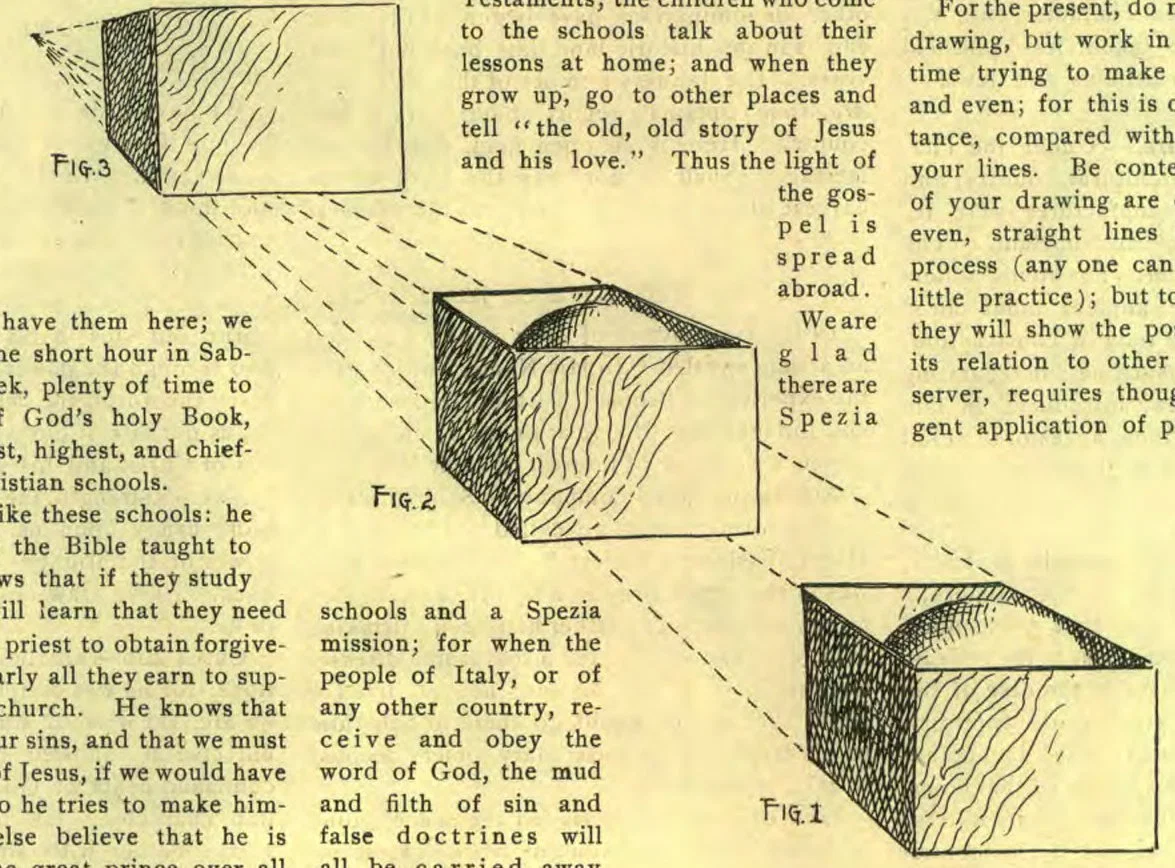
Many lack a knowledge of perspective; and this is one reason you will not always be able to make a perspective drawing that every one will recognize. When objects are above the eye, on the level with the eye, or below the eye, we get different views of them. For example, here is a box with a ball in it. When the box is below the eye, as in Fig. 1, it is easy to see the ball; but if placed a little higher, as in Fig. 2, we can see less of the ball; and when raised to the level of the eye, as in Fig. 3, or above the eye, it is impossible to see the ball in the box.
Suppose you see the box as in Fig. 3; and while you are sitting down drawing, some one enters the room, walks up to the shelf, sees the ball inside the box, and asks you where the ball is in your drawing. You have to say, “I am making a picture of the box as I see it; I can not see the ball, so I can not draw it.” To learn to look at a picture properly, we must be familiar with this fact of perspective,—that, looking from one position, we can not see all the parts of an object seen from other positions.
PEDRO LEMOS.

THE INDIA-RUBBER TREE

WHEN you put on a pair of overshoes or look at a rubber tire, do you ever think of the india-rubber tree, which gives its sap for these useful articles?
In Mexico these trees once grew wild. About a hundred years ago the Spanish government sent a man to Mexico to study its vegetable productions, and he discovered how valuable is the juice, sap, or milk, whichever you wish to call it, of the india-rubber tree. The natives soon learned its value; and they used the trees up, as we have our forests, and did not think of the time when there would be no wild trees to furnish the rubber sap.
Recently some men have bought land, and planted it to india-rubber trees. These trees are self-propagating; that is, they sow their own seed. In the cultivated india-rubber forests the trees are planted to grow in regular order, and the young shoots are either cut down or transplanted. The method of gathering the sap is not unlike our method of gathering maple sap; and before the rubber sap is ready for market, it must be boiled to get rid of the water. It is then pressed into cakes, and shipped to all parts of the world.— Selected.

GRANDMA

She sings so many pretty songs, She tells so many tales, We care not if the sun may shine, Or if it rains or hails; For in the house where grandma lives The clouds may never come; The sun must always brightly shine With grandma in the home.
She led our mama’s toddling steps, She taught her lisping tongue, And bent above her cradle bed When she was very young; But now her noon of life is past. The evening shadows come; We’ll be her gentle ministers While she is in our home.
Her stitches dropped will we pick up, Her needles will we thread; We’ll hunt her straying spectacles, And comb her snowy head. Why should we sigh for mission fields, Abroad why long to roam, While we may wait on grandma dear, The sunshine of our home?
ELIZABETH ROSSER.

SURPRISING MOTHER

MOTHER was suddenly called to a neighbor’s so soon after breakfast that she did not have time even to clear away the dishes, or tell ten-year-old Tom and eight-year-old Dolly what to do while she was gone. But they were never mischievous, and she knew they would take good care of little Ned and the baby; so she was not afraid to leave them.
As she was on her way home, however, after an hour’s absence, she began to think of all the work that must be done; for it was “preparation day,” and the winter days were short for all that must be done in them. Then, as many mothers sometimes do, she began to worry, lest all the work might not be finished before Sabbath. In fact, by the time she reached her own door, she almost had that terrible malady, “the blues.”
But what a change came over her thoughts as she stepped inside the door, and met the laughing children! How the work had disappeared! The breakfast dishes had all been washed, and put away; the floor had been swept; the kitchen window and chairs had been washed; and the children had helped one another wash their hands and faces. How different the day’s work looked to mother, and how pleased she was with the loving helpfulness of her children. Her pleasure doubled theirs, as they realized how much more blessed it is to give than to receive, even of pleasure.
AUNT BETTY.
Continue reading: THE STORY OF DELIVERANCE