The California delegates to the General Conference at College View, Neb., left Oakland, February 14, and arrived at Lincoln, Neb., the 17th. College View is five miles from the city of Lincoln, connected with that city by an indifferent electric railway, which runs, when on time, once every hour and twenty minutes. The center of College View is the campus of Lincoln College. The college building is a substantial brick structure, flanked by two substantial brick dormitories, the whole cost of which is about $90,000. Around the campus is the village, consisting to a great extent of families who have moved here to avail themselves of the advantages of education to be here obtained. The institute preceding the General Conference had been in session about ten days when they arrived, and nearly the full delegation of the General Conference were on the ground. We had the privilege of meeting brethren from the different parts of the great harvest-field, the world, and greetings were warm and many between those who had not met for two years, and some for many more.
The principal thing considered in the institute was the general wants of the cause, and Bible study. Those who took the leading part were Elder E. J. Waggoner, of London, England; Elder A. T. Jones, and Prof. W. W. Prescott. During this time meetings had been held in the Y. M. C. A. Hall in Lincoln, conducted by Elder Durland, of Battle Creek, Mich., and Elder G. E. Fifield, of Boston, Mass.
The number of delegates at this Conference is not as large as at our Conferences in the past. This is partially accounted for because of the stress of financial matters through which the world has been passing for some time, and partially also from the fact that the General Conference is not held at the center of the work. The Conference has really just begun business, so it is impossible at this early date to set before our readers any results which have thus far been accomplished. However, all the delegates have come with an object to work, and the institute and the early days of the Conference have been spent in solemn consideration of the responsibilities resting upon our people, who believe that the coming of the Lord is near at hand, and that to them is committed a solemn message to the world. This has been especially marked with reference to new plans for future work, and doubtless the future meetings of the Conference will present new ideas concerning the work, elasticity of organizations, and much broader plans. That which has life must grow. Any human organization never should be that which would hinder the development of life, and yet one of the great difficulties in all the religious history of the past has been that men, in seeking to help along the work of God, have really hindered it by their own plans and methods. This has been especially marked in human organization. Not being content with the statement of just principles of Christian labor and effort, they have encumbered the work of God with details which are not only belittling to his work, but are a hindrance to the workers. It is impossible to state the living truth of God in all its varied forms in mere human words; it is impossible to compass its life and growth with dead human forms. Humanity can see very little beyond the present, especially if it views things in the light of men. But God’s work is not for the present, merely, but for the future. Human rules and regulations at the best bring their work only to the present, and if these rules and regulations are such as to limit the work, the work of the morrow is hindered by the rules and regulations of to-day. It would seem as tho those who have faith in God and the progress of his work, would be content with such simple and expansive regulations that the cause of God would not be hindered, and that his servants could be left free to follow his bidding.
This matter of regulation and organization is one of the questions of solemn consideration at this Conference. The message of the Lord is going to the world, as the reports indicate, rapidly, and it is the earnest hope of the servants of God who have met at this Conference, that not only shall nothing be done that will hinder that work, but that all the plans that are laid shall be helpful in carrying it forward.
Preliminary meetings of the General Conference have been held, also of the International Tract Society and the International Sabbath School Association. The reports of the officers of these organizations show that the work of God is making progress in the different parts of the earth. The address of the president of the Conference, Elder Olsen, was much briefer than usual. Instead of embodying a report from foreign fields, that was left to be covered by the representatives of those fields that are present, and the plans for the future are so uncertain that nothing was suggested only in the most general way. These will be given more fully later.
Brother C. H. Jones, of Oakland, president of the International Sabbath School Association, presented a stirring address in behalf of the work of the Sabbath Schools. The financial report was very encouraging. It showed that during the years of 1895 and 1896 the total amount given to missions through the Sabbath schools was $42,144.71, an increase during the last year, notwithstanding the hard times, of nearly $5,000.
The most important committees for preliminary work have been appointed in the General Conference as follows:—
On Nominations—R. A. Underwood, R. S. Donnell, N. W. Allee, A. T. Jones, W. S. Hyatt, J. W. Watt, F. D. Starr.
On Plans and Resolutions—H. P. Holser, W. C. White, A. E. Place, E. J. Waggoner, N. C. McClure, J. N. Loughborough, F. M. Wilcox.
On Credentials and Licenses—R. M. Kilgore, A. J. Breed, W. B. White, H. W. Cottrell, W. M. Healey, C. M. McReynolds, S. H. Lane, Wm. Covert.
On Distribution of Labor—I. D. Van Horn, D. C. Babcock, J. E. Graham, J. C. Ottosen, G. B. Thompson, T. F. Bicknell, D. T. Jones.
On Education—W. W. Prescott, J. H. Kellogg, W. C. White, J. C. Ottosen, H. P. Holser, G. W. Caviness, E. B. Miller, F. W. Howe, E. A. Sutherland, C. B. Hughes, O. A. Olsen, J. H. Haughey, J. W. Loughhead, W. T. Bland.
On Finances—G. A. Irwin, N. W. Kauble, C. H. Jones, J. H. Morrison, N. P. Nelson, J. E. Jayne, C. Santee.
The Committee of the International Tract Society on Nominations is as follows—R. S. Donnell, N. W. Kauble, S. H. Lane, H. E. Robinson, M. C. Israel.
The two important committees of the International Sabbath School Association on Nominations and Plans of Work, are as given below:—
On Nominations—A. E. Place, S. H. Lane, W. B. White, E. A. Sutherland, H. E. Robinson.
Plans of Work—J. H. Durland, M. H. Brown, W. C. White, J. E. Jayne, W. A. Hennig, Mrs. L. Flora Plummer, Miss Alberta L. Little.
Very important work rests upon these committees, and fewer meetings of these organizations are held than usual, in order to give the committees ample time. It is thought by many that this work would have been expedited if the work had extended more largely over the delegates, instead of placing a few men on so many committees. Upon this we have no disposition to offer criticism in any way. We realize to some extent the responsibility that those must feel who appoint these committees, and are sure they have met the responsibility as seems best to them.
The religious meetings thus far, at least those we have attended, have been excellent. This was especially marked on the Sabbath. Wise counsel was given Sabbath morning by Elder A. J. Breed, of California, from the text, “For if the trumpet shall give an uncertain sound, who shall prepare himself for the battle?” In the afternoon it was our privilege to take part in a social service, the like of which we do not remember ever to have witnessed. There must have been between two and three hundred testimonies given, every one of which was full of courage, and there were many original and helpful thoughts expressed. This was noted by many. In most meetings of this kind there are many testimonies which follow in about the same line, and express about the same thing, but in the testimonies Sabbath afternoon there was a marked individuality shown in nearly every testimony borne by those present. Altho the meeting was long, the interest held even to the close, and the Spirit of the Lord was present throughout. This meeting itself seemed a pledge that God was working with his people, and would work with them throughout the entire Conference. We trust that this may be the case, and that this Conference, which is marked at the beginning with so much uncertainty as to what the definite plans of the future will be, will be the best Conference ever held among his people, not only in present spiritual manifestation, but in future results. We hope to be able in our next to give more definite results of the work actually accomplished.
M. C. W.
LITERATURE WANTED.
BROTHER J. C. BUNCH, Milton, Fla., desires clean copies of any of our periodicals for missionary work. Can use fifty copies per week at present.
NEW LIBRARY NUMBERS.
Bible Students' Library.
No. 142.—“Is Sunday Called the Sabbath in the New Testament?—An Examination of the Greek of Matt. 28:1 and Parallel Passages,” by Uriah Smith. Price 1 cent.
No. 143.—“Truth for the Times,” by G. C. Tenney. This tract shows that the coming of Christ is the special truth now to be presented. Price 2 cents.
No. 144.—“The Eastern Question; What Its Solution Means to All the World,” by Alonzo T. Jones. A Boston clergyman recently purchased one thousand copies of this tract for free distribution. Price 2 cents.
No. 145.—“Will A Man Rob God?” is a scriptural question, treated from a scriptural standpoint by R. A. Underwood. Price 10 cents.
No. 146.—“Rich Man and Lazarus,” by W. H. Littlejohn. Price 2 cents.
No. 147.—“Home Missionary Work,” by Mrs. E. G. White. Price 4 cents.
No. 148.—“The Sabbath in Prophecy,” by W. H. Littlejohn. Price 4 cents.
Religious Liberty Library.
No. 41.—“Fighting against God.” Beautifully illustrated. Printed on enameled paper. Just the thing to distribute by the thousands. Contains 16 pages, seven half-tone engravings. Price 3 cents.
No. 42.—“How to Reform Society.” Price ½ cent or 25 cents per 100.
Apples of Gold Library.
No. 26.—“I Will Come Again.” An excellent little number on the second coming of Christ. Price ½ cent or 25 cents per 100.
No. 27.—“Religious Liberty.” Price ½ cent or 25 cents per 100.
No. 28.—“The Law of Liberty.” Price ½ cent or 25 cents per 100.
No. 29.—“The Law of Love.” Price 1 cent or 50 cents per 100.
No. 30.—“Knowing and Obeying the Lord.” Price 1 cent or 25 cents per 100.
No. 31.—“Why the Earth Was Made.” Price 1 cent or 50 cents per 100.
No. 32.—“Trine Immersion.” Price 1 cent or 50 cents per 100.
No. 33.—“Scripture Answers to Worldly Questions.” Price ½ cent or 25 cents per 100.
No. 34.—“Seventh-day Adventists and Their Work.” Price 2 cents or 1 dollar per 100.
No. 35.—“The Hope Set Before Us.” Price 1 cent or 50 cents per 100.
No. 36.—“The True Church.” Price 1 cent or 50 cents per 100.
No. 37.—“Letter and Spirit,” by E. J. Waggoner. Price 1 cent.
No. 38.—“Who Are the Saints? Their Character,” by M. C. Wilcox. Price 1 cent.
Cyclone Washer
C. A. Branan, Neillsville, Wis., says: “I have made nine exhibitions of the machine, and taken nine orders.”
Chicago Branch for the State of Illinois, 1130 Monon Bldg.
LESSON XIII.—SABBATH, MARCH 27, 1897
International Series.
LESSON XIII.—SABBATH, MARCH 27, 1897
REVIEW.
1. READ carefully the five chapters which have been studied during the present quarter, and make a brief written outline in your own words of the leading topics in each chapter.
2. Observe that Christ is presented in these lessons as:—
(a) The Good Shepherd.
(b) The Son of God.
(c) The Resurrection.
(d) The Life.
(e) The King of Israel.
(f) The Light of the world.
(g) The Servant of servants.
(h) The Way.
(i) The Truth.
(j) The Comforter (through the Holy Spirit).
3. Study the following great truths as taught in these lessons:—
(a) The tender care of Jesus for his children.
(b) The universal character of the Gospel message.
(c) Christ the only Life-giver.
(d) The true character of Christ’s kingdom.
(e) Life through death; the law both for Christ and his followers.
(f) The cross of Christ the safety of the universe.
(g) The real cause of blindness and hardness.
(h) A neglected ordinance and the blessing of observing it.
(i) The true evidence of discipleship.
(j) The personal second advent.
(k) God in Christ.
(l) The Holy Spirit Christ’s representative.
(m) Love shows itself in obedience.
(n) True peace for believers.
4. In these chapters Christ finishes his work and his teaching among his enemies, and begins his last teaching in the inner circle of his immediate friends. Note the contrast between the triumphal entry and the washing of the disciples’ feet. Are the same principles of his character revealed in both instances?
5. Count the number of places and note the different ways in which life through Christ is taught in these chapters. This Gospel is indeed the Gospel of life.
6. Would it not be profitable for each one to consider whether he has received personal benefit from the study of these lessons? A clearer knowledge of Christ, and, as a consequence, advancement in the Christian life, should be the object of all Bible study. Has this been realized?
The Sunday School
International Series.
LESSON XIII.—SUNDAY, MARCH 28, 1897.
REVIEW.
LESSON 1.—Christ’s Ascension. Acts 1:1–14. Golden Text: “While he blessed them, he was parted from them, and carried up into heaven.” Luke 24:51. The book of Acts was written by Luke. According to “Hale’s Chronology” the ascension took place on May 31. The rulers at this time were: Tiberius Cæsar, emperor of Rome; Pontius Pilate, governor of Judea; Herod Antipas, governor of Galilee; Caiaphas, son-in-law of Annas, high priest. In addition to the ascension the lesson contains the promise of Christ’s return to earth in the same manner in which he was taken up from the earth into heaven, and the promise that the disciples should receive the gift of the Holy Spirit.
LESSON 2.—The Holy Spirit Given. Acts 2:1–13. Golden Text: “They were all filled with the Holy Ghost.” Acts 2:4. The time of this lesson is ten days later than that of the previous one. It includes the reception of the Holy Ghost by the apostles, and the speaking of the Word in the languages of the various nationalities represented in Jerusalem at this time. This mightiest of evidences was rejected by many of the sin-loving multitude, and some said, “They are filled with new wine.”
LESSON 3.—A Multitude Converted. Acts 2:32–47. Golden Text: “The promise is unto you, and to your children, and to all that are afar off.” Acts 2:39. This lesson contains the exhortation of Peter to the Jews, following his announcement of the fact that they were responsible for the crucifixion of the Messiah; the working of signs and miracles by the apostles; the accession of 3,000 to the faith in one day; and the selling of individual property for the good of the cause.
LESSON 4.—The Lame Man Healed. Acts 3:1–16. Golden Text: “His name through faith in his name hath made this man strong.” Acts 3:16. The scene of the lesson is at Jerusalem, in the outer court of the temple, near the Beautiful Gate. The healing of the blind man was one of the numerous ways in which the Gospel was impressed upon the minds of the people. It showed the love and the power of God. It was an evidence that God was working through the one who performed the act. The healing was followed by one of Peter’s characteristic accusations of the betrayers of his Lord.
LESSON 5.—The Boldness of Peter and John. Acts 4:1–14. Golden Text: “There is none other name under heaven given among men, whereby we must be saved.” Acts 4:12. The section includes the whole chapter to verse 31, with a review of chapter 3, being a record of a single event and its outcome. The event was the healing of the blind man. It includes the imprisonment of the apostles, and their trial before the Sanhedrin. Up to this time the church had about 5,000 members. The leaders of the Jews took knowledge of the apostles “that they had been with Jesus.”
LESSON 6.—True and False Giving. Acts 4:32 to 5:11. Golden Text: “Man looketh on the outward appearance, but the Lord looketh on the heart.” 1 Sam. 16:7. The members of the early church sold their possessions, and turned the price into a common fund for the support of the work and the poor among them. Ananias and Sapphira, selling their possessions, brought a part of the price, representing it to be the whole. The two classes here brought to view represent the true and false givers.
LESSON 7.—The Prison Opened. Acts 5:17–32. Golden Text: “We ought to obey God rather than men.” Acts 5:29. This lesson contains an account of the imprisonment of the apostles, and the opening of the prison doors by an angel of the Lord. Their deliverer instructed them to go and stand in the temple and speak to the people the words of this life. Then follows the trial before the Sanhedrin and the warning which caused Peter to utter the words found in the Golden Text.
LESSON 8.—The First Christian Martyr. Acts 6:8–15; 7:54–60. Golden Text: “Be thou faithful unto death, and I will give thee a crown of life.” Rev. 2:10. “And Stephen, full of grace and power, wrought great signs and wonders among the people.” For this and the bold stand which he took for Christ, the Jews “gnashed on him with their teeth,” cast him out of the city, and stoned him to death. While the cruel work was being done, Stephen was praying for his murderers a prayer similar to that of Christ upon the cross.
LESSON 9.—The Disciples Dispersed. Acts 8:1–17. Golden Text: “They that were scattered abroad went everywhere preaching the Word.” Acts 8:4. Following Stephen’s death came a “great persecution,” which scattered abroad the members of the early church, who caused multitudes of others to join themselves to the cause of Christ by presenting him wherever they went. By this means the Gospel was brought to Samaria, and the believers there received the Holy Ghost.
LESSON 10.—The Ethiopian Convert. Acts 8:26–40. Golden Text: “Then Philip opened his mouth, and began at the same scripture, and preached unto him Jesus.” Acts 8:35. This incident and that of the previous lesson show the way in which the Gospel began to be carried into the regions beyond. The Ethiopian convert carried the good news of salvation through Christ into the mountains and valleys of what is now Abyssinia.
LESSON 11.—Saul, the Persecutor, Converted. Acts 9:1–12, 17–20. Golden Text: “This is a faithful saying, and worthy of all acceptation, that Christ Jesus came into the world to save sinners.” 1 Tim. 1:15. Saul, the persecutor of Christ (in the person of his followers), was Paul, the extoller and advocate of Christ to all the world. Saul had letters of authority to bring bound to Jerusalem all who confessed Christ at Damascus. Christ interposed in behalf of his followers, and through his intervention saved Saul as well as those whom he would persecute.
LESSON 12.—Christian Self-restraint. 1 Cor. 9:19–27. Golden Text: “Every man that striveth for the mastery is temperate in all things.” 1 Cor. 9:25. This is a temperance lesson as well as an exhortation to faithfulness in the Christian life. In the different athletic games only one could be victor; not so with the Christian’s race. Their prize was a corruptible crown; the Christian’s an incorruptible one. Paul studied the Christian life from the standpoint of those who were not Christians that he might the more successfully lead them to Christ.
THE UNITED STATES IS IN PROPHECY.
We have several large works treating this subject in detail, but not until recently have we had anything sufficiently condensed for general distribution. Elder Uriah Smith, author of “United States in Prophecy,” “Thoughts on Daniel and The Revelation,” “Marvel of Nations,” and senior editor of the Review and Herald, has written a 32-page treatise on the prophecies relating to this country, and has entitled it “America’s Crisis.” That we have reached a crisis, all thinking men believe; but that this crisis and what it means to the world is foretold in Scripture, is not so generally believed.
To read this pamphlet is to become intelligent on this great question, and to awaken an interest for the details of the working out of these prophecies. Order Bible Students’ Library, No. 138. Price, 4 cents. Special price on quantities for distribution.
PACIFIC PRESS PUB. CO., Oakland, Cal. New York City, N. Y. Kansas City, Mo.
PACIFIC PRESS PUBLISHING CO
“The Eastern Question, What Its Solution Means to All the World,” by Alonzo T. Jones. While this great question is absorbing the attention of millions on both hemispheres, we wish to call your attention to the importance of reading and circulating something treating the subject from a Biblical standpoint. This tract contains the following subheadings: The Seven Trumpets; The Rise of the Turkish Power in Prophecy and History, Fulfilled to the Very Day; The World's Crisis; Daniel's Visions; “At the Time of the End;” The King of the North and His End; When He Comes to His End; The Plagues of God's Wrath, and Need for Watching and Praying. It contains 16 pages; price, 2 cents.
PACIFIC PRESS PUBLISHING CO
New York City, N. Y. Oakland, Cal. Kansas City, Mo.
The Gospel Primer
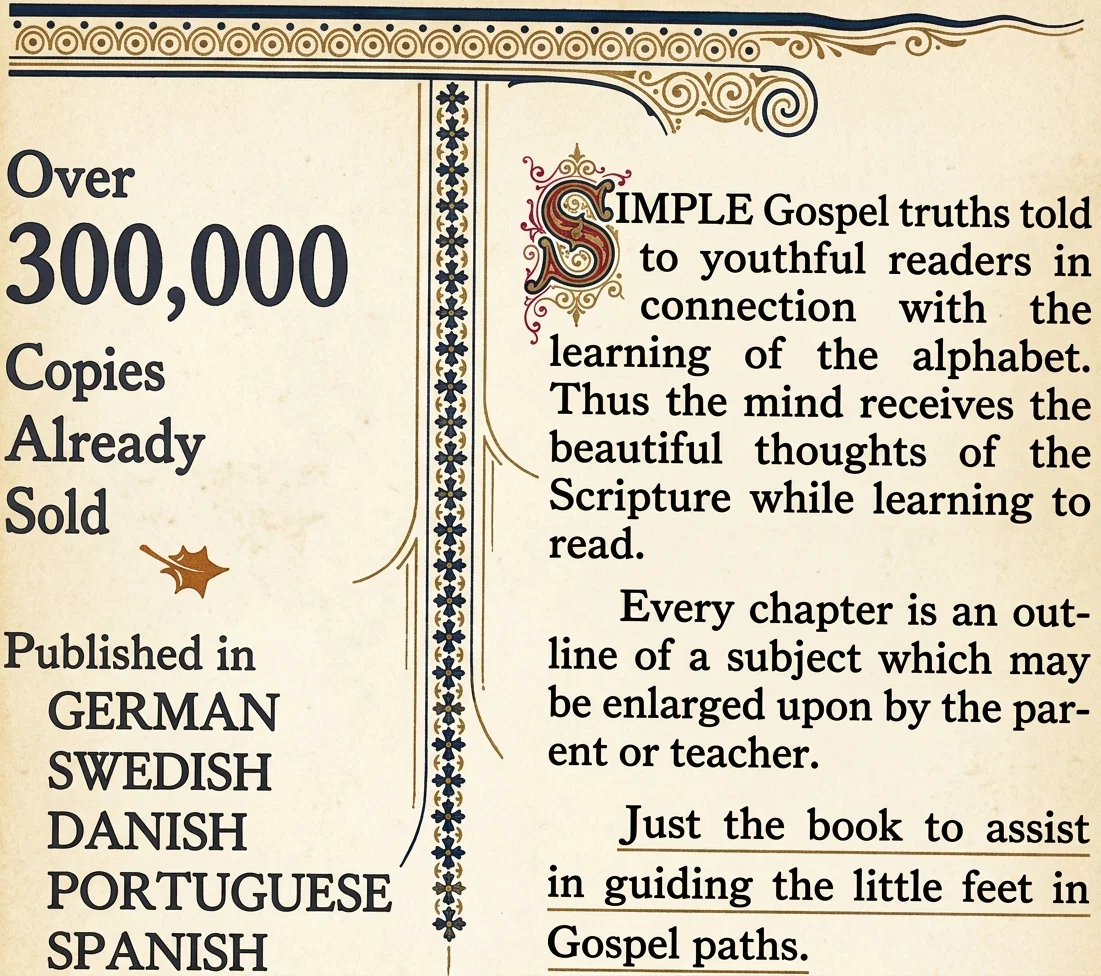
Over 300,000 Copies Already Sold
Published in GERMAN, SWEDISH, DANISH, PORTUGUESE, SPANISH
SIMPLE Gospel truths told to youthful readers in connection with the learning of the alphabet. Thus the mind receives the beautiful thoughts of the Scripture while learning to read.
Every chapter is an outline of a subject which may be enlarged upon by the parent or teacher.
Just the book to assist in guiding the little feet in Gospel paths.
Very Fully Illustrated
And Neatly Bound, as follows:—
Cloth, embossed in ink . . . . . 50c
Board Covers, Cloth back . . . . 35c
Heavy Board, in four colors . . . 25c
Address,
PACIFIC PRESS PUBLISHING CO.
Kansas City, Mo. OAKLAND, CAL. New York City
ANGELS, Their Nature and Ministry.
Revised by the late J.H. Waggoner.
In two parts. Part Two considers some hints on the Origin, History and Destiny of Satan, as gleaned from the Scriptures. Bible Students’ Library No. 83. 140 pages. Paper covers. Price, 20 cents.