Pacific Press Publishing Company · New York · May 7, 1896
PAPAL POLICY.
The Appeal of the Cardinals.
Two weeks ago we printed in these columns the appeal of Cardinals Gibbons, Vaughan, and Logue, for the establishment of an international court of arbitration. For a number of reasons this subject is worthy of more notice that it has yet received either from us or at the hands of the press generally.
The three cardinals named did not go so far as to say in so many words that the Papacy ought to be made the supreme arbiter of the world, but nobody can doubt that such was the purpose of their appeal. “Such a court existed for centuries,” say they, “when the nations of Christendom were united in one faith. And have we not seen nations appeal to that same court for its judgment in our own day?”
Only One of Many Similar Suggestions.
This covert suggestion of Cardinals Gibbons, Vaughan, and Logue, is only one of many similar ones made within the last ten years. To avoid a war in 1885, which Germany dared not undertake because of France, Bismarck turned to the Pope as arbitrator; and Rome, seizing the fact, has ever since, in season and out of season, urged that “his holiness” be made the arbiter of the world. In its issue of Feb. 17, 1894, in an article on
“The Pope as International Arbitrator,”
the Catholic Mirror said: “International arbitration is gaining ground more and more, and it promises to hasten the day when the sword shall be sheathed forever. . . .”
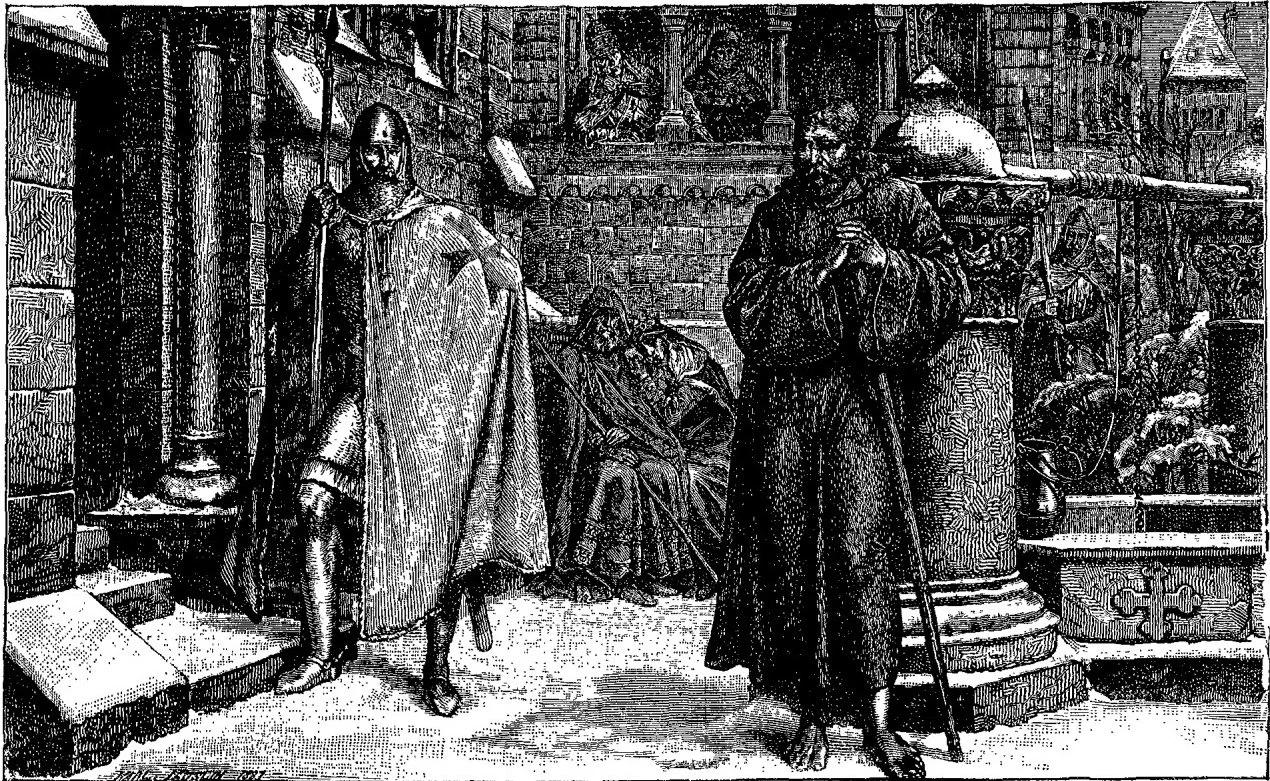
PENANCE OF HENRY IV. AT CANOSSA.
“During the century from 1793 to 1893 there have been fifty-eight international arbitrations. . . . From 1793 to 1848, a period of fifty-five years, there were nine arbitrations; there were fifteen from 1848 to 1870, a period of twenty-two years; there were fourteen from 1870 to 1880, and twenty from 1880 to 1893.
“The most interesting arbitration of the century was that in which the highest representative of moral force in the world was accepted in 1885 by the apologist of material force to mediate between Germany and Spain. Leo XIII. revived the roll of the popes in the Middle Ages.
“The obstacles to an international code are not insurmountable. . . .
“An interesting quotation from the Spectator and English Review says: ‘Humanity is in search of an arbitrator whose impartiality is indisputable. In many respects the Pope is, by position, designed for this office. He occupies a rank which permits monarchs as well as republics to have recourse to him without sacrifice of dignity. As a consequence of his mission the Pope is not only impartial between all nations, but he is at such a degree of elevation that their differences are imperceptible to him. The difficulty about religion is becoming weaker every day. . . . The fact that the most haughty statesman of Europe [Prince Bismarck] recognizes in the face of the world that he can, without loss of dignity, submit his conduct in an international affair to the judgment of the Pope, is an extraordinary proof that the Pope still occupies an exceptional position in our skeptical modern world.’
“Why should not the exceptional position of the Pope be utilized by the nations of the world? He is the highest representative of moral force on earth; over 200,000,000 of Christians scattered throughout all nations stand at his back, with a moral power which no other human being can command.”
The Ambition of the Papacy.
No one familiar with the situation and with the utterances upon this subject emanating from high sources in the Roman Catholic Church, can doubt that the ambition of the Papacy is to once more dominate the nations something as she dominated them when in 1076, Henry IV. of Germany, “the highest of secular potentates, stood for three days in the courtyard of the castle [of Canossa], clad in the shirt of a penitent, and entreating to be admitted to the Pope’s presence.”146
Complainant minds may think there is no danger, but what are the facts? There exists at the present time a world-wide condition of affairs exceedingly favorable to the
Pretentions of the Roman Hierarchy.
For years modern civilization has apparently been about to crumble, like the Roman Empire, under the weight of its own magnificence. Those conditions essential to stability have not been preserved, and the recognition of impending ruin has become well-nigh universal. Very naturally men are casting about to find some remedy; but so far the search has been in vain.
World-wide Perplexity.
An abnormal state of affairs exists everywhere. The jealousy of nations has imposed upon them burdens too great to be borne indefinitely. Immense standing armies have depleted national treasuries to the verge of bankruptcy. Indeed, some of the nations have been unable to meet their obligations already; but the armies must be maintained at any cost, for ability to repel an invader is the price of national autonomy.
Upon the unnatural condition created by exorbitant taxation and the withdrawal of so many thousands of men from industrial pursuits, has been superinduced unparalleled commercial depression. Nations are perplexed, the people are restless and dissatisfied to a degree that threatens the very existence of civil society.
Rome Sees All This,
and seeing it she is preparing to take every advantage afforded both by existing and by impending conditions. Rome has never been modest in her claims, but within the last decade she has become more bold than even her wont in asserting her powers and in pressing her claims as the saviour of society, the possessor of a panacea for all ills that afflict or threaten the body politic of the world.
Will the world be warned of the designs of the Papacy before it is too late? Of this system the Nun of Kenmare says:—
“It has the power in many countries to trample on the courage of the weak, because it flatters and bribes the strong to act as its allies until the strong also become weak; and then they, too, learn what are the tender mercies of this professedly Christian church.”
Rome Never Changes.
In her spirit, in her disposition, in her essential nature and characteristics, Rome is the same to-day that she was two hundred or five hundred years before Christ.
Between Rome’s beginning and our day, between 753 B. C. and 1894 A. D., she has appeared in different outward forms, she has taken on different phases, such as the kingly, the republican, the imperial and the papal; but it has been Rome all the time—Rome in spirit, in nature, and in essential characteristics.
There is no world-power that occupies so large a place in the Bible as does Rome. Rome, from its rise in ancient time and in its pagan form, through all its career, its merging into the papal form, and down to our own day, is traced in all its workings, and is marked in its every essential feature, by the pen of inspiration. And it is Rome all the time and always the same—cunning, crafty, insinuating, arrogant, violent, persecuting and bloody—always actuated by the same spirit and pursuing steadily the same policy. So constant, so persistent, and so characteristic is this policy, that it is singled out in the Scripture and distinctly defined as “his policy.”
In the eighth chapter of Daniel there is a prophecy of the career of Media and Persia, of Grecia under Alexander, and then under Alexander’s successors, and of the power that should succeed these which by every evidence of Scripture and history, is demonstrated to be
None Other Than Rome.
And in that place this power is thus described:—
And in the latter time of their [Alexander’s successors’] kingdom when the transgressors are come to the full, a king of fierce countenance, and understanding dark sentences, shall stand up. And his power shall be mighty, but not by his own power; and he shall destroy wonderfully, and shall prosper, and practice, and shall destroy the mighty and the holy people. And through his policy also he shall cause craft to prosper in his hand; and he shall magnify himself in his heart, and by peace shall destroy many: he shall also stand up against the Prince of princes; but he shall be broken without hand.
Observe that it is distinctly declared that “through his policy also, he shall cause craft to prosper in his hand,” “and by peace shall destroy many.” To know what this “policy” is, is to know the character of Rome from beginning to end. To understand this “policy,” is to understand papal craft even to-day, for “Rome never changes.”
Roman Policy Described.
Rollin, the historian, describes this Romish policy so fully and gives such a perfect analysis of it that we cannot do better than to quote his words:—
“The reader may perceive from the events above related, one of the principal characteristics of the Romans, which will soon determine the fate of all the States of Greece, and produce an almost general change in the universe; I mean a spirit of sovereignty and dominion. This characteristic does not display itself at first in its full extent; it reveals itself by degrees; and it is only by an insensible progress which at the same time is sufficiently rapid, that we see it carried at last to its greatest height.
“It must be confessed that this people, on some occasions, show a moderation and disinterestedness, which, from a superficial view, seems to exceed everything we meet with in history, and which we feel it incumbent on us to praise.
“Was there ever a more glorious day than that in which the Romans, after having carried on a long and dangerous war, after crossing seas and exhausting their treasures, caused a herald to proclaim, in a general assembly, that the Roman people restored all the cities to their liberty, and desired to reap no other fruit by their victory than the noble pleasure of doing good to nations, the bare remembrance of whose ancient glories sufficed to endear them to the Romans? The description of that immortal day can hardly be read without tears and without being affected with a degree of enthusiasm, of esteem, and admiration.
Only Imaginary Freedom.
“Had this deliverance of the Grecian States proceeded merely from a principle of generosity, void of all interested motives; had the whole tenor of the conduct of the Romans been of the same nature with such exalted sentiments, nothing could possibly have been more august, or more capable of doing honor to the nation. But if we penetrate ever so little beyond this glaring outside, we soon perceive that this specious moderation of the Romans was entirely founded on a profound policy; wise, indeed, and prudent, according to the ordinary rules of government, but at the same time very remote from that noble disinterestedness so highly extolled on the present occasion. It may be affirmed that the Grecians then abandoned themselves to a stupid joy, fondly imagining that they were really free, because the Romans declared them so.
“Greece, in the times I am now speaking of, was divided between two powers; I mean the Grecian Republics and Macedonia; and they were always engaged in war; the former, to preserve the remains of their ancient liberty, and the latter, to complete their subjection. The Romans, perfectly well acquainted with this state of Greece, were sensible that there was no necessity of apprehending any difficulty from those little republics, which were growing weak through length of years, by intestine feuds, mutual jealousies, and the wars they had been forced to support against foreign powers. But Macedonia, which was possessed of well-disciplined troops, inured to all the toils of war, which had continually in view the glory of her former monarchs, which had formerly extended her conquests to the extremities of the globe, which still harbored an ardent, though chimerical desire, of attaining universal empire, which had a kind of natural alliance with the kings of Egypt and Syria, sprung from the same origin and united by the common interests of monarchy; Macedonia, I say, gave just alarm to the Romans, who, from the ruin of Carthage, had no obstacles left with regard to their ambitious designs but those powerful kingdoms that shared the rest of the world between them, and especially Macedonia, as it lay nearest to Italy.
A Specious Bait.
“To balance, therefore, the power of Macedon, and to dispossess Philip of the aid he flattered himself he should receive from the Greeks, which, indeed, had they united all their forces with his, in order to oppose his common enemy, would perhaps have made him invincible with regard to the Romans, they declared loudly in favor of those republics, made it their glory to take them under their protection, and that with no other design, in outward appearance, than to defend them against their oppressors; and farther, to attach them by still stronger ties, they hung out to them the specious bait, as a reward for their fidelity. I mean liberty, of which all the republics in question were inexpressibly jealous, and which the Macedonian monarchs had perpetually disputed with them.
“The bait was artfully prepared and as eagerly swallowed by the generality of the Greeks, whose views penetrated no farther. But the most judicious and most clear-sighted among them discovered the danger that lay concealed beneath this charming bait, and accordingly, they exhorted the people from time to time, in their public assemblies, to beware of this cloud that was gathering in the West; and which, changing on a sudden into a dreadful tempest, would break like thunder over their heads, to their utter destruction.
A Tribunal From Which There Was No Appeal.
“Nothing could be more gentle and equitable than the conduct of the Romans in the beginning. They acted with the utmost moderation towards such States and nations as147addressed them for protection; they succored them against their enemies, took the utmost pains in terminating their differences, and in suppressing all troubles which arose among them, and did not demand the least recompense for all these services done for their allies. By these means their authority gained strength daily and prepared the nations for entire subjection.
“Under the pretense of manifesting their good will, of entering into their interests and of reconciling them, they rendered themselves sovereign arbiters of those whom they had restored to liberty, and whom they now considered, in some measure, as their freedmen. They used to depute commissioners to them to inquire into their complaints, to weigh and examine the reasons on both sides, and to decide their quarrels; but when the articles were of such a nature that there was no possibility of reconciling them on the spot, they invited them to send their deputies to Rome. But afterwards they used to summon those who refused to be reconciled, obliged them to plead their cause before the Senate and even to appear in person there. From arbiters and mediators having become supreme judges, they soon assumed a magisterial tone, looked upon their decrees as irrevocable decisions; were greatly offended when the most implicit obedience was not paid to them, and gave the name of rebellion to a second resistance. Thus there arose, in the Roman Senate, a tribunal, which
Judged all Nations and Kings,
and from which there was no appeal. This tribunal, at the end of every war, determined the rewards and punishments due to all parties. They dispossessed the vanquished nations of part of their territories, to bestow them on their allies, from which they reaped a double advantage; for they thereby engaged in the interest of Rome such kings as were in no way formidable to them, and weakened others whose friendship the Romans could not expect, and whose arms they had reason to dread.
“We shall hear one of the chief magistrates in the republic of the Achæans inveigh strongly in a public assembly against this unjust usurpation, and ask by what title the Romans were empowered to assume so haughty an ascendant over them; whether their republic was not as free and independent as that of Rome; by what right the latter pretended to force the Achæans to account for their conduct, whether they would be pleased should the Achæans, in their turn, officially pretend to inquire into their affairs, and whether there ought not to be an equality between them. All these reflections were very reasonable, just and unanswerable, and the Romans had no advantage in the question but force.
How the Romans Treated Kings.
“They acted in the same manner, and their politics were the same with regard to their treatment of kings. They first won over to their interests such among them as were the weakest, and consequently, the less formidable; they gave them the titles of allies, whereby their persons were rendered, in some measure, sacred and inviolable, and to a degree safeguarded against other kings more powerful than themselves; they increased their revenues and enlarged their territories, to let them see what they might expect from their protection which had raised the kingdom of Pergamos to such a pitch of grandeur.
“After this the Romans invaded, upon different pretenses, those great potentates who divided Europe and Asia. And how haughtily did they treat them even before they had conquered. A powerful king, confined within a narrow circle by a private man of Rome, was obliged to make his answer before he quitted it; how imperious was this! But how did they treat vanquished kings? They commanded them to deliver up their children, and the heirs of their crowns, as hostages and pledges of their fidelity and good behavior; obliged them to lay down their arms; forbade them to declare war, or to conclude any alliance without first obtaining their leave; banished them to the other side of the mountains, and left them, in strictness of speech, only an empty title and a vain shadow of royalty, divested of its rights and advantages.
Enemies to Liberty Everywhere.
“We have no room to doubt that providence had decreed to the Romans the sovereignty of the world, and the Scriptures had prophesied their future grandeur; but they were strangers to those divine oracles; and besides, the bare prediction of their conquests was no justification with regard to them. Although it be difficult to affirm, and still more so to prove, that this people had from their first rise, formed a plan, in order to conquer and subject all nations; it cannot be denied, if we examine their whole conduct attentively, that it will appear that they acted as if they had a foreknowledge of this, and that a kind of instinct determined them to conform to it in all things.
“But, be this as it may, we see, by the event, to what this so much boasted lenity and moderation of the Romans was confined. Enemies to the liberty of all nations, having the utmost contempt for kings and monarchies, looking upon the whole universe as their prey, they grasped with insatiable ambition, the conquest of the whole world; they seized indiscriminately all provinces and kingdoms, and extended their empire over all nations; in a word, they prescribed no other limits to their vast projects than those which deserts and seas made it impossible to pass.”
This Statement True of the Papacy To-day.
This statement of Rome’s policy and its workings is as true and as appropriate in the case of the Roman Church and the American Republic to-day, as it is in the case of the Roman State and the Grecian Republics in all time. It describes the policy of Leo XIII. and the ultimate purpose of the Papacy toward the Government and people of the United States; toward the workingmen; as the self-appointed intermediary between capital and labor; and the would-be arbiter of the world, to-day, as truly as it describes the policy of the Roman Senate and its ultimate purpose towards the governments and peoples of Grecia and the other nations of antiquity. Nor is
The Identity of This Policy
in Rome to-day, and in Rome of old, denied by the Papacy. In fact, it is asserted by the Papacy, and the continuance of this policy from ancient Rome is the acknowledged inspiration of modern Rome.
When Imperial Rome was falling to ruins under the violent inroads of the barbarians of the North, the spirit and policy of Rome not only survived but was deepened and perfected in papal Rome. And this spirit and policy were consciously and intentionally continued by the popes of the time and was consciously received and diligently cultivated by each succeeding pope.
It has been said of Leo II. that “all that survived of Rome, of her unbounded ambition, her inflexible perseverance, her dignity in defeat, her haughtiness of language, her belief in her own eternity, and in her indefeasible title to universal dominion, her respect for traditionary and written law, and of unchangeable customs, might seem concentrated in him alone.” At the very moment of his election he was absent in Gaul on a mission as mediator to reconcile a dispute between two of the principal men of the empire. He succeeded in his mission and was hailed as “The Angel of Peace,” and the “Deliverer of the Empire.” In a sermon, he showed what his ambition embraced. He portrayed the powers and glories of the former Rome as they were reproduced in Catholic Rome. The conquests and universal sway of heathen Rome were but the promise of the conquests and universal sway of Catholic Rome. Romulus and Remus were but the precursors of Peter and Paul. Rome of former days had by her armies conquered the earth and sea: now again, by the see of the holy blessed Peter as head of the world, Rome, through her divine religion, would dominate the earth.
Truly “Rome never changes.” This is “his policy,” craft and hypocrisy, hypocrisy and craft, always employed to feed an insatiable ambition for universal dominion. “Rome never changes.” In “policy,” in spirit, in working, in essential nature, Rome never has changed and never can change. And it is high time that the people of this country and of the world understood the full significance of this boast of the Roman Catholic Church.
A GOOD DEFENSE.
The Wilkesbarre Record of April 24 contains the following defense made by the three Koenig brothers, Seventh-day Adventist farmers living in the vicinity of Wilkesbarre, Pa., who, as noticed in our last issue, are now threatened with prosecution for pursuing their customary occupations on Sunday:—
Editor Record: Your issue of Wednesday contained an item relating to our religious belief and practice regarding the Sabbath; will you kindly permit us to make a brief statement of our attitude toward the Sabbath question and our attitude toward our neighbors whose belief and practice differ from our own. It is true that we have lately changed our views regarding Sunday observance. Until recently we were conscientious observers of Sunday, the first day of the week, supposing that we were thereby obeying the will of God as revealed in his word; but recently we have come to believe that to obey the fourth commandment we must observe the seventh day, or Saturday, as therein commanded. We are as conscientious in this belief as we were in our former belief, but still willing to be convinced of our error (if such it be) with scriptural testimony.
As stated in your columns, we labor on the first day of the week, considering it one of the “six days” upon which labor may be performed, as set forth in the commandment. Our work is not of a noisy character and is not performed where it will disturb either the public or private devotions of our neighbors. We are endeavoring to follow the Golden Rule in all our relations with our neighbors, and would not knowingly do unto them that which we would not be willing to have done to us.
We are sorry to see some of our neighbors laboring on the day we now regard as holy, but we think it unchristian for us to attempt to harass them by legal action, as we understand a few of our neighbors propose to do with us. If we are wrong the Lord of Sunday will reckon with us in the judgment, and so long as our work on Sunday does not injure our neighbors in any way, but is wholly a matter which belongs148to the realm of conscience and religion, ought we not to be left in the hands of a just and merciful God?
Railroads and street-cars thunder past us at all hours on Sunday, much nearer our neighbors than is our work, and pleasure-seeking wheelmen speed along unmolested; why then are we, who having kept the Sabbath day according to the commandment, go quietly about our honest toil on Sunday, singled out and threatened with prosecution? There are hundreds of Seventh-day Adventists in Pennsylvania who believe and practice as we do, but none of them have ever been arrested for their labor on Sunday.
We desire to impress upon all our neighbors that in pursuing the course we do, we are not attempting to needlessly offend them, and we sincerely hope that they will manifest the same kindly spirit toward us that we bear toward them, and not attempt to exact from us a tax of one-sixth of our income for the privilege of worshiping according to the dictates of our consciences in the land of the free.
W. M. KOENIG. John H. KOENIG. A. H. KOENIG.
Would it not be well for the State of Pennsylvania, or for any State, if all its citizens were as conscientious and as careful of human rights as are these men? And yet it is proposed by certain zealous religionists of their neighborhood to petition the borough council for authority to prosecute them in case they do not in the future observe Sunday. It is always the best citizens who are made the victims of religious prosecutions.
THE JUDICIAL MENACE.
The Appellate Division of the New York Supreme Court has affirmed the constitutionality of the Raines liquor law. This fact is not itself of great significance, but the language of the court in stating its conclusions has a significance which is highly ominous.
Justice Patterson wrote the opinion of the court, which was concurred in by four other members. In it he said:—
The subject presented for our consideration is the constitutionality of the law. The law has been severely arraigned in argument as offending against justice and reason. It may be as unjust, unwise, oppressive and odious as the relator claims, but all that does not help in the solution of the question before us, and we have no opinion to express on that subject. The Court of Appeals has said:—
“No law can be pronounced invalid for the reason simply that it violates our notions of justice, is oppressive and unfair in its operation, or because, in the opinion of some or all of the citizens of the State it is not justified by public necessity or designed to promote the public welfare. If it violates no constitutional provision, it is valid and must be obeyed. The remedy for unjust or unwise legislation not obnoxious to constitutional objections is to be found in a change by the people of their representatives according to the methods provided by the Constitution.”
Such language is calculated to raise in the reader’s mind the query what courts and constitutions are for in the machinery of government. If, as the Declaration of Independence asserts, and as common sense affirms, governments are instituted among men to preserve the inalienable rights given man by the Creator, how can it possibly be that a part of the machinery of government can legitimately operate to invade those rights? For what purpose was the judicial department of government established if not to act at all times in the interests of justice and the rights of the people?
The same may be said with reference to the constitution. The constitution of the State of New York has this preamble: “We, the people of the State of New York, grateful to Almighty God for our freedom, in order to secure its blessings, do establish this Constitution.” And yet the Appellate Division of the highest court in the State has gravely declared that a “law” may be oppressive and unjust, and still be constitutional! If the constitution is established by the people of the State in order to secure to themselves the blessings of freedom, how can that which is oppressive be constitutional?
If the assumptions of this court are to be held by courts generally, we have arrived at a most dangerous position, and the people may well call a halt and take their bearings. If our “courts of justice” have become instruments of oppression, it may be proper to inquire what further use we have for them. Certainly no person in this country wants to be oppressed; no one wants to become a victim of injustice. When appeal is honestly made to the court, it is that injustice may be averted, and the rights and liberties of the plaintiff secured to him; and it is to this end that all our courts were ordained to act.
We seem to have reached that place as a nation which the Jewish nation reached in the time of Christ, when the Scribes and Pharisees gave tithes of mint, anise, and cummin, and omitted the weightier matters of the law—justice, mercy, and faith. Matt. 23:23. More and more it becomes apparent that judicial decisions are taking less account of first principles, and exalting technicalities. The constitution is made superior to the people—the thing created, to its creator. Injustice is declared to be law, and the eternal law of justice is ignored.
Let the worst injustice and oppression now be put by legislative enactment into the constitution ordained by the people for the preservation of their liberties, and there will be no help for them in the courts of law, according to this decision of the Appellate Court of New York. The only remedy will lie in the slow, uncertain, and difficult process of changing the legislature and thereby securing the repeal of oppressive laws, and the enactment of that which is just. Commenting on the situation, the New York World, of April 26, heads an editorial with the words, “Contempt for Law.” Such decisions on the part of our courts of law can tend only in this direction. The clogging of the channels of justice can tend only to a popular outburst in the direction of anarchy and revolution.
THE PAPACY'S GROWING POWER.
[Present Truth, London.]
The Chronicle's special correspondent from Rome continues to mingle with his eloquent description of the Papal pomp and circumstance of events, at the Vatican and St. Peter's much that is of great political significance. He refers to the old contest between the Vatican and the Quirinal and dubs it “a controversy which goes down to the roots of the European situation, which troubles the peace of king and cardinals, and affects the alliances and estrangements of the great States of the world.”
After enumerating various local incidents which have caused friction between the representatives of the Papal court and the State, and have given some new prominence, within the very precincts of Rome itself, to the persistent seclusion of the “Prisoner of the Vatican,” he says:—
And above all the crushing blow which the House of Savoy has received in Africa, the relations of Italy to the Triple Alliance, the Pope's leaning toward France—all the pressing problems which, during the last few weeks, have centred in Rome and made her the “hub” of diplomatic Europe, the centre of the modern as she was of the ancient world—have swept this “Roman question” to the front.
And yet, he asks himself, why should there be any desire to see this question raised at this time?—for, “not for years—I had almost said for centuries—has the moral and political influence of the Vatican stood at so high a level.” In his view, too, the very disabilities under which the Pope has chafed so impatiently have been to the advantage of the Papacy, “and the Holy See has gained enormously by its dissociation from the responsibilities of secular power.” So that now it is a fact “that the Papal chair is raised in the eyes of the Roman Catholic world above the throne of kaiser and czar and king, that it is in a sense protected and guaranteed by Europe, that it has founded a new empire in the world, that it is sustained by an acute and active diplomacy, and yet is free from actual responsibility, and, like Hamlet's ghost, possesses a certain majestical invulnerability of its own.”
Yes, all this is true—the papal power is a creature of destiny and of prophecy. Until that destiny and that prophecy are fulfilled, it does possess a certain invulnerability. But when that time has come when she shall feel no longer these disabilities and shall say, “I sit a queen, and am no widow, and shall see no sorrow,” then “shall her plagues come in one day, death and mourning, and famine: and she shall be utterly burned with fire: for strong is the Lord God who judgeth her.”
RELIGIOUS TEACHING IN PUBLIC SCHOOLS.
A SESSION of the American Society of Religious Education was held in Washington, D. C., April 20-22, for the purpose of discussing religious education in its relation to the welfare of society and of the Church.
The discussion turned largely to the subject of the religious training of children. This it was assumed would be conducted by those to whom the general education of children was most largely entrusted; in other words, to those holding positions in public institutions of instruction.
Some of the assertions by which the discussion was characterized, were, that the teaching of our relations to the future was of greater importance than the teaching of our relation to God; that to know the reasons for belief was more important than belief itself; and that knowledge would be an effectual bar against all the isms which were leading the minds of many in the Christian world astray, and which could not be combatted by anything but an intelligent comprehension of the doctrines of the Christian religion. These and other statements made gave evidence that in the minds of prominent members of the association, the religious education required was not a mere knowledge of fundamental principles of Christian ethics, but a complete knowledge of the doctrines of Christianity.
There is manifestly an increasing sentiment in this country in favor of combining religious instruction with secular teaching in our public educational institutions, and of making this religious instruction comprehensive of the doctrines of Christianity. In so far as this results in the introduction of religious teaching in schools supported by the State, it must tend to a union of Church and State. The various religious denominations will inevitably be drawn into competition for the selection, through their influence, of instructors in the public schools, and also for the determination of the doctrines which shall be taught as pertaining to the Christian religion. A wide field would inevitably be opened up for denominational controversy; and the most powerful, or prevailing, church would receive the support of the State in the public dissemination of its doctrines, and the training of149the youth to become applicants for admission into her fold.
While some time was given in this session of the association to a discussion of the family as an educational institution, it is undoubtedly true that the importance of parental religious training for children and youth is becoming more and more lost to public view. The family, the church, and the denominational school are the only proper institutions for imparting religious instruction; and of these the family is not the least. The parental and family influence is incomparably greater over the youth than is that of the church or the school. Religious training should begin with the child as soon as it is old enough to understand religious ideas and principles, and for the purposes of such training the Bible, in the hands of parents, stands preëminent. It is the home influence that makes or mars the character. The person who in early youth contends with an adverse influence at home, struggles against great odds. The parents stand to the young child in the place of God, and their place cannot be taken by any others. This is fixed by the natural relation between the parties. To parents is entrusted by God the training of their children for usefulness in life, and no part of this training is of such importance as that which affects their moral nature, and sets forth their relation to God. If parents evade this responsibility or shift it to other hands, they neglect a sacred trust.
Where parents are not competent to train their children in religious knowledge, this work should be done by the church and the denominational school. In many instances this will be the case; but no parent is released from obligation in this respect. What the country needs is an agitation which will set before parents their duty to diligently instruct their children in religious knowledge as revealed in the Word of God, and not an agitation which tends to lessen their perceptions of personal responsibility in this respect.