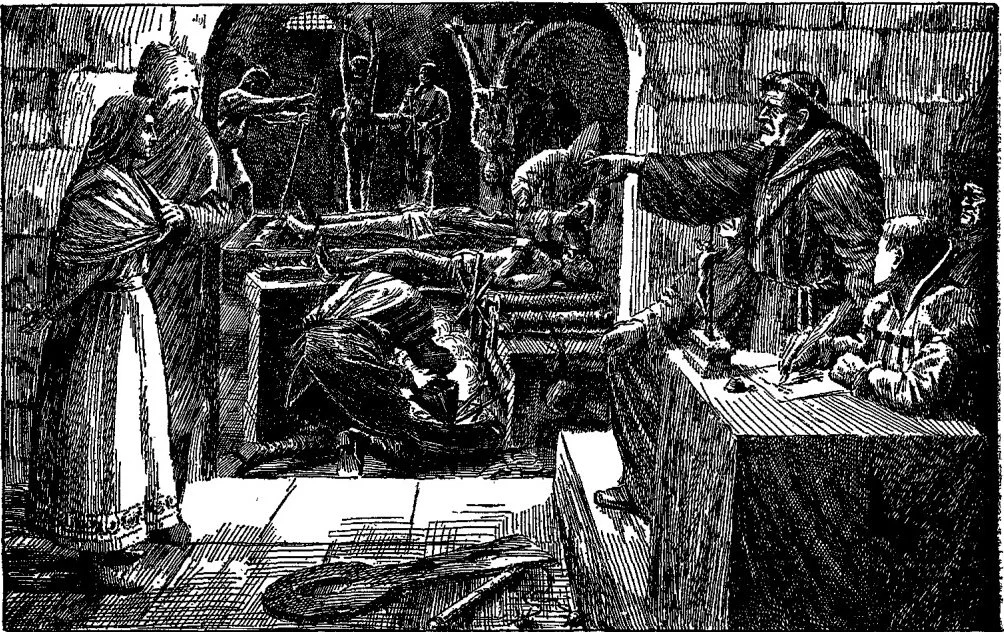
Probably all those connected with the Christian Citizenship movement, should they have occasion to refer to the matter, would severely condemn the Inquisition. But if their movement succeeds, will they not be driven to the establishment of some form of that tribunal?
Nothing is more logical than that an inquisition should follow an attempt to establish the Kingdom of God on the plan that the government should be controlled by the “saints,” and that the Christian Citizenship leaders are the ones qualified to decide who are saints. If none but saints can get office under the government, there will be great additions to the number of saints, of those who are saints “for revenue only.” And since the presence of counterfeit saints would ruin the proposed kingdom, it necessarily follows that there must be a saint tester to cull out spurious saints.
THE INQUISITION IN OPERATION.
In the last SENTINEL, it was clearly shown that already our Christian Citizenship friends are sadly in need of a saint tester. It was shown that in 1890 they deliberately selected a Kentucky congressman, of good standing in an influential church, to start their movement, who was at the time he began work on the kingdom, what they now term “an infamous old libertine.” They therefore confess that they selected “an infamous old libertine” as pioneer lawmaker for their kingdom, thinking of course that he was a saint. Nothing is clearer, therefore, than that some kind of an inquisition is needed by our Christian Citizenship friends to enable them to discern between the righteous and the wicked. This is what the original Inquisition was for. This is what the Spanish Inquisition was for, and this is what its apologists declare it was for, and this is the ground on which it is defended.
The Catholic Mirror, of Aug. 29, 1896, contained an article in defense of the Spanish Inquisition, which attempts to justify the acts of that awful tribunal on the ground that government favor to the Catholic religion produced so many hypocrites that the Inquisition was necessary to cull them out. Here is a portion of the article:—
“To put it briefly, in those middle ages, there was the greatest union of Church and State. . . . All the laws, then, had a tinge of Catholicity, and they were carried out in a manner savoring of the principles of the universal church. . . . In those ages of faith, . . . it was well nigh impossible for a Jew or infidel to ascend to prominence in any walk of life. . . . This was very galling to the avaricious Jew, and numbers of them, thirsting for wealth, while secretly remaining Jews, pretended to profess the Catholic faith, were baptized, pushed themselves into the courts and kingly places, and even were found among the priests and prelates of the church of God. . . . In time, this consumptive germ did not fail to cause great trouble and danger and alarm in Spain. Such a state of things called for immediate action; but since there was no doubt but that very many of the Jews were honest in their conviction, what to do was a very perplexing question. Hence arose a very great difficulty—a difficulty which, as all will agree, could be overcome only by an inquisition.”
Since the Roman Catholic Church has been in the State-Church business all her life, she is certainly qualified to know better whether it breeds hypocrisy than our Christian Citizenship friends who are just setting up in business. And from the foregoing we learn that it is the sober judgment of the papal church, the result of long experience, that governmental favor shown to a particular religion inevitably results in multiplying hypocritical professors of that religion, so perfectly counterfeit as to require an inquisition to discover the genuine. Any one with a mind to think and eyes to observe can see that this is true even if the long experience of the Catholic Church did not confirm it. It therefore follows that in the proportion that the Christian Citizenship movement succeeds, just in that proportion it will become the habitation of hypocrites, or as the prophet paints it, “the cage of every unclean and hateful bird.” This being the inevitable result, the next question is what will the Christian Citizenship managers do about it? Will they undertake to cull out the hypocrites? and if so, how? It is useless for them to say that they can discern a hypocrite without some form of an inquisition; for it was shown at73the beginning of this article that they have not the discernment to do so.
There is an infallible detector of hypocrites which belongs to the true church, but it is not the Inquisition. Hypocrites attempted to unite themselves with the early Christian Church, but in Acts 3:1–14 we learn that it was with fatal result. But this detector was the Holy Spirit, which departed from the church, as John Wesley tells us, as soon as the Church sought help from the State. No, the Christian Citizenship movement cannot have the Holy Spirit to protect it from hypocrites. An inquisition is all that is left. Will the Christian Citizenship managers organize an inquisition? A. F. B.
The Origin of Government.
By H. E. Giddings
BY H. E. GIDDINGS.
ANY government that is formed in recognition of the principle that governments derive their just powers from the consent of the governed, at once acknowledges that the governed as individuals are the factors, and the composite product is the government. The individual is the unit, and the government is the combined sum when the units are added together. But the addition is made, the sum is obtained, by the consent of the units.
All of the individuals as units, in a general way consent to the form of government in order that they may each enjoy the protection and other advantages arising from the union. They may not consent to all measures adopted by the majority of the people; but they have consented to government itself. They have consented to be governed themselves, by the political will of the mass, even in things that may not suit them.
Men may differ as to what measures will best serve the purpose of securing to each the enjoyment of his natural rights; but they do not differ as to whether there shall be government. All agree that governments are instituted among men for the purpose of securing individual rights; and that all these rights are to be enjoyed and secured by the protective instrumentality of government.
The foundation principle of the United States Government is stated in the Declaration of Independence: “We hold these truths to be self-evident, that all men are created equal; that they are endowed by their Creator with certain unalienable rights; that among these are life, liberty, and the pursuit of happiness. That to secure these rights, governments are instituted among men.” In this brief enumeration of rights, we have an illustration of the kind of rights that the Creator gave to each individual; and which each person has as a natural possession before he becomes a unit or factor in the formation of civil government.
Because of the insecurity of these rights against the invasion of the evil-inclined, governments were instituted to secure these rights,—or rather to secure those possessing them in the enjoyment of them. That is to say, When people found that their Creator had given them certain rights to enjoy in this life, and that because of the prevalence of injustice, or a disposition on the part of many to rob others of their enjoyment of the rights which God had given them; and desiring to secure these rights for themselves and others; they established governments for that purpose.
Now, the three designating terms employed in the Declaration of Independence are not intended to be limiting; for the language which points out the fact that men are naturally in possession of certain rights, says that “among these” natural rights are life, or the right to live; and “liberty” as wide as the Creator bestowed on man; also the legitimate “pursuit of happiness.”
In this we have an example of the nature of all the rights which were given by the Creator to all, or each member of the race alike. Every natural right stands on the same basis and is alike unalienable. In other words, such rights cannot be separated from the individual so long as he has a right to life. Governments rightly organized and administered never take any of these rights from a citizen by virtue of his citizenship; but secure him in the enjoyment of them all.
Man did not in the beginning, and does not now, give up any of his natural rights when he becomes a citizen of civil government. He consents to be governed, and to become a factor in the governing of others, in order that his rights may all be the better secured to him.
The political maxim, and the divine truth, is that governments derive just power from the consent of the governed. It is power, then, and not rights, which is surrendered to a general fund in the formation of government: this power to be employed in defense of the rights of each individual consenting.
But the question may be raised, Did not each individual possess power and a natural right, to defend himself, before he delegated it to the government as a combination?—No. Originally self-defense was not a natural right. Man was in possession of physical power; but it was given in the beginning for another purpose entirely. The matter of self-defense is wholly an artificial necessity, arising with sin and the efforts of the evil ones to use the power God had given them, to impose on others. This evil was selfishness, which proposed to have its own way, even at the expense of others.
Originally, man was endowed with power physically to accomplish certain ends; but self-defense was not a means to any one of those ends. He was given a mind capable, by its superiority, of governing all living things. The Creator gave him a virgin world with the Garden of Eden as a copy for the improvement of the whole in a like manner. The man was given intelligence and power to dress and keep the garden, and to subdue the rest of the earth in a like manner, and people it. Life, liberty, and the pursuit of happiness were his. But this did not include, it does not contemplate, the pursuit of an enemy; for all were his friends. He was given power to govern himself.
Religion and State in Russia.
RUSSIA has long enjoyed the “benefits” of State religion. From the days of Peter the Great, the Czar has been head of the Church as well as of the State. He has long been recognized as “priest” of the Russian “White House,” as well as civil ruler. His empire is and has long been a “Christian” nation.
In Russia the State is united to the “Christian” faith. The Russian legal code, called “Swod,” so declares, saying “that in the Russian lands the established faith shall be that of the Christian Orthodox Oriental Catholic Church.” Of course, the faith of a “Christian orthodox” church can be none other than the Christian orthodox faith.
The foregoing, with other facts given in the following quotations, are taken from an interesting article contributed to the Independent, of January 28, by a correspondent in Russia.
The Russian legal code declares:—
“The Emperor, as the Christian ruler, is the highest defender and protector of the dogmas of the established faith, the guardian of the orthodox faith and of each and every ordinance of the holy church.”
In the days of Peter the Great, each member of the “Holy Synod” took this oath: “I confess and confirm with my oath, that the highest ruler of this college [the synod] is the Czar, our most gracious Lord.” The oath exacted of bishops at the present time is as follows:—
“I promise to obey the directing synod for all the Russias in each and every respect as the authoritative legal body of the church, which has been appointed as such by his Majesty Peter the Great, of blessed memory, and has been confirmed by our present ruling Emperor.
“I also confess that I have received this office by the will of his Majesty and by the election of the Synod. And I promise to keep faithfully all that has been enjoined upon me, or shall be enjoined upon me by the Holy Synod, after the consent of his Majesty shall have been secured for the measures decided upon by the Synod.”
Peter the Great did not see, however, or professed not to see, that this state of things would interfere with liberty of conscience. “In 1722 Peter declared in a ukase that it was not his purpose to meddle with affairs of conscience, ‘although he had by divine authority the absolute power to decide in such matters.’” His idea of interference with conscience was very much like that held by some religious “reformers” of the present time.
The present Russian law in regard to dissenters reads as follows:—
“All the subjects of the Russian Empire not belonging to the Established Church, both native Russians and those from abroad who are in the service of the State, are permitted at all times openly to confess their faith and practice their services in accordance with the rite. This freedom of faith is assured not only to the Christians of foreign confessions, but also to the Jews, Mohammedans and heathens, so that all the peoples in Russia may worship God the Almighty, with different tongues according to the laws and confessions of their fathers, so that they may bless the government of the Russian Czar and pray for his welfare and prosperity to the Creator of the world.”
“This liberty, however,” says the Independent’s correspondent, “is assured only those persons who are born into a certain confession, but not to those who would adopt or accept a new faith, unless it be that of the Established Church. The legal code reads:—
“‘It is the privilege only of the Established Church in the Empire to seek others to adopt its teachings and tenets. This faith, however, can be effected only by the grace of God, by instruction, by kindness, and especially by a noble example. Therefore it is never permitted the Established Church to use force in gaining the adherents of other faiths or persuading unbelievers to embrace the orthodox faiths, nor to threaten those who will not come over to the Orthodox Church.’”
“In the strongest terms every propaganda of others among the adherents of the State Church is forbidden. Whoever persuades an orthodox Russian to join another church, loses all his legal and civil rights, and is banished to Siberia. Those who have left the orthodox communion in this way are put under the jurisdiction of the ecclesiastical courts. Until their return to the State Church they are deprived of all rights over their own children, for whom guardians are appointed, and who are placed in schools approved by the church authorities. If the convert has property where also orthodox people live, he is not allowed to occupy it, and the property is put into the hands of another. In case the convert absolutely refuses to return, all these punishments are made permanent. The ministers of “strange cults” are forbidden by law to engage in any polemics against the State Church. They are not allowed to warn their own members from going over to the Established Church. In fact, they are even compelled to report such conversions to the authorities of the State.
“What almost insurmountable difficulties are by the laws of Russia placed between dissenting members and the performance of their duties, can be seen, for example, from the legal restrictions put upon the Roman Catholics. The Roman Catholic bishops can confer with the Vatican only through the mediumship of the Russian Ministry of the Interior, and without the placet of the Minister they are not permitted to publish any pastoral letters or other official declarations. The disciplinary measures of the bishops are seriously interfered with by the laws of the State offering protection to disobedient priests and laymen. The bishops and priests are not permitted to visit Rome. Only one Russian bishop participated in the deliberations of the Vatican Council in 1870, and he was forbidden to return by the government. Occasionally the Imperial government allows75a Roman Catholic bishop to go to the Eternal City. Priests from abroad are not allowed to enter the country without special permission. No Russian subject is allowed to pursue his theological studies in a non-Russian school. Even the appointment of theological teachers by the bishops must be approved by the State.
“The Protestant Church is in no better condition legally. It, too, is merely an ecclesia licita; and the banishment of more than thirty per cent. of the pastors of the three Protestant German Baltic provinces in the last decade shows what the legal status of Protestants is in Russia. Only in Finland, where special conditions prevail, does the Protestant Church enjoy better legal rights. In every respect, however, religious dissent meets the heavy hand of the law. The great Jewish agitator in Kishineff, in Southern Russia, Joseph Rabinowitz, could not effect a Jewish-Christian Church organization because the Russian authorities refused to permit him to baptize. In the light of data like these it seems vain to hope for religious tolerance in the Empire of the Czar.”
The trouble is that the Russian people have religious “tolerance,” but not religious liberty. Religious tolerance represents the mildest attitude of the State towards dissenters when the State has professed religion; and “tolerance” implies the right to be intolerant whenever the tolerant party may choose so to act. Wherever there is “tolerance” of a religion, there also will always be intolerance to a greater or less extent.
We want no religious “tolerance” in this country; we want religious freedom. And therefore we want no union of religion with the State. If the State professes religion, it will certainly join a church.
Crime, Morality, and the Root of Evil
The Pittsburg Catholic, of January 14, notes that “Governor Hastings, in his message, deplores the fact that official statistics show that crime is increasing at a76more rapid ratio than our population,” and adds: “Building additional prisons will not prove a preventive. When the growing generation is trained in morality, as it is in secular knowledge, the State may look for a decrease. The education from which God is banished is the root of the evil.”
The “root of the evil” is the depravity of human nature; and only that which will change that nature can prove a remedy. Will training the growing generation “in morality” avert the evil? The Roman Catholic Church trains the growing generation of her adherents in “morality,” but criminal statistics do not speak more favorably for that class of our citizens than for any other. The morality which will restrain people from crime is that which is taught to individuals by the Holy Spirit, through the Word of God; and that morality does not come through any secular channel.
Proposed Law for Christmas Observance.
In Atlanta, Ga., the 25th day of December last was made an occasion of revelry and crime, by the baser element of the population, to an extraordinary degree. The result was a proposition by the chairman of the police committee of the city council to obtain legislation which would secure a “proper observance” of the day. The following information relative to the project is furnished by the Atlanta Journal of January 7:—
“Alderman Joseph Hirsch, the new chairman of the police committee of the city council, proposes to secure legislation that will bring about a proper observance of Christmas as a religious holiday. The alderman thinks that rowdyism and riotous conduct should not be permitted on Christmas and is determined to at least make an effort to put a stop to the practice prevalent here of celebrating Christ’s birthday as if it were the Fourth of July.
“I propose, if possible, to secure legislation that will prevent a repetition of the disgraceful conduct on the part of rowdies which has characterized Christmas in Atlanta in the past,’ said Alderman Hirsch, this morning. ‘Christmas is a holiday in celebration of the beginning of the Christian era, and by the Christians is regarded as a holy day. Therefore, it should be observed as such. In the north, east, west and, in fact, everywhere but here, the people observe Christmas as a holy day and attend divine worship. But here the day is turned into a regular Fourth of July. The streets are given over to rowdies, their riotous conduct disturbs the peace as well as the devotions of good citizens. This, I think, is all wrong, and I propose to start a movement that will result in the day being properly observed.’
“Captain Connolly, chief of police, heard the remarks of the chairman of the police committee and stated that his views coincided exactly with those of Mr. Hirsch. He said the police did their best to keep order, but were unable to do so.”
Anyone familiar with the history of Sunday legislation can easily see the exact parallel which will be furnished by the development of Christmas into a legal “holy day,” with the development of the legal “sabbath.” First appears the fact that the holiday is made an occasion of unusual lawlessness. This has long been the case with Sunday. For reasons which require no great study to understand, Sunday has long contributed more cases for the police court dockets than any other day of the week. To this fact the champions of Sunday have long been calling public attention; and that this Sunday lawlessness was exceedingly bad and demanded a remedy, could not be denied. And the “remedy” proposed and in many instances secured, was a stricter law for Sunday observance.
Upon the same ground precisely it is now proposed to secure legislation for the observance of Christmas, and a similar movement has been started to secure such an observance of Thanksgiving as will not conflict with the religious exercises of the day. By the same logic these “holy days” stand or fall together.
No one denies the evil of the rioting and criminal excess which our holidays so frequently bring forth. But the proposed remedy can only make the matter worse. Idleness can never become a remedy for crime.
There is no reason why people should not be required to behave themselves as well on Sunday, Christmas, or any legal holiday, as on any other day of the year; and there is no reason why they should not be required to conduct themselves as decently on every day as on these days. There can be no reason whatever for making Christmas, Sunday, or Thanksgiving legally different from other days in this respect.
The only remedy for holiday lawlessness is to cut off the opportunity from those to whose natures such conduct is congenial. In other words, they should be kept at work. If they were not so frequently cut off from honest work by these holidays, the civil authorities would not so often be called upon to furnish them with work in the penal institutions of the State.
It Has Always Been So.
By W. E. Cornell
BY W. E. CORNELL.
Men and organizations who have stood in defense of a principle that is in its nature reformatory; that strikes at existing evils, have always been the targets of every abuse and calumny that the opposition could heap upon them.
In the days of Christ, the people garnished the sepulchres of the righteous, and with tear-stained cheeks exclaimed, “If we had been in the days of our fathers we would not have been partakers with them in the blood of the prophets.” And yet this very people crucified the Prince of Glory.
Religious reformers in every age have had this spirit to contend with; but after their work is done and they pass off the stage of action, those who live after them, to enjoy the fruits of their labors, invariably look back upon the deeds of their persecutors with a holy horror, while at the same time they themselves may unconsciously be manifesting the same spirit toward a new truth for their day.
Seventh-day Adventists as an organization stand in defense of God’s law and all that that implies. Their bitterest enemies, those who have been instrumental in invoking the power of the law against them, openly and under oath, acknowledge that they are good, law-abiding, honest citizens; temperate, and ready for every good word and work. Indeed, it is of them as of Daniel of old, the only occasion against them is “concerning the law of their God.”
Seventh-day Adventists know that they have a work to do, and like faithful watchmen they have cried, aloud and spared not. They have unflinchingly raised a note of warning against approaching dangers. They stand unalterably opposed to the strong trend of sentiment that is fast setting in favor of measures that have in them the principle of a united Church and State. Because of this they are maligned and denounced in the severest terms by the would-be guardians of Sunday-sacredness. And why? Simply because they see in them a Mordecai in the gate against the consummation of their cherished plans.
Nearly fifteen years ago, an authority among Seventh-day Adventists had this to say:—
“Those who honor the Bible Sabbath will be denounced as enemies of law and order; as breaking down the moral restraints of society, causing anarchy and corruption, and calling down the judgments of God upon the earth. . . . Conscientious obedience to the Word of God will be treated as rebellion.”—“Great Controversy,” vol. 4, pp. 409, 425.
This prophetic utterance has since been fulfilled to the very letter in many instances. Here is one. Speaking of the opposition of Seventh-day Adventists to National Reformism, Rev. J. R. Day, Secretary of the American Sabbath Union for the State of Indiana, at a mass meeting held in Chicago in 1892, said:—
“It is religious anarchy. It is calculated to break down our rest day, destroy the peace of the country, and bring the judgments of heaven down upon the land.”
The Christian Endeavorer, whose “one absorbing purpose, one undying enthusiasm” seems to be that “Christ shall rule the caucus and the common council as he does the church,” in its issue of November last, states that the Seventh-day Adventists are “carrying on a guerrilla warfare against the United States Government,” and in the December issue of the same publication, the editor says:—
“These Seventh-day Adventists are flooding our churches with their literature. . . . They co-operate with the open blatant infidels and other enemies of our country in their attacks upon the Christian Sabbath. . . . The friends of the Christian Sabbath have many enemies to fight, but none appear to us to be more mischievous than the Seventh-day Adventists.”
Seventh-day Adventists are not nettled at this classification by the Endeavorer, though it is false in every respect. It is only what might be expected; indeed, it is just what is expected and what has been expected. For more than forty years, with voice and pen, Seventh-day Adventists have been telling all the people that what we now see enacted before our eyes, would take place; and no amount of denunciation, abuse, or misrepresentation will in the least swerve them from their duty as they view it. The warfare in which they are engaged is one on which hinge eternal consequences, and they have enlisted for life.
Des Moines, Iowa.
Cleveland's Thanksgiving Proclamation and Its Christian Acknowledgment
In the Christian Statesman, of January 23, the editor reports that he called recently upon President Cleveland, “to express to the President our high appreciation of the far-reaching influence” of his Thanksgiving proclamation. “No sooner had we referred to that remarkable document than the President said: ‘I have been amazed at the effect of that acknowledgment of Christ.77Letters have come to me in large numbers from various portions of the country, expressing intense satisfaction. My only wonder is that I never made a similar acknowledgment before.’”
The author of that truly “remarkable document” is not surprised that none of his predecessors possessed sufficient wisdom to issue such a proclamation, but only that he himself had not thought of it sooner! That is surprising, truly!
The Struggle for Religious Freedom.
Jewish Spectator, Memphis, Tenn.
“ETERNAL vigilance is the price of liberty.” Verily, religious liberty is the most precious prize this republic ever won, and every true American, be he Jew or Gentile, Atheist or Deist, ought to guard well the entrance to the temple of freedom, that no ecclesiastical institution whatsoever enter in the disguise of a civil law to gain the support of State and municipal governments. The peace and harmony binding so many heterogenous religious elements together in this land must not be disturbed, and the curse of religious strife must not be brought upon the land. There are no trifles in the science of politics; the smallest beginning may, in the end, work the greatest mischief; or as Horace says, “He has half the deed done who has made a beginning.”
The State of Tennessee, in its declaration of rights upon the statute book, emphatically proclaims: “No human authority can in any case whatsoever control or interfere with the rights of conscience; and that no preference shall be ever given by law to any religious establishment or mode of worship.” If, in the presence of this solemn and sublime declaration, it is just and lawful and compatible with the rights of conscience that thousands within the State are deprived of their freedom of will, and its legitimate exercise, by inserting a theological amendment regarding Sunday observance, it is just as lawful to frame a law to introduce the Bible into the public schools of the State as a text-book for religious instruction, and to convene at the hour set apart for the purpose all the Protestant and Catholic pastors of the State, together with rabbis and liberal ministers, to decide what version of the Bible should be used, and, as it were, to fight it out among themselves.
After it has been made just and lawful to read the Bible in the schools, although every creed believes in a different interpretation, it would also be considered a civil act to put God into the Constitution of the United States. It needs only to imbue State senators and legislators with the idea that any sectarian principle can be inserted in the civil law of the land, and there will be no difficulty to make congressmen believe the same thing. “E pluribus unum,” “one composed of many,” is the motto of the United States, and the representatives of each separate State are frequently elected as members of Congress. If the grand principles of reli- gious liberty and the secular character of our Constitution are ignored and set aside at the sessions of our legislature, why should the same men consider them more sacred and inviolable in the Congress chamber and Senate hall?
They may do all this with the best of intentions—perhaps in order to make the nation purer, better and nobler—but after the mischief is done these intentions will go for nothing. They may also have forgotten history, which told mankind how much misery religious wars have brought to nations of the past, and how much precious human blood was shed in the effort to establish a Church in the State, and to define the God in whose name the law was to be executed.
I know that many will consider this an exaggeration of the consequences which the question at issue will bring, but it is, nevertheless, a logical conclusion. If the Bible is to be taken as an authority in the observance of the Sunday, it is likely to be taken as an authority in legislation otherwise. If an ecclesiastical ordinance is to determine and shape the laws of the State, it is but natural to fear the encroachments of ecclesiastical authority upon the magna charta of the nation. . . . To avoid the Scylla and Charybdis of bigotry and fanaticism the State and the nation must steer clear of the reefs and cliffs of sectarianism. . . .
If every statesman, every member of the legislature or of Congress, would be guided by impartiality of judgment and purity in politics, if all ministers of the gospel and other religious people would recognize the mischief sectarian influences work within State legislation, every Sunday law in the land would speedily be repealed. . . .
We and millions of other citizens have come hither from other countries to seek shelter under the glorious banner of freedom and equality held aloft by a secular government, and no loyal citizen should set at naught these blissful promises, promulgated by the constitutions of the States to every human being in the land. We are Israelites by birth and religious education; we revere the laws of God and the religious maxims of Moses, but we do not desire that the States or the State at large shall enforce and perpetuate the ecclesiastical ordinances of the ancient Jews by virtue of the civil law. We protest against the introduction of the Jewish and Christian Scriptures into the spheres of public education, and denounce the efforts of over-zealous sectarians to put the God of the Jews and Christians into the American Constitution.
In France or in any other republic just emerging from the ruins of a monarchical government, some excuse can be offered for making concessions to ecclesiastical rules. There the Church and State were united for centuries, and a separation cannot be accomplished at once; but here on the virgin soil of America such a union was never contemplated; hence every effort, however small, which would gradually and eventually lead to it, should be repulsed by every true citizen. Within the wide boundaries of this land, many dissimilar creeds and religious78associations have now for more than a century lived in peace, harmony and prosperity; it would be treason to disturb this peace and good will. . . .
Whenever the day should come that the Church needs the support of the State, Christianity would be doomed to decay, because if religion has to lean on human law and on a penal code, it betokens debility and decrepitude on the part of religion. Let every denomination observe a day of rest and spiritual elevation for the heart and mind, be it now one day in seven or one day in three, but let them use no other means but moral persuasion and fervent piety to maintain it. . . . Thus the peace and prosperity of all citizens will be secured; the sublime principles of justice, freedom, and equality will be cherished by everyone as the noblest and most precious heirloom of the American nation.
THE proposed treaty of arbitration between this country and Great Britain does not now seem to be the embodiment of a desire for peace that it did at first. Lord Salisbury is quoted as saying that he will have the treaty in the form in which it was sent to the United States Senate, or not at all; and the Senate profess to see in it a shrewd scheme on the part of the English premier to put this country in a position of disadvantage. Consequently they have so amended the treaty that its acceptance by the representatives of both countries seems likely to be indefinitely postponed.
This only shows that the parties concerned in the matter are looking out for their own interests, respectively, much more than they are looking out for peace.
Senator Hoar on the Arbitration Treaty
“SENATOR HOAR,” says the Independent, “is said to have betrayed deep feeling in resenting the threatening tone of some of the communications to Senators peremptorily demanding the prompt ratification of the Arbitration Treaty. He deemed it a grievous indignity to so honorable a body to hurry it into immediate action by ‘jamming spurs into its sides.’”
The senator is right. The members of Congress are chosen to transact the most important business of the nation, and they should do this with that deliberation which waits on wisdom. We hope every member of our national Legislature will refuse to pay any attention to the threatenings of any party or body, big or little, religious or secular.
Criticism of Lyman Abbott's Treatment of Jonah
ONE such “sermon” as was preached on a recent Sunday in Plymouth Church, Brooklyn, by the Rev. Lyman Abbott, in which he amused his congregation even to the point of open laughter by his treatment of the Bible story of Jonah, does more to break down the bars of moral restraint in a community than can be offset by all the efforts of reform societies. Dr. Abbott says that the Book of Jonah is a fable, written to teach the goodness and mercy of God. But the average person will lose confidence in a God whose goodness and mercy must be taught by falsehood. The God of the Bible was never reduced to any such straits.
The greatest need of mankind to-day is that of more confidence in God and God’s Word.
Sunday Reformers Versus the Old Jewish Saturday
THE “Old Jewish Saturday” has been a source of untold trouble to the Sunday reformers for these many years. It has a certain dignity and persistency arising from its association with God, the Decalogue and Jesus Christ, which have made it so quietly stubborn when men have ordered it to get out of the way, that even Mr. Gamble, the latest “Daniel come to judgment,” has not been able to order it out of court without a struggle. The special aim of these discoverers in the field of Sabbath Reform is to destroy “Saturday” as the seventh day of the week. To do this they are willing to destroy the week if need be,—anything to be rid of the one fact that the law of the Sabbath finds its full expression in the last day of the week.—Sabbath Recorder.
Annapolis Ministers Launch Crusade Against Sunday Newspapers and Mail
A CRUSADE against Sunday newspapers and Sunday distribution of mails, was inaugurated January 21, by ministers of Annapolis, Maryland. At a meeting held in the First M. E. Church, a committee of seven was appointed to petition the postmaster-general on the subject, and devise such other means as might be necessary to the success of the crusade. The Sunday sermon is coming to rely more and more upon State and municipal legislation to enable it to compete with the Sunday papers.