We often hear the remark that “you Adventists are trying to scare people. You are constantly telling them that we are in the last days; that the end of the world is about reached; and that Jesus is soon to come in the clouds of heaven.”
But, friend, you are mistaken. We are not trying to scare any one. We do, however, see the calamities that are coming upon this world. We see the storms by land and sea, also the murders, the robberies, the drunkenness, the vice, the rioting and general discontent, and all the rest of the alarming evils of this time, and we know what it means. And the reason why we know what it means is because we read its meaning plainly in the Bible.
Now the simple facts are that we are not scaring people at all. But, on the other hand, we find that men are already filled with dreadful forebodings of the overhanging evil,—in the literal language of Scripture, “Men’s hearts failing them for fear, and for looking after those things which are coming on the earth; for the powers of heaven shall be shaken.” Luke 21 : 26.
The work that we Adventists are doing is to enlighten these people that are already filled with fear, telling them what all the dangers and evils of this time signify, and pointing them to the Fortress of eternal safety and power. There is no need of any being scared, for the Lord stands ready at all times to take each and every one under His all-sufficient protection.” T.
OUR NATION DRIFTING IN THE WRONG DIRECTION.
By William Penniman
The following, which we clip from the St. Louis Republic of August 29, contains, much condensed, truthful and comprehensive thought in respect to the present condition of our country, showing how history is repeating itself in regard to the nations of the Old World, and is also somewhat prophetic of the downfall of our nation. Being also from an eminent thinker, it has the more right, and we deem it worthy of publication in the SIGNS OF THE TIMES. It is from an address delivered in Ashfield, Mass., August 25, at the twentieth annual dinner in aid of Sanderson Academy, by Prof. Charles Elliott Norton, professor emeritus of fine arts of Harvard University. His subject was “The War Just Closed”:—
“Our hearts have been heavy with a new weight of care, and the very brightness of the sunshine has but deepened by contrast the cloud of our sorrowful thoughts—sorrowful that our nation should have turned its back upon its old ideals, and, standing at the parting of the ways, should have chosen the ancient path, familiar to the Old World, worn by the bloody feet of hapless generations, and which has never led to anything but ill—the path of aggressive war, of foreign conquest, of alien territorial aggrandizement—the path that leads from trouble to trouble.
“The black and brutal visage of war has indeed been lightened up from time to time during the summer by the gallant deeds of our men in service, and by the good conduct and marvelous good fortune of our navy, and by the general temper of humanity displayed so soon as the actual fight was over by both officers and men. But it has taken on a deeper shade of gloom from the needless sufferings which our brave soldiers have had to endure from the lack of due provision for their needs alike in camp, on field, and in hospital. It has been a miserable spectacle of incompetency, for which account must be rendered and penalty enacted.”
After a review of the events leading up to the war, Prof. Norton said:—
“Peace has nominally come. The actual conflict has ended, but less than 100 days of war has resulted in a revolution in the United States. The foundations on which the republic has rested have been unsettled; the principles upon which the government depends have been violated; we have undertaken obligations which neither our institutions nor our national character enable us properly to discharge; we, the one great non-military power in the world, have suddenly joined the ranks of the nations burdened with great armies and navies; we have burdened ourselves with an enormous additional debt, and with an enormous increase of annual expenditures, a permanent oppressive tax upon the industry of the people; and, further, whatever disposition may be made of the Philippines, we are already, through holding them and claiming the right to dispose of them, brought into entangling relations with the nations of the Old World, and run the risk of losing the inestimable boon which has hitherto been ours—of freedom in the complications of the international politics of the Old World, and of remaining the independent masters of our own fortunes. It is, indeed, a momentous revolution.”
William Penniman.
PLAGUES OF PALESTINE.
By W. H. Maxson
It is a well-conceded fact that the moral and physical habits of the people of a nation shape the prevailing diseases of that nation. In our own country, where there is so much rush and worry, with consequent lowered vitality we see dyspepsia, neurosis, and consumption the leading types of disease. In England, as a rule, the people worry less, work fewer hours, but with a marked convivial proclivity, regularly eating five times a day or more, and hence rheumatic and gouty diatheses prevail.
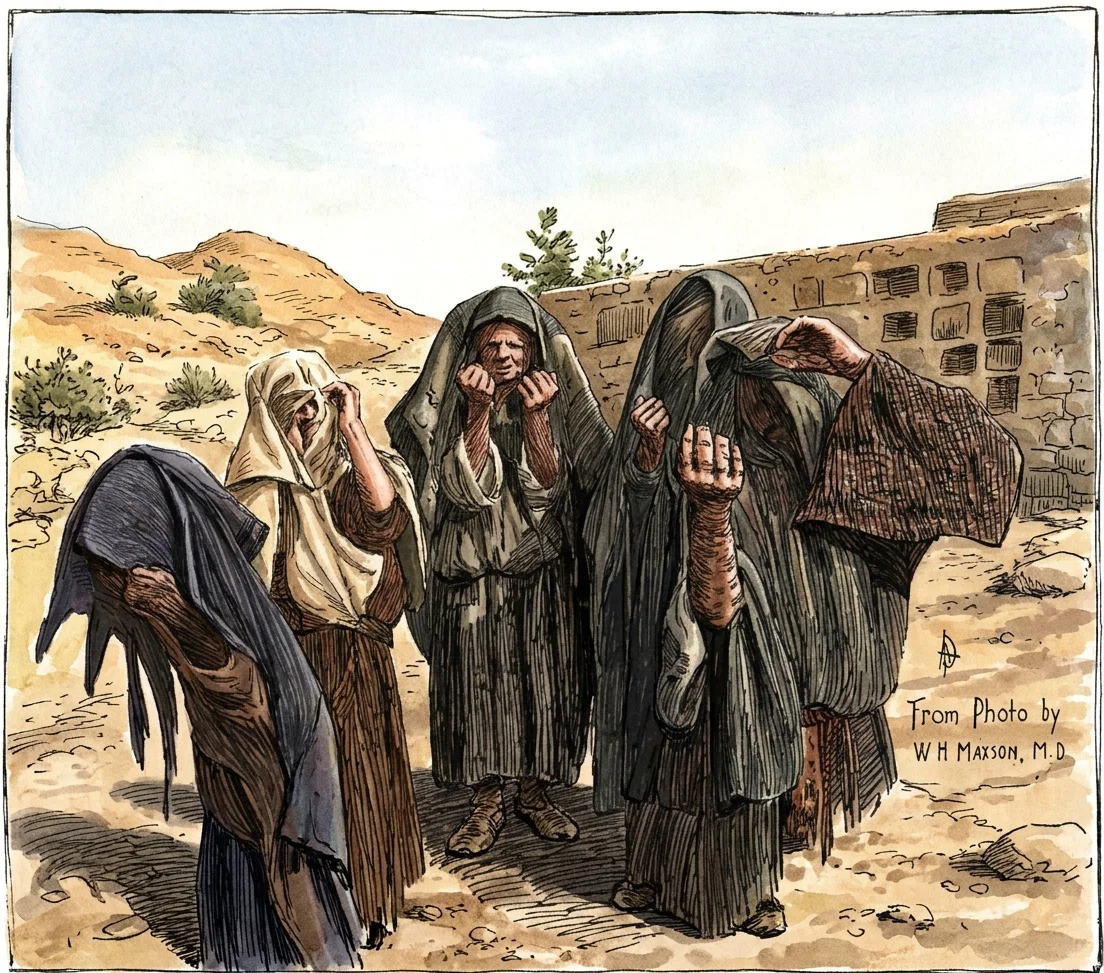
A GROUP OF LEPERS IN PALESTINE.
In Egypt and Palestine, where there is little worry and food comparatively scarce except in its simplest forms, we look in vain for a case of dyspepsia, consumption, or rheumatism; and yet these people, above every other people, seemingly, are cursed with a moral and physical depravity, and their diseases rank accordingly. Partial or complete blindness and leprosy prevail in these countries. No doubt the intense heat and light during the larger portion of the year, and the filthy habits of the people, figure incidentally in perpetuating these diseases.
But to the Bible student, in the light of the Gospel, disease is but the outward or bodily manifestation of sin; and essentially and primarily these two prevailing diseases of the once “Holy Land” are due to the curse resting upon it and its people; for “sin is transgression,” and “when it is finished, it bringeth forth death.” People with red and swollen eyes, purulent conjunctivitis, ulcerations of cornea, eyelids everted, meet the tourist everywhere. Of adult natives about one in ten have some form of visual disease.
It can be truly said that that country and that people have been blessed with the light of heaven. Manifestation after manifestation have been given it, and its glory made visible in a material sense as in no other country; and should it be thought incredible that blindness should follow as one of her prevailing diseases? The experience of Saul of Tarsus before Damascus would more than suggest the thought.
We are naturally very slow to admit that the Spirit-filled life of which Jesus Christ is an exponent, would elevate the body out of all its diseases. To thus believe is to admit that the rejection of divine light would bring physical darkness, disease, and death. May there not be food then in the thought that blindness and leprosy, which are the prevailing diseases of that country, are more than incidentally related to the special curses resting upon that people for rejecting the light of truth?
While diseases of the vision and organs of vision are amenable to treatment to an encouraging degree, leprosy has indeed been a plague for which there has been but little relief. Statistics indicate that leprosy has been slightly on the increase. It is estimated that there are at present more than two million lepers scattered over the world, mainly in the hot countries.
If the leper ever had a home, Palestine, from Mosaic times to the present, has been that home, having a larger per cent per capita than any other country. But the fact is the leper in Palestine never had a home. There are homes for fevers and houses for smallpox, but no house for the leper, and only meager family ties, no social friends, no easy-chairs or downy beds; but, instead, he is a wanderer, an outcast, inhabiting deserted tombs, legislated against in olden times, morally ostracized, with the thought that the curse of God especially rested upon all so afflicted; for, indeed, could they not see the decree written on their outward parts by the finger of God, “dying, thou shalt die;” and then it took but a little Phariseeism to take the next step and teach that they were individually and personally responsible for being thus.
In the days of Israel’s glory there were laws regulating the leper’s sphere, which were far more strenuous than at the present day. They were consigned to the caves and regions of deserted sepulchers, and in a section little frequented. In the vicinity of Jerusalem they were confined to the hill of death on the south, in the midst of which was the burning gehenna, where the refuse of the city was consumed—for, indeed, were not they the refuse of humanity, disconsolate in their anguish, living on months and years, dying many deaths in their living? Were the unfortunate to stray beyond the limits prescribed and appear on the thoroughfares leading out of the city, they were cursed and stoned by Pharisee, Sadducee, and Gentile alike. If a stranger came within their territory, he would turn and flee at the weird, shrill cry, “Unclean, unclean.”
The relations of the leper to the rest of humanity have materially changed since those times. They are now allowed the full range of the country, even to the gates and walls of the city. Whether the galling Roman yoke or the imperial sway of the Turkish power has tended to bridge the chasm between the common folk and the leper, or whether the commonwealth of Israel has deteriorated by natural causes until they see some kindred ties, can not be ascertained; but certain it is that the leper in Palestine at the present time has all the privileges of the poor without the city, and the tourists find them in all the thoroughfares begging for subsistence.
The road leading from St. Steven’s Gate to Gethsemane, over which our Saviour carried the sins of the world on the eventful night of His betrayal, is teeming with lepers, most of them sitting in the road, throwing dust in the air, and mourning in the vain effort to elicit sympathy from the passers-by. Their plea is for mercy and money, only asking a mite, and thankful when they receive it. We should judge that many of them eat their crust of bread and drink their cruse of water and sleep by the roadside, thus eking out a miserable existence without shelter.
By common consent or modesty most of them wear a covering of black cloth if they can afford it. If not, they have simply a pieced-up threadbare mantle, covering the body from head to foot, and only showing the disfigured face or hands in asking for money.
Many of the lepers of Palestine, so far as we were able to judge, marry and raise offspring, some of whom never show the leprosy and are admitted into the usual relations of city life.
There are several forms of leprosy, named according to some characteristic feature or color of the lesion. One form affects the skin and mucous surfaces mainly, another the nerves, while another and the worst form slowly amputates the joints; but it is all leprosy and from the same source. The milder forms are amenable to treatment. In fact, some are self-limiting, and the lepers are again received into society.
In the time of Titus the cry of “unclean” and the display of the leprous hand would put to flight a whole cohort of Roman soldiers. To-day there is such a time-honored aversion that perhaps not one in ten of the many tourists could be hired to touch a leper. Afraid of contagion, the majority draw their robes about them and pass by on the other side. Only a few would confess to a feeling of humanity in the presence of this living death, and yearn to show the great principle of brotherhood in a touch or a kindly word.
It is generally admitted that to live with them in their filth would transmit the disease in course of time.
A most vivid picture of a band of lepers was obtained by a rare circumstance. While returning from a visit to Hebron, as we stopped to water the horses, a band of lepers approached the carriage in quest of money. Their first act was to put out the hand, with a twanging request from faces hidden behind their mantle, but as our company was slow to respond to their appeals, they gradually drew aside their mantles until all the horrors of their person were disclosed. At that opportune moment, with kodak in hand, the button was pressed,10and we have a feeble tracing of the ravages of that disease. (See illustration.)
One woman with swollen cheeks, nose and upper lip destroyed, had also the fingers of one hand missing; another, with hands and feet largely gone; another, with throat and lower jaw missing, breathing through a protruding trachea; while another had lost nose, cheek, and side of the face until the floor of the brain was in plain view. Words can not describe the horrors of such a living death. We tossed them their money and they mantled their woes. We passed on profoundly impressed with sympathy for the sufferers; and yet they suffer comparatively little pain, for in the very nature of the disease, like sin, it destroys the sensibility before it destroys the tissue. If the loving Father wanted to give an object lesson to His children of what a living death is, how well indeed a band of lepers tells the story!
After Paul had been smitten and had miraculously received his sight, he saw the vileness of that living death, and exclaimed with fervor, “Who shall deliver me from the body of this death?” and immediately he saw the remedy and was healed.
Sin is as blighting and disfiguring to the image of God in man as is leprosy to the body. The one is the counterpart of the other, the one leprosy within, the other, leprosy without. Let us hope that thousands will see in the lepers the epistle which God has been writing in their flesh, lo, these thousands of years, and, like Paul, get a keen sense of the soul leprosy and be healed. Then will the leper, as the illustrator, and the sinner, as the one illustrated, not have lived in vain.
W. H. MAXSON, M.D.
LIFE'S OPPORTUNITY.
By Anna R. Henderson
HUMANITY stands all around thee,
And holds its waiting, weary hands,
And God with richest gifts hath crowned thee;
Go forth to heed His high commands.
Go, let His love thy footsteps lead,
No day without its crowning deed.
—Anna R. Henderson.
1 “And Jacob went on his way, and the angels of God met 2 him. And Jacob said when he saw them, This is God’s host; and he called the name of that place Mahanaim. 3 “And Jacob sent messengers before him to Esau his brother 4 unto the land of Seir, the field of Edom. And he commanded them, saying, Thus shall ye say unto my lord Esau: Thus saith thy servant Jacob, I have sojourned with Laban, and stayed until now; and I have oxen, and asses and flocks, and men servants and maid servants; and I have sent to tell my 6 lord, that I may find grace in thy sight. And the messengers returned to Jacob, saying, We came to thy brother Esau, and moreover he cometh to meet thee, and four hundred men with 7 him. Then Jacob was greatly afraid and was distressed; and he divided the people that was with him, and the flocks, and 8 the herds, and the camels, into two companies; and he said, If Esau come to the one company, and smite it, then the company which is left shall escape. 9 And Jacob said, O God of my father Abraham, and God of my father Isaac, O Lord, which saidst unto me, Return unto thy country, and to thy kindred, and I will do thee good; 10 I am not worthy of the least of all the mercies, and of all the truth, which thou hast showed unto thy servant; for with my staff I passed over this Jordan; and now 11 I am become two companies. Deliver me, I pray thee, from the hand of my brother, from the hand of Esau; for I fear him, lest he come and smite me, the mother with the children. 12 And thou saidst, I will surely do thee good, and make thy seed as the sand of the sea, which can not be numbered for multitude. 13 And he lodged there that night; and took of that which 14 he had with him a present for Esau his brother: two hundred she-goats and twenty he-goats, two hundred ewes and twenty 15 rams, thirty milch camels and their colts, forty kine and ten 16 bulls, twenty she-asses and ten foals. And he delivered them into the hand of his servants, every drove by itself; and said unto his servants, Pass over before me, and put a space 17 betwixt drove and drove. And he commanded the foremost, saying, When Esau my brother meeteth thee, and asketh thee, saying, Whose art thou? and whither goest thou? and whose 18 are these before thee? then thou shalt say, They be thy servant Jacob’s; it is a present sent unto my lord Esau; and, 19 behold, he also is behind us. And he commanded also the second, and the third, and all that followed the droves, saying, On this manner shall ye speak unto Esau, when ye find him; 20 and ye shall say, Moreover, behold, thy servant Jacob is behind us. For he said, I will appease him with the present that goeth before me, and afterward I will see his face; peradventure he will accept me. 21 So the present passed over before him; and he himself lodged that night in the company. 22 “And he rose up that night, and took his two wives, and his two handmaids, and his eleven children, and passed over the 23 ford of Jabbok. And he took them, and sent them over the stream, and sent over that he had. And Jacob was left alone; 24 and there wrestled a Man with him until the breaking of the 25 day. And when He saw that He prevailed not against him, He touched the hollow of his thigh; and the hollow of Jacob’s 26 thigh was strained, as He wrestled with Him. And He said, Let Me go, for the day breaketh. And he said, I will not let 27 Thee go, except Thou bless me. And He said unto him, What is 28 thy name? And he said, Jacob. And He said, Thy name shall be called no more Jacob, but Israel; for thou hast striven with 29 God and with men, and hast prevailed. And Jacob asked Him, and said, Tell me, I pray Thee, Thy name. And He said, Wherefore is it that thou dost ask after My name? And He 30 blessed him there. And Jacob called the name of the place Peniel; for, said he, I have seen God face to face, and my life 31 is preserved. And the sun rose upon him as he passed over 32 Penuel, and he halted upon his thigh. Therefore the children of Israel eat not the sinew of the hip which is upon the hollow of the thigh, unto this day; because he touched the hollow of Jacob’s thigh in the sinew of the hip.”
SUGGESTIVE QUESTIONS.
(1) What additional assurance did Jacob now have of God’s protecting care? Gen. 32:1. (2) What did Jacob say? What is the meaning of Mahanaim? V. 2. Note . (3) What message did Jacob now send to Esau? To what place? Why? Vs. 3–5. (4) What reply did he receive? V. 6. (5) What immediate effect did this have upon Jacob? What did he do and say? Vs. 7, 8. (6) To whom did this news drive him? What was his prayer? and in what spirit? Vs. 9–12. (7) What presents did he send before him for Esau? Why? Vs. 13–16. Also v. 20. (8) What questions did he expect Esau to ask? How was the foremost, and every other servant, to answer? Vs. 17–19. (9) What statement were they each to make? Why did he pursue this course, and adopt this special order of arrangement? V. 20. (10) Where did he stop for the night? Could he sleep? What did he finally do with his wives and children, and all that he had? Vs. 21–23. (11) Where was he then? What troublous experience did he now have? V. 24. (12) At daybreak what serious event occurred? V. 25. (13) What did this reveal to Jacob, and what attitude did he now assume? What was his great desire? V. 26. (14) What question did this mighty wrestler ask Jacob? V. 27. (15) What great change was this night effectually wrought in Jacob’s character? V. 28. (16) What did Jacob now desire to know? What was the result of his struggle and desire? V. 29. Note . (17) Did Jacob now know who it was? What effect did this knowledge have upon him? V. 30. (18) As he passed over Penuel, what rose upon him? V. 31. (19) How did the children of Israel keep this significant vision in mind? V. 32.11
Suggestive Readings.—“Patriarchs and Prophets,” pp. 195–203; “Mount of Blessing,” pp. 193, 194; “Great Controversy,” pp. 613–634; “Spirit of Prophecy,” vol. 1, pp. 118–125.
NOTES.
ADDITIONAL STUDY.
(1) What will become of us when Christ prevails? What is our name before Christ takes us? What after? After our “royal birth,” what are we to be with God? See Rev. 20:6; 22:4, last clause. (2) How only can we have power over wicked men for good? When only do we really live? When do we live most? (3) When a man becomes a prince with God, what becomes of the prince of this world? (4) Draw a careful comparison between Jacob in his time of trouble, and the remnant people of God in their time of trouble. (5) Show that the Angel was Christ. See Hosea 12:4, 5. (6) What other persons do you think of whose names the Lord changed? Whose names are yet to be changed? (7) How does God wrestle with us, and we with God? What for? and with what result? (8) What effect should trial and adversity have upon the servant of God always? Does it have this effect upon me?
SOMETHING FOR CHILDREN TO DO.
By B. F. R.
The Helping Hand Mission of San Francisco has just received a letter from a little boy in which its managers are much interested. Its writer sets a noble example for others to follow. That children who may be inclined to be living missionaries may see how they can do a good work for the Lord, we publish the letter. The following is a reduced facsimile copy:—
Who will follow Freddie’s example?
B. F. R.
WALLA WALLA COLLEGE SCHOOL OF CORRESPONDENCE.
MANY of the readers of the SIGNS OF THE TIMES might be greatly benefited by taking a course of study by correspondence. Walla Walla College offers by this method different courses of study in Bible, Language, History, Psychology, etc. All who are so situated that they can not attend school, and yet desire to increase their knowledge and ability to labor efficiently for the Master, should carefully consider this opportunity to receive help. Church officers, Sabbath-school workers, public laborers, and many others, can be benefited by this method of instruction. Write to School of Correspondence, College Place, Washington, asking for circulars giving full information concerning terms of tuition, courses of study, and other necessary particulars which will be of interest to any who contemplate taking instruction by this method.
OUR WORK AND WORKERS.
Sister Lulu Wightman reports four converts at meetings held at Sheridan, N. Y.
At Streator, Ill., six additions to our ranks are reported by Brother W. D. McLay.
Brother J. B. Goodrich reports eleven new members added to the church at Dyer Brook, Me.
The manager of the Denver, Colo., Mission appeals to the brethren of that conference for twenty more beds.
Brother Isaiah Moore, of the Iowa Conference, goes to Yazoo City, Miss., to labor in the interest of the colored people.
From Wisconsin we have the report that seventy persons were baptized at the various camp-meetings in that State this season.
Brother J. H. Kraft reports the baptism of two at Ni Wot, Colo., where it is expected that a new church will be organized in the near future.
The Welcome Visitor, organ of the Ohio Conference, has been moved from Cleveland to Columbus, the State capital. Address, 306 West Mulberry Street.
Brother O. O. Fortner, who for the past year has been secretary of Kansas Conference, has been assigned to Cape Town, South Africa, on call of the Foreign Mission Board. He left Topeka for his new field on the 25th ult.
Three have been added to the church at Springfield, Ill., through meetings held by Brother J. P. Henderson and Wm. Lewsadder. A number of others have been set to studying the truth as presented by these laborers.
The Wisconsin Reporter says that the Lyman Lumber Co., of Minneapolis, and the Rietbrook & Halsey Co., of Milwaukee, have given the Seventh-day Adventists of that State 200 acres of fine land in Wood County for an industrial school.
The quarter-centennial number of the SIGNS OF THE TIMES, to be dated Jan. 5, 1899, will be a double number, with a handsome cover, and well illustrated. The contemplated issue of a million copies will require fifteen car-loads of paper.
The Kansas Worker says: “A report comes in that two or three new workers in Kansas City spent about two hours canvassing for the SIGNS, and they took fourteen orders, eleven of which were for one year. Surely the Lord is going out before us in this work.” The question now is, Will the people follow Him?
A letter from Brother I. D. Van Horn to the Indiana Reporter states that his son, who had suffered from epilepsy, was healed in answer to prayer at the recent Logansport camp-meeting. The fits were becoming more frequent, and during the month of August he had suffered over six hundred falls. But since September 5 he has not had one.
The Kansas Tract Society, at its recent annual session, adopted the following:—
Whereas, God has blessed us much in the past, in our efforts to circulate the SIGNS OF THE TIMES; and,
Whereas, In the providence of God arrangements have been made for further pushing this work by the appointment of a general agent who will devote his entire time to that line of work; therefore,
Resolved, That we renew and redouble our efforts to assist in this line of work, pledging ourselves to co-operate with the general agent in carrying out the plans which he may recommend.
Resolved, That we furnish the Good Health, SIGNS OF THE TIMES, and Life Boat, free to reading-rooms and the State prison, and that we recommend our churches to furnish these papers to the jails.
In this connection we note that the Conference president has selected Brother T. J. Weese as general agent for the SIGNS in that State.
Brother J. M. Willoughby, writing to the Review concerning the work in Utah, says of the mission in Salt Lake City: “The business men of the city are interested in the success of the work, and have materially assisted in supporting it. We desire to enlarge our quarters for the mission the coming winter; any one wishing to help us may send contributions to the writer. The membership of the church in this city is increasing every quarter. Not long ago I had the privilege of baptizing the first convert from the Chinese of this place.” He further states that Brother C. Nelson has been doing an interesting and profitable work with the SIGNS OF THE TIMES, and some are rejoicing in the truth as the result of his labors. “We are convinced that the SIGNS is an excellent medium through which to reach the people in this State. It presents the truth in a way that wins confidence and respect. Our Bible worker has all she can do working with those who have become interested through reading the SIGNS.”
1 “And there shall come forth a shoot out of the stock of Jesse, and a Branch out of his roots shall bear fruit; and the Spirit of the Lord shall rest upon Him, the Spirit of wisdom and understanding, the Spirit of counsel and might, the Spirit of knowledge and of the fear of the Lord; and His delight shall be in the fear of the Lord; and He shall not judge after the sight of His eyes, neither reprove after the hearing of His ears; but with righteousness shall He judge the poor, and reprove with equity for the meek of the earth; and He shall smite the earth with the rod of His mouth, and with the breath of His lips shall He slay the wicked. 5 And righteousness shall be the girdle of His loins, and faithfulness the girdle of His reins. 6 And the wolf shall dwell with the lamb, and the leopard shall lie down with the kid; and the calf and the young lion and the fatling together; and a little child shall lead them. 7 And the cow and the bear shall feed; their young ones shall lie down together; and the lion shall eat straw like the ox. 8 And the sucking child shall play on the hole of the asp, and the weaned child shall put his hand on the basilisk’s den. 9 They shall not hurt nor destroy in all My holy mountain; for the earth shall be full of the knowledge of the Lord, as the waters cover the sea. 10 “And it shall come to pass in that day, that the Root of Jesse, which standeth for an ensign of the peoples, unto Him shall the nations seek; and His resting-place shall be glorious.”
Golden Text.—“The earth shall be full of the knowledge of the Lord, as the waters cover the sea.”Isa. 11: 9.
SUGGESTIVE QUESTIONS.
(1) What did the prophet see coming forth in the future? V. 1. Note 1. (2) What was to rest upon Him? V. 2; chapter 61: 1; Matt. 3: 16; John 1: 32, 33. (3) What should be the result of this baptism? V. 3. (4) What will be the result to us of such a baptism?—We shall have power and wisdom, etc. See John 16: 13, 14; Acts 1: 8; 1 John 4: 17. (5) How shall He judge the poor? How shall He reprove? V. 4, first part. Note 2. (6) What shall He do to the earth, and to the wicked? V. 4, last part; Ps. 2: 6-12; 2 Thess. 2: 7, 8. (7) What is said of His righteousness and faithfulness? V. 5. Note 3. (8) What is said of the peaceable condition of the earth under His rule? What will sustain this universal peace? Vs. 6-9. Note 4. (9) What position will this Root of Jesse occupy “in that day”? Who will come to Him? What is said of His rest? V. 10; Isa. 66: 22, 23. Note 5.
NOTES.
1. “Shoot” and “Branch.”—These symbols stand for the kingdom of Judah, representing the royal line, and Jesus the Messiah. The vine, pruned back every year to a mere stump, in appearance dead, sends forth new branches in the spring, on which the fruit is borne. So, at the time when Judah was greatly humiliated, with nothing but a stump left, then the Messiah springs forth. The producing value of the vine grown in Palestine, as also on the Pacific Coast, depends wholly on its being systematically cut back. “He purgeth [or pruneth] it, that it may bring forth more fruit.” John 15: 2. Jesse is specially mentioned because from him sprang David, to whom the promise was made that “of the fruit of his loins, according to the flesh, He would raise up Christ to sit on His throne.” Acts 2: 30; see also Rev. 22: 16.
2. “With righteousness shall He judge.”—One thing that God has always required of His people is righteous judgment, especially toward the poor. See Ps. 72: 1, 2; Isa. 58: 6, 7, 10; 59: 1-4, 8, 9, 14, 15. The neglect of righteous judgment was a cause of the downfall of both Israel and Judah. See Isa. 22: 29-31. Moreover, this want of righteous judgment, this oppression of the poor, is a characteristic of the last days. See James 5: 1-8.
3. Righteousness a girdle.—The girdle is an essential article in oriental dress, especially in action, as it secures the other garments in place and holds up the outer garment from the feet. To “gird up the loins” signified preparation for active service. See 1 Peter 1: 13. Faithfulness implies no deviation whatever from principle or promise. The “girdle of his reins” was that which held him firm in his self-denial for the truth’s sake.
4. When fulfilled.—Verses 6 to 9 could not possibly be fulfilled in the earth while still under the curse of sin. That such a condition applies to the new earth is shown by Isaiah himself in chapter 65: 17-25. Verse 4 of the lesson confirms this view; for it is after judgment has been executed upon the wicked, and the earth purified from sin and made new. That the reign of righteousness will be in the earth made new is made clear in 2 Peter 3: 9-13 and Revelation 21.
5. In that day.—The day of Christ, from His first advent to all eternity, from the beginning of His reign on the throne of grace onward. The seeking of Christ is here; His rest is found here first in the heart freed from sin, a pledge of His eternal rest in His everlasting kingdom. He is now the ensign lifted up by the true Gospel. Isa. 62: 10. Verse 10 covers the whole lesson, verses 1 to 9.