Your ShelfYour Projects

Signs of the Times, Vol. 22, No. 45.

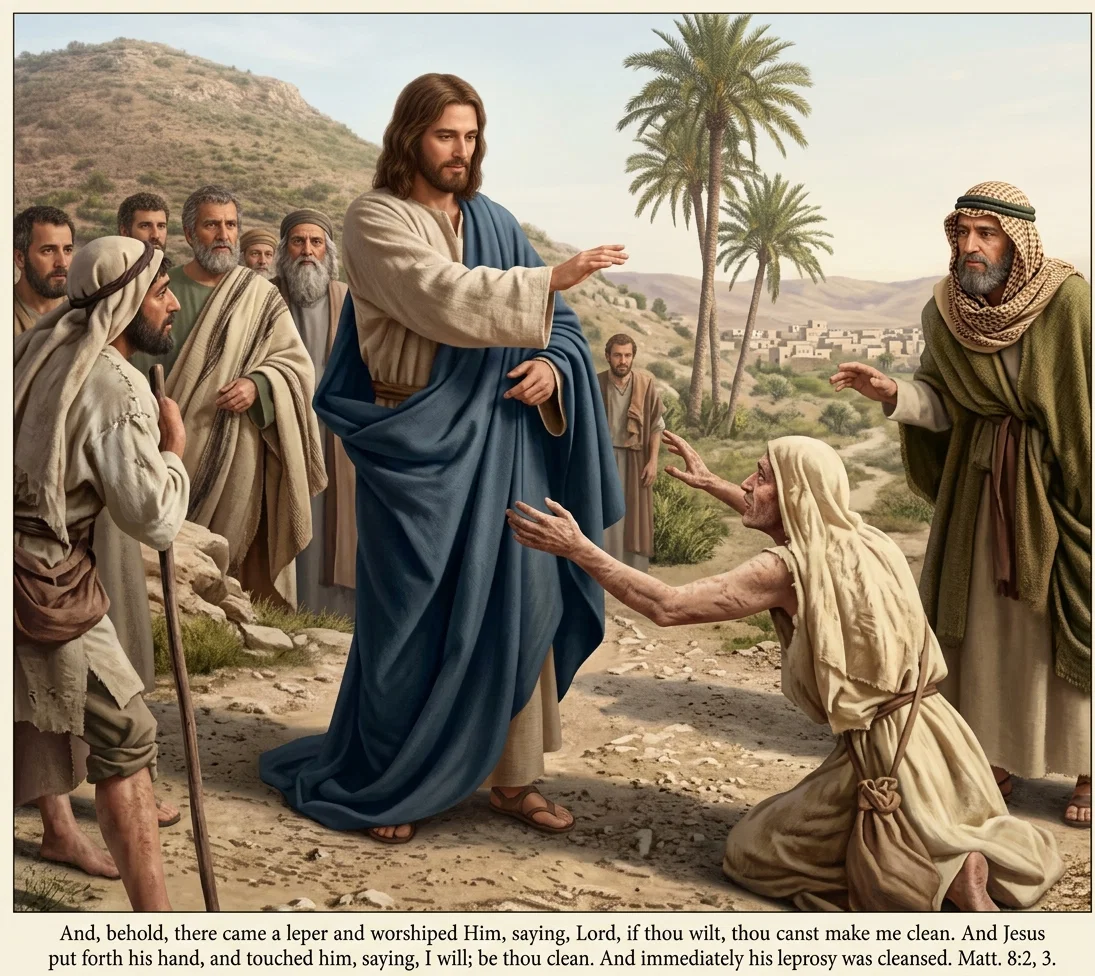
THE HEALING TOUCH
Earlier text: JESUS TEACHING THE PEOPLE

FIGHTING AGAINST GOD

Religious Liberty Library
Is the title of a sixteen-page tract just issued as No. 41 of the In which PICTURE, POETRY, and PROSE unite in teaching Christian principles of freedom of conscience 7 FINE HALF-TONE ILLUSTRATIONS 7 The pages shown below are reduced facsimiles of pages 6 and 7 of this tract

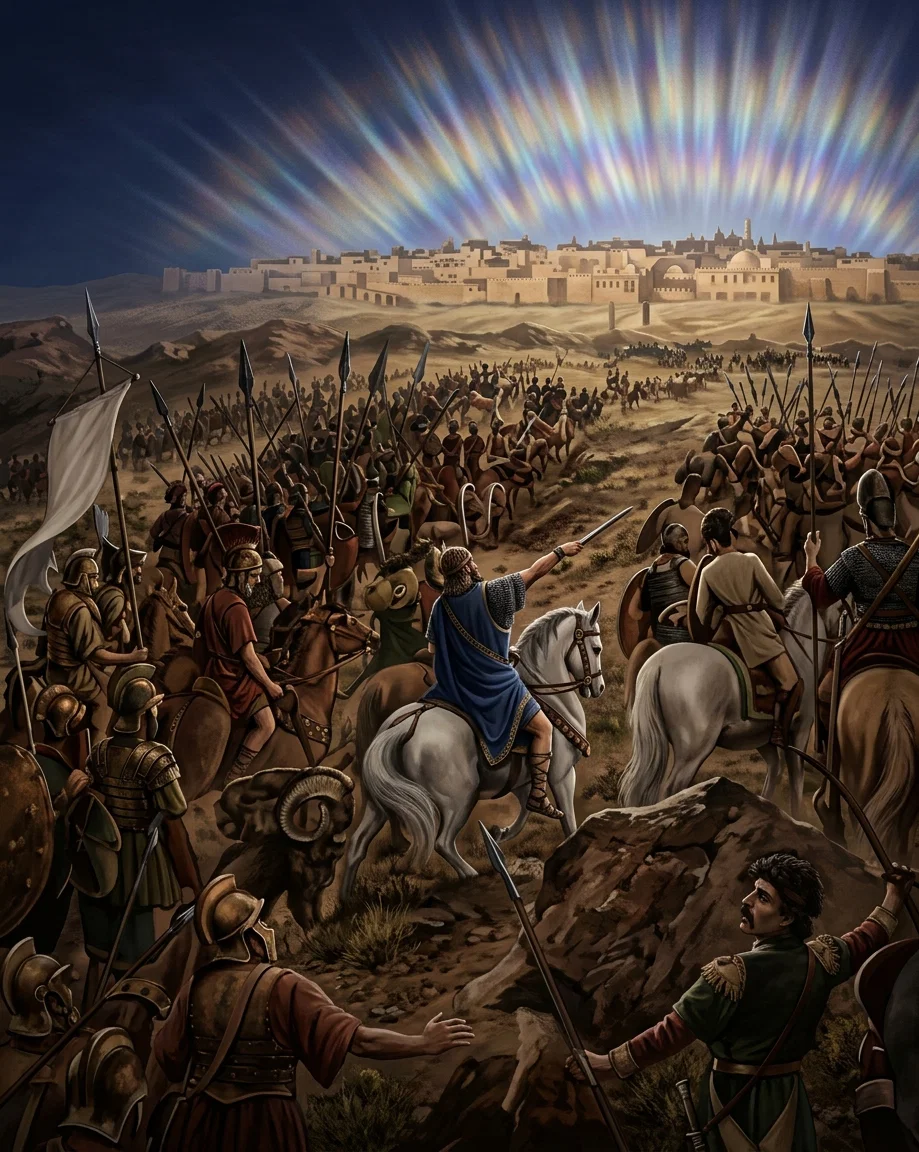
FIGHTING AGAINST GOD.

CAN NATIONS CONTEND WITH GOD?

"At his wrath the earth shall tremble, and the nations shall not be able to abide his indignation."
For a nation to compel a subject to disobey the laws of a foreign nation, when it knows it is powerless to protect him in so doing, is but to murder its citizen in cold blood, and merit international contempt.
Will the government attempt to protect its citizens against the wrath of one offended God? Will it declare war on the King of kings? Can it marshal its hosts and hurl its serried columns against the Eternal City?

"WE OUGHT TO OBEY GOD RATHER THAN MEN."

"When they went from nation to nation, and from one kingdom to another people; he suffered no man to do them wrong: . . . saying, Touch not mine anointed, and do my prophets no harm."
If God had intended that his children should submit to governments in matters of conscience, he would not have protected Daniel in the lions' den, the three Hebrews in the fiery furnace, nor have delivered Peter and John, Paul and Silas, from their prison cells, where they were placed for disobeying human enactments.

GOD AND THE POWERS THAT BE.

"RENDER therefore unto Caesar the things that are Caesar's; and unto God the things that are God's."
God has ordained that governments should exist among men. To these governments he has commanded his people to render tribute, honor, and respect. He has commanded them to be obedient to every ordinance of man, not for fear of punishment, but for the Lord's sake. So long as a government enforces ordinances of men, — such laws only as are necessary for the protection of men in the enjoyment of their equal, natural rights, — they will not come in conflict with the Christian.

The Sheats Law Declared Unconstitutional

The notorious Sheats Law, which was aimed at the American Missionary Society's school at Orange Park, Fla., with the design to destroy it, has been declared unconstitutional. To forbid the teaching of colored children by white teachers was a deliberate attempt to frustrate any practical education of the negroes, and it is encouraging to know that it was a Florida court that rendered the decision. But the only ground in the objections to the law which was adjudicated was the merely technical one that the body of the act contained matter not comprehended in the title. The spirit and intent of the obnoxious law was not passed upon, and may be reënacted in another form; yet this seems hardly probable after the very general censuring the state has received on account of this act of its Legislature.

"HARD TIMES."

It is surprising that this world knows anything else than hard times. The causes are legion. The "farmer-poet" of Scotland well said:— "Man's inhumanity to man Makes countless thousands mourn." The apostle James says to his "beloved brethren" of the last days: "Ye have despised the poor. Do not rich men oppress the poor, and draw you before the judgment seats?" Solomon says: "The poor is hated even of his own neighbor; but many are the lovers of the rich." And again: "The poor useth entreaties; but the rich answereth roughly."
But it is not alone the oppressions of one class by another that causes hard times. Wanton extravagance is perhaps one of the greatest causes; the desire to "keep up appearances." The poor young man with but eight or ten dollars a week wants to dress like a millionaire, "take in" all the amusements, and indulge all "fast" habits. The poor laboring girl, on her few hard-earned dollars, must appear on the street or in church in apparel that vies with the wealthier ladies of fashion. The poor mother, laboring night and day to meet even necessary expenses, strives to dress her girls and boys in the latest styles, lest their associates deem them poor. Thus, instead of becoming helps, they become spendthrifts. The families of wage earners with moderate incomes think they must eat, dress, and adorn their houses after the manner of the more opulent. They deem it very humiliating to be behind in the style. But by and by, with all these classes, sickness comes, accidents happen, employment ceases for a time, or some other of the various vicissitudes to which all are liable arise, and "hard times" is waiting at the door.
Another potent cause of hard times is foolish credulity, a credulity born of a desire to become suddenly rich, to make money without work, or to know what it is to be one's fortune in life. The lottery, the stock exchange, or some other gambling device, holds out the flattering inducement to invest a little and gain much. Vast sums are paid into these ventures, not only by the well-to-do but by the poor, and the practice, in the end, almost invariably begets poverty, negligence, want, discouragement. Not only are large sums invested in these unprofitable schemes, but much more is paid in efforts to gain information as to how fortunes may be made easily. In the city of Paris alone, more than two thousand people gain their living by telling fortunes, and their aggregate incomes are estimated at more than two million dollars. The schemes of wily tricksters to entrap the unwary the credulous seekers after sudden fortune are manifold, because they have learned that a "fool and his money are soon parted."
Nor would we overlook that giant evil, intemperance, which stalks abroad day and night, like Satan himself, seeking whom it may devour. Its victims are afflicted with every malady, led into every vice, divested of ordinary strength, reason, and judgment, robbed of their earnings, and unfitted for remunerative occupation. What could be the result but hard times? When the people of this nation spend twice as much for the two poisons, alcohol and tobacco, as for necessary food and clothing, what could be expected but hard times?
One more suggestion: The people of the earth must live from the products of the earth; yet the masses are forsaking the most honorable of all secular callings, the farm, and flocking to the cities and towns to live by their wits and upon one another. While in these great aggregations of people in one place we find the extreme of business activity on the one hand, we find the extreme of indolence on the other.
Where do we find the lowest depths of want, degradation, and crime?—In the large cities. Where are devised the great political corruptions and financial schemes for public robbery?—In the large cities. The devil can always influence the people to better advantage when they crowd together in vast concourse. Here the intemperate sight-seeing constantly creates artificial wants. The poor as well as the rich feel that they must have this, that, and the other unnecessary thing because they see others have it. Then follows the conjuring of schemes, credit or crime, to obtain what the lusts of the eye or the appetite crave. It is always in the great cities where the police find most work.
It was when the people congregated together en masse, contrary to God's order, in a plain in the land of Shinar, that they concocted the great scheme of building a tower to heaven. From that nucleus in course of time there arose the great city of Babylon, whose extravagant indulgences and vile practices have been by Inspiration used as a symbol of all that is corrupt and abominable unto this day. By thus congregating into towns and cities, which obtains more and more as the years go by, the masses become consumers rather than producers, dependent rather than self-sustaining, burdens upon their fellow men rather than colaborers. This persistent reversal of God's order can not fail to result in hard times. W. N. G.

Sunday Temperance.

The late Prohibition candidate for governor of Illinois made the sweeping promise that, if elected, he "would exercise his constitutional power to close every dramshop within the state on Sunday." On Sunday, forsooth! Naturally we would suppose that a Prohibition governor "would exercise his constitutional power to close every dramshop within the state" on every day. It is a sad fact, however, that the greater part of the temperance effort of our time stops short with Sunday closing of saloons. In other words, popular temperance reform has been prostituted to the position of a lever for securing enforced Sunday observance upon all classes.

California Rejects Woman Suffrage

Woman suffrage has been defeated again in California, altho it was quite generally thought that it would win. It was a plank in the platform of the successful party, yet the party, after indorsing the amendment in state convention, voted it down at the polls. During the campaign, there was much special pleading in behalf of the measure by women speakers of national repute, by ministers, and by the press; and, moreover, there was very little said publicly against it. But a majority of the electors spoke their real sentiments in the privacy of the election booths.

The Gospel Commission

"Go ye into all the world, and preach the Gospel to every creature." Mark 16:15. What is the Gospel?—"God so loved the world, that he gave his only-begotten Son, that whosoever believeth in him should not perish, but have everlasting life." John 3:16.

Sound Men and National Credit

The Union Signal, speaking of a certain disreputable candidate for Congress, makes the very pertinent remark that "sound men are as essential to the preservation of the national credit, at home and abroad, as sound money."

All Things Work Together for Good

With reference to the hopes and the disappointments engendered by the results of the election, it should be remembered that "all things work together for good to them that love God."

A Great Calamity.

The Christian Register suggests that there could not be "a greater calamity to the Christian world than unity, in the meaning almost uniformly implied." This is very truth; while the Lord's most earnest desire for his people is "that they may be one," he means that they may be one in him, not in some man-made scheme.
Of all the efforts at so-called Christian union, we have seen practical unity on but one point, namely enforced Sunday observance. All the nominal Protestant denominations (excepting those which observe the seventh day) and the Catholic Church are practically united on this question. True, the Catholics formally hold back, preferring that the Protestants would come all the way, and accomplish the work in the main by themselves. Of course the Catholics want to see such a work accomplished, but they want to see it done by the Protestants; for the reason that the Sunday sabbath is a Roman institution, and when the Protestants shall have forced the government to compel its observance, they will have yielded up their Protestant principle of liberty of conscience. Such a union with Catholicism on the part of Protestants is to give away their whole Protestant cause.
They have already compelled the government to legally recognize the day, but not yet to generally enforce its observance under penalty. It has for some time been noticeable that interdenominational conclaves for the furtherance of Sunday ordinances allude to the work as evidence of Christian unity. And in most cases they are satisfied with such a degree of union, for the reason that they all can come to that point without yielding any of their factional dogmas. This is a kind of common platform on which all first-day nominal Protestants can stand, and, standing there, they imagine that they have Christian union because they are all together. On this platform, too, they can walk right over to the Roman parlor, be cordially greeted, and imagine that Romanism is becoming liberalized under the influence of Protestantism.
But this very dogma, Sunday observance by civil law, was the door that opened to the way which led down to the Dark Ages. When the way is once opened to the compulsory observance of religious doctrine, the more "unity" we have to that end the greater the "calamity." W. N. G.
And, behold, there came a leper and worshiped Him, saying, Lord, if thou wilt, thou canst make me clean. And Jesus put forth his hand, and touched him, saying, I will; be thou clean. And immediately his leprosy was cleansed. Matt. 8:2, 3.

You have reached the end of this edition.

Signs of the Times · Nov 12, 1896