Signs of the Times, Vol. 35, No. 8.

Not Abandoned of God
Earlier text: Not Abandoned of God

Signs of the Second Coming of Christ

The Reign of Lawlessness

THE question, Is the world growing better? is not infrequently heard. How much we all wish this old, sinful world were growing better. But is it? Some answer, Yes; others, No. Human opinions clash. They are not, therefore, dependable. Hence how thankful we should be that we have access to a source of universal information which is unfailingly trustworthy. Of course I refer to inspired revelation—the Bible. What is the Lord's answer to this mooted question? His answer must certainly be accepted as final.
Our Lord, when announcing the most important signs of His second advent and of the end of the world, declared: "And because iniquity [literally lawlessness] shall be multiplied, the love of many shall wax cold." Matt. 24:12. Lawlessness implies more or less violence. In the days of Noah, the earth was filled with violence. See Gen. 6:11, 13. And did not the Son of God affirm that as it was in the days of Noah, so shall it be in the days of the coming of the Son of Man? Matt. 24:37, 38. Note further the catalog of sins that would especially mark the "last days," as recorded in 2 Tim. 3:1-13. Among the heinous sins there enumerated are lack of self-control, fierceness, and implacableness. A. R. V. Let us inquire then: Are these days in which we are living characterized by lawlessness with its attendant violence?

The Evidence Adduced.

Dec. 26, 1907, despatches were sent out from New York to the press of the nation, stating that notwithstanding the fact that six criminal courts were in operation in New York City, they could not keep pace with the crime wave which was and had been sweeping over the city for a number of years. At the time the despatch was sent out, there were 1,271 cases on the criminal calendar, while several years before there were on the calendar but 541 cases. The warden of the city prison, reporting on the crowded condition of the Tombs (the prison), stated that unless the people stopped committing crimes, it would be necessary to build, without delay, an addition to the city's picturesque prison. The despatch stated further that the commission of crime had become epidemic, and was breaking all records as to number.
In the World's Work of April, 1907, Judge Thomas, of Alabama, reported that during 1906, there had been in the United States 118 homicides for every million of population. This ratio is nearly ten times as large as it was in 1881. He avers that the American people have not been taught respect for law, human or divine. Only three in twenty of those who commit murder are convicted and punished. He declares that the consequences of law-breaking are not sufficiently certain, swift, and terrible to deter and hold in check those who are criminally inclined. The prime cause of the unprecedented reign of crime is declared to be "our national disregard for law, perhaps one might even say our national contempt for law." Other causes are maudlin sentiment, expenditure of vast sums of money, pressure of the political machine, the pleading of relatives, and the agitation of the press. The judge declares that we shall soon sink to the level of Mexico, where 145 are slain every year for each million.

Robbery.

Not long ago the San Francisco Chronicle printed a list of thirty-five burglaries, nineteen highway robberies, and fifty-seven thefts by pickpockets, which had occurred in San Francisco during the preceding thirty days. "The plunder of some thirty passengers disembarking from the steamer 'Mongolia' was truly spectacular. The wharf must have been thronged with professional thieves. The known value of the property secured during that period was over $82,000." The Chronicle affirms that this does not begin to tell the story, as the number of arrests for important crimes is insignificant. Gambling dens are more numerous than ever before. The existence of gambling dens, says the writer, can mean only one thing, and that is corruption in the police force. "The orgy of burglary and highway robbery can mean only the inability of the police to round up the professional criminals who are evidently among us in grand force. . . . San Francisco is a den of thieves."

Murder.

Speaking of the phenomenal increase of the population of Chicago during the past decade, Dr. Josiah Strong says: "Its increase of crime has been even more astonishing than its growth of population. We read of a dozen highway robberies on its streets in a single night, and of 128 homicides in a single year. During 1906 there were 253 homicides and 707 suicides in New York City—nearly 1,000 murderous deaths in a single year! No moral failure is more significant in a democracy than a spirit of lawlessness, which, there is reason to fear, is on the increase in the United States. . . . It would seem to be sufficiently clear that the moral development of the American city has not kept pace with the material; and, generally speaking, the larger the city the greater the disproportion. An inadequate intellectual growth is serious enough, but moral failure is much more so. It was the latter, so history shows, which proved fatal to the great civilizations of the past. Greece had no lack of intellect; hers was a moral failure. The same is true also of Rome."

Graft.

Statistics everywhere show a widening torrent of bloody crime. But the startlingly characteristic crimes of these latter days are apparently not bloody or violent. They are crimes perpetrated against the great body of the people by the organized masters of industry, trade, and politics. In the piquant phrase of Prof. E. A. Ross, "the darling sins that are blackening the face of our time are incident to the ruthless pursuit of private ends. . . . The victims are used or sacrificed not at all from personal ill-will, but because they can serve as pawns in somebody's little game. . . . We see on all hands monstrous treacheries, —adulterators, peculators, boodlers, grafters, violating the trust others have placed in them."
Many of the leaders of our social and industrial life to-day are picking pockets with a railway rebate, murdering with an adulterant instead of a bludgeon, committing burglary with a "rake-off" instead of a jimmy, defrauding with a company prospectus instead of a deck of cards, and cheating the honest tax-payer by "swearing off" their property to dodge paying an honest tax.
Again I quote Professor Ross: "To-day the villain most in need of curbing is the respectable, exemplary, trusted personage who . . . is able from his office chair to pick a thousand pockets, poison a thousand sick, pollute a thousand minds, or imperil a thousand lives. It is the great-scale, high-voltage sinner that needs the shackle. To strike harder at the petty pickpocket than at the prominent and unabashed person who in a large, impressive way sells out his constituents, his followers, his depositors, his stockholders, his policy-holders, his subscribers, or his customers, is to 'strain at a gnat and swallow a camel.'"

Suicide.

In 1881 twelve in every one million of population in the United States committed suicide; in 1907 the ratio of suicides had leaped to 126 in each million of population, or a total of 10,782. The total in 1881 was 603. If the present rate of increase be maintained, we shall lose by suicide in the next five years nearly as many lives as were lost by the Union army in battle during the four years of the Civil War. In the United States and Europe, there is a suicide every six minutes; in the world as a whole there is one every three minutes. Suicide has cost Germany 158,000 lives since 1893; the United States, 120,000 since 1890. In Saxony, there occur 324 suicides each year per million people; in Japan, 209 yearly for each million of population. Between 1883 and 1903, not fewer than 1,125 school children (under fifteen years of age) in Germany committed self-destruction. During the past twenty years the ratio of self-murder has increased throughout the civilized world more than tenfold.
How long can human society bear up under this stupendous weight of moral turpitude, of lawlessness, of crime? Every sign in the current history of our sin-devastated world, every latter-day prophecy of Holy Writ, points unmistakably to an imminent world-revolution—a revolution that can be effected by nothing less than the advent in glory of the Lord Jesus, who will then "destroy the works of the devil" and create "new heavens and a new earth wherein dwelleth righteousness." Shall we not all pray and work that His kingdom may come and His will be done on earth as it is done in heaven? In that endless kingdom there will be no lawlessness, but a free, glad, universal conformity to the law of love, and light, and life. And “the glory of the knowledge of Jehovah shall cover the earth as the waters cover the sea.”

With Our Inquirers

“If ye will inquire, inquire ye.”
[All questions to this department will be answered which to the editors will seem to minister to the good of the readers and to the mission of the paper. The same question can not be answered repeatedly in the same volume. The name and address must accompany question, not for publication, but as an evidence of good faith, and that answer may be made by letter if deemed advisable. It is well always to enclose a stamp for reply.]

2611.—The Experience of Romans 7.

Please explain what is meant in Romans 7, the last part of the chapter. Is this a Christian experience that Paul is describing, or is it an experience of one who is just awakened by the law of God to see himself a very great sinner?
It is the latter. God does not design that His children shall live in the experience described in Romans 7, yet there are thousands living there today, constantly discouraged, constantly cast down. The apostle is telling in detail, what he had already told before in general, of the experience through which the sinner passed, the experience doubtless, through which he himself passed. The law was not sin, the law pointed out sin in him. The law was holy, but he found himself exceedingly sinful; “carnal, sold under sin.” His conscience had been aroused as the Spirit of God had applied the law. He hated that which he did, but he found in himself no power to do the right. Over and over he would try, just as millions of others have, but over and over he would fail. He found himself as it were chained to a body of death, doomed to drag it with him until he himself would be corrupted by its presence, and die. And this wrings from him the agonized plea, “Wretched man that I am! who shall deliver me out of the body of this death?” Yet God gave the law to show how sinful is the case; how deplorable is man’s condition, and therefore to lead man away from himself to Christ. “The law was our schoolmaster to bring us unto Christ, that we might be justified by faith;” and therefore when Paul comes to that place where he feels himself to be utterly lost, he gets a sight of the Deliverer, Jesus, and so he says: “I thank God through Jesus Christ our Lord.” That is the experience of the Christian, continued in chapter 8.

2612.—A Lying Spirit. 1 Kings 22: 18-23.

Please explain 1 Kings 22: 18-23, also repeated in 2 Chronicles.
A part of the narrative is a parable, and that parable teaches us as to God’s dealings with men. When men refuse to hear His prophet and His instruction, the Lord permits the soul who rejects Him to have its own way. In this case the king of Israel refused to hear the prophet of God. He preferred to follow the prophets of Baal, and therefore, Micaiah represents it by this striking parable of his, of the various angels or spirits who came before God. In other words, when Ahab chose falsehood, God suffered him to fall under the falsehood. We are not necessarily to understand that what Micaiah saw was an occurrence which actually took place, but it illustrates very strikingly how it is that when men refuse to hear God’s truth and abide by His instruction, He gives them up to lying spirits who are permitted of God to deceive only those who desire deception instead of truth.

2613.—Story of the Flood.

If the story of the Flood be true, where could the wild animals of America have come from, especially the buffalo?
There are scientists who tell us that the ark was large enough for the various families of earth’s creatures. The buffalo belongs to the ox kind. The difference between these various branches has been the result of years of environment and inbreeding. After the Flood, the animals, of course, multiplied very rapidly and were doubtless crowded off the Eastern continent over the Bering Strait into America. There are those who believe that what is now the Aleutian Islands, a chain of volcanic rocks, was at that time continuous, really an isthmus connecting two large bodies; or that during the cold season the whole region was frozen over, when animals could have crossed on the ice.

2614.—The Two Daniels.

Were the prophet Daniel and Daniel of Neh. 10: 6 identical? Did he return to Jerusalem?
They were not. Daniel the prophet died in the days of King Cyrus. The Daniel of Neh. 10: 6 lived eighty or more years later. The name was not uncommon. One of David’s sons was named Daniel.

Resurrection of Believers.

JESUS did not lay aside our nature which He had assumed when His work of humiliation was completed; He did not leave the mortal part of it to rot in the tomb, or to be miraculously annihilated, and in a body of spirit ascend to God. No! He took our nature, soul and body, with Him, and wears the same human envelope of the Divinity on the throne of the universe that He did while suffering on the earth. Yes, the Son of God, in all His power and glory, is yet our Kinsman; bone of our bone, and flesh of our flesh. In the language of an eloquent writer: “The Son of God still wears His human nature; He remembers His own conflicts, His own temptations, His own sorrows. He can be touched with the feelings of our infirmities. Beneath His crown of glory are the scars of the thorns. The hand that grasps His scepter bears the print of the nail. The feet at which all heaven is prostrate show the past torture on the cross. Nay, in His blessed heart, the spear has left its deep trace of insult.” But Jesus, in His resurrection, was a pattern after which His people will be raised. As He rose in His proper body, glorified, so will they rise in their proper bodies, glorified; as He ascended to heaven in the same body in which He rose, so likewise will they ascend to heaven in their bodies which will rise.
Here are the teachings of the Scriptures as to the subject of the resurrection bodies of the saints. This is all we know, or can know, or need to know, concerning it. There are collateral arguments which we might bring from other sources, which might gratify our curiosity, but they would add nothing to our faith. The Bible stands alone, the infallible, authoritative, and all-sufficient word of God. And writing for Christians, for the instruction of their faith and the consolation of their hearts, on the subject of one of the most sublime facts of Revelation,—a fact to be realized solely by supernatural interposition,—we can not stop to answer the objections which a presumptuous philosophy might bring against it. The Bible alone reveals this truth. In all that it says concerning it, we are at liberty to inquire; but where that stops, we should stop, and not presume to elevate into coordinate rank with the volume from heaven the imaginings of our own minds, or the decisions of our own reason.—The Panoplist.

Act Before It Is Too Late

While we are considering where we are to begin it is often too late to act.—Quintilian.
Our Bible Band
Our Bible Band

Schedule for Week Ending Oct. 3, 1908.

Sunday Sept. 27 Jer. 40, 41 Acts 2
Monday “ 28 “ 42, 43 “ 3
Tuesday “ 29 “ 44, 45 “ 4
Wednesday “ 30 “ 46, 47 “ 5
Thursday Oct. 1 “ 48, 49 “ 6
Friday “ 2 “ 50 “ 7
Sabbath “ 3 “ 51, 52 “ 8

Suggestive Notes.

Our lessons for the week close the thrilling book of Jeremiah. The chapters 40 to 45 have to do with the Jews who were left in Babylon after Zedekiah’s captivity, and their flight into Egypt. It is interesting indeed to note the strong, faithful work of the prophet in connection with all this, and the insincerity of the Jews themselves. The vast mass of them had come to that place where they seemed to be unable to discern between right and wrong. Their promises were nothing, but the discernment of the Spirit of God laid bare the very secrets of their hearts; and when they came to Jeremiah for advice he knew that they desired only such advice as was in harmony with their own wishes and purposes. Instead of taking his advice and remaining in the land, under the king of Babylon who would have given them every necessary protection, so long as they heeded the voice of Jeremiah, whom the king had learned to highly esteem, they chose rather to go down into Egypt. In that country many went hilariously into idolatry. Yet again, Jeremiah predicts the futility of their plans by prophesying the defeat of Egypt and pointing out the very place where Nebuchadnezzar would set his standard in the capital of Egypt.
Chapters 46 to 51 inclusive are prophecies against Egypt, Philistia, Moab, Ammon, Damascus, but above all others, against Babylon, the kingdom which had perverted all the other kingdoms of the earth, not simply regarding Babylon in her ancient empire, but using that Babylon as a type of mystical Babylon.
Our New Testament lessons cover Acts 2 to 8. Let it be noted that we have given but two chapters for October 2, Jeremiah 50 and Acts 7, as both are long. Read carefully and thoughtfully all this wonderful week’s reading. Note the power of God with the apostolic church; what is the reason of it? Think of the conditions that brought it about; consecration on the part of the disciples, simple trust in the power of God’s word. Note also the boldness which this simple trust gave to the disciples; how the words of Peter ring out despite all the threatened persecution: “Whether it is right in the sight of God to harken unto you rather than to God, judge ye;” “for we can not but speak the things which we saw and heard.” And again, “We ought to obey God rather than man.” Such preaching of the word brought persecution; it also brought saved souls into the church of God. Note this emphatic truth, taught plainer than by words, that souls are saved to serve.

Facilities for Distribution of Literature in China
By H. W. Miller, M.D.
To install large printing-plants at different centers in China ten years ago would have seemed inconsistent, notwithstanding the immense population, owing to the lack of facilities for distributing the literature. There must first be the demand before the supply is necessary. Several events have, during the last decade, created a demand for more knowledge among the natives of China. This renaissance for Western learning began after the war between China and Japan, but it can not be said to have made much headway until after the Boxer uprising in 1899 and 1900. This resulted in several ingressions by the foreign powers, showing to the natives the weakness of the Chinese Empire and the superiority of Western methods, even in the interior provinces. In settlement of the claims of the different foreign powers for the destruction of life and property, many demands were made in the treaties which provided for the opening of many commercial enterprises, among which were the construction of railways, the opening of interior ports for foreign residents and foreign trade, the right to navigate the large rivers of China and carry on trade, a new system of tariffs on imports and exports such as would promote the commercial relations between the several countries, and the assurance of protection to the foreign residents in interior points all over the empire. China's good faith in keeping these articles of agreement has been made sure by the presence of gunboats of the different powers at nearly all the treaty ports.
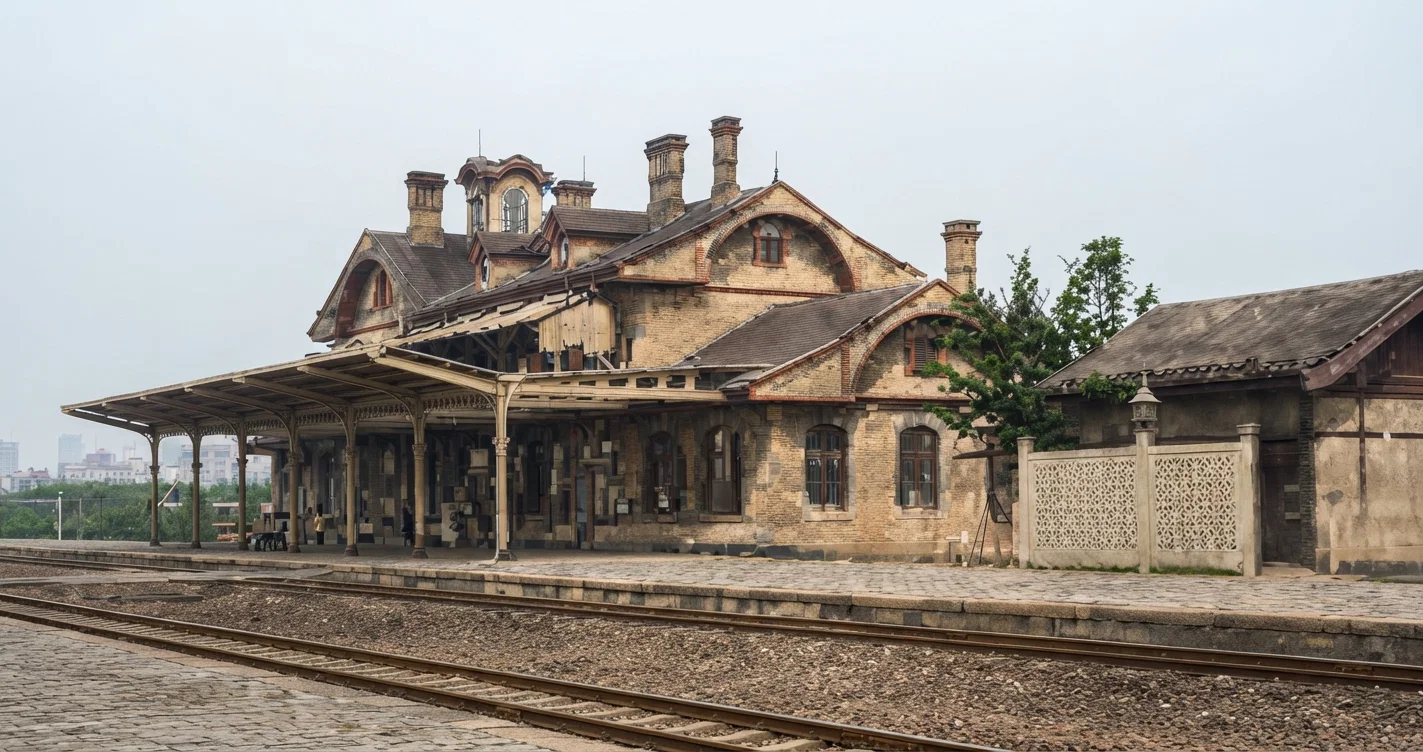
Railway Station, Shanghai, China.
Directly following the ratification of these treaties, men of wealth began the construction of railways in order to get at China's mineral wealth, and also to reap the fruit of the rich soil of the "Flowery Kingdom." At once there was a railway projected from Peking to Canton. The capital for the construction of the first half—from Peking to Hankow—was furnished by the king of Belgium; and that for the second half—Hankow to Canton—was advanced by an American syndicate headed by J. Pierpont Morgan.
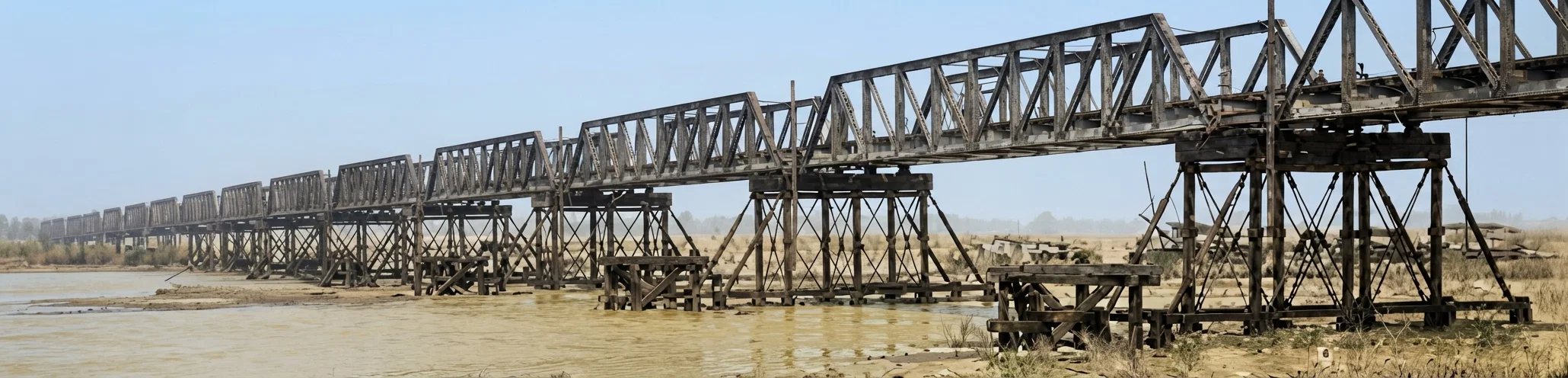
The line from Peking to Hankow was completed by the construction of the bridge across the Yellow River, which was reported to be the longest bridge in the world, being nearly two and a half miles in length. This structure was finished in 1905. To-day trains cover this distance in thirty-six hours. Lines are now projected throughout all parts of the empire. Many of them are completed, and building on the others is being carried on with remarkable rapidity. One of the latest lines completed is that from Shanghai to Nanking, a distance of two hundred miles. The ties are of iron, and the first passenger train made the trip on March 27 of this year. There are few coaches that will surpass the first- and second-class coaches running on this line. The rates of passage are half a cent a mile for third class, and two cents a mile for first class.
These facilities for transportation, thus promoting commerce, resulted in a demand for a post-office department. Previously mail and official messages were carried by private couriers in the interior points, and by the customs department on the navigable waterways. China was laid off in districts and an inspector set over each district to provide for native couriers in the territory under his jurisdiction; and this organization of the post-office department has gone on with remarkable rapidity, until to-day it is possible to send mail to all parts of the Chinese Empire at a rate about one-half the postal rates in the United States. At first the post-office department was encumbered by difficulty in covering long distances by native couriers, but now these distances have been greatly shortened by steam conveyances. It is practically in the short period of four years that the post-office department has inaugurated its complete system and perfected it to the state in which we find it to-day. In the larger cities will be found well-constructed post-office buildings and postal couriers who deliver mail at the residences and take up the mail from four to five times a day. The inauguration of the telegraph system has made it possible to start daily newspapers in the larger cities of the interior, and thus has created a demand for literature. To illustrate how extensive this system has already become, just last week in a storm the telegraph wires were destroyed between Shanghai and Hankow; messages were therefore sent from Hankow to Che Foo and transmitted from that city to Shanghai, with an option of several other lines over which messages could have been transmitted.
Railroad Bridge Spanning Yellow River, China. There are 103 piers, each span being about ninety feet, one hundred tons test.
The old system of education was based upon the Chinese classics. A recent edict requiring only the writings of the sages to constitute a complete education, resulted in a marked demand for a new literature. This was effected by China's most progressive statesman, Yuan Shi K'ai. The system of education has been completely reorganized, and modern school buildings have been erected in the large cities of each province, which have been supplied with the best teachers accessible. This, with the reorganization of the army and the complete reorganization of the whole system of government, has all tended to create a stir throughout the realm of his majesty, the Emperor Kuang Hsi. It is within the scope of this article to point out only in a general way, in but few lines, the marked development that has taken place within the last five years; but it has created a spirit of investigation among all, similar to what was foretold by Daniel, that many should run to and fro and knowledge should be increased. The running to and fro is for knowledge. Knowledge to-day is largely transmitted through literature; and there is a crying demand in all parts of the empire for knowledge as to what these things mean.
There is an interpretation, we believe, to the meaning of this stir in the old empire of China; and it is the privilege of those who have the interpretation to step in now and give the message that is in such demand. There is no time of such great opportunity to interpret the meaning of the present striking changes in the departures from the past; and to make known their bearing as the ushering in of more important events, than just now. The question is, What use shall we make of the facilities which commercial men are placing at our disposal, at great expense to themselves, as aids in carrying the Gospel of salvation to the millions in heathen darkness here? What shall we do with reference to these present opportunities? Shall we not supply the demand?

Turkey Warns

This week we change the pages of the regular weekly issues of the SIGNS OF THE TIMES back to their original size. We do this out of deference to the very many urgent requests that have come from all parts of the field. It is urged by our patrons that the small shape, with only sixteen pages of matter, makes the SIGNS OF THE TIMES look too much like a child's paper.

Turkey Warns.

The central committee of the Young Turk party, the influence of which induced the Sultan to proclaim a constitution, warns foreigners that if any foreign interference in the internal affairs of Turkey occurs, danger might arise for which Europe would be responsible. The condition of Turkish affairs is anything but promising.

Methods of Adorning.

Many people give the greatest part of their thought to the outward adorning of the body. They spend their efforts and their money in decorating their persons with clothing so that they may appear the most attractive and beautiful. How frequently we meet persons who are very attractive from the standpoint of their outward adornment. It is perfectly evident that they have spent a great deal of thought and energy in bedecking themselves with rich raiment. But engage many of these selfsame persons in conversation, and it is even more striking that the inward adornment of mind and heart has been sacrificed for the one purpose of making the body appear beautiful to the outward observer. Upon this subject of adorning, the Bible gives this instruction: "Whose adorning let it not be that outward adorning of plaiting the hair, and of wearing of gold, or of putting on of apparel; but let it be the hidden man of the heart, in that which is not corruptible, even the ornament of a meek and quiet spirit, which is in the sight of God of great price." 1 Peter 3: 3, 4.
The individual who has this inward adorning of mind and heart will not neglect the outward appearance, but thought and energy are devoted to the developing of the intellect by dwelling upon themes which bring us in touch with the infinite greatness and infinite intelligence of the Creator Himself. What a sad disappointment it is to meet a person whose whole attention is given to the outward adorning, and who is absolutely destitute of mental and spiritual culture.

His Word Was With Power.

Speaking of the Saviour's teaching, it is said: "They were astonished at His doctrine; for His word was with power." Luke 4: 32. The authority of Christ's teaching was the Scriptures themselves. This is clearly shown in His conflict with Satan, as recorded in the fourth chapter of Matthew. This word was made effective in power because of its power in His life.

Words of Life.

In one of His discourses, the Master said: "The words that I speak unto you, they are spirit, and they are life." And in a conversation with Peter immediately following this discourse, Peter said: "Thou hast the words of eternal life." John 6: 63, 68. So then there is real life in the words of Christ.

The Word of His Power.

Speaking of Christ in the letter to the Hebrews, it is said that He was "the brightness of His [the Father's] glory, and the express image of His person, and upholding all things by the word of His power." Heb. 1: 3. All the worlds and everything that is in all of these worlds, are upheld by the mighty power of the mighty word of God. Because there is life in God's word, there is also power in it. And this power is absolutely infinite. There is nothing too great for it to accomplish. God who can uphold the worlds by the power of His word can cleanse the soul from sin by the power of the same word, and can give him everlasting life also by this same power.

The Word Which Liveth.

Speaking of the spiritual birth, or the conversion, of the individual who accepts Christ, it is said that he is "born again, not of corruptible seed, but of incorruptible, by the word of God, which liveth and abideth forever." And then we have the further statement that "the word of the Lord endureth forever." 1 Peter 1: 23, 25. Thus we have the double statement that the word is not only alive, but furthermore, that it liveth forever. God's word is eternal. What God's word accomplished for and through Abraham, and Moses, and the rest of the prophets, God's word accomplishes to-day through those who surrender themselves completely to Him; because what God has spoken, He has spoken forever. It stands; it endures. His word liveth, and it liveth forever.

The Word Magnified Above His Name.

The high esteem in which God holds His word is strikingly and beautifully expressed in these words: "I will worship toward Thy holy temple, and praise Thy name for Thy loving-kindness and for Thy truth; for Thou hast magnified Thy word above all Thy name." Ps. 138: 2. God shows in His commandments that He would have us hold His name reverently and sacredly, but here He says that He regards His word even above His sacred name. We are led to place confidence in men when we know that they regard their word. We can well afford to place our confidence in our heavenly Father because He regards His word even more sacredly than His name.

The Word Giveth Life.

If we are in darkness or in doubt or despair, we may come to the word confidently, knowing that it will bring us light and hope. "The entrance of Thy words giveth light; it giveth understanding unto the simple." Ps. 119: 130.

The Power of the Word in the Heart.

If we would be victors in the combat against sin, there is a divinely philosophical plan by which this must be accomplished. "Thy word have I hid in mine heart, that I might not sin against Thee." Ps. 119: 11. It is the hiding of the word in the heart that thus clothes us with power to rise above sin.

The Word Speaks To Us.

If the words of the blessed Bible are hidden in the heart as they should be, then may we rejoice in the blessed experiences expressed in these words: "And thine ears shall hear a word behind thee, saying, This is the way, walk ye in it, when ye turn to the right hand, and when ye turn to the left." Isa. 30: 21. It is through the words of His Book that God would guide us. Many people are guided by their impressions, but the true follower of Christ is guided by the exact and definite instruction of His actual words of truth that are hidden in the mind and heart.

Result of Despising the Word.

God has provided us with a citadel of power in His word. He has provided that we may have life through that word. He has given us eternal salvation in the message that His own words bring. Then is it not perfectly reasonable that He should also tell us: "Whoso despiseth the word shall be destroyed: but he that feareth the commandment shall be rewarded"? Prov. 13: 13.

Signs of the Times in Magazine Form

The regular monthly issues of the SIGNS OF THE TIMES will be continued in the magazine form as already arranged. The form of the monthly is meeting with universal approval, and we are greatly encouraged by the immense circulation that it is receiving.

Storming a Cathedral

Storming a Cathedral.—Despatches say that on September 6, two thousand Socialists and unemployed, after listening to a number of violent speeches in an open air meeting in Glasgow, attempted to invade a cathedral during the Sunday service. A large body of police succeeded in dispersing the rioters. The threat is being made to meet 50,000 strong on a later date to attack the municipal buildings. We have reason to believe that the majority of the Socialists condemn all such violent measures. We have further reason to believe that a great many things are hastily attributed to the Socialists that they are not responsible for, except in so far as the strong speeches that many of them make have the tendency of stirring up turbulent feelings through inciting class hatred.

You have reached the end of this edition.

Signs of the Times · Sep 23, 1908