IN his Pentecostal sermon, Peter says respecting Christ: “Being by the right hand of God exalted, and having received of the Father the promise of the Holy Ghost, He hath shed forth this, which ye now see and hear.” These memorable words were spoken by the inspired apostle upon that day of all days in the history of the primitive Christian church, when the disciples, assembled together with one accord, were baptized with the Holy Spirit and thus endued and endowed with Pentecostal power.
This baptism of the believers by the divine Spirit with the power of God, was, as Peter testifies, the fulfilment of the Master’s promise: “But ye shall receive power, after that the Holy Ghost is come upon you; and ye shall be witnesses unto Me both in Jerusalem, and in all Judea, and in Samaria, and unto the uttermost part of the earth.” Acts 1: 8. See also John 14: 16, 17, 26; 15: 26; 16: 7, 8.
In Acts 1: 2, we read of Christ that He was “taken up, after that He thru the Holy Ghost had given commandments unto the apostles whom He had chosen.” Here all the hallowed intercourse between the risen Redeemer and His disciples, during the forty days between His resurrection and ascension, all the eternally significant communications that He made to them in respect to the things pertaining to the kingdom of God, are declared to have come to Him and to have been given by Him thru the Holy Spirit. This fact prepares us to appreciate the necessity of the commandment immediately following—that the disciples “should not depart from Jerusalem, but wait for the promise of the Father, which, saith He, ye have heard of Me. . . . Ye shall be baptized with the Holy Ghost not many days hence.”
Even He (in His humiliation) was indebted to the Spirit of God for the power essential to the success of His ministry. Then surely we can not presume to attempt the tremendous task of finishing His work, which He has committed to us, until we shall be anointed with the same divine power.
This commandment, expressing our need of the power of the Holy Spirit, is immediately followed by the emphatic assurance, “Ye shall receive power, after that the Holy Ghost is come upon you.” He added that they should be witnesses unto Him in Jerusalem and unto the uttermost parts of the earth, but not until after they should be anointed with the Spirit and power of God. Here the “promise of the Father” becomes also the promise of the Son. The same Holy Spirit who abode in Jesus, and thru whom He gave the disciples both instruction and commandments, would descend upon them, abide in them, and be to them the all-power and all-wisdom of God, and so qualify them for working and witnessing. So important was this spiritual anointing, this new baptism, that for it they were to wait, to “tarry,” before beginning publicly their appointed work.
This reception, by all disciples, of divine power and illumination thru the medium of the divine Spirit, is, in verse 38 of chapter 2, designated as the gift of the Holy Ghost. Now, it is of vital importance that we should grasp the fact that the gift of the Holy Spirit is the supreme and all-inclusive gift of God to His believing children—all-inclusive because it implies and includes all those marvelous spiritual gifts bestowed by our ascending Lord upon the individual members of His body, the church. The gift of the Holy Spirit is essentially a composite gift, for it carries with it all the specific spiritual gifts brought to view in the inspired word.
These diversified gifts are apportioned among the anointed believers by the divine Spirit according to His own infallible will. The twelfth chapter of 1 Corinthians contains an inspired enumeration of these gifts of the Spirit. In the very first words of this record, the Holy Spirit declares it to be the mind of God that His people should be enlightened in regard to the nature and purpose of such gifts. The all-comprehensive gift of the Holy Spirit was bestowed by our Lord upon His church practically at the time of His ascension to the right hand of the Father. We are told in Eph. 4: 8 that when Christ “ascended up on high, He led captivity captive, and gave gifts unto men.” Compare with John 16: 7.
The opening chapters of the book of Acts teach and illustrate this double truth, as expressed in the words of another: “The Spirit of God . . . is to be to the disciple and to the church all that Christ would have been had He tarried among us and been the personal companion and counselor of each and all. And by the Spirit of God working in and thru the believer and the church, believers are, in their measure, to be to the world what the Spirit is to them.”
The Gifts Enumerated.
In verses four to six of 1 Corinthians 12, we are taught that, tho there are diversities of gifts, of administrations, and of operations, these are all imparted by one and the same God to one and the same Lord (Christ), and thru one and the same Holy Spirit.5The impartation of these gifts constitutes the truest and highest manifestation of the Holy Spirit to the church of Christ. And this sacredly unique manifestation is “given to every man [believer] to profit withal.” Verse 7.
The gifts here specified are those of divine wisdom, of knowledge, of faith, of healing, of the working of miracles, of prophecy, of discerning of spirits, of tongues, and of interpretation of tongues. Not all these gifts are imparted to any one member of the body of Christ, but it is in the divine plan that each member shall be the recipient of at least one, and not infrequently, of several of these divine gifts.
It is evident that the blessed Spirit bestows this or that gift upon the individual member in accordance with the recipient’s original aptitudes. And the individual, in keeping with the particular gift or gifts received, is qualified and commissioned to serve the church in the capacity of an apostle, a prophet, an evangelist, a pastor, or a teacher. Eph. 4: 11. Or he may be especially fitted by spiritual endowment for the work of exhortation, for governing or guiding, for the gracious privilege of giving to an extraordinary degree, for uncommon effectiveness in praying for the healing of the sick and afflicted, for the doing of useful or necessary miracles, or for speaking in divers tongues when such speaking can glorify God by compassing the salvation of souls otherwise inaccessible to the Spirit of grace. The fact should be recognized, however, that persons of more than ordinary capacity are often qualified and deputed by the Spirit to serve in more than one of the offices named above.
The “Talents” Comprehend All Spiritual Gifts.
In our Lord’s thrilling, solemn discourse given on the Mount of Olives, He places before our inner vision, by the incomparable illustrative parable of the talents, a vivid picture of a most important aspect of the kingdom of God. The kingdom “is as a man traveling into a far country, who called his own servants, and delivered unto them his goods. And unto one he gave five talents, to another two, and to another one; to every man according to his several ability; and straightway took his journey.” The reader will recall the Lord’s statement to the effect that the servant who had received five talents and the one who received two, used their entrusted talents, or “goods,” to the utmost of their ability sanctified by the grace of God. The happy outcome of their absolute fidelity was the return revenue upon the original capital of one hundred per cent. At the time of settlement (the judgment), they surrender to their Lord the talents together with their phenomenal earnings. They are rewarded for their faithfulness with the high encomium, “Well done, good and faithful servant.” They are tangibly remunerated by being entrusted with vastly higher and more honorable responsibilities, and by being called to share the supernat and endless joys of their Master. Rewarded! —Yet they earned no reward. The capital was their Lord’s; the marvelous increase was the fruit of His blessing. The reward was not a debt, but the spontaneous expression of the heart of God, who “is love,” and so delights in mercy.
But the servant who was capacitated to use but one talent proved recreant to his sacred trust. He is said to have hid in the earth the gift committed to him. He tried to justify his faithlessness by trumping up all sorts of contradictory and stultifying excuses. He reasoned thus: “Because I can do so little, I might as well do nothing.” And that is precisely what he did. His logic was as presumptuous as it would be for a person of exceptional talents to reason, “Because I can do so much, I can do everything.” “He that is faithful in that which is least,” says the Master, “is faithful also in much.” Aye, the only guaranty of my being faithful in the doing of great things is the fact that I have been faithful in the doing of small things.
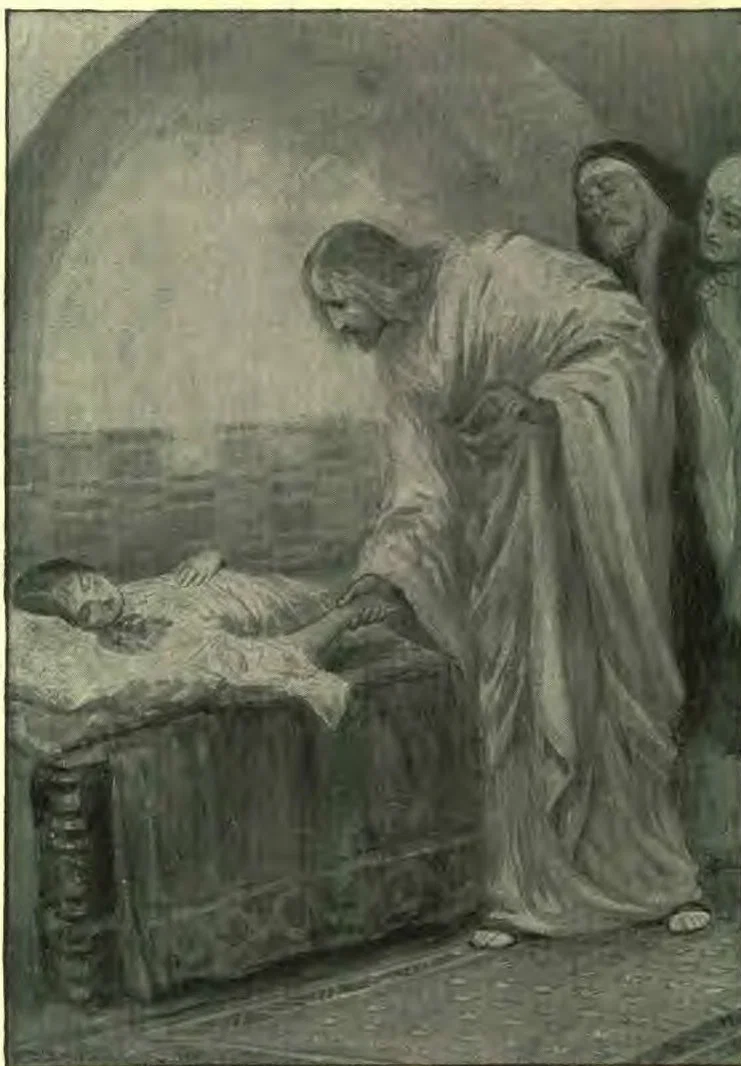
GIFTS OF HEALING.
The parable is its own evidence that the term “talents” embraces absolutely all the blessings with which God has entrusted man. The term includes not only all the distinctive spiritual gifts described above, but also our powers of intellect, our emotions and affections, our powers of influence, our health and strength, our accomplishments, and our property.
All these are included in the “manifold gifts of God” to His children. They are all the absolute property of God. For “ye are not your own. For ye are bought with a price,” even “with the precious blood of Christ.”
Does not this parable prove incontestably that all the gifts and powers comprehended by the “talents” were put in trust to His church anew when our Lord returned to the Father, to be scrupulously employed until He shall “come again” to “judge the world in righteousness”? It was the purpose of Christ that the primitive purity and power of His church should be continued intact from the time the “man” took his journey (or from the time Christ ascended to heaven) till the time in which he “cometh and reckoneth with them” (or “when the Son of Man shall come in His glory,” etc).
It is true that many of the gifts of the Spirit afterward became wholly unknown to the nominal Christian church. Yet the same Christ is still Lord over all, and is longing to pour out His gifts, if only faithful recipients can be found who would use them in love and fidelity for the good of the whole church, and so to the glory of the Giver. Were not His gifts originally bestowed “for the perfecting of the saints, for the work of the ministry, for the edifying of the body of Christ”? Are the saints of our day all perfect? Does not the ministry still need help? Is not the church to-day susceptible of further edification? Surely the church stands in dire need of all the “helps” that her gracious Lord so abundantly provides.
Development thru Use.
“Talents used are talents multiplied.” The parable of the talents unmistakably teaches that it is not enough to render back to our Lord what we have received unimpaired, and uninjured, but that we must in justice bring back more than we received; that is, we must by industry made effective by the blessing of God, add something to what God commits to us.
The parable teaches that we are God’s stewards; it enunciates the law of responsibility. It shows that the more we receive the more we are morally bound to do. Two talents must, by use, grow into four; five, into ten. God has placed us here to grow, to develop, to “go on to perfection.” There can be no growth apart from exercise, no development without strenuous, systematic effort, no perfection apart from the travail of intelligently directed to it.
Use and Improve, or Neglect and Lose.
This is the sentence pronounced upon every one of us by all the courts of God, in the physical, the intellectual, and the moral world. Use and improve your muscle, your memory, your perceptions, your reason, your6conscience, or they will be swift to languish, atrophy, and die. There can be no standing still; either progress and gain, or recede and lose. It means forward and finally all, or backward and finally nothing. Hence there was nothing capricious or arbitrary in depriving the faithless servant of his unimproved talent. It was in keeping with the inexorable law of God’s universe—in accord with the everlasting verities.
Pertinent Reflections.
All gifts and aptitudes are conferred for the benefit of the entire church. He who perverts them to his own honor and use perpetrates a kind of church robbery. “No one liveth unto himself.”
As in the living body each member fills a special office for the good of the world, so has every believer a special gift of the Holy Spirit for the use and upbuilding of the whole spiritual body of Christ.
It does not depend upon whether one has effected much or little, but upon whether or not one has been faithful and diligent in the measure of his power and sphere. For the lowliest Christian is just as truly a member of the body of Christ as is the most prominent.
As to the gifts of God, nothing can be merited, nothing forced, nothing affected. His Spirit gives and works as He wills. Hence no one must be envious because he can not do so much or act so conspicuous a part as some other. Everything depends upon the state of the heart and the quality of one’s faith. Each one is a distinct member, who has his own peculiar gifts and qualifications, and with these he should in love serve the others.
In the language of Doctor Pierson, “There are three grand departments of Christian experience: salvation, sanctification, and service; and unction and Pentecostal power appear to be especially connected with the last of the three, giving spiritual discernment of truth, and so, also, effectiveness in the utterance of truth.”
Shall we not all most earnestly covet the best gifts, in order that we may the more acceptably glorify the beneficent Giver, and the more efficiently labor to promote the well-being of every member of the church of Christ, which He purchased with His own blood?
Bestowal of the Gifts of the Spirit
By L. A. Phippeny
By L. A. Phippeny
Effect upon the Church.
THE effect upon the church of Christ of the bestowal of the gifts of the Spirit must be determined from the purpose of the bestowal. For what purpose are the gifts bestowed? For personal aggrandizement? For the gratification of curiosity or pride or love of power? For private salvation only?
The purpose is thus stated by Paul in his letter to the Ephesians: "For the perfecting of the saints, unto the work of ministering, unto the building up of the body of Christ." Eph. 4:12, A.R.V. The purpose, then, is wholly in relation to the church—to the perfecting of its members, who are called saints; unto the work of ministering; unto the building up of the body. All other aims or plans or individuals are excluded.
Bestowed Only in the Church.
But will not the gifts, or some of them, or some one of them, be bestowed upon the individual outside of the church? This would be quite impossible from the nature of the purpose of the bestowal. But we must remember that this church of Christ is not composed of fifty here and five there, only. It will be and is made up of companies in organized capacity the world over, but it includes more—those who respond to the Gospel call from every nation and kindred and tribe. So the church, the body, is known only to Christ, the Head, in its entirety. Therefore, in harmony with the purpose, what gifts are bestowed will be bestowed only on "the saints"—members of the church.
And then the gifts—the endowments of the Spirit—will be given only in harmony with the purpose, and it will be observed that this is a community purpose. It is not an individual, private matter. For me to have the gift of prophecy on a desert isle, living a hermit's life, would be incompatible with the purpose, unless the revelation could be communicated to those who might profit by it. And the illustration might be extended to the other gifts. The object seems, also, to be cumulative, sequential. After and along with perfecting is the work of ministering, named as a result of perfecting, and following this, as a natural result, the building up of the body.
The Grand Result.
Then with a body of saints being fashioned unto perfection by the manifold operations of the Spirit, for ministration under the guidance and with the power of the Spirit, with the body growing, building up under the hand of the Master Builder, what will be the grand result?—Attainment "unto the unity of the faith, and of the knowledge of the Son of God, unto a full-grown man, unto the measure of the stature of the fulness of Christ." Hardly could a more glorious result be outlined than is stated in these few words. And in the statement is embraced the church's development, its history in detail if we wish to follow thru the history in ascertaining the effect of the bestowal of the gifts.
The Unity.
"Unity of the faith"—"one faith." Gradually there will be eliminated everything of a dividing nature. The "saints" will become united; they will believe one thing; they will speak with one voice; they will be imbued with the spirit of oneness, because they are "saints," sanctified ones, fully controlled by the Head. At present there are some called "children, tossed to and fro and carried about with every wind of doctrine, by the sleight of men, in craftiness, after the wiles of error;" some who are not "dealing truly" with truth. These will either pass out from the church, which they are dishonoring with a vain profession, or they will die in the flesh and experience a new creation, and be made "saints." They will become fixed; they will have the "one faith;" they will speak "truth in love," and with all true members will "grow up in all things into Him, who is the Head, even Christ."
There will be unity of knowledge of the Son of God; that is, perfect knowledge, which is the knowledge of Him as He is—the Head of the church in all that He is to the church. The members will all be new-covenanters, with every vestige of old-covenant principles forever eliminated from their experience, under the operation of the Spirit when the gifts are given in fulness. They will be full-grown, measured by Christ's measure. And then the complainers and disturbers and grumblers will step out, and the church will be a clean, free church, not having spot or wrinkle or any such thing. Happy day!
All the Gifts Bestowed.
Then will the way be cleared for one intent and purpose of the bestowal of the gifts embracing all others—the revelation of divine power in fulness thru instruments of flesh. This brings to mind more particularly those manifestations usually regarded as supernormal or supernatural, such as healings, miracles, tongues, prophecies, and the like; for it is these that seem specially to appeal to most minds. What will be the effect on the church when these gifts are manifested in the church? But have they not been manifested in individuals at different times? Wherein will the final days be different than other days?
It may be stated as a basic proposition that the fulness of divine working has not been and will not be manifested in individuals here or there ahead of the growth of the body. The body has been growing thru the ages, and if there have been manifestations, they have been commensurate with the growth of the body, and have been properly timed by the One who does the work and gives the life. The development of the body is in good hands, and it is a fair assumption that there will be uniform growth. An arm, or a hand, or a set of muscles on this or that side of the body will not be abnormally developed. Stated in another way, there is a time of fulness of growth, a time coming—if not here already—when the church will be ready for a man's work, and then the man's work will be done with all of the gifts.
Growing Up in All Things.
That power has been manifested in extraordinary ways thru chosen instruments at various times thru the ages, no one can deny, but if we are safe in following the analogies of the word, it is clearly evident that when the time comes for the fulness of divine power to be manifested in all of the gifts thru the church, individual instruments will be more amply equipped, more efficaciously used, than have any individuals until that time, because of a riper knowledge of "all things," which is to be expected and looked for in the members of the remnant church. Notice the scripture: "But speaking truth in love, may grow up in all things into Him, who is the Head, even Christ; from whom all the body fitly framed and knit together thru that which every joint supplieth, according to the working in due measure of each several part, maketh the increase of the body unto the building up of itself in love."
One of the effects, therefore, of the bestowal of the gifts will be to prepare the church for the final and fullest manifestation of divine power in the close of the Gospel message. Locality may enter little into the consideration, but time will be an important element. The time will be the time of the "latter rain," when the "increase of the body" has progressed "in due measure of each several part," and the body is complete—a harmonious advance, a proportionate development toward the culminating revelation of power.
This culminating manifestation may be likened to the final charge of a line of battle. Thru the ages the lines have been forming, the forces marshaling,—spiritual forces,—for men and women have come and gone, leaving to the actors of the last generation a heritage only of truth, for which they must fight. There have been skirmishes, and individual combats, and personal deeds of valor under the direction of the great General—wonderful manifestations of power. Even now there are seen here and there His glorious workings thru individuals sent on special missions. But He has batteries in reserve, forces waiting, implements preparing, such as the world has seen little of, and some equipments never revealed, for the church of the last days. Everything is making ready for an advance all along the line. There is where the power lies—in the7firm, steady, simultaneous charge of the body. And the mighty General leads on before.
The Effect Produced.
Then notice another effect of this perfecting, upbuilding, transforming Spirit: "Thy people shall be willing in the day of Thy power." What a soul-stirring thought, that His "people shall be willing." Therein lies the secret of success in this great conflict—willingness! It is a wonderful secret, but it is open, free; every one may profit by it. It is the secret of the reception of power; it is the condition upon which the Spirit is bestowed. It is not primarily willingness to be used as a human dynamo, or thunderbolt, or even as an obscure wedge or a nail; but first of all willingness to die to the flesh, to crucify the old man. The Lord Jesus wants men dead to the flesh, men consecrated into His image, renewed with His Spirit of service, in this closing campaign. Then there will be no question as to how or where they are to be used. There will be only one concern—to remain dead, that the life of Jesus and His glorious power and His beauty of holiness may be continually manifested in their flesh.
Then there will be the humility and contriteness of heart requisite for indwelling power. Then there will be no glorying in and of the instrument. Some, chosen as scouts and special agents, and endued with power for the occasion, forget that theirs is only a small part of the battle, and imagine that they constitute the whole and have precipitated the final struggle. This is one reason why the General has not bestowed upon individuals in the past the measure of power He will bestow upon them when the church as a body moves forward in the grand charge. He knows the weakness of man, and the danger to individuals when they are given extraordinary power and isolated responsibility—the danger of self-exaltation. So He reserves the measure of fulness for the individual until the time of plentitude of power for the church as a whole. There will then be community of interest and responsibility, each soldier acting a part, an important part to be sure, but still only a part, not the whole thing. Even captains and lieutenants and corporals will be subordinates—not the head.
The Victors.
And then the stragglers will drop away, and the fearful will turn back, and the sowers of discord will pass on to more congenial fields, and the stumbling-blocks will take themselves out of the road, and the back-biters will flee, and the victory will be to the faithful who are left—will it?—The glory of the victory will be the Lord Christ's, and His only. For will He not be fighting the battle with men saved by grace—men bought with a price? And yet in His greatness of heart, in His goodness, He calls them brethren, co-laborers, co-heirs, and says all the gain is for them—"all things are for your sakes." He is a wonderful Leader. Who would not enlist under His banner! This is the day of His power. Are you "willing"?
What Shall Be After?
By Flora E. Yergin
I HEAR the moment echo as it passes
The question of the fading flow'r and tree:
"What shall be after earth and sea have vanished?"
Hear now the answer Love sends you and me:
"Sweet Love shall stay!"
Hear even now the murmur of Life's river;
The seraph-choir strike all their harps of gold;
The balmy breezes praising now the Giver
In one grand chorus—ever new and old:
"Love has no end!"
As barren earth drinks in the summer showers,
And sends new life to dying bud and vine,
The weary soul may from Love's golden hours,
Find what the transient seeker failed to find:
Love never fails!
Soon Love will raise His never-changing standard
O'er Hatred's hard and bloody battle-ground;
The silent grave will open at His bidding,
And all who trusted Love will hear the sound,—
The voice of Love.
O strivers after fleeting wealth and glory,
Gaze for awhile on Love's abiding throne.
Long as He reigns—who gave us Love's first story
The loyal heart will sing Thy praise alone,—
Immortal Love!
FLORA E. YERGIN.
Signs of His Coming.
No MATTER how we try to explain them, these are solemn, portentous words: "And there shall be signs in the sun, and in the moon, and in the stars; and upon the earth distress of nations with perplexity; the sea and the waves roaring; men's hearts failing them for fear, and for looking after those things which are coming on the earth: for the powers of heaven shall be shaken. . . . And when these things begin to come to pass, then look up and lift up your heads for your redemption draweth nigh." One thought in connection with these momentous words of the Lord Christ, is that perturbations of the heavens, of the earth and the seas are directly associated with the signs, or abnormal conditions which are to appear in the visible heavenly bodies. Are we not, therefore, forced by the words of our Lord to the conclusion that God lays His hand, which is another name for His law, upon the "sun and the moon and the stars," when He intends to shake the heavens, and set the seas and waves thereof roaring.
In plain words, is it not here distinctly taught that this is God's regular and normal way of causing phenomena which we witness in the earth, much as storms, tidal waves, earthquakes, and all kindred disturbances? Personally, we do not doubt that such is the case, and neither do we doubt that God will use the same means and methods, when, in the fulness of His purpose He determines to wind up this dispensation, and so awfully to increase these disturbances in the heavens and the earth, as to make men's hearts fail them in looking after those things which are coming to pass on the earth. We do not believe that it can be gainsaid that famine, earthquakes, wars, storms, destructive tidal waves, and volcanic violence, have, in all the history of the human race, been so universal or so generally destructive as during the period thru which we are yet passing. "Signs in the sun" have increased in the same proportion. What do they all mean? Who can show that they do not have direct relation to the solemn words of Christ, and that they are not intended to remind us that God's plans are ripening fast, and that "our redemption draweth nigh?"—Editorial from Word and Works, April, 1907, edited by Irl R. Hicks, the great weather forecaster.
Be as Thou Wouldst Be
Be as thou wouldst be in thine own clear sight,
And so thou shalt be in the world's ere long.
—Lowell.
Our Bible Band.
By Editor
HOW many of our readers have read the Bible thru once, twice, three times or more? It is not a large book. The one before us as we write has 1,207 pages, good, large-face bourgeois type, and many almost blank pages at the end of books. To read that thru in a year one would have to read a little over three and one-third pages a day. Another Bible we have with minion type has 806 pages, less than two and one-fourth pages a day. It takes about fifteen minutes of careful reading to cover the three pages required. Fifteen minutes a day will read the Bible thru in one year. Who is there that can not devote fifteen or twenty minutes a day to Bible reading? Who is it that can not give an amount of time equal to four days of the 365 a year in becoming acquainted with the Book of life, the word of the living God?
There are many, many Christians who have never read the Bible thru. They do not know its treasures. If a mansion were given them do you think they would wait year after year and not enter all its rooms and explore its treasures? If one room were locked, there would be no rest of curiosity or desire till it was opened and its secrets laid bare. The Bible is a great mansion with many rooms, but accessible to all who will take a little time to visit them.
How many will join with us in reading the Bible thru the next year?
How many will join our Bible Band?
The SIGNS OF THE TIMES is organizing a Bible Band of those who will agree to read the Bible thru in one year. How many will journey with us thru the great treasure-house?
The SIGNS OF THE TIMES will ask its Bible Band members to do the following:
1. To sign a card with name and address, agreeing by the Lord's help to read the Bible thru in the year 1908, and to forward that card to us. The card list of names will not be given away, sold, or in anywise made public.
2. To pay ten cents for the card, in order to defray the expense of conducting and directing the reading.
3. If a reply is requested by letter, a two-cent stamp should be enclosed.
The SIGNS OF THE TIMES on its part will agree to—
1. Arrange and direct the reading for the year.
2. Give the date of writing and authorship of each book as we reach it, together with brief analysis of lessons to be read from week to week.
3. It will give first place to proper questions from the Band members in the SIGNS OF THE TIMES.
4. It will answer all questions it is able to answer by letter if a two-cent stamp is enclosed.
In short, it will give especial attention to helping its Bible Band readers.
To Those Outside the Band.
The SIGNS will answer all questions by letter if ten cents is enclosed, in either stamps or coin.
It will answer all proper questions in the paper if a two-cent stamp is enclosed.
Is it unreasonable that the SIGNS should ask this?
It does not seem so to us. If we received a few letters only, it would be little trouble or expense to answer them. But we often receive more letters of inquiry in a day now than we did in six months a few years ago. About one-half of these letters must be answered thru the mail. This takes much time. Sometimes to answer the inquiries in the letter means hours and days of research, and the consulting of many volumes. Sometimes it means the writing of other letters; and such a department as our Question Page necessitates a good library. Frequently a letter will come to us asking a question or several questions demanding a reply, with not so much as a stamp or a postal card enclosed. Sometimes the questions are asked on a postal card.
We are sure that our readers will see the reasonableness and justice of our request. It is not to our personal gain that we are asking this. We, as editors, will be no richer, tho we expect it will add to our work. But we do feel that the paper ought to be relieved in part from its great burden of postage and expense, don't you?—We know you do.
We hope to make our Bible Band a school for all who enter it of great profit in the life which now is and in that which is to come.
Will you join? Wherever we have mentioned it, people are enthusiastic. One minister, Elder E. S. Ballenger, writes us that there are 500 in Southern California who have already promised to read the Bible thru in a year.
The SIGNS Bible Band will begin with the year 1908. We believe it will be easier to keep together and keep track of time to begin with the year. We will need the little time between now and the middle of December to get started.
In the meantime our Question Department will continue the same as ever.
Next week we will print a copy of the card we will use for our members.
Who will be the first to ask for an application blank?