Your ShelfYour Projects

Signs of the Times, Vol. 39, No. 38.

The Seed Sowing and the World Harvest

Earlier text: The Increasing Vices of Sodom
Our Bible Reading
Our Bible Reading

The First Day of the Week

1. What is the first and only mention of the first day of the week in the Old Testament?
"And the evening and the morning were the first day." Gen. 1: 5.
2. What are the eight passages in the New Testament where the first day of the week, commonly called Sunday, is mentioned?
(1) "In the end of the Sabbath, as it began to dawn toward the first day of the week, came Mary Magdalene and the other Mary to see the sepulcher." Matt. 28: 1.
(2) "And when the Sabbath was past, Mary Magdalene, and Mary the mother of James, and Salome, had brought sweet spices, that they might come and anoint Him. And very early in the morning the first day of the week, they came unto the sepulcher at the rising of the sun." Mark 16: 1, 2.
(3) "Now when Jesus was risen early the first day of the week, He appeared first to Mary Magdalene, out of whom He had cast seven devils." Mark 16: 9.
(4) "Now upon the first day of the week, very early in the morning, they came unto the sepulcher, bringing the spices which they had prepared, and certain others with them." Luke 24: 1.
(5) "The first day of the week cometh Mary Magdalene early, when it was yet dark, unto the sepulcher, and seeth the stone taken away from the sepulcher." John 20: 1.
(6) "Then the same day at evening, being the first day of the week, when the doors were shut where the disciples were assembled for fear of the Jews, came Jesus and stood in the midst, and saith unto them, Peace be unto you." John 20: 19.
(7) "And upon the first day of the week, when the disciples came together to break bread, Paul preached unto them, ready to depart on the morrow; and continued his speech until midnight." Acts 20: 7.
(8) "Now concerning the collection for the saints, as I have given orders to the churches of Galatia, even so do ye. Upon the first day of the week let every one of you lay by him in store, as God hath prospered him, that there be no gatherings when I come." 1 Cor. 16: 1, 2.
3. Are there any other places in all the Bible where the first day of the week is mentioned?
Ans.—No.
4. Is there any mention, in any of these texts, of the instituting of the first day of the week as a new weekly rest day, or "Christian Sabbath"?
Ans.—It is very clear that we must say No.
5. Could God or Christ or the apostles change the Sabbath over to the first day of the week and make it binding upon us mortals without saying something about it somewhere?
NOTE.—We leave the reader to answer this last question between himself and God.

The Bible or Roman Day

By Joseph and Katie Shurvinton
1. WHAT is the Bible interpretation of the day? — "The evening and the morning were the first day." Gen. 1:5, 8, etc.
2. When does the day begin, according to the Bible? — "When the even was come," "when the sun did set." Matt. 8:16; Mark 1:32.
3. When does the Sabbath begin, according to the Jewish or Bible calendar? — "From even unto even, shall ye celebrate your sabbath." Lev. 23:32. See also Neh. 13:19; Luke 4:40.
4. In what calendar is Sunday found? — In the Roman and secular calendars.
5. What constitutes a day according to the Roman calendar? — Twenty-four hours. Of course there is no Scripture reference.
6. According to this calendar, when does the day begin? — At midnight.
7. What is the day according to the Lord's reckoning? — It is the Bible day, an evening-and-morning day. Isa. 58:13.
8. How are the Lord's days designated? — By number with direct reference to the Sabbath.
9. How are the days of the Roman calendar designated? — By names of idolatrous origin. Note the diagrams:

BIBLE DAY

Begins at Sunset

ROMAN DAY

Begins at Midnight

Bible Week

First day Second day Third day Fourth day Fifth day Sixth day (Preparation day, or Sabbath eve) Sabbath day

Roman Week

Sunday Monday Tuesday Wednesday Thursday Friday Saturday
The Jewish calendar days, or the Bible days, all point toward the great high day, the Sabbath.
The Roman calendar days are all named in honor of pagan deities, the sun, the moon, Tyr (a martial god), Woden, Thor, Frigga (Venus), Saturn.
Which is the better calendar?

A Prayer

By Alice Cary Walden
Thou knowest whether we need sickness or health, Thou knowest whether we need poverty or wealth, Whether 'twere better to stay at home, Or o'er the broad harvest-fields to roam.
But we need Thy presence abiding within, We need to be free from the stain of sin, That we at last may stand before the King Without spot or wrinkle or any such thing.

For Peace and for War

WHEN one listens to the spokesmen of a large section of society, the impression is made that surely we are soon to have world-wide peace, there will be no great wars any more. And on the other hand, when we hear from another section of society, and look at another class of facts, it would seem that war could not be averted. These conditions present a peculiar contradiction.
As one of the many instances of the war fever that is raging, mention may be made of the way in which Germany and England have been so strenuously working for several years past in order to be prepared for the conflict that both nations think will surely break out between them in no far-off day. Both nations are openly discussing what each can do, and England has just been conducting some elaborate war maneuvers, in which an invading army is made to enter the island from the direction of Germany, and the British force is rallied to repulse it. Such are very queer things to do if it is desired to promote peace and good will between the two nations.
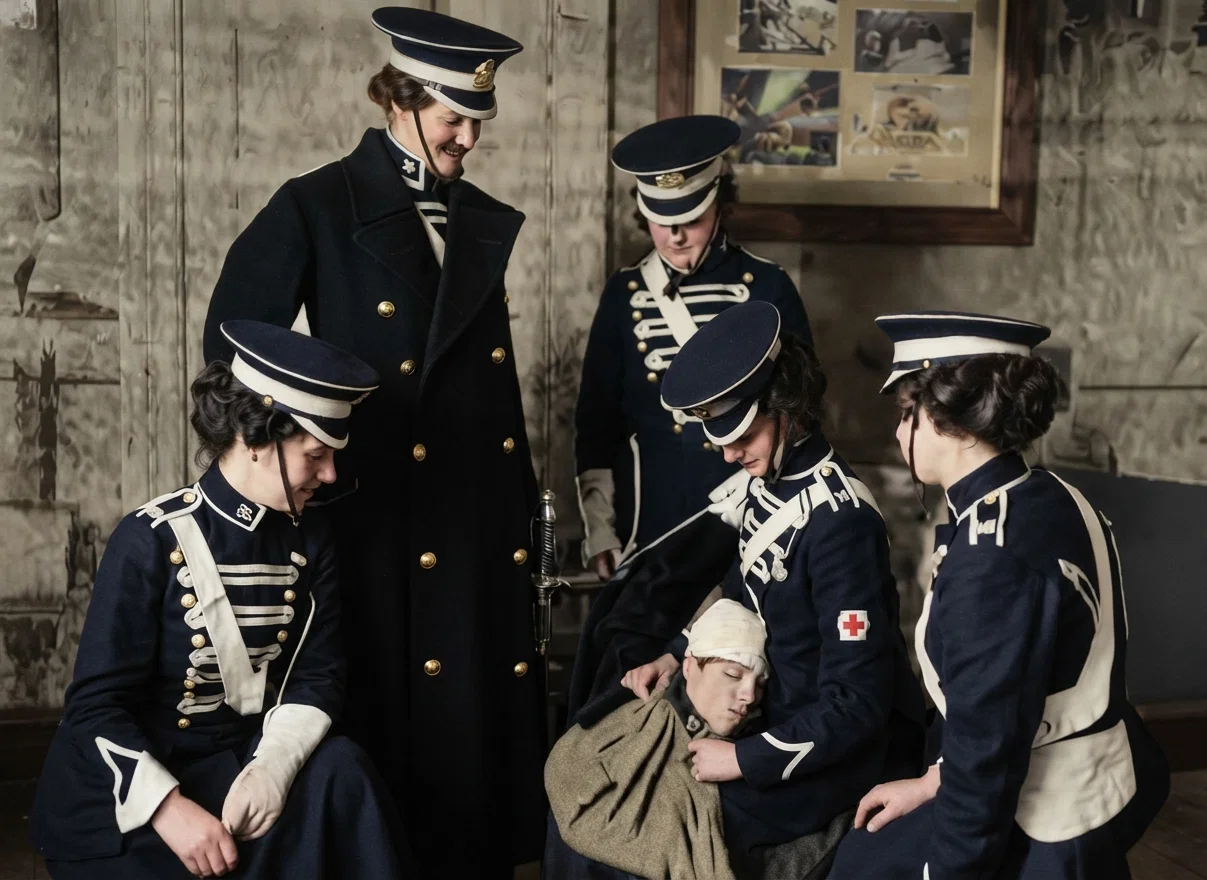
Both countries are agitating the matter of having all their women trained to the highest degree of efficiency, so that they may support the men at the front of the battle. It is not talked to any great extent that the women shall bear arms, but it is agitated that all able-bodied women should be required to take the training necessary to enable them to join the army at once in case of war as a trained and efficient hospital corps. Some of the women would have to follow the army to the field of action for emergency work there, while others would be on active duty at home so as to be able to take care of the wounded and the sick as soon as they could be brought back from the field. This plan of the home contingent could not be carried out, of course, if the war were at a great distance. In such a case, more of the women would have to go to the front.
Commander of the British Women's Auxiliary Corps
Napoleon, a little over a hundred years ago, was the first to put the whole of the male population under military conscription. It has been reserved for the war demands of today to agitate the question of compelling all the women to enter the service.
But while these war maneuvers are on in England, and while so much discussion and preparation for war may be seen in every part of the world, we at the same time have a Peace Congress in session at Geneva, Switzerland. This congress, that has its delegates from so many of the leading nations, it is true, is not so imposing in its plans and arrangements as some of the Hague congresses were, still it shows how the minds of men are working to oppose the spirit of war. It shows the contradictory and opposing forces that are arrayed against each other.
Soldiers of the new British force, called the Women's Auxiliary Corps, organized to aid the men in war
Those who are holding peace congresses may be working in a laudable direction, for Christ Himself is called the Prince of Peace, and a blessing is pronounced upon the peace-maker. But on the other hand, the Bible also tells of those who heal the hurt of the daughter of God's people but slightly by saying "Peace, peace; when there is no peace."
Many of those who are working for the peace of the world, and who say that the nations will never have any more wars, make frequent quotation of the texts in Isa. 2: 4 and Micah 4: 3, which speak of the time when "they shall beat their swords into plowshares, and their spears into pruning-hooks; nation shall not lift up sword against nation, neither shall they learn war any more." But those who quote these texts do not take the pains to observe that both of these scriptures are telling what the "many people" and the "many nations" are saying. It is not the Lord who is saying this, but it is the Lord foretelling what the "people" and the "nations" will be saying in the "last days." Study the text with ordinary care and you will see that this is the case.
Another text affirms the fact that the great climax is reached just before the time of the final destruction, when the "people" affirm that they have actually reached the time of peace and all is safety: "Concerning the times and the seasons, brethren, ye have no need that aught be written unto you. For yourselves know perfectly that the day of the Lord so cometh as a thief in the night. When they are saying, Peace and safety, then sudden destruction cometh upon them, as travail upon a woman with child; and they shall in no wise escape. But ye, brethren, are not in darkness, that that day should overtake you as a thief: for ye are all sons of light, and sons of the day: we are not of the night, nor of darkness; so then let us not sleep, as do the rest, but let us watch and be sober." 1 Thess. 5: 1-6.
The foregoing text plainly tells of a class that will be overtaken "as a thief in the night;" and it just as plainly says that the "brethren" are not in darkness and hence will not be thus overtaken. They are of the light, and know where they are standing. This class who are overtaken "as a thief in the night" are the ones who are also saying "Peace and safety." They are the ones who the Lord has foretold will be telling the world that all the swords will be beaten into plowshares and the spears into pruning-hooks. Did you ever stop to think what a marvel it is that our God could foretell thousands of years ago just what the people would be actually saying in this time? and, too, He describes them as "many people," thus showing that it would be the great popular cry.
At the same time that the Lord foretells what the people would be saying on the subject of peace, He also foretells what the actual conditions will be in the field of war. His word is, "And the nations were wroth, and Thy wrath came, and the time of the dead to be judged." Rev. 11: 18. And again the divine Word declares: "And the sixth poured out his bowl upon the great river, the river Euphrates; and the water thereof was dried up, that the way might be made ready for the kings that come from the sunrising. And I saw coming out of the mouth of the dragon, and out of the mouth of the beast, and out of the mouth of the false prophet, three unclean spirits, as it were frogs: for they are spirits of demons, working signs; which go forth unto the kings of the whole world, to gather them together unto the war of the great day of God, the Almighty. (Behold, I come as a thief. Blessed is he that watcheth, and keepeth his garments, lest he walk naked, and they see his shame.) And they gathered them together into the place which is called in Hebrew Ar-Magedon." Rev. 16: 12-16, A.R.V., margin.
Only a part of the scriptures that might be given on the subject are quoted in the foregoing. But enough is given to show that there will be an awful spirit of war right at the close of time. The spirits of demons will be gathering the whole world into it. The nations will be wroth. And right while this will be going on, the "many people" will be crying that all is peace, there will not be any more war.
It is not necessary to do more than to observe just what the foregoing words from the Bible say, in order to see that both war and peace will be great world-wide movements right in the last days. And we need only to open our eyes to the actual facts as they exist to-day, in order to see the most strikingly literal fulfilment of the prophetic forecast.
Let the reader ask himself: "If I had been going to make a prophecy, would I have made one that seemed to carry such contradictions with it as do these predictions that the Lord has made? Would I have foretold that the last days would mark the worst furies of war that the world has ever seen, and at the same time also predicted that when the war storm was gathering, the people would be saying, 'All is peace?'" Only the Infinite One who knows the end from the beginning can make such accurate predictions of such improbable conditions. If we follow the leadings of the One who can prophecy after this sort, we will certainly be "sons of the light," and not be among those that are overtaken as a thief in the night by the day of the Lord.
Female general of the king of Dahomey's army
T.

A Christian Service or a Show—Which?

In one of the daily papers in a certain locality there appears the following advertisement, supposed to be of a Christian service in a Christian meeting-house:
"GREAT ILLUSTRATED PROGRAM TO-NIGHT "WHERE? "At the — Church, of Course. "Congregational singing from a hymnal twenty feet square. Two thousand feet of moving pictures on 'The Holy City' (the American Passion Play). Illustrated lecture, 'Life and Times in Sunny Australia,' by ———, just arrived from Australia. Have you heard it said, 'Folks don't go to church now as in the good old times'? Then follow the crowd this very night to 'the Friendly Church.' Disillusionment awaits you."
The foregoing matter was duly and strikingly displayed so as to catch the eye. And we will ask the reader to strike out the few words referring to "church," and see if the advertisement might not seem to be of just an ordinary entertainment. The moving pictures of "The Holy City," to be sure, seem at first glance to leave the impression that you are going to have something distinctively religious. But when you get the parenthetical statement that it is "the American Passion Play," then you are led to ask, Is the performance to be religious, or is it to be semi-theatrical?
Passing the moving picture section of the program, what do we find that pertains to a church service on a Sunday night in an "illustrated lecture" on "Life and Times in Sunny Australia"? This would certainly be a perfectly appropriate topic for a lecture; but why call it a part of a religious service on the particular night of the week when so many people go to the church for divine worship?
In "the good old times" that the advertisement speaks about, the people went to church to hear the gospel preached, and crowds waited upon the soul-cheering, even tho it was a heart-searching message. And there are thousands of people to-day who are longing to hear the same message of salvation that pours from the sacred Book when it is allowed to tell the story of Jesus Christ, the Saviour of men. How sad it is to call men to the house that has been dedicated to the service of God, to listen to a program such as is outlined in the foregoing, and try to have them think they are worshiping the great Jehovah!
Good music has its place, and lectures on Australia, or any other country, are highly appropriate; but to the soul who may have chanced to step into that church on that particular night with the hope of hearing the story of salvation through Christ, the whole service must have been very disappointing.
Does not the advertisement of that church service show that we have reached a condition in society in which men are seeking mere pleasure and entertainment more than the real service of righteousness? To be sure, there are those now, as has ever been the case, who are truly seeking after God, and who find more pleasure in the study of His Word than in anything else. But ordinary preaching no longer attracts the crowds. The crowds must have excitement and "entertainment." And yet the people in general seem to desire a semblance of religion of some kind. They are not willing to have it appear that they are irreligious, hence entertainments that are semi-theatrical, or of the character of secular lectures, are brought into the church to draw the crowds, and many of the people have led themselves to believe that such is the divine worship of Jehovah.
We commend the following scripture, in this connection, to the careful consideration of the reader, and we quote from the "Twentieth Century New Testament" because of its modern language and forceful way of telling the story:
"Be sure of this, that in the last days difficult times will come. People will be selfish, mercenary, boastful, haughty, and blasphemous. They will be disobedient to their parents. They will be ungrateful, impure, incapable of affection, merciless, slanderous, wanting in self-control, brutal, careless of the right, treacherous, reckless, and puffed up with pride. They will love pleasure more than they love God; and while they retain the outward form of religion, they will refuse to allow it to influence them. . . . Their minds are corrupted, and, as regards the faith, they are utterly unsatisfactory. . . . You know what persecutions I went through; and yet the Lord brought me safe out of them all! Yes, and all those who aim at living a religious and Christian life will have to undergo persecution; while wicked people and impostors will go from bad to worse, deceiving others and deceived themselves. But you, Timothy, must stand by what you have learned and accepted as true. . . . "I solemnly charge you, in the sight of God and of Christ Jesus, who will one day judge the living and the dead—I charge you by His coming and by His kingdom: Proclaim the message, be ready in season and out of season, convince, rebuke, encourage, always willing to make allowances and to impart instruction. For a time will come when people will not tolerate sound teaching. They will follow their own wishes, and procure themselves a crowd of teachers, in their itching for novelty. They will turn a deaf ear to the truth, and give their attention to legends instead. But you, Timothy, must always be temperate, Face hardships; do the work of a missionary; discharge all the duties of your office." 2 Timothy 3; 4:1-5.
The foregoing is a scripture that it is well to study closely. It matters not what the version we read, the story is the same. The text tells of those who retain the outward form of religion, but who refuse to allow it to influence their lives; and as regards the faith, they are utterly unsatisfactory. It says they will not tolerate sound teaching, but they follow their own wishes, and procure themselves a crowd of teachers, in their itching for novelty; they give attention to legends rather than to the truth itself.
Now if we believe the Bible, we must acknowledge that the Lord caused the foregoing text to be written by inspiration nearly two thousand years ago. And if we will observe the first statement made in it, we will see that the conditions described are to exist in the last days. And is it not truly marvelous how accurately the conditions in this time fit into what the text predicts for the "last days"?
Of course, when people think they are doing some smart thing, when they are getting crowds to their church, and regard it as a great personal achievement rather than a manifestation of the power of God, it is not to be expected that they will take seriously the foregoing warning from Timothy. To listen carefully to what that scripture says, and to give heed to it, would show the wrong of following any such theatrical methods to get people to come to the place that is supposed to be a house of worship. And when any one is intoxicated with the idea that he is having brilliant success, he hates to think that he is making a failure, and at the same time is fulfilling divine prophecy by exhibiting his abilities for catering to those who are "itching for novelty."
Concerning the gospel, God's Word says: "I am not ashamed of the gospel of Christ: for it is the power of God unto salvation to every one that believeth." Rom. 1:16. Observe that the text says that the gospel is the power of God unto salvation. The very gospel itself is power. And if a minister or a church has the gospel, that minister or that church will have power. And power is able to draw as no fantastic methods can. For the individual who is drawn by the power of the gospel itself will come again and again, and does not need to have some new and exciting thing continually studied up to draw him to the house of God.
Again, we have this promise: "Ye shall receive power, when the Holy Spirit is come upon you: and ye shall be My witnesses both in Jerusalem, and in all Judea and Samaria, and unto the uttermost part of the earth." Acts 1:8. God promises His Spirit, and His Spirit brings power, and that power is the power of God unto salvation.
Then if we are seeking to save souls, we will seek for the power of the Holy Spirit, so that we may offer men the gospel that brings salvation. We may not always have the big crowd, but we will have those who are seeking to know God and to have eternal life. But let us not make the mistake of deceiving ourselves into believing that we are serving God by seeking out inventions to draw those who are "itching for novelty."
God's Word should be closely heeded, for it tells the story of this time just as it is. T.

Scientists Seeking to Create Life

Eminent scientists in various parts of the world are spending much time in seeking to learn how, in the chemical laboratory, to create life. Some men in both the Old World and the New think that they are on the eve of some great discoveries in the work of becoming actual creators. They claim to have formed a "strange octopus-like creature from chemicals," and that it "seemed to live for hours, and have a voracious appetite." The religious hierarchy and ecclesiasticism have ever stood in the way of progress in science and invention. But it has always been true that the good old Book of God has ever been far in advance and beckoning to come on into wider and more promising fields. And we believe that if these scientists would only carefully study this Book, they could become convinced that there is but one real Creator in all the universe. And we will get true joys from working in harmony with Him rather than in trying to usurp His prerogatives. Science and invention have done much and will doubtless still do more in this age. But it will always remain true that with Jehovah is the fountain of life.

The Waste and Ruin of Drink

The cattle wealth of the United States for 1911 is reported to have been $1,499,523,607. The American Grocer admits that the drink bill for the same time was $1,567,470,514, but other reliable figures show that the drink bill for that period was $2,362,046,508. Even the lowest estimate shows that drink destroyed more money wealth during that year than all the cattle wealth of the nation amounted to. And to this money waste we must add the moral depravity, the suffering, and the misery that were the result of the drinking. Why is it that men will insist on upholding and legalizing a business that is causing so much waste and ruin? If some plague threatened to stalk through our fair land and destroy all our cattle, the whole nation would be aroused to a frenzy. But here is a traffic that worse than uselessly wastes each year more than the cattle wealth of the nation, and nothing is done about it, except by a comparatively few of the people.

Farmers' Institutes in California

The University of California is arranging for very helpful institutes for the farmers during the coming year, for which purpose the state has appropriated $15,000. In these institutes dairying, fruit growing, the fighting of insect pests, and such subjects of interest to the farmer will be taught by experts.

Silent Martyrs of Civilization

A large part of the energy of civilization has come out of the bodies of the great four-footed races. The horse, the ox, the mule, the elephant, the camel, the reindeer, the water-buffalo, the yak, the dog, and the donkey — on the powerful and patient backs of these beings civilization has been borne for unknown hundreds of years. The power and mobility of these races have enabled man to carry out enterprises he never could have dreamed of undertaking single-handed. Without horses or other beings able and willing to wield the great implements, agriculture, the most basic of human industries, would be almost impossible.
They are overloaded, overworked, poorly sheltered, beaten without cause, neglected, starved, misunderstood, cut with brutal whips, deprived of leisure and liberty, and doomed to a round of wretchedness and toil such as only machines, with no desire for happiness and no capacity for despair, would ever voluntarily enter upon. From the time they start out in the morning till they come back at night, aching with weariness and covered with stripes, they are doomed to an existence that contains all the essentials of a living death. And it is not for a day, or a week, or a year. It is for a lifetime. They have absolutely nothing to look forward to.
No wonder horses become downcast and apathetic! No wonder they become broken-hearted! No wonder their faces become drawn, and out of their eyes streams the solemnity that darkens the faces of the doomed!

Worn-Out Horses and Men

And when man has extracted from them every benefit he is able to extract, he casts them out, as the money-hog does his worn-out workmen, to rot. The stars of heaven never looked down on more pitiful sights than that of horses or men, after having drudged faithfully all their lifelong days in the service of others, and after receiving for their lifelong devotion a compensation chiefly of pain, turned out in their helpless old age to starve to death.
The great law of love — the abstaining from that which we do not like when done to ourselves — reciprocity — is the only relation to exist among associated beings of any kind.
J. HOWARD MOORE.

The Boy That Did Not Care

"James, my son, you are wasting your time playing with that kitten when you ought to be studying your lesson. You will get a bad mark," said Mother Mason to her son.
"I don't care," said the boy, as he continued to amuse himself with the kitten.
"But you ought to care, my boy," rejoined the lady, with a sigh. "You will grow up an ignorant, good-for-nothing man if you don't make use of your opportunities."
"I don't care," said James, as he raced into the yard.
"Don't care will be the ruin of that child," said the mother to herself; "I must teach him a lesson he will not easily forget."
Guided by this, the lady made no provision for dinner. When noon arrived, her idle boy rushed into the house, as usual shouting, "Mother, I want my dinner!"
"I don't care," said his mother, very calmly, working with her needle without looking up.
"I'm hungry, mother," said the boy.
"I don't care," she repeated.
James was puzzled. His mother had never thus treated him before. They were strange words for her to use, and her manner was so cold that he could not understand it. He was silent for a while, then spoke again. "Mother, I want something to eat."
"I don't care," was the cool reply.
"But recess will soon be over, mother, and I shall starve if I do not get some dinner," urged James.
"I don't care."
This was too much for the boy to endure. He burst into tears. His mother, seeing him subdued, laid down her work, and, calling him to her side, stroked his hair very gently, and said:
"My son, I want to make you see the folly and sin of the habit you have of saying, 'I don't care.' Suppose I did not care for you, what would you do for dinner, for clothing, and for education? You see, I must either care for you, or you must suffer. And if you must suffer through my lack of care for you, don't you think you will also suffer if you don't care for yourself? And don't you see that I must suffer, too, if you don't care for my wishes?"
James had never looked on his evil habit in that light before. He promised to do better, and after having his dinner, went to school a wiser boy.—Christian Commonwealth.

Be Happy Every Day

By Mrs. M. E. Sollars
I thought, dear little songster, If you can be so gay, And sing your song so sweetly, When clouds are cold and gray, I'll try to learn a lesson sweet, A lesson from the bird, And let the cares that vex me so, Be evermore unheard.
—★—

Great Men and Higher Intelligences

GREAT men stand like solitary towers in the city of God, and secret passages running deep beneath external nature give their thoughts intercourse with higher intelligences, which strengthens and controls them, and of which the laborers on the surface do not even dream!—Henry W. Longfellow.

Need for Religion

CHILD study is now reduced to the most unemotional of the sciences.
The modern pedagogical expert betrays no more feeling when he analyzes the mind of a child than does a vivisectionist when he cuts open a cat.
His statistics are as cold as a table of logarithms; his diagrams are as soulless as the plates in a text-book of physiology.
No doubt there are valuable deductions to be made from such acute inquiries, but the theory that a child's spiritual nature can be developed with the same scientific certainty that one can train his mind, and by the use of identical processes, finds no confirmation in actual experience.
The character of a boy is safer in the hands of an intellectually deficient instructor who could not distinguish pedagogy from landscape gardening, but who loves God with all his heart, than in the hands of an expert psychologist who thinks God an unnecessary embarrassment to an educational process.—George P. Echman, D.D., in 'Christian Advocate.'

Bad Habits

BREAK off your habits at once. Don't attempt it by degrees. You never heard of a drunkard reforming by drinking less and less until he finally became a total abstainer. Faster and faster from the elevation falls the weight earthward, faster and faster speeds the runaway car down the grade. Good habits mark the up-grade; bad habits, the decline. Perfection is not easy; destruction is. The nearer perfection, the slower the progress, the greater the toiling; whereas the nearer we are to destruction, the more swift and sure the end.
There is no permanent breaking of bad habits without forming good ones. You have heard the old saying, "Nature abhors a vacuum." This is true all over the world. The field that is left unsown is sure to throw up a crop of weeds. It will produce vegetables if the seed be placed in the ground. And these useful plants will at length take possession of things, and crowd the weeds out. How glad I used to be, as a boy, when I came upon a pale, sickly ragweed growing alongside of a vigorous celery plant! I would say, "Ah, my fine fellow, you are getting the worst of it this time." This was the right order. So with the mind and heart. Plant a new thought, a new affection, a noble purpose, a high ideal, in place of the old and unworthy; and if properly cared for, we may hope that it will grow, and help to crowd out the evil. "Satan still some mischief finds for idle hands to do." It will be a help to associate with persons of good habits. To this very end God has given us our social nature, and our opportunities as members of society.—J. S. McGraw.

Friendship

FRIENDSHIP—what is it? Do smiles, words of cheer, and kind actions constitute it? Are those who never upbraid, but meet all our deeds with words of praise, who flatter us on every possible occasion, to be considered true friends? Their attentions may be pleasant to our vanity and conceit, and keep us in the best of humor with ourselves, and we may think their company very desirable, yet they will not do to put faith in, for their amiable behavior is often the cloak of self-interest.—Great Thoughts.

Optimists and Pessimists

EVERY optimist moves along with progress and hastens it, while every pessimist would keep the world at a standstill.—Helen Keller.

The Parent's Guide in Sex Problems

"The Parent's Guide in Sex Problems," by B. J. Kendall, M.D. Published by the author, Geneva, Ill. Cloth. Price $1.50.
The topic of this book is one of the most important, and many things have been written on the subject treated. Much of what has been written has been good, but a great deal of it has been quackish and calculated to do more harm than benefit. Hence in reviewing a book of this kind we always take pains to read it very carefully before saying anything about it. And after careful reading of the select little volume, we do not hesitate to say that it is one among the very best books that we have ever seen on sex problems. And certainly any parent will readily say that there is no problem with which we have to deal in these times that is any more difficult to handle.
We would heartily commend this book for the following reasons: 1. It is written in the spirit of the true refinement and elegance of culture that is found in the life and teaching of Jesus Christ. The author is evidently a man of experience in the things of the pure Teacher of Nazareth.
2. It is the fruitage of evident skill as a physician, and is based upon a wide practical experience in helping fathers and mothers on the subject-matter of the book.
3. Altho the book treats what is regarded as the most delicate subject with which parents have to deal, yet, as would be expected from what we have said in reasons 1 and 2, it is done in such a way that the reader can not help sensing an uplifting and refining influence as he peruses its pages. No one need hesitate to place it in the hands of any boy or girl of a suitable age, and all fathers and mothers should have it to help them in teaching their children before they are old enough to read the book for themselves. Indeed, one of the most helpful things about it is the instruction it gives to men and women before they enter the sacred obligation of becoming fathers and mothers.
Continue reading: BOOK NOTICES