In Linneus, Me., Brother J. B. Goodrich reports an accession of five to our ranks.
Brother M. G. Huffman, who has been laboring in Tennessee, has been assigned to Jacksonville, Fla.
At Albuquerque, N. M., a few weeks ago, Brother H. L. Hoover organized a Sabbath-school of fifteen members.
On the 26th ult., the new house of worship at Cripple Creek, Colo., was dedicated to the Lord, Elder J. M. Rees officiating.
Under date of December 20, Brother R. J. Nash reports six conversions at the Helping Hand Mission, Milwaukee, Wis.
The report comes from British Guiana that Brother Van Deusen has baptized eighteen persons, among them a minister and his family of five.
A gentleman not of our faith called at the office of the Iowa Tract Society, in Des Moines, about three weeks ago, and handed in subscription for eight copies of the SIGNS—six for one year and two for six months.
The word to us now is: “The Lord has aggressive work to be done.” “Every man to his work, each to do his best.” “Those who will stand where the Lord can work through them to communicate light to the world, will be chosen as vessels unto honor.”
Prof. W. W. Prescott recently spent a short time with the churches in Ireland. At Belfast, after a discourse on baptism, nine persons were baptized. From there he went to Scotland.
One voice to the church says, “Many will not engage in the work unless they can see clearly that there is no chance for financial loss.” Such are reminded that some of the first disciples were engaged in the business of fishing, by which they made a living for their families; but when Jesus called them to His work “they forsook all and followed Him.” “And every one that hath forsaken houses, or brethren, or sisters, or father, or mother, or wife, or children, or lands, for My name’s sake, shall receive an hundred-fold, and shall inherit everlasting life.” Do you believe it?
In Echoes from the Field, the Colorado Conference organ, of December 29, we find the following encouraging item: “The mission located at 1431 Fifteenth Street, Denver, is now open and the Lord is blessing in the work. Many who are hungry are being fed every day; those who have no place of their own where they can lay their head at night, find lodging with us. Some whose clothing is not sufficient to shield them from the cold, are being clothed; the sick are being cared for and many wounds are dressed. Regular services are being held each evening at 8 o’clock with good attendance. At almost every meeting, some one requests the prayers of God’s people. Some, we have every reason to believe, are giving to the Lord their hearts.”
Traveling in Montana with a road-cart in winter-time is certainly no pleasure trip in the ordinary sense of the term. But that is the manner in which Brother C. F. Shaffer and wife are visiting churches, canvassing, and doing evangelistic work. But the King’s business requires haste, and there is no time now to wait for railroads to be built everywhere, or for warm weather to make traveling a pleasure. At Elkhorn, one evening, when speaking to a good-sized congregation, an attempt was made by parties outside the hall to break up the meeting. Much disturbance was created, but it was answered by prayers on the part of the speaker that God would forgive the disturbers. Previous attempts had been made to break up the meeting held in a tent, all of which was the result of false reports that had preceded the laborers, as it was the first attempt of our people to do anything in the place. Notwithstanding the opposition, the work was not without a good degree of success.
Brother Wm. Covert, writing to the Wisconsin Reporter about some recent meetings at Chicago, bears this interesting testimony: “The evenings were devoted for the most part to working for sinners. The Star of Hope, the Working Men’s Home, and the Pacific Garden Mission were the principal places where evenings were spent in public meetings. Some would attend at one of these places while the remainder went to others; and the majority worked, too, when they were there. Many cottage meetings were held and much interest was taken in them. Another field of labor which received much attention was the saloons. Many went to these traps of death to hunt for the lost and if possible save them, and in this the result was much better than we could have expected. The whole occasion was interesting and profitable beyond anything which has been experienced among us in the past history of our work. As the days passed by, it was astonishing to learn how much the methods of labor resembled the work done by the apostles in their ministry after the Holy Spirit baptized them for their work.”
Brother W. C. Grainger, missionary in Tokyo, Japan, writes encouragingly of the work there, under date of December 17. Altho a foreign missionary, he is supported at present by the California Conference. We give these interesting items from his letter to Brother W. T. Knox, president of the Conference:—
“Two young officers of the army have recently embraced the truth, resigned their positions, and are now taking steps to prepare themselves to preach the last message to their countrymen. . . . Some friends of Brother Okohira, living in Kobe, with whom he has been laboring, have written him some very encouraging letters of late. There is a good prospect that fruit will come from his visits to that city. There is no let up to our Bible work. The interest is as good as it has been at any time in the past. Beginning with January we shall in addition to our Bible studies have two or three general studies or preaching services each week. We have rented and fitted up for our work a large hall that was formerly used for a billiard hall. It is well located, and is well suited for our work at its present stage. The rental is $6.50.”
The letter also notes the fact that a brother named Sayeki is a teacher of English in one of the imperial normal schools. Brother Grainger’s address is No. 2, Gobanchi, Shiba Koyen, Tokyo, Japan.
How to Pray
Lesson V.—Sunday, January 30, 1898.
How to Pray
Note.—The instruction contained in this lesson is of the most vital importance to the Christian. Prayer is the most powerful weapon of the Christian warfare. Satan has cause to tremble when he sees a Christian on his knees before God; and this lesson contains the Saviour’s own word-of-mouth instructions for the wielding of this power. The underlying principles of worship which He lays down before giving the form of prayer are an important part of the lesson study.
5 “And when ye pray, ye shall not be as the hypocrites; for they love to stand and pray in the synagogues and in the corners of the streets, that they may be seen of men. Verily I say unto 6 you, They have received their reward. But thou, when thou prayest, enter into thine inner chamber, and having shut thy door, pray to thy Father which is in secret, and thy Father which seeth in secret shall recompense thee. 7 And in praying use not vain repetitions, as the Gentiles do; for they think that 8 they shall be heard for their much speaking. Be not therefore like unto them; for your Father knoweth what things ye have 9 need of, before ye ask Him. After this manner therefore pray 10 ye: Our Father which art in heaven, Hallowed be Thy name. 11 Thy kingdom come. Thy will be done, as in heaven, so on 12 earth. Give us this day our daily bread. And forgive us our 13 debts, as we also have forgiven our debtors. And bring us 14 not into temptation, but deliver us from the evil one. For if ye forgive men their trespasses, your heavenly Father will also 15 forgive you. But if ye forgive not men their trespasses, neither will your Father forgive your trespasses.”
Golden Text: “Pray to thy Father which is in secret.” Matt. 6:6.
Suggestive Questions.
(1) Whose example should the Christian avoid in the matter of prayer? Verse 5. (2) What is a characteristic of their praying? Same verse. Note 1. (3) What is their object in this manner of praying? Same verse. (4) What does the Saviour say of such? Same verse. Note 2. (5) What is His instruction to His followers upon this point? Verse 6. (6) To whom is their prayer to be directed? Same verse. Note 3. (7) What will be the result of such true praying? Same verse. (8) What practice of the heathen did Christ instruct His followers to avoid? Verse 7. (9) What false reasoning do such employ? Same verse. Note 4. (10) What further admonition does He give them? Verse 8. (11) What reason does Christ give for the uselessness of long prayers and repetitions? Same verse. (12) In what manner does the Saviour begin the prayer which He taught His disciples? Verse 9. (13) What should be their wish concerning the kingdom of God? Verse 10. (14) What concerning the will of the Father? Same verse. (15) How perfectly should we wish that His will be done? Same verse. (16) What is the prayer for temporal sustenance? Verse 11. (17) For what does the one who prays this prayer ask forgiveness? Verse 12. (18) How does he limit his own prayer in this respect? Same verse. (19) How does he pray to be led? Verse 13. Note 5. (20) From what does he ask deliverance? Same verse. (21) With what words does the prayer close? Same verse. (22) What promise does the man have who forgives those that trespass against him? Verse 14. (23) What will be the result of refusing to forgive those who injure us? Verse 15.
Notes.
1. In the corners of the streets.—Where they could be seen from four directions. This is not an injunction against praying in the streets or in any other place where God could be glorified or souls saved. The instruction is directed against hypocrisy—against the heartless prayer, poured forth in a conspicuous place, that the one who offers it may be seen of men and honored for piety. The Christian will not pray to be seen of men. He will pray for himself mentally at all times and places, audibly in the seclusion of his home or where prayer is wont to be made, and for others wherever it may be necessary to pray.
2. They have received their reward.—They receive it while praying—not from Him to whom their prayer is apparently addressed, but from men who see them and praise them for their piety.
3. Pray to thy Father.—He only should be in the thoughts while prayer is being offered. There is an intimation here that when the hypocrite prays, he is in reality praying to men, and it is then reasonable that his only reward should come from men.
4. Use not vain repetitions.—Set forms, repeated over and over; printed prayers in the real making of which the one who reads them has no part; or the petitions of the heathen which are attached to the prayer-wheels and set revolving by the hand or the motion of the wind.
5. Lead us not into temptation.—No true Christian,13however strong, should pray to be led into temptation. Temptations may be necessary to perfect the character, but we do not know what those temptations are. God only knows. He will leave nothing undone that is necessary for the perfection of the character of those who put their trust in Him. “Whosoever wishes to be led into temptation, and is not afraid lest he fall, is already more than half fallen.”—Peloubet.
News and Notes
FOREIGN.
—It is reported from Kuram, India, that the Afridis are assembling in tribal council with a view to concluding peace with England.
—China has yielded to Germany’s demand and dismissed the commandant of the garrison at Tsao Chau for using insulting language to the German missionaries stationed there.
—The English in British Borneo are now dealing with a small rebellion in that province led by Matsalleh, one of whose subordinates recently captured the government station of Limbawang.
—Confirmation has been received from New Guinea of the murder of the German governor and police by natives, which was reported some time ago. The bodies of the victims were cut into small pieces.
—A French physician has discovered that by connecting the X-ray apparatus with the ground by a metallic circuit, the evil effect which usually ensues from its application to patients is entirely prevented.
—The gold production of the whole world for the year 1897 will amount to nearly $240,000,000, the United States leading all other nations in the output of the precious metal, while Africa, Australasia, Russia, Mexico, Canada, and India follow in the order named.
—It is reported that England and Russia have compromised the matter of superintending the Corean customs, and that the British agent and Russian agent will work the customs together. The British war ships were at the port of Seoul to give moral support to the demands of England in the matter.
—A murderous gang of youths, numbering thirty-three, the oldest of whom is only twenty-one, has been captured by the police of Paris. Within three months the bodies of fifty-three murdered persons have been found in a small section of the River Seine, and it is believed that the most of these murders are traceable to this gang.
—The annual scene of wild debauchery welcomed the new year in London. A crowd of fully 25,000 people assembled in the vicinity of St. Paul’s Cathedral, most of them in a drunken condition, and the police were unable to cope with the mob, which is reported to have given itself up to “the wildest orgies and licentiousness.”
—Clipperton Island, a guano island upon which the American flag had been raised by the American Guano Company, was visited recently by the Mexican gunboat Democrata, the American flag hauled down, and the Mexican raised in its place. The French now come forward with a claim to this island, which they say has never been controverted.
—The Indian girl known throughout northern Mexico as Saint Teresa and who exerts such wonderful influence over the Yaqui Indians by her claims to divine healing power, is again among the Indians of northern Mexico, inciting them to rebellion against the government. A force of government troops is on its way to the scene of threatened trouble.
—The natives in British New Guinea are becoming so hostile as to call for immediate action by the military authorities. Many native servants of the whites have been killed by the blacks, and all trace has been lost of many mining and trading parties which began operations there several months ago. It is believed that they have been murdered by the natives.
—The threatened advance of the Dervishes to the northward is causing renewed activity in the movements of the British troops in Egypt. The English gunboats are patrolling the Nile in advance of the expedition. It is reported that King Menelek is marshaling his forces, with the intention of assisting the French expedition on the upper Nile, and annexing an adjoining province to his own domain.
—At a mass-meeting in the city hall of London, Ontario, on January 3, the floor gave way, precipitating a large portion of the audience to the room below. A heavy safe and other articles fell in upon the struggling men, and twenty-five were killed outright, while a large number were more or less seriously injured, some of them being the recently elected city officials in whose honor the meeting was held.
—Events in the Orient have not changed to any great extent during the past week, with the exception of the “lease” of Kaiouchau Bay to Germany, with the rights of sovereignty over the same and the privilege of taking more if she should find it necessary. What China gets in return for this concession does not appear. It is reported that England has declared to China that she must be granted the same concessions that are accorded to any other power in the Orient, and she is still strengthening her fleet in Chinese waters. Japan, it is rumored, has made a similar declaration to the Chinese foreign office, and will act in accord with England in this particular.14
—The positions taken by the “higher critics” in regard to the Bible are being assailed by some of the most prominent archaeologists and Orientalists, such as Professors Sayce and Hommel and M. Halevy, the French Hebrew scholar. The latter in a recent meeting of the International Congress of Orientalists made a strong defense of the essential truths of Mosaic history, as against the positions taken by the radical “higher critics.”
—Dissatisfaction is rapidly spreading in the ranks of the Canadian branch of the World’s W. C. T. U., over the re-election of Lady Henry Somerset as vice-president of that organization. Mrs. Josephine Butler, superintendent of the Purity Department, and Mrs. Cole, superintendent of the Department of Systematic Giving, have resigned their respective offices on account of Lady Somerset’s re-election. The latter’s position on the Contagious Diseases Act is the occasion for this disaffection.
—According to the New York Tribune collections of money are being made among the followers of Mohammed, including the 30,000,000 Mohammedans in China and the 23,000,000 Japanese who profess the same faith, for the purpose of inaugurating a Pan-Islamist movement against the encroachments of the “powers” of Europe. That journal suggests that the European concert, by its policy toward the Porte, has produced a monster which is destined to become a source of dread and terror to its shortsighted creators.
—Emperor William has solicited the aid of the pope in support of the naval bill which the German Reichstag had refused to adopt. This is being done on the strength of the protection which the emperor is giving Catholic missionaries in China. The pope, while refusing to interfere directly in German politics, has signified his intention of using his influence with the Catholic members of the Reichstag for the accomplishment of the object which the emperor has in view. Thus is the influence of the pope becoming more and more marked in the politics of the world.
—The Cuban autonomous government was established in the island on January 1, 1898, the secretaries and president of the Cuban cabinet taking oath of fidelity to Spain, the queen, and Spanish institutions. At the conclusion of the ceremony mass was celebrated in the chapel of the palace by the bishop of Havana. All present knelt at the elevation of the “host” excepting the British and German consuls. General Pando’s military operations against the insurgents in Santiago de Cuba province have been brought to a standstill by his inability to procure supplies from headquarters on account of the activity of the insurgents, who are in virtual control of that province. The editor of the Madrid Herald, who has been studying conditions in Cuba, is returning to Spain, and it is reported that he will advise Spain to give up the island. General Segura has left the field and declares that he will no longer fight against the insurgents or be responsible for the “disgraceful Spanish rule in Cuba.” The insurgents are preventing the grinding of cane in Cuba and are setting fire to cane-fields from one end of the island to the other.
DOMESTIC.
—Captain Rich, an American, has been appointed to the position of director of railways in the empire of China.
—A less number of railroads went into insolvency in this country during the year 1897 than during any year since 1887.
—The steamer Corona, from Alaska, arrived at Port Townsend, Wash., on January 2, with $627,500 in Klondike gold-dust and nuggets.
—Amid a grand celebration the city of Greater New York was inaugurated on New Year’s eve, becoming the second city in size in the world.
—Two avalanches recently swept down Chilcoot Pass, Alaska, burying a newly-constructed tramway and many tons of provisions and miners’ supplies.
—Winnecke’s periodic comet was rediscovered at the Lick Observatory on January 2, and was very near the place at which it was predicted it would appear.
—The War Department has purchased 500 trained reindeer in Norway for shipment to the United States, to be used in conveying supplies to the relief of the miners at Dawson.
—The reduction of wages proposed in some of the cotton mills of the Eastern States, following close upon the declaring of a dividend by the mill owners, bids fair to inaugurate a strike of thousands of mill hands.
—The members of a certain religious sect of Lyme, Connecticut, known as the “Holiness Band,” have been arrested for attempting to cast out devils from an old lady of that place by torturing the woman herself.
—It is reported that the commander of the U. S. cruiser Oregon has unearthed the identity of the one who wrote the letter which appeared recently in the press charging the captain with attempting to Romanize the American navy. It seems that the letter was written by a deserter who wished to arouse the sympathy of his relatives and make a protest for his desertion.
—A call has been made for a national conference of Prohibition workers, which will be held at Cincinnati, Ohio, on January 26. The object of the conference is to arrange plans for future work and develop enthusiasm in the temperance cause.
—Mrs. Hannah Gould and sixty-four other women, including trained hospital nurses and a dozen missionaries, sailed from New York recently on the steamer City of Columbia, for the Klondike. Mrs. Gould will build a hospital and mission house at Dawson.
—The United States War Department and the Canadian mounted police will work together in the relief expedition which is soon to start for the Klondike regions. No duties will be charged by the Canadian authorities on provisions taken in by this expedition.
—A check for $8,500,000 was deposited at the Sub-Treasury on January 5 by the Reorganization Committee of the Union Pacific Railway. This completes the payment of $58,000,000 to the government, and entitles the reorganized company to take possession of the road.
—Two large warehouses at Stockton, Cal., in which were stored 12,000 tons of wheat, were burned to the ground on January 3. The loss on the wheat and the buildings in which it was stored will amount to nearly $500,000, and will fall mostly upon the farmers who owned the cereal.
—With the coming of the new year the most destructive frosts which the State of Florida has experienced in many years visited that State, and it is reported that the orange and pineapple crops will be almost a complete failure, while the truck farmers see nothing but starvation this winter.
—The colony of the unemployed at Soledad, Monterey County, Cal., under the auspices of the Salvation Army, was formally dedicated by Commander Booth-Tucker on January 1, 1898. Five thousand men, women, and children were fed at the Salvation Army barracks in San Francisco on the day of the dedication.
14 “And a certain woman named Lydia, a seller of purple, of the city of Thyatira, one that worshiped God, heard us; whose heart the Lord opened, to give heed unto the things which 15 were spoken by Paul. And when she was baptized, and her household, she besought us, saying, If ye have judged me to be faithful to the Lord, come into my house, and abide there. And she constrained us.
16 “And it came to pass, as we were going to the place of prayer, that a certain maid having a spirit of divination met us, which brought her masters much gain by soothsaying. 17 The same following after Paul and us cried out, saying, These men are servants of the Most High God, which proclaim unto you the way of salvation. 18 And this she did for many days. But Paul, being sore troubled, turned and said to the spirit, I charge thee in the name of Jesus Christ to come out of her. And it came out that very hour.
19 “But when her masters saw that the hope of their gain was gone, they laid hold on Paul and Silas, and dragged them into the market-place before the rulers, and when they had brought them unto the magistrates, they said, These men, being Jews, 20 do exceedingly trouble our city, and set forth customs which 21 it is not lawful for us to receive, or to observe, being Romans. 22 And the multitude rose up together against them; and the magistrates rent their garments off them, and commanded to beat 23 them with rods. And when they had laid many stripes upon them, they cast them into prison, charging the jailer to keep 24 them safely; who, having received such a charge, cast them into the inner prison, and made their feet fast in the stocks.
25 But about midnight Paul and Silas were praying and singing hymns unto God, and the prisoners were listening to them; 26 and suddenly there was a great earthquake, so that the foundations of the prison-house were shaken; and immediately all the 27 doors were opened; and every one’s bands were loosed. And the jailer being roused out of sleep, and seeing the prison doors open, drew his sword, and was about to kill himself, supposing that the prisoners had escaped. 28 But Paul cried with a loud voice, saying, Do thyself no harm; for we are all here. And he called for lights, and sprang in, and, trembling for fear, fell 30 down before Paul and Silas, and brought them out, and said, 31 Sirs, what must I do to be saved? And they said, Believe on the Lord Jesus, and thou shalt be saved, thou and thy house. 32 And they spake the Word of the Lord unto him, with all that 33 were in his house. And he took them the same hour of the night, and washed their stripes; and was baptized, he and all 34 his, immediately. And he brought them up into his house, and set meat before them, and rejoiced greatly, with all his house, having believed in God.”
QUESTIONS.
1. Relate the circumstances that led to Paul’s going to Macedonia.
2. What city did he first visit? What did he do on the Sabbath day?
3. What was the name of one of the women who went out by the riverside to pray, and heard Paul preach? What did the Lord do for her, and with what result? Verse 14.
4. Who were baptized at the same time that she was? What request did she make after her baptism? Verse 15.
5. Who followed the disciples as they went to prayer? By what was she controlled? Verse 16.
6. What did she continually call out after the disciples? Verse 17.
7. After enduring it a long time, what did Paul do? What was the result? Verse 18.
8. What did the girl’s masters then do? Why were they so angry because the unclean spirit had been cast out of the girl? Where did they drag Paul and Silas? Verse 19.
9. What complaint did they make against them? Verses 20, 21.
10. Who joined in with the girl’s masters in their attack on Paul and Silas? How were the magistrates influenced by the mob? Verse 22.
11. How did they treat the apostles? Having beaten them, what did they do? What charge did the jailer receive concerning them? Verse 23.
12. What precautions did he take against their escaping? Verse 24.
13. How did Paul and Silas feel after their harsh, unjust treatment? What did they do? How heartily did they sing? What time of the night was it? V. 25.
14. What suddenly took place as they prayed and sang? What effect did the earthquake have? What took place that could not have been caused by any ordinary earthquake? Verse 26.
15. What did the jailer attempt to do on awakening? Why? Verse 27.
16. How was he prevented from carrying this plan into effect? Verse 28.
17. What did the jailer then do? Verse 29.
18. What did he say to Paul and Silas? Verse 30.
19. What was their reply? Verse 31.
20. What did they then speak unto him? Was it to the jailer alone that they spoke? Verse 32.
21. What did he immediately do for them? How did he at once show his belief in the Lord Jesus Christ? Who else believed besides the jailer himself? What is the proof? Verse 33.
22. What did he further do for Paul and Silas? What was his state of mind? What was the cause of the joy that filled the household? Verse 34.
NOTES AND QUESTIONS.
1. Who was it that prompted the damsel to cry out after Paul?
2. What fault could be found with the words that she uttered?
3. Why then should Paul feel grieved over them?
4. Is it any credit to have the devil speak well of God’s work and workers?
5. What positive proof can you give that no infants were baptized in the jailer’s household?
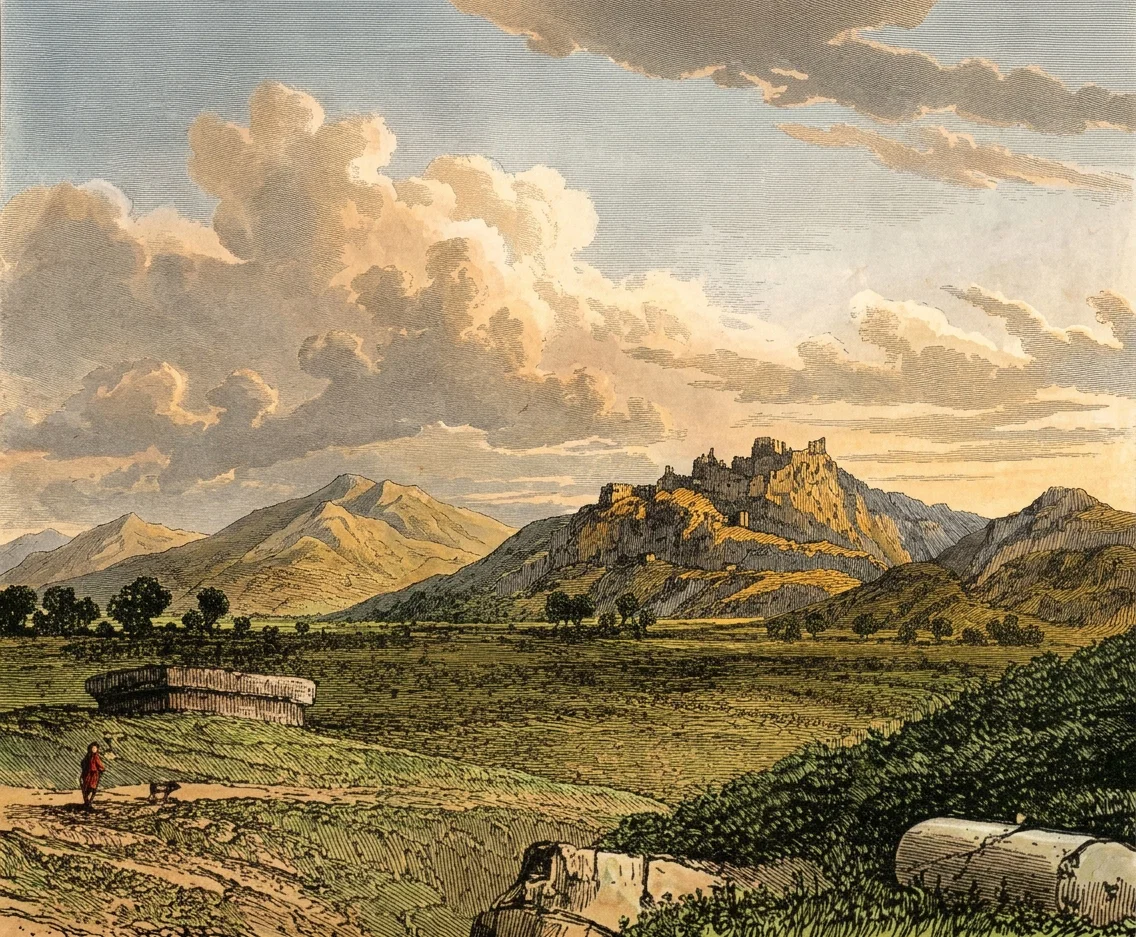
RUINS OF PHILIPPI AND SURROUNDING COUNTRY.
CHRIST AND THE SABBATH:
By James White
Or Christ in the Old Testament and the Sabbath in the New, by Elder James White. Paper covers, fifty-six pages, sent post-paid for ten cents. Address, PACIFIC PRESS, Oakland, Cal.
Full . . . . Running Over Measure
Printed on fine paper; the Helps helped by more than 350 elegant illustrations; cover leather lined to edge, making a durable binding, our Premium Bible is a thing of beauty and a bargain unsurpassed. Other features: round corners, divinity circuit, red under gold edges, minion type.
10,000 References to the Revised Version
Are given in the COMBINED CONCORDANCE, which contains in one alphabetical list, a Concordance, Subject Index, and Pronouncing Dictionary of Scripture Proper Names, diacritically marked for pronunciation, with meaning.
The Signs of the Times
One year—800 pages—illustrated, and this Splendid Bible to old or new subscribers IS given with our Fine Premium Bible, because it is printed on Fine Paper and has a Library of Helps Splendidly Illustrated, and the whole is substantially bound.
Decide Soon
The IMMENSE NEW BIBLE TREASURY
Is a library in itself, concerning Bible Customs, History, Geography, Weights, Measures, Books of the Bible, Etc., Etc. Among other valuable features:
LIFE OF JESUS AND HARMONY OF THE GOSPELS
PARABLES AND MIRACLES OF JESUS
LIFE AND TRAVELS OF PAUL
SACRED CHRONOLOGY, ETC., ETC.
Over 650 Pages of Valuable Helps
350 Fine Illustrations
$3.00
Read the SPECIAL TERMS in the first column, next page, and secure a few subscribers at the regular price of the SIGNS, $1.00 per year. Add $2.00 for the Bible to the prices there given. The commission will help you get the Bible.
WE WILL SEND THE BIBLE FREE, post-paid, for 7 new names and $7.00. Solicit the subscriptions and make it free for yourself. The Bible will be sent to any of the 7 subscribers for $2.00 extra. Bible and papers sent to different addresses if desired. Your Name on the Cover for 25 Cents Extra.
We Want Agents
Address, Signs of the Times, Oakland, California
SURE WORD OF PROPHECY. A study of the book of Daniel.
A concise study of this important prophetic portion of the Bible. Fully illustrated. Paper covers. 96 pages. Bible Students' Library No. 131. Price, 10 cents.