The Youth’s Instructor, Vol. 43, No. 15.

THE MONROE DOCTRINE

The Youth’s Instructor

Apr 11, 1895

S. D. A. Publishing Association · Battle Creek, Mich. · Apr 11, 1895

THE MONROE DOCTRINE.
THE settled policy of the United States not to allow any of the European countries to commit acts of aggression upon the weaker republics of the Western Hemisphere, is generally known and referred to as the “Monroe Doctrine.” It is so called because it was first officially declared by James Monroe while he was president of the United States. The message containing the statement from which the term “Monroe Doctrine” is derived, was presented to Congress Dec. 2, 1823, the most striking passage being as follows:—
“We owe it, therefore, to candor, and to the amicable relations existing between the United States and those powers, to declare that we should consider any attempt on their part to extend their system to any portion of this hemisphere as dangerous to our peace and safety. With the existing colonies or dependencies of any European power we have not interfered, and shall not interfere; but with the governments who have declared their independence and maintained it, and whose independence we have, on great consideration and on just principles, acknowledged, we could not view any interposition for the purpose of oppressing them, or controlling in any other manner their destiny, by any European power, in any other light than as the manifestation of an act unfriendly to the United States.”
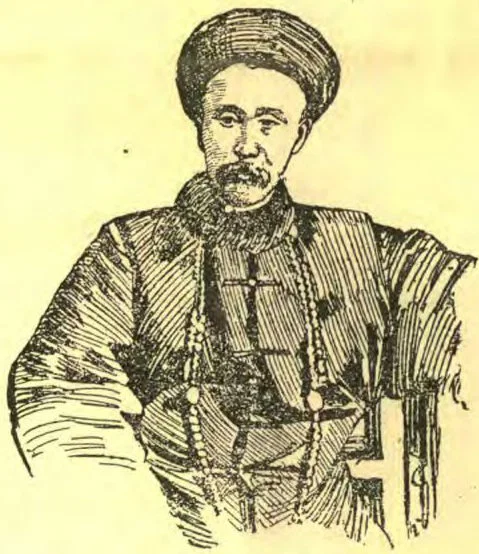
LI HUNG CHANG.
LI HUNG CHANG.
Other presidents of the United States have since reaffirmed this position, and it is generally known that, while this country will not interfere in any of the European complications, the price that we exact for such non-interference in Europe is the right to have our say in affairs in the Western Hemisphere, and especially that European aggression will not be allowed upon the weak republics of Central and South America.
The practical working of this national policy was seen soon after the close of the Civil war in the United States. While that war was in progress, France became involved in a war with Mexico, and subjugated the country. The republic was converted into an empire, and Maximilian, a brother of the emperor of Austria, was made emperor. Here was a direct infraction by France of the idea couched in the term “Monroe Doctrine.” A European system of government was by force of arms imposed upon an American republic. The United States protested, but being engaged at that time in a fratricidal struggle, did nothing but protest; but as soon as the Civil war ceased, this government made a peremptory demand of France that she withdraw her troops from Mexico. This she did, and Maximilian, left without support, was taken by the Mexicans and shot, and the republic was reëstablished. A very sad incident, growing out of this tragic affair, is that the empress Carlotta, wife of Maximilian, became insane, and has never recovered her reason. Thus the invasion of Mexico was a failure, and the Monroe doctrine was triumphant.
Thus much by way of history and retrospect. At the present time difficulties have arisen between both the republics of Nicaragua and Venezuela with England, that may lead this government to a further application of this principle. There is a boundary contention between British Guiana and Venezuela, and England evidently desires to gain the control of the Orinoco River. If this should be done, Venezuela would be in the same position that the United States would be in if a foreign power controlled the Mississippi. Against Nicaragua England presents a claim of damages amounting to seventy-five thousand dollars. These weak republics naturally turn toward the United States for protection. The last United States Congress passed a resolution demanding of England that the contention with Venezuela be submitted to arbitration. Lately Secretary Gresham has directed an inquiry to the British government, as to what it intends to do should Nicaragua refuse to pay what England demands. The people of this country are considerably agitated over it, the press is discussing it, and the opinion seems to prevail that here is a good opportunity for the further application of the Monroe Doctrine.
M. E. K.

LI HUNG CHANG.

No doubt the above name sounds very queer to many of our readers, and they can hardly believe any intelligent person can enjoy having such a name; but we should remember that names become familiar and lose their strangeness to us by use, and that to the Chinaman the names George Washington and Abraham Lincoln are just as strange as the most curious Chinese names are to us. We think Wei-hai-wei a queer name for a city, but what about Kalamazoo and Dowagiac?
In spite of his name, Li Hung Chang is a great man, as the world looks at greatness. He, with the help of the British officer, General Gordon, put down the famous Taiping rebellion, in which it is estimated that ten million people perished. But it is as a civil officer, rather than as a military man, that he is the most famed. When General Grant made his tour of the world, he visited Li Hung Chang, and was much impressed by his strong personality. He thought him to be one of the greatest statesmen of the world, and referred to him afterward as “the Bismarck of China.” This is not an inappropriate term; for he has probably had as great an influence in China as Bismarck has had in Germany.
It will not do for us to conclude that Li Hung Chang is not a great statesman and a great man because he has not succeeded in introducing Western improvements of all kinds into China during the years he has had an influence in affairs there. It must be remembered that China is a country where for many hundreds of years one thought has been paramount,—to prevent all foreign ideas and inventions from entering the country, and to do everything just as their fathers have done for ages. A people whose religion consists in the worship of their ancestors, cannot be quickly or easily turned aside from following in their ancestors’ footsteps. So Li Hung Chang, although desiring to see his country advance in the way of European and American civilization, has been obliged to strive continually against the inertia of a vast and ignorant population.
Again: the immense population makes the price of labor in China so cheap that the introduction of labor-saving machinery is looked upon as an evil rather than an advantage. The same feeling was prevalent a hundred years ago in England, and threshing machines were often broken in pieces by the excited English peasants, who thought such machines were robbing them of the work which they needed.
It is related that when General Grant advised Li Hung Chang to build a railroad to carry the rice from the interior of China to Pekin, he was answered in this way: “Twenty thousand men are now engaged in this transportation of rice on the river, and if we should build a railroad to do this work, what shall I do with the twenty thousand men thus thrown out of employment?”
This simple statement will give us some idea of the difficulties to be overcome in the introduction of modern inventions into China. However, some railroads are under process of construction. A telegraphic system has been established, and much has been done in the way of warlike preparations; but not enough of this has been done to make a successful resistance to the Japanese, who are fully abreast of the most warlike nations of Europe. The result was the defeat of China, and the degradation of Li Hung Chang. But the dethronement of the great viceroy did not stop the Japanese successes, and the emperor was at last obliged to call for him, and reinstating him in all his honors, commit to him the delicate and important mission of concluding a peace with Japan.
The aged statesman reached Shimonoseki in Japan in safety, and negotiations were progressing favorably, when a Japanese miscreant made an attempt upon his life, giving him a dangerous, and it is feared fatal, wound in the head. The Japanese government greatly deplore the action, and it is believed that the astute Chinaman will use this attempt upon his life to good account in the negotiations.
If a permanent peace shall be established, and Li Hung Chang be able to return to his country, he will doubtless be the recipient of many favors from his emperor, will receive the applause of the people, and may be able from the prestige thus gained to lead his nation a few more forward steps in progress toward a better civilization. M. E. K.

LITTLE THINGS.

It was only a little thing for Nell To brighten the kitchen fire, To spread the cloth, to draw the tea, As her mother might desire— A little thing; but her mother smiled, And banished all her care. And a day that was sad Closed bright and glad, With a song of praise and prayer.
'T was only a little thing to do For a sturdy lad like Ned To groom the horse, to milk the cow, And bring the wood from the shed; But his father was glad to find at night The chores were all well done. “I am thankful,” said he, “As I can be, For the gift of such a son.”
Only small things, but they brighten life, Or shadow it with care; But little things, but they mold a life For joy or sad despair; But little things, yet life's best prize, The reward which labor brings, Comes to him who uses, And not abuses, The power of little things. — Mrs. Mary Fenton, in Restitution.

THE FLORIDA SPONGE INDUSTRY.

IN TWO PARTS.—PART TWO.
When the sponger discovers a suitable sponge through the aid of the sponge-glass, he hurriedly grasps his hook, and, plunging it directly upon the sponge, he skilfully pulls it from its habitation, brings it up to the surface, and places it in the boat. As soon as the fisherman collects a sufficient quantity, he takes them to the vessel, where they are spread carefully on the deck in their natural upright position, so as to allow the slimy matter, called “gurry,” to run off. During the first stage of decomposition, they have a very unpleasant odor, something like decayed fishy matter. After the dingies have collected a sufficient number of sponges to make a vessel load, they are taken to what are called sponge crawls, which are inclosures of about ten to twelve feet, made generally by placing stakes in the beach where the water is from two to three feet deep.
Sponges, after being kept on the decks of the vessels from one to two days, will generally be sufficiently cured to be taken to the crawls, where they are kept for a few days, and then thoroughly washed and pounded with a flat stick. Now they are placed upon strings about six feet in length, and taken to the markets to be sold in lots, at auction. Then they are carefully trimmed and packed in bales, from fifteen to one hundred pounds each, the cheaper grades being generally packed in the larger bales.
The principal varieties of sponges found in Florida are the following: sheep-wool, yellow, and grass. The Florida sheep-wool are the best quality, being of very fine texture, soft, and very strong and durable. The yellow sponge is of fine quality, but not strong in texture, and not near as soft and durable as the sheep-wool sponges. The grass is very much inferior to the others, not being as strong nor so desirable in shape, and being easily torn.
There are no sponges found in the world to equal the Florida sheep-wool for softness and strength; and no better bath-sponge can be found than a good solid Florida sheep-wool, although they are generally sold for washing carriages, etc. In former years Florida sponges were loaded with lime or sand in order to decrease the price, but of late very few loaded sponges have been placed upon the market.
Sponges in great variety are also found in many places in the West India Islands, and in Cuba. The Cuban sponges are the next best to the Florida. The principal varieties found in Cuba or the West Indies are sheep-wool, reef, yellow, and grass, also velvet, which are next best to the sheep-wool.
The finer grade of sponges are found principally in the Mediterranean, such as the fine surgeon’s, toilet, bathing, and nursery sponges, and are very much higher in price than any others. They are fished principally by divers, sometimes at great depth. After being brought to the land, they are buried in the sand, and allowed to decompose, after which they are well washed and beaten with a small stick, and then packed in bags, and sent direct to London , and again thoroughly cleaned and packed in cases, according to their size and quality. The large London dealers have almost complete control of the sponges found in the Mediterranean. There are a great many varieties of them, principally the fine surgeon’s, toilet, bathing, potter’s, fine-thin-flat (called “elephant’s ears” by the native fishermen), fine cups, Zimoca toilet, Zimoca potter’s, etc. Some of the finest cup sponges are sold at as high as one hundred dollars a dozen. The Mandruka bath sponges are also very expensive and very rare. Some of the cheaper species are also found in the same waters, but none like those of the waters of Cuba or Florida. Florida produces nearly double as many sponges as are imported from all other countries together,—that is, in value, not in quantity; and the demand for good Florida sponges is considerably greater than the supply. Consequently the prices must advance from year to year. The prices of Florida sponges have more than doubled within the last twenty years.—Abridged from the American Journal of Pharmacy.

KEEP THE BRIGHTEST TRAIL.

A GOOD minister, Bishop Baker, in the days when railroads were few, was once inquiring the route across the plains from St. Louis, that he might keep an engagement for holding a conference west of the Rocky Mountains. Many directions were given him, but still he felt uncertain. He asked an old Indian chief, whose simple reply was:—
“Keep the brightest trail.”
This is a good rule for you and me when traveling through a dark and unfriendly world. We shall never get lost while we keep the straight road. It is only when there are crooks and turns that we are in doubt and uncertainty. Sometimes there are two ways—one a straight one, and the other nearly straight. Our best course, then, is to “keep the brightest trail;” to look straight ahead, turn not to the right or to the left, but follow the path trodden by prophets and apostles,—yes, by the Son of God himself.—H. L. Hastings.

Every Member Can Be a Helper

If we cannot all be leaders, we can all be helpers.

THE OLD-TIME SUGAR-CAMP.

To-night I seem to see once more The dear old camp, just as of yore; There's nothing changed—just see How drip those spiles of elder-wood! We thought such tubes were very good,— Two let into each tree.
And see! 'neath each the simple trough Of log rough hewn; quite good enough Those home-made troughs were then.
I'm told that now one never sees Such vessels under sugar trees, But buckets, red or green.
And where huge iron kettles hung, Three side by side, and bubbling, sung Above the camp-fire bright, Now an evaporating pan— Invented by some Yankee man— Quite covers up the light.
I like it not! I much prefer The good old ways: no patent ware Can make amends, I ween, For loss of all that gave its charm To sugar-making on the farm, Before such traps were seen.
Then, all day long, the kettles boiled, And all day long we, cheerful, toiled To gather in the sap. From tree to tree one drove around The sled, with cider-barrel crowned; He had no time to nap!
One fed the fires and swung the ax,— A task which older powers might tax, But boys were sturdy then,— And one beside the kettles stood With busy ladle—that was good Old jovial Uncle Dan.
When at length the wished-for night Of “stirring-off,” with what delight The youngsters, far and near, Flocked toward the spot where, freshly fed, The camp-fire shone out bright and red, Inviting to its cheer!
Mayhap that spring, 'mid lingering snow, The loosened sap would freely flow By day, at night congealed; Then happy we, who liked it best With snow at hand; that ready test The hardening wax revealed.
Ah! how delicious was the feast Of wax just cooled, and how increased By pranks and jests our joy! But then, alas! we could not eat As much as we had thought; so sweet A food will quickly cloy.
Some filled up egg-shells; some on sticks Adroitly rounded balls would fix For loved ones left behind; Whilst from his stirring, Uncle Dan Looked smiling on; that generous man Was certainly most kind!
At last, the granulating sweet To sugar turned, with lessening heat, And still increasing care, Is added to the barreled store Which, till the spring shall come once more, Will furnish wholesome fare.
And soon the gleeful girls and boys Disperse with answering shouts and noise; The camp-fire glimmers low; The grove and fields deserted lie, While placid rides the moon on high, And soft the night-winds blow.
— C. H. Preston, in American Youth.

Jena Factory to Build Giant Telescope Object-Glass

THE construction of an object-glass of extraordinary size is to be undertaken at the Jena factory for a telescope for the Berlin Exhibition of 1896. It is to be two hundred and ten centimeters (about forty-four inches) in diameter. This will be the largest object-glass in the world, being many inches larger than the great Lick instrument. It is said that this is the first object-glass of abnormal dimensions which has been undertaken by the Jena factory.

The Strong and the Weak Need Each Other

The strong need the weak, as well as the weak the strong; therefore no one has any just cause to be proud.

THE SPIDERS.

‘The last of the four little things which King Solomon said were “exceeding wise,” is the spider. Of this little insect he tells us, “The spider taketh hold with her hands, and is in king’s palaces.” Prov. 30:28.
There are many ways in which spiders show wisdom, as you all must have noticed if you have watched them at their work. When one has work to do, she takes both of those little hands that reach out in front of her head, and she seems to have no idea of working with one hand—half working and half playing. She works, and then she rests, and she is so patient and persevering in building up the web and drawing the lines tight that we may well learn from her to take hold with both hands, and not stop until our work is finished.
This lesson of patience and perseverance a spider is said to have taught King Bruce, of Scotland, one day when he was sad and discouraged. He was hiding in a hut from his enemies who were hunting him, and he saw a spider trying to get from one beam in the roof to another. It tried six times and fell every time. Bruce remembered that he had tried six times to save Scotland, and had been defeated every time. Then he watched the spider the seventh time, and saw it slowly and carefully fasten its thread to the beam and draw itself across. He resolved to persevere as the spider had done, and went out to take up his work again.
Now the Lord tells us to lay hold upon something. He says, “Lay hold on eternal life.” He gives life to us every day, and died to give eternal life to all. The trouble with so many is that they do not hold what he gives them, and so when they have lived the few years of this life, they die and lose the everlasting life which the Lord gave them, but which they did not hold to by believing his word.
We must never be discouraged, but take hold of the Lord’s promises with both hands—that is, believing them with all our hearts all the time. Jesus can then give us his own courage and patience. In this way he will add to our faith virtue, or courage, knowledge, temperance, patience, kindness, and other lovely Christ-like traits of character. Read the promise of this in 2 Peter 1:4–8, and see what a number of beautiful threads of character are woven together by Jesus for us, works of righteousness which will endure. All this the Lord will do for those who take hold in real earnest. The Lord says in the book of Job that the paths of those who forget God are as flimsy and short-lived as the spider’s webs. You know the web is so frail that a strong insect may tear it to pieces, or the wind may blow it away. They do not last long. It is not so with those who lay hold on eternal life. They shall live and endure; for when Jesus comes again he will make immortal all who have laid hold upon his life. “For God so loved the world that he gave his only begotten Son, that whosoever believeth in him should not perish, but have everlasting life.”
—F. P. Fisher.

THE FIRST ROBIN.

The promise is sure: While the earth shall remain, Seedtime and harvest shall come in their train. Summer and winter, autumn and spring, The swift-rolling cycles shall certainly bring; And as each one draws near, some token is given To tell us the promise is treasured in heaven. And now, quaker bird, with thy drab coat so trim, We listen with joy to thy heralding hymn: “'T is coming! 't is coming! 't is almost here— The glad, merry springtime, the wakening year!”
Ah, little bird, how many more springs Shall we list for thy song, the soft rush of thy wings, To tell us the springtime is coming apace, That winter is ending his blustering race?— Not many, I ween, and e'en now in thy song A new note seems to tremble and ripple along. Another sure promise it brings to our view From the throne of the Faithful: “All things I make new.” “'T is coming! 't is coming! 't is almost here— The glad new creation, eternity's year!”
JULIA H. DUFFIE.

BURNS FROM EXTREME COLD.

At the last meeting of the Swiss Society of Natural Sciences, at Lausanne, M. Raoul Pictet gave some particulars concerning cold burns experienced by himself and assistants during his investigations of the lowest temperature obtainable. There are two degrees of burns. In one case the skin reddens at first, and turns blue the following day, and subsequently the area of the spot expands until it becomes nearly double its original dimensions. The burn, which is usually not healed until five or six weeks after its occurrence, is accompanied by a very painful itching on the affected spot and the surrounding tissues. When the burning is more serious, produced by longer contact with the cold body, a burn of the second degree is experienced. In this case the skin is rapidly detached, and all parts reached by the cold behave like foreign bodies. A long and stubborn suppuration sets in, which does not seem to accelerate the reconstruction of the tissues. The wounds are malignant, and scar very slowly in a manner entirely different from burns produced by fire.
On one occasion, when M. Pictet was suffering from a severe burn due to a drop of liquid air, he accidentally scorched the same hand very seriously. The scorched portion was healed in ten or twelve days, but the wound produced by the cold burn was open for upward of six months. In order to try the effect of radiation in dry cold air, M. Pictet held his bare arm up to the elbow in a refrigerating vessel maintained at one hundred and five degrees, when a sensation of a peculiarly distinct character was felt over the whole skin and throughout the muscles. At first the sensation was not disagreeable, but gradually it became decidedly so, and after three or four minutes, the skin turned blue, and the pain became more intense and deep-seated. On withdrawing the arm from the refrigerator after ten minutes, a strong reaction was experienced, accompanied by a superficial inflammation of the skin.—Scientific American.

OUR CANINE FRIENDS.

While Holy Writ places the dog among the unclean animals not only (compare Deut. 23 : 13; Isa. 66 : 3; Matt. 7 : 6), but uses him even as an illustration of that which is low and vile (Phil. 3 : 2; Rev. 22 : 15), it must not be inferred that God condemned the creature throughout; for the Creator himself has placed within the animal certain instincts and dispositions which might well cause some of the creatures in human form to blush for shame by a comparison with him. And yet we would not approve of granting the dog equal domestic rights with man, nor anything like it, although we have seen this practised with both cats and dogs, even by some of the professed followers of Jesus. The place of both dogs and cats would properly seem to be out of doors, in a kennel or box appropriately large and bedded with straw or some equivalent, to afford them good shelter against all kinds of weather.
The utility of the dog is so varied that it would by far exceed our limits to even only briefly name each one of the many ways in which he proves of service. In Europe we have seen him draw little wagons or carts for poor peddlers and rag-pickers, their owners at times helping pull the often not inconsiderable load; sometimes he was hitched to a little children's carriage by well-to-do people. In the Alps, besides hunting and watching, he acts the noble part of rescuer of travelers lost in the snows. On the western plains, as well as in many other parts of the world, he is the shepherd's indispensable helper; the hunter makes use of his dexterity to chase up his game, or to catch and bring it, both on land and water; his services of watchman cover an almost endless variety of duties; and the circus as well as the stage utilizes his intelligence and aptness to learn by teaching him all manner of tricks and pranks for mercenary gain.
Science allots the dog his place with wolves, coyotes, dingos, raccoons, jackals, badgers, and similar mammals. He is found under one name or another from the home of the Eskimo in the extreme northern, to the frigid latitudes of the southern, hemisphere, and there is no age of which history makes mention in which the dog cannot be traced as coexistent with man, his master.
As to his distinguishing peculiarities, there is perhaps no canine trait more commendable or proverbial than his fidelity to duty, which often brings him into situations where he fills the place of both man and dog, so to speak, thus making him an exceedingly useful animal. To conclude, we give a well-authenticated instance in illustration of this:—
“In a remote corner of Texas there lived a lonely pioneer, with a considerable band of sheep, which our collie every morning aided to drive to pasture. The owner eventually sickened and finally died. In the morning the dog came to him, and whined and sniffed at the door of the cabin, but no one opened. Remembering his duty, the faithful creature drove his sheep to pasture, tended them, and drove them back at eve. This he did morning and evening regularly, for two years, until at length some settlers came into that section, and found the flock, grown to a large one, still under the charge of the collie, who like man himself, had subsisted upon it while guarding it, as was evident from the bones scattered around. Apparently, every time he needed food, he had seized the last of the flock to enter the corral, killed it, and eaten it as he required. The slaughter, however, was more than made up by the natural increase of the flock.”
AUGUST KUNZ.

EDITORIAL NOTES.

We noticed lately in a religious paper that a certain man had given five hundred dollars for mission work. He is a very wealthy man, and this sum was no more for him to give than it would be for many persons to give a nickel. However, the papers call attention to his gift. We would not insinuate that he gave the money to be seen of men; it was not so large a sum from a man of his means as to be at all remarkable; but how many thousands of persons, the same week,—yes, the same day,—gave larger sums than he, and no notice was taken of it! No notice, did we say?—Yes: no notice by men; but the Father “which seeth in secret” knows it all, and the gifts that are smallest in the eyes of men are often the greatest in his sight. Jesus said that the poor widow who gave two mites gave more than the rich who “cast in much.” There are records on earth, and there are records in heaven. The former are very incomplete and one-sided; the latter are true and faithful. The standard of measure in heaven is not the amount given, but the heart and the spirit of sacrifice that prompt the gift. So the smallest offerings are often the largest in God’s sight.
THE boy king of Spain has a regiment of boy soldiers. At a late review, he promoted some of them to be officers, and distributed bonbons and cake to many of them. One boy soldier who received nothing, was furious because nothing was given to him. He threw down his gun, declared himself a revolutionist, and began to “hurrah for the Republic.” The king hearing of his rebellious subject, sent for him, and gave him a whole box of bonbons, and a large piece of cake. At once he was pacified, and took his gun as a loyal subject to the king. This story is a good illustration of the secret springs of action of men as well as of children. A poet has said:—
“Men are only boys grown tall; Hearts don’t change much, after all.”
Many a man has changed from a royalist to a republican or from a republican to a royalist, or changed his political opinions several times, when the real cause of his change was money, or honors of office, which to him were the same as the bonbons and cake to the little boy. It is better to stand firmly for right principles than to change one’s mind because of some prospective benefit to be gained. That distinguished American statesman, Henry Clay, once said: “I had rather be right than be president.”
A FEW days since, conversing with an intelligent young lady who is making a success of teaching, and speaking of the qualifications now required of teachers and the rigid examination they are obliged to pass before they can receive a certificate to teach, she made this remark: “No question is hard if one knows how to answer it.” This is certainly true; and it is also true that the simplest question is hard to one who does not know how to answer it. So it is all a matter of knowledge and education. Some one has said that every one is eloquent in the things which he understands. This is not strictly true if by eloquence public speaking is meant; but it is true that we can tell what we know, and we cannot tell what we do not know. If we can have, with the knowledge which sometimes “puffeth up,” the charity, or love, which “edifieth,” we shall have found the happy medium. Knowledge and education, added to a heart purified by the gospel of Christ, will make of us vessels of honor, “sanctified, and meet for the Master’s use, and prepared unto every good work.”
In this number of the INSTRUCTOR will be found some additional notes upon the Sabbath-school lessons. It is expected that these will be continued in the future. The lessons are of great interest, and it is hoped that these notes will be a help to the student in the study of the lessons. May all remember that the study of the Sabbath-school lessons should be for the purpose of learning the practical truths they teach, in order that we may put them into practice. The study of mathematics, or any other science, would be of little use to a person if he did not intend to use the principles learned. The gospel contains the principles by which we may live a godly life. Every lesson we learn from the Scriptures is for the purpose of gaining this end. Shall we not make it a fixed principle to learn and do?
M. E. K.

THE SERVICE OF CHRIST.

There is no valid or sound reason why any one should refuse to serve the Lord Jesus Christ, nor is there any excuse for deferring the time when we will commence such service. God is as much entitled to our service in youth as in middle life or in old age. The yoke of Christ is not a galling yoke; and while it is often brought to view in the Scriptures as service rendered to a master, it is such a blessed and ennobling service that it honors those who render it as well as Him who receives it. The Lord has said: “My Son, give me thine heart.” Our heart, our affections, belong to God; as the author of our being and as the One who bestows upon us all our blessings, no one should be allowed to receive such love, reverence, and service as we yield to him.
God is entitled to our service as soon as we understand our relations to him. Human affections must be placed upon something, why not upon God? The vine which has no support winds its tendrils around everything upon the ground; so we, if we are not stayed upon God, find our affections reaching after and grasping the unworthy ambitions and forbidden vanities of this world. Says the apostle: “Set your affections on things above, not on things on the earth.” Col. 3 : 2. This shows that we have the freedom of choice. We can control our affections. Then let God, to whom our affections belong, have the first place in our hearts; and he, once enthroned there, will regulate our lives so that every act will be fruitful of praise and honor to him, and of help and blessing to others.
The Lord wants to do this. Yes, he is anxious to do it. He is represented in the Scriptures as coming to us, and knocking for admittance. “Behold, I stand at the door, and knock: if any man hear my voice, and open the door, I will come in to him, and will sup with him, and he with me.” How important, then, is the question, Shall we let him in? Shall we allow the royal guest, Jesus, the Son of God, to enter our hearts, to be our guest,—allow his blessed life to be mingled with ours,—sup with him and he with us? What sweet communion is here illustrated!
And we cannot commence this service too early. Life is very uncertain. God may see that we have but a few more years to live here,—perhaps but a few months or days. He may visit us with his spirit to impress our minds with the thought that we must now consecrate ourselves to him. Shall such love meet with nothing but hardness of heart as a requital? As long as probation lasts, God will accept all those who come to him; for he is rich in mercy, forbearance, and love; but should not the knowledge that he is a being of such infinite love lead us to give ourselves this day to him? He is speaking continually to us through his word, through his servants, by his providences. Whether we will hear him or not depends upon ourselves. It is for us to will, to hear, and to obey. “To-day if ye will hear his voice, harden not your hearts.”
M. E. K.

THE WAY OF SALVATION.

What will not mistaken zealots do in order to purchase salvation? A missionary from India describes what he saw at a great Hindu festival in the following manner:—
“It is a holy place and a holy time, and all the holy men have come in from far and near. Let me tell you these men are the embodiment of sanctity. They are so pure that the touch of even the European would defile them. They have forsaken the world for religion. They have clothed themselves with ashes. They subject themselves to terrible penances. I saw a man there on a bed of spikes, men hanging by the heels to a tree, a man buried up to the neck, a man sitting between five fires before the blazing sun, a man lacerating himself till the blood gushed out, a man holding up a right hand till it dried up—and all to gain salvation.”
The reason of this fearful self-immolation is because the idea of salvation by works is deeply ingrained upon the Hindu heart by ages of teaching from their sacred books. When a person really considers the immense number of his misdeeds,—how far short he has come from a perfect life,—and also believes that God requires of him perfect obedience, which he is utterly unable to perform, it is not so strange that he should seek to punish himself, that he may thus gain the favor of the Deity. Even professed Christians have done similar things, shutting themselves up in monasteries and convents, and wearing out their lives by protracted fasts and self-inflicted flagellations.
The gospel of Jesus Christ, when presented in its purity, gives relief to the soul by the glad assurance that salvation cannot be obtained by our own works, but that it is a gracious gift of God. Works are enjoined, but they are works of love to others; they are not to purchase salvation. We cannot purchase that; we have nothing to give. So Jesus purchased it and us by his death and life, and we, from gratitude to him for what he has done, should dedicate our lives to him. Thus doing, we become his children. “Behold, what manner of love the Father hath bestowed upon us, that we should be called the sons of God.” He wants us to believe it, and to enjoy the rest and happiness that there is in this knowledge. He says: “Come unto me, . . . and I will give you rest.” Blessed rest, when faith in our acceptance with him removes the condemnation for sin! “There is therefore now no condemnation to them which are in Christ Jesus.” If we are not in Christ, salvation is not ours, and we are in a sad condition. If we are in Christ, condemnation is gone, and we rest in Christ, saved by him.
M. E. K.
Continue reading: LESSON 4.—THE FIERY FURNACE