The Youth's Instructor, Vol. LI, No. 28

The Third Angel's Message in England

The Youth's Instructor

July 16, 1903

Review and Herald Publishing Company · Battle Creek, Michigan · July 16, 1903

The Third Angel's Message in England
THE third angel's message was first carried to England by the living preacher when, on May 23, 1878, Brother William Ings arrived in Southampton from Basle, Switzerland. His first report contains the statement that he found the people “hungering for the truth;” and at the end of his first sixteen weeks of labor, ten were keeping the Sabbath.
Why the opening up of our work in England was delayed until twenty-five years ago, and why so little effort has been put forth since that time, can hardly be explained, in view of the fact that England for the past two centuries has been the headquarters, or fountain, of the world's missionary zeal and enterprise. That country has done more to spread a knowledge of the word of God than all other nations of the earth combined; and from among the sturdy, noble men of England and Scotland have gone forth the greatest missionaries of the past century.
To refresh the minds of our readers with the facts in this respect, it is only necessary to call attention to such missionary heroes as William Carey, the “father of modern missions,” who went to India in 1793; Alexander Duff, who reached India five years before the death of William Carey; Robert Morrison, who, early in the nineteenth century, opened up China to the light of the gospel; Robert Moffatt, David Livingstone, and James Hannington, whose names are well known among the brightest missionary lights in the “dark continent;” Bishop Patteson, missionary to the South Sea Islands; John Mackenzie, missionary to China; James Chalmers, the recently martyred missionary to New Guinea; and last, but not least, our beloved J. Hudson Taylor, superintendent of the Chinese inland missions, whose name is known and spoken in tenderest terms at nearly every Christian fireside. These are a few among the scores of noble Christian patriots who have gone from England and Scotland to carry the glad tidings of salvation to the dark nations of the earth.

The First Angel's Message

England has been the birthplace of many of the world's great religious movements. Every great reformation has found fruitful soil in the zeal, courage, and devotion of the people of the British Isles.
Although we hear but scant reference made to the fact, yet we are informed on good authority that at the time when Mr. Miller and his associates were giving the first angel's message in America, seven hundred clergymen of the Church of England were raising the cry, “The Lord is at hand.” Many non-conformists also preached the same doctrine, among whom were Drs. Cummings and Bonar. In England, also, Dr. Joseph Wolff received the truth that the coming of the Lord was near, and proclaimed it throughout all the East, as well as before many, both high and low, in England. There are still many in England who advocate the near coming of Christ.

The Sabbath Truth

Observers of the seventh day were known as a distinct sect in England as early as the sixteenth century; and John Evans, who in 1801 wrote “A Sketch of the Denominations of the Christian World,” referred to these Sabbath-keepers as deserving of distinct mention “on account of their integrity and respectability.” In the reign of “Good Queen Bess” there was much agitation over the subject; and that agitation developed men and women who counted the truth of God dearer than honor, wealth, and life.

A Natural Center

England is a natural center for a world-wide work. Her shipping lines radiate to every land. Her steamers, the best manned and most comfortable among all that sail the seas, visit every nation on the globe. Her political and religious influence, the energy, intelligence, and strength of her colonies, and her vital touch with the nations of the world, make her the center of the world's work and power. Surely the present awakening in behalf of the third angel's message in the British Isles is a most important, though tardy, movement.
The population of Great Britain is about forty-two millions, and is distributed approximately as follows: England, thirty millions; Scotland, five millions; Ireland, five millions; Wales, two millions. It will be observed that the population of these little islands is more than one half that of the United States; and from the standpoint of the third angel's message, we must count a nation important in proportion to its population, rather than the square miles in its territory.

Organization

Before the Conference held on the camp-ground in Leeds, England, early in August, 1902, our work in Great Britain was organized as a single Conference; and at that time the membership was about one thousand. During this meeting the British field was divided and reorganized. England was divided into two parts, known as the North and South England Conferences. Take your map of Great Britain, and draw a line across the island from the Bristol Channel on the west to The Wash on the east, and you will have approximately the dividing line between these two Conferences. Scotland, Ireland, and Wales were organized as mission fields. Thus, Great Britain was divided into five parts,—two Conferences and three mission fields; and all were organized under a general management known as the British Union Conference.

A New Impetus

This reorganization of the British field marked the beginning of a strong, new impetus in the work. This has been particularly noticeable in sections of Great Britain lying most remote from London. Previously to the reorganization, the work centered in London; and those who directed the work were naturally situated in and about the metropolis.
As is nearly always the case, the needs nearest at hand seemed of greatest importance; therefore only secondary attention was given to such interesting portions of the country as Scotland, Ireland, Wales, and the north of England; but when these outlying sections were organized upon a responsible, self-directing basis, and supplied with a corps of workers, and the means with which to support them, good results began immediately to appear.
The spirit of our work in Great Britain is evangelical rather than institutional; and the people have adopted with all their hearts the glorious principle that it is better to go out and touch the needs of the world with their own hands rather than create a machine to do the work.
The International Tract Society, which occupies a rented building at 451 Holloway Road, London N., is the headquarters of our publishing and tract and missionary work. This is a purely Seventh-day Adventist missionary publishing house, and the spirit of the message pervades every corner. No commercial work is done; in fact, the facilities are so few that our brethren there have been unable to do all the denominational work. They print The Present Truth, the British Good Health, and their tracts and pamphlets; but nearly all the large, bound books are let out to printers and binders in London, who do the work quite acceptably. Thus, with a small investment, the International Tract Society is able to turn over a large business, and keep free from financial embarrassments.
Every morning the manager meets with his employees for a season of worship. These seasons are a source of strength and enjoyment. The easy family feeling, and the mutual confidence and desire to help one another, which are evident between the employees and managers, are a source of spiritual strength to the little publishing house, and help to make it a proper representative of the sacred work of God.

Subscription Books and Periodicals

Great Britain is proving a fruitful field for the sale of our large books. Although at times the apprehension has prevailed that large books could not be sold successfully, yet the Lord has called faithful men to this department of service, and they have always been able to demonstrate that Great Britain is a good field for the sale of these books. A strong impetus was given to that department in the spring of 1902, when a company of nine experienced canvassers was sent to Great Britain. These men without exception have been doing faithful, successful work; and they were so greatly appreciated that the British Union Conference passed a vote of thanks to the Mission Board for sending them, and endeavored to emphasize their appreciation by making a call for ten more. These also have been sent, and reports of their work have appeared in The Review from time to time.
The circulation of periodicals in Great Britain has been a marked success. With a constituency of only one thousand Sabbath-keepers, twenty thousand copies of Present Truth are circulated every week, and fifty thousand copies of the British Good Health each month. This means an average circulation of over thirty-two papers a week for each member. If the sixty thousand Sabbath-keepers in the United States would do as well, we should give our American papers a circulation of about two million copies a week.
In fact, our brethren and sisters in the British Isles are earnest workers for God. When they hear the truth, they immediately lay plans to carry it to others; and it is interesting to see the self-sacrifice and patient labor of our brethren who esteem it a privilege to work long hours on a small income, in order that they may give their lives wholly to spreading the truth.
There are fully two hundred Sabbath-keepers in the British Union Conference, or an average of twenty per cent of the membership, giving their time wholly, or nearly so, to the circulation of our literature.

The London Bible School

The London Bible School is a unique institution. It is a school at work. If we were to present to our readers a picture of the school, it would consist of the teachers and students only, unless we were to include a copy of “Webster's Dictionary” and a table, which, we are informed, is the entire apparatus.
During the school year ending about the first of May, 1902, the school was held in a little, dingy hall, about one mile from the publishing house. Many of the students were unable to advance money for their expenses; therefore, they divided their time between study and work. They attended school in the morning, and sold books and papers in the afternoon; and when the school closed, the managers reported that every student had paid his accounts in full, at both the school and the publishing house. This is a record to be proud of; and will, we trust, be an inspiration as well as a guide in forming the school's future policy.
The school year which has recently closed has been equally successful. The attendance of several young people from the United States has been a help and encouragement. The school was held in Holloway Hall, only a few doors from the publishing house. The accommodations were better than during the previous year, and yet the same simple form was maintained.
A good school depends upon the teachers and students more than upon the facilities. A magnificent school, with a good, broad course of study, and with the spirit and power of the message as its foundation and life, may be conducted in the most humble quarters, and with few facilities; while a very poor school, with the power and strength of the message sadly lacking, may be conducted in fine buildings, supplied with the most approved apparatus.
But our brethren in Great Britain have looked forward to the time when their little school could enjoy better facilities, and they have not been idle during the past three years. It is an old proverb that “All things come to those who wait.” It is a recent and somewhat pointed rendering of that proverb that “All things come to those who hustle while they wait.” Brother Salisbury and his associates, who have been earnestly working to secure funds with which to establish a better equipped school, now have in hand fully five thousand dollars to be devoted to this purpose, and it is the intention of the Mission Board to supply about double that amount, so as to enable them to establish a comfortable little school, that shall be free from debt.
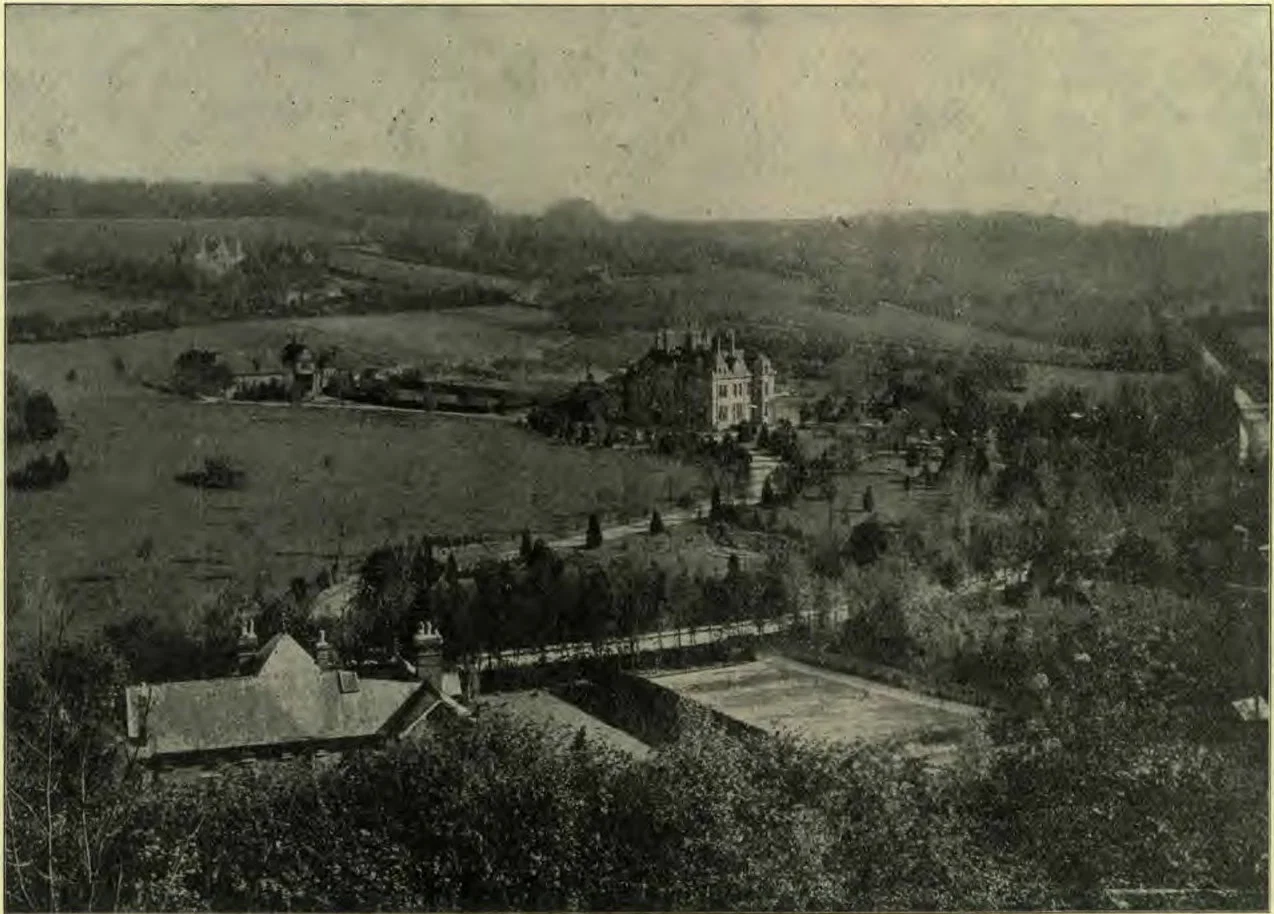
A VIEW IN THE CATERHAM VALLEY, SURREY, ENGLAND
Let us unite in praying that this earnest effort may be rewarded with success. The readers of the INSTRUCTOR will certainly enjoy the privilege of rendering some assistance when opportunity is offered.

The Caterham Sanitarium

For many months the brethren in Great Britain have been looking for a proper site for a sanitarium, for which the needs of the work had been loudly calling for a long time; and finally their search was rewarded by finding a suitable place in the Caterham Valley, about seventeen miles from London; and they have opened a comfortable little institution there.
The British Union Conference promptly raised five thousand dollars for this enterprise, or an average of five dollars for each member; and the brethren in America came to their assistance by supplying two dollars for each dollar raised in Great Britain; thus they were able to purchase and equip a sanitarium, free from debt; and a few days ago it was formally opened for its work. Elder G. A. Irwin, president of the Australasian Union Conference, and Dr. David Paulson, were present to assist in the opening exercises.
Thus the good work is growing in our fatherland, and we rejoice as we see the rapid developments. The long-neglected work in Great Britain is being revived. That country will certainly soon take a strong position in carrying the third angel's message to the world.
E. R. PALMER.

Living Lessons

ONE Sabbath afternoon in early spring, a girl friend and myself started out for a short walk. It had been raining hard, and even yet gusts of wind at intervals swept down with heavier drops between; but we had been separated for several weeks, and now longed for a quiet, restful hour, apart from the hurry and bustle of the world. So, caring not for dubious clouds, we donned rubbers and wraps, and taking each an umbrella, started.
The air was bracing, fresh, and sweet,—not only sweet in its purity, but laden with the perfume of countless orange blossoms; for we were in Southern California. Could we amid such loveliness speak of it in any other way than as an expression of our Father's thoughts to us?
As we talked of the parables drawn from wayside scenes, one of them suggested the thought of ourselves, trying to draw life-lessons from the beauty about us as we passed along; then, ere we reached home, relating what we had found.
I remember a few of the lessons thus gathered, one being the revelation of the attribute of gentleness in our Father's character by the manner of the raindrops’ fall,—never harshly, but always gently. Another was drawn from the height and rankness of the grass which grew beneath the sheltering branches, discarded by all animals if it is possible for them to get the short, sweet grass that grows more slowly, unprotected from wind and weather. Shelter from life's conflicts does not always produce or encourage sweetness of character.
Lifting our eyes, we beheld a rift in the storm-curtain, revealing great, glory-tinted billows of cloud, reflecting the last bright beams of the lowering sun. Thus came our lesson in hopefulness. “There is hope beyond the shadows; there is light beyond the veil.” And even though darkness seems above, beneath, and about us, the sunshine of His glory shines over all, and soon the clouds will lift, revealing how slight was the veil that obscured its shining.
Now we were almost home; but the hour had been thoroughly enjoyed, and we had learned to read some lessons of God's love in the things about us.
BERTHA E. SPEAR.

Learn to Think

TIME'S great chain is made of links; Just the present one is ours. Make it strong. The one who thinks Most and best, will use his powers.
Be not indolent, I pray, Drifting like a wave at sea. Master self while yet you may; Daily ask, What shall I be?
Now's the time for sober thought— Truth and error make the fight— Shall I drift along or not? All is well that endeth right.
Think who paints for us the rose, Yields to us its perfume sweet; Trees and hills His power disclose, Clouds and stars bow at his feet.
Leave thy mental sloth, and think Thoughts of God. The end is nigh. If the indolent must sink, We'll prepare for by and by.
PAULINE ALDERMAN.

Loren Blair’s Certificate

The mowing machine drawn by two big horses clicked its way through the tall grass of the south meadow, leaving a heavy swath of clover and timothy in its wake. The sun-burned young fellow who manipulated the mower and guided the horses was too intent upon his work to see another youth, as brown as himself, who leaned upon the fence next the road, until hailed with: “Hello there, Rod! Great summer for hay, isn’t it?”
“Great’s no name for it,” answered the young mower. “We’ll cut fifty tons, easy. How’s yours turning out?”
“Oh, all right, I guess,” was the careless answer. “I’d be cutting this morning if I hadn’t more important business.”
Rodney Jennings glanced up at the cloudless blue skies.
“Must be a big thing if you can afford to use this kind of weather for it,” he remarked, gathering up the reins, and looking a little curiously at the young man on the other side of the fence. He wore his best clothes, a thing rare in the country during the season when all hands “make hay when the sun shines.”
“’Tis, rather.” Loren Blair settled his tie complacently, and flicked a dust mark from his coat sleeve. “About as big as old Judge Roswell’s farm. That’s something to risk a load or two of hay for, I take it.”
“What do you mean?” asked Rod, interested at once. He dropped the reins, and stopped the “k’lk” to the horses before it was fairly begun. The Roswell farm was the best in the country, and the apple of the old judge’s eye.
“He wants a man to run it,” said Loren. “Moore, who’s there now, has bought a place up north of Ventnor. The judge pays top-notch wages,—more than I can make working on shares for father,—and I’m going into town to persuade his honor that I’m just the man he’s looking for.”
“What’ll your father do?” asked Rodney, after a little. Mr. Blair had been ailing all the spring, and it was an open secret in the neighborhood that he was straining every nerve to rid his farm of a “cut-throat” mortgage. He would be seriously handicapped if Loren left him; for help is hard to get through haying and harvest.
“Do the best he can, I suppose,” was the short answer. “I’m not tied to him. I was twenty-one last week. He’ll be rather cut up, but he can get a man somewhere, I guess. A chance like this doesn’t come every day in the week, and I propose to make the most of it. A fellow owes something to himself.”
“It’s a good chance.” Rodney Jennings spoke slowly as he gathered up the reins again. “A first-rate chance—only—well, what a fellow owes himself isn’t always the first debt he should square up. But talk won’t cut this hay. K’lk! Get up, boys! Good luck to you, Lo. Let me know how you come out.”
“Sure,” answered young Blair, jauntily, as he started off.
Seated on his “chariot of industry,” Rodney drove the big horses across the field to the west woods, thinking rather enviously of Loren’s chance at the Roswell farm. If only he had heard of it first! In another month he must give place to Farmer Kenton’s nephew, who had written that he must work out-of-doors or lose his health entirely.
“I hate to have you go, Rod,” Mr. Kenton had said only that morning when he had given him his “month’s notice,” “but you see how it is. I’ve got to help ’Liza’s boy if I can. You’re a good hand, though, and you won’t have any trouble in getting another place. I’ll speak a good word for you to anybody that comes along, but you don’t need it. Your best recommend is your work.”
“If I’d only known this morning!” thought Rod. Then, as a thought came to him, he laughed a little grimly, and pushed the lever hard down to lift the cutter-bar over a rock. “I’m a good one to be lecturing Lo!” he said aloud. “It doesn’t matter. I shouldn’t have left this hay if I had known. A fellow’s got to be fair all around, and take the consequences, I guess. Maybe, if Lo gets the Roswell farm, I can get a job with Mr. Blair.”
Still, the thought was not entirely satisfactory. What young man of spirit likes to take second-best when there is a possibility of having first?
Meanwhile Loren, untroubled by any scruples about fairness or neglected hay, whistled his way into town and up the stairs to the Judge’s office, where he made application for the place, and underwent a searching examination on subsoil plowing, rotation of crops, care of stock, pruning fruit-trees, trimming grape-vines and a dozen other branches of the science of agriculture.
“Oh, he put me through my paces,” Loren told Rodney that afternoon, on his way home, “but I answered him glib as you please, thanks to father’s being full of the same notions, and bound to talk them morning, noon, and night. I get sick and tired of it, but I guess it’s served me a good turn. I could see the old Judge was impressed with the store of useful information I carry under my hat.”
“Did you get the place?” asked Rod, rather disgusted at his friend’s conceit, and thinking to get away from it by driving off. Only a narrow strip of the meadow remained uncut, and he was anxious to finish it before sunset.
“Well, I’ve as good as nailed it down,” was the answer, “though we didn’t close the bargain. He told me to come in Friday. Well, good-by, Rod. Guess I’ll jog along home. It’s too late to cut any grass to-day, but there’s another day coming.”
“It may not be as good as this,” Rodney could not help saying as he drove off. But Loren only laughed.
“Don’t croak,” he called after him. “Anyway, I’ve done a good day’s work for Loren Blair.”
“And left your father’s hay to spoil in the field, or I’m no weather prophet,” growled Rod, with a glance at the southern sky, where the clouds were piling up one upon another in great, fleecy masses.
The rest of the week was “catchy weather,” bad for hay and the temper of those who make it. Sunny mornings, clouds by noon, sharp showers and gusts of wind, made haying slow work. On Friday the Blair meadow was in no condition to leave, but Loren hurried up to town to meet his appointment with the judge. He entered the office with a brisk step and a confident air, which, for some reason, seemed to anger the gruff old gentleman who sat at a big desk littered with papers.
“No, sir, no, sir! I’ve no bargain to make with you,” he exclaimed, with a wave of his hand before Loren had time to say a word. “I’ve read your certificate, and it won’t answer. You’re not the man for me.”
Loren gazed at the irate old judge, fairly dumfounded. “Read my certificate!” he exclaimed. What could he mean? Had some one been playing an underhanded trick? Surprised and angry, he stood his ground in spite of the wave of dismissal.
“I—I don’t understand,” he said, trying hard to keep his voice steady. “I haven’t any certificate. I didn’t know it was necessary. If you’ve seen one, it’s a forgery, and I can prove it if you’ll give me the chance.”
The judge looked up from the brief on which he was working, and something he saw in Loren’s face made him decide to spend a little more time upon his case. He leaned back in his chair, and rested his elbows on the arms, bringing the tips of his fingers together in a way the lawyers of his circuit had learned to dread.
“You have a certificate, young man,” he answered grimly, “and it’s no forgery. You wrote it yourself, and I read it yesterday afternoon. It’s written all over your father’s farm, and it’s no credit to you, sir. Now do you understand?”
“No,” said Loren Blair, dully, “I don’t.” Just then the only fact that he understood clearly was that he had lost the Roswell farm and the judge’s top-notch wages.
“I think,” said Judge Roswell, consulting a large gold watch, “that I can spare you just five minutes for further explanation. Yesterday afternoon I drove out your way in the rain and looked around. Your meadow was in bad shape. The mowing-machine stood there uncovered. The sulky rake was in the barn-yard, its teeth red with rust. Your hoe was leaning against the fence in the potato field. ‘Careless with tools’ you had written with your own hand, sir.”
“On your east fence there are a dozen boards missing. A hammer and a handful of nails would have made them fast when they first came loose. Two lengths of fence are down next the woods. You neglected to put them up when you hauled the wood last winter. Your gates all sag on the hinges because you drag them shut rather than lift them a little. That spells ‘Slack,’ sir, or I’m no judge of a farmer’s handwriting.”
“There are other items—worms’ nests in the apple-trees, yellowed trees in the peach orchard, and your windmill squealing for grease—but the word written largest in your certificate is ‘Selfish.’ Your father has been sick for six months and needs you sadly; yet you plan to leave him right in the thick of his work because you’ve turned twenty-one, and feel that you can better yourself. Have you no idea of common justice, sir? Is the perpendicular pronoun the only word in the English language? My advice to you, young man, is to go home. Erase what you have written as soon as ever you can, and write a better certificate for yourself before you dare hope to get a better place.” He glanced at his watch. “Five minutes, exactly. I hope I’ve made the matter plain?”
Loren Blair’s face was pale. But from the wreck of his careless conceit a manlier spirit rose dauntlessly, and he answered with a steady voice:— “Quite plain, Judge Roswell. And I thank you for it.”
“H’m!” muttered the judge as he turned to his work again. “H’m! He’s got good grit, anyway. Shouldn’t wonder if that five minutes was well spent.”
“Careless—Slack—Selfish!” Down the village street, and far along his homeward way, the fatal words of his certificate rang in Loren Blair’s ears; but he met them with a firm resolution that they should be speedily erased, as the judge had suggested. He would get the tools under cover, and mend the fence before he slept. Yes, and the windmill shouldn’t “squeal for grease” another day. As for his father, he’d see the farm clear of the mortgage before he struck out for himself, come what might.
“Hello, Loren!” It was Rod calling from the top of a big load of hay. “What luck?”
Loren hesitated for a moment. Across his mind there flashed two visions of the future—the future as it might have been but for the judge’s warning, and the future as he now meant it to be.
“First-rate!” he called back, cheerfully. “But I didn’t get the place.” Then, by way of giving the “largest word” of his certificate a vigorous wipe, he added, “You try for it, Rod. I’ve an idea your certificate will read better than mine. That’s the last load from the south meadow, isn’t it?”—Young People’s Weekly.

One Way to Help

Not long ago it was my privilege to talk personally with a number of our young people in College View, Nebraska, about the Young People's work. Many of them were going soon to their home churches, and all were interested in the work for which the Young People's Society stands. The company at Lincoln have been busy during the winter, and are happy and enthusiastic in their efforts to carry out the aim of the organization.
As I spoke with these young people, gathered from all parts of the West, I could not but wish that we might come into closer touch with them—might know more of what they are doing month by month. Of course statistical reports are sent out regularly to the various State Secretaries, but these reports are not such as can be printed in the INSTRUCTOR, even if they came to it. Now is there not, in nearly every Society, some one who would be willing to write, once a quarter if no oftener, a descriptive report of the work that that Society is doing? Not so much what has been done to benefit yourselves, as a Society, but what you have done to help others, and the results, if any, that are seen from your work. Let the writing of such reports be made one of the regular departments of the Society, and some one be appointed to the duty of either preparing them himself or seeing that they are written by some one else.
In this way our young people who belong to these Societies, though scattered all over this country, and even in other lands, may “speak often to each other,” and the speaking will be a source of profit and encouragement to all.

A Talk with the Young People

THE following from Brother B. E. Huffman is found in a recent number of The Kansas Worker:—
The Young People’s Society is not an organization independent or separate from the church, but a department of it; therefore the church should have a general oversight of its work. It is not necessary to have more than one class of members. Let all be active members. The benefits you receive do not come from membership, but from activity. You should come together to study the Bible, and plan to carry on missionary work. Conduct your work so that every one may have opportunity to develop his talents. It is proper for the older members of the church to attend, and we should be glad to have them do so; but we should not expect them to do all the work. The object of your meetings is to develop workers, not listeners. We need “old men for counsel and young men for strength,” in this missionary work.
Allow me to suggest that the Weekly Study in the INSTRUCTOR form the basis for your regular lessons, also that you try this thought for missionary work. While reading the INSTRUCTOR, The Signs of the Times, or some good book, such as, “Steps to Christ,” “Christ’s Object Lessons,” “Power for Witnessing,” etc., undoubtedly you will find some thought which is of particular interest to you. Having received comfort and blessing yourself, think of some acquaintance with whom you have influence, and carry the paper or book to him, requesting that he read this particular article or chapter. You should be the leader of the conversation, and in this way introduce your work. Either sell or loan the book or paper; and when you call again in a few days, ask what the person thinks of it, if he has read it. On this second visit carry with you something which you have found in the meantime, and which you think will be of interest.
In this way, you will be doing something definite, and you should persevere faithfully, too. At first you should not endeavor to interest people only in the Sabbath and other doctrinal points, which would close the way for the very work which you wish to accomplish, but manifest a real personal interest in them, carry them as a burden upon your heart, and study and pray much that you may be a blessing to them.
In this work you will indeed feel the need of coming together as young people to pray with and for one another, and to talk over the work you are doing. Mention the good thoughts you received from the article which you handed out, and also how it was received, etc. Further, plan for definite work, the following week. Then your meetings will be full of interest and life, and you will help and comfort one another and be a blessing to the world.

Thoughts That Help

“It is good for a man that he bear the yoke in his youth.”
ONE way to cultivate a contented spirit is to keep in mind those less fortunate than ourselves.
WE are all in danger of becoming carelessly, listlessly indifferent in the Lord’s service; or else half discouraged because we are not able to do the great things of which we have dreamed. All honor to the boy or girl who desires to do grand and noble things; but be it remembered that a truly noble spirit gives not up its nobility in lowly service.
STEPHEN was “full of faith and power,” and Jacob had “power with God and with men.” We all recognize that this power, which is of God, is necessary if we would lead others to Christ. Sometimes we pray for this power, without appreciating the fact that it is only given as it is really needed. If we attempt nothing, no power is needed. God gives power to those who use what they already possess.
A VERY old legend tells of a monk sitting in his cell in a spirit of deep devotion. Suddenly he became conscious of a wonderful brightness in his cell. An angel appeared, and sitting beside him on his wooden bench, began to converse with him. The monk was thrilled with the inspiration of such contact with a heavenly being. At the moment when his spiritual enjoyment was most intense, the monastery bell began to ring. It was the signal for him to go to the door, and pass out bread to the hungry poor. He hesitated, wavering between his almost overwhelming desire further to enjoy the great blessing of the presence of the angel, and his call to an immediate duty. Duty won, and he passed from the brightness of his cell and attended to his work. Returning afterward, depressed with disappointment, he was surprised to find the angel still there. “If you had not left me,” said the heavenly visitor, “I should have left you. But because you obeyed the call of duty, I am still here.”
Is it not true that we may lose rather than gain by leaving an important work undone, that we may enjoy some rare privilege by which we hope to secure great personal blessing?
MRS. L. FLORA PLUMMER.

THE WEEKLY STUDY

The Tithing System

(July 19-25)
The efforts to systematize and organize the work brought light on the matter of supporting the ministry of the work. We will take the tithing system as the topic for this study. Although we all have heard continually about the tithe, none can fail to profit by studying the subject afresh.
Note paragraphs on pages 213-215 of “Rise and Progress,” as to the support of the work, and the record of the general adoption of the plan on pages 223, 224.
Follow the simple statement of the introduction of the plan among us by a Bible reading on it. Of the various helps available in preparing the reading, none will be found more concise yet complete than the chapter on “Tithes and Offerings,” in “Patriarchs and Prophets,” page 525.
The tithe is not a way God has of taking something from us. It is his way of giving us his full partnership in all our concerns. Some of the young people may not have employment that brings in regular income. But begin setting aside the tenth on whatever does come in, no matter how small or how irregularly it comes, and you will find a joy and blessing in it. With the young people all alive as to tithes and offerings, it is bound to encourage the older folks to greater faithfulness.
Do not forget the prayer season for the fields, and for our fellow workers on the frontiers and at home. Let us get accustomed to naming the burdens on our hearts in public and private prayer. Drop conventional phrases, and speak to God in prayer of the very needs that lie upon your hearts. W. A. S.

Qualities of a Well-Balanced Character

BE reserved, but not sour; grave, but not formal; bold, but not rash; humble, but not servile; patient, but not insensible; constant, but not obstinate; cheerful, but not light. Rather be sweet-tempered than familiar; familiar, rather than intimate; and intimate with very few, and with those few upon good grounds.—Penn.

Bible Cruses

THE hosts of Israel Lay sleeping all around; I stood beside the king; his spear Stood upright in the ground. Then softly came a man,— The one my master sought,— He stole the spear, he stole the cruse: The king he injured not.
Though scant the store I held, And lessening day by day, My owner heard the hungry cry, Nor bade him turn away. Then, being blest of God, Replenished was my store; The widow and her house of me Did eat a year or more.
I stood beneath a tree Beside a sleeper’s head; And with me, baken on the coals, There lay a cake of bread. “Arise and eat!” Above The man an angel bent! He ate and drank, and in that strength For forty days he went.
ELIZABETH ROSSER.
Continue reading: Feeding the Calves