Five, six, seven little calves! spotted, and red, and white-faced, and all to be taught to drink from a pail! No, Beauty may have her baby,— and what a pretty baby it is, and how much she thinks of it! Even the maltese cat must keep out of the way. One quick lunge, and if kitty wasn’t spry, all would be over. We name this calf Dora, and talk to it and to its mother in soft, loving tones, till both are soon as tame as shepherd’s dogs, and Beauty would allow us to milk her if we chose to.
But Blossom, beautiful Blossom, the fine Jersey cow, that would, with a low “moo,” “moo,” ask us to come to her first with the milking-pail when milking-time came, and who almost talked with her deep, liquid eyes, was found dead not far from the stable-door; and her little Ruby, only a few days old, was left without a mother. No one knew what ailed poor Blossom. She was apparently well in the morning, and ate her fodder with the rest of the cattle at noon, and just after dark was laid away near the thick-boughed basswood on the hillside.
Then there was Bob, Minnie’s baby; and Daisy’s Duchess, who froze her ears and tail, and had to be brought into the house and rubbed: and the heifer’s saucy Dinah; and the twins—White Face and Saddle-Back,—all to be taught to drink.
Dinah, first. She had been used to eating whenever she felt hungry, and at first she did not like the change. Put one’s fingers on her nose, and her nose into the milk, and up would go her head. Then her teacher would allow her to suck one or all of her fingers for a few moments, and push her head down again, keeping the fingers in her mouth until she had drawn in several swallows of the sweet, creamy fluid; then she would carefully withdraw them, holding them on Dinah’s nose, until the little creature had learned that she could drink without them.
Then Ruby and Bob and Duchess were taught one by one in the same way. Bob was a little stubborn. He was sure that milk came from somewhere above him, and not from a pail on the ground, and was determined to have his head up in the air. He would not drink much the first time; but patience, perseverance, and kindness conquered at last, and now he is always ready for his meals.
Two lessons were enough for Ruby and Duchess, while little White-Face learned to drink before she was taken away from her mother. I think her brother, Saddle-Back, had cheated her out of her part of the supper by taking it all himself. At any rate she was hungry, and drank eagerly when the pail was offered her. Once only she stopped, ran to her mother, and came rushing back with a bright, knowing look in her eyes, to finish her meal.
But what a time we had with Saddle-Back! We worked with him until nearly bedtime, and then had to let him go supperless to bed. He couldn’t understand—poor little creature! He wouldn’t even suck the fingers that were put into his mouth. It was not much better in the morning; but when night came again, he was so hungry that he was glad to get something to eat.
The little learners had all gained one lesson, and Dinah was eating hay with all the relish of a grown-up cow. But she was lonely and cried, calf-fashion, until she was so hoarse she could hardly make a sound. Then Duchess was put with her, Bob and Ruby together, and the twins in a pen by themselves; and all were satisfied.
And now another lesson must be learned. With poor Blossom dead and Cozzie sick, there was not milk enough for so many calves, and something else must be substituted. Hay-tea was made from nice, early cut timothy; and with this were mixed gruel made from oatmeal, and what milk there was.
All the calves except Dinah were pleased with this change in their diet. Drink hay-tea?—No, indeed! She took a few swallows, looked up questioningly, and then, with firm, decided step, as if that settled the matter, marched back to her hay.
Her teacher re-warmed her breakfast, and took it back to her again and again; but each time it was refused, and so she was left until night. Then the hay-tea tasted better, and now she is glad to get it, and drinks as greedily as any of the others.
But weren’t the mothers sorry when their children were taken away?—Not very. We let them see their little ones fed, and afterward, when they mooed for them, we said, “Yes, your babies shall be fed,” and that was all that was needed.
S. ROXANA WINCE.
A Bit of Indoor Play
By Ormsby A. Court
ARE you the boy or girl who sometimes longs for a new amusement to while away the hours on some dreary day when you have to stay indoors? Then let me tell you of a play that I know of, and after you try it, tell it to your friends, that they also may know about it. Telling it to them will help you to remember it, too.
First make two flat pads out of flannel, about two inches wide and three inches long. Next borrow a plump stick of sealing-wax at least three inches long. Next take a small piece of window-glass, say five or six inches square, and the cover of a small tin pail. Then ask mama for a piece of old silk ribbon about an inch wide and a foot long, and a yard of silk thread. Now perhaps mama will burn a match for you until nothing remains but the charred stick. You will now need a wee handful of sawdust, four or five downy feathers, some tiny pieces of tissue-paper, a large piece of newspaper, and an empty egg-shell. To obtain the egg-shell, make a small hole in each end of a hen’s egg, then blow hard in one end, and the contents will run out of the hole in the other. Place everything on the table, and we are ready for our play.
Squeeze the ribbon between the two pads, and draw it back and forth between them a number of times just as fast as you can; then place the6ribbon against the wall, let go of it, and you will notice that it refuses to fall for some moments. Next take a piece of the newspaper as large as your hand, lay it flat on the table, and stroke it with your open hand about ten times. Hold this paper against the wall and then let go of it. What does it do? Now warm the paper and one of the flannel pads, and stroke the paper with the pad a number of times. Again hold the paper against the wall, and see how much more closely it clings. Try it against your cheek. Again warm the paper and pad, and rub the paper very briskly; then take hold of one corner of the paper, and gently peel it from the table. What a funny crackling noise it makes!—just as sometimes happens when you stroke pussy while she is near the hot stove.
Another very amusing play with the piece of newspaper and pad is to group your wee bits of tissue-paper on the table, again heat the paper and pad, and, after rubbing the newspaper briskly, hold it over the bits of paper. How they jump up and down! One would think they were having as much fun as you are. While we are playing with the bits of paper, let us put them in the tin cover and place the piece of glass over them. Briskly rub the glass with one of the pads or a piece of silk. How the paper dances about, as if each bit were alive! Now carefully break the burnt match into small pieces, put these pieces in the tin cover, and rub the glass as before. Do they not hop about in a wonderful way?
Now cut the piece of newspaper as if making a paper comb, with the teeth one quarter of an inch wide and four inches long. Warm this make-believe comb, and with your hand stroke it from top to bottom very carefully, lest you tear it; then hold it against the wall, or try to make it stand on its teeth on the table. Is it not amusing to see how it acts?
Next take a bit of the burnt match, which we will call a carbon, and the piece of silk thread. Tie one end of the thread very carefully to the carbon and the other to the gas fixture. Now very briskly rub the wax with the pads, bring it near the carbon, and watch the carbon jump toward it; then gradually draw the wax away from the carbon in a straight line or a circle. Is it not amusing to see how the carbon follows the stick of wax? Again rub the wax with the pad, and gradually move it toward the carbon until it touches it, and see how comically the carbon acts. As the carbon jumps away, let the wax chase it. There, did you ever see such a wonderful race? Now touch the carbon with your finger—one would almost think that it was alive!
Next take the sawdust, the feathers, and the scraps of paper. First make separate piles of each, and then mix them all together. Once more rub the wax very briskly, and point it at the sawdust, the feathers, or the scraps. Is it not a magical wand that you possess? Such fun if you keep the wax well rubbed! Separate the feathers and scraps, and try picking them up one by one.
Next place the egg-shell in front of you, again rub the wax with the pad, and bring it so near the shell that the shell is attracted toward it, then slowly draw it away, and the shell will roll after it for quite a distance. Choose a smooth, hard surface like a table-top to obtain the best results. As long as you keep the wax well rubbed, the egg-shell will follow it in any direction that you please.
A last experiment, and one that offers quite as much amusement, if not more, than the egg-shell, is to make a paper hoop about as large around as a silver dollar and one half an inch wide. Rub the wax well, and you will find that the hoop will roll after the wax more rapidly and more readily than does the egg-shell. This is quite an exciting as well as laughable diversion, and will no doubt be a favorite with you.
Remember, success depends upon how well you keep the wax rubbed; if you are careless in this respect, failure will be the result. Remember this also when you are telling your little friends what I have just told you.
I have purposely described these experiments as having been performed with simple, home-made apparatus. Girls and boys who care for something more elaborate will find, in many of the better toy-shops, complete sets of apparatus for doing these and many other interesting tricks with frictional electricity. —Ormsby A. Court, in St. Nicholas.
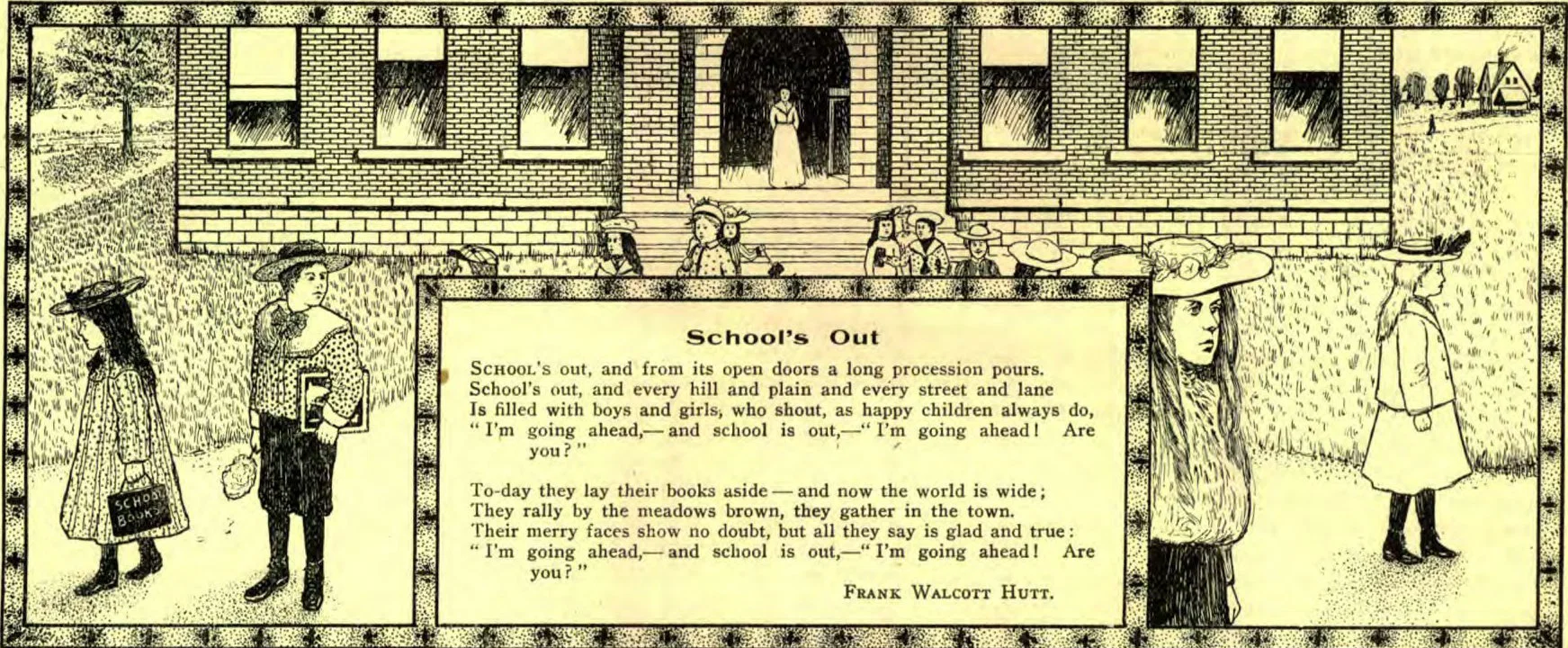
School’s Out
By Frank Walcott Hutt
School’s out, and from its open doors a long procession pours.
School’s out, and every hill and plain and every street and lane
Is filled with boys and girls, who shout, as happy children always do,
“I'm going ahead,—and school is out,—“I'm going ahead! Are you?”
To-day they lay their books aside — and now the world is wide;
They rally by the meadows brown, they gather in the town.
Their merry faces show no doubt, but all they say is glad and true:
“I'm going ahead,—and school is out,—“I'm going ahead! Are you?”
FRANK WALCOTT HUTT.
Lessons from the Life of Daniel—VII
By Ellen G. White
A Warfare against Intemperance
No young man or young woman could be more sorely tempted than were Daniel and his companions. To these four Hebrew youth were apportioned wine and meat from the king’s table. But they chose to be temperate. They saw that perils were on every side, and that if they resisted temptation, they must make most decided efforts on their part, and trust the results with God. The youth who desire to stand as Daniel stood must exert their spiritual powers to the very utmost, co-operating with God, and trusting wholly in the strength that he has promised to all who come to him in humble obedience.
There is a constant warfare to be maintained between virtue and vice. The discordant elements of the one, and the pure principles of the other, are at work striving for the mastery. Satan is approaching every soul with some form of temptation on the point of indulgence of appetite. Intemperance is fearfully prevalent. Look where we will, we behold this evil fondly cherished. In spite of the efforts made to control it, intemperance is on the increase. We can not be too earnest in seeking to hinder its progress, to raise the fallen, and to shield the weak from temptation. With our feeble human hands we can do but little, but we have an unfailing Helper. We must not forget that the arm of Christ can reach to the very depths of human woe and degradation. He can give us help to conquer even the terrible demon of intemperance.
There is no class of persons capable of accomplishing more in the warfare against intemperance than are God-fearing youth. In this age the young men in our cities should unite as an army, firmly and decidedly to set themselves against every form of selfish, health-destroying indulgence. What a power they might be for good! How many they might save from becoming demoralized in the halls and gardens fitted up with music and other attractions to allure the youth! Intemperance and profanity and licentiousness are sisters. Let every God-fearing youth gird on the armor and press to the front. Put your names on every temperance pledge presented. Thus you lend your influence in favor of signing the pledge, and induce others to sign it. Let no weak excuse deter you from taking this step. Work for the good of your own souls and for good of others.
The young men and young women who claim to believe the truth for this time can please Jesus only by uniting in an effort to meet the evils that have, with seductive influence, crept in upon society. They should do all they can to stay the tide of intemperance now spreading with demoralizing power over the land. Realizing that intemperance has open, avowed supporters, those who honor God take their position firmly against this tide of evil by which both men and women are being swiftly carried to perdition.
The followers of Jesus will never be ashamed to practise temperance in all things. Then why should any young man blush with shame to refuse the wine-cup or the foaming mug of beer? A refusal to indulge perverted appetite is an honorable act. To sin is unmanly; to indulge in injurious habits of eating and drinking is weak, cowardly, debased; but to deny perverted appetite is strong, brave, noble. In the Babylonian court, Daniel was surrounded by allurements to sin, but by the help of Christ he maintained his integrity. He who can not resist temptation, when every facility for overcoming has been placed within his reach, is not registered in the books of heaven as a man.
Dare to be a Daniel. Dare to stand alone. Have courage to do the right. A cowardly and silent reserve before evil associates, while you listen to their devices, makes you one with them. “Come out from among them, and be ye separate, saith the Lord, and touch not the unclean thing; and I will receive you, and will be a Father unto you, and ye shall be my sons and daughters.”
At all times and on all occasions it requires moral courage to adhere to the principles of strict temperance. We may expect that by following such a course we shall surprise those who do not totally abstain from all stimulants; but how are we to carry forward the work of reform if we conform to the injurious habits and practises of those with whom we associate?
The holy intelligences of heaven watch the conflict going on between the tempter and the tempted. If the tempted turn from temptation, and in the strength of Jesus conquer, angels rejoice; for Satan has lost in the conflict. In our behalf, Christ, when weakened and suffering on account of hunger, fought the battle against appetite, and conquered Satan. In the name and strength of Jesus every youth may conquer the enemy to-day on the point of perverted appetite. My dear young friends, advance step by step, until all your habits shall be in harmony with the laws of life and health. He who overcame in the wilderness of temptation declares: “To him that overcometh will I grant to sit with me in my throne, even as I also overcame, and am set down with my Father in his throne.”
MRS. E. G. WHITE.
The Judgment
By L. D. Santee
The wind from the southland is drifting,
Its warm breath is fragrant and sweet,
And God in his dealing is sifting,
Yes, sifting the chaff from the wheat.
To me it is awful and solemn,
But I know from the scripture ’tis true,
That all of earth’s far-reaching column
Will pass in review.
All the prayers and praise ever worded,
All the service of love ever given,
Have been by the angel recorded,
In the “book of remembrance” in heaven.
And the faith that would take no denial,
The duty that feared not earth’s frown,
The steadfastness under each trial,
Are all written down.
Yes, the record contains all the story
Of the motives, the deeds I have done.
And my actions of shame, or of glory,
Will all be reviewed — every one.
If my life has been worldly and careless,
If I’ve caused a weak brother to fall,
If my soul has been sinful and prayerless,
The record tells all.
L. D. SANTEE.
Enjoying the Blessings of Today
By Louise Heywood
In our anxious care for the morrow we fail to enjoy the blessings of to-day; we spend our lives anticipating, but not realizing; for, as soon as we have reached a desired point, we see beyond us something to reach after which we believe to be necessary to our happiness. If we have not the spirit of contentment to-day, we are never likely to have it. If we pass by unused the resources of to-day, we are likely to do the same to-morrow, thus making all our days barren of the joy and satisfaction which come from having made the most of the day’s gifts.— Louise Heywood.
MEMORY VERSE: “The name of the Lord is a strong tower: the righteous runneth into it, and is safe.” Prov. 18:10.
After the great victory at Gibeon, Joshua went through the land of Canaan, and all Israel with him; and wherever they went, God gave them the victory. Thirty-one kings were conquered, and their cities taken, but there was still much land to be won.
The Lord told Joshua to divide the land among the tribes, so that each tribe might cast the heathen out of its own inheritance. In your Bible maps you will find one that shows just how the land was divided.
Reuben, Gad, and half the tribe of Manasseh had chosen their inheritance on the other side of Jordan, before they reached the promised land. Moses told them that they might have their land there if they wished; but that they must go with their brethren to the land of Canaan, and help them to conquer it. So they left their wives and little ones in the place they had chosen, and went with their brethren to war. But when Joshua had divided the land, he sent these two and one-half tribes back to the land they had chosen.
Joshua told the people to be of good courage and take the land, because God had given it to them, and promised to cast out their enemies. But they did not do as the Lord commanded. They allowed many of their enemies to live in the land, making servants of them. God had given them the land, and given them rest, but they did not really enter in, because of unbelief.
Caleb, who had gone with Joshua to spy the land forty-five years before, was still living. He had seen the giants in Canaan, and yet had told the people that they were well able to go up and take the land, because God had given it to them. Now he showed his faith by his works. He chose the land where they had seen the Anakim (the giants of whom the ten spies were so much afraid) and the great fenced cities. This was the place where the greatest difficulties and dangers seemed to be; yet he asked Joshua to give him this for his inheritance, although he was then an old man. God was with him, and gave him the victory.
You will notice that in your map no mention is made of the tribe of Levi, nor was any inheritance appointed for them. The Lord was their inheritance, and so they received the tithes and offerings of all the tribes for their portion. Besides this, each of the tribes set apart certain cities for their use, that they might have places to live in, and pasture lands for their flocks.
Forty-eight cities were thus given to the Levites. Of these, six were appointed for “cities of refuge.” Here the Levites took in and sheltered any who were in danger. If any one had killed a man by accident, and some friend of the dead man should seek the life of the slayer in return, he could flee to the nearest city of refuge, and be safe.
In this way the people were taught, by an object-lesson, of salvation from death through the power of the high priest. Jesus is the true Priest, of whom the earthly priest was but a shadow. All who, having sinned, flee to him for refuge, are safe as long as he lives. And he is made priest “by the power of an endless life.” So he is able to save evermore those who come to God by him.
“The name of the Lord is a strong tower: the righteous runneth into it, and is safe.” We have not to go a long way to find this place of refuge, for “God is our refuge and strength, a very present help in trouble.” At any moment we may flee unto him for refuge from Satan.
Questions
1. How many of the Canaanite kings did Joshua and the Israelites conquer? Joshua 12: 1-24. Had they then taken all the land? Joshua 13:1.
2. What did God tell Joshua to do with the land? Verse 7. Tell what tribes had already received their inheritance. Why had they not rested in their own land? What did Joshua now tell them? Joshua 22:4-6.
3. Did the Israelites take the land and drive out the heathen, as God told them? What did they do instead? Joshua 15:63; 16:10; 17:13.
4. What good example did Caleb set the people? What had he said about the land when he first spied it? Did he not see the dangers? What was it that gave him courage?
5. What complaint was made by the children of Joseph? What did Joshua tell them to do if they wanted more room? Why did they hesitate? Joshua 17:16.
6. Did all the twelve tribes have an inheritance? Which one was left out? What was the portion of this tribe? How were they provided with places to live in? How many cities were given to them?
7. What cities were specially set apart from among those given to the Levites? Describe what these cities were for. Of what were they an object-lesson?
8. When any one fled to the city of refuge, how long was he safe there? Of whom was the high priest a shadow? How long can we find refuge in Jesus? Are we ever safe outside of him?
9. How far do we have to go to find our refuge? Ps. 46:1. Are you safe hidden in Jesus? If not, why do you delay?
MEMORY VERSE: “For he is our peace, who hath made both one, and hath broken down the middle wall of partition between us.” Verse 14.
Wherefore remember, that once ye, the Gentiles in the flesh, who are called Uncircumcision by that which is called Circumcision, in the flesh, made by hands; that ye were at that time separate from Christ, alienated from the Commonwealth of Israel, and strangers from the covenants of the promise, having no hope and without God in the world. But now in Christ Jesus ye that once were far off are made nigh in the blood of Christ. For he is our peace, who made both one, and brake down the middle wall of partition, having abolished in his flesh the enmity, even the law of commandments contained in ordinances; that he might create in himself of the two one new man, so making peace; and might reconcile them both in one body unto God through the cross, having slain the enmity thereby: and he came and preached peace to you that were far off, and peace to them that were nigh: for through him we both have our access in one Spirit unto the Father. So then ye are no more strangers and sojourners, but ye are fellow-citizens with the saints, and of the household of God, being built upon the foundation of the apostles and prophets, Christ Jesus himself being the chief corner stone; in whom each several building, fitly framed together, groweth into a holy temple in the Lord; in whom ye also are builded together for a habitation of God in the Spirit.—American Standard Revised Version.
Questions
1. What were the Ephesians called before their conversion? By whom?
2. What was their condition? What relation did they sustain to the commonwealth of Israel?
3. What did they know of the covenants of promise? How hopeless was their estate?
4. How accurately does this describe the condition of every one before his conversion? Through whom only may we become partakers of all these blessings? Gal. 3:29.
5. In what will the hope of the Christian culminate? Titus 2:13.
6. Through whom alone are we who are afar off brought into this heavenly fellowship? By what means?
7. What is Christ to every Christian?
8. What has he done by which he becomes our peace?
9. How did he bring about this reconciliation?
10. To how many has this peace been preached?
11. To whom do we have access through Christ? How many does this include? Rom. 10:11-13.
12. What relationship does this establish between us and our Father? What relationship does it destroy?
13. Upon what foundation are we built? Who is the chief corner-stone?
14. What is the nature of this building in which all form a part?
15. Who inhabits the building? Then what are we? 1 Cor. 6:19, 20.
Notes
1. The word Gentile comes from a Greek word (ethnos) meaning “race,” “nation.” The meaning in the Old Testament is the same. The Revised Version almost invariably renders it “nation.” It is the same word in the Septuagint as in the New Testament Greek. It generally refers to the nations outside of Israel, nations invariably pagan, without hope and without God. It also refers, as in this entire passage, to those who know not Christ; for such, not belonging to God’s “holy nation,” are classed with the nations without.
In the fullest, deepest meaning, Gentile and Israel denote spiritual conditions. To be a Gentile, ignore or reject Christ; to be an Israelite, accept him. The uncircumcision and the circumcision were terms used by the Jews to denote the two classes; but to them it was a mere outward matter. To the instructed child of faith, circumcision was a seal of the righteousness of God. See Rom. 2:28, 29; 4:11; Phil. 3:3. It was not itself a saving ordinance; it was a sign of a saved condition.
2. In the study of the “enmity” do not omit Rom. 8:7. There we are clearly told what it is. “The mind of the flesh is enmity against God; for it is not subject to the law of God, neither indeed can it be: and they that are in the flesh can not please God.” See also verse 16 of lesson. On ordinances study Col. 2:14, 15, 20-23.
The enmity is that which separated both Jew and Gentile from God; and the only thing which separates from God is sin. Sin takes away all peace of mind. Sinning is warring with God. Jesus Christ is not alone our peacemaker, but he is our “peace,” even as he was our “sin.” 2 Cor. 5:21. He abolished sin by becoming sin and dying to sin. Rom. 6:10. He became sin for us. By faith we accept the offering for our sin, accept the abolition in his flesh for our flesh, his crucifixion as ours, his life of righteousness as ours, and so he is our peace. “Reckon ye also yourselves to be dead unto sin, but alive unto God in Jesus Christ.” Rom. 6:11. “Crucified with him,” dead with him, “united with him in the likeness of his death,” in order that we may be “justified from sin;” that we “no longer be in bondage to sin;” that we may “live with him;” that we may be “united with him” “in the likeness of his resurrection.” Rom. 6:1-10. And the one new man is Christ the head, and his people the body.—Lesson Pamphlet.
In Season and Out of Season
ONE Sunday afternoon not long ago a company of friends and fellow workers, returning from a convention in the West, chanced to have the tourist car almost to themselves. One other occupant was a slender young girl, who sat very quietly in her place till evening, when she came to one of the ladies of the company, introduced herself, and said, “I see that you are Christian people, and I wondered if your company would not like to gather for a little song service, as long as we have to be traveling on the Sabbath?”
The question came almost as a rebuke to us, who had been busy and contented in each other’s company, and had given no thought to the lonely little traveler. But the suggestion was acted on promptly, and the song service was followed by each one repeating a verse of Scripture. Afterward one of the sisters had a long talk with the young girl, informing her that we were Seventh-day Adventists, giving an outline of the main points of our faith, and calling her special attention to the true Sabbath, and what it means to those who observe it. She found a heart open to receive the light, and willing to investigate further.
This incident emphasizes the lesson of guarding against the spirit of exclusiveness that makes us withdraw within ourselves when surrounded by strangers. The probability is—and it is a shame to say it—that if in this instance the lonely one of the company had not, in her longing for the evening worship that she was missing in her journey, put aside her timidity, and asked us to join her in song, no one would have made the opportunity to talk with her about the truths that we love. In this instance she herself opened the way; but that is not usually the case. Far too often we sit silent, when in the company of strangers, not seeking, by some friendly entering wedge of conversation, to gain the opportunity to leave seeds of truth in the hearts of those about us.
The injunction to “sow beside all waters,” leaves no place for selfish exclusiveness, disinterestedness in the lives of those we meet even casually along life’s journey, or cold indifference to their loneliness and heart hunger.
The Habit of Giving
By I. H. Evans
CONTINUAL repetition makes a habit. Once the habit is formed, the act becomes so nearly involuntary that no conscious effort of the will is required to perform it. We do it “without thinking,” as we say. For example, if a child is allowed to form the habit of crying, it cries without effort, and often, apparently, without cause. Telling falsehoods is another habit easily formed in childhood, and often very hard to overcome.
But good habits can be formed as truly as bad. Occasionally we hear it said of some sunny, cheerful person of our acquaintance, “How pleasant he always looks,” or, “He has a smile for every one,” or, “He is always doing a kind act for some poor soul.” Kindness, a smiling face, a pleasant interest in the affairs of those about him,—these have become a habit,—a part of his very nature.
Youth is the habit-forming time; and upon our acts and thoughts and words during these years largely depend our future happiness or unhappiness. Good habits make a life fragrant with the perfume of good deeds, a blessing to every one who comes within the circle of their kindly benediction; but evil habits blast and blight not only the life of their possessor, but the lives of many around him.
Giving is one of the most beautiful traits of character. It widens one’s interests, creates thoughtfulness, and lifts the soul above the low plane of selfishness into the clear, bracing air of love for others, and sacrifice for their welfare. The child who hoards its money, and is never willing to share its good things with another, or to part with its playthings to make some other child happy, will surely grow up into a cold, self-centered man or woman. “To give is to live.” To take pleasure in giving is to taste the truest happiness that can come to any one.
The example of giving is set by the Lord himself, “who gave himself for our sins.” “He beggared himself to enrich us.” “He hath borne our griefs, and carried our sorrows.” His whole life was spent in ministry and service to others. Those who early form the habit of giving are thus surely learning to walk in the steps of our blessed Master. But giving, to be of the highest order, to be a real strength and uplifting influence in the life, must be continuous. It must become a part of one’s thought; it must enter into all his plans; it must be a living, vital principle, governing his daily conduct.
What better meets this need than the weekly offering for missions? Here is a great field—the harvest field of the world, wherein we are to send reapers. Every day a hundred thousand persons in heathen lands go down in death without any knowledge of the Saviour’s love, or the provision that has been made for their salvation! The knowledge of this great need should inspire our army of young people to do what they can to save these perishing souls.
The ten-cent-a-week plan of raising money for the mission fields was started in order that every child and young person, as well as the older members of the church, might give a weekly offering to mission work. Can anything be more akin to the divine love that was poured out for us than that we should give, regularly and faithfully, some part of our little treasure to tell the good news of that love to those who have never heard it?
This plan of giving is regular; it requires forethought and often sacrifice. There is something definite and certain about it. Perseveringly followed, it forms a habit that uplifts and ennobles the whole character.
We appeal to our young people to take up this work, believing that every one who does so, and follows it honestly and faithfully, will receive not only the personal blessing that is promised to the cheerful giver, but that larger blessing that comes to those who truly taste the “joy of the Lord,”—the joy of seeing souls saved through self-sacrifice. I. H. EVANS,
Treasurer General Conference.
Taking Time to Meditate on God
“My meditation of Him shall be sweet,” sang the psalmist. No one can know the meaning of this verse, in its fullness, who does not take time to meditate on God’s goodness, to recount his mercies, to consider his loving-kindnesses. Therefore take a little time each day to be alone with God. Shut all other thoughts out of the mind, that he himself may speak to you, and teach you his way.
Egyptian Scenes Series and Island Missions History
By Editor
An interesting series of articles on Egyptian scenes and customs has been sent to the INSTRUCTOR by Brother Glen Wakeham, of Cairo, the first number of which will appear in an early issue of this paper. We are also glad to announce that the promised series on “The Story of Our Island Missions,” dealing with the early history of our various missions in the islands of the Pacific and the Atlantic, and showing how the faithful work of the pioneer missionaries has prepared the way for the giving of the last message, will soon be ready. These articles will be furnished by Miss Houser, who is familiar with the history of these missions from their beginning.
Graduates Asked: What Next? Preparation for Service
We have received the commencement program of our church school at Fresno, California, with a photograph showing the nine graduates. As we look at their bright, happy faces, we can not but think of all the other young people who this year have finished the “preparatory work” of their education in our various schools, and are asking “What next?” To some, and we hope to many, the “next thing” will be an intermediate school or academy. Others may not have the privilege of carrying their studies further in school; but in these days of opportunity no one, even of those who can no longer go to school, need miss the culture and wider usefulness that come from a practical education. It is not by what you have studied, but by what you can do, that the world will judge you in the days to come. And it is that same test, too, that will reveal your efficiency in the work and the place which the Lord of the harvest has for each one who will engage in his service. For the greatest possible usefulness in that service, these preparatory days are given: improve them with faithful work and earnest study, and you will find yourself ready for increased responsibilities by and by.
A New Book for Young People
PROFESSOR FREDERICK GRIGGS, of our South Lancaster Academy, has lately gathered into book form a number of his “chapel talks” to the students of that school. The Table of Contents gives a general idea of the subjects treated in this interesting little volume: Adaptability, Be Enthusiastic, Learn to Wait, The Value of Minutes, Our Conversation, Economy, Promptness, Our Manners, The Association of Young Men and Young Women, “If Thine Eye Be Single,” The Love of the Beautiful, Lest We Forget.
We should be glad to see a copy of this book in the hands of every young person who reads the INSTRUCTOR, knowing that all who read it will be benefited thereby. The book is bound in either red or white ribbed cloth, with gilt side-title; price, fifty cents, postpaid. Order of the South Lancaster Printing Company.
A Friend in the Kitchen
“WHAT TO COOK, AND HOW TO COOK IT.” This useful little book on healthful cookery should have a place in every home. It has lately been revised, and brought out in an oilcloth-paper edition, at a price which places it easily within the reach of every housewife. A large number of practical, tested recipes for the every-day menu, as well as for specially prepared health foods, dainty dishes for invalids, Sabbath dinners, etc., etc., is given. Price, oilcloth-paper covers, twenty-five cents; oilcloth cover, fifty cents, postpaid. Order of the publishing houses or of your tract society.