If the friends you fondly love
Seem to give you but a shove,
When 'tis self, and all of self with none of Thee;
Can you pass the insult by?
Let no tear-drop dim your eye?
Just give love and joy and sunshine, and be free?
Crush the evil with a thought —
Message by an angel brought;
Just be happy, kill the evil with a smile.
When you're helpless and alone,
And so many hearts seem stone,
Can you practise love and kindness without guile?
Can you keep your heart in tune,
Saying, “He is coming soon;
I will lay these weary, heavy burdens down,
Yes, I'll lay them at His feet,
All His gracious love to meet,
I'll exchange them for a royal starry crown”?
When your poverty is great,
Can you share your cup and plate
With another who has naught but groan and sigh?
When grim Want is at the door,
Can you then divide your store,
Trusting Him who feeds the ravens when they cry?
If you've learned this happy way,
It will help you every day,
Over all the rough and thorny paths of time.
You will not be very sad,
If you keep this thought,—Be glad;
God is working all things for you—the sublime.
Time Waiteth for No Man
By N. D. Anderson
By N. D. Anderson
Ah, brother, the day breaketh calm and clear,
With song of birds and blossoming flowers' cheer;
It is that time when wise men sow their grain—
Despise it not, it will not come again.
And when at noon the sun rides bright and high,
With splendor clothing earth and sea and sky,
Then is the time thy growing vines to train—
Despise it not, it will not come again.
Soon shall the harvest ripen, and the night
With darkest shadows fill the valleys bright;
There is yet time, ere yet the twilight wane—
Despise it not, it will not come again.
When the Sun Breaks Through
By Llewellyn A. Morrison
By Llewellyn A. Morrison
They may dwell within the valley
Where the rugged mountains rise
Toward the morning, 'till their summits
Kiss the azure of the skies,
Often lodge in murk and shadow
Where the mist doth all bedew;
But the pasture-lands are greener
When the sun breaks through.
It is not as easy serving
In the humidness and haze,
As when every bush and bracken
In the brilliance are ablaze;
But we gather faith and patience
Our ideals to pursue,
And expect to see the fulness
When the sun breaks through.
If the clouds be dense above us
And the world is in the wet,
Still the winds are on the uplands,
We can hear their music yet;
Past the duskiness and dimness
Come the gleam rays into view,
As the heralds of the splendor
When the sun breaks through.
Tho the fog distort the fancy
Till the less appears the great
And God's acre looms a "Tophet"
Where abhorrent demons wait;
It is only in the seeming—
Morn by morn the day is new:
We shall see the "Holy City"
When the Sun breaks through.
San Francisco, California.
Tired Mothers
By Anon.
A little elbow leans upon your knee,
That tired knee that has so much to bear,
A child's dear eyes are looking lovingly,
From underneath a thatch of tangled hair.
Perhaps you do not heed the velvet touch
Of warm, moist fingers folding yours so tight;
You're weary with the labors of the day.
You are almost too tired to pray to-night.
But it is blessedness. A year ago
I did not see it as I do to-day.
We are so dull and thankless, and too slow
To catch the sunshine till it pass away.
And now it seems surpassing strange to me
That while I bore the badge of motherhood,
I did not kiss more oft and tenderly
The little child that brought me only good.
And if some day, when you sat down to rest,
You missed the pressing elbow from your knee,
The restless little head from off your breast,
The lisping tongue, that chatters constantly;
If, from your own, the dimpled hand had slipped,
And ne'er would nestle in your palm again,
If the dear feet into the grave had tripped
I would not blame you for your heartache then.
I wonder so that mothers ever fret
At little children clinging to their gown,
Or that the footprints when the days are wet
Are ever black enough to make them frown.
If I could find a little muddy boot,
Or cap or jacket on my chamber floor,
If I could kiss a rosy, restless foot,
And hear it patter in the house once more,
If I could mend a broken cart to-day,
To-morrow make a kite to reach the sky,
There is no woman in God's earth could say
She was more blissfully content than I.
But, ah, the dainty pillow next my own
Is never rumpled by a shining head.
My little birdling from its nest has flown,
The little boy I used to kiss is—dead.
— Anon.
India During 1912
(From Our Own Correspondent)
(Concluded from last week)
Photo Underwood & Underwood
Changes in Caste System
SOCially, there is evidence of a desire of revising the inexorable caste system that has done more than any one thing to keep India down. Both Christianity and its progress among the “untouchables,” and the new political program, have brought about this change. A movement to make all Hindus willing to touch these untouchables, is steadily progressing. In North India, there is a propaganda which puts these hitherto untouchable classes through a ceremony, called a purification ceremony, after which they are allowed to draw water from the village wells, and take food and give food to the high castes. It is amusing to read the accounts of the amazement of these lower castes when they are put through this ceremony, and then conducted to the center of the village to draw water from the well from which their ancestors have been forbidden for centuries, and from which, if they had drawn during their lifetime, they would have brought dire vengeance on their own head. One can scarcely blame them for shrinking back, and finally drawing the water with fear and trembling.
No doubt Hinduism has become alarmed at the thousands of these untouchables who have become Christians. Then again, when the basis for political representation was fixed, there was a great effort put forth by Mussulmans to have the government not count as Hindus these untouchables, who, altho doing the servile work of the Hindus for centuries, were still not counted as worth the spiritual ministration of the Brahmans, and whose presence was forbidden entrance in Hindu temples. However, those in the West should not be too quick to take these movements as evidences of the early abolition of caste. It is simply evidence of a readjustment of the entire caste system to meet modern conditions, and is very likely to leave all the evils of the caste system, from a Christian standpoint, more firmly entrenched than ever before.
Lessons from the Census
The figures of the last census will soon be completely published in all their details, and I will write concerning them at a future time. Suffice it for the present to say that there are now 315,132,537 souls in India, a most substantial gain for the decade, in spite of plague, famine, and serious economic conditions. There are good authorities who claim that as soon as a reliable census is possible for China, that it is doubtful if she will exceed by very much this enormous figure. For the Christian, this vast number of souls presents a most powerful plea. As we compare this census with that of ten years ago, it is encouraging to find that Christians have increased; but any one with a sense of facts will be unable to see in this increase any promise of a speedy conversion of all India. Less than one and one quarter of the whole population are Christian, and less than one half per cent are Protestant. This Christian community is very unevenly distributed. One hundred million have never yet heard the voice of a Christian, or the sound of the Christian religion. There are about 22,000 Christian workers in India, ninety per cent of whom are Indian, ten per cent foreign. Among the foreigners forty-six per cent are males, fifty-four per cent females; while among the Indians the females number only thirty-one per cent. Eighty-one per cent of these workers are in British territory, and nineteen per cent in native states. The call of these figures, with the great gaps caused by unentered fields, makes a strong plea for more men and means, that the work may be finished.
The Pig Rupee
An incident has happened during the year that has recalled the bullet, the biting of which was supposed to have been one of the immediate causes of the great mutiny. With the new reign, we of course have a new coinage. This year the designers tried to make a design that would be distinctively Indian. They put the effigy of the king in his royal robes, with his crown, and hanging from his neck was what was intended to be the figure of an elephant—the emblem of royalty in India. But the figure is small and rather crude, so that it recalls a pig rather than an elephant. At once, there was a great hue and cry on the part of the Mohammedan population. “The government is trying to defile the Moslem,” was the cry that spread like wildfire. One Moslem wrathfully said, “How can I say my prayers with the effigy of a pig in my pocket?” The matter reached such serious proportions that the government issued the order to withdraw the obnoxious coin. But they still are circulating freely, and it is not known whether this last order has been rescinded or not. At any rate, the writer has not yet found a Moslem who has refused one of them.
Famines in 1912
It is said that poor unfortunate India is rarely free from famine conditions. It is only the news of the great ones that reach across the seas. It is estimated that even in normal years at least five per cent of the population have to retire to rest every night without having had sufficient to eat for the day. But this year has seen two considerable famines,—the one largely in Gujarat in the Bombay Presidency, carried over from last year’s failure of the rains, and the other on the Deccan, now in progress because of the failure of this year’s rains in those parts. The great famine in Gujarat was marked, as no other previous one has been, by the hearty coöperation of Hindu and Christian for the alleviation of the suffering. Hinduism has been provoked to emulation by the great examples of Christian benevolence seen in the past, and this famine marked a co-operation between all classes never before seen. The relief work was so well organized that there was scarcely any loss of human life, but thousands of cattle and buffaloes perished. As the Indian is largely dependent on his live stock, it is easy to see the economic consequences of the loss of this stock, which it is very difficult to replace. In the present famine on the Deccan, more than 300,000 cattle have already perished, in spite of the heroic efforts that are being made both by government and private charity. In closing the financial account of the Gujarat famine, Dr. George Taylor, of the Irish Presbyterian Mission, Ahmedabad, reported:11
“RELIEF COMMITTEE
“In glancing over the balance-sheet of the Famine Relief Fund, I could not help thinking that there is one very real asset which may well be taken into account, tho not admitting of expression in rupees, annas, and pies. The months of scarcity have come and gone, and have left behind them many memories, some indeed sad enough, yet others bright and pleasant. We shall not willingly forget the bond of sympathy that has, these past twelve months, drawn us together as fellow workers in a good cause. Despite distinctions of class or caste and creed, we have been privileged to coöperate one with another in the administration of relief; and, standing shoulder to shoulder, confronting a common foe, we have realized, in some faint degree at least, that solidarity which constitutes one of the most precious possessions of any community. Should this sense of solidarity have been at all strengthened, then the recent famine has not proved an unmixed evil. If, during this time of affliction, the rich have drawn closer to the poor, if the strong have befriended the weak, if Englishmen and Indians, Christians and non-christians have linked themselves in a common service of compassion, then most assuredly has this affliction brought in its train blessings in disguise.”
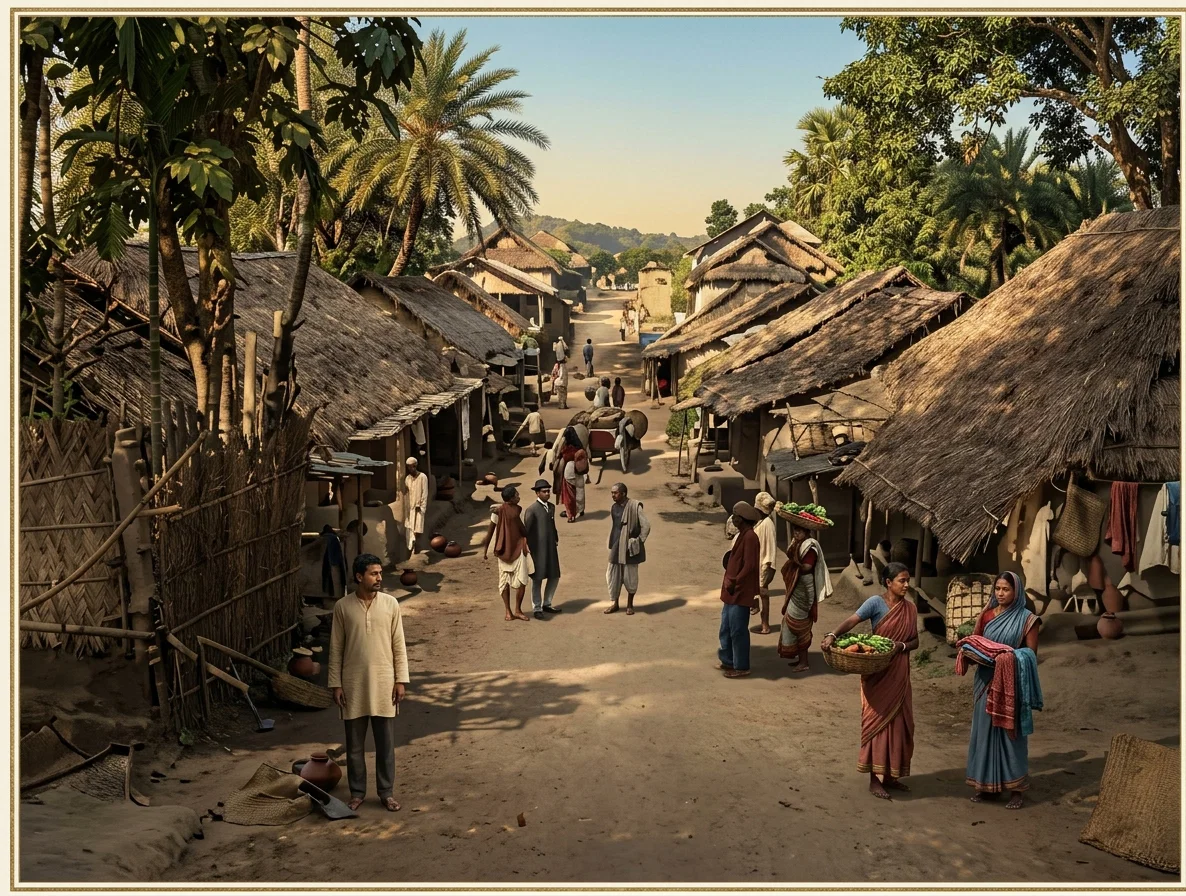
Native Village, near Calcutta, Bengal
University Hall, Bombay
The Ancient Traditions
THE University of California has been delving into the history, as far as possible, of the various tribes of Indians in the West, and especially those that are almost, if not quite, extinct. Among these is the tribe of the Salinan Indians, a century ago numbered by the thousands; but only forty-one remain alive to-day, and of these only twenty-nine can speak their ancestral language. Nowhere else in the world is there a living being who can speak Salinan, a tongue which it is thought is wholly unrelated to any other living speech, and as different from the nineteen other Indian language-stocks of California, or from any other language in the world, as English is from Hebrew or Chinese. Dr. Mason's account of it has just been published as a part of the tenth volume of the University of California publications in American archeology and ethnology.
Agriculture was wholly unknown to this tribe. People lived by hunting and fishing, and from the wild products of the earth, using a vast variety of native foods, we are told, “which the present inhabitants of California allow to go to waste,” such as rattlesnakes and other serpents (which were roasted in ashes), lizards, toads, horned lizards, ground-squirrels, chipmunks, rats, mice, the owl, the eagle, and the hawk. Among vegetable foods was a soup of the seeds of wild oats, clover eaten from the stalk, buckeyes, after the poison had been leached out, acorn mush, and bread baked from acorn flour, Christmas berries, seaweed, and various seeds.
Tobacco is highly esteemed, and thought to possess magical powers, we presume from its intoxicating or chemical effects. They seem to have lost entirely the knowledge of God. The dead, it was understood, journeyed to a distant island of the ocean, and in due time would be born again. The eagle and the kingfisher were credited with the creation of the world. Yet having lost the knowledge of God and almost everything with which they had to do, more or less perverted, they still have the tradition of the Deluge. We wonder whether the idea of the eagle-creator did not come from the same source as the eagle-headed deity of Assyria, and back of this from the cherubim idea in the form of eagles.
The Crime Wave and God’s Law
The Springfield “Republican” of November 28 has an editorial on “The Crime Wave.” It starts out by saying, “The newspapers are shocking to read nowadays, but we must not be disheartened.” And then, with an effort to minimize, it starts its second paragraph with these words: “Seldom have the records been more deplorable than just now. In one day we read of enough shocking and sensational cases for a normal month or year. Four professional assassins, who might have stepped out of the worst days of the Renaissance, are convicted in New York.” Then after enumerating several of the cases prominently before the public, it says: “It is a black record, and it would be pleasant to suppress it, but we may as well face the facts. These occasional cases of peculiar atrocity, or abnormality, are not the disease itself, but the symptoms of the disease.” And this is true, that disease lies back of all crime; nor can it be remedied to any great extent by civil law. It is indigenous to the natural heart of man, which “is not subject to the law of God, neither indeed can be.” The sad thing is that so many of those who profess even to be servants of the Lord Jesus Christ, have turned away from the hearing of the law of God, and are trusting to human schemes to effect that which can only be accomplished by divine aid. It ought to be a prayer of every devoted servant of God, “It is time for Thee, Lord, to work: for they have made void Thy law.”
The New Avatara or J. K. Worship
By George F. Enoch
No doubt many of your readers know more or less of Mrs. Anna Besant, the leader of the Theosophists at the present time. She was at one time the wife of a country clergyman, afterwards a rank atheist, and then an ardent disciple of Madame Blavatsky. She is now the head of the Theosophical propaganda, and spends much of her time in India. She is perhaps the most eloquent advocate of neo-Hinduism that has ever come to India from the West; still she has not succeeded in conciliating the great body of Hindu thought. Her propaganda has however made considerable headway, with headquarters in Madras, and a Hindu college in Benares. In this college, which will soon be affiliated with the new Hindu university, we have the strange sight of Hindus carrying with them brass images of Christ meditating on His soon return to the world in another avatar, or incarnation. In fact they have a young man there now, an intelligent looking young Madrasi named Alcyone J. Krishnamurti, who is declared to have the body in which Christ will appear. This Hindu college has been so led away with this false teaching, and so much time spent in meditating on this new incarnation, that study was interfered with, and steps had to be taken to regulate it. Mrs. Besant says that if J. K. is not actually the Reincarnation, he is the Forerunner.
To the readers of the “Signs of the Times,” this but reveals the articulate cry that is rising from all the world for the return of the Master. How we should hasten the message of His coming! In his work among the heathen villages in the vernaculars, the writer has found that no doctrine we preach strikes so universal a chord of interest as the preaching of the second advent of our Saviour and its nearness.
But in the meantime, Hinduism is not purifying itself very fast, as is shown by the fact that in 1912 on January 14, under British rule in the city of Allahabad, there was a procession of more than 1,000 worshipers who were stark naked, as they had reached that stage of perfection(?) that it was no longer necessary to wear clothing. We appeal to the readers of the “Signs” to help us hasten the preaching of the gospel of the kingdom.
GEORGE F. ENOCH.
Discovery of Kingdom of God Is Proclaimed
A Christmas bulletin comes to us from the International Translating, Printing, and Publishing Company, under date of December 24, stating in big, bold, black type the “Discovery of Kingdom of God Is Proclaimed,” and after stating various discoveries and accomplishments of the last days, they say that the conquest of the world is achieved, and no sooner is this done than the kingdom itself is announced. They have published a book, and two more books are to follow, telling more than all the books of the world up to the present time about it. They declare: “The kingdom is not at the south pole, nor north pole, nor anywhere else around the globe,” but that “it is within us, and must proceed forth out of us, if we are ever to enter into it;” that the great plan is set forth in this book that “men are the agents of their thoughts.” “They do whatever comes into their minds to do,” that “they can have the kingdom whenever they see the kingdom and set their minds to building the kingdom; and then trouble will cease and the millennium will come.” And yet these builders are going to give time to it. They refer to the wonderful works that men do, like the building of the Panama Canal; they say that in 100 years it built this mighty nation of freedom and liberty. Now give it the plan, and in another hundred years it can build the kingdom of the Almighty. And the book sets forth that plan, on which presses are running night and day.
No doubt the tremendous advertisement will sell a great many of the books, but the kingdom of God does not come in that way. It does not come into the heart in that way, nor does it come into the world through the zeal or enterprise or power of men. “The zeal of the Lord of Hosts will perform this.” This company gives us, in addition to this, an opinion of a law firm, in which these lawyers, having examined the advance sheets of the book, declare that this first volume alone will convert the world to the work of building the kingdom of God. But notwithstanding this opinion, we still believe the old Book and the simple plan which God has given through our Lord Jesus Christ.
The Freedom of the Press.
By Editor
The Farmers’ National Congress which met in New Orleans November 8 of last year, passed a resolution which ought to be spread far and wide:
“Resolved that a free and fearless press is of such great importance in safeguarding our liberties that no legislation abridging the freedom of the press should be enacted by Congress, and no legislation should be enacted by Congress unless it has been duly referred to and acted on by the proper committee of both houses, and opportunity has been had for free debate thereon in both the House and the Senate.”
The resolution is pertinent and timely. Our Roman Catholic friends are doing everything in their power to shut out all criticism of Romanism and its methods. Whatever is right can afford to be fair, and even more than fair; and a cause that can not be given the widest, fullest publicity ought to go down. We are glad that the Farmers’ National Congress recommends that a free press is the safeguard of liberty, that it stands against the abridging of that freedom. We wish that every other organization in the United States could awake to the dangers which menace freedom in this land.
Letting in the Sunshine
By Sydney Dayre
“What a poor little dark room!” said Faith, as, with her mother, she came out of a house in which she had been visiting an invalid girl.
“Yes; poor and dark and gloomy,” said her mother with a sigh.
“And so dreadfully dirty!”
“Yes. I have said as much as I dared to Mrs. Ray about keeping clean, but it seems to have done no good as yet.”
“Not a book, not a paper, not a picture, not a flower. Dear me! how can people live so! What if I were poor Ruth!”
A sober thought of the difference between her own cheerful home and the dreary one of the young girl who lay in the comfortless room, kept her silent for a while.
“I wish I could do something for Ruth!” she said presently. “But we have so little to give away!”
“So very little,” repeated her mother, “except kind words and a trifle now and then! But if we had more, Mrs. Ray is not one who thinks herself an object of charity.”
Arrived at home, Faith bent lovingly over the plants which had smiled her a welcome from the window.
“This little rose-bush is full of buds, mama. And one is just opening—do come and see!”
Her mother came to look at the lovely petals which were beginning to unfold in the winter sunshine.
“It looks as if it were waking up to thank the sun for the weeks and weeks of shining it has done for it,” said Faith, caressingly touching the green leaves.
“O mama, what if I should give my rose-bush to Ruth?”
“Why! I thought you were so fond of it, Faith!”
“So I am; but I have so little to give. It would be hard to give it; so all the more I ought to.”
“Take time to think about it before you make up your mind, dear,” said her mother.
Faith did take time, and one day, a week later, she wrapped a paper about the beautiful bush, for careful protection against the sharp wind, and took her way to Ruth’s home.
“See what I’ve brought you!” she said, placing the rose-bush, with its glory of half-opened buds, on the window-sill, within reach of the sick girl’s hand.
“For me? O Miss Faith, how could you!”
The flush of delight which arose to the pale face was a sufficient assurance that the gift which had cost so much self-denial would not be thrown away on her.
“You must give it the very tenderest care,” said Faith, half jestingly, motioning toward the flower, as, after a half-hour’s talk, she arose to take leave. “A little tepid water every second morning.”
“Yes,” said Ruth.
“And a good sprinkling once a week, or oftener, with water with the chill just off.”
“Yes I’ll be sure.”
“And it must have fresh air on mild days, and be set back from the window on frosty nights. And most of all, let it have sunshine. You have such a nice south window, it ought to do well here.”
A good deal of brightness went away with Faith’s face, but there was plenty left as Ruth turned with ever-growing delight to the lovely plant on the window-sill to count its buds and blossoms, and rejoice in the delicate beauty of the pink petals.
“You look as if you were smiling at me, you beauty,” she said, touching with her lips one of the flowers. “Sunshine! Yes, you shall have all you want.”
But as she moved it nearer the pane, in order to catch the rays of the afternoon sun, it struck her, as never before, that the sunlight seemed to linger outside, as if afraid of venturing through the dust-covered window.
“Dear me!” said Ruth. “I never noticed how dirty that window is. The sun can’t get in. That won’t do. What will Miss Faith say if her rose-tree droop here?”
Raising herself by a little effort, she rubbed the dust from one pane, feeling well rewarded by the kindly rays which seemed glad to beam in upon her.
“Look!” she said, pointing triumphantly to the rose, as her mother entered on her return from her day’s work an hour later. “Miss Faith brought it to me. And I’m glad you’re home so early before the sun is quite down. Doesn’t the sun shine in beautifully?”
“Yes,” said her mother, well pleased at anything which pleased her daughter.
“But how dirty them other panes is! It didn’t show so before.”
“No,” said Ruth. “I rubbed that one clean, ’cause Miss Faith says the rose must have sunshine.”
“’Twouldn’t take long to clean the whole of it.”
She was weary with the hard day’s work, and always before fancied herself too weary to clean things at home, besides having, poor soul, little courage for it. But the new interest and the new light in Ruth’s face were inspiring, and a little later the farewell beams of the sinking sun shone in through twelve brightly polished panes.
In her first bending over her new treasure, the next morning, Ruth’s eye wandered to the shelf on which it stood. The sun-beams seemed to be pointing out the dust which lay thick upon it, varied by stains which had come from setting medicine bottles there.
“I wonder if Miss Faith noticed it! I hope not. The sun didn’t shine in there. But she might have noticed the window—dear me! If I could only help mother a bit with things!”
She gave a discouraged glance around the disorderly room. She had thought little of it before, but now the sun seemed jealously to penetrate to every corner, as if taking pleasure in calling attention to the lack of care and neatness which would have struck horror to any cleanly soul. Ruth tried to look at it as other eyes might look, and it shamed her.
“Mother can’t do much more than she does now, but per’aps I could do a little myself.”
She had felt no worse from her effort of yesterday, and the new ambitions aroused in her seemed to give new strength. She brought a little warm water and cleaned the shelf; then took a needle and thread from a bag which hung near her and mended some holes in the old curtain.
“Now I’ll get mother to wash this next Monday, and it’ll look as neat as a pin.”
Mother took silent heed of what was going on. It would have been impossible for her to tell all the thoughts awakened by the presence of the rose-tree, but certain it is that the memories it called out softened and cheered her burdened heart. It was always there, always beautiful in its perfection of bloom, smiling a greeting to her as she came back from her daily toil. And something within her uttered a loud protest against allowing the lovely flowers to bloom amid surroundings of dirt and disorder. Poverty there must be, but poverty did not necessarily mean dirt, as she in her less discouraged days had proved.
So there came a day when the window was thrown wide open, and, in the sweet breath of the early spring, the floor was scrubbed and the walls cleaned and whitewashed; and it was impossible, of course, that the improved state of things should not extend to other portions of the tiny house.
“What an astonishing change!” said Faith one day, when she had been with her mother to see Ruth. “I am going to take a picture from my room to hang on the wall in Ruth’s room. It can be seen now.”
One day not long afterwards Ruth told Faith the whole story, saying, as she finished, “I’ve been looking in the Bible for the text, ‘Cleanliness is next to godliness,’ but I can’t find it. Can you tell me where it is?”
“O,” said Faith with a merry laugh, “that isn’t in the Bible; but it’s a very good text for all that. There are good things outside the Bible, you know.”
“Yes,” said Ruth, looking at her with an affectionate smile, “you are outside of it.” —Sydney Dayre, in Congregationalist.
Infantile Adepts in Wickedness.
We very frequently hear “the innocence of childhood” mentioned, but those who talk much of it do not know how far advanced children are in cities, in deception and crime. The prosecution of picture-show proprietors has brought this out in New York strongly. It is contrary to law for children to gather around such places, or to enter such places without guardians, but to meet this the children gather around such places and beg grown people to “take them to see the show.” In other instances, the children have put their nickels together and raised a sum to hire “fathers” and “mothers,” one of whom takes in the whole flock of the youngsters, and it has been found that children of very youthful years, almost infantile, are adepts at gambling, and consult dream books to “get wise” as to the best means of beating the game. The New York World remarks, regarding the gambling, that “the babies hire grown people13to help them to turn the trick. Why not childhood suffrage, since the mother is away from home, and the father is played out?”
FEBRUARY “Signs of the Times Magazine”
By Editor
A Live Magazine
Readers of this journal will easily recognize this February number of the “Signs Magazine” as being one of the most timely that has yet been produced.
Sample copies, ten cents, in coin or stamps.
“The Future of Turkey in Prophecy,” by L. A. Reed. The events in the fulfillment of the prophecy are traced out clearly, definitely, and interestingly. A strong, convincing setting, showing the importance of the times.
“Lack of Faith a Sign,” by the editor. An article that clearly shows those particular conditions to-day as a sign of the times, and turns the minds of the readers to serious thought.
“The Advent Message in Europe,” by Mrs. E. G. White. Another timely article in this important series. Real foundation builders.
“The Movement with Which Seventh-Day Adventists Are Identified, as Foretold in the Scriptures”—No. 2, by T. E. Bowen. These articles, without question, are of the utmost importance, presenting the rise and progress of this great movement in just the way that will interest the unacquainted reader. Genuine, converting, missionary articles.
“Light on Life’s Path,” the new department, but one of wide interest and helpfulness.
“Like as a Father,” by Mrs. L. D. Avery-Stuttle. Another of those sympathetic, home articles for our Home Department.
“Glimpses of China,” by F. E. Stafford. “Gardens” is the subject presented in this number.
“Bible and Science, Evolution in Prophecy,” another sign of the times. Worldwide fulfillment. A brief, unanswerable presentation.
“Replenished from the East.” The heathenism of the East supplanting Christianity—a sign of the times.
“Signs of the End” in earthquake, famine, and sword.
STANDARD HOUSEHOLD LUBRICANT
Don’t let your tools get rusty.
Standard Household Lubricant
In the Handy Oiling Can
Preserves tools from rust; keeps them sharp and clean.
Standard Household Lubricant never corrodes, gums or turns rancid. The best oil in the world for a sewing machine or a lawn mower, a go-cart or a gun—anything about the house that needs oiling.
Get the can with the patented nozzle attached. No risk of breaking. No dripping to soil the fingers.