The Youth’s Instructor, Vol. 64, No. 38.

Household Suggestions from Here and There

The Youth’s Instructor

Sep 19, 1916

Review and Herald Publishing Assn. · Takoma Park Station, Washington, D. C. · Sep 19, 1916

Household Suggestions from Here and There

CREAM-OF-TOMATO soup will never curdle if the milk and the white sauce are heated in one saucepan and the tomatoes in another. Take them off the stove, and after they have stood a moment put them together, or pour the tomatoes into the soup dish and stir into them the cooked cream.
To wash brushes and combs, put a teaspoonful of ammonia in a basin of hot water and dip the brush up and down in it, letting the comb remain in the water for a few minutes. In this way all the grease will disappear, and after rinsing in cold water both brushes and combs will be perfectly clean.
Ink can be removed from linen by moistening the stain well with paraffin and then washing as usual.
Whipped cream goes much farther if the white of an egg is added before whipping. Add a pinch of salt to the whites to make them froth easily, and see that the beater is thoroughly dry.
An ordinary blackboard eraser is splendid to keep near the kitchen range to wipe off the top; the range is kept clean, and does not need to be washed or polished but once or twice a week.
When a tablecloth begins to break or a small hole appears, cut a piece of white paper somewhat larger than the place to be mended, baste over the hole, and stitch on sewing machine lengthwise and crosswise, very closely and evenly. It will look much neater, and is easier than darning or patching by hand. Sheets and bedspreads may be mended the same way. The paper will disappear when washed.
One of the prettiest greeneries for the dining table, on those days when fresh flowers are lacking, is made by planting thickly the seeds of grapefruit. Keep in a warm place and water daily. In a fortnight, the tiny shoots will appear. In another fortnight the leaves unfold, and soon there is a mass of rich, glossy green that will outlast a dozen ferneries of the ordinary sort obtained from the florist.
Keep all shoes fastened in pairs with handy little spring clothespins; then, instead of having them on the closet floor or in bags, throw them over a rod placed low on the closet wall, or hang them on low hooks provided for the purpose.
In fruit-preserving time you can get the children to help you in a way they will enjoy. Do not hesitate to let them know that it is work, for it is good for children to realize that work is often interesting. Give them a stack of old magazines and seed catalogues, several envelopes, and some scissors, and tell them to cut out all the pictures of fruits and vegetables that they can find. Each envelope bears a label of the kind that it is to contain; for example, one shows a bunch of grapes and contains pictures of grapes only. When the fruit or the fruit juice is in the jars, let the children put on the labels. Have them use the largest pictures for the large jars of canned fruit, the medium-sized ones for the smaller jars of preserves and jam, and the very small ones for jelly glasses. Jars and tins of fruit labeled in that way present an attractive appearance on the shelves, and when you want a certain kind of fruit there is no chance of making a wrong selection.
A subscriber who profited from the suggestion that paraffin increases the “life” of stockings, went one step farther, and rubbed the paraffin on the inner lining of her shoes at the heel and the toe. The result was that the lining wore without breaking as long as the shoes were usable, and was much easier on hosiery than the lining of shoes that had not received the paraffin treatment.

Obedience Strengthens the Spiritual Life

EVERY instance of obedience, from right motives, strengthens us spiritually, while every act of disobedience weakens us spiritually.—George Müller.

Peter’s Loan

“Lend me thy boat,” the Master kindly said To Simon, wearied with unfruitful toil. He lent it gladly, asking but the smile Of him who had not where to lay his head. But Jesus knows our need of daily bread, And will be no man’s debtor. If awhile He uses Simon’s boat, in kingly style He will repay—a hundredfold instead. And Peter’s Lord, as yesterday the same, Walking, though now unseen, among his own, Still condescends to ask from each a loan. Oh, humble toiler, when he calls thy name, Lend him thy all. The Master ne’er forgets Discouraged fishermen or empty nets.
—Selected.

Be Noble, Do Well, Speak Kindly

“WHOEVER you are, be noble; Whatever you do, do well; Whenever you speak, speak kindly; Give joy wherever you dwell.”

Women Taking Wartime Jobs in Germany and New York

THE German capital now has more than one thousand female mail carriers, and more than a hundred of the wagons and automobiles of the post office are driven by women. The number of female employees of the street railways has increased to more than four thousand. About three hundred women have taken the places of the motormen called to the front, and the remaining thirty-seven hundred are acting as conductors, starters, inspectors, and clerks.
THE Mother Police is an extraordinary organization of five hundred women of New York to act as unpaid assistants to the regular police force. It is composed, primarily, of mothers, and its work is, in the first place, the protection of young girls, although the women aim to interest themselves in other matters directly affecting the homes, such as sanitation, fire escapes, and playgrounds. There is to be one mother policewoman for each block, who is supposed to know every one in her territory, who moves in and who moves out, and she is to be known by every one in her territory, especially by the unprotected young girls. The Mother Police has its foundation in the simplest form of government — the old neighborhood idea.

Street Scenes and Sounds

W. S. CHAPMAN
One great source of wonderment to a foreigner on a first visit to China is the thronging, teeming crowds of people. In the European quarters in the large cities, with their wide and cleanly kept streets, the oppressiveness of the multitudes is not felt, but on passing beyond, into the limits of the old city, with its distinctive Chinese population, the immense numbers of human beings in the streets is a constant source of astonishment.
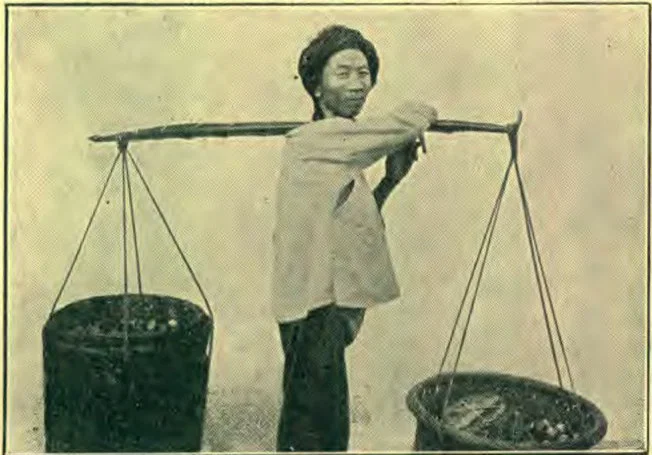
A CHINESE PEDDLER
A CHINESE PEDDLER
The next great marvel to a foreigner is the courtesy and forbearance shown, and the astonishing good nature of the people. Down the narrow, crowded street will come the countryman with his two packs of brushwood, which, slung at the ends of bamboo poles, just fit the six feet of passageway, if he ventures to turn sidewise. A coarse, ill-featured, dirty, and ragged specimen of a man, yet, like a lord, he cries as he moves: “Clear the way!” “I’ll bump you!” “Fly, fly!” “Go to the side!” and all, rich and poor, high and low, smilingly crowd to the sides, squeezing themselves into the shop tables to give him room. Following may be a string of burden bearers with their loads also strung on poles, who make room for themselves by the cry of “Oil, oil!” or, “Fish, fish!” at which dread sounds even the haughty scholar gathers his gown hastily and snugly for fear it will be soiled, and smilingly presses as far back as obstacles will allow.
Amid the myriads of street cries there is one, and only one, the people dread to hear. This strikes terror to every heart. It is the cry, purposely given in a hollow, mournful tone, I-O, accompanied by the beating of gongs. As soon as it is heard, all occupations cease, and every soul that can do so seeks safety in flight; others press humbly out of the way; all, in submission, unfasten their queues from under their caps, letting them drop down their backs, and stand with lowered eyes and clasped hands in trembling, humble attention. This cry precedes the coming of the mandarin. Before him walk in a row the villainous-looking men who give the cry. In their hands they carry long rattans, with which they mercilessly beat any one found obstructing the way, while back of them is a body of murderous-looking men carrying chains. If a poor soul is guilty of any irregularity, these heartless fiends seize and bind him and drag him off to jail and possible torture. This terror-inspiring cry is the only outward shadow, seemingly, on the jovial street life of this peculiar people.
Rarely is a street in the Chinese portion of a city over twelve feet in width, and that width is found only in the principal business streets; and seldom in any street is the passageway for pedestrians over five to six feet in width, because the merchants put out their tables with merchandise, which occupy five or more feet of the total width.
The shops are dingy, dark, and dirty one-story buildings without fronts. The wooden shutters that close them at night are used during the day, generally, as tables for the exhibition of merchandise. In some of these dirty rooms are often stored thousands of dollars’ worth of valuable goods, yet to a foreigner it seems as if they contain nothing for sale. Often the stock is stowed away out of sight, and such articles as silk and cloth are carefully wrapped in paper to keep out dust and light. Only in the cheaper stores is the stock of merchandise exposed for sale.
As a rule, in the large cities, the merchants of a like business congregate together, the shoe merchants in one street, the silk dealers in another, the fish markets in another, and so on. In some respects this is convenient and economical, because competition lowers prices, but it necessitates much traveling to complete all purchases. However, the greater part of the household buying is done by the servants, mainly the cook. These agents usually retain a percentage, and when considered safe to do so, further “squeeze” — steal — from their employers, as opportunity offers.
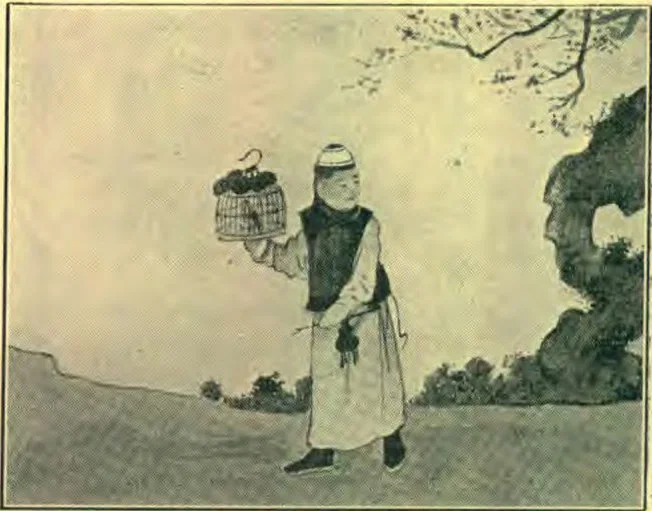
A COMMON SIGHT IN CHINA
Many of the peddlers of China are what might be called a necessity, especially for the women, who are forbidden to shop on the streets, and have to depend upon these traveling salesmen for the goods and trinkets they require. These men are actually doing a revolutionary work among the women, bringing to their notice the wearing apparel and jewelry worn by the “outside kingdom” women, or foreigners, creating a longing for such things, and thus bringing about great changes in their costumes, remodeling and modernizing their appearance.
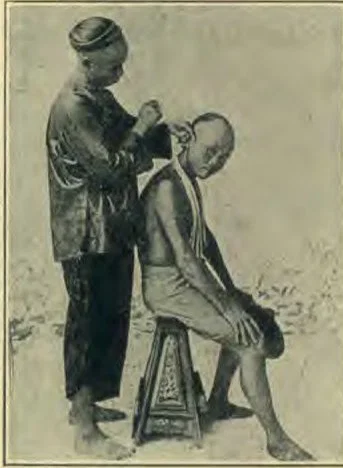
CHINESE BARBER AND EAR CLEANER
Then there are the peddlers in cakes, the dealers in “sweets and sours,” and most popular of all, the “candy man.” Each has his peculiar and particular cry, the last named wielding a huge pair of shears with which he cuts the candy. At the sound of the clanking of these shears, every boy within hearing distance starts for the candy stall with a shout, holding up the cash he has saved for the occasion.
In some cities where sedan chairs are in use, these chair bearers are most provoking. They literally shove their way through the crowd. One hears their shrill cry far down the street, “Pei-a, pei-a, pei-a!” that is, “Mind your back, mind your back, mind your back!” If this warning is not heeded, one is bumped in the back. Sometimes a mother with her baby strapped upon her back will be encountered. It looks strange to see her turn around and use the baby as a bumper to receive the shock. The youngster is in no danger, as he is heavily swaddled in cotton-batting clothing. To the uninitiated, however, it looks like a dangerous experiment, remembering the cash value of a boy in China. Should the baby be injured or killed, the woman would in all probability pay the forfeit with her life.
One of the most interesting characters met with is the scholar, a man held in high respect everywhere. His clothing may be shabby and threadbare, and poverty be stamped on all he has and is, yet there is a proud and calm look of superiority in his face and in the unruffled dignity of his movements, that commands respect. Thousands of these men who have passed examinations which entitle them to government positions, live half starved all through their lives, waiting for the commissions that never come. Too proud either to work or to beg, it is a mystery how they eke out an existence.
Every merchant is a “character,” let him own a shop or roam the streets as a peddler; each has ways and tricks so peculiar to himself that they form a delightful study. You enter a silk shop. The goods are wrapped in paper on the shelves. Several idle clerks stand around, but make no effort to wait on you. Instead, they all indulge in a conversation in which they criticize your dress and appearance. You express a wish to look at some silks. Then, and not until then, the proprietor comes forward, and two or three clerks are sent into a back room for goods to show you. After selecting what suits, you ask the price, and the merchant names a sum far in excess of the real value. Individually or through an interpreter, you make an offer. The merchant, with a sweet smile, answers:—
“Mai puh tao” (“Sell not arrive”).
Still smilingly, the merchant names a price a trifle lower. It is then your turn to raise your offer a trifle, too.
“Mai puh tao,” he still smilingly answers, with a feint to rewrap the silk. Then you raise the offer again, and so the bargain progresses until the sum named by you meets with approval, when with an air of lordly indifference, the merchant cries:—
“Mai teh, mai teh!” (“Buy attain, buy attain!”) and the silk is yours. Possibly the total difference has been but a few cents.
Most shops keep a bird in a cage for good luck. It is a common sight to see men on the streets carrying with the utmost care, as they would a baby, a bird in its cage for its morning airing.
In some recess in the street where the crowd will not press in too closely, one will find the fortune teller. His stock in trade consists of a few bamboo sticks inscribed with cabalistic characters, and a Java sparrow in a cage. A man approaches and asks to be told his fortune, paying his cash in advance. The bamboo sticks are spread out on the board, and the door of the cage is then opened, when the sparrow will hop out, pick up one of the sticks, dropping it to receive the grain of rice as his reward, and then return to the cage. The fortune teller reads the result from the stick the bird indicated, and if satisfactory, the customer disappears, and the fortune teller and bird compose themselves to wait patiently the coming of another inquirer. If, however, the result is “not good,” another trial is generally resorted to, and thus both bird and master profit by the ill success. Then there are the street readers and letter writers, and the ever-interesting street barber, while the street storyteller always has a gaping crowd about him.
Among the strange sights, however, are the multitude of movable kitchens with their stock of cooked foods, found wherever the crowds are the greatest. The kitchen consists of two stands slung on bamboo poles in such a way that they can be lifted to the owners’ shoulders and transported quickly to a new location if necessary. In one of the stands a large pan of rice is placed over a very slow fire, where it remains hot, but does not cook. The top of the other stand is used as a show place on which the various delicacies for sale are laid out on small plates. These are side dishes to tempt the appetite of the customers, and are placed on top of the bowl of rice as ordered.
The cheapest dish is salted turnips, then come bean curds, cucumbers, celery, lettuce, salted beans, and plates of various kinds of fish, with different styles of soy, to be sprinkled on the rice as an appetizer. Why do so many people eat on the streets? Have they no homes? Surely a man without a home, and sons to perpetuate his memory, is a rarity. Possibly the question cannot be answered.
But the saddest of all sights are the opium dens, the “foreign medicine” dealers as they are called, now happily being suppressed by law. These buildings differ from the others in that they have no fronts, and all the windows are closed tightly. There is an entrance door, but a heavy screen is hung just back of it, preventing the interior from being seen. Pushing aside this screen and entering, one sees a dimly lighted room, strongly impregnated with the odor of burnt opium. Around the walls are benches for the customers to recline on when smoking, for the drug temporarily paralyzes the user, rendering any movement impossible.
In the center sits the proprietor, busily engaged in molding small pellets of opium into various-sized balls, which are deposited in tiny cups, made up in advance for future customers who, he knows, are sure to come. By experience the man knows just what quantity each of his customers requires, and prepares the dose in advance, as the men are always crazily hungry to obtain the drug, and inhale the smoke without a moment’s delay.
After all, when summed up, the strangest of all the strangenesses of a Chinese city is the absence of noise. There is something uncanny about the street life of this people, who live for their dead. The roar of European cities, with their electric cars and cabs, their automobiles and trucks, and the hundred other noise producers, is absent. Not even the clatter of a horse’s feet breaks the weird stillness. Only occasionally is a street cry heard, while the people come and go, but pass and repass like ghosts, making no noise. One sees, but does not hear them; their cloth shoes or bare feet give no sound. Even the mules shuffle silently through the dirt of the streets. All seems ghostlike and weird. As one turns and passes out again into the European quarters with its automobiles and “outside kingdom” noises, the change is sometimes startling, and you query, Will this people ever abandon tradition and accept the progress of modern nations? If not, what is to be the ultimate fate of China?

Trip from Riga to Siberia Along the Irtysh River

Trip from Riga, Russia, to Siberia, near the Chinese Border — No. 1

[The trip described by Mrs. Boettcher loses little, if any, of its interest from the fact that it was taken several years ago; for the conditions and people described remain almost unchanged.]
ONE year ago we were at home in Norwalk, Ohio, getting ready to enjoy the “home-coming,” and now, at this writing, we are away off for Siberia en route to Central Asia. We are on the river Irtysh from Omsk, Siberia, to Semipalatinsk, and it is the latter part of June.
This river is 1,800 miles long, and navigable almost the entire length. Our boat is about the size of the large passenger steamers on Lake Erie, and is, in every way, just as well equipped, having comfortable state-rooms, electric lights, and a good restaurant, with very moderate prices. I cannot think of a more delightful trip than a week spent on this river,—a trip overland by water, with all the pleasures of a sea voyage, without even running the risk of being seasick.
As the boat stops at the various landings, we have abundant opportunity to see the towns and study the people. The sights are strange and new to us. We are in Asia, and no modern city greets our view. On one side of the river are the Cossack towns or settlements, and on the opposite the Kirghiz tents or huts. At the landings we see Russians, Kirghiz, Tartars, Chinese, Japanese, and Gypsies. To us they appear curiously dressed, most of them in bright, gay colors; men perhaps with wide green breeches and red shirts worn on the outside over the breeches. The heat is intense, yet most of the Russian and Kirghiz men have on heavy fur caps, and felt boots often lined at the top with fur, and quite often they have on their fur coats. They must know what is good for them, for we certainly could not endure the hot sun in our clothes as well as they do in theirs. The women, however, are dressed in their gay prints, with pretty embroidered handkerchiefs tied over their heads.
Men, women, and children, camels, horses, cows, and sheep, are all bathing in the river together; some women are washing clothes, while near by men are filling barrels with water to be used for drinking and household purposes. The fear of germs seems unknown here.
There is much on our own boat which is interesting, especially if we go downstairs where the third-class passengers are. They are mostly immigrants, Russians and Germans, who are settling up the land and making new homes for themselves in this vast Eastern country. Here the tide of emigration flows east instead of west. Our boat carries a large amount of freight, which we have watched the men load and unload all along the route. To our surprise we find that it consists mostly of American farming machinery—hayrakes, self-binders, mowers, etc. At the last landing, as the freight was being unloaded, we could read quite plainly, “Made in Chicago.”
The Tartars and Kirghiz till the soil very little, nor do they care to build permanent houses. They lead a nomadic life, having great herds of cattle, and prefer to live in their mud huts in winter. There are many of these huts to be seen along the river, now empty, of course. They are surrounded by fences, not made of rails or wire, but of manure piled up like a wall.
We are now about five thousand miles away from our home in Riga. Our first stop was made in the city of Moscow, where we spent several days. It is a city of barbaric splendor, very striking with its green roofs, golden dome, and steeples.
We visited the royal palace, with its grand marble halls and rooms and doors of carved gold. We saw all the thrones with their respective crowns, one of which especially caught our eye because of its great brilliancy. It was composed of diamonds alone, set in gold. How it did sparkle! Then there were the coronation robes and gowns made of solid silver and gold. The robes of the czars are of gold, those of the czarinas of silver. Over the gold and silver garments are worn the beautiful ermine robes. The gold and silver are drawn into fine threads from which a sort of metal cloth is made—very costly, to be sure, but looking somewhat stiff, and to my mind not comparing favorably in beauty with some wonderfully embroidered silk robes hanging near, presented by the Japanese.
Before leaving the city we also visited a great museum, where are represented, life-size in wax, all the different races of people found in the Russian Empire. Not that they are standing along in a row. No; they are in their homes, with their children, dressed in their national costumes, with a display of the industries of both men and women. There was beautiful fancywork and wonderful pink capes made in the most fantastic shapes. These simple Russian peasant women can do some of the most lovely embroidery I ever saw.
One could spend weeks in this museum, studying the many different races of people found in this great empire; people about whom no books have been written, and of whom so very little is known by the outside world. One can read much more about the different races of Africa, yet how greatly superior are these races! One feels a desire to make their acquaintance, a feat in many cases more difficult than to visit the tribes of Africa. I counted thirty-six distinct races of people, and these may be subdivided many times, as a great many more dialects and languages are spoken.
As we continued our trip, we found that our study in Moscow prepared us better to appreciate and understand the people we met all along the way. We have watched with interest all the towns, villages, and settlements as we passed by. The country from Moscow to the Ural Mountains is very different from anything we have been accustomed to. The settlements look more like a collection of straw stacks than they do like villages. The walls of the huts are built of mud and covered with a straw roof. Most of them are too low for a grown person to stand upright in, and many of them have no chimneys. Even in the towns the houses are very low, and the total absence of trees, green grass, and gardens gives them a desolate appearance. The people seem to have no idea whatever of raising garden stuff.
We began to understand why the Russian peasantry love so well to dress in such gay colors—red, green, and yellow. Their gowns and headgear alone bring life and color into their surroundings, which would otherwise be unbearably dull. They have no flower gardens, so the women embroider the most beautiful flowers upon their skirts, aprons, and scarfs, and upon the men’s shirt fronts. All the world over it is true that women love, and will have, the beautiful.
Traveling in Russia, after one has learned how, is very enjoyable. The cars are large and high, and passengers take most of their baggage with them into the train. The seats are arranged like berths in a sleeper, and each person has a long seat or berth to himself. All Russians take a complete bedding outfit with them wherever they go, as even most of the hotels furnish only the bedstead and mattress. So in the cars one spreads out his bedding and lies down for a nap whenever he feels like it. As the cars do not go very fast, it is quite comfortable. At all the large stations hot water is furnished free of charge, and most of the passengers carry teakettles with them. It is amusing to me to watch well-dressed gentlemen as well as ladies, running about with their teakettles. In the train each person has his coffee pot or teapot, and prepares and drinks his coffee or tea at his leisure. Good hot milk is sold in bottles. Isn’t this a better way than swallowing things down so hot at a lunch counter while the conductor calls, “All aboard”? Siberian trains are clean and well kept. The locomotives are heated with oil instead of coal, which also helps to make traveling pleasant.
Mr. Boettcher and I had a small compartment to ourselves, and we felt quite at home as we traveled five days before even changing cars. We especially enjoyed the trip through the Ural Mountains. It was night when we entered the mountains near the city Ufa. A thunderstorm was on, and as the lightning flashed through the mountains it made the scenery appear grand indeed. Ufa lies high up on the mountain side, while below, in the valley, flows a large, beautiful river. It reminded us of Pennsylvania. We even saw fireflies dancing—a sight we have so often missed since leaving Ohio. After the storm had passed, we could hear the nightingales singing in the woods.
Daylight found us high up in the mountains among the gold and iron mines. At the highest point through which our train passed, near Slatons (3,500 feet), a stone monument marks the boundary between Europe and Asia. On one side of the monument is engraved the word “Europe,” and on the other side “Asia.” A short distance across, on the opposite side of the mountain, we noticed a wireless telegraph station.
At Tcheliabinsk we changed cars, and soon left the mountains behind us, passing out into the flat plains of northern Siberia, the land of the exiles, of whom we have heard so much.
The heat had been intense all the week, but now, very suddenly, the air grew bitterly cold, as we found, much to our surprise, upon leaving our comfortable car at five o’clock in the morning to get out at a small Tartar station, some 250 miles from Omsk. Our conductor objected to letting us off at such a station, as he was sure there was a mistake; but we were following directions, as our friends had written us to get off here and we would find horses and wagon to meet us and take us farther. There was, however, no wagon to be seen, so we went into the station and made some hot coffee to warm us. While we were drinking, the wagon arrived. The driver was a German with whom we could converse. Our road took us first through the Tartar village with its low mud houses and flat sod roofs, but the houses had windows, in many of which I noticed blooming house plants; then through a Russian village the houses of which looked like hay stacks scattered about, and on over the prairie and through the woods, miles away from any town or settlement. It was all very interesting, only I thought it the coldest ride I had ever taken. We had plenty of warm clothing in our trunks, but could not get at it.
At last we reached a quiet German settlement, beautifully located on a small lake at the edge of a woods. We were suddenly at home among friends, and here was to be held our first camp meeting in Siberia. Religious liberty has been progressing backward instead of forward in the Russian Empire, until of late there is very little liberty at all, so closely does the government watch for fear some one may be “making propaganda,” as they call it. Also a new law has been passed forbidding all missionary lectures at conference meetings. That is to say, no sect is permitted to talk at all about missions in foreign lands, such as Africa, India, or China, nor are any collections allowed to be taken. So our Mission Board decided to hold their meetings in Siberia and Central Asia, far away from the cities and the ever-watchful eye of the police.
A large tent had been pitched in the woods, and was comfortably seated. There we worshiped God in perfect liberty according to the dictates of our own conscience. Some came more than three hundred miles with their teams to attend the services. We enjoyed the meetings very much, and it seemed almost like being at home again in the States. I think I could understand a little why our forefathers, for the sake of liberty, endured all the hardships of their New England homes.
A Kirghiz tent pitched on the lake shore reminded us, however, that we were not in America. It was the home of a Kirghiz shepherd who herded the cattle of the settlement, so we decided to pay the family a visit. The man, whose name is Abraham, rose at once upon our entering, and gave us a hearty welcome and spread rugs on the ground for us to sit upon. These tents are round and contain an astonishing amount of things. Directly in the middle of the tent is the fire built of little sticks of wood. The smoke escapes from a hole in the top of the tent. A kettle was suspended over the fire, and a grandmother and a young girl were cooking. They wanted to make tea for us, and upon our declining, offered to get wine, although, as Mohammedans, they themselves do not drink. They were quite pleased when we assured them that we, too, drank no wine.
There was a baby in a cradle, an old woman, bed-ridden, lying on her mat, and soon Abraham’s wife came in. As he seemed to have but one wife, she completed the family circle. Such a tent, with its bright matting and many rugs, presents a more home-like appearance than do the bare huts of many of the Russian peasants. We are told that these Mohammedan shepherds are quite trustworthy, and do not steal the cattle, as do the so-called Christian shepherds.
After our visit to them they felt free to attend our meetings, and were also present at a baptismal service on the lake shore. Baptism in northern Siberia, in such a lake, with the evening sun setting at nine o’clock for a background, and the beautiful blue clouds above, was a scene long to be remembered by all present.
After spending four days at this place we went by rail to the city of Omsk, and there boarded the ship from which I am writing this letter.
MRS. J. T. BOETTCHER.

The Mystery of the Niger

THE Niger is the third greatest river in Africa and the eleventh in rank in the world. How did it happen that for generations no one knew the place and the manner of its junction with the Atlantic? The problem was really a hard nut to crack, though with our present methods of African exploration and our knowledge of how to live in the deadly climate of the delta, the mystery would probably have been solved in a few months.
The Niger delta, one of the largest in the world, stretches two hundred and fifty miles along the coast. Most of its streams are small, and skirting the coast, one can hardly observe them, so completely are they hidden in the dense region of mangrove swamps. Explorers soon found that they might struggle up a stream for weeks, only to prove it a blind alley; for a peculiarity of the Niger is that not a few independent rivers form between the delta branches and have no connection with the Niger itself. Most of the delta is a network, difficult to enter or to retreat from.
All nature is hideous there. The brown waters lazily coursing; the evil odors of the slime and ooze; the repulsive animal life, from crocodiles to pythons, lurking in the shadow for their prey; and a choice collection of insect plagues, including the Anopheles mosquito with its poisonous sting. These terrible conditions, persisting for forty miles inland, are then succeeded by solid earth, noble trees, and sweet air; but the swamp region of the lower delta is one of the most forbidding parts of Africa.
Richard Lander, at last, in 1830, floating down the Niger, was taken by natives into the Nun branch of the delta, and descended it to the sea. The Niger problem was solved. For many years, the Nun branch was the means of commercial communication with the river; but some time ago a sand bar forming at the Nun mouth made entrance difficult for ships; and a good route to the Niger has now been developed through the Forcados branch of the delta.
But the terror of the delta persisted till the white man learned how to fight the malignant agencies of tropical disease.
England gave the Niger a wide berth till after 1830. It was thought to be a plague-stricken region, from which no good would ever come. Its terrors have fled today before the advance in knowledge. Large vessels ascend the Forcados branch, carrying commerce to and from the far interior of Africa; and Nigeria, a coming empire of industry, with its great cattle, cotton, tin mines, and other resources, is joined to the sea both by rail and river.— Review of Reviews.
Continue reading: A Modern Nimrod