The Youth’s Instructor, Vol. 38, No. 10.

HOMES OF THE THLINKET INDIANS

The Youth’s Instructor

Mar 5, 1890

S. D. A. Publishing Association · Battle Creek, Mich. · Mar 5, 1890

HOMES OF THE THLINKET INDIANS.
A STUDY of the habits and customs of any race of people is interesting, not only because it gratifies our love of the curious, but because it reveals the workings of those motives and passions that proclaim the common brotherhood of man. When the United States government paid to the Russian government in 1867, $7,200,000 for a portion of territory bordering on Behring’s Strait, with nine times as many square miles as are embraced in the New England States, it came into possession of a country of which little was then known, but which has since proved rich in fisheries and fur-bearing animals, and which in coast scenery is not surpassed by the grandeur of the Old World.
The interior of Alaska has never been thoroughly explored. Since it is away from the modifying influence of the Pacific gulf stream, and near to the Arctic Ocean, its vast fields remain frozen for the greater part of the year, and hold out no inducements to the mere adventurer. But along the coast, the warm waters of the gulf stream and the long days of summer have so far softened the atmosphere that in the vicinity of Sitka the temperature at midwinter falls but little below that at Washington, D. C. The summers are cool and temperate. Rain is abundant in this region, and while it causes all vegetable life to grow in rank profusion, it also keeps the atmosphere so moist that hay cannot be cured, and grain will not ripen. It is therefore mainly on its fisheries that Alaska depends for its wealth.
But any description of the geography of the country must be reserved for another time, while at present we take a peep at the houses of the original inhabitants. With the advent of the white man, the Indian has begun to take on some of the ways of civilization, and thus is gradually losing the distinctive features of his race.
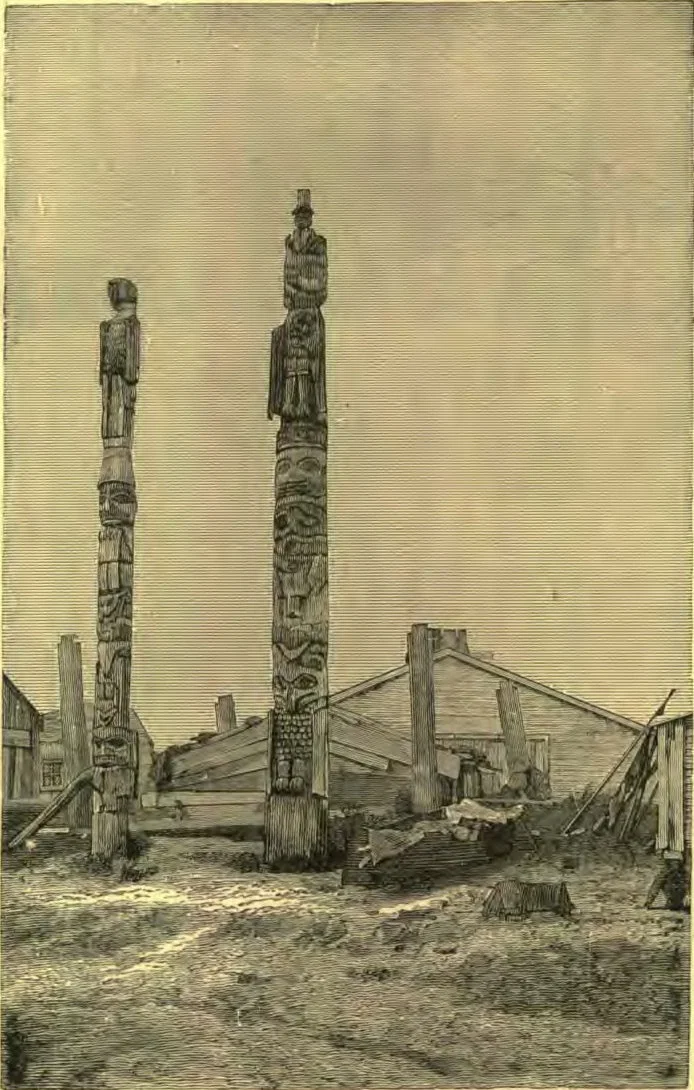
In a recently published book, “Journeys in Alaska,” the writer gives an interesting description of the houses of the Thlinket Indians about Fort Wrangell, and this, together with the accompanying picture of an Indian hut with its totem poles, may give you some idea of life in this part of the world. She says:—
“The houses of the Indian village string along the beach in a disconnected way, all of them low and square, built of rough-hewn cedar and pine planks, and roofed over with large planks resting on heavy log beams. One door gives entrance to an interior, often twenty and forty feet square, and several families live in one of these houses, sharing the same fireplace in the center, and keeping peacefully to their own sides and corners of the common habitation. Heraldic devices in outline sometimes ornament the gable front of the house, but no paint is wasted on the interior, where smoke darkens everything, the drying salmon drip grease from the frames overhead, and dogs and children tumble carelessly around the fire and over the pots and saucepans. The entrances sometimes have civilized doors on hinges, but the aborigine fashion is a portière of sealskin or walrus hide, or of woven grass mats.
“Before many of the houses are tall cedar posts and poles, carved with the faces of men and beasts, representing events in their genealogy and mythology.” “The truth about these totems will never be quite known until the innate humor of these Indians is civilized out of them;” for “there is nothing the Siwash himself enjoys so much as misleading and fooling the curious white man in these matters.” “These totems are for the most part picture writings that tell a plain story to every Siwash, and record the great events in the history of the man who erects them. They are erected only by the wealthy and powerful members of the tribe, and the cost of carving a cedar log fifty feet long, and the attendant feasts and ceremonies of the raising, bring their value, according to Indian estimates, up to one thousand and two thousand dollars.
“The subdivisions of each tribe into distinct families that take for their crest the crow, the bear, the eagle, the whale, the wolf, and the fox, give to each of these sculptured devices its great meaning. The totems show by their successive carvings the descent and alliances of the great families and the great facts and incidents of their history. . . . Descent is counted on the female side, and the first emblem at the top of the totem is that of the builder, and next that of the great family from which he is descended through his mother. In some cases two totem poles are erected before a house, one to show the descent on the female side, and one to give the generations on the male side.”
“In their mythology, the crow or raven stands supreme as the creator and the first of all created things. He made everything, and all life comes from him. . . . The Indians have a tradition of the deluge, in which the chosen pair were given the shape of crows until the water had subsided, when they again returned to the earth, and peopled it with their descendants. No alliances are ever made within the great families, and a crow never marries a crow, but rather a member of the whale, bear, or wolf families. The man takes the totem of his wife’s family, and fights with them when the great family feuds arise in the tribe.”
“These Thlinket Indians of the coast have broad, heavy faces, small eyes, and anything but quickness or intelligence in their expression. They are slow and deliberate in speech, . . . and any theories as to fish diet’s promoting the activity of the brain are dispersed after watching these salmon-fed natives for a few weeks. Many of their customs are such a burlesque on our civilized ways as to show that the same principles and motives underlie all human action. When a totem pole is raised, the event is celebrated by the whole tribe. A common Indian can raise himself to distinction and nobility by giving many feasts and setting up a pole to commemorate them. After he owns a totem pole, he can aspire to greater eminence. That man is considered richest who gives most away, and at the great feasts, or potlatches, that accompany a house warming or pole raising, they nearly beggar themselves. All the delicacies of the Alaska market are provided by the canoe-full. . . . Blankets, calico, and money are distributed as souvenirs. . . . His rank and riches increase in exact ratio as he tears up and gives away his blankets and belongings; and the Thlinket has satisfied pride to console himself with, while he struggles through the hard times that follow a potlatch.”},{

ONE THING AT A TIME.

“Early in life,” related a gentleman who has now spent many decades in the service of God and his fellow-man, “I learned from a very simple incident a wholesome lesson, and one which has since been of incalculable benefit to me.
“When I was between twelve and fourteen years old, my father broke up a new field on his farm, and planted it with potatoes; and when the plants were two or three inches high, he sent me to hoe it. The ground of that piece was hard to till; it was matted with grass roots, and sprinkled with stones. I hoed the first row, and then stopped to take a general look at the task before me. Grass as high as the potatoes was everywhere, and looking at the whole from any point, it seemed to be a solid mass. I had the work to do all alone, and as I stood staring at the broad reach of weedy soil, I felt a good mind not to try to do anything further with it.
“Just at that minute I happened to look down at the hill nearest my feet. The grass didn’t seem quite as thick there, and I said to myself, ‘I can hoe this one well enough.’
“When it was done, another thought came to help me: ‘I sha’n’t have to hoe but one hill at a time, at any rate.’
“And so I went to the next and the next. But here I stopped again, and looked over the field. That gave me another thought, too. I could hoe every hill as I came to it; it was only looking away off to all the hills that made the whole seem impossible.
“‘I won’t look at it,’ I said; and I pulled my hat over my eyes so I could see nothing but the spot where my hoe had to dig.
“In course of time I had gone over the whole field, looking only at the hill in hand, and my work was done.
“I learned a lesson, tugging away at those grass roots, which I never forgot. It was to look right down at the one thing to be done now, and not hinder and discourage myself by looking off at the things I haven’t come to. I’ve been working ever since that summer at the hill nearest my feet, and I have always found it the easiest way to get a hard task accomplished, as it is the true way to prepare a field for harvest.”—New York Evangelist.

STRENGTH FOR TO-DAY.

STRENGTH for to-day is all that we need, As there never will be a to-morrow; For to-morrow will prove but another to-day, With its measure of joy and sorrow.
Then why forecast the trials of life, With such sad and grave persistence, And wait and watch for a crowd of ills That as yet has no existence?
Strength for to-day—what a precious boon For the earnest souls who labor! For the willing hands that minister To the needy friend or neighbor.
Strength for to-day—that the weary hearts In the battle for right may quail not; And the eyes bedimmed by bitter tears In their search for light may fail not.
Strength for to-day—in house and home To practice forbearance sweetly! To scatter kind words and loving deeds, Still trusting in God completely.
Strength for to-day is all that we need, As there never will be a to-morrow; For to-morrow will prove but another to-day, With its measure of joy or sorrow.
—Selected.

ROUND THE WORLD.—10.

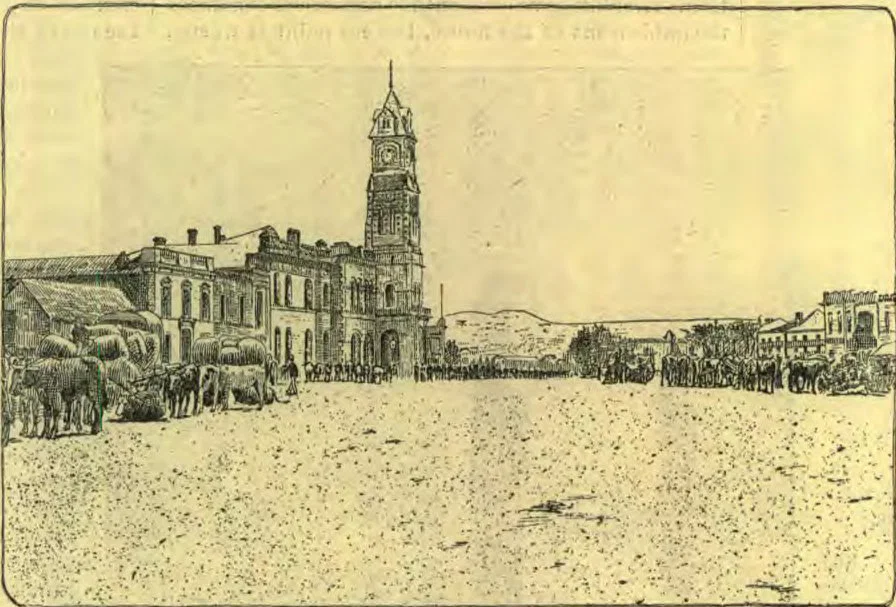
On the twenty-fifth of November we once more resumed our journey, and are now far away from the Cape of Good Hope, over in the Eastern Province of the Colony. Our first point was Port Elizabeth, a large city situated on the southern coast of the continent, on Algoa Bay, in the Indian Ocean. There are two routes by which it can be reached from Cape Town,—one by rounding the Cape of Good Hope, and sailing along the coast, and the other by rail to De Aar, up country, and then down again. We chose the latter. The first part of our journey lay over the same road and through the same country which we traveled in going to the Diamond Fields, and as I have already described it, it will need no mention here. We reached De Aar, the City of the Heights, early on the morning of the second day, and after a brief delay, were off again. For a considerable distance, the road runs through much the same class of country as that upon which we had come up,—nothing but karoo bushes, here and there an acacia, red hematite soil, rocks of every size and description, and a few lonely-looking Kaffers.
GRAHAMSTOWN, THE CITY OF THE SAINTS.
During the whole journey from Cape Town to Port Elizabeth, distant some eight hundred or ten hundred miles, we were nowhere out of sight of some range of mountains. They are irregularly dispersed all over the African plains. As we come nearer to the seacoast, the country has a more settled appearance. On either side of the road are large, well-managed farms. The inhabitants are mostly English, and their methods of carrying on farming accord more with our ideas of how it should be done than do those of the Dutch.
We passed through many ostrich farms. A few years ago, this industry was a source of large profit, but lately the feathers have greatly decreased in value, and there is not nearly so much demand for them. The ostrich in its natural state is not a pretty bird. The males are black, and the females a dull gray color. The longer feathers of the former are white, and it is these that are of value. They have long necks and legs, and are very powerful, and, if their nest is in danger, will not hesitate to attack a man. When such danger arises, those who take care of them enter the inclosure armed with a bough from an acacia bush. The formidable spines of this are poked in the face of the bird, which, afraid that its eyes will be put out, retires. When the ostrich is very savage, it becomes necessary for the one attacked to lie down on the ground, and keep the foe at bay with the bush. Sometimes the bird keeps such a vigilant watch over his supposed enemy, that the man is obliged to lie there for a whole day, or longer.
Toward evening we were running between two ranges of mountains; then we drew into a ravine, and to all appearances were going straight for the rocks, when the road suddenly made a sharp curve, and we commenced to ascend, and were soon winding zigzag round and round, then through a tunnel, and, with air-brakes tightly set, began the descent. From this onward till Port Elizabeth is reached, the train passes through a rocky, mountainous country, covered with various kinds of wild brush.
Only a few miles from Port Elizabeth is the famous “Assagai Bush,” where wild elephants are found in great numbers, and a little further off is a place known as “Koombs Bush,” where are a great many buffaloes.
The business part of the town of Port Elizabeth lies on the flats by the sea-shore and on the hill-side. The stores are well built, and the town does a large shipping business. Nearly all the supplies for the Gold and Diamond Fields are landed here, and although the place has only about eighteen or twenty thousand inhabitants, there is fifty per cent more business transacted in it than in Cape Town.
The residences are on three hills, with but slight dips between them. The central of the three is known as “Monument Hill.” On its summit is a large pyramid erected to the memory of Lady Elizabeth Donkin, who first laid out the town, and from whom it derives its name. On the same hill stands a flag-staff, from which the signals for the ships are run up, and a light-house, the light of which can be seen for some eighty miles. The streets are wide, well made, and beautifully planted with cypress, eucalyptus, and beef trees. The place has more the appearance of an American town than any we have yet visited. Its inhabitants are mostly English, and there are only two thousand negroes in the entire city. These do not reside within its limits, but have their “kraals” some distance out.
There is a beautiful park and botanical gardens, containing a magnificent fernery. Here we saw one of the “fern palms.” The stem is thick, and grows straight up, while at the top it branches out into long, slender, fern-like leaves. The trunk itself is filled with little crevices which soon become filled with clay and other material blown in by the wind. Seeds from the flowers that are growing all around find lodgement in these crevices, and take root and grow, so that the trunk forms a curious spectacle, as out of it grow primroses, violets, and many other flowers.
There is no harbor at Port Elizabeth, and the open sea runs into the bay. Many ships have been lost, whose shattered hulls we could see all along the coast. Among other ships in the offing I noticed the Warwick Castle, which had been my home for so long on the voyage out. After a short stay, we once more resumed our journey, this time for one of the inland cities, Grahamstown, “the city of the saints.”
P. T. M.

MENTAL LOAFING.

It is considered a disgrace to be lazy. He who is too indolent to work for his own living becomes a by-word and a reproach. But there is a very common form of laziness, which is not always noticed; it is that of the mind. We first become conscious of it in our young days when we “don't feel like study.” We dawdle over the book with our thoughts half asleep, and as a result give a fine exhibition of stupidity in the recitation room. This sort of indulgence in youth is very dangerous; for it becomes a habit, and the mind grows rusty and dull in the very prime of life, when it should be at its best.
On the heels of this form of laziness comes another bad habit—that of intellectual loafing. What loafing is in the common sense we all know; it is hanging about with no definite aim or purpose, idling away the time without profit. Well, there is mental loafing as well, and it is known in the dictionary as “reverie.” It is a dreamy state of the mind, when the thoughts go wool-gathering. This habit, so common to young people, is fatal to mental growth; many a promising youth is ruined by over-indulgence in it. It wastes time, and enfeebles the mental powers. It is really a form of laziness, and should be sternly corrected at the very outset. The action of the mind should be kept under control. When the thoughts begin to wander, it is time to whip them into order. A resolute will will do it.—Selected.

PAINSTAKING

“What is worth doing at all is worth doing well” is an excellent motto for every boy and girl to follow. Not only does practicing this adage establish habits of carefulness, speed, and accuracy, but it lays a good foundation for success in life. A prominent judge living near Cincinnati wished to have a rough fence built, and sent for a carpenter.
“I want the fence mended,” said he, “to keep out the cattle. There are some unplaned boards—use them. It is out of sight from the house, so you need not take time to make it a neat job. I will pay you only a dollar and a half.”
However, afterward, the judge, coming to look at the work, found that the boards were planed and finished with neatness. Supposing the young man had done it in order to make a costly job of it, he said, angrily,—
“I told you this fence was to be covered with vines. I do not care how it looks.”
“I do,” said the carpenter.
“How much do you charge?” asked the judge.
“A dollar and a half,” said the man, shouldering his tools.
“Why did you spend all that labor on the job if not for the money?”
“For the job, sir.”
“Nobody would have seen the poor work on it.”
“But I should have known it was there. No; I’ll take only the dollar and a half.” And he took it and went away.
Ten years afterward, the judge had a contract to give for the building of a certain magnificent public building. There were many applicants among the master-builders; but one face attracted his attention. It was that of the man who had built the fence.
“I knew,” said the judge, afterward, telling the story, “we should have only good, genuine work from him. I gave him the contract, and it made a rich man of him.”—Youth’s Companion.

PUT ON THE BUFFERS.

Did you ever notice the way in which a train of railroad cars is fastened together? At the end of each car is a huge bolt, which slides in and out a little way, to which is hooked another bolt just like it on the next car. When the engineer backs, and the two cars come together, they do not strike with a hard bump, jolting the passengers out of their seats; but the two fastenings meet, each slides in a few inches, breaking the force of the blow, and the two cars come together easily and gently. These slides are called buffers, because they buff each other, and save the cars from many a bump. Now do you know that everybody can carry with him a buffer which will help him to avoid hard hits with other people? That buffer is kindness.
A kind word, spoken gently, even in answer to an unkind one; a kind action, seeking the good of another; above all, a kind heart, full of love, will make all around us friendly, and fill the world with sunshine.
You remember how Joseph went out of his prison to become a prince. If he had moped and sulked in Potiphar’s house, as he had some reason for doing, or had sat down in the prison cross and snappish, do you suppose he would ever have risen to greatness? No, with all his ability, but for his kindness and cheerful, helpful spirit, you and I would never have heard of his name. Kindness will often succeed where eminent ability will fail.—Raleigh Christian Advocate.

A Bright Face and a Warm Heart

A BRIGHT face is better than a clear sky, and a warm heart than a summer sun.

MAMIE'S PUPIL

“Mamma, Miss Allen says I have all the lessons in the first book perfect now, and I need a new one with harder lessons,” cried Mamie, excitedly, as she came in from school one afternoon.
“Indeed, I am glad to hear it,” said mamma; “Miss Allen must be a good teacher to be able to report such progress.”
“Miss Allen is a good teacher, and I’m going to be a teacher when I’m grown, just like her, if I can.”
“Then I hope your pupils will make as good reports of your work, dear, but I think you need not wait until you are grown; you are a teacher now.”
“I a teacher? Why, you are surely joking, mamma!” laughed Mamie.
“No, indeed, I am in earnest; and if you would like to hear the report of one of your pupils, come with me. I think he needs some new lessons, too, at least he has the old ones learned by heart.”
Wondering, Mamie followed mamma. What could she mean? She hadn’t taught any school, she was sure.
“Top! Top ’at!” came in angry baby tones from the next room. “Top! Baby hit ’ou!”
“The bad boy,” said Mamie to her mamma. “How can—”
“Sh! Baby is only saying his lessons,” said mamma, putting her hand to Mamie’s lips.
“Baby must have his little face clean,” urged Dinah, in a kind tone.
“Won’t, to now! Do ’way, Dinie!” again came from baby, accompanied by a stamp of his little foot.
Mamie looked much shocked, and was just about to urge mamma to go in and make him behave, but again mamma said, “Keep quiet; he is only repeating the lessons he has learned.”
While Mamie was wondering whether her brother had ever been to school, she heard him scream out again, “Bad Dinah! Baby hit ’ou!” and then there was the sound of a little pat, and Dinah pretended to cry.
Mamie couldn’t stand it to have any one hurt old Dinah, and she broke out, “Mamma, go in and make that bad boy behave!”
“Doesn’t he say them perfectly?” asked mamma, not in the least disturbed. “Don’t you think he has been a rapid learner?”
“Learner? I think he is a naughty boy.”
“Naughty just to remember so well the lesson he has been taught? How much of all this could baby say three months ago?”
“Why it’s only within a month or so, mamma, he said any of those naughty things.”
“And how do you think he came from not knowing them, to know them so well? They did not come flying into his head through the air; the angels did not whisper them to him, did they?”
Mamie shook her head.
“Do you think papa or I taught them to him, or Dinah?”
Another shake of the head.
“Then who has been his teacher; whom has he ever heard say such things?”
Mamie’s head dropped now; and she stammered, half ready to cry, “I didn’t know that was teaching; I didn’t mean to be that kind of teacher, but of good things, like Miss Allen.”
“But you have heard your pupil’s report, and you see what a quick learner he is; now, if you are not satisfied, you can easily change the lessons by putting him in another book.”
“That’s what I mean to do,” said Mamie, drying her tears—“the book of kind words, instead of cross ones.”—Our Morning Guide.

KATY'S GUESS.

WITH twelve white eggs in a downy nest, Then she sits in a box by the shed; And the children, yesterday, stood and guessed Of the hope that hid in her speckled breast, Of the dreams that danced through her red-crowned head.
"She thinks," says the labor-hating Ned, "Of a land where the weasels are all asleep, Where the hawks are blind, and the dogs are dead, Where are heaps of corn as high as the shed, And plenty of earth-worms for her to eat."
"She remembers the county fair," says Bess, "And the prize she took at Hampton town." "No, no, she don't," cries James the less. "She dreams of her little ducks, I guess; She is wondering why they didn't drown."
And what say you, little curly-pate? I see a thought in your merry eye. "She fink," said the bright-haired baby Kate, As she lifted the latch of the garden gate, "Vere'll be tickens to skatch for by and by."
Three cheers for the wisdom of three-year-old, Who told you the secret, little pet, That love is better than ease or gold, That labor for love pays a thousand-fold? "Oy fluked it ourself"? Well, don't forget. —Selected.

MERRY DAYS IN INDIA.

WHAT do you think the children do who never have any Christmas or Thanksgiving or Fourth of July? There are hosts of such children in India and China and Japan. But you are very much mistaken if you suppose they have a dull time all the year round. They think nobody can have any merrier times than they themselves have. The children in India have some great day to look forward to almost every month in the year. On such days school does not keep, and they have great dinners made ready for them at home, besides having special celebrations for the different days.
Now, I am going to tell you about one of these feasts that the children in India look forward to, that you may see what sort of time they have there.
The name of this festival or feast is “Divali,” or “the feast of lights.” Just before this festival is held, people are very busy cleaning their houses, because they say that at that time a little old goddess, like a fairy, comes around, and goes into every house after dark to see if it is neat and clean, and she blesses all whom she finds living in nice clean houses, and punishes all whom she finds living in dirty houses. When the day comes for her visiting to begin, they light up their houses, inside and outside, with little oil lamps. These lamps are usually nothing more than little saucers, with bits of cotton in them for wicks. They are placed in a row, a few inches apart, along the roof or over the doors of the houses. Sometimes there are three or four rows of them on one house, and they look very pretty at a distance, especially if you look down a narrow street. It seems as if the houses had suddenly turned to gold. Of course the children enjoy having everything lighted up, but they enjoy something else that goes along with the lighting up a great deal better, and that is fire-crackers. You would think it was the Fourth of July in India were you to be there when this festival occurs. The crackers come from China, and are just like those you get here. But, besides the cannon crackers and the ordinary crackers, there is something the girls like to fire off, because it does not make a noise, and because it is so pretty. It is a squib done up in white paper, and after setting fire to it, they hold it out at arm’s length, and beautiful stars flash out and drop from it to the ground. Three, four, or even six stars drop from one of these squibs.
Besides these gunpowder amusements, there is to be had at this time a particular kind of candy that is not made by the confectioners at other times. It is made out of sugar and milk, and is very delicious to eat. It is shaped like horses, elephants, monkeys, men, temples, balls, and all sorts of fancy things; but the favorite way of making it is in the form of large coins as big as silver dollars, with strings run through them, so that children can wear a necklace of them; and that, you see, is very handy, for the child can take a bite every now and then, whenever he chooses.
What with fire-crackers, sugar necklaces, and the illuminations, which last three nights, no wonder the children in India think the “Divali” a grand, good time. I think they prefer it, on the whole, to any of the other great days of the year.—Well-Spring.

Putting Things Back in Their Places

Put things back in their places when you have done with them. Never leave them about helter-skelter. Little folks should begin early to form habits of order. The habits which you form when you are young stick to you all your life. If you try to break one of them, you find it hard work.

TREE DWELLERS.

The children in Mr. Miller’s family were delighted. Uncle Ralph, who had been traveling through Western Africa, had returned, and every day he had something new to tell them.
“What do you suppose I found in certain trees of that country?” he asked one evening, as they gathered about him.
“Birds,” said little Nellie, climbing up on his lap.
“Monkeys,” said Fred and Will at the same time.
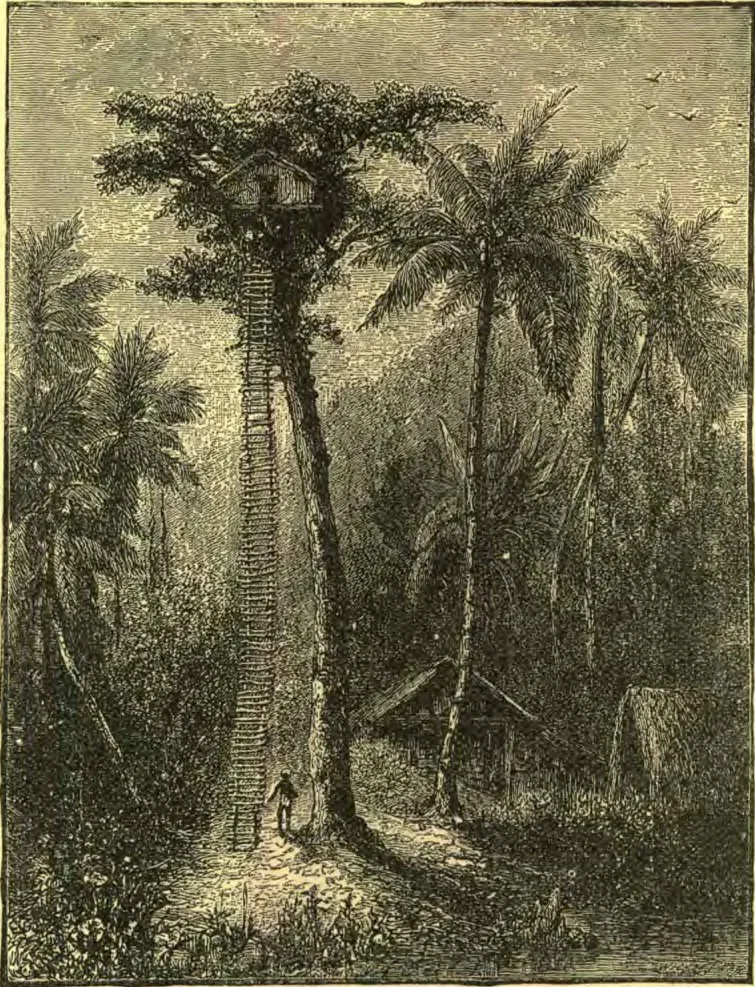
“Yes, I saw many birds and monkeys up in the trees, but I also found the huts of the natives fastened among the great branches of the Baobab trees.”
“How do the people reach them?” asked Fred.
“By means of rude ladders which at night they draw up after them,” replied his uncle. “In the thinly populated parts of the country, where lions, tigers, and leopards abound, the people feel safe in these home nests, though the lions roar under the trees until the light of day drives them to their lairs. As many as twenty families sometimes live in one tree.”
“The trees must be very large,” said Will.
“Yes, they are much larger than the great trees of California, we hear so much about. The Baobab trees do not grow so very high, seldom over one hundred feet, but their branches, growing out of a trunk thirty feet thick, are often sixty or seventy feet long.
“The leaves are large and of a dark green color. The flowers are white and very large, hanging to peduncles of a yard in length. The fruit is often called monkey-bread. It is inclosed in long green pods, and the pulp between the stones tastes like cream of tartar. It is used by the natives to flavor their food; while the juice, pressed from the leaves, is relished as a drink, and is considered a very good remedy for fevers and other diseases.”
“I wish we had such a tree growing in our yard,” said Will. “It must be as useful as the palm-tree.”
“Yes,” said Uncle Ralph, “it is a very valuable tree. The bark is stripped off regularly, and made into ropes, fishing nets, and clothing for the natives. The tree has wonderful vitality; one-half the trunk may be cut or burned away, or even the tree cut down, if, while lying on the ground, it has any connection with its roots, it will grow and yield fruit. The Baobab tree is said to attain to a greater age than any other tree. Some say it will live for thousands of years.”
“Then I’m sure it will live until I’m a man, and can go to Africa to see the curious old tree,” said Fred.
“I think you need not fear on that account,” his uncle replied. “And you may learn how the natives sometimes use the tree, when hollow, for a burial-place; and other things of interest about the Baobab trees of Africa.” —Sabbath Visitor.
Continue reading: A PILLOW OF THORNS