The Youth’s Instructor, Vol. 66, No. 22.

News Items from Recent Wartime Events

The Youth’s Instructor

May 28, 1918

Review and Herald Publishing Assn. · Takoma Park Station, Washington, D. C. · May 28, 1918

News Items from Recent Wartime Events

The Petrograd palace of the deposed czar of Russia will, it is said, be preserved as a museum.
It is estimated that sixty per cent of the adult population of the United States is engaged, either directly or indirectly, in agriculture and its related callings.
Recently eight women attired in army uniforms went from the South to Lansing, Michigan, for the purpose of driving army trucks laden with supplies back to Atlanta, Georgia.
The wool shortage in the United States is estimated at 70,000,000 pounds. Only enough wool is being raised in this country to make one suit for each inhabitant every four years.
One item in the diplomatic and consular appropriation bill now before congress provides $1,045.25 as the share of the United States toward the upkeep of the Carnegie Peace Palace at The Hague.
Senator William J. Stone of Missouri died in Washington, D. C., April 14. For years he was a prominent member of the Foreign Relations Committee, and his death is a distinct loss to the country at large. Since the declaration of war against Germany seven of our Senators have died.
Thousands of American girls are serving in the telephone unit of the American Expeditionary force overseas, as operators and interpreters. They are under the same rules and regulations as the men of the United States Army, and Mrs. Inez Ann Crittenden is in direct command, under General Pershing.
All wheat products were recently barred from the dining-car service of the Southern Pacific Railroad. Every chef with the company must attend special instruction in cooking, to learn the utmost use that can be made of barley, corn, and rice flour. The action of the company makes “wheatless” about 6,000,000 meals every year.
The city of Baltimore, Maryland, has been asked to furnish 2,000 homing pigeons for military use in France. These birds are invaluable for army service, being able to carry messages under conditions which would prevent the employment of the telephone or wireless. Over ninety per cent of the messages sent out by carrier pigeons arrive safely at their destinations, it is said.
An order has been issued by the Fuel Administration placing, until further notice, every ton of coal mined anywhere in the country under Government control. This means that every contract made for the purchase of coal or coke is subject to cancellation, and fuel is also subject to requisition. No contract for the purchase or sale of coal or coke shall extend more than one year, and under each contract made, deliveries must begin within six months.
George Creel, chairman of the Committee on Public Information, states that since the declaration of war our regular army has grown from a scant 128,000 to 513,000; the National Guard troops in Federal service have expanded from 80,446 to 450,000; and half a million young Americans are in the National Army. That is to say, within a year the army of the United States has grown from 9,524 officers and 202,510 men to 123,801 officers and 1,528,924 men.
The mayor of the greatest city in the United States is worthy of attention. Like many other great men, he rose from the ranks by his own effort. As a boy John F. Hylan worked on the farm; then he became water boy for a section gang, and at the age of eighteen was fireman on a small railroad. Later he became a track layer on one of the New York elevated roads; and then an engineer. He took a course in a business college, and then a law course, graduating in 1897. At this time he lost his job and was compelled to beg a free ride on a locomotive catcher to Syracuse, where he took his examination for admission to the bar. Since that his progress has been steadily upward. He is not brilliant, but he is a plodder, and his undaunted plodding has led him to his present position. Some call him lucky, but luck smiles only on those who apply their energies and their enthusiasm to the work at hand. The man who sticks to his work is the one who acquires success.
A candle more than eleven feet high and weighing over two hundred pounds was made a few years ago to be burned before the altar of St. Biagio in St. Peter’s, Rome. The candle, which was made of beeswax, embossed with fine gold leaf and carved by a skilled artist, cost $950. It was estimated that it would burn continuously for six years. In making it the wick was tied to the arm of a derrick twenty-five feet high and dipped sixteen times daily into a vat of molten wax below. In all two hundred dippings were required to make it of the desired size. The giant candle is the largest of which there is any record.
German alien enemies before they can change their place of abode or leave the district in which they registered under the President’s proclamation, must first present themselves to the registration officer in their district and obtain a permit issued under the direction of a United States Marshal. If a German alien enemy moves from place to place without first having complied with the regulations mentioned, he is liable to arrest and internment for the period of the war. It is the duty of postmasters in towns under 5,000 population to make out the change of residence permits, and of the police in the larger cities.
In India the average income of the native is said to be ten dollars a year. In the government of India’s three million people, Great Britain employs only twelve hundred Europeans. The post offices not only distribute mail, but conduct savings departments, in which one may start an account with eight cents. They are also the telegraph offices of the country. Messages of ten words may be sent anywhere in India for twelve cents.

The Bravest Battle

THE bravest battle that was ever fought, Shall I tell you where and when? On the maps of the world you will find it not; ’Twas fought by the mothers of men.
Nay, not with cannon, or battle shot, With sword, or nobler pen; Nay, not with eloquent word or thought, From mouths of wonderful men.
But deep in a walled-up woman’s heart — Of woman that would not yield, But bravely, silently bore her part — Lo! there is that battle field!
No marshaling troop, no bivouac song; No banners to gleam and wave! But oh! these battles they last so long — From babyhood to the grave!
Yet faithful still as a bridge of stars, She fights in her walled-up town — Fights on, and on, in the endless wars, Then silent, unseen, goes down!
Oh! ye with banners and battle shot, And soldier to shout and praise, I tell you the kingliest victories fought Are fought in these silent ways! — Selected.

Holding a Cottage Meeting in the Country
INEZ HOLLAND-STEVENS
Our Missionary Volunteer Society here at our mission headquarters in Argentina has received many invitations to hold meetings in private homes in the surrounding country and villages; and during the past year much of this work has been done. In answer to one of these calls my husband and I, with some other young people, were asked to hold a service one Sunday afternoon in a home fifteen miles away.
Inasmuch as what we found was very typical of criollo, or native, country life here in Argentina, I shall describe it quite in detail.
This country is so peppered with foreigners who bring their own peculiar customs along with them that one hardly knows sometimes what is really Argentinian and what is foreign. Buenos Aires, for instance, has been so Europeanized by the English, French, and German elements there that in many respects it does not seem Spanish at all, except in language.
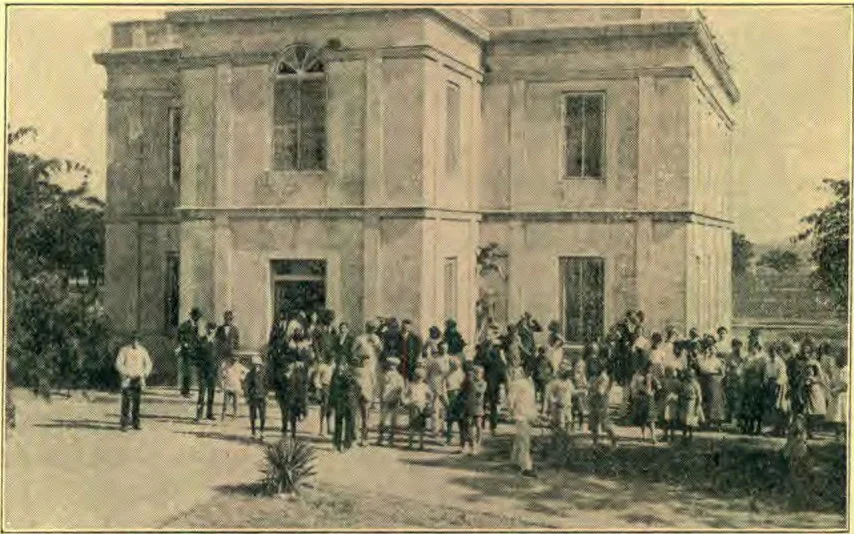
MAIN BUILDING OF THE COLEGIO ADVENTISTA DEL PLATA, ARGENTINA
But the farther away one gets from the big centers into the small towns and country districts, the more he meets the native, and sees how he lives, untouched by the improvements of modern life, and the new-fangled ideas of the gringo (foreigner).
Traveling by wagon over the rolling plains of Entre Rios, which are practically treeless in these parts, we arrived at our destination about noon. We were expected, and a few of the neighboring young people had been invited to the home.
The family is a wealthy one, the father being one of several brothers who own all the land for leagues in every direction, and have lived there all their lives; but to look at the house one would think them to be poor, for it is anything but a mansion. Composed of three low rooms of brick, neither painted nor whitewashed within or without, with mud floors, and a little black kitchen separated from the rest of the house, it is a typical country home of the native.
You may wonder why, being rich, they do not improve their homes, and make them comfortable. But the criollo's ambition does not lead him in the direction of modern improvements or a comfortable home. He cares nothing about a modern house or fine furniture. He is comfortable enough as he has always lived, and prefers to invest his money in more land and more cattle.
But however humble his dwelling, he has a generous heart, and one always finds hospitable welcome to all he has. We were warmly received, and dinner was served at once. First, a meat soup (the invariable introduction to a meal) quite thick with macaroni and a sprinkling of vegetables. Then roast meat (it happened to be mutton in this case, since they have great numbers of sheep), with galletas, or hard biscuits, which is the native bread. The next course was a meat stew, with macaroni. Then came the postre, or dessert, very common in all parts of the country. It consisted of a piece of cheese with a square of quince jam prepared quite hard and put up in tin boxes. It is not a bad-tasting combination, either, and is something one can always have on hand, ready for the chance guest. The natives make very few desserts. The last thing was black coffee.
As one can readily see, meat is the principal article of diet among the Argentinians, two or three different kinds often being served at one meal. Needless to say, the vegetarian, especially if he is traveling in the country, will not fare very sumptuously if he adheres strictly to his dietetic principles.
After dinner the table was cleared, and we prepared for the “spiritual meal” which they were expecting. The meeting was held in the one large room, which served both as dining- and sitting-room, and which had no adornment save an array of images of various saints clustered about a large crucifix in a niche in the wall.
About twenty in all assembled for the service, the first of the kind that most of them had ever attended, as was evident by the amused and curious expressions on several faces. We sang several songs, in which they did not join, some because they could not read, the rest because the melodies were unfamiliar.
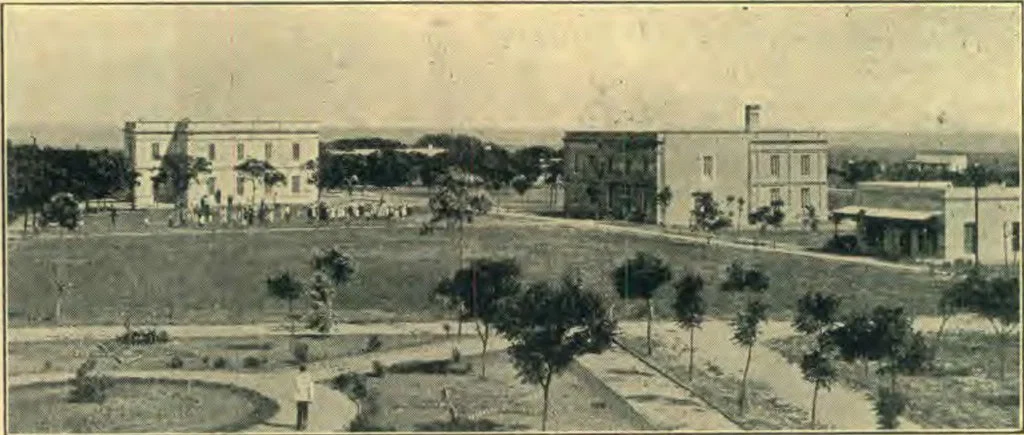
SCHOOL BUILDINGS OF THE COLEGIO ADVENTISTA DEL PLATA, ARGENTINA
The large building at the left is the school building; the large one at the right is the girls' dormitory.
SCHOOL BUILDINGS OF THE COLEGIO ADVENTISTA DEL PLATA, ARGENTINA The large building at the left is the school building; the large one at the right is the girls' dormitory.
Mr. Stevens gave a short talk on the love of God in the gift of Christ, and all were attentive. The father seemed especially impressed at times, and when pleased would nod his head and say aloud, “Yes, yes, that’s true.” Although one can never tell how deeply the sown seed is taking root, still from all appearances the young people present, apparently a careless, world-loving class, seemed more amused than anything else. Of course it all seemed very strange to them.
As soon as the meeting was finished, we went outside with the parents to look about the place a bit. Hardly had we left the room when the sound of the guitar was heard. Looking back, we saw the young people coupled off, dancing to the music played by one of their number. Dancing is a very common Sunday afternoon diversion among the young people here.
Of course we were somewhat surprised, but it is what one finds everywhere,—a surprising indifference to spiritual things, and a love for the empty pleasures of this world.
The parents, however, seemed to appreciate the meeting and cordially asked us to return. They are friendly to our work, one of the sons being in our school, and several members of the family having been helped in the sanitarium. So we hope to return soon to follow up the interest.

"The Melting Pot of the Nations"

AMERICA'S door has always been wide open to true men and women of every nationality. Since the "Mayflower" cast her anchor at Plymouth, an endless procession of immigrants has been coming through the open door, altogether a company 33,100,000 strong. Marching day and night, more than one year would be required for this company to pass a given point in single file.
"From 1905 to 1914 more than 10,000,000 immigrants came to our land. This means that a larger number came each year than the population of Nebraska or Washington, or the combined population of North and South Dakota. It means that the equivalent of a city of 100,000 has sprung up every month somewhere in this country for 120 months. . . . If we should divide the people that came in 1914 into groups occupying cities all by themselves, we would have an Italian city as large as Minneapolis, an Austro-Hungarian city of the size of Milwaukee, a Jewish city as big as Providence, Rhode Island, a Polish city outnumbering Nashville, Tennessee, and we would still have about fifty towns of some 5,000 to 20,000 people, all without a single English-speaking person in them."
This great influx of foreign peoples presents to us both an opportunity and duty of home missionary work. Should we not search out these peoples and do all we can for them? Is it not as important to make known the offers of salvation to a foreigner in this country as to send a missionary to his native land to bear the news to his brother?
Not infrequently those who leave their native land for a strange land across the ocean are dissatisfied with the home church, and under the new environment are more susceptible to religious influence than they would be in the homeland. Should not our young people make a special effort to show friendship and kindness to all foreigners within their immediate neighborhood, and also to seek earnestly to win them to Christ and his truth for this time?

The Story of a Polish Jew

FORTY-SIX years ago a baby boy was born in the home of a wealthy Jewish family of the higher class in Poland. Proud of the little son, and very ambitious as to his future, there was much debating as to what name should be given him. In the days of ancient Israel the names of children were thought to be prophetic of their future, and the same thought must have been in the minds of Shapiro’s father and mother, for they gave him a name that embodied their fondest hopes. They called him Benjamin, “the son of my right hand;” Aaron, “enlightened;” Moses, “drawer-out;” and Alexander, “helper of man.” A good name wasn’t it?
The boy did not stay in Poland. He went to Germany, and not finding there the opportunities he desired, came to the United States in 1890, aged nineteen years. He did not know one word of English, but finally found his way to the reading-rooms of the Hebrew-Christian Mission in New York. He did not realize that he was placing himself under Christian influence, and at the suggestion of the superintendent of the mission, joined a class of Jewish boys who were learning English. Before the noon hour on the first day he could name in English every piece of furniture in the room, the days of the week, the numerals from one to ten, and write his name in English script. His ready grasp of the language attracted attention, and the officials of the mission did all they could to help him.
Well versed in Hebrew, he followed in his own Bible the psalms that the others read in English, and became deeply interested as he learned the truths of the New Testament.
He soon found employment, and through the efforts of one of the customers whom he served in the shop of Mr. B. Clayton, of Jamaica, Long Island, was enabled to attend school under Christian teachers. Here he was led to accept the Messiah as a crucified and risen Saviour, and united with a Christian church in Brooklyn, New York.
He felt that he must do what he could to bring the light to his own people. They knew nothing of a mediator and his atoning love. How could he reach them? He had no money, no influence, and few friends. “A stranger in a strange land” he was indeed, but he had faith in his Saviour, and zeal in his service, together with a deep conviction that he had been called to this work.
Mr. Horatio S. Steward, who had given Mr. Shapiro a scholarship at Pennington Seminary, again came forward, and with other friends helped the young preacher to secure a small hall in Brooklyn, where he started his meetings. Strange to say, the Jews came in crowds to hear him, and he held Saturday afternoon meetings for two years. These services were well attended, although there was intense opposition on the part of some. A free evening school for Jews was also established.
In June of 1900 Mr. Shapiro began the publication of an illustrated Hebrew-Christian quarterly entitled The People, the Land, and the Book, a valuable source of information to both Jews and Christians.
This young preacher also carried on a mission in the eastern district of Brooklyn, and here he encountered stones, sneers, and curses, but he was undaunted. The leader of the crowd of persecuting Jewish boys went into the mission one day, intending to break up the meeting. Mr. Shapiro was talking of the Saviour’s love, and before Samuel knew it he was listening with interest to a story he had never before heard. He was converted, united with the church, and is an earnest Christian today.
Aside from superintending the work of his mission, Mr. Shapiro has compiled a book entitled “Christian Obligations to the Jews,” and translated several Hebrew works into English, besides sending out valuable tracts and pamphlets. He is still at work for the remnant of the tribe of Judah. S. ROXANA WINCE.

Freely Ye Have Received, Freely Give

“FREELY ye have received, freely give.”

Diamond Output, Ancient Food Labels, and Corn Sounds

The South African diamond output in 1917 totaled more than 2,902,000 carats, and was worth in the neighborhood of $38,500,000. The production shows an increase of more than 550,000 carats over that of the preceding year.
According to Risner, pure food labels were in existence as early as 900 B. C. In the ancient city of Samaria, seventy-five labels which were used as seals on jars of wine and oil, have been excavated. These name the vineyard or orchard from which the product came, and the year when it was placed in the storehouse attached to the palace of King Ahab.
Startling as it sounds, the fact remains that corn can be heard growing. The cylindrical pith which forms the center of the stalk and leaves sheathed about it grow very fast. The expanding pith pushes against its sheath of leaves, and the leaves in turn push upward and outward. The result is a scraping noise, similar, but by no means so loud, as the sound produced when green corn is stripped of its husk.
A plumber in a Western city heard so many jokes about plumbers having to “go back for tools” that he decided he would make a reputation for himself. Accordingly, says Arthur Hallam in System, when any of his men are called to a house, they carry a notebook and take careful notes of the position and condition of all pipes and fixtures. Then, when the next call comes, they know exactly what to take; also, they know exactly what fixtures are wearing out, and have a first-class selling talk for the purchase of new fixtures. Isn’t there some way that you could use a notebook in your business?
O. L. Moore, of Bluff Point, New York, says that according to a journal of Augustine Washington, father of George Washington, the tree that George cut when a boy was not a cherry tree at all, but a plum tree, and that it was cut with a saw and not a hatchet. The entry referred to, dated March 1, 1739, reads thus: “A fine day and warm. This A. M. I found my best young plum tree spoiled with a saw. I thought it was some vagabond, and spoke of it at noon. My son George owned up to the deed. First I was excited and minded to whip him, but did not. He was truthful and repentant. He cut it with my small handsaw.”
The greatest telescope in the world is at Mt. Wilson. The reflector of this telescope is 100 inches in diameter, as large across as the height of an ordinary ceiling. The telescope was in process of construction for several years. The parts were so large that they had to be built in a shipyard. The telescope is mounted in a dome 100 feet in diameter and 100 feet high. The hauling and mounting of this huge “stellar gun” without mishap was an engineering feat of no small importance. It is estimated that with this new and stronger eye 300,000,000 stars will be brought under observation. Who can find out the magnificent works of God?

The Courageous Soul: A Point of Cheer

“Don’t complain! Keep your chin up! The courageous soul, no matter in what conditions, is a point of cheer, a lamp of brightness, a tonic draft, to his fellow men.”

The Love Letters of a Genius

JOHN FISKE, the philosopher and scientist, met Abby Morgan Brooks in 1861, while he was still a student at Harvard; and they were soon engaged. Looking back at the love letters which you received during your engagement, madam, how do they compare with these extracts from the boy wonder, Fiske, to his fiancée? They are quoted in the new “Life of Fiske,” by John Spencer Clark.
Miss Brooks had given him a sketch of her educational training, and he comments on it as follows:
“I supposed you must have acquired a familiarity with French, and I am very glad to know that you have studied Latin and German. After all, my dear girl, you have hit upon those dialects which are most useful and most fraught with pleasure. I mean especially French and German, though I would not discourage the study of Latin for young ladies. . . . I can’t talk in any language but my own: but I read in French, German, Spanish, Italian, Portuguese, Latin, Greek, and Anglo-Saxon. Then, with hard study, I can decipher, sentence by sentence, Dutch, Danish, Swedish, Hebrew, Chaldee, and Sanskrit; and there are some few which I have dipped into without doing much, either because they have little literature or because I have no time for them—Zend, Gothic, Wallachian, and Provençal. Persian and Arabic I long to know, but I despair of ever having time to learn them.”
He laid out a course of reading for her, and checked her up on it from time to time:
“Yes, read your Roman history next, if you like. As a general rule it would be best to read Greek history first; but it is always best to read what we feel most in the mood for.
“When you tell me how you are getting along, please tell me by the events, thus: ‘I am in the reign of Henry VIII,’ or wherever you may be in English history. Similarly in Greek and Roman history, where there are no reigns to go by, tell me at what war or great event you have arrived. Any event or man mentioned at random will do, for I have them all tabulated in my mind.”—Every Week.

Perseverance in Missionary Endeavor

OCCASIONALLY I hear from a brave little woman isolated out in a wild and sparsely settled section of the country. She always mentions the work she is doing with our message-filled literature, and all her letters carry a note of victory and encouragement. Out there in that lonely spot, she is holding up the light of truth for those about her.
This little sister reminds me of the wife of a lighthouse keeper about whom I once read. The breaking ice floes swept away her husband, with both his assistants. The poor widow was left alone through a long, dreary winter. When the supply ship reached the island on its semiannual visit, the captain, in utter astonishment, asked her how she ever managed to get along. “I don’t know,” she replied with a sob. “I only know I kept the lights burning.”
Faltering and hesitating Christian in the midst of the floes of temptation, do not give up. Some sin-tossed brother is depending upon your light, feeble though it may be. Let it shine just where you are. Some one needs it. One light may kindle many. That cottage meeting you are holding may be the nucleus for a church. The little tract you gave away yesterday may start a revival in some home. The papers you distributed last Sabbath afternoon may awaken in those homes sufficient interest to warrant a public effort. Who knows? Just those things have been accomplished by such little agencies.
A young Negro preacher, who was asked to define Christian perseverance, answered: “It means, firstly, to take hold; secondly, to hold on; thirdly and lastly, to nebber leave go.” We need that sort of perseverance in our missionary endeavors. “Be ye steadfast, unmovable, always abounding in the work of the Lord,” 1 Cor. 15:58. And that splendid verse closes with this assurance: “Forasmuch as ye know that your labor is not in vain in the Lord.” There is no such thing as wasted effort in the service of the Lord.
ERNEST LLOYD.

How Grant Got to West Point

When General Grant was a boy, his mother found herself one morning without butter for breakfast, and sent him to borrow some from a neighbor. Going, without knocking, into the house of a neighbor, whose son was then at West Point, young Grant overheard a letter read from the son stating that he had failed in examination, and was coming home. He got the butter, took it home, and, without waiting for breakfast, ran down to the office of the congressman from that district.
“Mr. Hamar,” he said, “will you appoint me to West Point?”
“No. So and So is there, and has three years to serve.”
“But suppose he should fail, will you send me?”
Mr. Hamar laughed. “If he doesn’t go through, no use for you to try.”
“Promise you’ll give me a chance, anyhow.”
Mr. Hamar promised. The next day the defeated lad came home, and the congressman laughed at Uly’s sharpness and gave him the appointment.
“Now,” said Grant, “it was my mother’s being out of butter that made me general and President.”
But it was his own shrewdness to see the chance, and promptness to seize it, that urged him upward.—Christian Advocate.

C. J. TOLF

Reliability

RELIABILITY is one of the most valuable assets of manhood. There is small place in the work of the world or in the work of God for the man who is not reliable. Reliability carries with it the idea of dependability,—some one who is always loyal and in whom confidence may be reposed.
Napoleon lost the battle of Waterloo because two of his generals were not reliable. His army was divided into two divisions, one under the command of General Ney near Waterloo, and the other under the command of General Grouchy some miles away. The latter division was ordered to join the former on the day of the battle, but there had been a terrible rainstorm the night before, and Grouchy decided that the roads were too muddy to move his troops. His general depended upon him, and he failed. Ney also disregarded Napoleon’s orders, and instead of waiting for re-enforcements, attacked Wellington’s forces, thinking he could win alone, and was defeated.
Let us be reliable. Let us be dependable.

C. J. TOLF

Gleanings from the General Conference

The Last Sabbath

THE last Sabbath of the Conference was unlike any other in the history of our people. Elder Daniells gave an earnest appeal for gifts to missions by setting forth what the gospel has accomplished in foreign lands, and enumerating present needs. After this forceful presentation of facts, opportunity was given for the people to supply these needs. The response was intensely interesting. An earlier gift of $20,000 by one man was now followed by individual checks for $12,000, $6,000, $5,000, $4,500, $3,000, $2,000, $1,000, $500, $300, $200, $100, etc., until a total of $152,000 was given. This amount was supplemented by pledges from conference officers, by gifts of jewelry, and conditional gifts, so that the offering in cash and pledges for the day totaled $237,000.
Many feel that it is now time to sell their property, and give of their means in an unusual way to extend the work of God to all peoples. This accounts for some of the large gifts made at the Conference.
There was no urging on the part of those in charge of the meeting. The people were anxious to give. And it is evident that this generous offering to missions is but a precursor of what will be done at the camp-meetings to be held this summer throughout the country, when the needs of the cause of God are presented.

Miscellaneous Notes

Located in College View, Nebraska, is a printing plant conducting a large business in behalf of the blind. Eighty-two tons of literature have been distributed during the last four years. This reading matter is sent out in a monthly magazine called the Christian Record, and a Circulating Library. These publications are circulated in the United States, Canada, Mexico, England, China, India, Jamaica, and the Bahama and Philippine Islands. The Government sends this reading matter free of postage.
An agent of the American Bible Society addressed the Conference and appealed for aid in furnishing Bibles to the soldiers and to peoples of heathen lands. The $1,318 given in response to his appeal is said to be the largest gift ever made to the Bible Society at one time by any convention or denomination during the last one hundred years. Officers of the society say that the Seventh-day Adventist Church gives more generously to the society than does any other church.
A cablegram near the close of the Conference from Elders Conradi and Dail was the only word from central Europe. Before the war broke out plans were being made by the European Division for the holding of this General Conference in their territory. It was expected that this would be the greatest meeting ever held on European soil.
Elder S. N. Haskell's eighty-fifth birthday was celebrated one morning near the close of the Conference by the presentation to him by friends who had been attending his early morning services, of a Bible, “The Desire of Ages,” and a staff. Elder Haskell, in expressing his appreciation of this kindly remembrance, said that while he prized the staff as a souvenir, he would, as aforetime, use the Word of God as his staff.
New York City has a Noon-Hour Prayer Band. Membership in the band is obtained by praying each day between twelve and one o'clock for oneself and all the members of the band; for kin and loved ones; for isolated persons who are upholding the banner of truth alone; for backsliders; and for all the workers and the world-wide work. Membership throughout the world is solicited.
The facilities of the Oakwood Junior College are to be improved to the amount of $60,000. The same amount is to be raised for construction work at the Southern Junior College, formerly known as the Graysville Academy.
One dollar a member is the goal set before our churches in this country by the Conference to be raised for extension work among the colored people. September 7, 1918, has been appointed as the day for presenting to all our churches the needs of the Negro people.
The Fireside Correspondence School has been in existence eight years. This school has given instruction in more than fifty subjects to 1,775 pupils. The school has students from almost every State and province in the United States and Canada, besides representatives in Java, India, China, Japan, Korea, the Philippine Islands, Fiji, Hawaii, Australia, Brazil, and Chile.
Twenty-four of our young men attending the College of Medical Evangelists were called for army service in the first draft. These were later allowed to continue their studies for the present year, at the close of which they will be assigned to duties in the medical corps.
One reporter in this country interviewed Elder Daniells on the meaning of the world war, and syndicated the article, which was a column long and attractively put together, to three hundred newspapers.
While our work might have made greater progress than we see today, it is evident that we have advanced greatly since the first General Conference was held. Elder J. N. Loughborough put on exhibition at the Conference just closed a copy of the first bulletin, printed in July, 1859. This bulletin reported the business proceedings of a three-days' session, in three and one-half pages. A call was made at that Conference for $500 for missionary purposes. Only a part of it was raised. On the last Sabbath of the recent Conference $237,000 was given and pledged to the work in mission fields. But there is danger that this prosperity may be a snare unto us. In “Gospel Workers” we are told that “the steady progress of our work and our increased facilities are filling the hearts and minds of many of our people with satisfaction and pride, which we fear will take the place of the love of God in the soul.”
Since the outbreak of the war twenty-five foreign workers have arrived in India and Burma to strengthen the mission forces; but about the same number have left the field either permanently or on furlough. The General Conference has just recommended that the following persons go to India as soon as satisfactory arrangements can be made to this end: Glen C. Russell, H. E. McWinny, Lindsay Semmens, Miss Margaret Cady, J. B. Carter, Mrs. Edith Bruce, Loren C. Shepard, Arthur Nelson, Clyde Scanlon, N. C. Nelson, and Harold Reith.
During the air raids over London and its suburbs, not one of our people has been injured. One Sabbath while services were being held, a shell from an enemy airship fell by the side of one of our churches, and buried itself ten feet in the ground, but failed to explode.
Elder Anderson related a novel experience he had with the white ants, which have an omnivorous appetite. One night while en route to a mission, he hung his trousers on the limb of a tree. The wind blew them down, and in the morning he was not a little chagrined to find that the ants had eaten off one leg entirely, and several inches out of the goods. But since the native is often found without either trouser leg, the unfortunate missionary, who had but one pair of trousers with him, was not seriously embarrassed.

Sabbath School Offerings

The Sabbath school offering for the second Sabbath of the Conference was $2,024.64. The first Sabbath the offering was only $750.
In the early days of this message our Sabbath schools made no offerings to missions; and when it was proposed to do so, some thought it not wise to divert the donations from the interests of the school to the foreign work. Now that the schools aggregate an offering of more than half a million dollars in one year, none can fail to rejoice that the plan of devoting the Sabbath school collections to missions carried.
How much do the Sabbath schools give? More than $10,000 each Sabbath passes from the pockets of Seventh-day Adventists into the mission treasury, or one dollar for every minute. This annual gift supports 750 foreign workers in the mission field.

The Selfish Family

THIS family includes every member of the human race, for all are selfish. We have all “sinned, and come short of the glory of God;” and in the books of heaven sin comes under the general head of selfishness.
The selfish family is a very loving family. Each member loves himself devotedly, and if he loves another it may be for some selfish reason, such as material gain. If a fellow traveler offers you his seat in a crowded car, he perhaps expects some one to remark: “How polite Mr. — is.” If you ask the opinion of an acquaintance on any subject, his pride becomes inflated, and he straightway strives to impress you with his superior wisdom.
We look with contempt upon selfishness which will lead one to take the largest apple, or the most tempting piece of pie or cake, and say to ourselves, “I would not do such a thing!” In less than an hour you may be heard remarking to a friend: “Your trips over the bay must be delightful! I have often thought I should like to go.” If a friend wishes my company, she will not forget to invite me. Your friend will do the same. Don’t ask to be invited. Don’t even hint such a desire. It savors of low breeding, and it is selfish.
We gossip from selfish motives. The incidents under discussion may or may not be true, but is it kind to hold up a neighbor in an unfavorable light? We frequently do it to draw a comparison with ourselves. But this practice is contrary to the golden rule, and probably there is no class of people more prone to feel grieved when talked about than those very ones who make a business of riddling the reputation of others. “As ye would that men should do to you, do ye also to them likewise.” And don’t be selfish! Mrs. D. A. FITCH.
Continue reading: Stand Up for Jesus