“Stand up! stand up for Jesus!
Ye soldiers of the cross;
Lift high his royal banner,
It must not suffer loss;
From victory unto victory,
His army shall he lead,
Till every foe is vanquished,
And Christ is Lord indeed.”
IN 1858 a great revival was held in Philadelphia, Pennsylvania, of which Dudley A. Tyng was one of the leaders. He was a young minister of about thirty years, an eloquent speaker and an earnest Christian worker. During the meetings, while resting at his home in Brookfield, he left his study on the morning of April 13 to inspect a corn-shelling machine, operated by mule power, which was running in the barn. He paused to say a kindly word to the animal, and as he patted it on the head the sleeve of his gown caught in the machinery. Before he could be released his right arm was fearfully lacerated, and almost torn from his body. As he was dying, his father asked him if he had any message to send to his fellow laborers who were associated with him in the great revival work. “Tell them,” he said, “Let us all stand up for Jesus.”
Among the many friends of the young minister was Rev. George Duffield. A few weeks after the sad accident Reverend Duffield preached in his church on Ephesians 6:14, “Stand therefore, having your loins girt about with truth, and having on the breastplate of righteousness.” He closed his sermon with the words of a hymn which he had just composed, entitled “Stand Up for Jesus.” This song was introduced into the hymnals, and became a special favorite of the soldiers during the Civil War.
GEORGE S. BELLEAU.
Why They Smiled
Everybody smiled at me,” said the tot who had just returned from the park.
“Bless the child, it was her own sweet little smile, ready for everybody, that made them all smile back,” laughed the maid who had been along.
If you give good will, you will receive good will in return. Most people will respond to your good opinion of them by thinking well of you. And not the least pleasant thought will come with the knowledge that your smile is helping others, quite as much as their smiles help you.—The Comrade.
Medical Missionaries Needed for Africa's Population
The population of Africa is 111,891,068. To minister to this large number of people are but 130 medical missionaries. There are 109,089,220 persons in the United States, and 108,000 physicians are ready to attend them when they are ill. Should we not share our blessings with needy Africa?
National Pests: Whence They Came
By C. A. David
The Australian Hare
ONE day it dawned upon a certain Englishman living in Australia that there was something wrong with the landscape of his adopted home; it seemed to lack something to which he had been accustomed. For a long time he could not figure out just what was missing, but finally decided it must be rabbits. All his life he had been used to seeing these little animals on the grassy lawns of his ancestral estates, and the manly sport of “hunting the hare” had been the main relaxation of his ancestors for centuries. Even if transplanted to alien shores, the true Englishman must be amused; so he had imported a number of rabbits to give him that homey feeling for which he yearned.
These rabbits at once saw that they had reached their paradise. The climate suited them, the rich herbage was to their liking, the soil was soft and easily tunneled, and their natural enemies were few. So they at once turned their attention to raising families to enjoy the benefits of the new country to which they had been transported. In a short time where there had been one rabbit there were a dozen, where a dozen had sported now fifty were seen, and where there had been fifty there were now hundreds. The whole land seemed to have turned into rabbits, and they spilled out over the landscape like locusts. They ate the foliage that had heretofore supported the flocks and herds, and they actually threatened to exterminate the native animals because of the loss of their food supply.
Like an army of white ants they swept the fields clean of every blade of grass, eating it away clear to the roots. One morning Australia woke up to the fact that she had warmed to life a serpent, and had a problem to solve if she expected to hold her position as a grower of wool and beef. Something had to be done, and that quickly, as the subject was one that brooked no delay. The sheep owners tried burning over vast tracts of country, wholesale poisoning, and hunting the rabbits with trained dingoes, or wild dogs; but all to no purpose, as the rabbits increased faster than they could be destroyed. As a last resort fencing them out was tried, and it looked as if the problem were solved. But in the solving, New South Wales alone has spent the sum of twenty-seven million dollars for rabbit extermination, and since 1891 has built 20,148 miles of wire fence. These fences are made of wire netting three feet high, set four inches in the ground, and topped by a strand of barbed wire. More than one hundred thousand miles of this standard fence have been built in Australia in order to check the ravages of this imported pest.
The English Sparrow
A few generations ago another misguided individual decided that the brown sparrow, common in England, would be a good thing to bring over for the protection of the trees in our parks. His idea was that the sparrow would be charmed just to feed on the larvæ of the insects that were doing much damage to the shade trees in some sections. So the first shipment was welcomed to our shores, and New York City and Brooklyn neglected their regular business to build cute little rustic houses for the small immigrants, and fed them out of the public crib. Grave laws were passed for their protection and comfort, and everything possible was done to make them feel at home. They felt at home all right; but in the meantime they forgot to eat the insects and their eggs, while they ate everything else in sight. Not content to remain in the cities and towns that wanted them, they invaded the country districts and cultivated an appetite for garden truck, grain, and small fruits. Many of our native birds, unable to tolerate their fussy, quarrelsome ways, disappeared before their advance; and where we used to hear the song of the bluebird, the oriole, and the chickadee, our ears are assailed by the noisy chattering of this ubiquitous pest.
The Wild Onion
Some fifty years ago still another would-be philanthropist imported the seed of the wild onion, claiming it would be an improvement on our native grasses for pasturage. The wild onion came and saw and conquered. As an object lesson in multiplication it ranks ahead of the Canadian thistle. One tiny white bulb will have increased in a season to a double handful. It will grow in any soil, no matter how poor. When a colony of wild onions take possession of a piece of ground, they are there to stay; the only way to really get rid of them is to sift the soil and then heat in a retort before replacing.—C. A. David, in the Visitor.
A Mouth-Organ Band
A BAND composed of 1,000 harmonica players is being organized at Camp Meade, Maryland. So many soldiers show ability on this instrument that the War Department Commission on Training Camp Activities is considering the organization of a mouth-organ band in each division.
One thing that should add to the charm of such a band is the fact that the harmonica these days is rapidly becoming as extinct as the dodo. These small reed instruments are manufactured in Germany, and the only ones remaining are those that were imported here before the outbreak of the war. Even this stock, it seems, has been bought up and are selling for six or seven times their cost prior to the war. So, apparently, in a short while the mouth organ will be no more unless some humanitarian American corporation starts to manufacture them, which seems hardly probable10in these days when nonessential industries are being weeded out.
The mouth organ is the oldest known form of musical instrument, even antedating the flute. Its sound-producing properties are twenty reeds, through which the breath is blown, and they bear a marked resemblance to the pipes of the ancient shepherds. It is, in fact, a lineal descendant of and works upon the same principles as the well-known “Pipes of Pan.” — Washington Herald.
A. W. HERR
By A. W. Herr
Trees
THE trees are clothed with living green,
In hill and vale and marshy fen;
Each branch a thought, each leaf a word,
They cheer my heart, inspire my pen.
They teach me that if I would be
A perfect man, I needs must grow
Like them. I, too, much time require
To large and full fruition show.
They shoot their rootlets in the ground,
They spread their branches in the air.
Each leaf is spread two sides abroad
To gather food from everywhere.
Like them I'm placed beneath the sun,
Upon this earth since life began,
To gather courage day by day,
And be a help to needy man.
I'm made a channel of good things,
I'm blessed that I may bless in turn.
What I dispense I truly keep;
What I retain is lost, I learn.
Then let us learn to live for man,
Our service give to aid his need.
In giving up our lives for him,
Those lives we save in very deed.
A. W. HERR
What One Woman Has Been and Is
MRS. ELLEN SPENCER MUSSEY is the daughter of P. R. Spencer, the originator of the famous Spencerian penmanship, and the widow of Gen. R. Delavan Mussey of the Civil War. She is a member of the United States Supreme Court bar, where she has won five cases. The founder of the Washington College of Law, of Washington, D. C., she was its dean for seventeen years, being the first woman dean of a law school. She is now Honorary Dean, and lectures on Social Service Legislation.
She was the author of the bill which gave married women in the District of Columbia the right to their own earnings, and mothers equal rights with fathers in their children. She secured the first appropriation from Congress for free kindergartens in the District of Columbia. She is now pushing a bill in Congress to allow American women married to aliens to retain their own nationality.
For twenty-five years she was attorney for the legation of Sweden and Norway in this country, was one of the early members of the American National Red Cross, a former vice-president, and was elected a delegate to the International Red Cross Congress at St. Petersburg in 1902. She is vice-president general of the D. A. R., and is now the president of the Woman’s Bar Association of the District of Columbia, and an ardent suffragist.—National Enquirer.
True Greatness
By J. W. Lowe
HE who subdues and conquers self is greater than he who subdues and conquers a nation.
A man may overcome a nation, and at the same time lack the qualities of true greatness.
Photo by H. H. Cobban
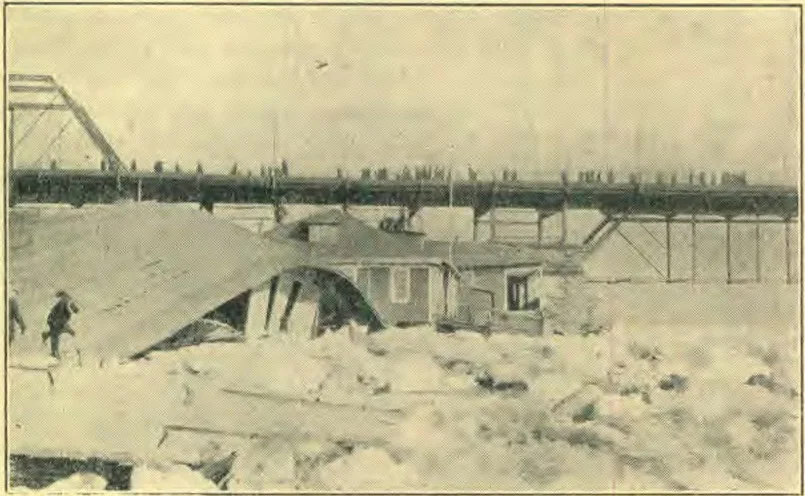
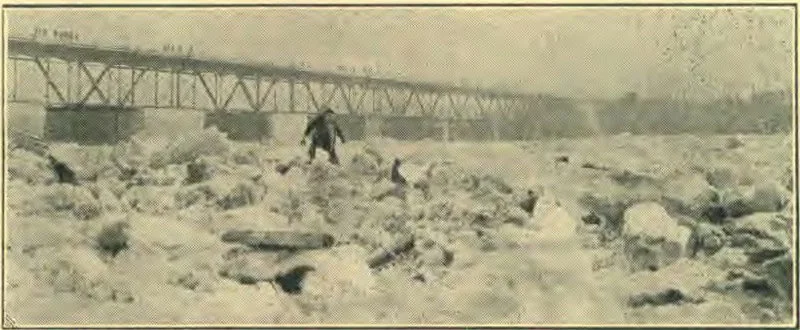
BOATHOUSES DESTROYED BY FLOATING ICE
No man can be really great if the acts of his life are dominated by motives of selfishness.
It is possible for one to be an intellectual giant, and yet lack the qualities of true greatness.
A great man, in the right application of the term, must of necessity be a good man.
Abraham Lincoln was a great man, not because he was wiser than his fellows, but because he was dominated by noble, humane motives.
George Washington was great, not because he was instrumental in securing independence for the Colonies, but because of his stanch integrity.
Aaron Burr possessed great talent and a remarkably strong personality, but he was greatly deficient in the qualities that make for true greatness.
Let no one imagine for a moment that he can be truly great without manifesting in his life obedience to the requirements of the decalogue.
A great man will live out the golden rule in all his dealings with his fellows, and endeavor in all he does to please his Maker. This is the highest duty and privilege.
True greatness is manifest in the life of our Example—the Lord Jesus. We are to study his precepts and follow in his footsteps.
J. W. LOWE.
“Tomorrow May Be Too Late”
Photo by H. H. Cobban
THE steamship “Central America,” on a voyage from New York to San Francisco, sprang a leak in midocean. A vessel, seeing her signal of distress, bore down toward her. Perceiving danger to be imminent, the captain of the rescue ship spoke to the “Central America:” “What amiss?”
“We are in bad repair, and are going down; lie by till morning,” was the answer.
“Let me take your passengers on board now.”
But as it was night the commander of the “Central America” did not like to send his passengers away, lest some might be lost, and thinking that they could keep afloat awhile longer, he replied, “Lie by till morning.”
Once again the captain of the rescue ship called, “You had better let me take them now.”
“Lie by till morning,” was sounded back through the trumpet. About an hour and a half later the lights were11missed, and though no sound was heard, the “Central America” had gone down and all on board perished, because it was thought they could be saved more conveniently at another time. Let the reader take the lesson to heart. “Now is the accepted time.” Tomorrow may be too late. Too late for what? — Too late to be eternally saved.— Selected.
The God-Filled Life
“THE God-filled life the richest fruit shall bear.”
A Friend in Need
By Iva Sabin Burger
IVA SABIN BURGER
WELL, my fine young woman, I s'pose ye know that ye won't have much longer to go to school an' play the lady, while yer hard-workin' father supports ye in yer idleness. Don't ye s'pose it's bad 'nuff fer me to have sech a burden as yer sick mother on my hands, without supportin' a lazy girl that's old 'nuff to earn her own bread an' butter?
Sydney Merredith, having given vent to his chronic ill humor, sat down to the table and began eating the food which his daughter had prepared.
“I will go to work, father,” Joy answered timidly but respectfully; “I have only three weeks more of study, and then I shall be ready to take a position.”
“An' if yer mother hadn't put sech foolish notions into yer head about schoolin', ye would of gone to work long ago. I reckon you're no better than other gals that do honest work, an' it would be a good sight more decent fer ye to soil yer white fingers with a scrub brush than let yer old father wear his life out fer ye, to my way o' thinkin'.”
Joy made no reply. Since babyhood she had been accustomed to her father's unkind words, but she had never ceased to tremble at the sound of his voice.
As soon as Mr. Merredith had finished his breakfast, he donned a heavy overcoat, placed on his head a large fur cap, and went out, slamming the door behind him.
The home of the Merrediths consisted of two rooms in a damp, poorly ventilated basement, where the rays of the sun never entered. The larger of the two rooms was furnished with a table, a stove, three or four chairs, and a bed. There was no carpeting on the floor, no pictures adorned the bare walls, and one could scarcely imagine a more cheerless abode. On the bed lay an invalid woman, Joy's mother. Her face told a story of long years of drudgery, privation, and abuse at the hands of a drunken husband. But all this could not efface the marks of refinement in every feature.
Fortunately, Joy was so much like her mother that a stranger would not have believed it possible that she was a daughter of the rough, uncultured Sydney Merredith. Her large dark eyes, wavy brown hair, and clear olive skin were the envy of many of her schoolmates who came from homes of wealth.
As soon as her father left the house, Joy hastened to prepare some breakfast for her mother. There were still a few red coals in the old stove, but there was no more fuel with which to replenish the fire, and her father had said that it might be several days before he would be able to get any more, as the supply was not sufficient to meet the demand of consumers. The wind was blowing in around the windows and doors and through the cracks in the bare floor. Joy shuddered as she thought what it might mean to her mother if her father should fail to get coal, for how could the poor invalid survive in such a room as this without any heat?
“Here is some toast, mother, and a cup of hot milk; please try to eat it all,” said Joy, coaxingly.
“Thank you, dear,” the mother answered, kissing the small hand that offered the food.
While her mother was eating, Joy went about the task of making the room as neat and cheerful as possible. This done, she brought the worn coverlets from her own bed in the adjoining room and placed them over her mother.
“There, mother, I hope you will be warm enough with these extra quilts.”
Then, with a good-by kiss and a brave smile, Joy left the house. When she reached the street, the smile quickly disappeared. It was a cold, bleak morning; there had been a heavy blizzard in the windy city, and the snow was still falling, so that it was very difficult for the frail girl to make her way through the huge drifts, which defied all efforts of the men who were trying to clear the walks.
Joy drew her thin wrap more closely about her. In her eagerness to provide nourishment for her helpless mother, she often denied herself the food which she so much needed, and today she had left home without having eaten a bite.
But Joy was urged on by a great hope; she had studied very, very diligently, and only three weeks more of study lay between her and the realization of her hopes, namely, a lucrative position in a business office. For, as soon as she should complete her course, she had the promise of a position that would enable her to furnish her mother with the comforts of life and procure medical assistance, which might bring the glow of health once more to the wasted cheeks of Mrs. Merredith.
Sydney Merredith was a clever workman, and received wages which would have furnished himself and his family with nourishing food, warm clothing, and a healthful abode, but the greater portion of his earnings went into the cash register at the Drayton saloon.
Joy could not forget the unkind words which her father had spoken, and hot tears filled her eyes. But as she approached the school building, she tried to forget it all; for did not all her hopes depend upon the few remaining school days which she was to enjoy?
Quickly she ran up the steps. But in front of the doors stood a large bulletin board upon which were written these words, “School closed until further notice, on account of coal shortage!”
Joy read the notice, once, twice, three times—so here was an end to all her hopes! She knew that she could not pass the examination without the instruction which she was to have received in the following three weeks. She also knew that her father would compel her to go to work at the end of that time, and that meant that she would never be able to finish her course.
How could she go home and break the news to her mother? In her despair she leaned against the cold brick wall and covered her face with her hands, as though to shut out the knowledge of her disappointment. But many of her schoolmates were coming and going, and her pride would not allow her to betray her feelings in this way.
She started quickly down the steps, coming face to face with Glenmore Austin, who had been her instructor in English, a handsome, stalwart young man, whose sterling qualities were reflected in his face.
“Are you sorry that school is to be closed for a time, Joy?” Mr. Austin asked kindly.
“Yes,” she answered, “it means more to me than it does to some of them. You see I shall have to go to work the first of next month, and now I shall never complete my course!”
“May I walk with you, Joy?” asked the young man. “Perhaps we can find a way out of your troubles.”
“Certainly you may, but I fear there is no way out—now!”
“It is a shame!” exclaimed Glenmore Austin. “Many will be compelled to go to work; others will12go to work, intending to return to school when it reopens, but will never return after they have become wage-earners, because having once known the independence of a wage-earner, they will be unwilling to give it up. In later years they will realize all too well the disadvantages of an incomplete education; but then it will be too late to make amends!”
As they approached the Drayton saloon, they were astonished to see that an immense truck was unloading coal at the saloon. Joy stood still, while a burning anger flushed her usually pale cheeks.
“Do they mean to close the schools and condemn me to a life of drudgery, while at the same time they supply plenty of coal to keep the saloon open?—the saloon that has crushed out my father's manhood and robbed my mother of the comforts of life? At this very moment my invalid mother lies helpless in a cheerless room without heat, and they tell us that they cannot sell us any coal to heat her sickroom; but there is an abundance of fuel to give warmth to the saloon!”
Unconsciously Joy stamped her small foot, and her dark eyes glowed with anger. Glenmore Austin was deeply touched by the young girl's agitation, and resolved to find a way to help her. His own soul was stirred with righteous indignation as he saw the cruel injustice of it all.
“I don't blame you, Joy, for feeling as you do. I promise you that I will use my influence in every possible way to stamp out this evil, which has blighted your young life. There is plenty of coal in my father's bins, and your mother shall no longer suffer with the cold. And now let us see what can be done for you. There is an excellent teacher who lives near my home, and I am sure she will give you the instruction needed to complete your course. Will you come with me to see her?”
“O, I cannot afford to pay a private teacher!”
“But I will lend you the money, and you may repay me whenever you feel able, after you secure a position. I shall be very glad if I can be of any assistance to you.”
Joy hesitated, but the young man insisted. They went together to the home of the teacher, and that very morning Joy began studying with her.
Glenmore Austin's father was one of the editors of a widely known newspaper, in the columns of which there appeared that evening an editorial, which read in part as follows:
“Do we call ourselves patriotic citizens while we allow our public schools to close their doors to thousands of worthy students because the school buildings cannot be supplied with coal, and meanwhile we furnish the saloons with plenty of fuel to conduct their business? By so doing we say to the world that we emulate the position which the saloon holds among us, while the work of educating our youth is of infinitely less importance! Thousands of boys and girls will never again enter the doors of a schoolroom. Do we wish to people our State with citizens who begin life in this great working army without the equipment which only a complete education can afford?
“Will not public sentiment arise to condemn this injustice? Are we willing to give precedence to a business which many of our sister States have condemned altogether as a menace to the public welfare?”
This editorial, from one of America's leading newspapers, stirred the hearts and opened the eyes of thousands of persons who had hitherto been blind to the conditions existing in their own home city.
Joy completed her business course, and is now occupying a position of trust. Her mother, with the aid of proper nourishment and medical assistance, is gaining strength, and Joy has rented a cheery, well-ventilated room for the convalescent.
Glenmore Austin has thus far refused to accept payment for the loan which enabled Joy to complete her course, and has given many substantial proofs that “a friend in need is a friend indeed.” A short time ago he took her to look at a suburban lot which he had recently purchased, and he says that some day he is going to present a sunny cottage to the little woman who has become the “Joy” of his life.
Young Japanese Boy Kogoshima Embraces the Sabbath
By H. Kuniya
Kogoshima
KOGOSHIMA is a nineteen-year-old Japanese boy who loves the gospel for the last days more than anything else. He first heard this message last summer while I was holding a tent-meeting in the city where he lived. He attended faithfully every night. Finally he gave up school and began to keep the Sabbath as a result of the truths he heard.
To reach his home he had to pass my residence, and often he walked home with me after the meeting was over, and asked questions about Bible truths. At first I could hardly understand what he said, as he speaks the dialect of one of the small islands, but at last we became very friendly, and I explained things to him.
One day he brought me two cents, saying that was his tithe, and asked, “Will you receive it?”
“Certainly,” I replied. “The Lord will bless you if you are faithful to him in small things.”
He loves to tell the story of Jesus and to sell our literature. Through his influence two of his sisters have recently started to observe the true Sabbath. His mother says he has changed very much since joining our church. In telling it to me she added: “Truly the Christian religion is the only power to save men.” Sometimes his whole family attend church.
I hope we can get hold of more such boys so that the gospel of the kingdom may go forward with power in these islands, and we may soon be ready to welcome our Lord. Pray for the young people of Japan.
H. Kuniya.
A Symposium
“WHAT is the secret of success?” asked the Sphinx. “Push,” said the Button. “Take pains,” said the Window. “Never be led,” said the Pencil. “Be up to date,” said the Calendar. “Always be cool,” said the Ice. “Do business on time,” said the Clock. “Never lose your head,” said the Barrel. “Do a driving business,” said the Hammer. “Aspire to greater things,” said the Nutmeg. “Make light of everything,” said the Fire. “Make much of small things,” said the Microscope. “Never do anything offhand,” said the Glove. “Spend much time in reflection,” said the Mirror. “Do the work you are suited for,” said the Flue. “Find a good thing and stick to it,” said the Glue. “Strive to make a good impression,” said the Seal. — Selected.
Concealed Geography
EACH of the following sentences contains the name of a city, town, or village in the United States:
1. The bold rider refused all assistance.
2. Madam says, you must leave at least one more letter each morning or she will patronize another postman.
3. The new porter dropped ten trunks the very first day.
PHOSA BUTTERFIELD, DAUGHTER OF C. L. BUTTERFIELD,
PRESIDENT OF THE CHOSEN CONFERENCE
4. We discovered the bear den very close to the sheepfold.
5. I won't mind this baby longer than today.
6. Now let the doctor see Jumbo's tongue.
7. If you are the curlew I stoned yesterday, I apologize.
8. Frightened by the terrible mob, I led sister away.
9. How Anna polishes the silver when Jack is expected!
10. Just look at that superb Angora cat!
11. When I asked him what time it was, he replied, “It am past two by two minutes.”
12. Barnum brought Jumbo on to New York.
13. He was the most comical hound I ever saw.
14. Such little puffs of air have no effect upon the yachts.
15. It took him a whole day to notice her new frock.
16. A discerning critic says that many so-called connoisseurs mistake high art for daubing.—Selected.
Answers to Questions Printed April 16
Part II
1. Queen of Sheba
2. Samson
3. Jacob
4. Eve
5. Jonah
6. Moses
7. Lot’s wife
8. Mary and Martha
9. Felix
10. Dorcas
11. Nebuchadnezzar
12. Absalom
13. Joseph
14. Haman
Did It Pay?
WHEN Queen Victoria was a little girl, her mother purposely left the papers containing the line of succession to the throne of England where she would find them. After a while the little queen-elect came to her mother with the question, “Mother,” who is to be the next heir to the throne after Uncle William? It just looks as if I am.”
“Yes, daughter,” said her mother thoughtfully, “it is you.”
The little princess answered not a word, but stood thinking deeply as she saw the responsibility of the nation resting upon her young shoulders.
Suddenly she turned, and lifting her sweet young face up to her mother’s, she said earnestly:
“Then, mother, I will be good!”
The childish resolve was never forgotten, and Queen Victoria’s long reign was one of unusual blessing and happiness.
You may never be called upon to be a ruler of nations, but every day you will have to be ruler of your own heart, and no resolve that you can sincerely make will bring more peace, happiness, and blessing into your life than Queen Victoria’s motto, “I will be good.”—Selected.