The Youth’s Instructor, Vol. 32, No. 42.

THE PARABLE OF THE TEN VIRGINS

The Youth’s Instructor

Oct 15, 1884

S. D. A. Publishing Association · Battle Creek, Mich. · Oct 15, 1884
THE PARABLE OF THE TEN VIRGINS.

WHEN the Saviour began his ministry, at Jerusalem, upon the Mount of Olives, and upon the shore of the Sea of Galilee, he preached sermons to the people; but he afterward spoke to them in parables. Do you know how many parables are recorded in the Gospels? And do you know what a parable is? It has different meanings in Scripture; but our Lord’s parables are a sort of fable, or feigned story, made up from something real in life or nature, to teach us true and important things. Please take your Bibles, and read the first thirteen verses of the twenty-fifth chapter of Matthew. Here we have the parable of the ten virgins, which refers to a Jewish custom, still practiced in Eastern countries.
When a marriage takes place, the bridegroom, in company with several young men,—groomsmen, called in the Bible “children of the bride-chamber,” goes to meet the bride at her father’s house. They usually start out late in the evening, and are preceded by a band of musicians or singers.
The bride, with her bridesmaids, called in this parable the ten virgins, is anxiously expecting the arrival of the bridegroom to lead the whole party back to his father’s house. While the bridegroom tarried, they sometimes became weary in watching, and fell asleep. But the music and noise of the approaching train is heralded by some one who cries, “Behold, the bridegroom cometh! go ye out to meet him!”
Torches and lamps are always carried in these processions. Our Lord represents five of the virgins as foolishly forgetting to take any oil with them. Probably their carelessness was due to the hurry and excitement of going early to the wedding.
When the party were all in confusion, trimming their lamps and lighting those which had gone out while they were asleep, to be in readiness to meet the bridegroom upon his arrival, the foolish virgins discover that they have no oil, and say to the other virgins, “Give us of your oil; for our lamps are gone out.” But the wise virgins answer that they have none to spare; they must go and buy for themselves. While they are gone in pursuit of oil, the procession starts on its journey, and with others who join them on the way, they reach the house of the bridegroom, when, agreeably to their custom, the door is shut, and no further admittance given.
The Lord makes use of this parable to instruct his hearers upon the subject of the kingdom. Can you tell when it has its application? what is meant by the tarrying time? the midnight cry? the foolish virgins? and the door’s being shut?
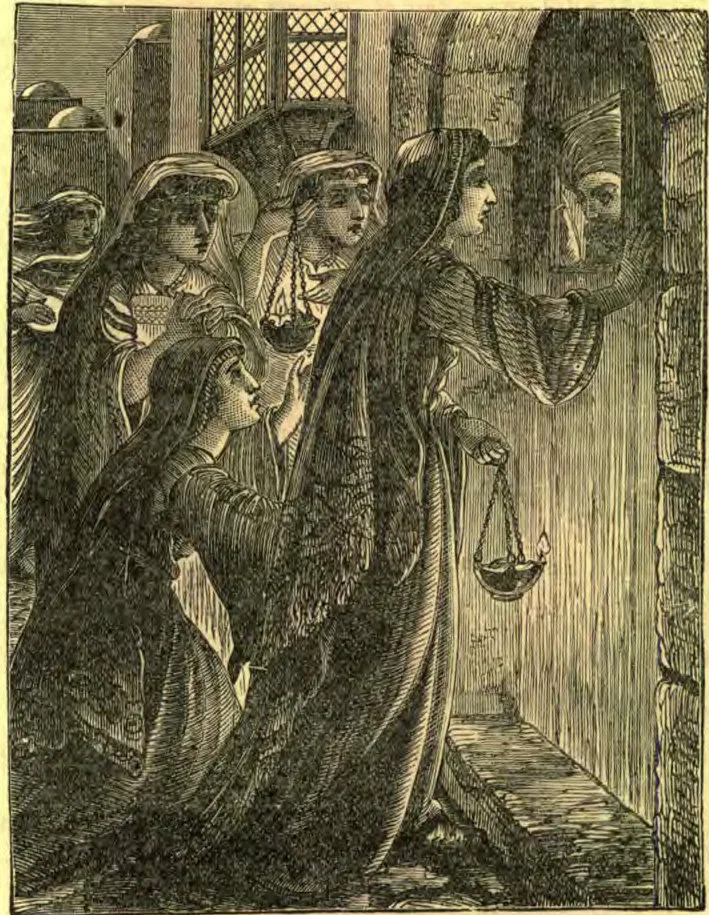
In the accompanying illustration, the foolish virgins are represented as having arrived at the house of the bridegroom after the door is shut, and as pleading for admission. But alas! their appearance tells the sad tale, too late! too late!
Who is not surprised at the course of these foolish maidens,—to forget the one thing upon which they were most dependent to gain admission into the bride-chamber? Is there not danger that some of us shall marvel, and wonder, and perish, while pursuing the same course? Let us rather follow the example of the wise virgins, and make the necessary provision to be admitted with the guests. We need and should have every day the assurance that we are accepted of God, and walking according to all his requirements. Dear reader, after whom shall you pattern?
M. J. C.

TESSA'S GOOD THINGS.

She wanted so many good things; it was so hard to understand why she could not have them, so hard to be willing to go without them!
They were all good things, too; things that she was sure it would be well for her to have, and yet she did not have them.
She wanted Mrs. Hoyt, her Sabbath-school teacher; she always helped her so; but Mrs. Hoyt was miles and miles away in her new western home, with so many cares that she rarely found time even to write to Tessa. She wanted to teach in Sabbath-school herself, but her health was not good enough to permit her doing so. She wanted to invite her old class of boys to the house one evening every week; they were getting rather wild, apt to spend their evenings in the streets with bad boys. She was sure that they would come willingly to her; she knew she could make it pleasant for them, and profitable.
She had it all planned when Aunt Sarah came to spend the winter with them. When she heard Tessa talking about it, she said directly that she could never bear the noise and confusion; it always made her nervous to have boys around.
Just now Tessa wanted to go to Thursday evening meeting, but it poured torrents. She had been looking forward to this meeting all the week, and she was very, very much disappointed.
“It seems to me I am always wanting something that I cannot have,” she thought to herself bitterly. “And they are good things, too; it would not be so hard to give them up if they weren’t. I don’t see why I can’t have them!”
And then, nestling down among the sofa pillows, Tessa let herself be as miserable as possible, and thought over all her disappointments until life seemed very hard to bear.
By and by her father came in, and took up the Bible for prayers. Mother and Aunt Sarah put up their work. Tessa went out into the sitting-room, and sat down in the corner where it was too dark for any one to notice that her eyes were red from crying.
The psalm for the evening was the eighty-fourth. Tessa liked to hear her father read the Bible; she said she always felt a new meaning to the verses just from his tone and way of reading.
There was such a sure, triumphant ring to his voice, as he read the eleventh verse of this psalm, “The Lord God is a sun and shield; the Lord will give grace and glory; no good thing will he withhold from them that walk uprightly.” “No good thing,” thought Tessa. She could not read those words in any such tone.
Then she noticed with a sudden pang how bent and gray and old her father looked. He was not so very old either; it was hardship and trouble that had made him a prematurely old man.
Still, for all that, he could say so positively that no good thing was withheld! She wondered how he could!
After prayers, her mother went out into the kitchen to give orders for breakfast. Aunt Sarah went up stairs, leaving Tessa and her father alone.
“It—doesn’t seem to me that that is true, father,” she said, half defiantly.
“What, daughter?” he asked.
“That God does not withhold any good thing from his children. I have wanted so many good things—things that I’m sure would have been good for me, too; but I did not have them.”
“Tessa, suppose you were sick, and I had two kinds of medicine for you; that one was good—that is, it would keep the life within you, and perhaps even give you a little strength, but the other would build you up into perfect health; which do you think I should give you?”
“The best, of course, father.”
“God is the physician of our sin-sick souls. Cannot you trust him to give you what is best for you? Nothing that is for our best good is ever withheld.”
“But it is very hard to see it, father. For instance, it rained so hard that I could not go to meeting to-night. I wanted to very much. I needed the help I should have had there. Why couldn’t I go? And why did Mrs. Hoyt have to go so far away? I used to be better for just catching a glimpse of her.” Tessa spoke sharply—almost bitterly.
“I cannot tell why, daughter. Sometimes I think we depend too much upon earthly helps, and so the Lord takes them away to bring us nearer to himself. It is not necessary for us to know the whys and wherefores always, though it is well for us to pray that we may learn the lessons God wishes to teach us in his dealings with us. The Lord has withheld many a desire from me. He has taken from me many a cherished object; but, Tessa, child, I do not believe there has been one single good thing kept from me.”
“But oh, father,” said Tessa brokenly, “why must we want the things we cannot have? If things are not good for us, why need we care for them?”
“ ‘Whom the Lord loveth, he chasteneth.’ ‘And every branch that beareth fruit, he purgeth it, that it may bring forth more fruit,’” was the reply. And Tessa, hearing it, went slowly upstairs to her own room. She had had her word; and now she wanted to be by herself to think it over.
“I hope God will make me fruitful, even if I do cry out at the hurt of it. I will try to remember.” —Christian Intelligencer.

Autumn Woods.

Ere, in the northern gale, The summer tresses of the trees are gone, The woods of autumn, all around our vale, Have put their glory on.
The mountains that infold, In their wide sweep, the colored landscape round, Seem groups of giant kings, in purple and gold, That guard the enchanted ground.
I roam the woods that crown The uplands, where the mingled splendors glow, Where the gay company of trees look down On the green fields below.
My steps are not alone In these bright walks; the sweet southwest, at play, Flies, rustling, where the painted leaves are strown Along the winding way.
And far in heaven, the while, The sun, that sends that gale to wander here, Pours out on the fair earth his quiet smile— The sweetest of the year.
Where now the solemn shade, Verdure and gloom where many branches meet; So grateful, when the noon of summer made The valleys sick with heat?
Let in through all the trees Come the strange rays; the forest depths are bright; Their sunny colored foliage, in the breeze, Twinkles, like beams of light.
The rivulet, late unseen, Where bickering through the shrubs its waters run, Shines with the image of its golden screen, And glimmerings of the sun.
O autumn! why so soon Depart the hues that make thy forests glad, Thy gentle wind, and thy fair, sunny noon, And leave thee wild and sad!
Ah! ’t were a lot too blest Forever in thy colored shades to stray; Amid the kisses of the soft southwest To roam and dream for aye;
And leave the low, vain strife That makes men mad—the tug for wealth and power— The passions and the cares that wither life, And waste its little hour. —Bryant.

Foreign Travel: From Copenhagen Through Norway

FOREIGN TRAVEL.—NO. 19.

FROM COPENHAGEN THROUGH NORWAY.

The voyage from Copenhagen to Christiania, Norway, takes about twenty-four hours. The harbor of Copenhagen is well fortified. The city is built upon an island, and several other small islands make the entrance to it quite narrow.
The coast of Sweden is in sight on the right; and the northern portion of Denmark lies quite a long distance beyond the city; so that there is comparatively quite a narrow passage between the upper coast of Denmark and the coast of Sweden, perhaps two or three miles in width. Through this passage nearly all the commerce of Russia and certain portions of Germany has to pass. For several centuries there were fortifications on both sides of this channel—part in Sweden, and part in Denmark, and all the commerce of the world going through it, had to pay tribute for the privilege of passing. Some of the time this was controlled by Denmark; and at other periods by Sweden. This continued till, I think, the year 1848, when our own government strongly protested against paying tribute any longer. Other governments united with it, and little Denmark had to give up this source of revenue for a small compensation. The forts are still standing, but the ships now pass in peace.
We suffered more from sea-sickness on the voyage to Christiania than at any other time in our absence. The vessel was a small one, and the seas were quite rough as we passed the channels of Kategat and Skagerack, portions of the North Sea, lying between Denmark and Norway. If you look on the map, you will see their location. It might have been an interesting spectacle to have looked into the cabins some of the time during this voyage, more interesting to the spectator, probably, than to the passengers. There were but few who were able to walk around very much; and strange noises were occasionally heard.
When we arrived within seventy miles of Norway, the sea narrowed down to an inlet, at the head of which Christiania is located. High, rocky bluffs raised their heads on each side of this entrance; and thus we were sheltered from the wind, and had a smooth and pleasant passage. The scenery was indeed very picturesque; and we enjoyed it very much after our rough voyage.
In several places, strong fortifications are erected to defend the passage to Christiania, the capital of Norway. The city is very pleasantly situated in a semicircle around the head of the inlet. Its population is about 125,000. It has many fine buildings, and is kept in a clean and neat condition. Much attention is paid to flowers and shrubbery; and many vessels enter its harbor. On the highest point above the city is located the water works, formed by an excavation in the top of the hill, and a large reservoir built of solid masonry. The sides of the hill below are set out in beautiful patches of shrubbery, with fountains and walks, making a very attractive resort for the citizens of the place.
Christiania was founded by Christian 9th, king of Denmark, I believe, in the ninth century. His statue stands in one of the public squares. Norway formerly belonged to Denmark for many centuries. Now it is connected with Sweden, and enjoys freedom, with King Oscar as its sovereign. The Norwegians are a very independent, liberty-loving people. They have their own legislature, which is called the Storthing, where they make their own laws. King Oscar has had quite a troublesome time with these independent-minded subjects, and he is not very popular in Norway. He has a very nice palace in the city.
We will say this for the people of Norway,—we saw no city in all our travels where the people on the average appeared so clean, neat, and good-looking as in this city. All are instructed to read and write; and they have pleasant faces, clear complexions, and look like sober, sensible people.
Norway resembles no other country in Europe which we visited. It is largely composed of rocks and mountains, covered with brush; and much of it is really uninhabitable. The people number about 1,100,000. All along the coast, running into the land, there are little inlets called fjords, where there are small towns and fishing villages. By far the largest portion of the population live by fishing and sea-faring. Large quantities of timber are cut in the mountains, and are shipped to the various ports of Europe. This affords employment for many of the population. Although Norway is such a small country, it is said that it stands third in the amount of shipping it possesses, Great Britain and the United States only exceeding it. This shows the enterprise of the people.
In matters of religion there is a striking difference between the people of Norway and those of the southern countries of Europe. While the people of the latter countries are given up to pleasure-seeking, sensuality, infidelity, and irreligion generally, the people of Norway, on the contrary, are a religious people; and love the Bible, and are sober and serious.
We happened to reach Christiania on a day of religious festival, “All-prayer-day,” we believe it was called. Several centuries ago, on an occasion of a great pestilence, some of the kings of Denmark appointed May 9th as a day of prayer to God for his merciful interposition. From that time to the present, the day has been celebrated with great solemnity, much more so than Sunday usually is. All of the stores and business places were closed. We attended one of the largest churches in the city, and found it so crowded that we could scarcely find standing room. The people seemed serious and earnest. This shows how man’s institutions may become very sacred in the eyes of man, while the Sabbath of the Lord is entirely forgotten.
We spent four or five days in Christiania very pleasantly. Quite a number of Sabbath-keepers meet here for worship, to whom we spoke through an interpreter.
UNCLE IDE.

A Boy's Duty to Imitate the Boy Jesus

A boy’s temptations are no harder for a boy than a man’s temptations are for a man. It is just as much a boy’s duty to be faithful and just and kind on the play-ground, or at school, or at home, as it is a man’s duty to be just and honest and true in the counting-room, or in the senate-hall. It is just as much a boy’s duty to imitate the boy Jesus, as it is a man’s duty to imitate the man Jesus.—Witness.

IMPORTANT BIBLE SUBJECTS.

LESSON 16.—NATURE OF MAN.

[NOTE TO THE STUDENT.—Do not consider the lesson learned until you can give at least the substance of every text, with the correct reference for each. The references in black letters indicate those texts that should be committed to memory. A little diligent application each day will enable you to do this.]
“Remember now thy Creator in the days of thy youth, while the evil days come not, nor the years draw nigh, when thou shalt say, I have no pleasure in them; . . . or ever the silver cord be loosed, or the golden bowl be broken, or the pitcher be broken at the fountain, or the wheel broken at the cistern. Then shall the dust return to the earth as it was; and the spirit shall return unto God who gave it.” Eccl. 12:1, 6, 7.
“And the Lord God formed man of the dust of the ground, and breathed into his nostrils the breath of life; and man became a living soul.” Gen. 2:7.
“All the while my breath is in me, and the spirit of God is in my nostrils; my lips shall not speak wickedness, nor my tongue utter deceit.” Job 27:3, 4.
“If he set his heart upon man, if he gather unto himself his spirit and his breath; all flesh shall perish together, and man shall turn again unto dust.” Job 34:14, 15.
“Put not your trust in princes, nor in the son of man, in whom there is no help. His breath goeth forth, he returneth to his earth; in that very day his thoughts perish.” Ps. 146:3, 4.

QUESTIONS.

  1. What exhortation did Solomon give to the young? Eccl. 12:1.
  2. To what place does he say a man goes when the years come in which he has no pleasure? Verse 5.
  3. What is the home to which a man goes when he dies? Job 17:13.
  4. How long does he wait in that home? Job 14:10-12, 14.
  5. By what figure does the wise man represent death? Eccl. 12:6.
  6. What does he say takes place at death? Verse 7.
  7. When man was created, of what was he formed? Gen. 2:7.
  8. How much of “man” does the text say was formed of the dust?
  9. Then when Solomon says that at death the dust shall return to the earth, are we to understand that it is man himself that returns to dust? Job 34:14, 15.
  10. When the dust (man) returns to the earth, in what condition is it? Eccl. 12:7.
  11. Is it reasonable to suppose that the dust had a conscious existence before it was formed into man?
  12. Then since it returns to the earth “as it was,” what are we taught as to man’s condition in death?
  13. When the dust returns to the earth, what else takes place? Eccl. 12:7.
  14. What was it that God gave to man after he was created? Gen. 2:7.
  15. Can anything more “return” to God than that which came from him?
  16. Then what must be referred to in Eccl. 12:7 by “the spirit”?
  17. Where is this breath located? Gen. 2:7; Isa. 2:22.
  18. What further authority can you quote for speaking of this breath as the spirit? Job 27:3, 4.
  19. What positive proof can you give that when the process described in Eccl. 12:7 takes place, man has no more consciousness? Ps. 146:3, 4.

NOTE.

God formed “man” of the dust of the ground; it was the whole man that was thus formed. All that was added was the “breath of life,” which was breathed into his nostrils by the Lord himself. When man dies, the dust “returns to the earth as it was,” and the spirit returns to God who gave it. But all that there was given to man was the “breath of life,” which came directly from God; hence it must be this that is called “the spirit” in Eccl. 12:7, and which “returns” to the Lord.

FISH OUT OF WATER.

It is a common thing to say that people in strange circumstances feel “like a fish out of water;” but numbers of fishes are found out of water who seem to feel very comfortable.
Many queer things have been seen in New Zealand, and among them is a species of running fish called Gobies, which get over the sands very rapidly at low tide, snapping at the half-buried shell-fish, and acting much more like water-birds than fishes. Another kind of Goby runs along the rice grounds of Asia; and, in China, the pakkop, or white frog (also a fish), is carried around for sale alive, and when it falls to the ground, it will try to hop away.
An East Indian fish, with the neat little name of periopthalmus, jumps from rock to rock, like a veritable frog, when pursued, as it often is, by the natives; and only when in great danger of being caught, does it return to its native element. The Gobies are all “queer fish;” and “hundreds of them have been found high and dry in the grass, darting around as nimbly as frogs, raising themselves on the two pectoral fins, and looking around with their prominent eyes in a most comical manner; but it is extremely difficult to catch them.”
In South America, queer-looking objects have been seen by travelers, floating down streams on submerged logs; and these fish have long, narrow bodies and heads,—the former fringed on each side, and the latter adorned with bunches of snake-like whiskers. On they go, brushing past the great leaves and flowers of magnificent lilies, yet thinking probably of nothing but how to keep from tumbling off their logs and getting drowned.
“The curious cat-fishes, doras, and callichthys are noted overland travelers. In the dry seasons, the streams in which the latter are found run low. Then the entire body of fish start overland, a compulsory migration; but, with unerring instinct, they head for distant water. At times, the column, that is struggling through the grass, now erect, now on their sides, comes to a halt, and some of the fish burrow, as if in the hope of finding water below the surface. Birds and other animals prey upon them. But at last they reach water, not having been affected by their stay on dry land.”
A Ceylon fish, in time of drought, tries burrowing first, and works down as far as four feet from the surface of the pool. If there is still a lack of water, back they wriggle, and take to the woods in a body, always managing to turn in the right direction to find the water they are seeking. They get themselves along by a backward and forward movement of the fins, although there are occasional jumps and standing upon end; and they keep on the grass as much as possible, as this helps to keep them up. In spite of its traveling propensities, this queer fish is very domestic, and builds an actual nest of leaves for its eggs, over which it watches as devotedly as a mother-bird.
Another fish found in the Amazon River, instead of going off in quest of water when its native supply becomes scarce, takes to the mud instead, and rolls itself around in it, until it becomes a perfectly tight ball, except a little opening opposite the mouth for the creature to breathe through. In this condition, it can be carried off on a journey of months; and, on dissolving the mud in warm water, the inmate of this strange fish-ball will move around in the most lively manner. Says a popular journal: “The Rev. J. G. Wood possessed for four years a large lump of dry Nile mud, a hole in one of its sides showing that a mudfish was within it. The other day he carefully cut the lump open, and found the inhabitant in good condition, doubled up, with its tail over its head, just as when it went in to sleep more than twenty years ago.”
But the queerest fish of all is the fish that climbs a tree, the very last thing that a fish could be expected to do. Anabas scandens, or tree-climber, is the name of this remarkable specimen, which has the good sense to choose a palm tree, on whose trunk a sort of staircase makes the feat easier. It does not go exactly bird-nesting, but it is supposed to have an eye to the insects found in a small reservoir of rain-water collected in the axils of the leaves. The Anabas is found in the Malay regions, and is eaten by the poorer classes.
A shooting fish is perhaps as strange an object as a climbing fish; and, in Eastern aquariums, tame specimens of the long-beaked Chaetodon afford their owners much amusement by shooting the insects held over the water. It does this by ejecting a drop of water through the long bill, like a blow-gun; and it never fails to bring down its game.—The Well-Spring.

THE SECRET.

Not long before Mr. Lincoln became President, he made an address in Norwich, Conn. A clergyman in the audience listened with keen interest. In the morning, at the station, he was introduced to Mr. Lincoln, who immediately asked him to sit with him.
He said, “Mr. Lincoln, I heard your address last evening.”
“Yes, I saw that you did.”
“But you don’t mean that you could single out any one person in such a throng.”
“I knew you at once, before the major introduced us.”
“Well, Mr. Lincoln, will you please tell me how you acquired your wonderful art of putting things?”
Mr. Lincoln smiled: “Yes, you are quite right. I did acquire it; I worked for it. When I was a youth, nothing made me so vexed as to have a man say a thing I couldn’t understand. I went to my room, and stayed, till, walking back and forth, I had picked to pieces what I had heard, and then recast it into intelligible language.”—Exchange.

COMMENCEMENTS

THE following answer is given by the New York Tribune to the question: Why are the closing exercises of colleges called “Commencements”?—
“For the simple reason that the collegiate year begins at that time. Applicants for admission to the Freshman class are then examined, and if approved, are then admitted; the late Freshmen then become Sophomores, the late Sophomores then become Juniors, and the late Juniors then become Seniors. The oddity of the case is that the principal vacation of the year immediately follows its ‘commencement’ and postpones the beginning of study.”

GRATITUDE

I GAZED on the flowers, All fresh and sweet, Lifting their heads The sunlight to greet, With their leaves still wet In the morning’s dew, And I said, “Little flowers, What can you do In return for all That is done for you?” And the flowers all softly Seemed to reply, Their pure faces fondly Raised to the sky: “In return for warmth, And water, and food, We grow all we can, And breathe gratitude.” —New York Observer.

NUTTING

Hick'ry nut and beechnut Ripening in the sun; Butternut and chestnut Falling, one by one. Frost is on the window-pane; Leaves are turning brown; Birds are seeking warmer climes Ere the snow comes down.
Boys and girls go nutting As the days pass by; Little squirrels watch them From some covert, sly. They may find a chance to steal Something from the store Of these merry girls and boys Ere the harvest's o'er.
Winter days are coming; They must have some food Ready for the comfort Of their tender brood.
So, when nuts are falling down From the leafless tree, They will rob the little ones, Sly, but merrily.
—Golden Days.

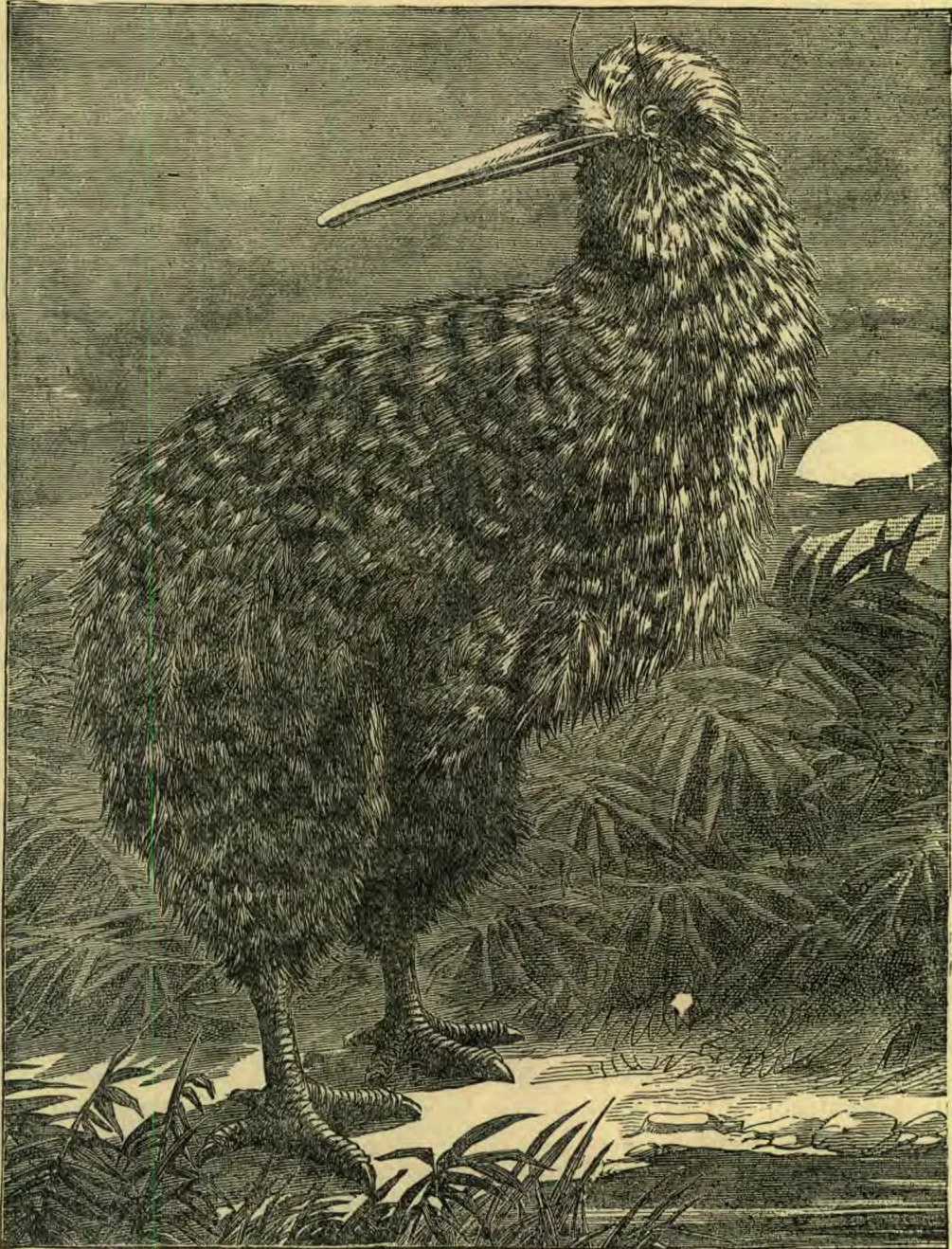
THE KIWI-KIWI.

Such is the name of the strange-looking bird seen in the picture on this page. Its home is in New Zealand. Get out your maps, and see where that is. Once this bird was very common, but now it is rarely seen.
It is very shy. In the daytime it hides in deep recesses among the rocks, or among tree roots, or the tall ferns that grow in that country. It can run very fast indeed, and so it is hard to catch.
As you would suppose by looking at this picture, the bird has no tail. As for wings, it has two little stumps, mere apologies; but it cannot fly with them, neither do they aid it in running. Scientists have called the bird the apteryx, or wingless bird. The feathers are of a chestnut-brown color.
Its beak is long and curved. The nostrils are small, and set on each side of the tip, so that the bird does not have to depend on its eyes alone, when searching for its food; but it can smell the bugs and worms, just as some animals do. It has a curious way of jumping and striking the ground with its powerful feet, to attract the bugs and worms, of which it is so fond, to the top of the ground. Then it can, by means of its long bill, reach down into the soft earth, and get the food it needs.
It lays monstrous eggs, weighing fourteen or fifteen ounces. The bird itself weighs only four pounds, and is two feet in height. You may be sure it does not lay these eggs very often.
You would not think that people would care to hunt for such a homely bird, would you? The New Zealanders think a great deal of it. They go out at night, and hunt for it with torches and spears. Its skin is very tough, but yet it is flexible. The native chiefs value it very highly, and out of it make the mantles that they wear on state occasions. They are very unwilling to part with these cloaks, even when offered large sums of money for them. W. E. L.

BORN AMONG THE ICEBERGS.

Away up North among the cold icebergs seems a very uncomfortable place to live; and so it would be for you and me; but for Baby Walrus, who was born there and is suited to such a cold place, it is delightful.
There is nothing the chubby little fellow likes half so well as taking a nap on a great cake of clear ice, or diving into the cold water.
Though born on land, or on ice, the walrus is most at home in the water; and well it may be, for as it has only flippers instead of feet and legs, it cannot do anything but flop on the land, while in the water it can swim like a fish.
It can even dive down, and not come up again for an hour.
The full-grown walrus is a terrible fellow, almost as big as an elephant, with two great tusks in his upper jaw, and a mouth covered with a beard as coarse as so many knitting needles. The baby, however, has no such tusks, and for two years has to be taken care of like any little human baby.
And how its mother does love it! and its father, too, for that matter; but it is the mother that takes the greatest care of it. She is usually as gentle as anybody could wish, but touch her baby, and you will see a fearful creature. She has tusks and whiskers as well as Papa Walrus; and when she opens her mouth to roar, she looks as savage as any animal can.
The walrus has several enemies, and the worst, I am sorry to say, are men who hunt it for its tusks and oil; but the great polar bear is almost as bad as men, and delights in a little baby walrus for dinner above all other things.
When Mamma Walrus sees any powerful enemy trying to catch her baby, she rushes to it, takes it under her flipper, and scuds away through the water as fast as she can. If she is overtaken, she calls all her friends about her, and then woe betide the pursuer, for the angry animals can use their tusks with terrible effect. They have often attacked a boat full of men, and not ceased to fight until the boat was destroyed and the men drowned.
The reason why the walrus does not mind the cold water and the ice is, that it has a thick coating of oily fat under its thick hide, and that keeps it warmer than the warmest furs could make you or me.—John R. Coryell.

Letter Budget.

GEORGIE OWENS, of Solano Co., Cal., writes: “I have never written a letter for the INSTRUCTOR, but seeing so many children writing, I thought I would write too. I am almost fourteen years old. I take the INSTRUCTOR, and like it very much. I get my lessons from it every week. We live twelve miles from any Sabbath-school, and so cannot go very often. I have two sisters and my father and mother who keep the Sabbath, and we have a Sabbath-school at our house every Sabbath. Although we are deprived of hearing a sermon, we are not deprived of God’s rich blessing. I am trying to keep all of God’s commandments, so that when Christ comes, I may be found among the redeemed.”
The two or three who meet together in God’s name may have an abundant blessing if they seek for it, as Georgie here testifies. Will the lonely ones all try for it?
VENNIE PEARSON, writing from Carroll Co., Tenn., says she keeps the Sabbath with her father and mother, and wants to be a good girl. Her father is superintendent of the Sabbath-School, which she attends. She studies in Book No. 1. She takes the INSTRUCTOR, and likes it very much. Aunt Maggie Fulton gave her a Bible for learning the commandments. She reads in Bible Readings. She wants a home in God’s kingdom.
Strive earnestly, Maggie, and Jesus will help you.

You have reached the end of this edition.

The Youth’s Instructor · Oct 15, 1884