STANDING on the Rock of Ages?
Praise the Lord!
Stand with martyrs, seers, and sages:
Praise the Lord.
Should you suffer persecution
For some sacred institution,
Then with patient resolution
Praise the Lord.
Do you meet with fierce temptation?
Praise the Lord.
It will work for your salvation:
Praise the Lord.
We are purified by trial,
And a bit of self-denial
Sweetens, much, the bitter vial:
Praise the Lord.
Are you shedding tears of sorrow?
Praise the Lord.
They will bring you peace to-morrow:
Praise the Lord.
For it is our firm conviction
That, with God's sure benediction,
We are sweetened by affliction:
Praise the Lord.
Kamiah, Idaho.
The Wise Man
By H. A. Robinson
H. A. ROBINSON
If I should ask men of the world, “Who is a wise man?” I am sure there would be great diversity in their replies. Some might think of great scientists, or great physicians, or perhaps business kings; but the Lord himself has told us in his Holy Word, “He that winneth souls is wise.” Prov. 11:30.
The world regards the man who gives as a benefactor of mankind. He may will his wealth to a church or to a college, for the establishing of a school or an asylum. These men certainly are benefactors, but who has been the greatest benefactor?—Our Lord and Saviour Jesus Christ. He it was that came “to seek and to save that which was lost,” and finally gave his life that men could have hope of salvation. And when he was leaving this earth, he commanded his followers to go and preach the gospel to every creature. Should we, then, be slow in deciding to work for the Lord?
“He that winneth souls is wise,” and “they that be wise shall shine as the brightness of the firmament; and they that turn many to righteousness as the stars forever and ever.”
Now, what will you do?
Tampico, Mexico.
The Great Commission
“Go ye therefore, and teach all nations, baptizing them in the name of the Father, and of the Son, and of the Holy Ghost.” Matt. 28:19.
Blame
It is so sore a thing we feel like touching it lightly, and yet how often and unthinkingly it is thrown at one and another in the family circle. But handling never callouses it; it only keeps all its surfaces raw.
So do not blame the child if he has broken some precious thing. If he is to blame, that knowledge, with the shock of the affair, is all he should be called upon to endure. Do not blame your wife. Can you not feel her cringe? Do not blame your husband. The results are most unsatisfactory. Do not blame your neighbor, and say she would never do so by her own child. Perhaps she wouldn’t need to. Withholding blame which is merited will work no disaster, and a word of undeserved praise sometimes sets people thinking.
Among the different children we have had in our home, there was one who gave us a great deal of anxiety, because we seemed powerless to work the improvement necessary. She was a problem difficult to solve, and many times tried our patience past the limit, until we became quite as discouraged with ourselves as with her.
On her return home, we expected nothing but blame. We all know what parents are, and they would have heard only her account. Imagine our feelings when they afterward came to us with tears in their eyes, declaring they could never repay us for all we had done, and when the child herself, now older grown, sends us warm, appreciative letters.
It hasn’t done us one bit of harm, but on the contrary has touched a spring of gratitude in our hearts, and given us a new glimpse of the divine forbearance.
Beloved, “if our heart condemn us, God is greater than our heart, and knoweth all things.” He appreciates the resistance, even if it gives way at last before temptation, and says, “Neither do I condemn thee: go, and sin no more.” Can we not learn the lesson?
A Letter to Parents
By Mary H. Moore
DEAR PARENTS: Every one who considers at all what it means to be a parent, must at times feel burdened with the responsibility resting upon those who have entrusted to them the training and welfare of the young. We all tremble at the thought of making mistakes in these things. We all realize that eternal interests are involved, and most earnestly long for help, for guidance, for wisdom from above, and gladly welcome any light upon the problems which daily confront us in rearing our children.
One means of gaining such help as we need is parents' meetings, in which may be discussed the true principles of child-training, and the duties of the different members of the household.
But since the rush of modern business life is so exacting that in many cases the whole burden of home making and family discipline falls upon the mother, these meetings naturally are left to mothers, and become mothers' meetings. In attempting to meet the need which mothers feel for help, newspapers and magazines abound in “Women's Pages,” “Mothers' Departments,” and “Hints and Helps for Housekeepers;” yet the subject is not exhausted nor overdone. Among such helps the mothers' meeting takes a front rank, and is especially suited to the needs of Seventh-day Adventist mothers, who need to draw from every source of strength and wisdom if their households are to be brought up in the faith.
These meetings are a means of help, affording a regular time and place where mothers may find sympathy and enjoy a free interchange of ideas and experiences, and unitedly petition the throne of grace for the salvation of their children. These meetings ought to be held in all places where there are Adventist families. At our camp-meetings there are usually parents' or mothers' meetings held, which are of great benefit. But would it not be well to begin the good work beforehand by organizing at home; and so prepare ourselves to gather up, retain, and apply all the good instructions we may hear at camp-meeting?
There need not be much machinery of organization, a leader, a secretary, and a regular place and time of meeting being the most important elements. Other needs can be met as they arise.
We have such an association in College View, Neb., which has been in successful operation for nearly two years. It has done great good, and has found a field of usefulness as wide as it could ask. Those who have enjoyed its benefits have been knit together in Christian fellowship, and many have been helped, encouraged, uplifted, and given higher ideals and enlightenment concerning the daily recurring problems of life.
Among the many helpful papers read and discussed at these meetings, five have been selected as especially deserving of circulation, and have been published in leaflet form for distribution, as we have felt a desire to pass on to others the light given us. These leaflets are as follows: “Domestic Methods of Queen Victoria,” “Co-operation of Parents in the Training of Their Children,” “Social Purity,” “Co-operation of Teachers and Parents,” and “Heredity.” Others will be added to the list in the near future.
Sisters, take hold of this work. Meet and organize and study these subjects on which we need so much to be informed. Study the Bible and the Testimonies and see what rich treasures are there awaiting your search. Pray together, and God will certainly give his blessing and help you to order your households in his fear and to his glory.
Yours for the salvation of the children.
MARY H. MOORE,
Temperance Secretary of the S. D. A.Church, College View, Neb.
Thank God
By C. W. Bronson
THANK God for joy!
For glad, sweet thoughts that flood the
soul and spring
Larklike into the sky to soar and sing;
For kindly airs that woo to bud and
flower
Thy dormant being, and awake new
power
With each new morn; new purposes that
bring
To heart and soul their full and just
employ.
Thank God for joy!
And O, thank God for pain,
That shuts thee in in silence! Wait and
know
The rain that breaks the blossom, and
lays low
The fair green stalk, doth nourish e'en
in grief
The being's root, of future bud and
leaf
The guaranty; so shalt thou surely grow
To fairer heights, to nobler powers
attain.
Thank God for pain!
— C. W. Bronson, in New York Observer.
Good Breeding
Good breeding shows itself most where, to an ordinary eye, it appears the least.—Addison.
Planting a Garden
Unless you live south of Mason and Dixon's line, it is not much use to plant a garden until the first of May, and in the New England States the middle of May is even wiser, lest a late frost nip all the young seedlings. The only vegetable which is an exception to this rule is peas. They will stand the cold, and may be planted as soon as the frost is out of the ground. The first thing after deciding on the place and size of the land to be cultivated (and it goes without saying that land that lies open to the sun, away from the shade of trees and buildings, is the best) is to have the earth well stirred and turned by plowing or spading. The vegetables most suited to garden culture and to the usual taste of eaters are peas, wax and lima beans, green corn, beets, lettuce, cucumbers, summer squash, tomatoes, carrots, radishes, and cabbage. Potatoes are not feasible in a small garden, as they take up too much room.—Harper's Bazar.
Is It Nothing to You?
Is it nothing to you, O ye Christians!
That Africa walks in night?
That Christians at home deny them
The blessed gospel light?
The cry goes up this morning
From a heart-broken race of slaves,
And seven hundred every hour
Sink into Christless graves!
Is it nothing to you, O ye Christians!
That in India's far-away land
There are thousands of people pleading
For the touch of a Saviour's hand?
They are groping and trying to find him,
And although he is ready to save,
Eight hundred precious souls each hour
Sink into a Christless grave!
Is it nothing to you, O ye Christians!
That millions of beings to-day
In the heathen darkness of China
Are rapidly passing away?
They have never heard the story
Of the loving Lord who saves,
And fourteen hundred every hour
Are sinking to Christless graves!
Is it nothing to you, O ye Christians!
Will ye pass by and say
It is nothing—we can not aid them?
You can give, or go, or pray;
You can save your souls from blood-guiltiness,
For in lands you have never trod
The heathen are dying every day,
And dying without God.
Is it nothing to you, O ye Christians?
Dare ye say ye have naught to do?
All over the world they wait for the light,
And is this nothing to you?
—Selected.
General Meeting of the Central Asia Mission Field
By J. T. Boettcher
J. T. BOETTCHER
This first general meeting was held at Orlow, Turkestan, Nov. 5-8, 1909, and to it I journeyed alone. The brethren there had most earnestly called for help, and I had hoped to take one worker with me, to leave in that needy field; but there was no one ready to go.
The journey is comparatively easy now, as the Russians have built, at great expense, a railroad from Orenburg to Tashkend. I left Kief Saturday night, and arrived in Tashkend the following Friday evening, after continuous traveling.
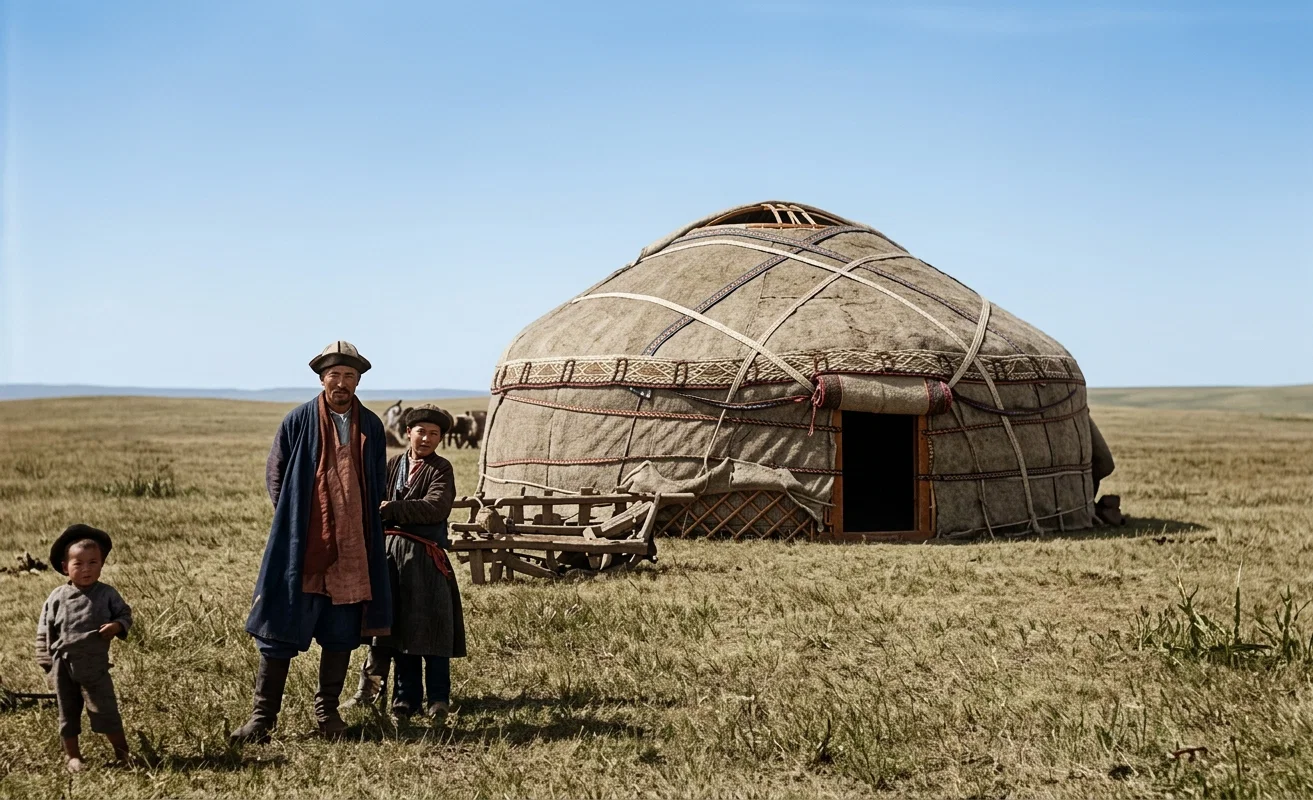
It was my first trip to Asia, and it was full of interest to me. There was no great difference in the country to mark the boundary between Europe and Asia, but the customs of the people changed almost immediately, and, instead of horses, camels were being driven. Two hours' ride brought us into the great sand desert, or the Kirghiz Steppe, more than one thousand miles long. Looking out of the car window, it seemed as if we were riding in the middle of the ocean, as the wind drives the sand into great, wave-like piles. A feeling of loneliness overcomes one, as there is so little to break the monotony—here and there a Kirghizen hut or two, and camels grazing on a sort of herb that grows in the desert. The men were clothed in furs, while the women wore very gay, thin dresses. They looked healthy and intelligent, owing partly, perhaps, to the fact that, as Mohammedans, they drink no alcohol. I thought of the time when the Lord has promised that the wilderness shall blossom as the rose; for the greater number of these people have never seen a green tree or a river.
HERE AND THERE A KIRGHIZEN HUT OR TWO
We passed through no cities or villages, nor were we troubled by new passengers coming in to find seats. At one station we saw a train filled with Sartin pilgrims on their way to Mecca.
Nearing our destination, we could see the snow-capped mountains in the distance, and were aware that we had left the desert. The scenery was rapidly changing. The inhabitants of Tashkend are mostly Sartins and Russians, numbering, in all, one hundred fifty thousand. The city itself is quite Oriental, and in the few days that I spent there, many customs of Bible times became plain to me.
Brother J. Ebel met me at the depot, and took me to his home to remain over the Sabbath, from which place we would go on together to the place of meeting. The village of Orlow lies over three hundred miles inland; and as there is no railway there, we were to travel this distance in wagons. The brethren from Orlow who were to meet us were already there, and had been waiting for us several days. Sunday morning, at daybreak, we started. We had two large covered wagons, without springs and without seats. They told us to sit right down on the bottom of the wagon, which we did, and were off. I tried sitting in every kind of way, but it was a most fearful jolting that my head could not endure; so, after about twenty-five miles of that kind of riding, I got out and filled some sacks with straw, which served as comfortable seats by day and beds at night.
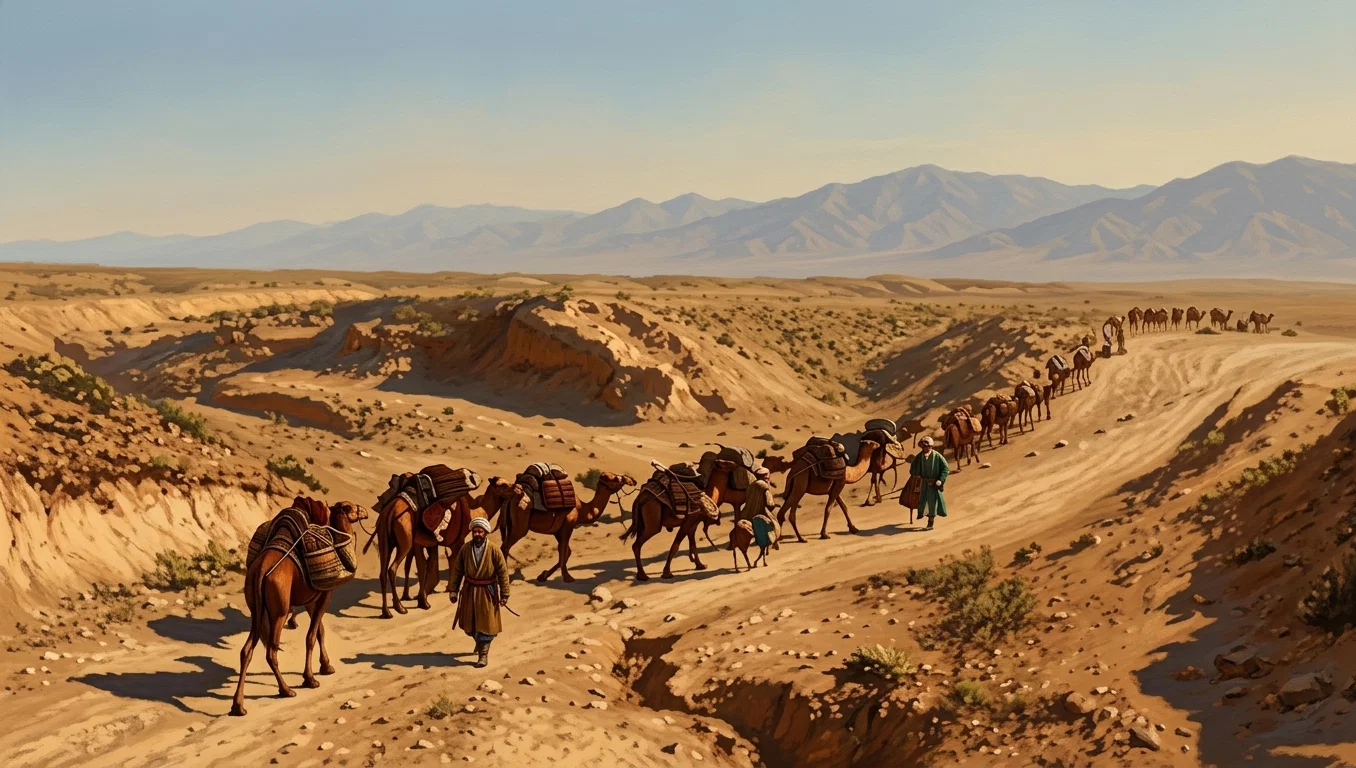
We were traveling along the great caravan road which goes from Tashkend to Semipalatinsk, a distance of about fifteen hundred miles. It is in a broad valley, with high mountains on both sides, snow-tipped even in hottest summer. The road winds in and out, and great caravans of camels and wagons are passing. Once we counted sixty-five wagons in a row, and at another time a caravan of fourteen camels, laden with articles of commerce. Each camel can carry about six hundred pounds.
In the day it was extremely hot, but during the night, cold. This valley formerly belonged to the Sartins and Kirghizens; but of late the government has been settling Russian and German emigrants there. We passed through two German, six Russian, and thirteen native villages.
Generally we stopped at Sartin inns, to rest ourselves and feed our horses. The sign for such a place was a big bundle of clover stuck up on top of the roof of the house.
We also took our morning bath at the inn, and then went into the Sartin hut to order hot water and prepare our meal. There were no chairs or tables. All sit upon rugs, which also serve as tables. The meals did not always look inviting, but we were hungry.
When we were within about sixty miles of our journey's end, we saw, a long way off, upon an elevation, a little party watching our approach. Those with us said, “See! those are brethren from Orlow, who have come to meet us.” And so it proved. They had come with their comfortable carriages; and, knowing that our provisions would be falling short, they had brought along many good things to eat, had rented the best room in a Russian inn near by, and prepared for us a bountiful meal, to which we did full justice. Their hearty greetings made us feel at home among them, and, refreshed, and thankful to God, we continued on together, over rocks and stones, through ditches and rivers, arriving in Orlow at eleven o'clock at night. In some houses lights were still burning, and the brethren pointed out to us where some of our people lived. We were brought to the pleasant home of Brother Wever, and the good beds, ready for us, looked exceedingly inviting.
Orlow is a German village, settled by Lutherans and Seventh-day Adventists. It lies upon a river, and is near the9mountains. The wide street, which leads through the center, has trees planted on either side, and also ditches are dug on both sides, through which water flows, fresh and cool. The village looks thrifty, and, although there are a few small clay houses, most of the buildings are of modern style, and have tin roofs. Behind the houses, toward the mountains, are the farms. Everything is grown by means of irrigation, but the water flows here the year round. One could see that this year the harvest had been medium only. The Sartins do most of the farm work; this is done in the most primitive manner, two stones still serving as a thrashing-machine.
The Adventists have built a meeting-house and school together. But as it is situated at one end of the village, and over the river, it is not easy of access for all, especially when the river is high.
Our people meet every Sabbath for Sabbath-school and services. During the year 1909 twenty-one new members were added to their numbers; and, as far as I could see, they are worthy members, earnest in the message.
The first Bible reading of our general meeting was held the Thursday morning after our arrival. Besides the brethren and sisters of that place, brethren were present from Aschabad, near the Persian boundary, and from Tashkend and vicinity. At this first service, held at 9 A. M., we were aware of the fact that our place of meeting would be too small. There was not even room for our own people. We at once formed the plan of erecting a tent meeting-house. The yard of the brother with whom we were stopping seemed the best place for us to locate. The scene reminded one of a swarm of bees busily at work. Two sides of the brother's house served as walls of our tent. On the opposite side we drove posts into the ground. Upon these on the one side, and upon the house on the other, we fastened a sort of scaffold. The people brought big felt blankets, straw mats, and even boards, to cover the structure. One brother brought two windows, one of which was put into the roof, and the other set in the side of our house. A pulpit was built, seats were brought from the houses, and two lamps were hung up. It really looked very nice. Then, as the nights were cold, we had to have a fire. Indeed, we felt very happy to find ourselves so comfortably situated and able to accommodate all who would come. And many not of our faith did attend, and invited us to visit them at their homes.
The meetings were conducted in the German language, Brother Ebel translating into Russian for those who could not understand. We enjoyed perfect liberty, with no police to hinder our work. We could read our resolutions, take up our collections, hold social services, without any fears of being stopped.
All this was new for our people in Turkestan, and they took a lively interest in everything that was done. Especially were they interested in the resolution concerning the school for Russia. Slips of paper were passed around for each one to subscribe how much he would give for this project. As these were returned, and the amount counted, it was found that the sum had not reached four hundred rubles. Our people were not satisfied. One brother said, “Come, brethren, we must bring that amount up to four hundred rubles.” And this they did, one giving twenty rubles more, another ten, etc. It was touching to witness their enthusiasm. One sister pledged the proceeds from a piece of land, another gave a calf, and one a lamp, which was sold at once, and the money put into the collection.
THE GREAT CARAVAN ROAD FROM TASHKEND TO SEMIPALATINSK
We also endeavored to give instruction concerning the tithing system, as not all had understood this.
Our members there begin to feel a burden for the Mohammedan nations around them. Many of our young people speak the Tirgisian, and what a pity that we have no literature in that tongue! This mission field now has sixty-eight members, one ordained minister, and two canvassers.
Some of these people have not a very clear idea of the world at large, never having seen a city or a railroad. As I was talking about the progress of the message in Europe, some one in the meeting asked where Europe is. But they understood the truths of the third angel's message, and its relation to them.
All were so pleased with the session that they voted to hold another next year in Tashkend. They also appointed a delegate to attend our Russian union meeting, to be held next spring. When he returns to tell them the story, it will also serve as a means of education.
It was with regret that we parted. Some of the brethren brought me back to Tashkend, desiring instruction in the Bible all along the way, although the dust was so thick that it seemed as if I could not speak.
This is a field rich with opportunities for the Mohammedan world. May God give our brethren grace to be light-bearers in far-off Turkestan and Persia, is my sincere hope and prayer.
Riga, Russia.
Progress in Japan
By F. W. Field
F. W. FIELD
The work in Japan has continued to advance since my last report, written several months ago. And the lack of more frequent reports from this field has rather been because we have been so busy. Interests of an encouraging nature are springing up in various places, and we have good reason to believe that this is to be a very successful year. A brief mention of some of these interests, and of some who have recently accepted the truth, will show how the message is making its way among the people.
Ashio, a city of some fifty thousand inhabitants, is a mining town not far from Nikko; and its copper mines are among the largest in the world. Last year one of our canvassers labored there for several weeks, and circulated some of our literature. This year he sent a single copy of the New-Year’s number of our paper to a company of Christians in Ashio, addressing it to the pastor. He wished to return it after learning what it was; but some wished to read it. So it was passed from hand to hand till about worn out. And now our brother learns by correspondence that six of this company have come out and accepted the truths advocated in our literature, as far as they understand them; and they now ask for further light and help.
The teacher of a village school on a small island near Shizuoka, has been reading our papers and corresponding with Brother H. Kuniya, who plans to visit the place in the spring. The young man writes that he is much pleased to learn of this intended visit; that he will provide the best entertainment their little island affords; and that he will plan to lay aside his work during the visit, that he may be free to study the Bible.
A Presbyterian pastor at Kiryu, near Maebashi, has been studying our truth for some little time past. He is well educated, and has a good reading knowledge of English; so besides reading our Japanese publications, he has read several of our works in English. Last week he was in Tokyo, and visited our school; and the brethren held some Bible studies with him. Since returning home he writes that both he and his wife have fully accepted the truth, and that he will resign his position at once, and take his stand with us.
A young lady near Wakamatsu has accepted the truth this winter. Her parents are quite well-to-do; and as she is the only child, all their hopes for preserving the family line are bound up in her. And as she is now of marriageable age, they have sought to arrange for her marriage. But as they are not Christians, she can not marry according to their wishes. And their disappointment at her course in thus becoming a Christian, is the great cause of their displeasure10toward her. But though suffering this persecution, which of all forms of persecution is hardest to bear, she is firm in her determination to follow Christ. And she has just written of her desire to give herself to the Lord’s work. Surely the faith which looks beyond the things of this world to the eternal things of God, is not yet extinct.
Last Sabbath an elderly man attended our services here in Tokyo, and made known his decision to observe the Sabbath of the Lord. It was the first Sabbath he had kept. One of our brethren had brought him some of our literature, and had visited him and explained the truth to him, with the result that he was led to accept it.
The above are a few of the encouraging omens of the harvest of souls that we feel sure awaits us this year. Our school is drawing near its close; and we are very thankful for the opportunities thus afforded for helping our little band of workers. And after these four months thus spent with about a score of earnest young people, we plan to throw our whole force into the work of further seed sowing, and of gathering the harvest. We are expecting great things of the Lord, and ask all who read this to unite their prayers with ours to this end.
There are other interesting plans and developments in our work that we hope to report soon. A spirit of harmony and brotherly love prevails among our workers and believers, which will surely bring the blessing of God into our work. So we are of good courage in the Lord.
Tokyo.
Matandani Mission
By S. M. KONIGMACHER
S. M. KONIGMACHER
We have obtained permission from the district resident, or local governor, to locate three out-schools, and we have commenced to build the schoolhouses.
Many of these children come to the mission; but when the rains begin, they will not, as it is too far. There are also many who will not attend school at all. If I can put a school near by, it may have a good influence, and gather in others who will not come to the mission, as we are three miles from these villages.
God is very good to us, and we thank him for it. This is truly a great work. We are glad to report progress. Forty-six attended school this morning, and one hundred were present at church services. We usually have thirty in the advanced school, in the afternoon. If all came, I am sure there would be nearly one hundred. Yet they do very well. Some very small children attend, even though their homes are three miles away. Of course the native is a good walker.
Recently four boys came to build their temporary huts at the mission. They will labor three hours each day for their food. Their wives pound it, which saves the mission the expense of hiring this done.
We are glad to see from ninety to one hundred at the services on the Sabbath. How we do enjoy the Sabbath! We prepare for it. On Friday we have no school, that we may finish our duties and get ready for the Sabbath. The boys bring in their wood to keep the fire going so they may iron, and on Sabbath they look very nice, indeed.
O, if our people at home realized the blessing which comes when they give all to Jesus, the treasury would be full, and the great needs of these fields could be supplied! We need many more of our brethren and sisters of the home land to help in finishing the message here. I am glad for a place in this field. Sometimes the way seems hard and dark, but not all the time. We miss the association of God's people, and the exchange of thought with those of like faith and experience.
The boys have just been in for evening prayers. They asked me to show them pictures. I showed them those in Life and Health of a boy learning to smoke. These pleased them greatly, as I speak often about the evils of tobacco and the way it affects the users.
Neno, British Central Africa.
Mission Notes
By T. E. Bowen
FORTY-NINE students among the natives attending the schools at the Solusi and Somabula mission farms were baptized during 1909. Many more are now receiving instruction preparatory to receiving the rite later on.
Elder J. C. Rogers reports from Nyassaland that during 1909 forty-eight were baptized. A class of seventy-five are anxious for baptism at one school, some of whom have been waiting two years, while at another school one hundred are preparing in the same manner. Surely God's Spirit is working upon hearts out in the great Dark Continent. Other sections just as propitious as Nyassaland must await the coming of other consecrated workers from the home land to take the oversight of teaching the young people so that they in turn can go out as gospel teachers—evangelists. How long must they wait?
In the quarterly record of the Christian Literature Society for China, some interesting particulars are given in regard to the new regent: “He is also easily accessible to all who have information to impart or matters of importance to discuss, and has lately announced that memorials to him must be presented with unbroken seals, so as to secure that their contents are not interfered with by the censors whose duty it is to present them. His modesty is shown by the fact that, in giving audience to his ministers, he has waived the ceremony of kneeling and prostration, and permits his councilors to sit in his presence; he has also modified the rules of conduct and privilege which were drawn up by the board of rites, refusing the dignity of the imperial yellow sedan-chair which the board had conferred upon him, preferring to move freely among the people as of old, without escort or attendant—a determination which has elicited an earnest protest on the part of some of the officials of the court, who were fearful of the consequences which might follow.”
The Chinese government has deposed the dalai-lama as head of the Tibetan government, and in an official statement explains its action on the ground that the nominal ruler had deserted the capital following an attempt by him to organize a general revolt.
At an out-school recently started near the Malamulo Mission, Nyassaland, already fifty students are enrolled, and the teacher, a native, is reported to be greatly enjoying his work. At Solusi the attendance is ninety-two, and more huts must be erected to house the students.
In summing up the account of how Japan was opened to Christian civilization, Pastor Chas. A. Bowen, in the Missionary Review of the World for July, 1909, cites the testimony of Count Okuma, given in his old age, as follows:— “Through some good missionaries at Nagasaki, I was able to get a history of the United States, and one of England. These made a revolution in my mind. I no longer wanted to be a military man. I wanted to devote my life to the destruction of the feudal system. I wanted to see all the disunited provinces of my country united under one head, the emperor. Nor was this enough. I could then see far enough to know that it was not political changes alone that we needed. Neither Buddhism nor Shintoism was equal to these new demands of our awakened country. We needed freedom in religious belief. Christianity, which had been so important in the development of the Western nations, was to be welcomed.”
The late Bishop William Taylor narrated the following: “I saw a woman who had been accused of witchcraft, and condemned to death by ferocious ants. She was bound to an ant-hill — often from ten to fifteen feet high — and kept there all day. The cries of her infant were such as to cause her release at night. The victim usually dies in two days, but this woman was bound and tortured for five days, and then driven away because ‘she was too hard to kill.’ She crawled, in a terrible condition, to the mission station, and the missionary told me she was the most pitiful sight he ever beheld. After careful nursing for months she recovered, and this woman, so terribly scarred and disfigured, was converted at my services. The recital of such scenes may seem terrible to civilized nerves, but how much more so is the endurance of them by millions of helpless human beings? Jesus Christ came to destroy the work of the devil. Pray daily that Africa shall speedily know him whom to know aright is life eternal.” It is to these poor deluded souls that we are asked to send the gospel. Truly they need our help.
T. E. BOWEN.
Our First Hymn-Book.
—In the Present Truth for December, 1849, it was announced that a small forty-eight-page collection of hymns was on the press. The title-page of this little book reads, “Hymns for God’s Peculiar People, that keep the Commandments of God and the Faith of Jesus, compiled by James White, Oswego, 1849.” It contained fifty-three hymns, without notes. There were a few Sabbath hymns, most of which have found place in our “Hymns and Tunes,” and a few of the old familiar hymns commonly classified as devotional; but the greater number were hymns of the advent hope and of the eternal home. Some are unfamiliar to most of us, as this old-time “glory song:”—
“I’m glad I know that Christ shall reign
In glory, glory, glory,
And come to earth in clouds again,
In glory, glory, glory.
’Tis glory’s foretaste makes me sing
Of glory, glory, glory;
And to my Saviour praises bring,
Sing glory, glory, glory.”
The call, “Come out of her, my people,” was sung in the vigorous lines,—
“Then blow ye the trumpet in pure testimony,
And let the saints hear it again;
O come ye from Babylon, Egypt, and Sodom,
And make your way over the plain.
Come, wash all your robes in the blood of the Lamb.”
The political upheavals and unrest in Europe in those days, really the beginning of the arming of the nations, gave timely force to a hymn of the coming conflict,—
“The cry is up, the strife begun,
The struggle of the mighty ones;
And Armageddon’s day comes on,
The carnival of Slaughter’s sons;
War lifts his helmet to his brow:
O God, protect thy people now!”
One hymn of the 1844 movement would be considered as having too much the character of a narrative for a hymn, but it told a heart-stirring story:— “Hail, partners in the advent band!
Your race is almost run;
God’s led you with his own right hand,
Since looking for his Son.
All hail, ye loved ones of my God,
Come listen to my song,
While I recount the steps we’ve trod,
Nor shall the strain be long.”
It tells how,—
“In forty-three each took his lamp,
Went forth to meet the Lord;”—
and how, after the first time passed, the “midnight cry” roused all to look for the coming King on the “tenth day of the seventh month,” in 1844. Then came the bitter disappointment,—
“Our longing eyes were raised in vain
To meet him in the air.”
But the hymn points those who passed through that experience to the fact that the coming to judgment for which they looked was not the second advent of Christ to this world, but his coming before the Ancient of Days, in the most holy of the heavenly sanctuary,—
“There to the fair Jerusalem
Unseen by mortal eye,
Jesus our King and Priest did come,
Thus answering to the cry.”
In 1852 a second hymn-book was printed in Rochester, N. Y., with many more hymns. However rough the way, the believers have cheered it with song, and so it must ever be; for “the redeemed of the Lord shall return, and come with singing unto Zion.”