—The Russian news is meager and conflicting. The Czar is evidently unable to decide upon any policy, vacillating between liberalism and repression, to the discouragement of his friends and the encouragement of his enemies. No further mention of the coming coronation is made, although the journey to Moscow was supposed to have been taken as a preliminary to it. Such meager intelligence as comes to hand, however, shows the journey to have borne more the character of a continued flight than a royal tour. Its immediate cause appears to have been the discovery of a new plot against the imperial family, from which a flight to Moscow offered the only means of escape. But a stay of a few days in the latter city was cut short by the discovery of another plot, necessitating a hurried departure for Nizhni Novgorod. What happened there is not known, although the return of the imperial family to Peterhoff within the same week indicates a recurrence of the plots. Putting the known facts together, the Czar seems to have been followed174everywhere by Nihilists, and to have found no place of safety outside the walls of the palace from which he was first driven.—Interior.
A Mountain Steamer.
Steam navigation among the mountain ranges of Colorado is one of the peculiarities of that wonderful region. “A sail over the placid and translucent waters of Twin Lakes will convince the traveler that Colorado affords some of the most beautiful aquatic scenery in nature. Twin Lakes are located three miles from Twin Lake station, Denver and South Park Division U. P. Railway, or 150 miles southwest of Denver, at the eastern base of the Sawache Range, at an elevation of 9,333 feet above the level of the sea. The lower lake covers 1,525 and the upper 475 acres, and they are united by a small, swift, clear stream, about half a mile in length, which winds through grassy meadows, studded with scattering shade trees, affording delightful picnic or camp-grounds. On the north stands Mount Elbert, altitude 14,360 feet above the sea, or 5,027 feet above the lakes. Directly opposite (at the south side of the Lakes) are the Twin Peaks, also giants of the Rocky chain. The sheets are, therefore, thoroughly mountain-locked.” The paper above quoted says the little steamer playing on Twin Lakes “has the distinguished honor of being nearer to Heaven than any other craft in the wide, wide world.”
Notes of News.
—The German harvests promise well.
—The Georgians are cultivating olives successfully.
—There are 10,000 Protestant Christians in Mexico.
—The Mormons are erecting a temple in San Francisco.
—The standing armies of Europe number over 2,100,000 men.
—300,000 of the 6,100,000 Jews in the world reside in this country.
—It is estimated that there are 3,000 professional burglars in America.
—By the recent wreck of the steamer Teuton, 44 persons lost their lives.
—During the month of August, the public debt was decreased $14,181,221.
—The annual raisin production of California amounts to about 62,000 boxes.
—In the anthracite coal region of Pennsylvania, water sells at 25 cents per barrel.
—This year the New England colleges conferred the degree of A. B. on about 850 students.
—Fires are destroying the forests in Ontario along the line of the Kingston and Pembroke Railroad.
—Last month was the hottest August for ten years, and had the smallest rain-fall for the decade.
—The cost of the trial of Parnell and his associates in the Irish Land-League agitation, was £9,800.
—On the 1st of September, a fire in London, Eng., destroyed property to the value of $1,000,000.
—Pope Leo’s paper, the Aurora, has been given up, after sinking several hundred thousand dollars.
—On Saturday, Aug. 28, an easterly gale damaged Charleston, S. C., $140,000. Several lives were lost.
—In the neighborhood of Kingston, Ont., many farmers have been driven from their homes by bush fires.
—At a bull-fight in Marseilles, France, Aug. 17, seventeen persons were killed, and one hundred and thirty injured.
—The proposal of the working-men of London to erect a monument to Dean Stanley has met an enthusiastic response.
—It is stated that from 50,000 to 60,000 slaves are taken from Africa to Turkey and Egyptian ports and sold over the Sultan’s dominions.
—Tchesme, in Asiatic Turkey, opposite the Island of Scio, has been visited by an earthquake which caused great damage to property.
—The smallest engine in the world has just been finished in Baltimore. It can be covered by a thimble, and three drops of water fill the boiler.
—From Morocco to Tunis the whole Mohammedan race is in a state of ferment. The Arabs are concentrating to defend Kairouan, their holy city.
—The Emperor of Germany has conferred upon Prof. Wm. D. Whitney of Yale College the order of merit left vacant by the death of Thomas Carlyle.
—Forest fires are raging in Arkansas, where no rain has fallen for ten weeks, and in many sections trees are shedding their foliage as if struck by frost.
—In Central Indiana and Illinois cattle are suffering greatly for want of water. Near Warren, Ohio, sheep are dying by the hundreds from the drought.
—General D. B. Fearing is lying at the point of death at Marietta, Ohio. His disease is the breaking out of an old wound received at Chickamauga eighteen years ago.
—The tenantry of England and Scotland will probably soon demand a law similar to the Irish Land Bill, which has just passed, and received the Queen’s signature.
—An American committee have obtained permission to place a memorial of Sir Walter Raleigh in the great west window of St. Margaret’s Church, Westminster, London.
—On Friday and Saturday, Aug. 26, 27, the Hately packing and ice house, Chicago, suffered from a great fire. The loss is nearly $1,000,000, mostly covered by insurance.
—Canes cut from the battlefields of Chickamauga and Mission Ridge will soon be offered for sale at $1 each, to raise funds for the erection of a $10,000 Methodist church in Chattanooga.
—California spends $3,000,000 a year on her schools, and the value of her school property is $7,000,000; yet there are only 100,000 attendants at school out of 150,000 of school age.
—The Greek government has made a contract with a French company for the construction of a railway connecting the old kingdom with the territory recently ceded by Turkey.
—On the morning of Sept. 2, an insane man in Chicago went into the street, and shot five men, at least one of them fatally, before his career was ended by a shot from a policeman.
—A family of ten persons living near Kauffmann, Texas, were poisoned by eating cooked peaches containing arsenic. Little hope is entertained of the recovery of any of the victims.
—A dispatch from San Francisco states that on the 26th inst., the little hamlet of Eureka, New Mexico, was attacked by Indians, and the inhabitants, 70 in number, ruthlessly massacred.
—On Sunday, Aug. 28, a fire broke out in Cincinnati, Ohio; and in the panic that ensued, one man jumped from a fourth-story window and was killed. Seven other persons were injured.
—The chief of the bureau of statistics reports the excess of exports of merchandise for the year ending with July at $256,691,591. Our gain in coin for the same period was $90,666,977.
—The total number of communicants in the Presbyterian Church, as given in their published annual statistics, is 581,401. This is a gain during the year of 2,730, or half a member to a church.
—The work on the Mexican National and American Southern Railroad is progressing very favorably. At the present time, it seems possible that the entire road will be open to travel in five years.
—A gentleman, Alphonse Carr, thus sums up the subject of food adulteration: “If I poison my grocer, I shall be sent to the penitentiary; but if he poisons me, he will get off with ten dollars’ fine.”
—The aqueduct built by the Emperor Augustus to supply the city of Bologna with water, has recently been opened, after being closed for 1,600 years. The masonry was found in an almost perfect condition.
—The telephone is used with great success in the scientific explorations now conducted in the Bay of Naples. By its means the diver can communicate with those in the boat above without the possibility of mistake.
—Germany has made peace with the Vatican. Dr. Korum’s appointment as Bishop of Treves has been indorsed by the Imperial Government, and a German charge d’affaires is to be appointed to the Vatican.
—In Cyprus there is great scarcity of water. But it is said that $100,000 spent in the formation of artificial lakes, for the preservation of water now running into the sea, would relieve the island from much discomfort.
—Extensive forest fires are raging in the vicinity of the French settlement of Philippeville, Algeria. The conflagration defies all efforts of the soldiers and people to extinguish it. The Arabs are suspected of originating it.
—At Ur of the Chaldees, the modern Urfa, there is an evangelical church of 1,400 souls. An Armenian weaver was converted at Aintab, and returning to Urfa, combined evangelical work with his daily toil, with the above results.
—Work has commenced on the Panama canal. Groups of buildings, 15 in a group, designed to accommodate 400 men, are going up along the line. They are provided with a system of sewerage and water tanks, and are called “sanitary towns.”
—Some ship-builders from Scotland have leased land at Havre, France, upon which they design to erect a ship-building establishment capable of employing 3,000 men. They do this to secure the bounty offered by the French government for home-made ships.
—The mania for revision has reached the Parsees. One of their journals suggests that the Scriptures of the fire-worshiping community be submitted to a body of learned experts for such wholesale revision as will render the doctrinal teaching “more acceptable to the present generation of Parsees.”
—Texas has in her treasury $2,000,000 of school funds derived from the sale of public lands; and as 40,000,000 acres of land remain unsold, the State will have, at a moderate estimate, $100,000,000 to add to this fund—an amount equal, it is said, to the aggregate school funds of all the other States.
—Of the 11,000 factories on Manhattan Island, 950 factories are engaged in the manufacture of clothing, producing $78,000,000 worth annually. 540 printing and publishing houses produce $24,000,000 worth of literature. There are $8,000,000 worth of cigars, and $10,000,000 worth of furniture, produced every year.
—There were 102 railroad accidents in the United States during July. Thirty-eight persons were killed, and 120 wounded. Twenty accidents of the total number caused the death of one or more persons each, and twenty-four caused injury but not death, leaving 56.9 per cent of the whole number in which no personal injury was recorded.
—Lieut. B. Long Edes and Lieut. Lyman G. Spaulding, of the United States Navy, were killed by the premature explosion of a torpedo Monday afternoon, Aug. 29, at the torpedo station at Newport, R. I. The bodies of both gentlemen were blown to atoms. The explosion was caused by the accidental “closing of the circuit.” Lieut. Edes leaves a wife and family; Lieut. Spaulding was unmarried.
—A terrible storm visited parts of South Carolina and Georgia on the 27th inst. The loss of property was very great; but the loss of life was simply frightful. In Savannah alone, 35 persons were killed, and property to the value of $1,000,000 was destroyed. All the people on Shad Island were drowned, also about 36 persons in the cities of Port Royal, S. C., and Augusta, Ga. It is believed that some of the vessels along the coast suffered from the storm.
—There is considerable excitement in Atlanta, Ga., over the arrest of a young colored man for entering the City Hall Park. The arrest was made in accordance with an order from the Police Commissioner to arrest any colored people who might enter the park. The negro was discharged, and has now brought a suit, under the Civil Rights Bill, against the city for $20,000 damages. The city is held to be liable: 1. Because the plaintiff suffered injuries by reason of his race and color; 2. Because of trespass and detention of person and restraint of liberty of which he was deprived by reason of his race and color. 3. Because the city failed to protect him in his rights, privileges, and immunities under the laws of the United States, but instead oppressed him, and denied him said rights.
Ireland's New Party and Parnell's Continued Influence
—The last state of Ireland always seems worse than the first. No sooner does the land bill promise to restore a measure of quiet to that distressed country than a new political party springs up to continue the agitation. Sir Charles Gavan Duffy is the leader of the new movement. The party which he proposes to establish is to be made up of the Home Rulers who seceded from Parnell during the last session of Parliament, the Catholic clergy who sympathize with the seceders, and the Catholic gentry of Ireland, whoever that may mean. Exactly what the new party proposes to do is not stated, but it is not at all likely that it will diminish Mr. Parnell’s influence in Ireland to any great extent. That gentleman still maintains a pretty fair standing with the Irish people, and is just now increasing his prestige by waging a very bitter warfare with the British ministry. There is a vacancy in one of the Irish boroughs, and Mr. Parnell has issued a “most violent” address to the voters of the constituency to vote for the Tory candidate, and to defeat a government which has banished personal liberty from Ireland. As the Irish miners hold the balance of power in the borough, it is probable that the raid of the great agitator will cost the ministry a seat. Mr. Parnell’s opposition to the government has for its basis the retention in jail of the Irish suspects, for which, he insists, there is now no cause.—Interior.
Trusting Faith in Visible and Hidden Ways
—The religion that we can trust where we see the way, is the religion that we can trust where the way is hidden. The religion that commends itself to our common-sense is the religion that commends itself to our faith. The religion that is faithful in little is the religion that will be faithful in much.—National Baptist.
Treat Others as You Wish to Be Treated
—Act toward others as you would that they should act toward yourself. It is the same in life as in the midst of the waves. For every navigator there is the same sea, the same tempest, the same danger, to beware of. The same conduct you have shown to others will be shown to you by your fellow-voyagers.
Obituary Notices.
“Blessed are the dead which die in the Lord from henceforth.” Rev. 14:13
BRIGHAM.—Died of cancerous tumors, in North Plains, Mich., Aug. 18, 1881, our dear mother, Sophia Brigham, aged 78 years and 11 months. She embraced the views of Seventh-day Adventists about thirty years ago, and held them fast until the end. She was a member of the Bushnell church. Her sufferings were borne patiently, until she very quietly passed away, feeling that all was well with her. She leaves four sons, one daughter, and ten grandchildren to mourn their loss. Funeral services conducted by Eld. Kemp (Disciple). Text, Rev. 14:13. N. S. BRIGHAM.
SMOTHERS.—Died of a complication of diseases, near Logan, Harrison Co., Iowa, Clarinda Smothers, in the sixty-ninth year of her age. Sister S. embraced the truth about seven years ago under the labors of Eld. J. F. Bartlett. Several children and grandchildren mourn her loss, but they mourn not as those without hope. She died in the faith, looking forward to the resurrection with joyful anticipations. The funeral services were deferred to some future time, when her children can all be present. Mrs. N. A. BECK.
MASON.—Died at Wasioja, Minn., July 30, 1881, Elizabeth A. Mason, aged 56 years and 2 months. Sister Mason was taken sick immediately on her return from the Minnesota camp-meeting. As to the real character of her disease, the physicians who attended her were not agreed. When she was first taken ill, it was pronounced inflammation of the stomach and bowels.
Sister Mason made a profession of religion in her youth, and lived a consistent life. About three years since, she accepted the doctrines of S. D. Adventists. During her last illness, she dwelt with peculiar delight upon the truth, and especially the resurrection. Although a great sufferer, her peace of mind was great. With strong faith in God, she calmly met the last enemy. She was a woman of a fine mind, and her loss is much felt by her family, and by the Dodge Center church, of which she was a member. A husband and four children mourn her loss. A large concourse of friends attended the funeral. Remarks were offered by the writer, from 2 Tim. 1:12; Job 19:25-27. N. BATTIN.
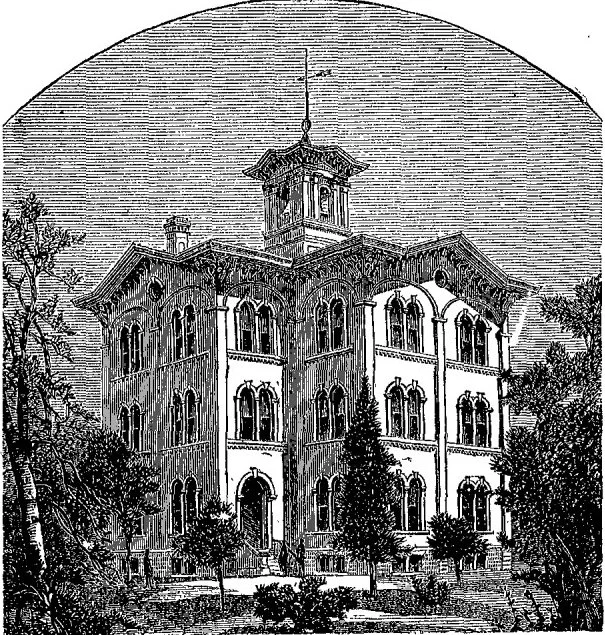
BATTLE CREEK COLLEGE.
A MODEL EDUCATIONAL INSTITUTION, COMPRISING FIVE DEPARTMENTS.
Nearly 500 Students Enrolled Annually, Coming from 32 States and Territories.
DEPARTMENTS.
I. DEPARTMENT OF THE ARTS AND SCIENCES.
This includes a Classical Course of FOUR YEARS and an English Course of three years, each with its Preparatory Course of two years.
II. NORMAL DEPARTMENT.
This includes a Teachers’ Course of FOUR YEARS, and a Model School. The course in this department includes all the branches required for a first-class certificate in any State. Professional instruction in Didactics is also given to those in this department who are expecting to teach.
III. COMMERCIAL DEPARTMENT.
This includes instruction in the following topics: Book-keeping, Business Correspondence, Business Forms, Business Penmanship, Commercial Law, Banking, and Telegraphy. The common branches are also pursued in connection with the topics given above; also, French and German.
There are two sessions daily—afternoon and evening.
The courses in this department are of varying length, and the tuition ranges from $5.00 to $30.00.
Superior advantages for those desiring to prepare themselves for Tract and Missionary Secretaries and Librarians. (Send for special circular.)
IV. DEPARTMENT OF THEOLOGY.
This department has a course of three years, which includes, besides the usual common branches, Geology and Greek.
V. DEPARTMENT OF HYGIENE.
This department has a course of one year. It is designed for those who desire to obtain accurate and scientific information on all subjects pertaining to the preservation of health, together with a fundamental knowledge of anatomy and physiology, and a practical acquaintance with the nature and ordinary treatment of common diseases.
THE FACULTY
numbers fourteen members. They are all men and women of experience and critical scholarship.
The majority of the students are young men and women of true moral worth. Their influence over the unstable is highly restrictive and salutary, making it comparatively easy to maintain the most rigid discipline.
EXPENSES.
Probably there is no other College in the United States where a thorough education can be obtained at so small an expense. A system of clubbing, which has become very popular among students, enables them to secure excellent board at $1.10 a week, exclusive of lodging, which costs 50 cents to $1.00 more. The annual expenses of each student, including all but traveling expenses and clothing, need not exceed $113.00. A full descriptive Catalogue will be sent free, upon application.
Address BATTLE CREEK COLLEGE, Battle Creek, Mich.
VALUABLE BOOKS OF REFERENCE.
MANUALS OF INSTRUCTION FOR SABBATH-SCHOOL TEACHERS AND BIBLE STUDENTS.
History of England from the accession of James II. By T. B. Macaulay. 5 vols. $5.00
Rollins’ Ancient History of the Egyptians, Carthaginians, Assyrians, Babylonians, Medes and Persians, Macedonians, and Grecians. 2 vols., cloth. $4.50
Sacred Geography and Antiquities, with maps and illustrations. By Rev. E. P. Barrows, D. D. The investigations of missionaries and explorers during the last century have thrown a flood of light on many points once involved in obscurity, and it is the aim of this book to condense and put into methodical form what has thus been collected. 685 pp. $2.25
Companion to the Bible. By E. P. Barrows, D. D. Designed to assist teachers of the Sabbath-school, ministers of the gospel, and Bible students generally, in a thorough and systematic study of the Scriptures. Part First contains a concise view of the Evidences of Revealed Religion. Parts Two and Three are introductions to the Old and New Testaments. Part Four is devoted to the principles of interpretation. 668 pp. $1.75
The Church, School, and its Officers. By J. H. Vincent, D. D. This thoroughly instructive and interesting volume was written mainly for the younger ministers of the church. It also defines the duties of the Superintendent, the Secretary, and the Chorister, upon whom the success of the school so largely depends. 224 pp. 75 cts.
The Art of Questioning, with an introductory address on Training Classes. By J. G. Fitch. 15 cts.
Use of Illustrations in S. S. Teaching. By J. M. Freeman. 15 cts.
The Art of Securing Attention in a S. S. Class. By J. G. Fitch. 15 cts.
Bible Geography, Hand-Book of. (New and Revised Edition.) Containing the Name, Pronunciation, and Meaning of every Place, Nation, and Tribe mentioned in both the Canonical and Apocryphal Scriptures. By Rev. Geo. H. Whitney, A. M. Illustrated by 100 engravings and 40 maps and plans. 400 pp. 12mo. $2.50
The Bible Atlas and Gazetteer. Containing six large and accurate maps, and a list of all geographical names with reference to their Scripture places, and to the proper maps; also a variety of useful tables. Muslin bound. $1.00
Smith’s Dictionary of the Holy Bible. For general use in the study of the Scriptures; with engravings, maps, and tables. Muslin bound. $3.00
Cruden’s Complete Concordance to the Holy Scriptures, with a Concordance of the books called Apocrypha, and a Life of the Author. One rarely becomes so familiar with the Bible that he has no occasion, at times, to use a Concordance in looking for particular passages. A book of this kind has, therefore, come to be considered an indispensable aid in the study of the Scriptures. And it is a laudable ambition to seek for the best. This, in the line of Concordances, is found in Cruden’s Unabridged, which we are prepared to furnish by mail, post-paid, for $1.75
Dowling’s History of Romanism. This large work of 940 pages, traces the history of Romanism from the earliest corruptions of Christianity to the proclamation of Papal infallibility, and the deposition of Pius IX. as a temporal sovereign. It not only refutes the errors and superstitions of Romanism, but tells the story of their origin, exhibits the workings of the iniquitous system, reviews historically its domination over kings and princes, its oppression of the consciences and torture of the bodies of men, and the efforts of different ones at different times to relieve Christendom from its terrible thralldom. The papacy occupies so prominent a position in the prophetic field, and is gaining such an influence upon the people of this country, that any information pertaining to it is of special interest to the student of prophecy. Muslin bound. $4.00. Half Morocco. 4.75
Pilgrim’s Progress. 12mo. edition, printed by Dodd, Mead & Co. This edition is firmly and beautifully bound, printed on heavy tint paper, contains 36 engravings, and has marginal references to such texts of Scripture as are illustrated by the story. 336 pp. $1.50
D’Aubigne’s History of the Reformation. 1 volume. $5.00
Gibbon’s Rome. The History of the Decline and Fall of the Roman Empire. 6 vols. $5.00
Josephus. By William Whiston. $3.00
The Complete Analysis of the Holy Bible: or, How to Comprehend Holy Writ from its own Interpretation. This work contains the whole of the Old and New Testaments, collected and systematically arranged; together with an introduction, setting forth the character of the book, and the immense faculty this method affords the reader for understanding the word of God. Also, three different tables of contents prefixed, a general index of subjects, a Scripture index, and tables of principal subjects with their parallel sections subjoined, so elaborated and arranged in alphabetical order as to direct at once to any subject required. Concordances, Introductions, Collections, Manuals, etc., however excellent and useful in their place, can form no substitute for such a work as this, which is on a plan peculiar to itself, and places the whole Bible singularly at the command of the investigator. It is arranged in Chapters and Sections, which embrace Thirty Books, Two Hundred and Eighty-Five Chapters, and Four Thousand One Hundred and Forty-Four Sections. The title of each Book gives name to its subject. The title of each Chapter is expressive of all included in that portion of that Book, and the caption of each section develops the prominent idea embraced in the section. By Rev. Nathaniel West, D. D. 1097 pp. Half Morocco, gilt. $7.00
Any of the above works will be sent by mail, postpaid, on receipt of prices named.
Address REVIEW & HERALD, Battle Creek, Mich., Or, SIGNS OF THE TIMES, Oakland, Cal.
THE YOUTH'S INSTRUCTOR.
AN ILLUSTRATED WEEKLY PAPER FOR YOUTH AND CHILDREN, DEVOTED TO MORAL, MENTAL, AND RELIGIOUS CULTURE.
This paper is not devoted to insipid stories and religious fiction, but is filled with a great variety of that kind of reading which tends to the healthful development of the youthful mind. Its pages are made bright by the choicest illustrative pictures, and its columns are always full of useful information.
As a Sabbath-school and Lesson paper, it is suited to the wants of scholars and teachers, and is calculated to increase the interest of all who read it, in thorough Bible study.
The Sabbath-school Department contains two series of lessons, one for children and one for youth.
SUBSCRIPTION PRICE, 75 CENTS A YEAR.
All new subscribers paying the above price will receive the “Child's Poems” as a premium without extra charge.
TERMS TO CLUBS, PAID IN ADVANCE.
Price per Copy, Post-paid.
5 to 10 copies .......... 60 cents a year.
10 copies and upward .......... 50 cents a year.
Subscription for 5 to 10 copies will be taken for six months. Larger clubs may be paid for quarterly.
Address YOUTH'S INSTRUCTOR, Battle Creek, Mich.
ADVENT HAROLDEN.
SIXTEEN PAGES.
A SWEDISH RELIGIOUS MONTHLY.—PUBLISHED AT BATTLE CREEK, MICHIGAN.
Advent Harolden is devoted to the proclamation of the second coming of Christ, the explanation of Prophecy and Bible doctrines in general, and the defense of the commandments of God and the faith of Jesus. Its family department is filled with instructive reading, accompanied with beautiful illustrations, and also gives valuable hints with reference to the preservation of health and the treatment of disease.
TERMS, INVARIABLY IN ADVANCE.
TO AMERICAN AND EUROPEAN SUBSCRIBERS.
1 copy, one year, 75 cents.
To new subscribers, with Way of Life as premium, 75 cents.
CLUBS TO BE USED FOR MISSIONARY PURPOSES.
5 to 10 copies, 50 cents per copy.
10 or more, 40 cents per copy.
Address REVIEW AND HERALD, or ADVENT HAROLDEN, Battle Creek, Mich.