The Youth’s Instructor, Vol. 38, No. 33.

CONTENTMENT

The Youth’s Instructor

Aug 13, 1890

S. D. A. Publishing Association · Battle Creek, Mich. · Aug 13, 1890

CONTENTMENT

When fields are bleak, and skies are dun, And winds are moaning in their sadness, Some spot, I know, lies in the sun, All light and gladness.
When black clouds float athwart the moon, When sullen rains come pouring after, 'Tis somewhere, I am sure, high noon, All life and laughter.
When trees grow rigid with the rime And chilling gusts of gray December Somewhere the flowers are in their prime, I then remember.
So, let us learn to bear our woe— The morn will always follow even; And, though our lot's to toil below, There's rest in heaven.
—Selected.

THE WHOLE ARMOR OF GOD.

In the ancient days of chivalry, when a lad was eight or ten years old, he often became a page. From this time his duty was to render service to some knight, to wait upon him at table or at other times. When he was a few years older, he became a squire, and then he could follow his knight to the field of battle, and could bear his armor, and show him much true service. As he grew still older, if he had been very faithful as page and squire, he had a right to the great honor of being made a knight. This was the highest honor to which any one could attain, for it was the knight's privilege to defend the church and all helpless persons and those who were in any wise oppressed or in trouble, and even a king could have no nobler duty than this.
The ceremonies by which a young man became a consecrated knight, were very solemn and impressive. He was first conducted to the bath, while two who were already knights read in his hearing the rules which were to guide their future actions. Others brought forth the different pieces of armor which he was soon to assume, the breastplate or corslet, the helmet, the shield so bright and strong, and what was most highly prized by the young knight, the good sword with which he should perform deeds of valor. These were hung up beside the church altar, and he passed the whole night praying and watching before them, and the day following he knelt before his sovereign, and received a touch from his knightly sword. This completed the ceremonies, and he arose a true and noble knight.
And you, dear boys, are also to be Christian knights, but your deeds of valor will be against spiritual foes. You learn from the Bible of that "whole armor of God," which is far better than the sword and shield with which the knight of the Middle Ages went forth to defend the right. In the sixth chapter of Ephesians this beautiful armor is described. The breastplate and corslet are to be "truth and righteousness;" for a helmet you are to have the "hope of salvation;" for your good sword one that can never fail you, "the Word of God;" and above all, "the shield of faith," which shall turn aside the "fiery darts of the wicked." There are many of these darts, and you will need to be very watchful against them and ready with your shield. One of them is the thought that it is of no use to try to overcome evil because you so often fail; that it is just as well to give up; but if you write on the shield of faith that word, "More than conquerors through Him that loved us," this dart shall not be able to reach your soul.
A knight of the Middle Ages was very careful not to let his armor become tarnished or in any way unfitted for use. And so you must be careful that truth and righteousness which are to encase your breast never become tarnished. The Word of God, which is to be your sword, must be constantly kept bright in your mind; you must learn to use it, that it be not strange to you in the day when you must meet an enemy. And the shield of faith must be kept strong by constant prayer; so shall you "be able to stand against the wiles of the Devil."—Selected.
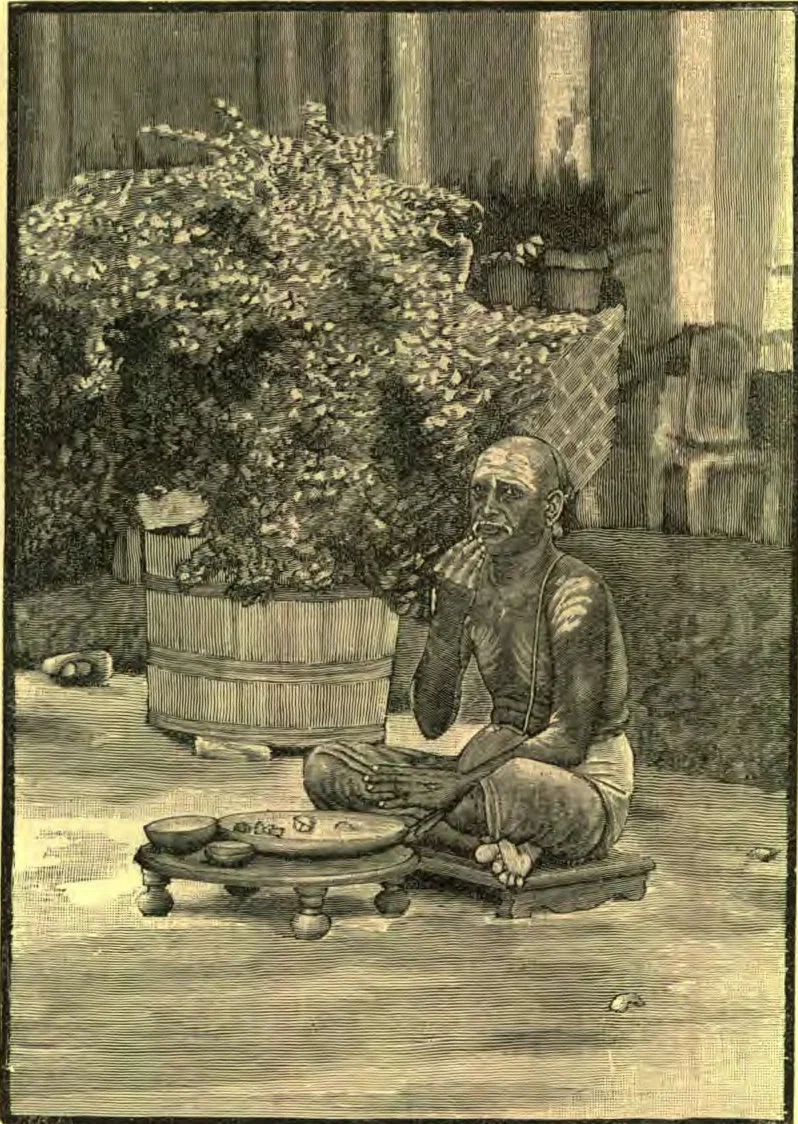
A BRAHMAN PRIEST.
A BRAHMAN PRIEST.

ROUND THE WORLD.—23.

ASIATICS IN INDIA.

That there are on the earth “all sorts and conditions of men” is a truth as universally agreed to by “globe trotters,”—as those on the “grand tour” are often derisively styled,—as is, by soldiers in the British and Continental armies, the Bible text that says, “Promotion cometh neither from the east, nor from the west, nor from the south.”
Sometimes it seems to us that our eyes grow weary with viewing nothing but these dark-skinned Asiatics, with their scant apparel, or long, white, flowing robes, and turbans of every shade; and although we acknowledge the truth of the adage that “the negro is as good as the white man so long as he behaves himself,” our natural inclinations lead us to wish that we were back among white folk once more. It would be a pleasure to walk down a street where you would not have to watch lest a leper jostle himself up against you, or hideously deformed negroes, with legs and arms sticking out from every part of their bodies except where they ought to be, besetting you on every side with cries of, “Salaam, Sahib! backsheesh! backsheesh!” which by interpretation means, “Hail, master! give me a present! give me a present!”
Authorities differ as to the population of India, and in reality it cannot be correctly estimated, as the natives have a special antipathy against allowing themselves to be numbered. They will hide in every conceivable place, to escape the vigilant eye of the Government official, who comes to take the census. What prompts them to do this we do not pretend to say, but we do not believe that it is because they have any religious scruples in the matter, and are afraid that judgments will be visited upon them as upon ancient Israel when King David numbered them. The standard authorities on Indian statistics give the population of British India, the twelve groups of feudatory States, the Portuguese and French settlements, and Burmah as 258,073,753, or 182 to the square mile. This is more than double the number that is accorded to the Roman Empire when in the zenith of its glory. When compared with the United States, it is a dense population, and the statement is made that on an average the British Provinces, exclusive of Assam and Burmah, have to feed two hundred and fifty-four to the square mile. Imagine, those of you who have homes on a quarter-section of land, that you had to share the living you obtain from it with sixty-two and a half people besides. It would be close circumstances at best.
Comparatively speaking, there are not many large towns in India. It is a rural country, and many millions of Indian peasants will not only live, but become positively rich where a white man would starve. Many of them have no homes at all. In the streets of Bombay are wide stone sidewalks, and after about 8 P. M., hundreds who have toiled hard all day in the heat of the sun may be seen stretched out on a sorry-looking blanket, with a few yards of cotton cloth around them, and sometimes not even that, taking their rest. Some of them could afford to take far better care of themselves if they only wished to, but they love to hoard money and spend it all again on some great occasion, such as the marriage of one of their children, an event at which a Hindoo generally spends the earnings of years of labor. Many, with only a loin-cloth for their apparel, are worth thousands of rupees, and could drive in a carriage and four if they felt so disposed.
For the sake of convenience in describing them, we will divide the people of India into four divisions:—
  1. The Non-Aryan, or Aboriginals.
  2. The Aryan or Sanskrit race, now called Brahmins or Rajputs.
  3. The mixed Hindoo population.
  4. The Mohammedans.
The Hindoos are by far the most numerous, and in proportion to the Mohammedans are about one to five.
The oldest dwellers in India consisted of many tribes, who, in the absence of a race name of their own, are called Non-Aryans, or Aboriginals. Concerning their early history no written records are left; indeed, the use of letters, or of even the simplest hieroglyphics, was unknown to them. From remains found in their tombs it has been discovered that they fought with iron weapons, and wore ornaments of gold. They are mostly very dark in color, have coarse and sometimes woolly hair, thick lips, and squat noses. They are seldom tall, never corpulent, but strong and active. They subsist by the chase and on fruits, herbs, and roots known to them, and wear little or no clothing. The hillmen of Madras are of this class, and live on jungle products, mice, or any small animals they can catch, and worship demons. Another clan, the Mundavers, have no fixed dwellings, but wander among the innermost hills with their cattle.
When fairly treated, the aboriginals are, as a rule, truthful, loyal, and kind, and under British rule they are prospering instead of decreasing.
The Aryans belong to the splendid Aryan, or Indo-Germanic stock, from which the Brahman, the Rajput, and the English alike descend. From the early camping-ground in Central Asia, some went east and others west. Some went to Italy, and reared the “City on the Seven Hills,” which grew into Imperial Rome. Other powerful bands found their way through the passes of the Himalayas, and spread themselves chiefly as Brahmans or Rajputs over India. The Brahmans were, and are, to a greater or less extent, the priests, and the Rajputs were the warriors or fighting companions of the kings.
The Brahmans of the present day are the result of several thousands years of hereditary education and temperate living. They have evolved a type of manhood quite distinct from the surrounding population. They are different in appearance from the bronze-cheeked, large-limbed, leisure-loving Rajput warrior. They are tall and slim, with finely-molded lips and nose, fair complexion, high forehead, and cocoanut-shaped skull. They are an example of a ruling power which has gained its ascendency, not by bloodshed and victory in battle, but by hereditary culture and temperance. “One race has swept across India after another, dynasties have risen and fallen, religions have spread themselves over the land and disappeared; but since the dawn of history, the Brahman has calmly ruled, swaying the minds and receiving the homage of the people, and accepted by foreign nations as the highest type of Indian manhood.”
“The Brahmans had a long struggle with the warrior caste as to who should be supreme, but finally secured that position by teaching that it had been given them by God. Their legend was that at the beginning of the world the Brahman proceeded from the mouth of the Creator; the Kshatriya [Rajput warrior], from his arms; the Vaisya and Sudra [lower castes], respectively from his thighs and feet.” This legend is true so far as that the Brahmans are really the brain power of the Indian people, the Kshatriya its armed hands, the Sudras the down-trodden serfs. The Brahmans were and are the theologists, physicians, and philosophers of the Indian people. All animal food is forbidden them, and even some vegetables. In Northern and Central India they eat unleavened bread; in Bengal, the south of India, rice with ghee, or boiled butter, which is esteemed very nourishing. Formerly they abstained from the use of fermented and spirituous liquors, drinking nothing but milk and pure water.
The third class are Hindoos en masse, who fill the ordinary vocations of life. In Southern India they are small of stature, narrow-chested, and arrant cowards. They are cowards to such an extent that they will acknowledge it themselves. Were I to be asked their chief characteristic, I should say that it was habitual lying.
The last class in the fourfold division are the Mohammedans. They are believers in Mohammed, and are to a man entirely separate from the Hindoos, just as much as the Hindoos are from the Christians. Hindoos worship thousands, yea, a million gods, but the Mohammedan believes in only one true God, but ascribes no more power to the world’s Redeemer than that of an ordinary prophet. They are opposed to the Hindoo religion, and cannot eat or intermarry with those of that faith. The two races have but little sympathy with each other, as the Hindoos were the original possessors of India, and were conquered by the Mohammedans, who held sway over them for many centuries, and indeed till the English gained the ascendency over both. Mohammedans are more grave, more formal, more proud than Hindoos, conservative and reserved in the extreme, yet with a considerable amount of courtly and polite manners. F. T. M.

CHRISTIE'S PLAN

Rose stood by the kitchen table, an open letter in her hand, and an anxious look on her face. Her mother, trying to seem indifferent, but showing worry in the very bend of her back, molded her bread in silence, while Christie and Will donned their wraps by the fire.
“I know, Rose, it’s all true,” she said at last, giving her dough a thump. “You really deserve a rest, but how shall I get along without you? I’d do it all if I could, but I simply have not the strength, and your father has no means to hire help.”
Rose sighed.
“Couldn’t the children help you, mother? I don’t mean to be selfish, but this is such a chance.”
“I know. I wish it could be, Rose. But as to the children—well, you know what their help is worth as well as I do.”
“Yes, I know.” Rose turned away, and Christie, tying on her hood, saw a great tear roll down her cheek.
Rose crying? How queer! Good-natured Rose, who laughed through hard times and easy, and sang till the most wintry days grew bright! She must be bitterly disappointed now!
Christie took Will by the sleeve, and hurried him out. They were to coast down the long hill which led straight to the village, where they had some errands to do for mother,—a delightful way to go to town, but the climb back, with the sled full of groceries, was quite a different thing; so the children usually went together, to “spell” each other back. They were part way down the long incline, Christie braced behind Will on the small sled, before she ventured to relieve her mind with a—
“Well, what did you think of that?”
“What?”
“Why, what mother said about our helping.”
“Well, I suppose it’s true,” said Will, coolly. “We don’t do much but errands, do we?”
“I suppose we might, though.”
“Yes, and then we mightn’t! What’s the use of working, when you don’t have to?”
“Did you see Rose when she turned away, Will?”
“No; why?”
“She was crying.”
“No! that so?”
“Yes, she was. A tear most as big as a teacup splashed on the floor.”
“I s’pose she wants to go just awful!” mused Will.
“Of course she does. Aunt Mary has offered to pay all her expenses. And think what a fine time she’d have there—with the piano, and all!”
“It does seem too bad she can’t go!” said Will, sympathetically.
“She might.”
“Why, how? Mother said she couldn’t.”
“I know, but if we’d turn in and help, Will.”
“Well, what could we do?”
“I’ll tell you; I could do the chamber-work, and wash the dishes, and you could wipe ’em, and sweep the kitchen; and we could both tend baby, and chop hash, and pare potatoes, and—”
“Ho! we’d have a nice vacation, wouldn’t we? What’s the use in teacher’s getting sick and giving us a week off, if we’ve got to work like that?”
“Well, it wouldn’t be very nice for us, but Rose could go.”
Will humped up his shoulders, glad that right here the incline grew steeper, requiring all his attention to steer, so no more was said until, as they were toiling homewards, with the loaded sled dragging behind them, Christie spoke again,—
“Come, Will, let’s do it! Rose is good to us, always.”
“And won’t you shirk a bit, Chris?”
“Not a grain! Come, say yes!”
“Well, yes, then!”
So the compact was made, and when the children re-entered the house, it was with a look of weight and mystery, which must have attracted notice had not all been busy getting ready for dinner.
Rose, just tying baby into his high-chair, looked as sweet as ever, but the look about her eyes meant tears, and Christie’s purpose grew stronger; for the warm-hearted child could never bear to see any one in trouble, least of all her beloved sister.
When comfortably served, and baby’s clamors quieted with a cracker, she divulged her scheme, at which the mother laughed incredulously.
“Indeed! that’s a generous offer, children, if you could only carry it out!”
“We can! Now I’ll tell you,”—and Christie expatiated on what they could do, if they tried.
“Pretty well!” said Mr. Curtis, as she finished. “Let them try, mother. I’ll agree to dress baby mornings, and put in my oar where it will count all day. If we co-operate, we’ll carry this thing through lively, and give our good Rose a vacation. It’s been a bit one-sided hitherto, I imagine—rather too much weight on mother and Rose, eh? But we’ll all put a shoulder to the wheel now.”
What mother could refuse, especially when her own heart was longing to consent? So, though with grave misgivings, for she knew a sure illness would follow too severe a strain, she said, cheerfully,—
“Rose shall go! We’ll all do our best, and, my dear, I hope you’ll enjoy every minute!” At which, to Christie’s amazement, Rose tried to speak her thanks, but, instead, burst into a flood of tears, and ran from the room.
She had wept at her disappointment, which was natural enough, but to cry now seemed absurd.
So Rose went, and the children took her work. It was no fun to catch only glimpses of the wintry sports without, as they hurried from task to task, and to go to bed every night, tired with something besides play. But, to their credit be it said, neither shirked, and when Rose came back, bright-eyed and charming, loaded with gifts for all, and enthusiastic over her visit, they really felt repaid.
“But,” said Mr. Curtis, as they talked it over at supper, “co-operation works too well to give up! I propose to retain my stock in this working concern, and each of you youngsters must keep a share, only each one shall also have dividends, in the form of a vacation, every year, from mother, down! We’ll try it, at least, and you shall have the first turn, Chris and Will!”—The Weekly Magnet.

RAISED FROM THE DEAD.

In Shunem, a village in Israel, there lived a rich woman. The prophet Elisha, in his journeys from place to place, was often entertained at this home, and the good man and his wife had prepared for him a little chamber, and furnished it in a simple manner. A bed, a table, a stool, and a candlestick were all the prophet needed. This comfortable home was a lonely one; for no little children were there to gladden the hearts with their sweet baby ways, and this was to the Israelitish woman a source of deepest sorrow.
When the good Elisha asked his God to reward these worthy people for their kindness to him, the Lord was pleased to send them a little son. The little boy grew to be the pride of their hearts. He often went with his father to the fields. One day in harvest time, when he was out among the reapers, he exclaimed, “O, my head, my head!” The father called a young man to carry the lad home. His mother took him on her lap awhile, and at noon he was dead.
You well know this fond mother’s heart was filled with anguish to see her darling boy die in her arms. What did she do? She carried him up to the prophet’s chamber, and laid him on the bed, and closed the door, and went away. She had faith that God would restore her boy to her, so she said nothing to her husband about the death of their child; but she called for a servant, and started immediately for a long ride to Mount Carmel, where the man of God was. It is not needful to relate all about the interview with Elisha; you can read it for yourself in the fourth chapter of Second Kings. The mother would not be satisfied till Elisha returned home with her, and when they arrived, the prophet went with the sad mother to the little chamber on the wall. There lay the dead child upon the prophet’s bed. Then Elisha prayed to God; for he had no power in himself to raise the dead. He breathed into the child’s mouth, and lay down beside him, and chafed the cold flesh with his warm hands, and at last the child grew warm; and then his sweet eyes opened, and turned to the dear mother who so fondly loved him.
The mother was overcome with gratitude, and she fell at the prophet’s feet, and would have worshiped him; but the praise belonged to God.
Dear children, none of you are too young to die; and should you, like the little Shunammite boy, sleep in death, there is no good Elisha to restore you to your friends in this present world, but the blessed Lord Jesus said, “I am the resurrection and the life,” and he will raise the dead at the last day. Through him every little child who dies may “come again from the land of the enemy,” and have a new, blessed, and eternal life in the paradise of God.
Mrs. A. W. Heald.

Trust in the Lord and Do Good

“Trust in the Lord, and do good; so shalt thou dwell in the land, and verily thou shalt be fed.”

BOTTLED SUNSHINE.

“WHAT was the text this morning?” said auntie.
“Be ye therefore perfect, even as your Father which is in heaven is perfect,” replied Mattie, promptly.
“And what did the minister say about it, dear?”
“He said we must love everybody, because God does; and, auntie, he said one thing that was very strange, and I kept thinking of that, and didn’t hear much afterwards. He said that coal was ‘bottled sunshine.’”
“Bottled sunshine! What did he mean by that?”
“Why, he said the sun shone on trees, and they took the sunshine right into them, and it made them grow; then the trees turned into coal, and when we light it, it gives out the warm, bright sunshine again. Is that so, auntie? Is coal made out of trees?”
“Yes, dear. The coal which we burn was once wood which has been buried many, many years. You cannot understand it just yet, but it is so, and it is through the kindness of our Father that it has been stored up in the earth for our use. But I never heard it called ‘bottled sunshine’ before, and I am sure it is a beautiful thought. Do you know, dear, you can be bottling up sunshine all the time now for the comfort and happiness of others when you are older?”
“How, auntie?”
“By getting into habits of kindness, for one thing. When you are thoughtful of others, you are storing up a kind, loving disposition, that will shine out like bright sunbeams when you are older, making you a great treasure to your friends. When you take disappointments pleasantly, you are getting a habit of cheerfulness that will sparkle and shine and be far more beautiful than the most brilliant diamond. Studying God’s word, too, and laying up his precious promises, is one of the very best ways of storing up sunshine. Once I knew a blind man who had bottled up an immense supply of sunshine.”
“A blind man! How could he, auntie?”
“He was so patient, kind, and loving that every one who knew him felt better for being in his company, just as we feel better this lovely afternoon for this beautiful sunshine. His mind was full of useful knowledge, and when we wanted to know something we could not find in our books, we used to go to him; for, blind as he was, he knew a great deal, and he would give us the information we wanted. Such a bright gleam of sunshine as that was to us after we had studied and searched so long in vain!”
“Do you know anybody else that has bottled sunshine, auntie?”
“I do, I do. Somebody who doesn’t forget to say, ‘Good morning, auntie,’ and who smiles pleasantly when she says it. Somebody who runs to open the door for papa when he comes home at night. Somebody who kisses mamma, and walks softly when her head aches.”
“O auntie, do you call that sunshine?”
“It is very warm, cheering sunshine, dear.”
“Then I’ll bottle up a big jugful,” said Mattie.—Child’s Paper.

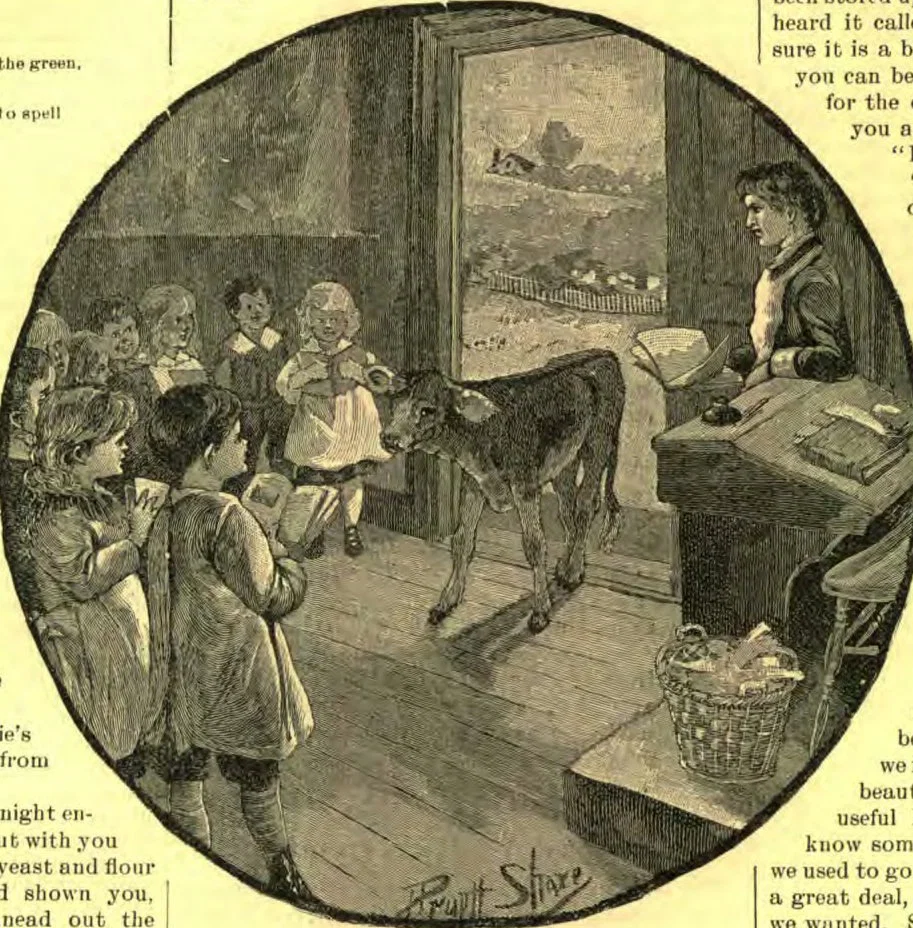
THE CALF THAT WENT TO SCHOOL.

A dozen little boys and girls, With sun-browned cheeks and flaxen curls, Stood in a row one day, at school, And each obeyed the teacher's rule. Bright eyes were on their open books, Outside the sunny orchard nooks, Sent fragrant breezes through the room To whisper of the summer's bloom.
A busy hum of voices rose, The morning lesson neared its close, When “tap, tap, tap,” upon the floor, Made every eye turn to the door. A little calf that wandered by Had chanced the children there to spy, And trotted in to join the class, Much to the joy of lad and lass.
Their A B, ab, and B A, ba, It heard, and solemnly did say, “Baa! Baa!” then scampered to the green, And never since in school has been. Those girls and boys soon learned to spell And read and write; but who can tell How great that little calf became? It may be, now, a cow of fame! Or was that “Baa!” all that it knew? I think it must have been. Don't you?
—George Cooper.

THE LEFT-OUT PART.

MAMIE was learning to cook. She was twelve years old, and her mother had said, “Surely a girl so old as that ought to know how to make good bread and cake.” So, every baking morning, she was expected to spend one hour in the pantry, watching and helping her mother put together the ingredients of plain, wholesome food, and to have care of the fire and oven’s heat, while the batter she had stirred, and the dough she had rolled, were baking.
One evening, not long before Mamie’s bedtime, her mother said, looking up from her sewing in the sitting-room,— “You may set the bread-sponge to-night entirely alone, Mamie, and I will not go out with you into the pantry. First get ready your yeast and flour and milk, just as I have taught and shown you, and to-morrow morning you may knead out the loaves, and take the care yourself of their rising and baking.”
Mamie was very glad and proud to be so trusted, and, tying on her big, white, cooking apron, darted into the pantry, after carefully washing and drying her hands, eager for her papa to see that his little girl could make the best of bread.
The kneading-board came down from its nail with an important little flirt and bang. Then she sifted a panful of flour, and brought butter and milk and a yeast-cake from the cellar, and hot water from the kitchen, and was then ready to mix her sponge.
The yeast-cake she put into a little warm water to dissolve. Then into the big bread-bowl she carefully measured four cups of milk, three cups of water,—just hot enough to bring the mixture to a blood-heat,—one tablespoonful of salt, three tablespoonfuls of sugar, and half a cup of butter. Into this mixture she stirred flour until she had a stiff dough, then kneaded it on the bread-board fifteen minutes, and put it back in the bowl, a great, smooth, heavy lump, and, closely covering it, closed for the night, for greater warmth, the pantry’s door and window, thinking how she would find in the morning, instead of the solid white mass that hardly a third filled the bread-bowl, a brimming panful of light sponge.
But she didn’t. The heavy lump lay flattened out in the bottom of the bread-bowl, with no more hope of rising and being fit to knead into puffy white loaves than a great wad of sticky clay.
“And all because you forgot to put yeast in the batter,” Mamie’s mother said, discovering the cup of dissolved yeast pushed aside on the pantry shelf, when called the next morning by her little girl, to see what ailed her bread-sponge.
“O mamma, I did forget it! But I put in everything else, the butter and salt and sugar—everything but that yeast-cake that I had set dissolving and then forgot. But how strange that such a little thing—only a tablespoonful of yeast-water—could have spoiled my bread! Just think, mamma, all that great flat cake of heavy dough needed to make it rise and fill the bowl with puffy, feathery sponge, was just this little bit of yeast; and because I didn’t put it in my bread-batter, it is all spoiled and wasted,”—and Mamie, with a very sober little face, scraped the clayey, sticky mass into the swill-bucket.
But it was not wasted—the lesson that those spoiled loaves taught.
Mamie had been thinking that it didn’t very much matter if she did not take Christ as her Saviour, so long as she was a truthful, obedient, kind little girl. She didn’t see that she needed to be a Christian if she was only a good, sunny-tempered little girl. But the left-out yeast, the leaven that the bread-sponge spoiled without, in spite of the good things it held, its sugar and milk and butter, led her to see that her life and every other life needs the “little leaven”—Christ’s love—in it to make it expand and fit it for God’s use; for without this leaven our lives will be wasted and our souls castaways.—The Sunday-School Times.

OBEYING PLEASANTLY.

LITTLE HARRY had seen some older boys fly their kites from the tops of the houses, and he thought it would be nice fun if he could do so too; so he came to his aunt, and said,—
“Aunt Mary, can I go up to the top of the house and fly my kite?”
His aunt wished to do everything that was proper to please him, but she thought this was very unsafe, so she said,—
“No, Harry, my boy; I think that is a very dangerous sort of play. I’d rather you wouldn’t go.”
“All right. Then I’ll go out on the bridge,” said Harry.
His aunt smiled, and said she hoped he would always be as obedient as that.
“Harry, what are you doing?” said his mother on one occasion.
“Spinning my new top, mother.”
“Can’t you take the baby out to ride? Get out the carriage, and I’ll bring him down.”
“All right!” shouted the boy, as he put his top away in his pocket, and hastened to obey his mother.
“Uncle William, may I go over to the store this morning?” said Harry, one day at breakfast. “I want to see those baskets again that I was looking at yesterday.”
“Oh, yes, Harry,” said his uncle, “I should be very glad to have you.”
“But I cannot spare you to-day, Harry,” said his mother; “I want you to go out with me; you shall go to the store another time.”
“All right!” said Harry, and went on eating.
No matter what Harry was asked to do, or what refusal he met with when asking for anything, his constant answer was, “All right.” He never asked, “Why can’t I?” or, “Why mustn’t I?” Harry had not only learned to obey, but he had learned to obey in good humor.—Little Christian.

A GRAND OLD HERO.

Would you like to know a grand old hero? Then read this story of Chrysostom before the Roman emperor, who had just threatened him with banishment if he still remained a Christian.
“Thou canst not, for the world is my Father’s house; thou canst not banish me,” Chrysostom replied.
“But I will slay thee,” said the emperor.
“Nay, but thou canst not,” said the brave Christian; “for my life is hid with Christ in God.”
“I will take away thy treasures,” threatened the emperor.
“Nay, but thou canst not; for in the first place, I have none that thou knowest of. My treasure is in heaven, and my heart is there,” was the reply.
“But I will drive thee away from man, and thou shalt have no friend left,” continued the Roman.
“Nay, and that thou canst not,” once more the noble Christian answered; “for I have a Friend in heaven from whom thou canst not separate me. I defy thee; there is nothing thou canst do to hurt me.” Was he not a grand old Christian hero?—S. S. Advocate.

THE CLOVE.

Rumph, the intelligent naturalist of the Molucca Islands, describes the clove tree as, “the most beautiful, the most elegant, and the most precious of all known trees.” In its native soil, the Moluccas, it grows to a height of forty feet, and lives to the good old age of between one and two hundred years. The spice is not the fruit, but the blossom, gathered before it is quite unfolded. These fragrant flower buds are gathered quickly and carefully, and dried in the shade before they have an opportunity to lose the strength of their aroma.
There is a sad history connected with the clove trade in the Molucca Islands. When the Portuguese and Spaniards first invaded these islands, they were cultivated by a numerous, enterprising, and industrious population. The clove-tree was their wealth, and they lived in peace and plenty, sending out the spice to every part of the then civilized world.
When the Dutch drove the Portuguese out of the Moluccas, in 1605, they found the clove culture already greatly restricted. The Portuguese had done this to increase the value of the spice. The Dutch established the clove culture in the Island of Amboyna, where it had been begun before the Portuguese conquest. Then they began to destroy the clove-trees upon the islands which were their natural home. Every year laborers were sent to cut down every bush which might chance to spring up, and a native was punished with death who was known to plant a clove-tree, or sell a pound of its spice blossoms. All this was done to increase the value of what remained in the hands of the greedy Dutch monopolists.
When the forests of the Moluccas were destroyed, the fertile soil was washed away by tropic rains, and parched by a tropic sun. The land became barren, and the poor natives perished of starvation at home, or as slaves in the clove plantations of Amboyna. Thus what had been their spring of prosperous life became their death.
It is some satisfaction to know that the Dutch did not gain anything by attempting to improve upon nature’s choice of location for the growth of the clove. The tree is grown to much less advantage in any of the islands where it has been introduced, and the annual product is far below that of the Moluccas three centuries and a half ago under native rule and free labor. It is believed that the time will come when the culture of the clove will be restored to its natural home.
The clove gets its name from its resemblance to a small nail. The Chinese name means “fragrant nails,” the Dutch name signifies “herb nails,” while French call it simply clou, “nail.”—Selected.

THE OWL AND THE CAT.

THE only one of our northern owls which seems to be short-sighted is the little Acadian owl. It seldom, if ever, moves in the daytime unless disturbed. When found, it can often be taken alive without difficulty, says a writer in “Forest and Stream.” But whether this unwariness is due to defective sight remains to be proved, for those which we have had as pets seemed to see perfectly in the daytime, although they did not become lively until night.
In all, we have had three. One refused all food, and we let him go after a few days. The second ate only too willingly, and died from devouring a scrap of salted meat. The other was for a long time a most interesting pet. He was given the range of the house, and soon became very tame, and was on good terms with the whole family except the cat.
The owl was a gentle little creature, quiet in the daytime, but lively at night, when he would sometimes be heard talking to himself, the only vocal noise that he made being a soft co-co-co-co-co several times repeated. He never was contented to sit on any perch which would cause one foot to be below the other, and when he alighted on such a place (as the top of a clock or a chair-back), he immediately walked sidewise up the incline until he stood at the highest point, where his feet could be on a level. He was an acrobat in a small way, for when a small stick was put between his jaws, and he was lifted by it, he would swing back and forth in wider and wider arcs, until on some backward swing longer than the others, he could throw up his feet and grasp the stick; then he would raise himself into an upright position, and look as sedate as any owl.
His great delight was to torment the cat. He hectored the poor beast until an undisturbed nap was something not to be dreamed of. He would fly down from some high perch with a speed and silence which enabled him to scratch his victim’s nose or ears, and escape in good season. So sudden were the attacks that the cat got no opportunity for revenge until after the owl died and was stuffed. Then one day he tore off the owl’s head. Whether he was satisfied that the bird was killed, or was disgusted to find him only tow and feathers, can never be known; but after that he looked at the owl, and the owl looked at him, without enmity.—Woman’s Journal.
Continue reading: WEST INDIAN CARRIERS