The Youth’s Instructor, Vol. XLIX, No. 45

THE MINERAL STATE

The Youth’s Instructor

November 14, 1901

Review and Herald Publishing Company · Battle Creek, Mich. · November 14, 1901

THE MINERAL STATE
Colorado’s principal crop comes from beneath the surface of the earth; consequently, the extent of its harvest is not dependent upon the amount of rain, dew, or sunshine. The State is known the world over for its enormous mineral resources. The amount of gold taken from the Cripple Creek region last year amounted to nearly twenty millions of dollars. But its wealth is not confined alone to that hidden in the rock. By an extensive system of irrigation, large tracts of what were formerly more or less arid districts have been transformed into productive agricultural land.
On account of its high altitude, and the unusual number of days of sunshine in each year, Colorado has acquired a well-merited, world-wide reputation as a health resort. Almost the entire State is literally one extensive sanitarium. The climate seems to be particularly favorable for those who are afflicted with various forms of pulmonary disorders, although various other chronic ailments yield more readily to treatment here than in more unfavorable climates. When the invalid can have the advantages of rational treatments and a well-regulated dietary, combined with the benefits which naturally result from a high altitude and a favorable climate, he certainly has all the earthly requisites necessary to secure health. These conditions are admirably met in such a well-regulated institution as the Colorado Sanitarium, at Boulder. The institution has been overflowing with patients all summer; so the workers have had the blessed opportunity of camping in tents on the mountainside.
A successful hygienic café is being conducted in Denver, and a well-managed treatment-room is also maintained for the benefit of those who are so situated that they can not go to the sanitarium at Boulder. Such missionary enterprises could be in operation in each of our large cities if all of the young people who are to-day successfully engaged in purely business pursuits would dedicate their abilities to the service of God and humanity, and secure the necessary training.
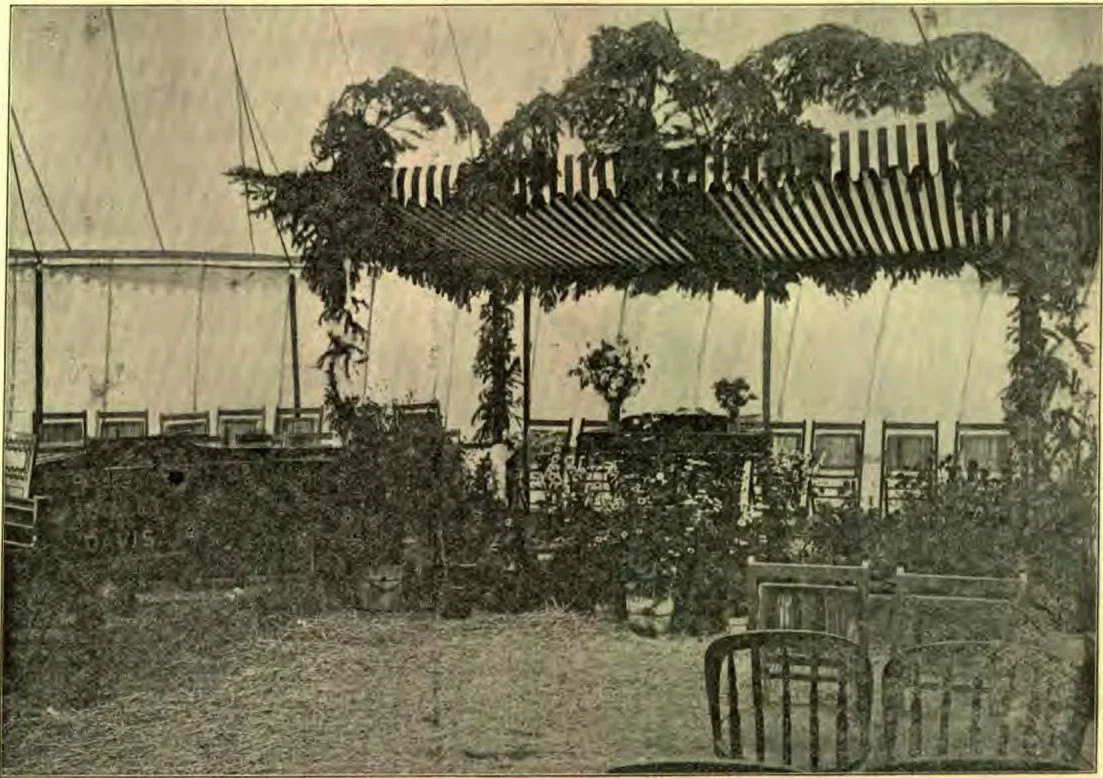
PULPIT IN LARGE PAVILION AT COLORADO CAMP-MEETING
The State camp-meeting was held this year in almost the very heart of Denver, a flourishing city of one hundred and fifty thousand inhabitants. Particular pains was taken to make every portion of the camp neat and attractive. The large pavilion was seated entirely with comfortable chairs, and was brilliantly lighted with electric arc-lights. The accompanying illustration shows the beautiful floral decorations of the speakers’ stand. One of the pleasant features connected with this meeting was the thorough work of contrition and putting away of sins that was manifested among the young people. There was shown a strong determination on their part to get their feet planted on higher ground, that they might be fitted to act a useful part in the service for humanity.
DAVID PAULSON, M. D.

LESSONS FROM THE LIFE OF JOSEPH

(Concluded)
“Him hath God exalted with his right hand to be a Prince and a Saviour, for to give repentance to Israel.” We have seen how the first part of this Scripture applied to Joseph when he was exalted from prison to be a prince and a saviour to Egypt. Now let us see also how he gave “repentance to Israel.” The famine extended in all lands. It reached Jacob and his sons, who were also called Israel. Many years had passed since Joseph had disappeared. His father supposed he had been torn in pieces by beasts. His brothers had tried to forget him, and never expected to hear of him again. But the famine compelled them to look to Egypt for help. Joseph recognized his brothers at once, and his heart went out in deep yearning for them. Most of all he desired to see them converted. They must repent and acknowledge God.
In order that this might be brought about, he pursued a course that might seem tantalizing and cruel if we did not stop to consider its purpose. The brethren were awed by the greatness of the prince, they were captivated by his kindness and generosity; and yet every step seemed to involve them more deeply in difficulty. They were intimidated by his severity, encouraged by his promises, and mystified by his deep knowledge of their affairs. “Ye are spies,” was the first greeting. In order to prove their sincerity, they were called upon to do the one thing which above all others it seemed impossible for them to do. Must they again wring their old father’s heart by taking from him the other beloved son? How vividly this brought home to them their great sin against Joseph! He understood their talk, and saw their deep anguish. It cut him to the heart, and he turned and wept for them, even as Jesus weeps at the suffering of his wandering children.
The finding of their money in their sacks, they regarded an unfavorable omen. They had not learned that repentance and salvation are without money and without price. The aged father exclaimed, as many professed Christians do nowadays, “All these things are against me.” But they were not against him. They seemed like great calamities, but in reality they were parts of a great plan which God was working out for their good. They had not learned what Paul knew: “We know that all things work together for good to them that love God.” Jacob loved God, and God loved not only him but also his erring sons.
The brothers did not return to Egypt for corn the second time until they were actually compelled to do so to save their lives. How reluctant we all are to come to our Saviour. Many of us never come until we are driven by some great stress. Nor could they go acceptably until they brought with them the dearest object of their lives and home. Even Benjamin must be surrendered and placed in Joseph’s hands. Nor will our Saviour receive us while we hold back from him some cherished object. They returned with trembling. They acknowledged their faults. Joseph’s heart yearned over his sinful brethren, but still the mill of contrition must grind on. They ate at Joseph’s table, and started home rejoicing. But the most dreadful experience of all soon overtook them. The favorite cup of the great prince was found in Benjamin’s sack. What could they say? What could they do? They returned in the most abject despair. They cast their helpless souls at the feet of Joseph. The story of their sin came out of their own lips. In bitterness of soul they acknowledged that their calamities were justly come upon them. They gave themselves soul and body to Joseph.
Joseph could refrain himself no longer. He had given true repentance to Israel, and he now revealed himself as their long-lost brother. O, what joy! “Come near me, I pray you,” he exclaimed. How like the Saviour’s voice: “Come unto me, all ye that labor and are heavy laden, and I will give you rest.” He even condones their sin by saying, “It was not you that sent me hither, but God.” So God sent his only Son, that through him the world might have eternal life.
G. C. TENNEY.

HE CAME

He came and dwelt in Nazareth, A son of poverty, And oft he thought of that high place Where he was wont to be— Where angel bands, a mighty host, Their shining wings swift curved At his command; but he was here With men as One who served.
He came at eve to Bethany, Where hearts that loved him dwelt; And there communed of heavenly things, Or ’round the altar knelt; And as he led that house in prayer, He saw the holy place, And that high altar that he knew Before the throne of grace.
He came to John, and was baptized, Who knew no taint of sin,— Came down to Jordan’s restless wave, And meekly sank therein. The river’s flowing tide swept o’er That head, those hands of his, That made and planned the sea and land, And all that in them is.
He came to sad Gethsemane, And, kneeling on the sod, In the dark shadow of the cross He cried three times to God. Then he who was the Lord of all The seraphs ’round the throne, Received, to help and comfort him, One angel—one alone.
He came at last to Calvary, That dark and fearful place, Where, from the suffering Son of God, The Father hid his face; But through the tomb he passed unharmed, And rose again to reign. Rejoice, ye saints! Behold, your Lord In glory comes again!
ELIZABETH ROSSER.

OUR WORDS

“KEEP a watch on your words, my darling, For words are wonderful things. They are sweet, like the bees’ fresh honey; Like the bees, they have terrible stings. They can bless like the warm, glad sunshine, And brighten a lonely life; They can cut, in the strife of anger, Like a cruel two-edged knife.”
What a little thing a word may seem, yet how great its power! By our words we may lift souls from the depths of despair, and send them rejoicing on their way; or we may wound them so sorely that they will bear the pain in their hearts as long as life lasts. O how much better it would be if we would speak only those words that will give strength and encouragement to those around us!
Did you ever stop to think, my dear young friends, how much a word may mean to the listener? How many people are hungering—yea, even starving—for a kindly, sympathetic word? A hearty hand-shake, a pleasant good morning, may cheer a fainting soul; and yet how many allow golden opportunities for this everyday ministry to slip by unheeded.
Our words are an index to our heart: we can not speak pure words if our hearts are not pure. But if Jesus sits enthroned in our heart, our words will be kind and helpful; for, “Out of the abundance of the heart, the mouth speaketh.” If we could but realize the solemnity of the statement made by Jesus, that by our words we shall be justified, and by our words we shall be condemned,—there would be far less idle gossip and cruel criticism among us as young people. May our daily prayer be, “Let the words of my mouth, and the meditation of my heart, be acceptable in thy sight, O Lord, my strength, and my Redeemer.”
“May peace guard your lives, and ever From this time in your early youth, May the words that you daily utter Be the beautiful words of truth.”
LOUISE ADAMS.

BELOW THE LADDERS

Jean, swinging her sunbonnet by its strings, went slowly up the front walk at Miss Belinda’s. Her eyes were so abstractedly set downward that a mocking-bird in a near-by syringa, though he trilled his most perfect even-song, could not win a glance.
“Wait a minute!” called Miss Belinda from the porch, “till I get a yardstick.”
“A yardstick?” repeated Jean, solemnly staring.
“To measure your face!”
“But you do not know,” lugubriously, “what the matter is.”
“Famine?” and twinkles shone over her glasses as she nodded invitation to one of her cosy cane rockers, then went on with her knitting.
“Eavesdropping,” Jean answered, with a half-laughing pout.
“Attended by the usual fate, I see. Were you painted very black?”
“Selfish in every stroke. Not by intention—which makes it the harder to bear—but by contrast with the beautiful generosity of the painters.”
“And there’s nothing either attractive or original,” sympathetically, “about selfishness.”
“Nothing.”
“Could we get round to the beginning?”
“You know the beginning—how I set my heart on going to college this year.”
“You were quite determined.”
“Yes; that’s the self. I was going,—going roughshod over obstacles, without particularly inquiring into them.”
“Determination is an excellent rung in a scaling-ladder,” said Miss Belinda.
“Yes; but I’ve stepped down. I’m to stay below.”
“Because——?”
“Because of what the eavesdropping discovered. I was to go by certain sacrifices. I knew them in my secret heart, but hearing of them waked a bit of grace in me. Not that there was any grudging; it was the beautiful haste to give me all that made me ashamed.”
“There are times when sacrifices may be accepted.”
“Perhaps. But I’m an able-bodied, healthy-minded young person, quite capable of paddling my own canoe.”
“One should do the best possible for one’s self.”
“I will; but I’m no leech.”
Miss Belinda smiled. “You look happier than when you came in.”
“Because you have set me thinking,” said the girl. “You’d make a fine surgeon, Miss Belinda.”
“I should know how to probe on this subject,” was the reply, “for my own mind was once bent on college.”
Jean stopped rocking, in her astonishment. She hastily reviewed her knowledge of Miss Belinda. Delicious preserves, pies, prim little afternoon “teas,” continual knitting or gardening, or long drives along shady lanes; gracious courtesies and dainty gifts for sick and sorry and poor—in fact, for all in reach; a face and voice of sweet content; but—learning? She drew a long breath, and looked in through open doors to the one small sitting-room bookcase; was it ever opened except to lend its books? She glanced on to the center-table, where there were some current magazines. She had seen Miss Belinda look at the illustrations. Several times she had been asked to read aloud from one or another. Her eyes came back searchingly to the knitting fingers, so patient and light and firm, and to the quiet face above. Sudden light broke on her.
“Oh,” she said, with sweet reverence, “how brave you are! I remember hearing long ago about your eyes.”
“Brave?” repeated Miss Belinda. “My dear, I was rebellious. My girl friends were always talking of their specialties—one was talking music, another medicine, another art, and I talked weak eyes, and wept them worse. Finally it came to me that there are specialties down below the ladders of classic learning quite as hard as those on the way up, perhaps as valuable.”
“For instance?” cried eager Jean.
“For instance,” gently, “the pursuit of happiness.”
“For self and friends,” said the girl, and stood up to make a pretty courtesy. “But,” doubtfully, “isn’t college a short cut?”
“Perhaps; but if you’ve no right of way on the short cut?”
“I see, Miss Belinda; I’ll be your apprentice. A good beginning will be to return some small, convenient favors for the sacrifices lately offered me. I can at least see that there are fresh flowers on the breakfast table.”
“You’ve a contagious smile,” suggested Miss Belinda; “it is excellent capital in such a line of business.”
“I must see,” anxiously, “that there’s no forlorn statue of Renunciation posing about the house.”
“You have only to keep busy and consider,” her eyes going out toward the glories of the sunset above the far hills, “consider how beautiful the world is.”
The mocking-bird had finished his song, but a whip-poor-will was calling sweetly from the gate, and up the valley came the soft jangle of cow-bells. A little breeze came over with the glow of the evening sky, and it brought the fragrance of violets and clover.
“A beautiful world,” repeated Jean; and suddenly she read, in the sweet, dim eyes turned toward the hills, what it is to fear blindness and endure it.
“I wonder,” she said, softly, “are there many such heroes down under the ladders?”
Miss Belinda laughed. “You’ll stay a while with us?”—Well Spring.

VEGETABLE IVORY

The plant whose seed is known to commerce as vegetable ivory is a native of South America, found principally on the banks of the River Magdalena in Colombia, and always in damp localities. Other vegetation is seldom found in its vicinity; it grows alone in separate groves, no other trees, shrubs, or herbs flourishing with it, the ground beneath it looking as if it had been swept.
By the Indians the “ivory-palm” is known by many names; but its botanical label is Phytelephas macrocarpa. It is a stemless, palm-like plant. The fruit is a large head, composed of six or seven drupes (pulpy masses, each containing a nut with a kernel), each drupe containing from six to nine seeds, the whole enveloped in a woody covering forming a globular ball the size of a man’s head. A single plant will often bear from six to eight of these heads, weighing from twenty to twenty-five pounds.
When the fruit is young, it contains a fluid often used to allay thirst. As the fruit matures, the fluid changes into a sweet, milky substance, which gradually hardens, finally becoming nearly as hard as animal ivory, and taking its place in the arts and in many kinds of ornamental work.
W. S. Chapman.

AN INVITATION

“What do you say?” said the Work To Be Done; “Shall we start bravely together, Up with the earliest peep of the sun, Singing, whatever the weather? Come, little busy-folk, what do you say? Let’s begin fairly together to-day.
“Shall we keep step with a laugh and a song, All through the runaway morning? And when the noontime comes speeding along, Whistling his chorus of warning, Then,” said the Work To Be Done, “let us see Who has kept up in the hurry with me.
“Hark, in the midst of the long afternoon, When you’re a little bit weary, How all the meadows keep sweetly in tune, Toiling, and prattling, and cheery. “What do you say,” said the Work To Be Done, “Shall we be comrades till setting of sun?”
— Frank Walcott Hutt.

WHO IS THE HERO?

Very different, are they not — the common man and the hero? Why, one would recognize a hero anywhere. “Strong, active, keen, with a firm face and noble bearing, modest and polite,”—that’s the way the books describe him. Who could miss him! “He wears the word ‘hero’ written in every inch of his handsome form.” Yes, yes,—a noble fellow!
“Stop!” came a policeman’s sharp order. His prisoner—the man he had caught in the saloon row—wrenched apart the “grippers,” and darted into the crowded street at the risk of his life. A little girl was snatched from death, and placed tenderly on the sidewalk. Was this man a hero?
The “Trenton” was carrying her load of passengers across the bay. She was crowded. “Child overboard!” “Man overboard!” rang through the boat. They were dragged up together from under the very side-wheel. A little boy was placed in his father’s arms. The rescuer—his clothes were ragged, and he looked hungry—refused the money offered him. Later in the day he was looking for work. Work, indeed! Humph, not for a tramp!
“Sure an’ I’m full,” said the little newsboy, cheerily, as he crouched, hungry and shivering, among the bales of hay on the wharf.
“’Cause if you wasn’t,” said his sick companion from a heap of straw and rags, “I couldn’t eat it; but I’m so hungry.” O friend! was this a hero? Why, I see a thousand like him on the street. No, no! I have learned from the books what a hero is—“Strong, active, keen ——” What’s that?
“I was just sayin’,” she repeated, holding the needle closer to the smoky flame while threading it, for her eyes were getting dim, “I was just sayin’ John’ll be through college next year. I’ve kept him at it these two years, you see.”
“Yes; but it’s cold up here, mother,—no carpet, and you ought to be warm.”
“And oh, how glad I am! He’s a real hero, John is. He belongs to the football up there, and he’s done something great—I don’t know much about such things, but he writes as they’s callin’ him a ‘real hero’ for ‘savin’ the day’—a re-al hero!”
A hero truly! We read his story in the papers everywhere. Young men and young women are taught to look on him and his kind as the “real heroes.” There are lots of that kind—more and more every year. But if the books of God were opened, and you could see John’s name, do you really think it would read “JOHN—HERO” on the golden page?
I suppose that tall young man yonder, who wears so jauntily a blue suit and brass buttons, is a hero. They call him that. What has he done?—Why, he and three comrades captured an enemy’s storehouse at —. It was guarded by a dozen men, and in the fight eight of them were killed. Eight men—a hero! You could pick him out of a thousand: he wears a medal.
The literature of our language and of other languages is full of false ideals of heroism. It is not that men do not sometimes recognize the true hero, but it is that they give medals to the false, and praise him by word of mouth and pen, that the boys and girls of this day have so poor an appetite for true heroism.
Jesus Christ of all heroes is greatest. Every act of his life was an act of heroism, simply because all he did was done unselfishly, and for the love of men. And when even an ordinary man throws aside fear and selfishness to help a brother in need, however small that need may be, he thereby becomes a hero in the sight of God. Let us thank God that the true standard of heroism is such that by doing our best, we may all become heroes. EDISON J. DRIVER.

DIVISION I—GEOLOGY

Chapter X—Earthquakes; Volcanoes; Hot-Springs and Geysers

§92. An earthquake is said to be a volcano without vent. The pent-up gases, which, as we learned in Section 72, are formed by the washing together of various chemicals within the earth, also by the uniting of water and previously burned limestone, must have some place of escape. The expansion caused by the heating of large quantities of earth and rock has also a part to act in the phenomena that accompany earthquakes. This internal pressure becomes so great that immense sections of land are severely shaken, and often misplaced. Whole islands have thus been raised up from the depths of the sea, while other portions of land have sunk away, and entirely disappeared.
§93. In many portions of our earth there are at present going on just such changes. The western coast of Greenland has for the past two centuries been gradually sinking away. So marked is this lowering of the land, that the early European settlements are now entirely or in part submerged. The southern portion of Sweden is also sinking at the rate of about four feet each century, while the northern portions are rising up out of the water at about the same rate. During an earthquake in Chile, in 1822, the coast of South America was raised from two to seven feet for a distance of one hundred miles. The whole area of territory thus elevated at that time was estimated at one hundred thousand square miles. In 1819, during an earthquake, a tract of land two thousand square miles in area, near the mouth of the Indus, sank from sight, and became an inland sea; while other portions of the country, fifty miles in length, and several miles in breadth, were elevated to a nearly uniform height of ten feet.
RUINS OF TEMPLE OF JUPITER SERAPIS
§94. Perhaps the most interesting example we have of a gradual change taking place in our earth's exterior is that displayed by the ruins of the Temple of Jupiter Serapis, built near Naples, on the shore of the Mediterranean, about the time of Christ. For centuries this magnificent structure lay buried beneath the surface of the earth; but in 1849 there were discovered the tops of three marble columns standing up out of the soil. Upon being excavated, it was found to be the above-mentioned temple. The structure was originally one hundred and thirty-four feet long by one hundred and fifteen feet wide; the roof was supported by forty-six pillars, each forty-two feet high, and five feet in diameter. Three of these columns are yet standing, and bear evidences that they were for some time partially submerged by the salty waters of the sea, as will be plainly seen by the accompanying illustration. The lower twelve feet are smooth, having been protected by the mud and earth, while the nine feet above this are eaten and scarred by a kind of boring shell-fish, such as now inhabit the Mediterranean waters, and whose remains are still found within the perforations of those pillars. Above this point the columns are smoother, having stood out of the water. The paving of the temple is now submerged. Five feet below this there is a second paving, showing that these oscillations of the land had gone on before the temple was finally deserted by the Romans.
§95. Experiments made some time ago by officers of the topographical corps of United States engineers, on the expansion of various rocks by heat, give data which prove that if a mass of sandstone a mile in thickness should be raised in temperature two hundred degrees Fahrenheit, it would expand sufficiently to lift its surface ten feet above its former level. Also that if a portion of the earth's crust one hundred miles in thickness were to have its temperature raised from six hundred to eight hundred degrees, it would produce an elevation of between two thousand and three thousand feet, while the cooling of the same mass would cause the lifted surface to recede to its original position. This explains the gradual changes that we see going on in our earth at present.
§96. Dr. Emmons, superintendent of the Geological Survey of North Carolina, states that the bottoms of the sounds on that coast are everywhere so thickly studded with stumps of the common pine of the mainland that it is necessary to remove them with gunpowder before a net can be drawn for fishing. These stumps were not washed there by river currents, but actually grew where they now are, at a time when that land was above the level of the sea. These are all changes of recent date. Many instances might be given to substantiate the prophecy of Isa. 51:6, which says that the “earth shall wax old like a garment.”
§97. Since the day of the crucifixion, when “the earth did quake, and the rocks rent” (see Sections 78–82), this rebellious dominion of Satan has been shaken mightily time and again by the power of God. As the Saviour looked down the stream of time, and beheld the “waxing old” of this earth, he said, “And there shall be famines, and pestilences, and earthquakes, in divers places;” and thus it has been.
§98. According to our standard geologies, the greatest earthquake known to history is that which occurred at the opening of “the sixth seal,” Nov. 1, 1755. “And I beheld when he had opened the sixth seal, and, lo, there was a great earthquake; and the sun became black as sackcloth of hair, and the moon became as blood.” Rev. 6:12. This earthquake, which destroyed the city of Lisbon, in Portugal, gave no warning of its terrible approach save a rumbling noise like subterranean thunder. This was soon followed by successive shocks, which engulfed that wicked city, with its sixty thousand inhabitants. So completely did the earth open her mouth and swallow that seaport town, that it is said that not a single body ever came to the water’s surface to mark the spot where Lisbon once stood. The shock of this fearful event lasted only about five minutes; but over four million square miles of territory was shaken by it. The West Indies; the Atlantic States; the kingdoms of Scotland, Norway, and Sweden, recognized the opening of that seal. In Morocco upward of eight thousand persons perished.
§99. If this in the eyes of the Lord is considered as only “a great earthquake,” how terrible must be the one that shall shake this earth at the time of the close of its present history! “And there came a great voice out of the temple of heaven, from the throne, saying, It is done. And there were voices, and thunders, and lightnings; and there was a great earthquake, such as was not since men were upon the earth, so mighty an earthquake, and so great.” Rev. 16:17, 18.

QUESTIONS

Explain the cause of earthquakes. Describe some of the changes in the land elevation now going on, also their cause. In what manner is this cause produced? What would produce an opposite result? Tell all you can about the earthquake of 1755. Will there ever be a greater one? When? DR. O. C. GODSMARK.
2005 Magazine St., Louisville, Ky.

ACCEPTABLE SERVICE

  • (November 17–23)*
EXAMPLE of unwilling service—
Jonah. Read his experience.
Examples of willing service—
Mary. Mark 14: 3.
Gideon’s army. Judges 7.
Jonathan. 1 Samuel 14.
Nehemiah and his associates. Nehemiah 4.
Hezekiah. 2 Chron. 29: 3.

NOTES ON THE TOPIC

1. Jonah’s experience in warning Nineveh is a typical example of service performed in an unwilling spirit. Something always swallows up a worker who persists in working in a wrong spirit. If he lives through the ordeal, and does not begin to work from right motives, he may be sure he will repeat Jonah’s experience, as outlined in chapter four. We learn from this chapter that not only our blessings but also our trials and disappointments are all prepared by God.
2. In pouring the box of precious ointment upon Jesus’ head, Mary unconsciously gave a bright example of acceptable service. But note that it was not until she had broken the box, that the house became filled with the fragrance of its contents. In order for a community to become filled with the fragrance of Christ’s love that we have thus far shut up within us, it will be necessary for us to break up some of our pet schemes and selfish plans. Mary might have saved the box, but then no one would have known the fragrance of its contents. You and I may cling to our selfish plans, but then our friends will never have the opportunity to discover the Christ-love that we are shutting up within us.
3. Gideon’s three hundred men, who stayed with him until the last, differed from those who went home only in the matter of acceptable service. They had all volunteered to go to battle. But the three hundred were so imbued with the spirit of battle that all they had time to do for themselves was to scoop up a few handfuls of water, and bring it to their parched lips, while the rest were very deliberate, and determined to get all the comfort they could out of the occasion. Meanwhile the three hundred were up and away, filled with a determination to do their duty. These three hundred possessed several other commendable traits of character. See if you can find what they were.
4. The fourteenth chapter of 1 Samuel contains perhaps the most remarkable account in the Bible of what one man can accomplish when he is filled with the spirit of acceptable service. Read it and reread it until your soul becomes fired with a determination that you will allow God to mold and discipline you until he can, if occasion demands, use you to repeat this experience. In order to have this wonderful experience, Jonathan had to pass through a place where there were sharp rocks on either side. Verse 4. The devil’s service always appears attractive; but when we enlist in it, it soon becomes a galling yoke. The man who enters the Lord’s service, to be used in a marked manner, will be led in a road that appears to be lined with sharp rocks on either side so closely that it does not look as if he could possibly slip between them. The Lord’s providences are often marked with a series of forbidding circumstances, while the devil’s plans are nearly always as inviting and attractive as a midsummer’s sunset, but the man who is willing to pass between the sharp rocks will suddenly be plunged into such wonderful and thrilling experiences as will amply repay him for any sacrifice he has made.
The man who accomplishes master strokes for humanity will often have to climb upon his hands and feet (verse 13); that is, he will be often in prayer. Such personal effort will hasten the shaking-time. Verse 15. The hosts of evil will melt away. Verse 16. The backsliders will come into line. Verse 21. Those who have become fearful and faint-hearted will again take their places in the work. Verse 22. God will yet raise up young people who will do an even greater work than that accomplished by Jonathan. Are we so filled with thoughts of self-serving and worldly pleasure that he will have to pass by us, and select some one else?
5. Nehemiah and his associates present another striking example of what acceptable service means. The people had a mind to work. Verse 6. They were not simply looking for an easy place. They did not ask the Lord to do for them what they could accomplish themselves; consequently they not only prayed, but they set a watch. Verse 9. They had to contend with rubbish from the ruins from the old wall. Verse 10. We have to contend with sinful, vile habits in our own lives and in the lives of others. Have you tried to build up character in yourself, and also tried to inspire the same work in your associates, without having your Bible conveniently near? Verses 17, 18. Half of these people were willing to do ordinary menial work, while the other half were having a practical experience. Verse 21. They all stayed in Jerusalem in the evening. They did not go out to cheap entertainments and foolish gatherings in the neighborhood. Verse 22. So likewise we should never put off the emblems of service. Verse 23.
6. Hezekiah furnishes another example of acceptable service. As soon as he became king, he began at once to repair the doors of the house of God. He did not wait until he had been to camp-meeting, or had gone to college, but he used the first opportunity that came to him. He cleansed the holy place from its accumulation of rubbish. Verse 5. He thoroughly impressed his associates not to neglect their duty. Verse 11. A complete work was accomplished. Verse 18. He was an early riser. Verse 20. The youth who expect to stir the world will not spend time in sleep that they do not absolutely require.

SUGGESTIVE

1. The more faithfully a person is trained, the greater field of usefulness can he fill. He should be able to hurl missionary missiles with the left hand as well as with the right. 1 Chron. 12:3.
2. He should be so precise in his efforts that he can aim truth at its mark, and not miss it by a hair’s-breadth. Judges 20:16.
3. He must be sure to have definite truths in his mind (2 Sam. 18:22); otherwise he will find himself ordered to “Turn aside, and stand here” (verse 30), while some one else, perhaps inferior to him as far as natural abilities are concerned, will deliver his message. Verse 31.
4. He must be willing to cast his bread upon the waters, even if there seems to be no prospect of its returning. He must work when circumstances appear to be against him, and when clouds of darkness and discouragement are stealing down upon him. Eccl. 11:1–4. He must toil in the early morning, and keep at his work in the evening. Verse 6.
DAVID PAULSON, M. D.

WAS IT YOU?

THERE was somebody who said unkind words which hurt somebody else. Was it you?
There was somebody who was selfish and thoughtless in her manner and mode of living. Was it you?
There was somebody who found nothing but fault in the belongings of her friend. Was it you?
There was somebody who borrowed a book and kept it for months. Was it you?
There was somebody who never stopped to think who was hurt by the sarcastic word. Was it you?
There was somebody who, day in and day out, never did anything to make anybody else happy. Was it you? — Selected.

Self-Confidence Versus Humility as Spiritual Defense

“SELF-CONFIDENCE is a poor shield. At the first touch of the lance of temptation, it proves a worthless defense. Humility is a better guard for any soul than pride.”

LOYAL SOLDIERS

Loyal little soldiers, we Think of naught but victory; And we sing And we stand and march and fight For the honor of the right, Happy hearts, and faces bright, For our King.
Yes, we have an enemy; Full of craft and hate is he, Full of sin: And he casts his poisoned darts With an aim full at our hearts; Yet our Captain knows his arts, And we win.
When we have our armor on, Soon the crafty foe is gone; For he knows That the armor steel of love All his darts can never move, And the fight must only prove Death to foes.
Why is ours the victory? Loyal little soldiers, we March along, Frail in childhood’s weaknesses, But our Captain knows of this; We are weak, but we are his,— He is strong.
B. F. M. Sours.
Continue reading: A LITTLE PRINCE'S STORY