Men are Impressed.—Those who make a specialty of the study of the prophecies are not the only ones who perceive a solemn significance in the events that are now occurring in the Eastern world. We doubt if there ever was a point in human history so carefully scanned as the present juncture. An obscure preacher in Indiana, reputed to be a Seventh-day Adventist, an obscure sect, gave his views to a reporter, and his name and views have been blazoned from one end of the land to the other by scores of papers. We take this opportunity to remark that Mr. Ebert is not a Seventh-day Adventist, and does not correctly represent the views held by them. But the remarkable feature of the circumstance is the avidity with which the world at large seizes upon any possible solution of the present problem. Nor does the world seem unwilling to learn what the truth of the matter is.
Mr. Gladstone recently said, while speaking of these things: “I wish to add that, in my opinion, no cause more sacred and none more urgent than that of the Armenians has ever been brought before the citizens of our humane and enlightened century. It is for the moment enveloped, so far as the public is concerned, in uncertainty, but yet there are indications that the handwriting on the wall, which warned one ancient despot of his coming doom, has again been traced visibly enough to betoken some approaching crash of a system of government far more impious and iniquitous.”
National Reform Association.—Their meeting was held in Baltimore, Dec. 12 and 13. The usual subjects of God in the Constitution, uniform divorce laws, public schools, and the Sunday question, were up for discussion. Baltimore was chosen as the place of meeting, as being near the national capital, where it was hoped the influence of the meeting might be felt. The first address was entitled, “Christian Government Our Safety from Present Perils.” And the bent of the entire convention was along that line, looking to an intimate union of Church and State. The thin mask under which this association at first paraded, is now so worn and tattered that their design to overthrow the principle of religious freedom in this country is no longer hidden from open view. One speaker declared that “we exaggerate the dangers of a State church.”
But the sailing of the convention was not altogether calm. Some of the members were not blind to the iniquity of the scheme. At the close of a speech by J. M. Foster, in which he declared among other things that “political acknowledgment of Christ is the only means of freeing ourselves from the charge of dishonoring him,” C. A. Fulton, pastor of the church in which the conference was being held, jumped to his feet, and said: “I have accepted an invitation to preside over to-night’s meeting, but if I thought for an instant that the gentleman who has spoken, represented the views of this gathering, my own feelings and my conscience would compel me to decline to take any part in it.”
Another surprise was sprung upon the meeting by the reception of a letter from Mr. E. Livesey, of Baltimore, which contained the following sentiments:— “The purposes of the National Reform Association are thoroughly revolutionary, as they are to change entirely the character of our Constitution. This Constitution was wisely framed by the fathers of this republic. The name of God was omitted because they wished to establish religious liberty and a purely secular form of government; Church and State were to be forever separate.
“It was declared that Congress should make no laws for the establishment of any religion. Religion, as Madison declares, was not within the ‘purview of government,’ and Washington affirmed in the treaty of Tripoli ‘that in no sense whatsoever is this government founded upon the Christian religion.’
“These are the foundation principles of our government. The question arises, Is it policy to change our form of government and inaugurate a new scheme? make this a religious government? and put God and Christ and the Bible in the Constitution, and radically reform its spirit and purpose?”
Dr. Mc Allister replied with the worn-out argument that this country was discovered by Christians coming hither with the open Bible in their hands. This proves, as has been shown repeatedly, that if it is therefore a Christian nation, it must be a Catholic nation as well; for such were its discoverers.
Fred Douglass’s Successor.—To Booker T. Washington, president of the Tuskegee Industrial Institute, belongs by general consent the place made vacant by the death of Fred Douglass, the famous leader of the colored race. Professor Washington recently lectured in Chicago, and his speech was one of the purest and most eloquent appeals for that brotherly charity which our Saviour introduced on earth, that we have ever read. The following sketch of his early life, given by himself in that address, will be of interest:—
“I was born a slave on a plantation in Virginia in 1857 or 1858, I think. My first memory of life is that of a one-room log cabin with dirt floor and a hole in the center that served as a winter home for sweet potatoes; and wrapped in a few rags on this dirt floor, I spent my nights, and clad in a single garment about the plantation, I spent my days.
“The morning of freedom came, and though a child, I recall vividly my appearance with that of thirty or forty slaves before the veranda of the ‘big house’ to hear read the document that made us men instead of property. With the long-prayed-for freedom in actual possession, each started out into the world to find new friends and new homes. My mother decided to locate in West Virginia, and after many days and nights of weary travel, we found ourselves among the salt furnaces and coal mines of West Virginia. Soon after reaching West Virginia, I began work in the coal mines for the support of my mother. While doing this, I heard in some way, I do not remember how, of General Armstrong’s school at Hampton, Va. I heard at the same time, which impressed me most, that it was a school where a poor boy could work for his education, so far as his board was concerned.
“As soon as I heard of Hampton, I made up my mind that in some way I was going to find my way to that institution. I began at once to save every nickel I could get hold of. At length, with my own savings and a little help from my brother and mother, I started for Hampton, although at that time I hardly knew where Hampton was, or how much it would cost to reach the school. After walking a portion of the distance, and traveling in a stage coach and cars the remainder of the journey, I at length found myself in the city of Richmond, Va. I also found myself without money, friends, or a place to stay all night. The last cent of my money had been expended. After walking about the city until near midnight, when I had grown almost discouraged and quite exhausted, I crawled under a sidewalk and slept that night. The next morning, as good fortune would have it, I found myself very near a ship that was unloading pig iron. I applied to the captain for work, and he gave it, and I worked on this ship by day and slept under the sidewalk by night till I had earned money enough to continue my way to Hampton, where I soon arrived, with a surplus of fifty cents in my pocket. I at once found General Armstrong, and told him what I had come for, and what my condition was. In his great, hearty way he said that if I was worth anything, he would give me a chance to work my way through that institution.
“While at Hampton, I resolved, that if God permitted me to finish the course of study, I would enter the far South, the Black Belt of the Gulf States, and give my life in providing, as best I could, the same kind of chance for self-help for the youth of my race that I found ready for me when I went to Hampton, and so, in 1881, I left Hampton and started the Tuskegee Normal and Industrial Institute in a small church and shanty, with one teacher and thirty students. Since then the institution at Tuskegee has gradually grown, till we have connected with the institution 800 young men and women, representing nineteen States; and, if I may add the families of our instructors, we have on the grounds constantly a population of about one thousand souls.”
The Venezuela Dispute.—Matters in this controversy are approaching an acute stage. Venezuela lies on the northern shores of South America. Adjoining it on the southeast is British Guiana. The boundary line between these two countries has been a matter of dispute for half a century. For a long time Venezuela has been pleading for arbitration as the only means by which that small country could obtain what it regarded as its rights. Great Britain does not look upon the matter as one to be arbitrated. That which belongs to her she claims as her own, without any interference of a third party.
Lately the matter has been pressed more closely, and the Venezuelans arrested some British police on the disputed territory. This was a cause of grievance, and Venezuela offers to make reparation. In August, Secretary Olney sent to Mr. Bayard, U. S. ambassador to England, a communication for the British government, urging that settlement by arbitration be adopted. The ground for this action of the United States, was the celebrated Monroe doctrine, which holds that the aggrandizement of the European powers in the western hemisphere, by unjust means or by force, is inimical to the welfare of the United States.
The Latest Aspect.—In his reply, Lord Salisbury, the English premier, was not disposed to accede to the suggestions of this country, but did not render a final answer, though on the whole it is regarded as unsatisfactory. On the 17th instant, President Cleveland sent a message to Congress, in which he referred to this matter in very sober and positive language, reaffirming the position that had been taken. He recommended an appropriation of money for the use of a commission, to be appointed by himself, which should proceed to Venezuela, investigate the grounds of dispute, “and report upon the matter with the least possible delay.” And he continues: “When such report is made and accepted, it will, in my opinion, be the duty of the United States to resist by every means in its power as a willful aggression upon its rights and interests, the appropriation by Great Britain of any lands, or the exercise of governmental jurisdiction over any territory which, after investigation, we have determined of right belongs to Venezuela.”
The reception of this message stirred Congress very deeply, and there was a very unanimous approval of the stand taken. But there is no real occasion for talk of war or bluster. We are confident that each party will be disposed to act calmly and considerately, rather than precipitate a trouble for which there is no sufficient ground on either side. The British papers and many people on this side think that the position of President Cleveland is scarcely tenable since Great Britain is a resident of America, and holds more territory on the western hemisphere than is held by the United States; and that the dispute with Venezuela is no affair of this country, consequently interference is impertinence. The better people of both countries are averse to war. Even the talk of it is sickening. T.
THE “CIVILIZATION” OF JAPAN.
By T.
The Japanese are an apt nation. They are fully impressed with the idea of catching up with the rest of the world after the long Rip Van Winkle slumber in which they have so long been wrapped. Very rapidly the little island empire is adopting the ways of modern civilization, as we call it; though what they gain by some of their changes it is hard to perceive.
But there are some features of “Christian culture” that they cannot adapt themselves to without a very severe struggle. Indeed, they have not yet “risen to the occasion.” One is the habit of kissing. A young Japanese student in a Yokohama college wrote an essay on the habit of kissing, of which the following is an extract: “What is kiss?—Kiss is a salute by touching the lips closely together, and use when express a strong sympathy. Now let me tell you the reasons of it. First, it is physically dangerous. Toothache, consumption of the lungs, and other diseases transfer by certain means to other persons. The kiss is the best interposition among certain means of transferring certain diseases. Take a lady who has disease in her lungs, for instance, and I kiss her; her disease may transfer to me, and I may become a sick man. This is the first disadvantage. Secondly, it does not seem fair to Japanese eyes. When I see people kiss, I feel disagreeable, and therefore all Japanese feel disagreeable. I am sure in such reasons, I dare say, it is quite bad to introduce that custom in our country.”
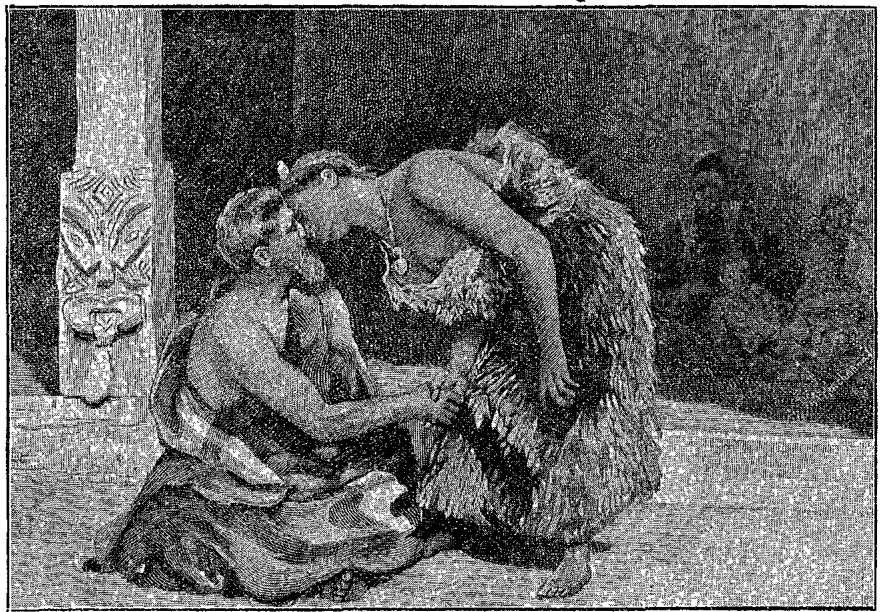
We believe the young man is quite right; and that much more might be said in the same line. It certainly must be a grotesque if not a disagreeable sight to those who, like the Japanese, never practice it. At any rate we who kiss have no particular ground for ridiculing the Maori custom of greeting by rubbing of noses, as shown in the engraving.
Another custom to which the Japanese women cannot bring themselves, is that of restricting their waists with the murderous and abominable corset. Their ideas of “shape” and symmetry do not run that way any more than ours do to the cramped and pinched feet of the Chinese belles,—not nearly as much, indeed. A foreign lady whose waist was constricted to a very small diameter, and whose shoulders were broad and roomy, went into a restaurant in Japan, and proceeded to stow away a very large lunch. One of the waiter girls looked on in astonishment, and finally asked, “Where does she keep her stomach?” No one was able to answer. “Very strange,” said the pretty waitress; “she must keep it just under her throat, where she is so big.” T.
HOW WE ADOPTED THE TITHE.
When Dennis mentioned the matter for the first time, I was almost indignant. We were sitting at the fireside one evening,—he had been reading the paper, and I was almost dozing over a dull book,—when he looked up quite suddenly, and said: “I have been thinking, Clara, that you and I should begin giving systematically.”
“Giving systematically to what?” I asked in genuine surprise, and endeavored to look wide-awake and interested.
THE MAORI GREETING. From “Land and Sea,” by G. C. T.
“Why, to the church and missions and hospitals and so on,” explained Dennis.
“Give what?” I asked again, setting my lips a trifle firmer, and making it just as hard for poor Dennis as I could.
“Money, of course,” he answered. “You know what I mean, dear. Suppose we keep a tithe-box. At present we really give nothing worth speaking of.”
“Whatever are you thinking of, Dennis, to talk so soberly of giving, when you know we have not nearly enough to live on as it is? It is more a problem every day, with our income, to make ends meet.”
I looked meaningly around the plain little room, with its modest, homely looking furniture, and reminded Dennis of the rent which was overdue, and the many things we both needed. I even quoted Scripture, to the effect that if any provide not for his own, he is worse than an infidel; and being fairly started, soon talked both him and myself into a very dissatisfied frame of mind. It all ended in Dennis’s saying, “Oh, well! no doubt, as you say, what is impossible, is impossible, and that ends it. But I do wish we were able to give something.”
A serious illness came to me, and, as I needed constant care, Dennis, who was very busy in the office, proposed that we send for a young girl whom we had become interested in, as a child, in the Orphans’ Home. I knew she had had experience in attending the sick, and rather unwillingly consented. Maggie was a capable, well-trained girl, and had a peculiarly gentle and pleasant voice. I loved to hear it so well, that during my convalescence I kept her talking on one pretext or another most of the time. In this spirit I asked her rather languidly one day what she kept in a little pasteboard box I had several times noticed in her hands.
“This is my tithe-box,” said Maggie, turning her honest blue eyes full upon me. “I was just counting the money over to see how much I have for the missions next Sabbath.”
“Why, child,” said I, “come here and sit by me; I want to talk to you. Do you mean to tell me that you give a tenth to the Lord?”
The girl was rather surprised at my vehemence; but she answered simply, “Why, yes. I am very sorry it is so little I can give, having only my earnings. Sometimes I think it would be nearer right if I, whose whole is such a trifle, should give one fifth. There is so much need of money, you know. It is different with rich people; one tenth of their money is a great deal, and so much good can be accomplished with it.”
I winced under Maggie’s ingenious argument,—such a decided inversion of mine,— but she, sweet child, all unconscious of my thoughts, went on to tell me of the good matron at the Home, who had taught her, when a little child, that she had a Father in heaven ready to be more to her than the father and the mother she had lost. “She told me,” said Maggie, “that when Jesus left the earth, after his resurrection, he put the missionary work he had been doing for three years—and for that matter, all his life, the matron said—into our hands to do for him; and he said plainly that we who love him should show it by what we do of the work he loved. If we cannot preach, or teach, or give all our time to him here or over the seas, we can at least give a part of our money to him. She liked to give a tenth, because that was God’s own plan for the people he loved, and so must be the division of one’s money that pleases him best. ‘It is right,’ the dear matron said one day, ‘to give a tenth of our all; and after that, if we can spare more, we can call it a gift.’ She gave us a tithe-box, and the very first money I earned, all my own, I put a tenth into it.”
“So your matron thought that every one should give a tenth to the Lord, Maggie?”
“No,” was the quiet answer; she did not say we ought to; she did not think of it in that way. But she said that, like the other plans the good Lord has made for our every-day living, it is really all to make us good and happy. We are so glad when once we begin to give in that way, and the nine tenths which we keep are blessed of him with the one he accepts, and are lifted above being ordinary money, and do us far more good.”
My mind was busy with those sweet words long after Maggie had left me, and the question came, If she can give out of her pitiful poverty, what is my excuse? Yes, I saw clearly now. I had been in the wrong and a stumbling-block to my husband. So in the evening as we sat cozily by the fire again, both happy in my returning strength, I said to Dennis, “I823have learned a lesson which makes my illness a blessing, dear. Shall I tell you of it?” And then I told him of Maggie’s ministering to my soul as well as to my body, and showed him a little box on which was written “tithes.” Dennis did not speak at first, but a glad look shone in his eyes, and he clasped my hand very tenderly.
“The Lord’s hand is in this, Clara,” he said at last. “We will pledge a tithe of all God ever gives us, over this little box, won’t we?”
It would be half a truth to say that we never miss that money. It has brought us a blessing. Though we are not rich, and probably never shall be, we are content, which is far better, and need to fret about matters no more.
“O Dennis,” I said the other day, “how well worth heeding that suggestion of yours has proved.”— Woman’s Home Missions.
“THE FATHER.”
By Edgar S. Caro
BY EDGAR S. CARO, M. D.
(Sanitarium.)
“For I know him, that he will command his children and his household after him.” God's words of commendation to Abraham would apply with equal force at the present day. To the father belongs the important work of ruling the entire house, of manifesting justice and judgment, and above all, of turning the hearts of the children unto the Lord. Just as the family and servants of Abraham depended upon him as their head, and in so doing met God's approval, so, now, the Lord will uphold that man who takes his place at the head of his household, and rules with mercy and with equity.
A wise father will make himself one with his children. His daily business over, he will return to his home with a prayer to God that he may carry with him a ray of sunshine. Strong in his determination not to let worldly cares mar the happiness of his home, he will heartily enter into the harmless pastimes and social enjoyments of his children. In turn they will give him their confidence, and will grow up to look upon their father as their truest and best-loved friend. Few fathers know the power of a father's smile. How few realize the harm that an unjust frown will do. Each son, each daughter, is a soul to be lost or won. Patiently God waits to hear the father commit his loved ones to divine keeping, and each prayer receives its answer a hundred-fold. As sons and daughters grow to years of discretion, such a father will be amply repaid by beholding the fruits of his children's right-doing.
TEACH THE CHILDREN TO HAVE SOMETHING IN VIEW.
By J. P. Henderson
BY ELDER J. P. HENDERSON.
Activity is the product of life. Vitality flows out more freely in the beginning of days than in later years, as is manifested by all the animal kingdom. The kitten, the lamb, and the child, in their full vigor, are equally frolicsome. This overflow of life must expend itself, and can be made a foundation of great usefulness if properly influenced. The activity of childhood is not to be restrained, but directed; not crushed, but controlled. To check the natural instinct of “doing something” is to dwarf the growth of usefulness, and inculcate idle habits, an evil for which parents are often responsible.
To provide amusements just for the purpose of keeping the children “out of mischief” or of “killing time” is not always best. To tear up paper, cut rags, or whittle sticks, without an object before the mind, begets wastefulness. Children should be taught, even in their amusement, to work with something definite before the mind. When the boy builds cob houses, makes mud fences, or whittles out toys or articles for use or ornament; when the girl cuts paper into models of birds or animals, makes rugs, dresses dolls, or sews quilts, always having an object in view, usefulness is encouraged. Children thus become men and women ready for every emergency of life, for they learn usefulness in childhood.
A gentleman of prominence once accepted a young man for his son-in-law, who was without family or fortune, and of whose reputation he knew but little. When expostulated with for his apparent careless concern over the future of his daughter, he replied: “I have watched this young man. He is a constant whittler when away from his business, and I have observed that he always produces a result that is ornamental or useful, and sometimes both. A man with such a habit of hand and brain will surely make a living for any woman.”
It is true that machinery and inventive genius have filled the market with articles of use and ornament, many times cheaper and perhaps better finished than hand can produce; but those articles made by the ingenuity and deft fingers of the dear ones at home are of inestimably more value in comparison. Even clothing thus made seems to wear longer, mittens and stockings have an extra touch of warmth. The brackets, the crayon work, ornaments which are the product of thought and labor, the quilt pieced by delicate fingers, the rug on the floor, the stool by the fireside,—all, somehow or other, seem to make things so much more homelike when wrought by loving hands, than when purchased from a store. In fact, every article produced by the use of saw, hatchet, knife, scissors, pen, or needle, sweetens the memory, endears the ties of friendship, and gives home a luster of love and happiness that money cannot buy.
It has been demonstrated in many families that such a course of usefulness acts as a safeguard against vice and immorality. The idler’s brain becomes the “devil’s workshop,” but the tempter cannot use those who always have “something to do.” “Seest thou a man diligent in his business? he shall stand before kings: he shall not stand before mean men.” Prov. 22 : 29.
DISINFECTION OF THE SICK-ROOM.
By A. B. Olsen, M. D.
BY A. B. OLSEN, M. D.
(Medical Missionary College.)
A room that has been occupied by a sick person for a time, becomes unhealthful and unfit for use. This is especially so when the disease has been a contagious one. If the room is not thoroughly disinfected, those who come to live in it are very likely to take the same disease.
Merely scrubbing the floor with soap and water is not sufficient. More thorough and drastic measures are required to purify the room,—to free it from germs. Although at all times invisible to the naked eye, germs are present in the room. They infest every article of furniture, every piece of clothing. Being microscopic in size, they enter the smallest cracks and crevices, and thus are often lodged in places where they cannot be reached by the scrubbing-brush. Therefore, other means than a thorough house-cleaning must be resorted to.
Perhaps the cheapest as well as the easiest way thoroughly to disinfect a room, is to burn sulphur in it. Sulphur costs but a few cents a pound, and can be obtained from any druggist. First measure the room, and ascertain its cubical contents. Suppose it were fourteen feet long, twelve feet wide, and ten feet high. These figures multiplied together give 1680 feet as the cubical contents of the room. Now, 1000 cubic feet require three pounds of sulphur. This room being more than one half larger, would require about five pounds.
To prepare the room for fumigation, close all the windows and openings into it. The small openings between the windows, under the doors, etc., must also be sealed up. This is easily done by pasting long strips of paper over the cracks. If flour paste is used, it can be removed later by washing, without any damage to paint or varnish. All articles of furniture must be opened up, and taken apart as much as possible, in order that the sulphur fumes may penetrate everything. Pull out the drawers, open wide the doors of cupboards, take the bed to pieces, and open up and spread out everything in the room.
Then boil a kettle of water in the room for several hours, in order that the air of the room may become moist. This will render the burning sulphur much more efficacious in its work. After all these precautions have been taken, and the room is tightly sealed up, so that the sulphur gases cannot escape, prepare the sulphur. Put it in a strong old kettle, place this on several bricks in a tub or large dish-pan containing three or four inches of water. Place this in the center of the room on the floor, and light the sulphur by means of live coals. Wait till the sulphur is well afire, then leave the room, and seal up the door from the outside by pasting strips of paper over the cracks and the keyhole.
The sulphur will burn out in a few hours, and the resulting fumes will penetrate and permeate everything. These fumes are poisonous to the germs, and are sure to destroy them if sufficient time is given. The room should be left in this condition from twelve to twenty-four hours. Then open the doors and windows, and give it a thorough airing. Now is the time to begin scrubbing the floor, walls, and ceiling, and articles of furniture. Everything should receive a thorough cleaning. And it would be an excellent thing if the floor and woodwork could be painted, and the walls and ceiling papered anew. Then everything is fresh and clean, and no fears need be entertained about living in the room.
SEVERAL KINDS OF FLOUR.
By Mrs. D. A. Fitch
BY MRS. D. A. FITCH.
(Sanitarium Cooking-school.)
Of all questions in regard to our dietary, none are more perplexing to answer than those relative to the different mill products. Sometimes we think there are as many kinds of flour as there are millers, if not more. But perhaps there are a few suggestions which may be useful to inexperienced housekeepers. From what has already been said, it will be readily concluded that we are going to tell you that the flour used should contain the whole of the wheat kernel. Of course we say it, because the needs of the system demand it, so why throw away or feed to the calves the better part, while the children starve trying to live on that in which there is so little to build up waste tissue and promote growth?
Graham flour, when properly made, contains all parts of the wheat in varying degrees of fineness, from the starch to the coarse, flaky bran. The best graham flour in the market is, however, only a robbed article, having the starch removed to be sold as “fancy patent,” or pastry flour, which is also a robbed article, in that the outer portions are not in it. There are some other acknowledged methods of manufacturing graham flour, such as mixing bran and a poor grade of white flour together, grinding the screenings, or shrunken wheat, and also palming off the sweepings of the mill. No better graham flour is to be had than that manufactured by the old stone process, of good sound wheat, with no part of it removed. There seems to be more life in it, especially for the aerated breads. Whatever may be the case with other flour, it is true that graham deteriorates with age.
As for fine flour, the whiter it is, the more carbonaceous is its nature; but on the other hand, if it has a yellowish color, it contains a good portion of gluten. Among the best flours of this kind we would mention “Pillsbury’s Best,” “Washburn’s Superlative,” and the “Gold Medal,” all manufactured in Minnesota. But these are only samples of others probably equally good. They are among the best of those known as “bread” flours, in contradistinction to “pastry” flour, because they contain gluten enough to make a light, spongy bread.
Tests for white flour are: If it has a yellow tint, is granular, and falls loosely from the hand when pressed, it may be counted good; but if it retains the print of the fingers, it is of little value as a tissue builder. It is simply carbonaceous, and will not do much more than supply fuel to the body. Another test is to chew a portion, and if a considerable quantity of gum, or gluten, is found, it may be counted good.
When wheat is subjected to a pulverizing process, the portion containing the least gluten is made finest. This is the starch, and the whole is passed over a fine sieve, removing the starch. This is pastry flour, and is frequently, yes, quite commonly, called the best. The remaining coarser portions are then passed over a sieve not so fine. The flour which passes through it is known as “seconds,” and contains more gluten than any other one product of roller mills. It is not identical with the shorts, middlings, or canaille, of the stone mills. It is inexpensive, and with the addition of some clean bran, makes a good substitute for some grades of graham flour. “Whole wheat” flour is not graham, but still it contains the same elements minus the outside flinty bran only. The manufacture of this flour requires special machinery to pulverize the glutinous part of the wheat, and so it is more expensive than other flour.