The Youth’s Instructor, Vol. 34, No. 30.

THE TWO DIMES
Earlier text: THE TWO DIMES

DISPOSING OF EGYPTIAN MUMMIES.

In Miss Gordon Cummings’s recent work on the land of the Pharaohs, she writes some interesting paragraphs about the modern Egyptian’s manner of disposing of the mummies. They read as follows:—
“It is strange, indeed, to find a nation such as Egypt once was—the greatest and most civilized of all peoples—now so literally proving herself (as Ezekiel foretold she would become) ‘the basest of the nations’; that, not content with converting the bones of thousands and tens of thousands of her ancestors into charcoal, to be used in refining sugar for their degenerate descendants and their foreign task-masters, she must needs actually make merchandise of her dead. These precious mummies, which in the days of her glory were accounted worthy of such exceeding honor that they were considered the very best security on which to lend money, inasmuch as the Egyptian who had been driven to pawn his deceased father or mother would sooner die than fail to redeem his pledge, now, in the hour of Egypt’s degradation, are valued at so much per ton, and sold to strangers and aliens as a suitable manure for foreign soil. As you journey toward Memphis, you might very recently have chanced to meet long strings of camels, heavily laden with human bone-dust from the tombs. Here, too, from these old Alexandrian catacombs to the merchant vessels in the harbor, barges laden with brown dust ply to and fro. Their cargo is carried on board in baskets, and thrown into the hold; and the vessels deliver their choice goods in British ports at £6 10s per ton, to be mixed with the guano of Peru, and sold at a considerable profit. Several eye-witnesses have told us how they visited the ancient sepulchres while this work was going on, and saw pieces of human bone, small earthenware lamps, and tear glasses, among the dishonored dust of these myriad Egyptians, who were to be carried over the seas to fertilize English fields.”
“The bones of by-gone generations of old Egyptians are not the only relics with which this present age has dealt ruthlessly. A gentleman told me that a few years ago he had ridden about seven miles into the plain to the east of Alexandria, a spot rarely visited, where, to his amazement, he found ruins of buildings, pillars and sepulchres carved in the rock, which he could only compare to those of Arabia Petraea. While he stood there, some workmen were employed in dragging forth a sarcophagus carved with intricate figures—a treasure for any museum. Its destination, however, was to be cast into a limekiln, as being the easiest way to obtain lime for building a mosque.”

ARCHITECTURAL CROSSES.

Three or four hundred years ago there were several kinds of crosses built all over England, the principal of which were memorial, market, boundary, preaching, and weeping crosses. To the last, the priests sent all those whom they thought needed discipline or punishment. Often they had to walk miles to reach them, and when there, were compelled to say many prayers.
Memorial crosses were erected by persons who had lost their friends. They also marked the scenes of battles, murders, and other events. Fifteen beautiful memorial crosses were built by King Edward I. at the places where the body of his queen, Eleanor, rested during that long journey from Grantham to London. Only three of these now remain, the most famous of which is the Gothic cross, at Waltham, which has been restored and carefully preserved. In Alpine regions, memorial crosses denote the most dangerous parts of the mountain road.
Market crosses were first used in market towns, for the priests went there on the great shopping days to preach. They were called by special names, as Butter and Poultry. They were built partly to afford shelter from the wet weather. They are still to be seen in many parts of England.
Boundary crosses marked the dividing line between different places. At preaching crosses, sermons were delivered and proclamations read. One of the latter stood in front of St. Paul's Cathedral, and here some of the Reformers preached the doctrines of the Reformation.

STORY OF A JACKDAW.

THE JACKDAW is a native of Europe, and is the smallest specimen of the crow family. It has the name of being an impudent, noisy, and thievish fellow. An English exchange tells a curious story of one, as related to them by a little boy. It is as follows:—
“My aunt was some time since possessed of a jackdaw, which was the wonder of the village. He could sew well, putting the needle in and drawing it out with his bill, while he held the material down with his foot. He had a great partiality for keys and studs, hopping off and hiding them as often as he could; and he opened a pincushion, put his booty therein, and, incredible as it may seem, actually stitched it up again. He had another trick. Whenever he saw any persons in deep conversation, or engaged in reading, he very quietly gave them a dreadful peck on their ankle; yet, when the injured man looked up, ‘Jack’ was in some remote corner, either pluming himself or gazing about in the utmost innocence.”

THE SIMPLEST PATENT ON RECORD.

THE officials in the Patent Office, Washington, tell many interesting anecdotes about that institution. One of them described to the writer, recently, the simplest patent on record. Some one conceived the idea of pasting a piece of thread under the flap of the envelope, the object being that the recipient of a letter, by taking hold of the end of the thread, could neatly tear the envelope open in an instant. The plan did not meet with much success, as the end of the thread was generally twisted out of place and hard to find, which fact led some genius to tie a knot in the end of the thread, and take out a separate patent on the knot.—The Argonaut.

A HERO.

“I WISH I could be a hero,” A little boy said to me; “And when I grow up, a hero I really mean to be. ‘I mean to be brave,’ he told me, While his face was all aglow: ‘I’ll do something grand and noble That all the world shall know.”
My little, unfledged hero, I’ve something to say to you. In the time when you’re sorely tempted, To your own self be true. Do right, and let no one lead you Into the ways of wrong, And you’ll be as true a hero As e’er roused poet’s song.
Be kind to the poor and needy You’ll meet with in the way; Your life be a light to lead them To loftier heights, I pray.
Be steadfast, and work in patience, In all things do your best; Be a man, my little fellow, And you’ll be all the rest.
—Eben E. Rexford.

CHARLIE'S DOG.

WHEN Charlie was six years old, his uncle gave him a little black and white puppy. It was so bright and playful, and Charlie took such good care of it, that it soon became a great pet, and grew to be a large, fine dog. It was a shepherd dog, and was quite shaggy, and you can't guess what Charlie called him, although I've told his name already, as the old riddles say. Well, his name was Guess. Isn't that funny?
Charlie taught him a great many tricks. Of course he could shake hands, roll over, and stand up in the corner on his hind legs and beg. He would swim out into the water, and bring back sticks that Charlie had thrown in, and he thought it was rare sport; but he couldn't be coaxed to go after a stone when that was thrown in. He would shake his head, and wag his tail, as if to say, “I know better than that, sir.”
But the cutest trick, he taught himself. One very rainy day the door-bell rang, and when Charlie's mamma went to the door, wondering who could be out in such a storm, whom do you think she found?—Guess. He had got tired of staying all alone, for it was too wet for his little master to play outdoors, and so he took this way to get in. He took into his mouth the knob attached to the bell-wire, and pulled it just as he had seen others do. At first, mamma would hardly believe it; but she shut him out again and watched, and so found out all about it. She thought this was so cute that she let him in; but after that he bothered her by ringing it so much that he had to be punished to break him of it.
When he was very thirsty, he used to turn the faucet in the kitchen sink; but as he could never turn it back, the water sometimes ran all over the kitchen floor; so he was soon taught that this was very wrong, and that he must ask when he wanted a drink. To do this, he would put his fore paws on the edge of the sink and whine.
Charlie said he would rather play with him than with a boy, and that they never quarreled. I suppose that was because Charlie could always have his own way. Guess would draw his sled in the winter, and his cart in the summer. He could catch a ball almost as good as anybody, but he could not throw it. He could play “teeter,” too; and I must tell you what happened one day when Charlie did not mind his mother.
It was baking day, and mamma was almost ready to make a nice cake, when she found out that she didn't have any eggs. So she called Charlie, and giving him a little basket, told him to go over to the store and get her a dozen. “And don't stop to play, for I am in a great hurry,” she said.
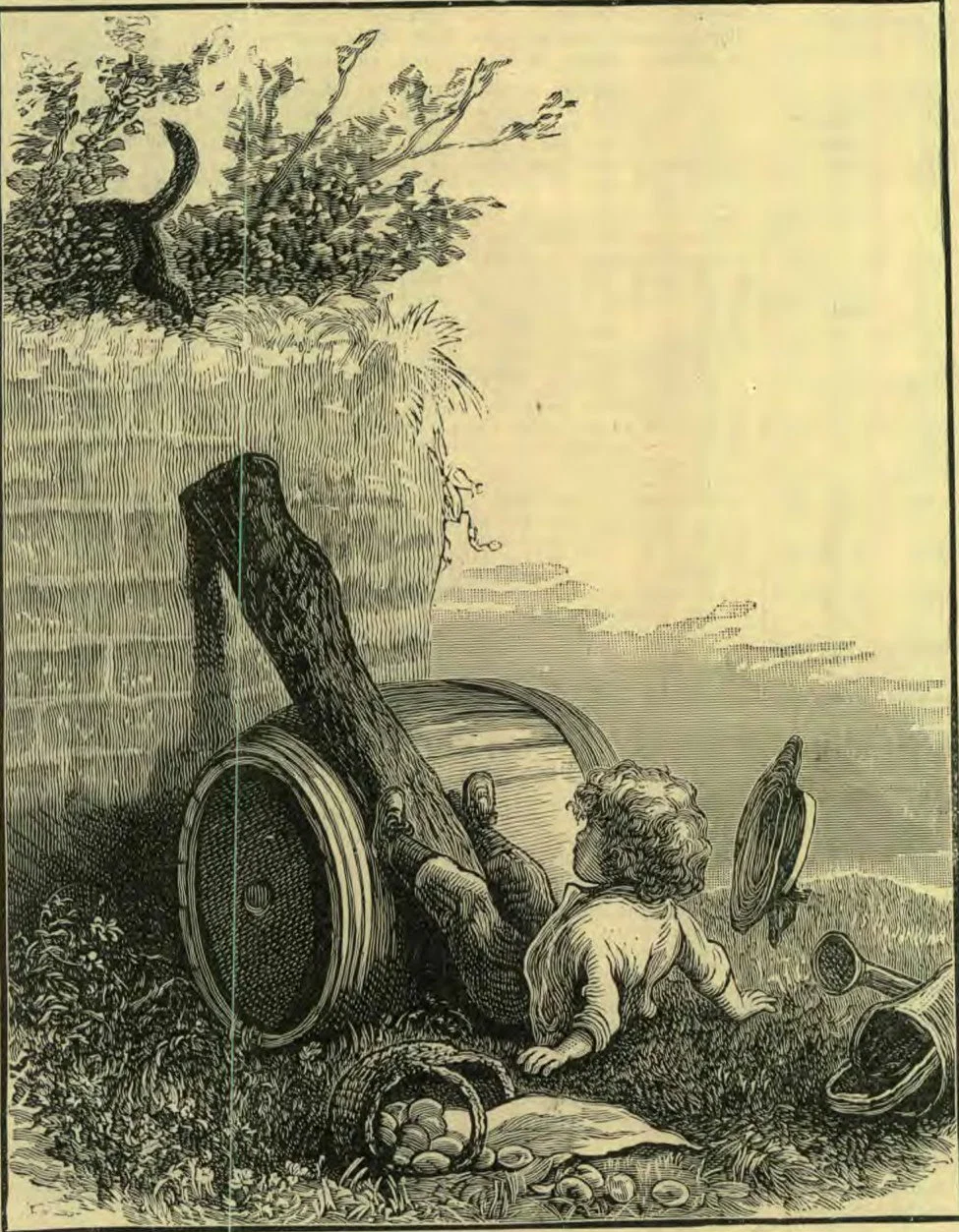
Charlie and Guess hurried along, Guess carrying the basket, and soon reached the store. The clerk counted out twelve large, white eggs, and back they started. The weather was warm, and Charlie was warm, and I think Guess was warm, too. Perhaps this was the reason they didn't walk quite as fast as before. They reached the low stone fence at the foot of the orchard safely at last; but alas, right under the first tree, in a shady nook, lay an old barrel and a board! Now I hear you say, “What of that?” Why, don't you know that a barrel and a board make the best kind of a teeter?
“Let's stop and teeter just a minute, Guess. We won't stay long, and then we'll hurry home all the faster,” said Charlie.
Now he knew, just as well as you or I, that he ought not to stop; but then—he was just like some other little boys whom I know. Do you know of any?
He set the basket on the ground, and put the board over the barrel. Then Guess jumped on one end, and he got on the other, and what a nice time they did have!
“Teeter, tawter, Bread and water,” sang Charlie; but just then a tiny squirrel ran along the top of the stone wall, and quick as a flash, Guess sprang on to the wall after him, and sent Charlie sprawling on the ground. The fall was quite hard; but the worst of it all was that the basket was tipped over, and all but two of the white-shelled eggs were cracked, while three of them were broken outright.
It was a very sorry little boy that went home with the basket of broken eggs. How he wished he had minded his mother! But he was a brave little boy, too; for he didn't tell any wrong stories about it. He didn't say that some big, bad Tom Jones did it, or that he stubbed his toe and fell down. No; he said, “Mamma, I have been real naughty. I stopped to play as you told me not to do, and so I broke nearly all the eggs; but forgive me, and I'll try to obey you after this.”
Mamma forgave him, I'm sure, when she heard all about it; for I know she would rather he would break a dozen dozen eggs than to tell a lie. I think Charlie felt better than if he had told a lie; don't you?
S. ISADORE MINER.

Letter Budget.

RENA E. MILLER, of Berkshire Co., Mass., in ordering the INSTRUCTOR to a cousin, sends, at the same time, a letter to the Budget. She writes: “I love to read the letters so well I thought I would write one. Some kind friends send us the paper, and I have been saving my money to send it to one of my cousins. Perhaps she will like it so well that she will send it to some other little girl. I shall be nine years old the 10th of June. I keep the Sabbath with my mamma. We have been praying for those two little girls’ papa ever since they wrote about praying for him. Will they please pray for my papa, that he may see the truth. He is a Christian, and a dear, good papa, but does not yet keep the Sabbath. I have several pets; first and best are my little baby sister and a little brother three and one half years old, Sadie and Harry. Then I have an old cat named Beauty, and two handsome kittens. When Beauty catches a squirrel, she brings it in for the baby to play with, and is so pleased to have her take it in her little hands. When she thinks baby has played with it long enough, she takes it away from her and eats it up. I have a pair of bantams. One of them was so tame last winter that he used to come into the house and fly up on to the foot of the baby's cradle and cuddle down, making a very contented little noise. Once he flew down right by the side of baby's head, and stood looking at her. I go to Sunday-school every Sunday. The little girls in my class are trying to see how many new scholars they can get. I have got three. My teacher is a dear, good woman. We all love her very much. I am trying to do right, that I may live in the earth made new.”
Who will start a wave in motion, as Rena has, by sending the INSTRUCTOR to another boy or girl, who, in turn, may furnish it to some one else, and thus extend the influence of the paper? One little knows the good that may be accomplished in this way.
WINNIE BOON, of Noble Co., Ohio, writes, “I like the INSTRUCTOR very much. A little friend in California sends it to me every week, and I send him our Sunday-school paper, the Sunday-school Advocate. I think it is nice to have friends so far away to write to us. We have never met each other, and do not know whether we ever shall or not, but if we never meet here, I hope we may meet on the other shore, with the rest of the INSTRUCTOR family. I am a little boy nine years old. I walk a mile and a half to Sabbath-school. We have our classes all named. My class is ‘Busy Bees.’ Our teacher takes up a penny collection every Sabbath, and our class comes out ahead nearly every time. I have one sister fourteen years old. We are raising sheep. I have three now, and my wool brought me over ten dollars. Sister has bought an organ with hers. She has five sheep now, and ten dollars left. There is much I would like to tell you, but I am afraid of the waste-basket. I send my love to all.”
We should all be interested to hear how Winnie's class earned the name of “Busy Bees,”—what kind of work they did. It is a good name, and we trust they are busy in every good work.
GEO. W. MOORE, of San Benito Co., Cal., writes: “I am a little farmer's boy, nine years of age. We live eighteen miles from town, right in the mountains. There is a very large creek running through the land, and in the winter it is like a mad river. I have a saddle, and ride horseback. My sister and I walk a mile and a half to school. We all keep the Sabbath, but have no church within many miles. We used to live in Petaluma; then we attended church and Sabbath-school regularly every Sabbath. This is my first letter to the Budget, and I hope to see it printed. I send my love to the INSTRUCTOR family, and hope to meet them all in the earth made new.”
If you make the farm cheery with sunshine, you would hardly want to change your “mountain home, to dwell in any other,” would you, George? It is well to enjoy it, at the same time keeping in mind that the glory of this world passes away, and that there is a brighter home in reserve for the willing and obedient.

KIND AND GENTLE.

KIND and gentle I must be, All from hate and envy free; Slow to strive, quick to forgive— Full of love as I can live.
Kind and gentle, I must pray To be led in wisdom's way— To be kept from every sin, Hand without and heart within.
Kind and gentle, I must try Jesus-like to live and die. Doing good in every thing, When I work, or pray, or sing.
Kind and gentle, I must learn Right to do, and wrong to spurn, Truth to seek, and error shun, Folly lost, and wisdom won.

You have reached the end of this edition.

The Youth’s Instructor · Jul 28, 1886