The Youth’s Instructor, Vol. 34, No. 30.

THE TWO DIMES

The Youth’s Instructor

Jul 28, 1886

S. D. A. Publishing Association · Battle Creek, Mich. · Jul 28, 1886

THE TWO DIMES.

Mrs. Smith had been complaining for a number of days about a pile of sawed wood, which was lying out of doors, instead of being piled up in the wood-shed where it belonged; and she “expected every day,” she told her husband, “that they would have rain, and then she wouldn’t have a dry stick to cook a meal of victuals with.”
So Mr. Smith, who was a business man, and hadn’t time to attend to it himself, hailed two little boys whom he met on the street, and offered them a dime apiece if they would pile the wood up nicely in the shed.
The boys were Willie Hizerd and Fred Brown. They were bright, active little fellows about ten years of age, and were very glad of a chance of earning a few pennies.
They worked briskly and steadily. The wood was soon piled high and dry in the shed, and the boys felt themselves amply repaid for their labor by the glad words of Mrs. Smith, a piece of custard pie from her pantry, and a bright silver dime in the pocket-book of each.
“Now,” said Willie, as they stepped into the street, “let’s go down town and spend our money.”
“I don’t believe I care to,” answered Fred. “What are you going to buy with yours?”
“Oh, I don’t know exactly. Prize-boxes of candy, I guess. They have some nice ones down at Harley’s. Come on; they’ll give us two boxes for ten cents.”
“No, I’m not going to spend my dime that way. In a few minutes the candy will be gone, and the money, too. Grandpa told told me the other day that he’d give me old Topknot. She wants to set now, so I think I’ll buy a dozen fresh eggs with my dime, and take Topknot home with me and set her. You buy your prize-boxes if you want to, but I’ll invest in eggs. So good-by!”
And Willie bought and ate his prize candy, then played around the street until dinner time, when he went home with a sick headache. By night he had a high fever. In the morning he was no better. A physician was sent for; but in spite of all that could be done for him, he had a long spell of sickness, which lasted many days. The doctor pronounced the candy the prime cause of the whole trouble; and when he sent in his bill, amounting to over fifty dollars, Willie felt as though he had made a pretty poor investment of his ten cents.
But how was it with Fred all this time? Well, he followed up his first intentions—spent his dime for a dozen eggs (the farmer’s wife giving him an extra one for good luck). He set them, and in three weeks eleven downy, fluffy little chicks were following proud Mrs. Topknot all about the yard.
Fred tended the promising brood carefully, and was rewarded by seeing them thrive and grow beyond his highest expectations. About the middle of June he was offered twenty-five cents apiece for them. It was a little higher than the usual price, but they were unusually large and nice.
He had lost but one out of the eleven, and he sold the remaining ten for $2.50.
With two new, crisp dollar bills and a fifty-cent silver piece in his pocket-book, Fred felt that his dime had been well invested.
He stopped in to see Willie, who was still confined to his room, intending to show him the money, and do a little boasting; but the sight of Willie’s pale face drove all such thoughts from his mind. He felt so sorry for him that he didn’t even mention the subject.
No millionaire ever studied more over different modes of investing than did our Freddie that night. First, he resolved to put all of his money in chickens, and go into the business quite extensively. This, however, he discarded as being rather risky. Cholera might put in an appearance, and he would lose them all. Then he was about determined to go halves with Jimmy Whitehall, and buy a calf; but the calf might die. It wouldn’t do to venture his all where there was any possibility of a total loss.
He at last decided as to the investment of his money. In the first place he would write to Boston for a bracket-saw, which would cost one dollar. Then he would spend fifty cents for wood. With the remaining dollar he would buy Mr. Grinley’s pig, which he had offered him for that sum. It was a little, sickly thing, but he thought if Fred kept it by itself, and nursed it up a little, it would come out all right, and he would make money out of it.
The following night found Fred minus a cent of money, but with a letter on the way to Boston, containing a dollar and an order for a bracket-saw; also material sufficient, in the corner of his room, apparently to supply the whole country with brackets, work-boxes, and the like for a long time to come. Then, in a little pen, made by Fred himself, was the pig, properly fed and made comfortable, with a good, dry bed, and plenty of buttermilk. Piggy, of course, improved. He was soon entirely well, and grew rapidly.
In due time Fred’s saw arrived, and when some of his handiwork began to appear, the orders for brackets and picture-frames, work-boxes and various articles came in faster than they could be filled. Fred was industrious, and stimulated by the encouragement he received, he sawed away with untiring energy.
Now, Piggy continued to grow, until one day in November, when Fred was offered eight dollars for his pig. He sold him, and then opened his bank to count its contents. One dollar, two dollars, three dollars, and so on, were counted, until fourteen dollars and a half were taken from their snug retreat.
Fred looked at his pile of money with a proud heart. Twenty-two dollars and a half lay before him, and it all came from the wise investment of ten cents.
Just then Willie came in. He was strong and well enough now for Fred to conscientiously comment upon the different results of their expenditures the spring previous.
“Willie, do you remember buying candy with your dime that Mr. Smith gave you last March?”
“Yes, sir-ee! Don’t say candy to me. It makes me sick to think of it. I don’t believe I shall ever like it again. I think that prize-package candy had poison in it. Do you know Doctor Bond says that it was really the cause of my long sickness?”
“Why, yes, I have heard so; but what I want to say is, do you remember I said I was going to buy some eggs with my dime?”
“Yes. Did you do it?”
“I did, and here is the result.”
And Fred proudly counted out his twenty-two dollars and a half before the astonished gaze of his friend.
“Whew! You don’t mean to say that that has all grown from your ten cents?”
“Yes, sir. I do. I’ve had to work some to help it along; but if I hadn’t invested my ten cents as I did, I shouldn’t have this pile of money to go to school with.”
“Well,” said Will, “if that doesn’t beat anything I ever heard of. Who would have thought it? Twenty-two dollars and fifty cents from one dime! I wonder if Mr. Smith hasn’t some more wood to pile up. I believe I’ll try it over again.”—Golden Days.

ABOUT MONEY.

Why is it that every body wants money? We can not eat it, nor wear it, nor drink it. Why is it so valuable? Simply because, as the Bible says, “Money answereth all things;” that is, money will buy anything that can be bought. But what is money? We mean by it, gold, silver, copper, or paper money. But many things at different times and places have been used as money. Tin was thus employed in ancient Britain; iron was used as money in Sparta, Greece; cattle were so used in Rome and Germany; indeed, the word pecuniary, relating to money, is derived from pecus, cattle. Leather was used as money among the Carthaginians, platinum in Russia, lead in Burmah, nails in Scotland, silk in China, tea in Tartary, slaves among the Anglo-Saxons, tobacco in Virginia, codfish in New Foundland, bullets in early Massachusetts sugar in the West Indies, soap in Mexico, etc. The term money, comes from the Roman temple, Juno Moneta, where there was a mint for coining money. Silver and gold are the articles most generally used; there are good reasons for this. These metals are valuable in themselves; they wear out very slowly; they are largely distributed over the globe, and yet are very scarce; they are of the same quality wherever found; and their value changes less than anything else in the world. Hence, they are the best standards of money. The first mention of their use as money is in Gen. 23: 16, where Abraham bought a piece of land.
But gold and silver were not at the first made into pieces of money as we now have them. They were in fine particles, or little pieces, in the form of lumps, buttons, wedges, and spikes. They had to be weighed, in trade. Thus we often read in the Bible of weighing money. See Gen. 23: 16; Ezra 8: 26. These metals, thus uncoined, are called bullion. The first account we have of money made into coins such as we now have, was about eight hundred years before Christ. The Lydians are credited with the invention. There is no evidence of coined money among the Jews until the time of Ezra, about five hundred years before Christ, and the first Jewish coin of which we have any history, was made B. C. 140.
These early coins made by the Jews and other nations were very clumsy, rough affairs, compared with our money. They were evidently at first hammered out, and hence were uneven and ill-shaped. On these pieces of money was stamped some figure, generally the head of the king who reigned at the time, or the figure of some animal. A few words were printed on these, the same as now. Thus, you remember that Jesus, when showed a piece of Roman money, asked, “Whose image and superscription is this?” They said it was Caesar’s, that is, there was the image of Caesar’s face, and his name was on the coin. I have seen, in the Boston museum, many of these ancient coins running back through different ages, and gathered from different people. They are of all shapes and sizes, having various pictures and letters upon them. These coins are mostly of copper.
But in modern times, a process has been invented by which money is coined so that each piece is exactly of the same weight and shape as the others, because they are all struck in the same mold. This is done in what is called the mint,—a place where they coin money. We have only four of them in the United States, one at Philadelphia, one at San Francisco, one at Carson City, and one at New Orleans. They are all under the control of the Government.
Bad men often make counterfeit pieces of money that look just like gold and silver money. They make them of lead, or some other metal, and then wash them with gold or silver; but an experienced hand can readily tell the difference. Genuine gold and silver coins have often had pieces cut out of them, holes bored into them, or the center dug out, and then filled up with some other cheap metal, until the piece of money was worthless. You see, a man could take just a little piece out of a half dollar, and then a little piece out of another one, and so a small piece out of a lot of them, until his small piece would amount to a good deal. To stop this, the Government refused to take these mutilated pieces of money for their full value. A ten-cent piece with a hole in it is only worth five cents. That stopped the business, practically.
What becomes of all the money? Millions of dollars are coined every year, and yet the world is not full of it. Well, even gold and silver wear out by constant use, and very often it is lost where it is never found again. A great many millions of dollars have gone down on vessels in the sea. It is sometimes hid, buried in the earth; the owner dies, and it is lost.
Bank notes are also called money, simply because they are used instead of gold and silver, and can be exchanged for real money at any time. Money is one of the most useful things in the world, simply because it enables us to carry on trade in an easy manner, without carrying around bulky articles which we wish to exchange for something else.
D. M. CANRIGHT.

SUMMER

WHO has not dreamed a world of bliss On a bright sunny noon like this, Couched by his native brook’s green maze, With comrade of his boyish days, While all around them seemed to be Just as in joyous infancy? While o’er the waste of purple ling You mark a sultry glimmering; Silence herself there seems to sleep, Wrapped in a slumber long and deep. Love you not, then, to list and hear The crackling of the gorse-flowers near, Pouring an orange-scented tide Of fragrance o’er the desert wide? To hear the buzzard’s whimpering shrill, Hovering above you high and still? The twittering of the bird that dwells Among the heath’s delicious bells; While round your bed, o’er fern and blade, Insects in green and gold arrayed, The sun’s gay tribes have lightly strayed; And sweeter sound their humming wings Than the proud minstrel’s echoing strings. — William Howitt.

ABOUT BEETLES.

If all the birds were to cease their singing, the music of nature would not be dead. From millions of tiny creatures the harmony would still be carried on. If you were to listen, you would hear their low monotone, a subdued accompaniment to the brilliant songsters. It comes from the thousands upon thousands of creatures that people the insect world,—a part of the great realm of nature that from its apparent insignificance we often pay little attention to, but which is really a most interesting field of study, and one well worth consideration.
If you were to upturn a stone, perhaps the most familiar specimens you see would be the beetles, or, to use their scientific name, the coleoptera, from two Greek words meaning sheath-winged; for these little creatures differ from other insects in that they have four wings, two large, light, gauze ones that they can fold away beneath the two hard outside ones. The latter are useless in flying, but serve excellently well to protect the gauze wings and delicate body of the insect from harm. Their manner of breathing, though common to all insects, is very curious. They have no lungs, but their whole body, even to the wings, is full of little air tubes, by means of which the blood of these tiny creatures is purified.
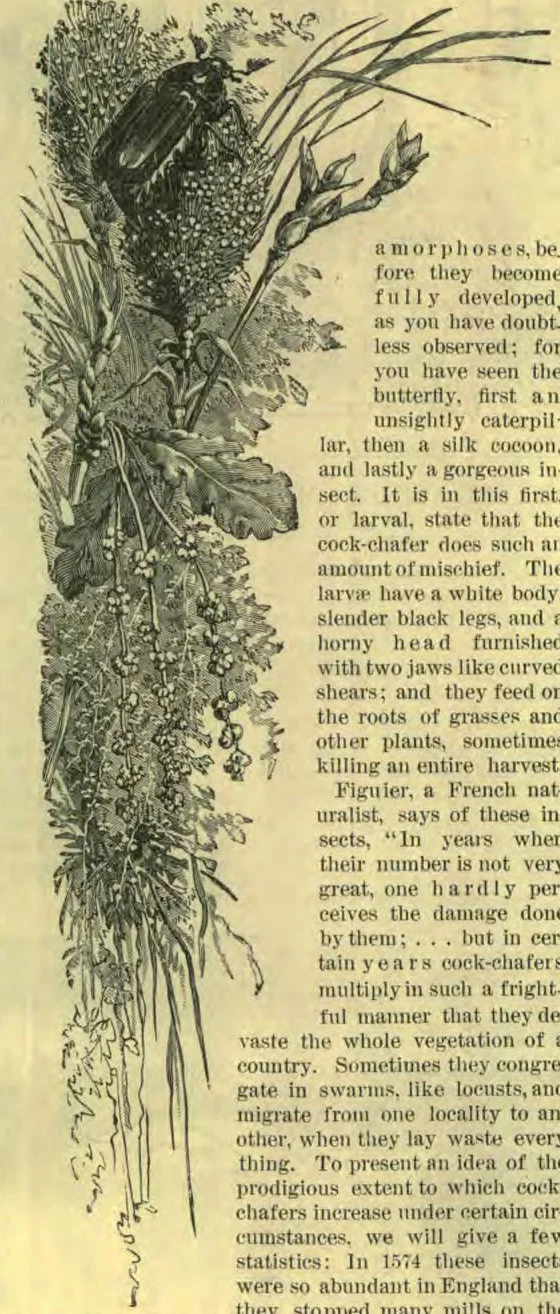
In our picture the artist has shown us two prominent members of this order. The one at the top of the page is the cock-chafer, a European insect, but a close relative of our own May beetles. The cock-chafers fly rapidly, but have no skill in steering, and hence are constantly hitting against objects and falling to the ground. They cannot fly very long at a time, for they are obliged to pause occasionally to fill their bodies with air.
I really wish something good could be said about the cock-chafer, but naturalists have given very bad accounts of his doings. In certain countries of Europe they sometimes come in such vast numbers as to constitute a plague, stripping the trees of their verdure, and leaving the land as desolate as a winter’s landscape. But they are more to be dreaded when they are first hatched out than at any other time. All insects undergo certain changes, or metamorphoses before they become fully developed, as you have doubtless observed; for you have seen the butterfly, first an unsightly caterpillar then a silk cocoon, and lastly a gorgeous insect. It is in this first, or larval, state that the cock-chafer does such an amount of mischief. The larvae have a white body, slender black legs, and a horny head furnished with two jaws like curved shears; and they feed on the roots of grasses and other plants, sometimes killing an entire harvest.
Figuier, a French naturalist, says of these insects, “In years when their number is not very great, one hardly perceives the damage done by them; . . . but in certain years cock-chafers multiply in such a frightful manner that they devastate the whole vegetation of a country. Sometimes they congregate in swarms, like locusts, and migrate from one locality to another, when they lay waste everything. To present an idea of the prodigious extent to which cock-chafers increase under certain circumstances, we will give a few statistics: In 1574 these insects were so abundant in England that they stopped many mills on the Severn. In 1688, in the county of Galway, in Ireland, they formed such a black cloud that the sky was darkened for the distance of a league, and the country people had great difficulty in making their hay in the places where they alighted. Their voracious jaws made a noise which may be compared to that produced by the sawing of a large piece of wood, and in the evening the buzzing of their wings resembled the distant rolling of drums.”
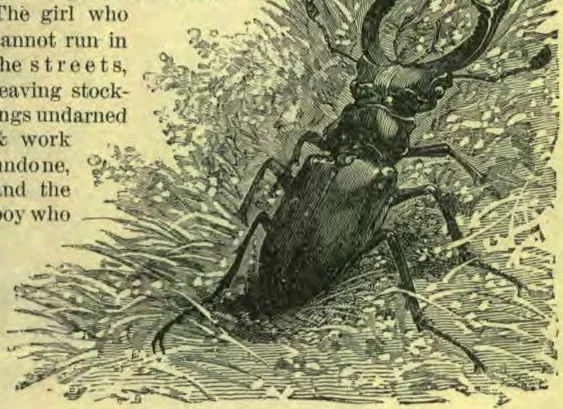
The lower picture shows us the stag beetle, a formidable creature that is not really half as savage as it looks. It is powerfully strong, and makes use of its mandibles in lifting objects. It never attacks other insects, but lives on vegetable juices. It really seems possessed of a slight degree of intelligence, for one naturalist says he had a stag beetle which followed him around like a dog when he offered it honey.
But this is not the only one of the coleoptera that manifests some instinct. In speaking of one variety, a naturalist says: “One should especially notice the artifice which this one employs, as indeed do many of the coleoptera, to escape from his persecutors by counterfeiting death. As soon as it is seized by an enemy, its members stiffen and become motionless. The body, abandoned to itself, lies unevenly on whatever side it falls, for its legs no longer bend; if you bend them over, they remain in the inclination given to them. Nothing then betrays life in this little dry and slender being, frozen with fear, and imitating death, without, perhaps, being aware itself of what it is doing.”
Perhaps the INSTRUCTOR boys and girls have noticed this peculiarity many times; but if you haven’t, get outdoors among these myriads of tiny creatures, and see how much you can learn of their habits. W. E. L.

CONSIDER THESE FIGURES.

The late Dr. Spencer, of America, has credit for the following facts and figures, to which we wish to call the especial attention of our young friends:—
“An accurate examination into the periods of life in which those whose lives of godliness give evidence of true religion, first began to be followers of Christ, furnishes an amazing demonstration of the folly and danger of delay! The probability of conversion diminishes rapidly as years roll on.
“Make up a congregation of a thousand Christians. Divide them into five classes, according to the ages at which they became Christians. Place in the 1st class all those converted under 20 years of age; 2d class, all those converted between 20 and 30; 3d class, all those converted between 30 and 40; 4th class, all those converted between 40 and 50; 5th class, all those converted between 50 and 60. Then count each of the five classes separately. Of your thousand Christians, there were hopefully converted—
Age at conversion Number
Under 20 years of age 548
Between 20 and 30 years of age 337
Between 30 and 40 86
Between 40 and 50 15
Between 50 and 60 3
“Here are your five classes! But you complain of me; you ask, ‘Why stop at sixty years old?’ Ah, well, then! if you will have a sixth class, and can call it a class—converted—
Between 60 and 70 years of age, 1.
“Just one out of a thousand Christians converted over sixty years old! What a lesson on delay! What an awful lesson!”
“I once made an examination of this sort in respect to two hundred and fifty-three hopeful converts to Christ, who came under my observation at a particular period. Of this two hundred and fifty-three, there were converted,
Age at conversion Number
Under 20 years of age 138
Between 20 and 30 years of age 85
Between 30 and 40 22
Between 40 and 50 4
Between 50 and 60 3
Between 60 and 70 1
“Beyond seventy, not one! What a lesson on the delay of conversion! what an awful lesson! How rapidly it cuts off the hopes of the delaying, as they continue on in life, making darker and darker the prospect as they are nearing the tomb! How rapidly the prospect of conversion diminishes! far more rapidly than the prospect of life! Let the sinner delay till he is twenty years old, and he has lost more than half the probability of salvation he had at twelve! Let him delay till he is thirty years old, and he has lost three-fourths of the probability of salvation which he had at twenty. Let him delay till he has reached forty years, and only twenty-nine probabilities out of a thousand remain to him. Let him delay till he has reached fifty years, and beyond fifty there remain to him only fourteen out of a thousand! What a lesson upon delay! what an emphatic lesson! As an unconverted man treads on into the vale of years, scarcely a single ray of hope remains to him! His prospect of conversion diminishes a great deal faster than his prospect of life!”
Some who may read these startling facts, may be men and women who have passed the meridian of life, some may be quite advanced in years, and still have no hope in God. If so, we ask, How much longer will you delay, allowing your prospects of coming to Jesus to continually diminish? He kindly invites you to come unto him, and be saved.
He bids us, “Seek first the kingdom of God and his righteousness.” Seek it first in point of time, and first as being more desirable than every thing else. Wisdom personified makes the gracious promise: “Those that seek me early shall find me.” Prov. 8: 17.
A. S. HUTCHINS.

YOUNG MARTYRS.

THERE is a great amount of suffering in this world, especially among the young and willful. The boys and girls who cannot have all the money they want to spend, before they have ever earned it, count themselves greatly wronged and abused. The girl who cannot run in the streets, leaving stockings undarned & work undone, and the boy who is not allowed to go where he pleases, and do what he likes, think themselves martyrs.
Such persons have great ideas of their rights, but very limited ones of their duties. And yet a few years will change the whole complexion of their dreams and thoughts. If they have their own way in early life, the time will come when in disgrace, sorrow, and shame, they will curse their own wilfulness, and blame their parents for allowing them to have their own way. But if controlled and wisely guided in youth, when they arrive at years of understanding, they will thank God and thank their parents that they were kept from evil, and guided by firm and kindly hands into ways of pleasantness and peace.—Little Christian.

SOME THINGS FIRE AND WATER ARE DOING.

The great internal fires of the earth are constantly at work, sometimes acting with shocks, and sometimes quietly and steadily changing the face of the earth. In India, seventy years ago, one of these sudden changes took place which was very remarkable. There was an earthquake shock, and a great piece of land fifty miles long and sixteen broad was suddenly lifted up ten feet higher than the country around, and there it has staid, with a straight wall around the edge called by the natives “Ullah Bund,” or “God’s Wall,” from the mysterious way in which it arose.
Without any earthquake shock or sudden movement, continents are in some places slowly sinking and in others as slowly rising. It might seem as if it were the waters which were rising or falling, but a moment’s thinking will show you that this cannot be so. Water soon comes to a level, and as there is nearly the same quantity in the oceans all the while, it must be the land that is changing.
There was, a great many years ago, before Christ came into the world, a temple built on the Gulf of Baiae near Naples. Three pillars are still standing of this temple, though they have seen many ups and downs since their building. The original pavement was of beautiful mosaic, and so well built that it still remains, though the earth on which it stands slowly sank for many years. About two hundred years after Christ a new floor was laid six feet above the old one, showing at that time how much the earth had sunk. Down, down the pillars went into the sea, till they had sunk twenty-six feet. Then came a terrible eruption of volcanic lava, and the temple was lifted bodily more than twenty feet, the pillars still standing upright. Twenty-six feet above the first pavement, and for twelve feet below that line, the pillars have been fairly pitted by some small sea animal which had burrowed into the marble when it was under the sea. The story of the temple’s travels is written on the face of the pillars. Now the temple is again slowly sinking at the rate of an inch a year.
Our own continent is tilting up in some places and sinking down in others. The Florida coast is sinking; the North Carolina coast is rising. Near Boston the land is rising, and Greenland for six hundred miles is sinking so manifestly that the Greenlanders have learned not to build their huts close by the sea. An island in the Gulf of St. Lawrence is gradually tipping; its southern coast is dipping down and its northern rising into high bluffs.—Harper’s Young People.

IMPORTANT BIBLE SUBJECTS.

LESSON 17.—SANCTIFYING THE SABBATH.

1. In how many days were the heavens and the earth completed? Ex. 20:11.
2. What can you say of the seventh day?
3. After God had rested on the seventh day, what did he do?
4. Why did he hallow, or sanctify, the seventh day? Gen. 2:3.
5. When Moses, according to the Lord’s instruction (Ex. 19:12), had set bounds about Mount Sinai, what did he say had been done to it? Ex. 19:23.
6. What did the children of Israel do with certain cities? Josh. 20:7, margin.
7. In what words did the Lord, through one of his prophets, command that a fast should be appointed? Joel 2:15.
8. From these instances, what must be the meaning of “sanctify”?—To appoint; to set apart for a special use; to make sacred or holy.
9. Then what is really meant by the expression, “God blessed the seventh day, and sanctified it”?—That God appointed, or set apart, the seventh day for a special use; in short, that he commanded that the seventh day should be kept holy.
10. Was any one living to whom such a command could have been given? Gen. 1:26, 27.
11. For whom did Jesus say the Sabbath was made? Mark 2:27.
12. In what sense is the word “man” here used?—In the sense of “the human race; mankind; the totality of men.”—Webster.
13. Did the Saviour mean that the Sabbath belongs to man? Ex. 20:10.
14. Then is it proper to speak of the seventh day as the Sabbath of any particular class of people?—Certainly not; it is God’s own property.
15. Did God bless the Sabbath institution or the Sabbath day? Ex. 20:11.
16. What is the great design of the Sabbath? Ezek. 20:12, 20.
17. How is the true God distinguished from false gods? Ps. 96:4, 5; Jer. 10:10-12.
18. From what may we learn the power and glory of God? Ps. 19:1; Rom. 1:19, 20.
19. Then how does the Sabbath serve as a sign to remind people of the true God? Gen. 2:1-3.
20. Does the Lord wish to be remembered by only a few? Ps. 33:8.
21. Then how extensively should the Sabbath be kept?

GAINS FROM ANY ENVIRONMENT.

There is often need for vigilance and for appreciation of what seem trivial gains on the part of those engaged in a high work. When a pastor notes the small number of accessions to his church, and longs despairingly for a call to some field where his services will be more productive; when a Sabbath-school teacher thinks of giving up her class because in a year’s time she has only succeeded in teaching them a little about the Bible, and has not succeeded in persuading any one of them to come out publicly on the Lord’s side; when any Christian becomes discontented with the success granted to him in a work of God’s choosing, and seeks to turn aside to a work of his own choosing,—it is time to remember that the smallest gain in God’s work is worthy of the largest sacrifice, and that no gain is too trivial to escape glad record in the book of God. Paul knew and acted upon this principle. He would have rejoiced if all men had listened to his message, and had turned in free surrender to the Saviour; but though such success did not follow his preaching, he knew that no effort must be relaxed on that account, and so he became all things to all men, that by all means he might save some. This is true thrift in Christian work; to keep to one’s own divinely appointed field, however narrow it may be, and to count no opportunity too small or trivial to be utilized for Christ.
There are some men who are forever throwing the blame of their failures upon their environment. In the long run, it matters less what our environment is in itself than what we make out of it; as the tin of the Scilly Isles, dug out of the ground, was more valuable to the ancient world than the gold of California, not dug out, and as the barrenest hillside, beneath the hand of diligence, is worth more than the richest plain abandoned by sloth to luxuriant weeds. There is no environment, however poor, which is not rich enough to yield some reward to those who diligently seek it. The chief cause of failure among men is not the poverty of their environment, but the shiftlessness which fails to make anything out of any environment.— S. S. Times.

Raising a Fine Flock of Sheep

A MAN who had a fine flock of sheep, was asked by a friend how he succeeded in raising them. He replied: “By taking good care of the lambs.”

COMMONPLACE

A COMMONPLACE life, we say, and we sigh; But why should we sigh as we say? The commonplace sun in the commonplace sky Makes up the commonplace day; The moon and the stars are commonplace things, And the flower that blooms, and the bird that sings; But dark were the world and sad our lot If the flowers failed and the sun shone not; And God, who studies each separate soul, Out of commonplace lives makes his beautiful whole. —Christian Union.

LITTLE FOLKS AMONG THE ZULUS.

The inquiring mind is always entertained with facts in the history of other nations and peoples, particularly when these are separated by great seas, and located in a climate almost the extreme opposite of his own. Such is Zulu Land, away in the southeast of Africa. Here ice and snow are seldom seen, except back from the coast or up on the mountains, and the weather is so warm the little babe needs no clothing, which it never has except it be a cotton blanket to occasionally wrap it in upon a cool morning. The following little picture of Zulu life is an extract from an article furnished the Presbyterian Observer:—
“The Zulu mother has no bed or crib in which to put her babe, and so she lays it on a mat, on the ground, where it sleeps sweetly. The mother has not much work to do in her hut. She has no clothes to make or wash or mend. She does not even wash the baby’s blanket often, for she says it will wear it out to wash it, and I think it would wear holes in it if she should wash it clean. She has only one dish of food to cook at a meal. She sets that out in the middle of the floor, and the men gather around it, sitting on the ground, and eat with wooden spoons till they are satisfied. Then the women and children come and eat what they want, and if there is any left the dogs lap it out of the dish. So the woman has only one dish and a few spoons to wash, and only one room in her hut to sweep out, and no furniture to dust.
“But she does not expect to live in idleness, since her husband has paid ten head of cattle for her. She takes great pride in having a nice garden—as much so as your mothers in having a nice house. When the mother goes out into the garden to work, she ties the babe on her back with the blanket I have spoken of, and marches out with a great hoe on her shoulder, a dish of sour milk on her head to feed the babe with, and her hands full of ears of corn. Arriving, she scatters the corn broadcast and begins her digging, swinging back and forth with her little one on her back, thus rocking her babe to sleep. She then lays it on the soft grass in the shade of a tree, and although there are so many snakes all about there, we have never heard of their biting the little ones.
“When the baby wakes up, it cries just as white children do, and the mother throws down her hoe and runs to it just as fast as any of your mothers run for you when they hear you crying. She loves her child just as much as white mothers do theirs. It is hungry, and the mother feeds it with that sour milk she has brought on her head. She has a nice way of feeding her little one without cup or spoon. She puts her hand just under the babe’s mouth and makes a tunnel, and pouring in the milk it runs right down the child’s throat.
“The children are contented with plain food, and have but one kind of food at a meal. They never complain of a hard bed, though they sleep on a mat on the ground, often without even a blanket to cover them. They are just as happy as the goats they sleep with at night, or as the monkeys that come down from the tops of the trees to steal the corn as soon as it is ripe. They are as cheerful as the baboons that come out from among the rocks to scratch up the corn the mother plants, if she does not remain in the garden all day and keep them out. They are very fond of play. One of their amusements consists in making oxen and cows and other animals of clay. They skip and jump about as happy and joyful as the animals about them. But there is a kind of happiness which you have and which they have not until some one goes and teaches them. And this is the happiness that comes through knowing Christ and obeying his precepts.”
Continue reading: DISPOSING OF EGYPTIAN MUMMIES