BOYS, send to us for 20 packages of Bluine, which you can easily sell at ten cents each. Return us the $2.00 received, and we will at once send free, post-paid, a Regulation size Rugby Football, consisting of a tested bladder made of the best rubber, and a strongly sewed leather cover. It is warranted to stand rough work. Send your address. We trust you with the Bluine. Satisfaction guaranteed. We also give other athletic goods.
BLUINE MANUFACTURING COMPANY
Mill Street, Concord Junction, Mass.
The Old Reliable Firm
World's Fair and other Excursions via the Santa Fe
St. Louis and return . . . . . . $67.50
Chicago and return . . . . . . $72.50
New York and return . . . . . . $108.50
Boston and return . . . . . . $109.50
Return limit 90 days from day of sale, except October sales which will be limited to December 31st. Good on California Limited—Good going one way and returning another—with stop-off at pleasure, within limits.
Visit Grand Canyon
going or returning, and remember that
Santa Fe is the Way
Information, tickets, etc., from
J. J. WARNER, Agent,
1112 Broadway, Oakland.
Scripture References
This pamphlet groups the more important references on twenty-four different subjects in a very helpful way. Some of these subjects are; Signs that Show Christ’s Coming Near, The Millennium, The Sanctuary, The Sabbath, Spiritualism, The Soul in the Old and New Testaments.
Price 2c each. $1.40 per hundred, post-paid.
ADDRESS PUBLISHERS OF THIS PAPER.
ON THE WAY TO THE WEST COAST OF SOUTH AMERICA.
By F. H. Westphal
BY F. H. WESTPHAL.
We left New York the 29th of June on the steamer Oceanic. It is a large boat, and the journey across the water to England was very pleasant indeed. The ocean was as calm as a lake in pleasant and fair weather. There was only one sad occurrence to mar the pleasure of the voyage. After we had been nearly three days on the journey, a man fell overboard. It was just dinner time, and none of the sailors were on deck. Some of the passengers saw him fall into the water, and one of the second-class passengers saw him after he had fallen. He might have thrown a life-line to the unfortunate man, as there was a buoy within a few feet of him; but he did not think to throw it out, and simply called for others to help him. The ship’s crew did all they could to save the man; the ship was turned about in a few minutes, and a life-boat and crew were let down. About an hour was spent in trying to find the lost passenger, but it was too late; the man had gone down not to rise again, and the ship steamed on.
I spoke with the man who saw the drowning passenger in the water. He said that the man stretched out both his hands for help, and swam with all his might to save his life. He reproached himself bitterly, because he had not thought to throw out the buoy that might have saved a life. It seemed to him as tho he could see the man stretching out his hands, even after we had resumed our voyage. May we not learn a lesson from this incident? There are many people around us whom we might help, if we would just think to throw out the life-line. There are many sinking down into death, never to have the blessed experience of hope in God. A world is left unwarned of the great events that are to take place very soon.
We spent one day in Liverpool, made a few purchases there, and on the 7th of July took the steamer Victoria for South America. As we passed through the streets of Liverpool, and saw some of the many people there, we were led to pray that God might send more laborers into the field, that His work might be closed up quickly. England had been visited by an earthquake the Sunday before we arrived. Some of the people were shaken out of their chairs. It should be a reminder to them that a greater earthquake will soon shake them out of their places of careless repose.
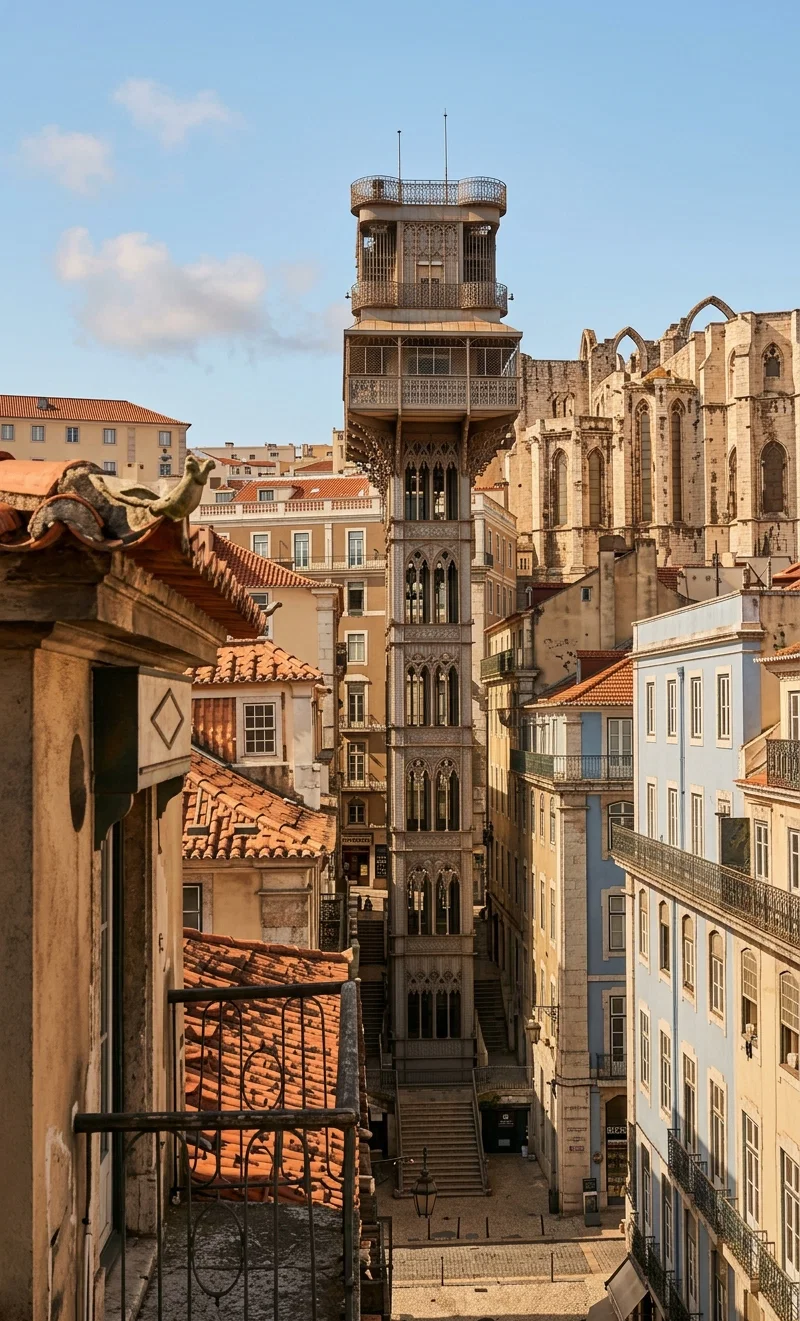
Elevator of Carmo, Lisbon, Portugal, from the top of which tourists view the city and the great cathedral ruined by the earthquake of 1755.
After leaving England we found the sea as calm as before; our journey to France was very pleasant, as none of us were seasick. We came to La Palisse on the Sabbath, and spent the day there. We walked into the country for a little exercise, after having been on the ship so long. The walk did us good. We also came into the city of Marseilles, which used to be the key to France. But when the Seine River, on which Paris is located, was opened to navigation, vessels were enabled to enter France by the new route. At La Palisse we saw three submarine torpedo boats lying in the harbor with their sterns covered over. Some think they have a special improvement of some kind in that part, and for this reason are kept covered. The greater part of the boats were submerged, but, as the water was very clear, we could see them below the water line. What awful weapons of destruction are being manufactured! We saw in the forts there four great disappearing guns. I am glad that something is being done to bring the truth to the millions of France; but how much more should be done than is being done!
On Sunday at 11 o’clock we sailed away, and soon came to Corunna, Spain. After taking on some passengers and freight, we steamed on to Corelez, where more passengers and freight were received. Spain occupied an important place in the world when America was discovered, but she has grown small since that time. However, the millions in that country should hear the last message of mercy.
We next came to Oporto, Portugal, where much wine was taken on board. It is claimed that from here the best wine in the world is shipped; but the best of it is “a mocker.” We did not go ashore at Oporto; missionaries are not so well supplied with money that they can make a business of sight-seeing. But when we came to Lisbon, we felt that a little time spent ashore might be of value to us and the cause. This is the place where the great earthquake of Nov. 7, 1755, which also shook about four million square miles of the earth’s surface, caused the greatest destruction of life and property. We had learned that there was still to be seen an old ruin caused by the earthquake. When we reached the shore, and inquired for the ruin, the people knew how to direct us to it. We thought that they might have quite forgotten it, inasmuch as about one hundred and fifty years had passed since the earthquake, but when we inquired for the ruin, we were immediately directed to it. We were surprised to find that the whole matter was fresh in the minds of the people.
When we came to the place, we found that a tower had been built on one side, and an elevator provided, so that visitors could ascend to the top, and take a look at the ruins from the tower. We also obtained a good view of the city and the harbor. Lisbon must be a very old city, for the history of its foundation is lost in antiquity. From the tower, we could only see the top of the old church ruin. The back wall and the side walls of the church are still standing.
There is a bridge constructed from the center of the tower to the front of the church. We walked over this bridge to examine the ruins farther. The church had been sunk six feet into the ground from the effects of the earthquake. The ground had sunk with it, and by the terrible jar the whole roof of the church had fallen down. Great, heavy stones were broken into many pieces. Some tombs of great men were also broken open. The head of the bust of Pope John XXII. was broken off. The head with the crown on was put in a case, where it is still in sight. The eyes and cheeks were colored, as also the crown, so as to look life-like. The grave of the founder of the church is still in this old church. One might suppose that because this church, ground and all, had sunk six feet, the ground must be somewhat soft; but this is not the case; for I examined it thoroughly, and found that the church was built on rock bottom. It must have been an awful crash that broke the ground and the rocks to such an extent as to sink a considerable part of the hill six feet.
Another interesting feature is that the street in front of the church rose nearly five feet, and remained in this condition. Farther back the ground raised still higher. The whole city was shaken to such an extent that the hills skipped like lambs, and moved like the waves of the sea. This earthquake marked the opening of the “sixth seal” of Rev. 6:12. In the country where the greatest effects were felt, and where a tower was built as a memorial, we have not a single worker to point out to the people the meaning of this great earthquake. Should not some one get a burden to labor for the salvation of that people? There will soon be an earthquake which will cause the cities of all nations to fall. The mountains and the hills are to sink away, and the islands shall not be found.
While men are stationed at the ruin to tell the people about the earthquake, and when it took place, we ought to be on the ground to tell them that at that time the sixth seal was opened, and that the darkening of the sun and moon followed on the 19th of May, 1780; that the stars fell on the 13th of November, 1833, and that the generation now upon the earth will see the Lord and Saviour come as King of kings and Lord of lords. The nations of the earth are now angry, and soon war and desolation will sweep over this earth like a mighty avalanche. Now is the time to get ready for these great events. Now is the time to sound an alarm, to get the people ready for a better country than the earth is in its present condition.
It is now the 17th of July, and we have passed the Canary Islands. To-morrow we shall reach the Cape Verd Islands, and there our ship will take on coal. Here was the scene of an earthquake about a year ago. Ships from every country, crossing the ocean south and north, generally stop here for coal. It is a great coaling station, and is controlled by the Portuguese Government. Our whole company are well; thus far none of us have been seasick to any extent. The voyage has been pleasant. We hope to be of service in proclaiming the message of the soon-coming Saviour in South America, in order that souls may be won for the Lord’s cause and kingdom.
WHAT HAVE WE DONE TO-DAY?
By Nixon Waterman
We shall do so much in the years to come,
But what have we done to-day?
We shall give our gold in a princely sum,
But what did we give to-day?
We shall lift the heart, and dry the tear,
We shall plant a hope in the place of fear,
We shall speak the words of love and cheer,
But what did we speak to-day?
We shall be so kind in the after-a-while,
But what have we been to-day?
We shall bring to each lonely life a smile,
But what have we brought to-day?
We shall give to truth a grander birth,
And to steadfast faith a deeper worth,
We shall feed the hungering souls of earth;
But whom have we fed to-day?
We shall reap such joys in the by-and-by,
But what have we sown to-day?
We shall build us mansions in the sky,
But what have we built to-day?
’Tis sweet in idle dreams to bask,
But here and now do we do our task?
Yes, this is the thing our souls must ask,
“What have we done to-day?”
—Nixon Waterman.
Forget Others’ Faults by Remembering Your Own
FORGET others' faults by remembering your own.
VILLAGE LIFE IN INDIA.
By A. S. Albrecht
[A. S. Albrecht, in Lutheran Observer.]
An Indian village is a little world in itself. Men live and die in the little village in which they were born, often without going beyond the village limits in their lives, or feeling the need of going. Their livelihood is there, their wants are few, and these wants can be supplied by their neighbors. Some villages are much larger than others, and some have a few educated men, while in others no one can read or write but the munsiff, or head man, and the karnam, or village accountant. The style of houses varies in different parts of the country, and also according to the size or wealth of the village, but in most respects all villages are alike. The houses are close together in two long rows, with small side streets branching off here and there.
If we enter the village from the east end, first we see a group of little huts, constructed chiefly of split bamboos, and not high enough for any one but a very small child to stand erect. These are the dwellings of the yanadi, or thief caste, who are employed as village watchman, perhaps on the principle that “it takes a thief to catch a thief.” At any rate, they never allow any one to steal what they are watching. Next come the houses of the Sudras, rich and poor, but the Sudras are by no means all one caste, as many suppose. The reddis and the kammas are the principal farmers, and when any religious procession takes place, each struggles for precedence. Here is the house of the village munsiff, who is a government servant, and whose duty it is to try all small cases of theft or disturbance, and report all others to the higher authorities.
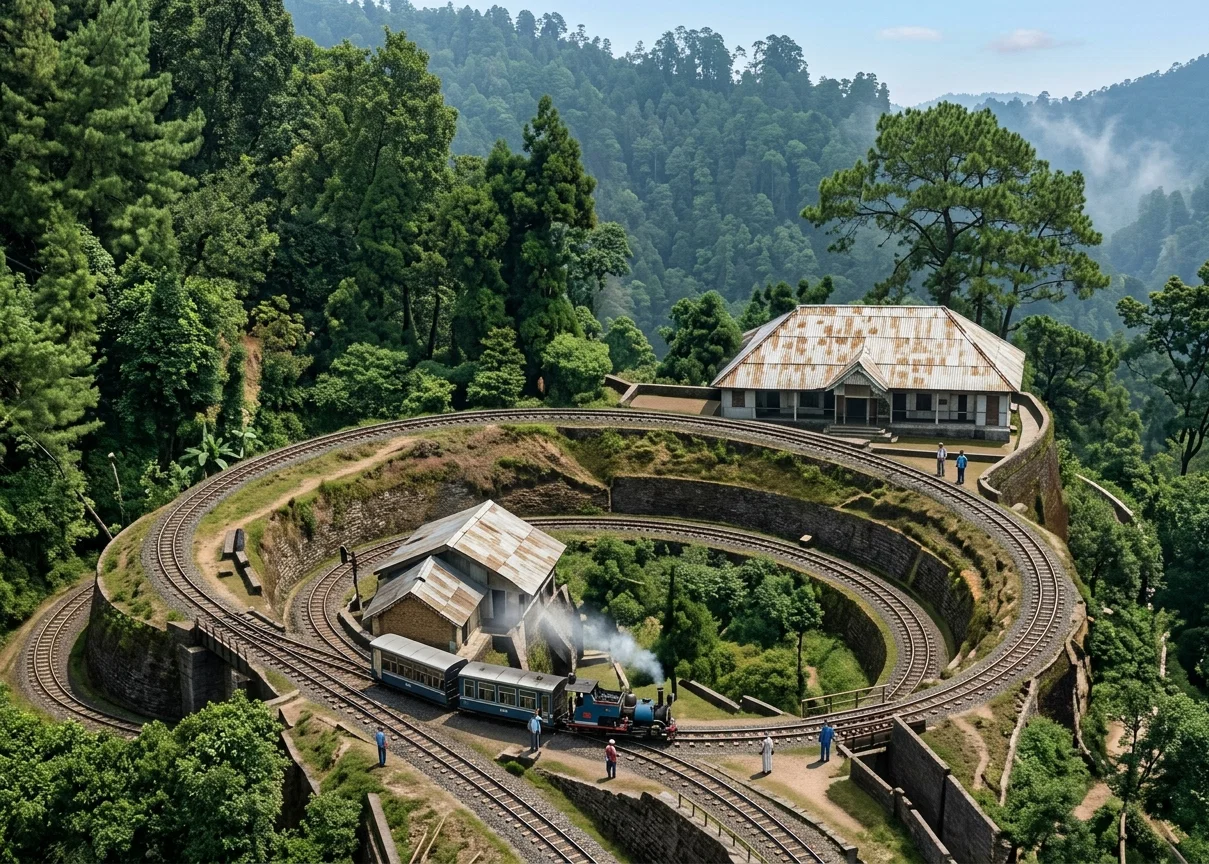
The Wonderful Double Loop on the Darjeeling Railway, India.
There, where the blue smoke is curling up, is the house of the potter whose wheel is always turning to supply the earthen pots used by the village for cooking, and for water. Those houses that are locked belong to the shepherds, who are away in the fields with their flocks and herds, and whose food must be carried to them by the women of the family.
Next come the rich merchants, who sell cloth, grain, curry stuffs, and the other things necessary for daily use. They are also the money-lenders, and take from 12 to 100 per cent. from their neighbors who want money for a wedding or a funeral feast, or to pay their taxes; and, sad to say, there are few who do not at some time fall into their clutches, and fewer still ever get out again.
Adjoining is the village post-office, kept in the house of the Brahman postmaster; next is the karnam’s and the schoolmaster’s, if there happens to be a native school, and the other Brahmans who occupy the adjacent houses are gentlemen of leisure, living from the income of their lands, and on the fees they get for performing weddings, foretelling auspicious days for marriages, journeys, etc.
Peep into the next house, and you will see the goldsmith at work, making a gold collar for some dark-skinned beauty, while his little son sits in front of him, blowing the bellows, and learning the trade. Here are some more boys also learning a trade. They are the barber’s sons, shaving their little brothers for practice, while the father stands near, giving directions, first to them, and then to another boy who is learning to beat the drum, for the barbers are also the drummers. Down that side street are the houses of the dhobies, or washermen, who wash for the whole village. A very rich lady, who has a fine cloth she is afraid the dhoby will spoil, will sometimes wash it herself, but otherwise, no one, rich and poor, not even a beggar, will wash his own clothes. That is the dhoby’s work.
Down that other street are the houses of the Mohammedans. In many places the Mohammedans are numerous and wealthy, but here they are few in number, and usually poor. Here is to be found the government toddy shop, which brings more poverty and misery to the people. In sandy places where the palmyra trees flourish, are also found the toddy tree climbers. There are also the Sudra weavers; the pichagunta people or gypsies, who go from house to house, telling stories, singing songs, and begging, and the mutthurachalu, who have long guns, licensed by government, and who often bear a bad reputation for their use of them.
At the extreme end of the village are the tank-diggers and road-makers, who say they used to be a very good caste, but it was spoiled from their eating field rats. Next to them often are to be seen little temporary huts occupied by the yellaka people, a wandering tribe of gypsy fortune-tellers, who weave baskets, and on their wanderings take from one place to another salt, cows, and donkeys.
All these, and others not mentioned,—for instance the carpenter and the hunter,—are caste people, and most of them belong to the Sudra caste. They are divided and subdivided, and many will not eat with each other, and none of the subdivisions will intermarry. Nearest to the tank-diggers, but separated from all of them, are the outcasts—the Malas and the Madigas. The Malas weave much of the cloth used by the villages, which must be washed in caste water before it can be worn. The Madigas are the leather workers, and the servants of the caste population. They make the shoes for the village, the leather collars, etc., for the bullocks and plows, and do the coolie work in the fields of the farmers.
They are not paid daily wages, nor for the goods they supply, but at the harvest time are given grain for the year. They also get the carcasses of all cattle that die from disease or old age, and are despised because they often eat the flesh, as well as take the skin for their work.
ASSISTING WORTHY STUDENTS.
By C. C. Lewis
BY C. C. LEWIS.
When I meet with a young person who could go to college as well as not, whose parents are anxious to have him go and are ready to meet the expenses, but who is either too indifferent or too greedy for gain, or too worldly-minded even to accept the advantages within his reach, I feel almost too indignant to say anything except, “Ephraim is joined to his idols, let him alone.” But when I talk with others who are thirsting for an education, and whose eyes fill with tears of mingled desire and disappointment as they acknowledge their lack of money to go to school, my heart goes out to them in sympathy. To some I would cry, Stand firm, brave heart! You can win an education by your own efforts and the blessing of God! God has given you health, strength, ability. Consecrate these to the task of gaining your heart’s desire, that you may honor God and bless humanity. Work at any honest employment; take the job nearest you; work hard. Study how to serve the interests of your employers. Be saving. Shun pleasures which scatter your earnings as the sun scatters mist. You will succeed, and will be all the stronger for your exercise of self-reliance.
Others there are, just as earnest, just as deserving, just as able to work out their education; but circumstances bind them to other objects. They have aged parents to sustain, or afflicted friends to care for. Never mind; you will never do anything nobler, even if you should gain the best education the schools can afford. Love and duty are the highest motives. Your duty is not in two places at the same time. Your lot needs a sublimer courage, a more patient faith, than that of the other. But the dear Lord has promised you strength for your day, grace for your need. He will help you to wait for His salvation. Do not give up, circumstances will change, the way will yet open for you to attend one of our training-schools.
To my brethren and sisters, let me say: Are you watching to help these persons? They are in all our churches. We are prone to overlook them because we know them. Merit and need seem great when far removed from us. Let us search out these cases and aid them judiciously. Some one has said that such work is planting seed-corn for eternity.
College View, Neb.
OUR WORK AND WORKERS.
FIVE persons were baptized by Brother S. B. Whitney, in Onondaga Valley, N. Y., August 6.
FOUR candidates were baptized by Brother Geo. W. Rine, and united with the church at Sacramento, Cal., August 14.
AT the last quarterly-meeting of the church at Rockford, Ill., two candidates were baptized by Brother L. D. Santee.
IF you want to see a live interest in the message, note the places where the circulation of the SIGNS OF THE TIMES and kindred literature is being pushed with energy and faith.
WRITING from Galesburg, Ill., Brother Geo. G. Johnson says: “I have been here a year. Sixteen have been baptized and fourteen added to the company in this city. A new chapel for meetings and church school has been erected and dedicated of late.”
At a meeting held at Jeddo, N. Y., July 8-10, five candidates were baptized. Three united with the Jeddo church, and two with the church in Buffalo. This meeting also resulted in clearing off the debt on the new house of worship, and was, therefore, an occasion of much rejoicing. This was the last meeting attended by Brother A. O. Burrill in New York before taking up work as president of the Ontario Conference.
On the theory that God wants the last message of mercy proclaimed in the very center of our noisy, throbbing cities, Brethren M. L. Andreasen and L. H. Christian have pitched a large tent in a very busy part of Chicago. Their report in the Recorder notes the situation in these words: “The Socialists, Mormons, Free Methodists, Plymouth Brethren, Salvation Army, and several other wandering parties and preachers, hold forth, some of them, every night, and all of them some nights, within a stone’s throw of the tent. Right behind the tent, near the platform, is a large music and merry-making palm beer-garden.” Yet, it was necessary to add a twenty-foot splice to the 40x80 tent in order to accommodate those who want to hear the truth. A further word is, that “one of the most encouraging features of the work is the eagerness with which people buy and read our tracts.”
THERE is no limit to the ways of doing good. Brother W. B. White, in Pacific Union Recorder, tells this experience during a recent journey: “The train was running through a forest; near by the track a man was cutting wood. He seemed to be entirely alone. I waved the package of tracts and tossed them to him. I saw him leave his ax and go to pick them up, and I thought, Surely he will read them, and no one knows the good they may do. Coming to a small station, I saw the engineer of the pumping plant looking out of the window. Rolling up a small bundle of tracts, I tossed them to him. He came out, opened the package and looked at the headings, then lifted his hat to thank me for them. While the train was standing at the station, I saw five men gathering around him, looking at the tracts with him. I sent a silent prayer to God that the truth might find a lodgment there. A lady was working in a garden near the railroad, and a good, strong throw landed a package of tracts near her. She carefully picked them up, and I saw her put them in a little basket that she had with her. May the Lord let the seeds of truth fall into her heart. Another package of tracts was thrown at the feet of a section boss. Before the train carried me out of sight I saw him unroll the package, and, after looking at the headings, he withdrew from the men at work, and, sitting down in the shade, began to read.”
LESSON 13.—SEPTEMBER 25.—QUARTERLY REVIEW.
Golden Text.—“The Lord is merciful and gracious.” Ps. 103:8.
Lesson I.—The Kingdom Divided.1 Kings 12:12-20. Golden Text: “Pride goeth before destruction, and an haughty spirit before a fall.” Prov. 16:18. Rehoboam, the son of Solomon, by his rashness and disregard of wise counsel, hastened the division of his kingdom which the Lord had foreseen and foretold in Solomon’s day. Jeroboam, also a man of opportunity, failed to make the most of it through departing from the way of the Lord. Instead of leading his people in the right way, he led them into sin.
Lesson II.—Jeroboam’s Idolatry.1 Kings 12:25-33. Golden Text: “Keep yourselves from idols.” 1 John 5:21. Jeroboam was jealous of his own power. He was afraid to let the people worship God in God’s appointed way, lest they be led away from his own influence. He failed to grasp the thought that what God had given him God was able to take away, and that the only way to surely retain it was through loyalty to God’s Word, whatever the appearances might be.
Lesson III.—Asa’s Good Reign.2 Chron. 14:1-12. Golden Text: “Help us, O Lord our God; for we rest on Thee.” Verse 11. Asa was the grandson of Rehoboam; he was therefore the third king of Judah, but Jeroboam, the first king of the northern kingdom, was still reigning when Asa came to the throne. Asa trusted God, and destroyed the idols which his father and grandfather had encouraged for many years; but at last he fell, through prosperity and unfortunate alliances.
Lesson IV.—Jehoshaphat’s Reform.2 Chron. 19:1-11. Golden Text: “Deal courageously, and the Lord shall be with the good.” Verse 11. Jehoshaphat had a prosperous reign, although he made some mistakes, chief of which was an alliance with Ahab, king of Israel, and allowing his son Jehoram to marry Athaliah, daughter of Ahab and Jezebel. This eventually brought much trouble to the kingdom of Judah.
Lesson V.—Omri and Ahab.1 Kings 16:23-33. Golden Text: “Righteousness exalteth a nation; but sin is a reproach to any people.” Prov. 14:34. The gradual downfall of Israel is shown in the reigns of Omri and his son Ahab. They both walked in the way of Jeroboam, but in a greater degree, and each did worse than any of his predecessors.
Lesson VI.—God Taking Care of Elijah.1 Kings 17:1-16. Golden Text: “He careth for you.” 1 Peter 5:7. God’s care for Elijah during the three and a half years of famine is illustrative of His inimitable ways and means of caring for His own. Not only is He prepared for any emergency, but His promise to those who trust and obey is, “I will never leave thee, nor forsake thee.”
Lesson VII.—Obadiah and Elijah.1 Kings 18:1-16. Golden Text: “I thy servant fear the Lord from my youth.” Verse 12. Obadiah was steward of King Ahab’s household, having charge of all the king’s vast commissariat. While he had to supply food for four hundred of the priests of Asherah, at Queen Jezebel’s command, he also took advantage of his position to feed one hundred of the Lord’s prophets, whom he had hidden in two caves when Jezebel was trying to have all the prophets of the Lord destroyed. This was another instance of God’s care for His own.
Lesson VIII.—Elijah on Mount Carmel.1 Kings 18:30-46. Golden Text: “If the Lord be God, follow Him.” Verse 21. The test of answer by fire was a fair one for the prophets of Baal; for Baal was looked upon as a sun-god, lord of the forces of nature. Therefore he was the very god that ought to have been able to answer by fire. On the other hand, if he should fail at such a time, before such a large and varied assembly, it would be disastrous to the claims of his prophets.
Lesson IX.—Elijah Discouraged.1 Kings 19:1-8. Golden Text: “In my distress I cried unto the Lord, and He heard me.” Ps. 120:1. There is no time when men are so weak morally as just after a great victory. There is usually such an elation on the relaxation of the strain of the contest with the enemy as to put one off his guard, and Satan is sure to take advantage of such a time. Elijah had evidently thought the victory complete when the battle on Carmel was won. But the enemy’s wrath was aroused to a pitch of desperation which Elijah had not anticipated. But God sent His angel to nourish and encourage His weary and discouraged servant. See Heb. 1:14.
Lesson X.—Elijah Encouraged.1 Kings 19:9-18. Golden Text: “Fear thou not; for I am with thee.” Isa. 41:10. Elijah is shown that great demonstration is not always the work of the Lord. His wonderful power may be manifested very quietly, through a “still, small voice.” It is a game of the adversary to produce a great display, in order to allure the unwary and superficial. God was not in the great wind-storm, nor in the earthquake, nor in the fire. That was the work of “the prince of the power of the air” (Eph. 2:2)—a desperate attempt to bewilder and deceive Elijah.
Lesson XI.—Elijah Taken Up into Heaven.2 Kings 2:1-11. Golden Text: “He was not; for God took him.” Gen. 5:24. In Elijah’s translation we have a type of those who will be “changed” when the Lord comes to take all His people to Himself. He will come in glory, with all the angels (Matt. 25:31); then He will raise the righteous dead, and change the righteous living. 1 Cor. 15:51-54; 1 Thess. 4:15-18. Unbelievers will be slain by His coming (2 Thess. 2:7-12), and the wicked dead will not be raised for a thousand years after the first resurrection (Revelation 20).
Lesson XII.—Israel Reproved.Amos 5:4-15. Golden Text: “Seek the Lord, and ye shall live.” Verse 6. At this time Israel was prosperous temporally, and strong physically, but the government and the people had become so corrupt that when the Lord would reprove them, He had to get a prophet from Judah. So he sent Amos, a herdsman from Tekoa. Great outward prosperity is not a sign of harmony with God’s purpose in the earth. Through disobedience, Israel went down from great prosperity to division and final dispersion.
LESSON XIII.—THE ETERNAL CITY.
(Study for Sabbath, September 24.)
QUESTIONS.
1. What did the angel promise to show John? Rev. 21:9.
2. Describe what John saw. Verse 10.
3. From what place was the city seen coming? How was it adorned? Verse 2. To what place did it descend? Zech. 14:4, 5.
19. What is the passport through the gates of pearl? Rev. 22:14.
20. How did the view of all these glorious things affect the aged prophet? Verses 8, 9. Note .
NOTES.
The Sabbath-school lessons, at the close of this series, are discontinued in this paper. The Lesson Quarterly may be obtained, containing three months’ lessons and notes, for five cents. Address, Pacific Press, Oakland, Cal. The Sunday-school lessons will continue.
WANTED
Any man, woman, boy, or girl who is willing to work a few hours each week, can make 233 ⅓ per cent. profit selling the Southern Watchman. We want agents in every town, as well as out in the country districts.
Each issue will be well illustrated, and, during the next few months, will contain many things that will be of special interest. The people are sure to want it. For full particulars address, Southern Publishing Association, 1025-27 Jefferson Street, Nashville, Tenn.
WANTED
A BRIGHT, energetic S. D. A. young man (not under 18) to drive a bread and health-food wagon. Write, stating experience, and give references. Address, H. & N. Steele, 380 Pacific Avenue, Santa Cruz, Cal.
Popping of lamp-chimneys is music to grocers.
By Macbeth
MACBETH.
If you use a wrong chimney, you lose a good deal of both light and comfort, and waste a dollar or two a year a lamp on chimneys.
Do you want the Index? Write me.
MACBETH, Pittsburgh.
Low Rates From The East
To California, Arizona and New Mexico will be in effect, via the Santa Fe, from September 15 to October 15, 1904. From Chicago $33.00; Kansas City $25.00; St. Louis $30.00, and similar low rates from many other points.
Tell Your Friends
about it and instruct them to ask for tickets via the
Santa Fe
50 Different Bulbs all for 30c.
By John Lewis Childs
By mail with cultural directions, for garden or pots.
1 Japan Lily. 1 Golden Sacred Lily. 2 Tulips, 1 double, 1 single. 2 Narcissus, “. 3 Cardinal Freesia. 3 Belgian Hyacinths. 3 Giant Crocus. 3 Star of Bethlehem. 3 Giant Anemones.
All different colors, and fine flowering hardy bulbs.
Also Free to all who apply, our elegant Fall Catalogue of Bulbs, plants and seeds, for Fall planting and Winter blooming. Choicest Hyacinths, Tulips, Narcissus, Crocuses, Lilies, Shrubs, Fruits and Rare Plants.