WITH the general election over and the new Parliament getting under way with its work, a few backward glances at the events of the last couple of months may not be unprofitable, more especially as the revolution in public feeling, of which that election was the evidence, is generally regarded as forming an important turning point in British politics.
Electioneering Ministers.
One of the most significant features of the late campaign was the intense electioneering activity displayed by the leading Nonconformist ministers. The Free Church Council, an advisory board representing the chief Nonconformist churches, resolved itself into a political body of no mean efficiency, and conducted a well-organized agitation in all the leading centers, special attention being given to strategic points. Automobile tours were arranged by which a number of the most prominent clergymen were taken rapidly over large tracts of country, making numerous fiery election speeches, and arousing great enthusiasm. Perhaps the general spirit of this campaign is revealed in the remark one of the ministers engaged in it made to a friend. He said he was having "a high old time." Certainly the telling of funny stories calculated to place the other side in a ridiculous light, the use of highly-colored rhetoric, and other prominent features of political speechifying were all called into use. In short, these eminent divines seemed to take to politics like ducks to water, and while nothing unseemly was done from the standpoint of a man of the world, it can hardly be denied that the course taken was such as to impair the dignity and sobriety of character which in a special sense we expect of the Gospel minister.
"An Organized Army of Puritans."
Naturally the present attitude of these ministers is best described as jubilant. If they are not openly boasting that they helped very materially to win the recent victory at the polls, they know it in their hearts, and have a feeling that the new body of legislators sitting in Westminster in a special sense belongs to them. One minister goes so far as to call it a "Free Church Parliament," and adds, "For the first time we [Nonconformists] are adequately represented, and our influence in the national life is reflected in our preponderance in the political counsels of the nation." What a Nonconformist minister regards as adequate representation may be gathered from the fact that in the present Parliament the number of Nonconformist members outnumber the entire Conservative party.
The religious phase of the election was generally recognized by the Conservative papers. Thus the London Times, referring to the defeat of a certain candidate, said he was a "victim to Nonconformist animosity."
Of course it is not with Nonconformists as individual voters that we are here concerned. It is quite natural, in view of the obnoxious Education Act of 1902, that they should generally vote against the Conservative party; but the recent election involved more than this. Even the careless onlooker could hardly help seeing that all through the campaign the Nonconformists were acting together as a well-organized religious body, largely under the leadership of their ministers, in a supreme effort to elect a Liberal and, incidentally, a Nonconformist Parliament. It was a case of a church body entering politics in dead earnest. As one of the leading agitators said: "Once again in English story, we have an organized army of Puritans, well equipped, and animated by a resolute spirit. . . . We shall not allow ourselves to be robbed of the fruits of victory," etc.
"An organized army of Puritans"—to the student of history the phrase sounds ominous. What has always been the result of the church organizing itself for political warfare? It has invariably meant an alliance in some form with the reigning government, which has worked havoc with the spirituality of the church, while it has fettered the hands of the legislators and the executive.
Is It an Exchange of Yokes?
It is therefore with mixed feelings that we look forward to the future. While gladly allowing that the Nonconformists have been in the right in their opposition to the Education Act and in their attitude toward disestablishment, we can not but fear that if the policy upon which they have embarked is carried out with complete success, it will simply mean that the country will get rid of one yoke for another. No religious body has yet obtained a leading voice in a government without using its power to aggrandize itself and oppress other bodies of individuals with different convictions. In other words, it is perfectly possible for England to develop under Nonconformist influence a religious despotism, in comparison with which the mild sway of the present endowed church would be absolute freedom. Chapel rule has no intrinsic advantage over church rule; and presbyter, as Milton said, may be simply "priest writ large." Indeed, the modern Nonconformist churches are, in point of political aggressiveness, more to be feared than the state church. It would be hard to find a parallel to their zeal outside the Roman Catholic Church. In America this political zeal has thus far taken form chiefly in such institutions as the National Reform Association, the American Sabbath Union, and like organizations. In Britain it has not yet assumed such specialized phases of activity, but is all the more powerful in that it stands for certain large general ideas, and is so firmly united.
The Labor Party.
There is another phase of the recent election which calls for consideration, namely, the rise of the Labor Party. In previous years there have been in Parliament a few straggling members who have represented the Labor interests, but they have never counted for much. In the late election some fifty Labor members were returned. What is of still further significance is that four-fifths of them have formed themselves into an independent party, entirely apart from the Liberals, and have taken their places on the Opposition benches, under the leadership of Mr. Keir Hardy, a radical Socialist. Thus, for the first time in its history England has an Opposition Labor party organized on much the same lines as the German Socialists.
What developments, favorable or unfavorable, will grow out of this new factor in British politics, remain to be seen. Socialist newspapers make light of the very general surprise expressed throughout the country that so large a Labor representation should be returned. The Clarion, which is probably the most influential of these organs, prophesies that at the present rate of growth, something like two hundred Labor members will be returned at the next election.
The saddest feature of this rapid development of a distinct Labor party is that it points unmistakably to the prevalence in Great Britain of social conditions which hitherto have been confined largely to continental countries. Indeed, there have not been wanting in recent times other indications of social distress. For some years past Londoners have been familiar with processions of unemployed men and women, "forlorn citizens of the British Empire, marching tattered and hungry through the streets of wealth and pleasure." Not very long since a very large number of such marched into St. Paul’s Cathedral during the Sunday afternoon service, and crowded into seats alongside the elegantly-dressed worshipers. Quite a commotion was created, but there was no serious disturbance, and when the service was over, the motley crowd gradually dispersed, after some fiery speeches by the leaders.
Naturally the course to be taken by the Labor party in Parliament will depend largely upon the leader. Mr. Keir Hardy, it must be confessed, does not have the reputation of being a safe man. His utterances at times have savored strongly of anarchism. Some months ago, when Manchester was passing through a grave social crisis, he sent a telegram to the leading agitators which was of a decidedly inflammatory character, and his public speeches have at times betrayed the same heat and lack of self-control. He is, however, a man of disinterested aims, strong convictions, and one deeply affected by the suffering and distress of the lower classes. If he possessed the wisdom of a statesman, he could be of very great help; but it is to be feared that he may take a course to hinder, rather than aid, practical legislation in behalf of the unemployed.
WHY THE POSTAL DEFICIT?
THE express companies, the great daily papers that use the express service instead of the mails, and the railroad companies, are the enemies of cheap postage on weekly papers and tract and pamphlet periodicals. These interests, together with certain personal enemies of certain classes of literature, endeavor to create the impression that it is because of the low rate of postage on what is called "second-class mail matter" that there is an annual deficit in the Post-office Department. But all the reports, other than manufactured ones, go to prove that the deficits are the results of abuses of certain privileges and extortionate rates of mail transportation. Official testimony to this effect shows that dishonesty, rather than low postal rates,7is the cause of deficits in the department. Note the following from the Commoner:
Testifying before the house Committee on Post-offices and Post Roads, Edwin C. Madden, third assistant postmaster-general, said that indiscriminate use of the government free-mail envelope by various executive departments of the government was one of the chief causes of the postal deficit. He said that typewriters, billiard tables, desks, chairs, lounges, carpets, book-cases, and heavy steel safes were sent on mail cars free at all times of the year, and that it happened that much of these heavy shipments were made during the period when the mails are weighed for ninety days in order to determine the basis of compensation to railroads. Mr. Madden said that in 1899 this government free matter, exclusive of bags and wrappings, constituted 12.58 per cent. of the entire weight carried. Postmaster General Cortelyou, he said, had estimated that in 1904 the government lost in round numbers $20,000,000 by this free matter.
As this abuse is the work of senators and representatives, and persons to whom they transfer their privilege illegally, it is not to be expected that any remedy will come from Congress. And the government will go on paying the railroad companies eight times as much for carrying the mails as the express companies have to pay for a like service.
CHURCH AND STATE IN FRANCE.
By Editor
The Springfield Republican thinks that all the riotous disturbances in certain Paris churches over the enforcement of the law separating church and state will not move the French Government from its course. That remains to be seen. Of course the disturbances spring from the hostility of the clergymen and the Royalists to the republic, and the enemies of the republic are at work. The hostility lies over the taking of the inventory of the church property. It really is in the interest of the Catholic Church, looking at it from the mere property standpoint, for the government does not propose to confiscate the church belongings or the church property. They wish to turn it over to regular legal associations formed by the churches for the purpose of holding the property.
It may be presumed that some of the church officials do not want to let the people know how wealthy the church is,—how much through the years it has taken from them. But on the other hand, the support of the church must come from the people. Hitherto it has received support from the government. If it meant a lessening of the taxes under the new régimé, the people would fall into harmony with it more quickly, doubtless; but presumably the condition of the French Government is such that the taxes will remain just where they have been, and the church will tax the people in addition for the maintenance of her great army of priests, and through this, dissatisfaction and revolution may arise.
If the church would keep out of politics there would be no trouble, but Rome is in politics to stay, and every trouble that may arise, political or social, every calamity that may sweep over France, the church teachers will impress upon the people that all have come because of the attitude of the government to the church. France is certainly not out for a time of peace, she is just entering upon a long war.
THE STORM ON MOOREA.
THE tidal disaster that visited the Society Islands February 7, is said to have been more forceful on the island of Moorea, or Eimeo, fifteen miles from Tahiti, than on the greater island. A correspondent of the San Francisco Examiner who was on Moorea at the time, says:
On February 7 the rain had been falling in solid sheets, but beyond a blurring of the battlemented mountains to the south of the settlement, and an unusual surge of the sea, no sign was manifest of the coming havoc. At 8 P.M., the word came from Afeweta, four miles to the westward, that a hurricane from the northwest had struck that part of the island, and destroyed all but three of the fifty houses in that settlement, everything being smashed flat, including the coconut plantations, and that all the coconuts and copra which had been gathered to send to San Francisco by the Mariposa were destroyed.
At 3 A.M. on the 8th, a hurricane from the southwest smote the sea which was advancing, tearing off the crests of the waves and drowning its noise.
This change in the direction of the wind saved the settlement of Oponohu from destruction by the waves, for, tho it leveled every house but two, it kept the sea back. Loud cries in the darkness and the crash of falling houses showed, however, that considerable damage was being done, and it was not long before my house went, too. The natives grabbed my belongings, and I made a hasty change of base. The corrugated iron roofs, the branches of trees, and lumber went whirling through the air, and a Chinese cherry tree in front of my temporary stopping-place was torn up by the roots.
The natives developed what to me was a new trait in their nature. They dropped their usual indolence, and, in the darkness and terror of that February night, threatened by the wind and sea, and thrown flat by the might of the storm, they worked hard and saved life and property. Only when they looked up at the denuded hillsides and saw where their little patches of plantains, on which they depended so much, were gone, they wrung their hands and made gestures of despair.
WASHINGTON CORRESPONDENCE.
By JOHN D. BRADLEY
One Sunday Bill Defeated in Congress.
UNFAVORABLE action has just been taken in Congress on one of the two measures in behalf of enforced Sunday observance which the International Reform Bureau has had introduced into Congress at the present session, and which it has persistently sought for some years to get enacted into law. The measure in question is entitled, "A bill to prevent Sunday banking in post-offices and the handling of money orders and registered letters," and provides "that the issuing and paying of money orders, and the registering of letters and delivery of registered mail on Sundays, is hereby prohibited in the mail service of the United States."
On February 22, it was announced that the Committee on Post-offices and Post-roads of the Senate had ordered an adverse report on this measure. By this action of the Senate Committee on Post-offices and Post-roads this measure is no doubt killed for this session of Congress, but of course it will appear at the next session. The Fifty-ninth Congress had not been in session two weeks before this measure, which has been introduced in all the recent Congresses, had been introduced in the Senate by Senator Penrose of Pennsylvania, and scarcely more than two days before it had been introduced in the House by Congressman Sibley of the same state.
The measure is designed by the Reform Bureau as an entering wedge for further prohibition of Sunday work in government departments. This measure has been energetically opposed by the Religious Liberty Bureau at Washington, which is maintained to oppose Sunday and other religious legislation, and to it is no doubt due much credit for the action of the Senate Committee on Post-offices and Post-roads. The officers of this bureau have corresponded with the members of the committee in opposition to the measure, and have refreshed their memory with reference to the historic and truly-American precedent in this matter afforded by the nobler report on Sunday mails, rendered by the Committee on Post-offices and Post-roads of the Senate in 1829.
The Appointment of Chaplains Unconstitutional.
IN the course of a rather unusual debate in the United States Senate, on February 7, between Senators Patterson and Bailey, over the eternal issue between the individual and his organized fellows, the fact was emphasized by Senator Bailey, that in appointing chaplains there is a violation of that provision of the Constitution which declares that "no religious test shall ever be required as a qualification to any office or public trust under the United States." A feature of the debate was Senator Patterson's relations with the President, and to demonstrate that he was enjoying no favor or patronage from the President, he declared that during his five years in the Senate he had "never requested the President to make a single appointment, with one exception," and that had been refused. He stated the matter thus:
Last fall I sent him a letter from Denver, asking him to appoint a most excellent young Episcopalian clergyman to a vacant chaplaincy in a regiment in the Philippines. . . . I was almost immediately and politely informed that the chaplain whose resignation created the vacancy, was a Methodist, and that one of that denomination would be selected for his place. The result of it was, Mr. Eustis is still performing the duties of pastor of a Denver church, and I suppose that some good Methodist is now drawing the salary and performing the duties of a chaplain.
Referring to this matter in the course of his speech, Senator Bailey said:
I wonder that the senator did not have something to say about the President's oath of office when they wrote him that letter that a Methodist parson must hold a particular place. In the very oath to which he turned in the Constitution for an argument against us, it is provided that no religious test shall ever be required as a qualification to any office or public trust under the United States, and yet the senator says that the President answered his letter by saying that a particular place belonged to the Methodists, and that no Episcopalian could hope to secure it.
Senator Patterson here interrupted Senator Bailey, saying:
I was a little inaccurate in my statement. The answer did not come from the President. It came from his secretary who spoke for him. I trust there will be no assumption that that would make the slightest particle of difference as to the meaning or effect of a thing of that kind. . . . I would scorn to take advantage of a quip of that kind, but the truth ought to be stated as it is.
Senator Bailey then continued:
The President ought to get him a secretary who would keep the oath against establishing religious discriminations, because the Constitution requires that there shall be no religious test. I knew they had established certain political discriminations at the White House, but I did not know that they had divided the places among the various religious denominations.
It is not at all strange that in the selection and appointment of chaplains that provision of the Constitution which declares that "no religious test shall ever be required as a qualification to any office under the United States" is violated, for the chaplaincy system itself is a flouting of that provision. How can religious teachers and guides be appointed to the government service without a religious test? Even where no discrimination is made as to denomination, no chaplain can be appointed without violation of the provision of the Constitution prohibiting a religious test. That provision can be observed only by having no religious persons as such in the service of the government, and of course that leaves no place for the chaplaincy system. The fact that in the selection and appointment of chaplains a religious and denominational test is applied, proves how sound is the position of those who declare the chaplaincy system to be a violation of the principle of separation of church and state.
A significant statement made in a newspaper report of a visit to the President by a committee of the Presbyterian Church, on January 25, says:
It is probable that the Presbyterian Church, through its general assembly, will adopt the plan long ago put into operation by the hierarchy of the Catholic Church of recommending ministers of their faith to the President and Secretaries of War and the Navy for appointment to chaplaincies in the armed services of the government.
The committee was composed of Rev. John Bancroft Devins, editor of the Observer, and Rev. John H. Edwards, both of New York. A bill was pending to increase the number of chaplains in both the army and the navy, and this church committee "called upon the President for the purpose of discussing the question with him"—the question evidently of having a share of these chaplaincies accorded to the Presbyterian Church! "The callers said that if the bill became a law that the Presbyterian Church would ask for recognition." It looks as if things were in a fair way to exhibit the utterly-church-and-state nature of the chaplaincy system. It is to be hoped that the denominational cupidity and rivalry for the chaplaincy appointments will increase, for it may serve the good purpose of having the church-and-state chaplaincy system abolished. The President referred this church committee to Secretary Taft, "upon whom devolves the work of selecting men to fill the vacancies in the army chaplaincies."
AN UNJUST DECISION.
By Editor
A DESPATCH in the Toledo Blade from St. Paul, Minnesota, dated January 13, states that an opinion of the municipal court of Minneapolis was upheld by the Supreme Court of Minnesota holding "that the Sunday-closing law is equally applicable to Jew and Gentile." M. A. Weiss, a Jew, was convicted of selling groceries on Sunday contrary to the Sunday-closing law. He asserted that "the law is unconstitutional, being prejudicial against the Hebraic religion."
Now we do not call this an unjust decision because of its lack of discrimination, for if the law is a good law it certainly ought to apply to all alike. The unrighteousness of the decision is that the law should apply to any one at all. Man has absolutely no right to prescribe laws regulating religion. Whenever any law of the kind is passed at all, it invariably becomes class legislation, for there is no religious institution whatsoever which is the same to all. The Minnesota Supreme Court held that the "Sunday law is justified as a sanitary measure and as a legitimate exercise of police power." Indeed! but if this be the case, then the police have a right to regulate all things sanitary. It is good for a man that he rest so many hours, therefore a law regulating hours of sleep. It is good for a man that he eat certain foods and abstain from certain others, therefore a law regulating eating. It is good for a man that he take a proper amount of exercise, and wear certain kinds of clothing, and ventilate his house in a proper way, therefore laws prescribing all these. The strange thing is that these judicial men can not see the utter absurdity of endeavoring to defend a Sunday law from the view-point of a sanitary measure. The very term itself is only a verbal donkey blanket to cover the religious tiger which crouches beneath. Sunday laws are religious, pure and simple.
TEMPORAL POWER OF THE PAPACY
By C. E. Milton
BY ONE ON THE GROUND
After the Defeat of Arianism.
(Continued from last week.)
WITH the defeat of Arianism the church of Rome had no longer a rival in the religious world that could endanger her claims to the spiritual supremacy. And consequently the fight henceforward waged in the Catholic camp was not directly against the Papacy as an institution, but rather against certain prelates and popes. Not until the time of the Reformation was a mighty blow directed against the Papacy itself. And therefore we find that from 538 onward the development of the Papacy was very rapid toward a domineering position among the nations.
With the advantage thus gained, Gregory I. (590-604), who was a pope of some genius in political affairs, strengthened and confirmed the concessions already acquired, and largely developed them to their logical conclusion, as the following citation will show. Gregory, therefore, was certainly the first one that comprehended the true power of the church and developed the Catholic principle in the true meaning of the word; and, raising the spiritual authority of the Papacy to its highest grade, he prepared the way of sovereignty to his successors.
Not only in the city of Rome, but in other parts of Italy, Gregory caused his power to be recognized; and he even went so far as "to attribute to himself a power superior to that of the first officers of the state." "Gregory was held in so great esteem also outside of Rome that the Lombards considered him independent of the empire."
Shortly after Gregory, Boniface III. ascended the papal throne. He induced Phocas, emperor of the East, to make a decree recognizing the pope of Rome as the head of Christendom. But this decree amounted simply to a confirmation of the power already conferred upon the pope by the famous decree of Justinian, for Justinian was the greatest emperor that ever reigned over the Eastern Empire, while Phocas was a usurper of the throne of Constantinople. Then Justinian not only made a decree making the pope "the head of all the holy churches," but destroyed two great nations to put that decree into effect. Furthermore, the priority in time of the decree of Justinian gives it the first place, and makes the decree of Phocas simply a confirmation of that of Justinian. And if we study carefully the history of the Papacy, we shall discover that it has ever been the policy of the popes to confirm with new decrees the grants already obtained.
War against the Images.
In 726 Leo, emperor of Constantinople, began a war against the sacred images of the church, with the idea, as he expressed it, of banishing idolatry from Christianity. But the enforcing of his decree against the images was opposed in a fierce-fought contest waged by
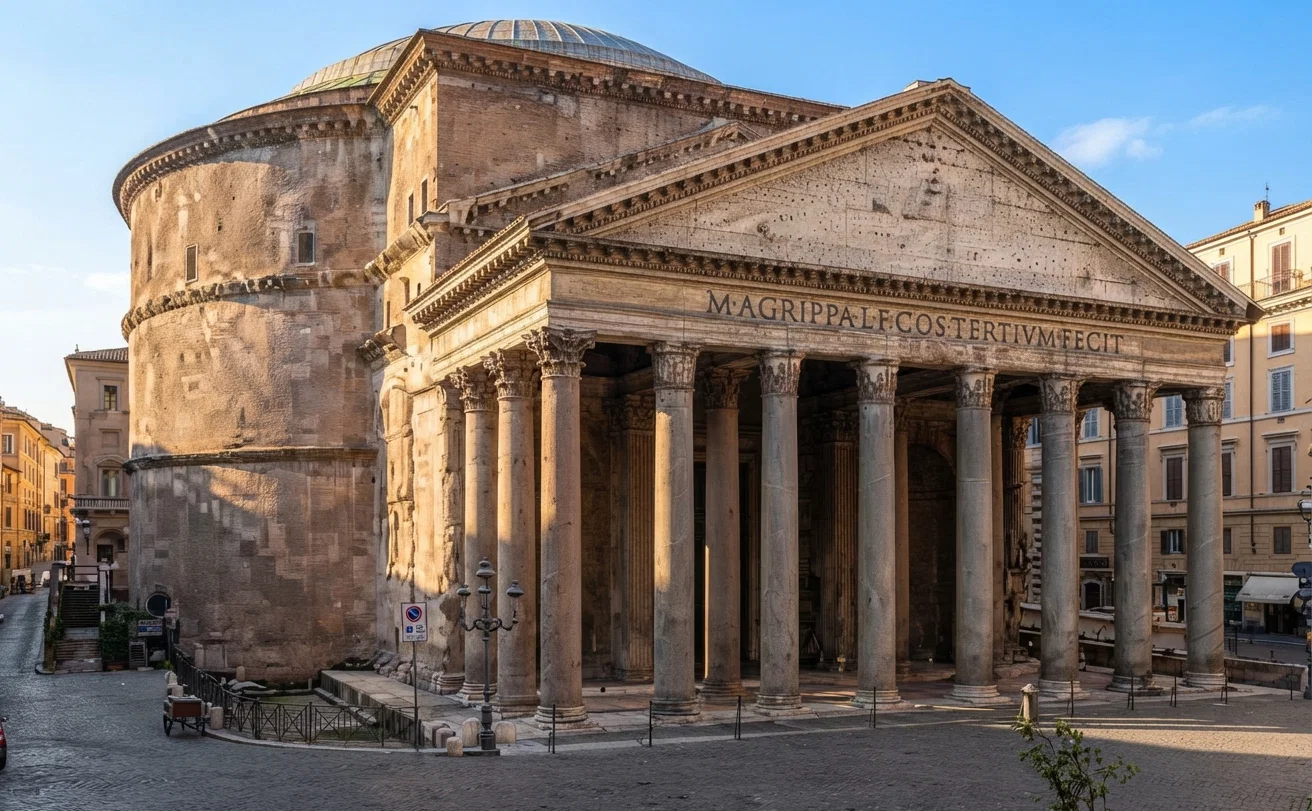
Pantheon of Agrippa, Rome.
Pope Gregory II. The people likewise rose in rebellion against the decree, so that the various factions in Italy stood together in defense of the sacred images and the pope. The pope entered upon the fight with great energy, and wrote a fierce and threatening letter to the emperor. The Romans took advantage of the controversy and proclaimed a republic at Rome with the pope as the head of the government. The emperor, desirous of punishing the rebellious Romans, and still intent on enforcing his decree against the images, sent a strong fleet against the city of Rome. But this fleet was shipwrecked on the way, and therefore he abandoned the attempt, and becoming occupied in more serious affairs in the East, he left the pope and Rome unmolested.
Grants Under Pepin.
Shortly after this time Luitprand, king of the Lombards, decided to conquer all Italy and make it subject to the Lombard rule. With this object in view, he advanced quickly against the Roman duchy; and the pope, finding himself opposed by a strong enemy, and without means of defense, appealed to Charles Martel, king of the Franks. While Charles Martel did not take up arms against the Lombards, yet he assisted in establishing a treaty of peace between them and the pope whereby the pope acquired new territory. But under Pope Zaccharias (741-752), hostilities broke out anew; for Astolf, king of the Lombards, again attempted the conquest of Rome. The pope appealed to Pepin, king of the Franks and successor of Charles Martel. Pepin descended in Italy and compelled the Lombards to make a treaty of peace with the pope, and to concede to the pope the Exarchate of Ravenna, Pentapoli, and the Duchy of Urbino. But as soon as Pepin had left Italy and returned to France, the Lombards renewed hostilities and besieged Rome, and again threatened the papal rule. Again responding to an urgent request of the pope, Pepin returned to Italy and compelled the Lombards to withdraw from papal territory and maintain the treaty made with the pope. At this time he also added another city to the papal territory. "And it is certain that as a consequence of this fact, the popes of Rome began to rule as sovereigns, and to be recognized as such by all, and from that time onward they ceased to place in their letters the date of the reign of the emperors as they were previously accustomed to do."
Charlemagne and the Church.
"When the Lombard tooth began to gnaw at the holy church, Charlemagne defeating them, under his wings gave her aid." In these words Dante speaks of the descent of Charlemagne in Italy in defense of the church. The Lombard king, Desiderius, in order to avenge some outrages committed against his friends by the papal power, and with the view of extending his dominions, marched against the city of Rome. Pope Hadrian I. fortified the city and at the same time sent messengers praying Charlemagne to come to his aid. The Lombard king, when he learned of the coming of Charlemagne, hastily withdrew from Rome and returned to his own kingdom. In the year 774, Charlemagne marched against the Lombards, but finding it impossible to cross the well-fortified passes in the mountains, was on the point of returning, when a priest offered his aid, and guided the Franks through in safety. And thus the Lombards were defeated, having a religious traitor in the camp. "Therefore from very remote times, in the bosom of the priest has reposed the spirit of political parricide and treason." Charlemagne immediately went on to Rome where he was received with great pomp and ceremony by the pope. At this time Hadrian asked Charlemagne to ratify the donations of territory made to the Papacy by Pepin; this he unhesitatingly did, adding also other territory, and signing it on the tomb of St. Peter. He then proceeded to the complete destruction of the Lombard power, which he shortly accomplished, and assumed the title of king of the Lombards.9"The Lombards were a people in advance of their times in civilization, and their laws and customs as compared with other parts of Italy and other nations, were far superior, and therefore, if it had not been for the pope's insatiable desire to domineer, Italy might have enjoyed peace and prosperity under the Lombard rule." But the popes of those times were the most crafty and ambitious of men." And, as says the poet, "Understand that the ambitious man is a cruel man."
Rome, Italy. C. E. MILTON.
(To be continued.)
OUR GREAT TREASURE-HOUSE
By Ellen G. White
BY MRS. E. G. WHITE.
I. GOD'S WORD OUR GUIDE.
THE one book that is essential for all to study is the Bible. Studied with reverence and godly fear, it is the greatest of all educators. Its pages are filled with truth. Would you gain a knowledge of God and of Christ, whom the Father sent into the world to live and die for sinners? An earnest, diligent study of the Bible is necessary in order to gain this knowledge.
The words of the Bible and the Bible alone should be echoed from the pulpits of our land. This book is our great director, given us by God. It is a lamp to our feet and a light to our path. It flashes its light ahead, that we may see the path over which we are traveling, and its rays are thrown back on the past, showing the most perfect harmony in that which, to the mind in darkness, appears like error and discord. In that which seems to the worldling an inexplicable mystery, the student of God's Word sees light and beauty.
We all need a guide through the many straight places of life, as much as the sailor needs a pilot over the sandy bar or up the rocky river; and where is this guide to be found? We point you to the Bible. Inspired of God, written by holy men, it points out with great clearness and precision the duties of both old and young. It elevates the mind, softens the heart, and imparts gladness and joy to the spirit. The Bible presents a perfect standard of character; it is an infallible guide under all circumstances, even to the end of the journey of life.
Compared with Words of Men.
Had it been essential for us to study the writings of the early fathers, Christ would have told us to do this. But the fathers do not all speak the same thing. Which of them shall we choose as a guide? There is no need for us to trust to such uncertainty. We pass by the fathers to learn of God out of His Word. This is life eternal, to know God. O, how thankful we should be that the inspired Word of God has been placed in our hands. Holy men of old wrote this Word as they were moved by the Spirit.
The commentaries written about the Word do not all agree. Often they come into collision with one another. God does not ask us to be guided by them, but by His Word. All can search the Scriptures for themselves. And they may know that the teaching of this precious Book is unchangeable. The opinions of human beings differ, but the Bible always says the same thing. The Word of God is from everlasting to everlasting.
God did not leave His Word to be handed down from generation to generation by oral transmission and traditional unfolding. Had He done this, the Word would gradually have been added to by man. Let us thank God for His written Word.
The Bible Is the Key
that unlocks the mysteries which it is essential for human beings to understand in order to gain eternal life. The Bible is its own expositor. Its bright beams are to shine into all parts of the world, that sin may be revealed. The Bible is a chart, pointing out the waymarks of truth. Those who are acquainted with this chart will be enabled to tread with certainty the path of duty, wherever they may be called to go.
He who will search the Bible with a humble, teachable spirit will find it a sure guide, pointing out the way of life with unfaltering accuracy. This book contains nothing that is non-essential, nothing that has not a bearing upon our lives. It teaches man how to simplify life's complicated experiences. It is an educator, endowing the simple-hearted followers of Christ with the wisdom that comes from the Author and Finisher of their faith.
If you would be strong, if you would have the integrity and wisdom of a Joseph or a Daniel, study the Scriptures. Parents, if you would teach your children to serve God and do good in the world, make the Bible your textbook. It exposes the wiles of Satan. It is the great elevator of the race, the reprover and corrector of moral evils, enabling us to distinguish between the true and the false. There is a rich mine of truth in this holy Book.
The sailor who has in his possession chart and compass, and yet neglects to use them, is responsible for placing the lives of those on board his vessel in peril. The vessel may be lost by his neglect. We have a Guide-book, the Word of God, and we are inexcusable if we miss the way to heaven, for plain directions have been given us.
Whoever will prayerfully study the Bible, desiring to know the truth, that he may obey it, will receive the divine enlightenment. He will understand the meaning of the words, "If any man willeth to do His will, he shall know of the teaching." As he endeavors to reach the highest standard, the Bible is as a light to guide his footsteps homeward. By studying it, he finds that he is a joint-heir with Christ to an immortal inheritance. The Guide-book points him to the unsearchable riches of heaven. Day by day the peace of God is his reward, and by faith he sees a home of everlasting sunshine, free from all sorrow and disappointment.
Every means of grace should be diligently improved, that the grace of God may abound in the soul more and more. We must have spiritual knowledge that we "may be able to comprehend with all saints what is the breadth, and length, and depth, and height, and to know the love of Christ," that we may "be filled with all the fulness of God."