Wartime Facts: Shipping, Bombing, Injuries, and Women's Candidacy
Page 2
The Youth’s Instructor
Apr 16, 1918
Review and Herald Publishing Assn. · Takoma Park Station, Washington, D. C. · Apr 16, 1918
Wartime Facts: Shipping, Bombing, Injuries, and Women's Candidacy
There were 68 Dutch vessels in New York Harbor alone when Dutch shipping was taken over by the United States and England.
German airships have dropped over one thousand bombs on beautiful Venice. Much damage has been done, though the most interesting historical places have escaped serious injury.
Every man who goes to the war takes about one chance in thirty of injury to his arm, one chance in one hundred of losing one or both legs, and about one in ninety of being blinded.
April 6, the first anniversary of the war, was celebrated throughout the land as “Win-the-war Day.” Every citizen—man, woman, or child—was asked to stop work or play one minute on that day and pledge allegiance to the nation.
Miss Anne Martin, of Nevada, has announced her candidacy for the United States Senate, to complete the unexpired term of the late Senator Newlands. This is the first time that a woman has knocked at the door of this conservative branch of Congress.
Before the war, in proportion to her population Belgium was the richest country in Europe. In the early days of the occupation, Germany modestly demanded only foodstuffs, cattle, horses, and fodder; today Germany drains from her $100,000,000 a year.
Dr. Henry G. C. Hallock, a missionary in China for twenty-two years, has just completed his concordance of the Bible in Chinese. This work contains 5,000,000 Chinese characters, and 4,000 direct and indirect Bible references. Its compilation has required twelve years of close application and many thousands of dollars.
John D. Rockefeller will pay this year to the Government approximately $38,400,000 income tax if the estimate recently made by a financial authority is correct. This is within $3,000,000 of the amount collected in personal income taxes from the entire country in 1915. The thirty wealthiest persons of the country will pay about $124,500,000, which is nearly four fifths of the total income tax receipts for 1917.
The populace of London and several of the counties of England, from the king down to the humblest subject, are now on compulsory rations of meat, butter, and margarine. No one is permitted to buy any of these food materials without a card. The weekly allowance of meat is twenty ounces for adults and ten ounces for children under ten years. The butter or margarine ration is four ounces weekly per person.
A salary of $75,000 with allowances for traveling expenses up to $25,000 extra and $160,000 for clerk hire and White House expenses, or $260,000 altogether, seems a lot of money to ordinary wage-earning citizens for one family to use in a year. Yet it is true that the President spends that amount and often more in meeting the various expenses connected with his position. The President’s job isn’t a money-making one. Many Presidents have come out of the White House poorer than when they went in. Some of the White House mistresses have had private incomes of their own to help them out. It is said, however, that the present Mrs. Wilson is the only President’s wife who has ever had a private income large enough to enable her to live up to her position.
Harold R. Peat, a Canadian soldier, spent two years at the battle front. He was wounded twice, thus being disabled for future military service. When asked by the editor of Every Week for the most tender, gentle thing he ever saw a soldier do, he replied: “After the first gas attack at Ypres, in April, 1915, I was knocked out for a while and was in the clearing station at Merville. One day when I was lying there on a stretcher a poor miserable soldier came in. He was covered with mud and blood. He was minus his overcoat, and his tunic was torn by shrapnel. He was soaked to the bone, for it was raining, and he was shivering with cold and pain. The nurse hurried to him and asked what had become of his overcoat. ‘O,’ he said, his teeth chattering, ‘my pal was killed back there, and he looked so cold, lying there in the rain, I took off my coat and put it over him.’”
Joseph Heifetz, a Russian Jew, is world-famous at the age of seventeen. Almost as much of a prodigy as Mozart, he began his regular musical studies at the age of three, played the Mendelssohn concerto in public at six, was graduated from the conservatory at eight, and made his début at ten.
Let Us be Kind
LET us be kind;
The way is long and lonely,
And human hearts are asking for this blessing only —
That we be kind.
We cannot know the grief that men may borrow,
We cannot see the souls storm-swept by sorrow.
But love can shine upon the way today, tomorrow —
Let us be kind.
Let us be kind;
This is a wealth that has no measure,
This is of heaven and earth the highest treasure —
Let us be kind.
A tender word, a smile of love in meeting,
A song of hope and victory to those retreating,
A glimpse of God and brotherhood while life is fleeting —
Let us be kind.
Let us be kind;
Around the world the tears of time are falling,
And for the loved and lost these human hearts are calling —
Let us be kind.
To age and youth let gracious words be spoken,
Upon the wheel of pain so many weary lives are broken,
We live in vain who give no tender token —
Let us be kind.
Let us be kind;
The sunset tints will soon be in the west.
Too late the flowers are laid then on the quiet breast —
Let us be kind.
And when the angel guides have sought and found us,
Their hands shall link the broken ties of earth that bound us,
And heaven and home shall brighten all around us —
Let us be kind.
— Author unknown.
Old Spot Pond
By S. J. Townsend
S. J. TOWNSEND
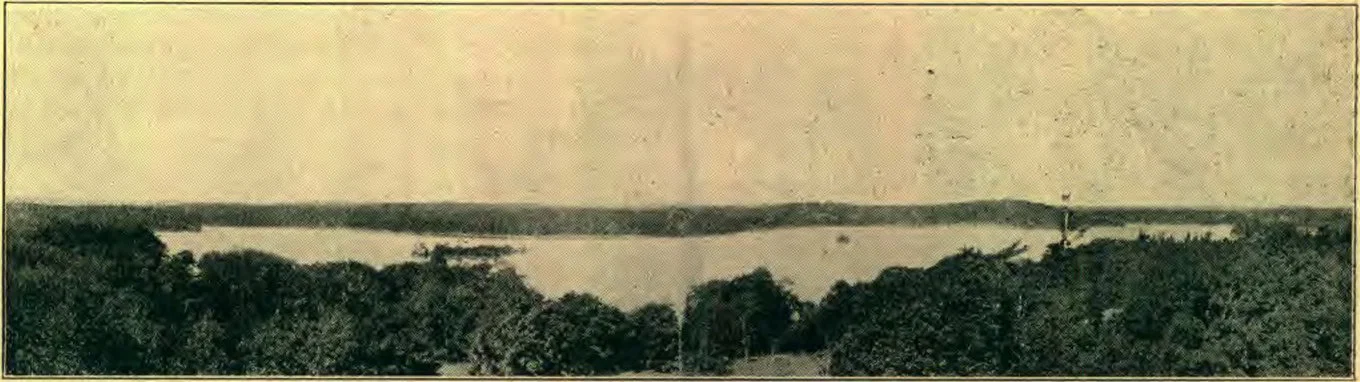
OLD SPOT POND, A LAKE NEAR BOSTON, MASSACHUSETTS
To my winter home, where I love to dwell
On the balmy shores of Lake Estelle,
Came a little bird one morning in spring,
And these were the words that he seemed to sing:
“O come, go with me to a realm afar,
That lies ’neath the gleam of the cold North Star,
And I’ll show you a beautiful lake that dwells
All alone in the midst of the Middlesex Fells;
“Where the days are joyous, and skies are fair,
And the heart is buoyant and free from care;
Where the peaceful calm of a quiet retreat
To the weary soul brings a comfort sweet.”
Then the bird took wing and I followed fast,
Till your lovely shores I have reached at last;
And though he has flown to the lands beyond,
I have stopped here to visit you, Old Spot Pond!
From the southern home of the summer sun,
Where the zephyrs scorch till his race is run,
I have come to the cooling winds that play
Hide and seek ’mid your isles the livelong day;
And to feast on your beauty at every turn,—
Your necklace of bowlders and fronded fern,
So daintily imaged one scarce can trace
’Twixt their mirrored smile and their virgin grace;
The faultless profile of Turtle Rock;
And the shadowy coves, which the paths unlock
To the grand old forest that wraps about
And hides your charms from the world without.
While at each new glimpse of your smiling face,
’Round the glancing curves that your shore lines trace,
Your mingled glory of earth and skies
To my raptured soul brings a glad surprise.
But alas! wherever I turn, I see
The words of warning on post or tree:
“No one is allowed here to skate or boat,
Or in these waters to swim or float.”
Dear me! and the songster, with never a tear,
Has taken his flight, and has left me here!
When of all these pleasures I am so fond,
What a mean, selfish thing you are, Old Spot Pond!
“Hold, hold! not so fast now, my little maid,
Restrain for a moment your rash tirade.”
(Thus in low, soft accents I seem to hear
A voice from the pines, on an island near.)
“Be seated, I pray, on this great stone chair,
And I’ll tell you a story of joy and despair:
Not always was I the captive you see,
So selfish and lone; for I once was free—
“Free as the fawn that came to drink
In the noonday heat at my cooling brink;
Free as the waterfowl that flew
Along the shores in the morning dew;
“Aye, free as the children of the woods,
Who roamed at will ’mid their solitudes;
And never a lassie, or brown or blonde,
Was e’er turned away from Old Spot Pond!
“But along came some men one day, and by stealth
They bound me (they said) for the commonwealth.
And imprisoned within a wall of stone,
I was told that henceforth I must dwell alone.
“I fretted and mourned, till my troubled waves
Had worn my banks into mimic caves;
I wept, till every green thing that grew
Was wet with my tears, like the falling dew;
“Then the commonwealth, with its magic wand,
Transformed me, from being a humble pond,
To a beautiful lake, so deep and wide
That all trace of my former self I hide.
“And an arm which they gave, that I might reach out
To the welcoming towns lying round about,
Stretched away, till the world-renowned city beyond
Felt the touch of the hand of Old Spot Pond!
“Where once the denizens of the wild
Along the paths through my marshes filed,
Now a nation makes pilgrimage to my shores,
And my beauty with rapture and praise adores.
“For each fawn that came to my humble brink,
In the olden time, for a noon-day drink,
A thousand children are lifting up
Their dainty lips to my crystal cup.
“By the couch of the sick, with a tear I bow,
And lay my hand on the fevered brow.
I temper with frost the summer’s heat,
And with tropic breath the winter’s sleet.
“To the sunburnt sward and the thirsting flowers,
From cloudless skies I bring fresh showers.
I light the demons of fire and flame,
And hurl them backward to whence they came.
“I turn the wheels in the marts and mills;
I light the lamps on the seven hills;
In the lowly cot, and the halls of state,
I minister now to the small and great.
“I flow as a fountain of life and health
For the rich and the poor of the commonwealth;
And no prince of the realm, with his regal wand,
Is more loved and honored than Old Spot Pond!”
Forgive my unkindness, dear Old Spot Pond,
In your royal robes with their fringe of frond!
For I am the one with the selfish heart,
While for you has been chosen the better part.
Your power to serve, so meager of old,
Has been multiplied full many a fold.
And you are the prince of the realm, who reigns,
And the world is blessed by your prison chains.4
I shall love you still; for your shores abound
With a pristine beauty I’ve seldom found;
Where the soul may sit at the Master’s feet,
And beholding his works, find communion sweet.
I shall love you the more for your fetters of stone
Which hold me aloof, and that keep you lone;
For a lesson you’ve taught me of hope and love,
And of faith and trust in our Father above.
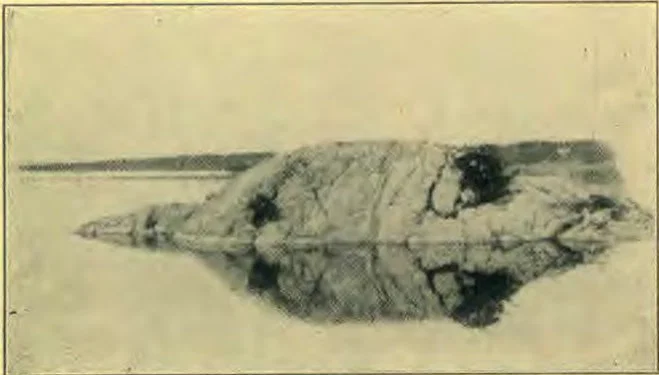
TURTLE ROCK
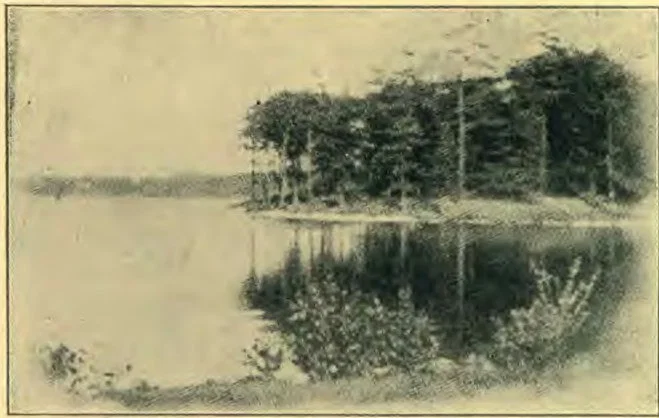
PINE POINT, ON OLD SPOT POND
When my little life, with its quiet content,
Seems all broken up, and my heart is rent,
And there rises around me a wall so high
That I scarcely can see to the vaulted sky,
May I trust with a love that casts out fear,
That my Father’s presence is ever near;
And that he erelong to my soul shall give
A far broader and nobler life to live.
For “all things work together for good
To them that love him” as true hearts should;
And this great truth, by your life impressed
On my weary heart, has brought me rest.
And so now I thank you, my new-found friend,
For the goodly lesson your life shall lend;
May our friendship be sealed with many a bond,
Nevermore to be broken, dear Old Spot Pond!
Answered Prayers
Anita’s Prayer
A NEIGHBOR’S house was burning. When observed, it was too far gone to be saved, therefore the efforts of the people were given to the protection of a near-by house upon which burning brands were falling.
In the absence of a fire department and of men, a generous-hearted neighbor woman climbed upon the roof of the endangered home, and poured pails of water upon it. When this woman’s little girl saw her mother in this dangerous position, she was frightened, and said to a friend standing by, “There’s my mother on the roof of Brother Leach’s house; I must go and pray the Lord to take care of her and of Brother Leach’s house.” This she did. The woman to whom Anita had spoken followed the child to see if she really did as she had suggested doing. Glancing through the window, the woman observed the child on her knees by the bed, earnestly beseeching the Lord to “keep my mother from getting hurt and Brother Leach’s house from burning.”
Surely the Lord, to whom the prayer of earnest faith is the sweetest of music, heard and answered Anita’s prayer.
Don’s Prayer
Don had mislaid his library book. He could not find it even with the earnest assistance of other members of the family. More than one faithful search had been made for it; but without success. It was a book of worth, and Don felt the importance of finding it. So as he sat thinking about it, he felt impressed to ask the Lord to direct his search. This he did, with the result that the missing book was soon found. The answered prayer brought great joy to Don.
Don’s mother was away from home at the time of the finding of the book, so on her return he related his experience. He said that as he sat thinking of his failure to find the book he thought, “Well, if Jesus is good for anything he knows where that book is, and can help me find it. So I went to my room, shut the door, and kneeling by my bed I asked Jesus to help me find it. When I got up from my knees, it seemed as if somebody was right by me pushing me straight to the place where the book lay.”
Don was a very happy boy to think Jesus heard and so signally answered his prayer. But Jesus is doing just this way by somebody all the while. Now it is possible that some other time Don might ask Jesus for something as definitely as he did this time, but he would not receive the answer in the same way. Jesus would hear, but in his great love and wisdom he would know that it was not best to do just what Don wanted him to do. We must always pray that God’s will be done, whether it is our way or not.
Dr. Barnardo’s Prayer
“Dr. Thomas J. Barnardo, the famous ‘father of nobody’s children,’ who during his lifetime rescued thousands of homeless London waifs, tells this story among hundreds of other incidents: One bitterly cold winter the children were shivering for want of warm clothing, and there was not a penny on hand to buy it. Dr. Barnardo took the matter to God, but no money came. He went to a merchant, and selected the clothing needed, but found that it cost $500. He would not go into debt, so he returned home without the goods, and prayed to God to supply the need. The next morning the first letter he opened contained a check for $500, ‘to provide clothing for the children.’”
The Teachers’ Prayer
Dr. William Burt, European Bishop of the Methodist Episcopal Church, when he visited the Boys’ School in Vienna about two years ago, “found that although the year was not up, all available funds had been spent. He counseled with the teachers, and they decided to take the matter to the Lord in prayer. Ten days later he was in Rome, and there came to him a letter from a friend in New York which read as follows: ‘As I went to my office on Broadway one morning [and the date was the very one on which the teachers were praying], a voice seemed to tell me that you were in need of funds for the Boys’ School in Vienna. I gladly5inclose a check for the work.’” The check just covered the amount needed. There was no human communication between Vienna and New York, “but while they were yet speaking God answered their request.”
The Captain’s Prayer
“When the Second Massachusetts Volunteers marched into the Southland in the days of the Civil War, Johnny Ring, sixteen years old, went as orderly to Captain Conwell, a young lawyer. The boy was passionately devoted to his captain, who laughed at his religion, particularly the boy’s fidelity in reading the Bible.
“‘Why do you do it?’ asked the captain, who was an agnostic, ‘it is full of lies.’
“‘Because my mother made me promise I would,’ replied Johnny. Daily he knelt in prayer in his tent, which annoyed Conwell.
“‘One day the Union soldiers were driven across the river. Johnny Ring remembered that the captain’s sword, which was presented him by the citizens of Springfield, Massachusetts, had been left in the captain’s tent. He crossed the river, got the sword, clasped it to his bosom, and started back toward the Union troops under the fire from both armies. He made his way across a burning bridge and fell into the arms of his friends, gasping out, ‘Give the captain his sword.’ He was mortally wounded, and died a few hours later.
“‘When Captain Conwell heard of Johnny Ring’s sacrifice, he was greatly disturbed. He prayed that night, ‘O Lord, why did you spare me, the agnostic, and take the life of that splendid Christian boy?’
“‘A month or so later Conwell was left for dead on the battle field. As he lay there through the long night, facing death, he offered another prayer: ‘O Lord, if you spare me, I will give my life to the service of Jesus Christ. I will live two men’s lives, God helping me, one for Johnny Ring and one for Conwell.’ The prayer was heard. He was found, and carried to the field hospital the next morning.
“‘That is why Rev. Dr. Russell H. Conwell, pastor of the Baptist Temple, Philadelphia, has been endeavoring for more than half a century to crowd sixteen hours of work into each day—eight hours for Johnny Ring and eight hours for Conwell.’
If our eyes could be opened to see all the results of just one day’s answered prayers from every corner of the earth, a wonderful story of love and wisdom would be revealed. Let us trust the Lord more. Let us pray more.
In the Christian Pathway as Seen by Others
SPEAKING on the point that Daniel, though a very busy man, found time to pray, D. L. Moody said: “I am reminded of the words of an old Methodist minister: ‘If you have so much business to attend to that you have no time to pray, depend upon it you have more business on hand than God ever intended you should have.’”
One of the best governors of the Isle of Man was impeached for treason in the civil wars, and sentenced to death. The king granted a pardon, but it fell into the hands of a bitter enemy of the governor, who never delivered it, and the governor was executed. We hold in our hands the pardon of the world; shall we hold it back?
Dr. W. L. Watkinson describes a physician demonstrating to an audience before whom he was lecturing how the pulse varied in certain diseases. The lecture-room was placed in telegraphic communication with the hospital, fifteen miles distant; and then, by means of special apparatus and a vibrating ray of magnesium light, the pulse beats of a patient were exhibited upon the wall. “There is not a throb of our heart,” adds the preacher, “but makes its sign upon the Great White Throne.”
A missionary said she did her best teaching when she dressed the dear little body of the baby that had left her, putting on its prettiest frock, brushing back its flossy hair, laying a rosebud in its waxen fingers, and then called in the heathen women to look at it. They sobbed out in their astonishment, “You’ve fixed your baby up to go to a lovely place, and you expect to see her again. When ours die, we throw their poor little bodies out for the dogs to eat. They have gone into darkness, and we have no hope of ever seeing them again. We want to know about your Jesus who will take care of your baby, and let you have her again.”
A missionary in China writes of a girl in the mission school under her care, that one night she came to her and said, “Teacher, I want you to pray that I may be a whole Christian.” Struck by the expression, the teacher inquired what she meant. So the girl told her of certain things she had done that day that she felt to be wrong, and of things she had failed to do, which her teacher had commanded her. All this she instinctively felt was not in keeping with the spirit of the gospel. So she came with tears in her eyes at the close of day, saying, “Oh, teacher, I want you to pray for me that I may be a whole Christian!”
John Wesley was walking one day with a troubled man who expressed his doubt of God’s goodness. “I don’t know what I shall do with all this worry and trouble,” he said. At that moment Wesley noticed a6cow looking over a stone wall. “Do you know,” asked Wesley, “why that cow is looking over that wall?” “No,” replied his troubled companion. “I will tell you,” said Wesley: “because she cannot see through it. That is what you must do with your wall of trouble—look over it and above it.” Faith enables us to look over and above every trouble, to God, who is our help.
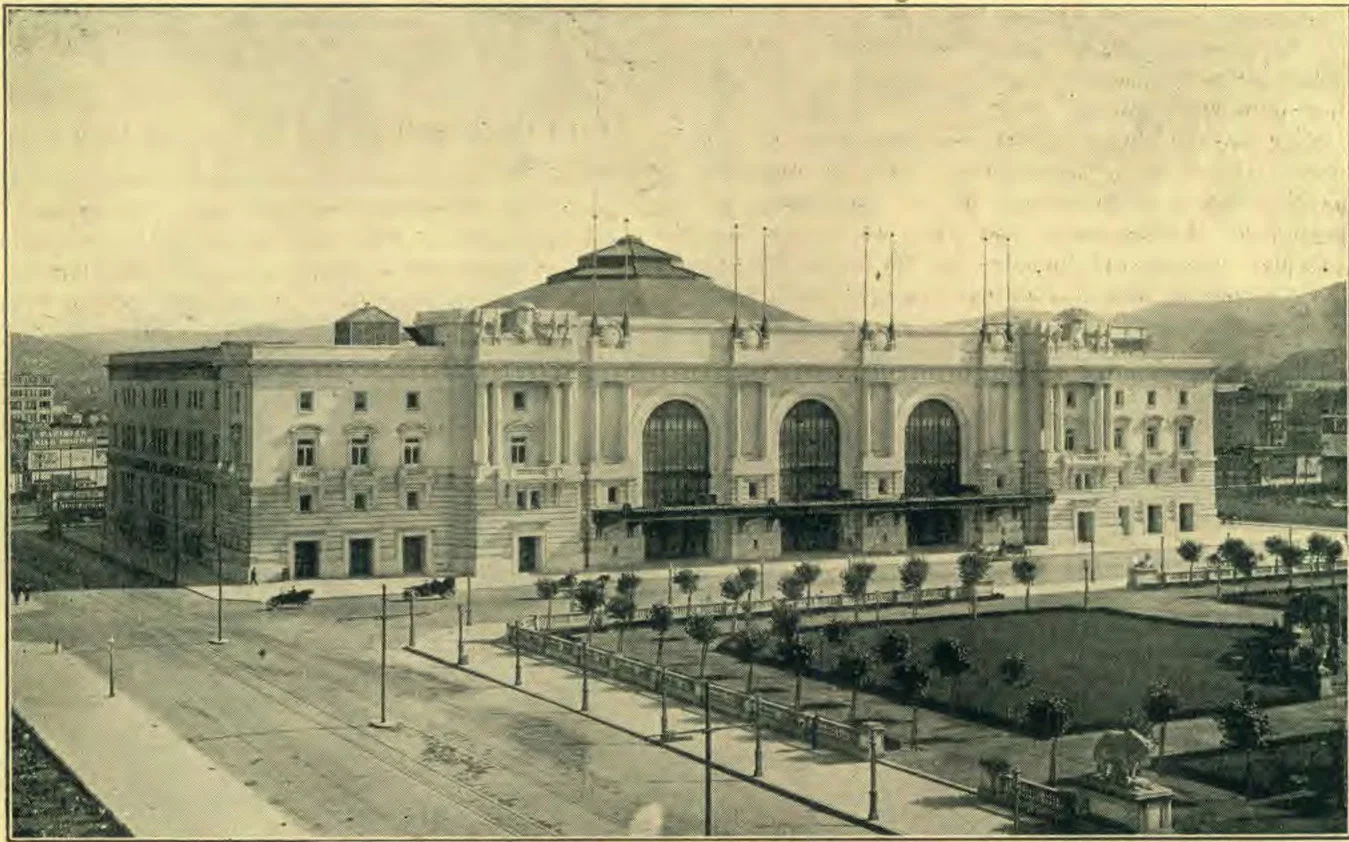
EXPOSITION MEMORIAL AUDITORIUM
In the early days of emigration to the West, a traveler once came, for the first time in his life, to the banks of the mighty Mississippi. There was no bridge. He must cross. It was early winter, and the surface of the great river was sheeted with gleaming ice. He knew nothing of its thickness, however, and feared to trust himself to it. He hesitated long, but night was coming on, and he must reach the other shore. At length, with many fears and infinite caution, he crept out on hands and knees, thinking thus to distribute his weight as much as possible, and trembling with every sound. When he had gone in this way, painfully, about halfway over, he heard a sound of singing behind him. There in the dusk was a colored man, driving a four-horse load of coal across the ice, and singing as he went! Many a Christian creeps tremblingly out upon God’s promises, where another, who is stronger in faith, goes singing through life upheld by the same Word.
Speaking of the Cuban War and his Rough Riders, Colonel Roosevelt declared: “The men I cared most for in the regiment were the men who did the best work; and therefore my liking for them was obliged to take the shape of exposing them to the most fatigue and hardship, of demanding from them the greatest service, and of making them incur the greatest risk. Once I kept Greenway and Goodrich at work for forty-eight hours without sleep and with very little food, fighting and digging trenches. I freely sent the men for whom I cared most where death might smite them, as it did the two best officers in my regiment, Allyn Capron and Bucky O’Neil. My men would not have respected me had I acted otherwise.” One must not be surprised if Jesus chooses the same method of winning his battles.
John Wesley's Argument
MR. WESLEY, in speaking of the inspiration of the Scriptures, gives the following argument concerning them. He says:
“I beg leave to propose a short, clear, and strong argument to prove the divine inspiration of the Holy Scriptures.
“The Bible must be the invention either of good men or angels, bad men or devils, or of God.
“1. It could not be the invention of good men or angels, for they neither would nor could make a book and tell lies all the time they were writing it, saying, ‘Thus saith the Lord,’ when it was their own invention.
“2. It could not be the invention of bad men or devils, for they could not make a book which commands all duty, forbids all sins, and condemns their own souls to hell for all eternity.
“3. Therefore, draw the conclusion that the Bible must be given by divine inspiration.”
What God Hath Promised
By Annie Johnson Flint
God hath not promised
Skies always blue,
Flower-strewn pathways
All our lives through;
God hath not promised
Sun without rain,
Joy without sorrow,
Peace without pain.
But God hath promised
Strength for the day,
Rest for the labor,
Light for the way,
Grace for the trials,
Help from above,
Unfailing sympathy,
Undying love.
*—Annie Johnson Flint,
in Christian Endeavor World.*
Subscriptions Taken While You Wait
By Ernest Lloyd
WHILE waiting for a train at —,” writes a church missionary leader, “a young man came and stood near me. I was impressed to give him a tract, which he immediately began to read. Shortly afterward, he turned and said, ‘Can any one subscribe for this paper?’ I did not understand just what he meant, but it soon dawned upon me that he referred to the Signs weekly which was advertised on the last page of the tract. I answered in the affirmative, referring him to the Signs office; but he asked, ‘Can’t you take the subscription?’ It did not take me long to assure him that I could. My heart was rejoicing. The young man handed me forty cents for a three months’ subscription, the paper to be sent to his dear old mother away back in Tennessee. He said he wanted her to know that her boy had not forgotten his mother. So you see we cannot tell what a little tract will accomplish. May the Lord constrain more of his people to be ready with the printed pages when an opportunity comes.”
Thus the Lord is working through those who have the spirit of readiness to serve. “Let us remember that if the opportunities for great deeds should never come, the opportunity for good deeds is renewed for us day by day.” The passing of a tract, the mailing of a paper, the selling of a magazine, the lending of a book—these are among the good deeds that all Adventists can perform, and they are sure to count for righteousness, ERNEST LLOYD.
Knowledge and the Restraint of Words
“He that hath knowledge spareth his words.”
For the Finding-Out Club
By Grace Pickard
Part I
WHAT was Jesus to every Bible writer, as expressed in every book of the Bible?
Part II
Guess Who
1
I WAS a queen with some very fine clothes,
And I came with my jewels and gold,
To learn of King Solomon’s wisdom and wealth,
For the half had never been told.
2
I was a leading Israelite,
And strong beyond belief;
But I talked too much to a lady friend,
And then I came to grief.
3
A patriarch I, both wise and wily,
With many a sturdy son,
I served seven years for the girl of my heart,
’Twas her sister that I won.
4
I was the fairest maid on earth,
A garden was my home;
I only ate some tempting fruit,
And then I had to roam.
5
When I was sent to tell some men
What were the Master’s wishes,
I ran away to weep and mourn,
And landed ’mong the fishes.
6
I lived a long and useful life,
One hundred years, and twenty more.
I weary grew of so much strife,
And longed to find my wanderings o’er.
My eyes, but not my feet, found rest
Upon the land I loved the best.
7
I lived in the city of Sodom,
Though that was hardly my fault,
And when I started to leave it
I was turned to a pillar of salt.
8
Two well-known sisters we,
And one was called a shirk,
For she loved to sit at the Teacher’s feet
While her sister did the work.
9
I was a Roman governor,
And, though I had no reason,
I told St. Paul to come again,
At a more convenient season.
10
’Tis wrong to tell of my good deeds,
But then they were so many!
I made a lot of coats and things,
For those who hadn’t any;
I worked so hard it made me ill,
I had to die; and then
St. Peter came and raised me up,
And I went to work again.
11
I was the king of Babylon,
But I would not mend my ways,
So I lost my throne and golden crown,
And was turned out to graze.
12
I thought I was a nice young man
And I had long curly hair,
But my head got caught in a big oak tree,
And left me hanging there.
13
My brothers threw me in a pit,
For I was father’s pet;
If the Midianites had not arrived,
I might have been there yet.
14
I lived in the land of the Persians and Medes
And a mighty man was I,
Till I tried to deceive the Jewish queen,
And they hung me up on high.
— Lillis M. Phelps in the Young Pilgrim.
Members of the 1918 Finding-Out Club
WE are glad to begin the 1918 Finding-Out Club membership with the names of Mrs. Grace Hoover and Lester M. Roscoe, each of whom sent in an excellent set of answers to the lists of inventions found in the issue of February 26. All answers were not just the same as those given in this number; but it is not always easy to determine just who really deserves the credit for a given invention. Frequently several persons may be working upon the same idea at the same time, and may therefore produce results at about the same time. Authorities in such cases are not always agreed as to whom credit should be given.
Mrs. Grace Hoover Lester M. Roscoe
Grace Pickard
Answers to Questions Printed February 26
ARCHIMEDES invented the burning glass, the endless screw, and the reflecting mirror.
Berthold Schwartz and Roger Bacon invented gunpowder.
Galileo invented the thermometer.
Johann Gutenberg is quite generally given the credit for inventing movable type, but the Britannica gives the honor to Lourens Janszoon Coster.
The first practical discovery of the telescope was made in Holland about 1608. Hans Lippershey, Zacharias Jansen, and James Metius are all given credit for its invention. Galileo may be said to have invented the8telescope independently, but not until after he had heard of the Dutch invention.
Volta invented the modern battery.
John Harrison invented the chronometer.
Lionel Lukin invented the lifeboat.
Humphry Davy invented the miner’s safety lamp.
Lewis Paul, James Hargreaves, and Richard Arkwright all receive credit for the spinning jenny.
Eli Whitney invented the cotton gin.
Robert Fulton invented the American steamboat.
George Stephenson invented the steam locomotive.
Louis Jacques Mandé Daguerre began the modern art of photography, through the invention of the daguerreotype.
Samuel Finley Breese Morse invented the electric telegraph.
Cyrus Field invented the ocean cable.
Charles Goodyear invented the process of vulcanizing rubber for commercial use.
John Ericsson invented the revolving turret used on battleships.
Charles Wheatstone invented the stereoscope.
Henry Bessemer invented the modern process of preparing steel for many uses.
It was not until the beginning of the nineteenth century that any attempt was made to invent a reaping machine on anything like the lines that have been adopted since. In 1826 Patrick Bell made the first reaper that proved a practical success. The present or recent form of the common reaper was evolved by an American, C. H. McCormick, in 1831.
Elias Howe invented the sewing machine.
Richard Jordan Gatling invented the destructive cannon that bears his name.
Alfred Nobel invented dynamite.
Wilhelm Konrad Röntgen invented—or discovered—the X-ray.
George Westinghouse invented the air brake, which has made traveling by rail infinitely more secure than before it came into use.
Threats Frighten Debtors
A JEWELER on Long Island, recently concluded to go out of business. Thousands of dollars of bad debts had accumulated on his books, and as he desired to move away from the town he took a novel plan of collecting those bills. He did not say in the paper that he was selling out and leaving town, and trusted that the people who had owed him money so long would call and settle, but put the following unique advertisement in a local newspaper: “I shall publish the name and exact address and vocation of each of the persons who have persistently neglected to settle their accounts, giving in my usual style a psychological treatise on their character and make-up. The paper goes to press at 10:30 A. M., and all who are anxious to have their character defined in print should not settle their accounts before that time.”
Immediately debtors began to appear and pay their bills, and for a whole week, up to the moment of going to press, the store was thronged with delinquents, and the proprietor had little time for much else than receipting the bills long overdue. Men who had bought engagement rings on credit, and others who had purchased presents that they did not care to have published, all paid up. The jeweler said that he was now able to leave town in a happy mood, as not a mortal in it owed him a cent.
There are thousands of merchants who fail because many of their customers are slow pay or no pay at all. Some of these merchants are partly to blame themselves, for they are so anxious to sell the goods that they are too easy with their credits. Debt is a dangerous thing. The dishonest man will be careless of his obligations and will often get credit on purpose to dead-beat the merchant. But honest people often get into the slovenly habit of having everything “charged,” and then have a hard time to settle the bill. A good rule for beginners, and even for older persons, is to buy only what there is money to pay for. It is dishonest to go in debt without the probability or certainty of payment.— Christian Herald.