SEVERAL months ago a letter came to the office of the Maine Tract Society from a young woman in Massachusetts, saying that on a certain day and at a certain hour she would be at the office, and, if permission were granted, would take up the sale of one of our magazines. She also said that, if they looked upon her application with favor she should like for them to have on hand six hundred magazines at that time. She sent with this request the best of references.
The tract society made close investigations with reference to her standing, and found everything satisfactory, though she was not of our faith. The magazines were ordered.
At the appointed day and the exact hour, the young woman appeared at the office, introduced herself, and said that she was ready to begin work. Cash was paid for the magazines, and she began operations.
Since that time she has been selling at the rate of from twelve hundred to fifteen hundred copies a month, confining her work to the city of Portland. Her sales usually vary from one hundred to one hundred and fifty copies each day she works.
This experience has at least two valuable lessons in it. First, God will find material with which to give the message to all the world in this generation, even if the stones are made to cry out. Second, our magazine agents as a rule are inclined to cover too much ground in their work. It is better to work territory closer and more systematically.—Atlantic Union Gleaner.
The Greater Blessing
“It’s hard at times to believe that there is some One watching over the affairs of this world,” said Jack Graham to his minister. “For example, here is an account in today’s paper,” he continued, “where twenty miners were entombed by an explosion. A crowd collected at the mouth of the mine. The manager declared that another explosion might occur at any moment. Any attempt at relief would be very dangerous business. Yet three men came forward, recognizing the danger, but ready to risk their lives in the attempt to save their fellows. The car started down with the three men in it. Before it reached the bottom, another explosion took place, and all three were immediately killed. Can it be possible that there is a God of love ruling the universe when such noble heroism is no better protected than that?”
Dr. Brown sat thinking before he spoke. “Suppose, Jack,” he said at length, “that God always miraculously guarded the lives of all heroes, so that no hero were allowed to lose his life in noble adventure? Would that seem to you a better-conducted universe than the one we now have?”
“Of course it would!” answered Jack, with conviction. “Is there any question about it?”
“Well, let us see. Then the next time an explosion occurred in a mine and men were imprisoned, any man in the crowd could step forward and offer to go to the relief carelessly, in the absolute certainty that he would return alive. He would not run the slightest9risk. But by the same token, heroism and all possibility of heroism would be taken from the life of the world. Nothing would be left to be heroic about. There would never be the slightest risk. What a tawdry thing human life would be if there were never anything daring and heroic in it!”
Jack sat thinking over the clergyman’s words. “Doctor,” he said, earnestly, “I can see that it’s better for us to have a world where the most awful tragedies do occur than it would be to have a world where no moral heroism could ever inspire the race.”—The Youth’s Companion.
Forty-Sixth Psalm Set to Music by Washburn
THE GLORY OF THE CELESTIAL CITY STREAMS FROM THE GATES AJAR
The forty-sixth psalm, or “refuge psalm,” has been set to music by Elder J. S. Washburn. Thirty-three pages, octavo. Fifteen choruses, solos for soprano, contralto, tenor, and bass. Illustrated by appropriate pictures of real artistic merit. Price, 50 cents; better binding, $1. Present introductory price, 25 and 50 cents (one and two shillings). The usual discounts to agents and tract societies.
Forty-Second Week
October 17.Mark 15, 16: Review Mark’s Gospel, and note some of the points in which it differs from Matthew’s.
October 18.Luke 1, 2: The child Jesus. Read the introduction to Luke.
October 19.Luke 3 to 5: Preaching of John; the temptation; “Follow me.”
October 20.Luke 6 to 8: True Sabbath keeping, etc.
October 21.Luke 9 to 11: The twelve sent out; the seventy; “Teach us to pray;” etc.
October 22.Luke 12 to 14: Warnings against hypocrisy, etc.
October 23.Luke 15 to 19: Precious parables; second coming of Christ; his death foretold; triumphal entry; etc.
If You Have Time
Compare the Gospel of Mark with that of Luke, noting differences.
Begin a list of miracles and parables mentioned in each Gospel.
Add to your list of references on proper Sabbath observance.
Luke and His Gospel
Like Mark, Luke was not one of the twelve, yet he was chosen for the high honor of writing an account of the life and sufferings of our Lord, and an early history of the church. From his opening statement it appears that many at that time at least began a record of the wonderful things upon which their faith and hope were based; but of all these only four have been preserved to us. This is not a matter for regret. The Lord knew how many were needed, and which ones; and we may be very sure that his hand guided in this matter. These are sufficient to introduce us to him whose character and sacrifice will be our theme of study and praise during eternal ages.
Luke’s Gospel was the third in order of time, and is supposed to have been written about twenty-eight years after the resurrection of Jesus. Luke “used many sources of information, and doubtless he was more or less dominated by the spirit of Paul. The Gospel is intended for all, but especially for the Greeks. This is the most complete Gospel. In this Gospel, women appear most often. It preserves for us a number of most beautiful hymns. It uses many words peculiar to Luke, which serve to bind together the Gospel and the Acts, and prove them to be by one author.”
Of the personal history of Luke very little is known. By Paul he is called “the beloved physician,” and we know that he was the friend and companion of the great apostle to the Gentiles. Luke’s own writings contain “the least possible reference to himself, yet we cannot doubt that he was eminently useful to the early church by his learning, judgment, fidelity, and even his medical skill.” The “most excellent Theophilus” to whom Luke inscribes his Gospel, is supposed to have been “a Gentile of rank and consideration, who came under the influence of St. Luke or under that of St. Paul at Rome, and was converted to the Christian faith.”
“It pleased God to have the earthly history of our divine Redeemer written by four different men, two of whom belonged to the inner circle of companionship of our Lord, Matthew and John who were numbered among the chosen twelve; and two of them, Mark and Luke, were ardent believers, though not numbered among the twelve apostles. Thus we have two witnesses from within and two from without that distinguished hand, all bearing united testimony to the same great facts concerning our Lord.”—Starr.
Greatest Graveyard of Shipping
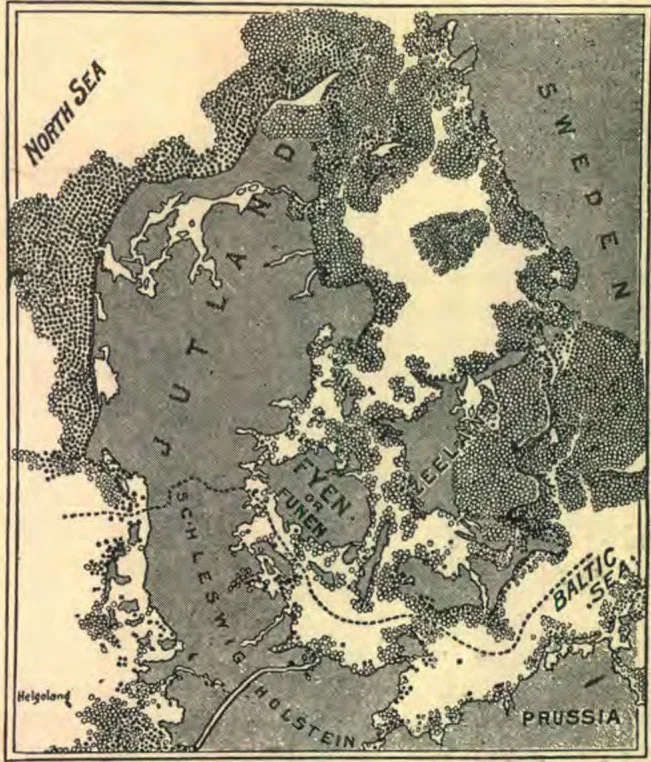
Map showing the shipwrecks that have occurred during a period of fifteen years. Each of the little circles represents a wreck.
The waters along the west coast of Schleswig-Holstein and Denmark and through the treacherous channels leading from the North Sea into the Baltic Sea are often spoken of as the “graveyard of ships,” a name that is evidently appropriate in view of the fact that there is no other region in the world where so many ships have been wrecked. The enormous number of wrecks that have occurred in this region during a period of only fifteen years is indicated by the accompanying map reproduced from a map issued by the German hydrographic office. The entire region is subject to storms and cross-currents, and in many places, particularly along the west coast of Denmark, the sea deepens so gradually that a ship can easily run aground when miles out from shore.—Selected.
The Age of the World
DR. ALFRED HARKER, one of the most noted living geologists, says in regard to the age of the earth as estimated by many geologists:—
“Various geological arguments have been advanced for limiting the age of the earth to a span of eighty or a hundred million years. The method of procedure is broadly the same in all. A computation is made of the rate at which some fundamental geological process is going on. It may be the lowering of the land surface by erosion or its destruction by solution, or the deposition of sediment or the addition of salt to the sea. Some estimate is then made of the total result of the process throughout geological time. Having the annual rate of increment and the total amount, simple division gives the measure of the time in years. The10observational data employed in these calculations are of a very precarious kind, and it would not be difficult to point out instances of that levity in handling figures which is the bane of science. But the fundamental weakness of all such reasoning lies in the assumption that the present rate of any of these geological processes can be adopted as the equivalent of the average rate throughout the whole time.”
Every one of the various geological processes which have been discussed of late years is controlled by conditions which cause its rate to be very variable. It is a clock which now hurries and now creeps or stands still, and it never can be trusted as a timekeeper. In fact, according to this authority, the age of the earth cannot be determined by any geological method at all. The truth, if ever ascertained, will have to be sought through some other source than geology.
Bees as Expert Travelers
AN elaborate series of experiments was conducted by two noted scientists to arrive at an explanation of the homing instinct of bees:—
“Marked bees were placed in a dark box, and were carried away from the hive in an opposite direction from that in which they were finally liberated. The box was repeatedly turned about, so that the inmates should lose all sense of direction. Every possible means was taken to render useless any known or conceivable method of obtaining their bearings. The bees were even placed within an induction coil in the effort to confuse them.”
“This long and elaborate series of tests was without value, so far as getting any explanation of the homing power was concerned. In every case, from thirty to forty per cent of the bees found their way home without apparent trouble, no matter how confusing the trip away from home had been made.”
The Jewelweed
By Mary Barrett
WE are indebted to certain plants like bouncing Bet for the hiding of disfiguring ash heaps, tin cans, and broken crockery. The jewelweed is another such benefactor. It does the work perhaps more quickly and thoroughly than any other plant. It is an annual, coming up every spring in great numbers. The growth of these is rapid; all they seem to need is plenty of moisture, and they are soon high enough to hide from view the surface of the ground, with all its unsightliness.
The buds appear in June, and continue to unfold throughout the summer months. The flower is pale yellow, somewhat spotted with reddish brown. A daintier flower would be hard to find, or one more fitly called a jewel. Earbobs, wild touch-me-not, and silver-leaf are other common names. How lightly the flowers “bob” when the wind moves the branches on which they are so delicately hung. It is called silver-leaf from its silvery appearance when touched with the rain or dew, or when held beneath the water. The name touch-me-not refers to the seed pods, which burst open with violence when touched, and send the seeds to a comparatively great distance. Thus they are dispersed without the aid of the wind or the rain. What an independent, self-supporting member of the plant kingdom our little jewelweed is; well worthy our admiration and study, and an example to such as depend too confidently upon others. MARY BARRETT.
How Automobile Wheels Are Painted
OWING to the great number of wheels to be painted, the common method of applying the paint with brushes is too slow and expensive a process for an automobile factory, and this work is therefore done by dipping the wheels in tanks containing paint. The wheels are run by gravity down an inclined track from the storage room to a point convenient to the paint tanks. Each wheel is then picked up in turn and placed on a vertical axle in the tank, over which is a horizontal arm carrying a pin that engages one of the spokes. The axle, and with it the wheel, is lowered into the tank and immersed in the paint. The axle is then raised until the wheel is well above the paint surface, and the wheel is rotated rapidly by the horizontal bar. The surplus paint is thrown off by centrifugal force, leaving the wheel dry enough to be stored on racks at the rear of the tanks.— Popular Mechanics.
The Uses of Salt
As the salt of the earth, Christians are not always to bring only joy and comfort into the lives of others. Salt has other uses. A Bible study group of college girls were recently discussing the familiar passage in the Sermon on the Mount, and were asking why Christians are like salt. “All thought at once of salt’s preservative qualities. Then a Chinese girl in the group quietly suggested, “Salt creates thirst.” The truth went home. As one of the leaders afterwards said, “Our lives should be such that people would continually come to us and ask us to explain ourselves.” Do our lives create in others the thirst that only the Water of Life can satisfy?— Sunday School Times.
Idleness Rusts the Mind
“IDLENESS rusts the mind.”
Harnessing Habits
Harold came into the dining room with brow knotted thoughtfully, and silently took his seat by the window. His father glanced at him sharply. “What is it?” he asked.
Harold looked up. “I was just thinking,” he answered.
“About what?”
“I heard two fellows talking on the street as I came home,” Harold replied; “I couldn’t hear all they said, but one of them was talking about bad habits. He said he believed in ‘harnessing habits.’”
Mr. Cox smiled. “Well?” he interrogated.
“That was a kind of new thought to me,” Harold went on. “I thought bad habits always ought to be destroyed or banished entirely. I didn’t think a person could harness them.”
“I suppose he meant ‘control’ them,” Mr. Cox answered, taking up his paper.
But Harold was not satisfied, and all through dinner he pondered over the subject. After the meal was finished, his father asked him if he would finish putting the coal in the basement.
“Won’t tomorrow do?” asked Harold; “I don’t want to do it this afternoon.”
His father regarded him over the top of his paper. “There is one habit you will have to control or it will run away with you some day,” he remarked; “if habits are horses, as your friend seemed to think.”
Harold flushed, and went out of the room without answering. The basement had no convenient chute, and the quarter ton of coal remaining must be put in by hand.
“O, I’ll do it tomorrow,” he decided finally, and sat down upon the wheelbarrow to think.
“I don’t see what that fellow meant,” he said to himself. “A person ought to be rid of a bad habit altogether. People only harness things that they can use, and how any one can use a habit, I can’t see.”
He buried his head deeper in his hands. “I know procrastinating is my worst habit,” he ruminated, “and I can’t seem to break it off short as I ought to do. I wish I could harness it some way and make it work for me instead of against me.”
So engrossed was he in thought that he did not hear footsteps approaching or notice a chum of his until he stood at his elbow.
“Got the blues?” asked a voice, and Harold started.
“O, it’s you, Bert!” he exclaimed.
“’Course it’s I,” answered the other; “didn’t I say I’d call for you this afternoon to go over to the river?”
“I didn’t say I would go,” Harold answered. “Father says he does not think the ice is quite safe yet.”
“A lot of the fellows tested it this morning,” said the other boy, impatiently. “Come on and go with us.”
“Father wants me to carry in the coal,” Harold continued.
“Did you say you would?”
“No,” hesitated Harold.
“Then come along.”
But Harold shook his head. “Tomorrow or some other time,” he answered. The other boy stared.
“Procrastination seems to be your forte,” he sneered; “but I never knew you to put off anything you really wanted to do before.”
Harold stared back at him for a moment, and then shouted.
“Why, I’ve done it!” he cried.
“Done what—gone crazy?” asked the other boy disgustedly. Harold did not answer immediately, and seeing some of his friends passing, Bert leaped the fence and hurried unceremoniously away.
“I’ve done it; I’ve harnessed my bad habit,” Harold repeated; “I’ve always put off doing things that I didn’t want to do, and now I’ve put off doing something that I wanted to do, and that I knew I oughtn’t to do. If that isn’t harnessing a habit, I don’t know what is. I’d like to ask that fellow if that’s what he meant.”
He looked at the heap of coal speculatively. “I wonder how I could make that work here,” he said. “I guess I’ll put the coal in now. The next load I can put off carrying down cellar if I want to. I’ll put off passing work by until another day. Here goes!”
In the course of an hour the coal was all stowed away. Just as he was finishing, his father called him. He was standing by the window looking at the sky, which was clouding over.
“I am sorry,” he said to Harold, “but I am afraid I must insist on your putting the coal in, for there is going to be a storm.”
“Can’t do it today,” answered Harold briskly, lowering his head to hide a mischievous grin.
“What!” his father exclaimed.
Harold laughed. “I just got through with it,” he chuckled.
“Harold! You don’t mean it? Have you banished old Procrastination already?”
“No; I’ve harnessed him,” amended Harold, “and he makes a pretty good steed if you know how to manage him.”
His father sighed in relief. “Well, I am glad if you have,” he said heartily; “you do not know how you have disappointed me at times in that respect.”
“After this I’ll put off disappointing you to some future time,” said Harold eagerly; “do you see how it works?”
“I see!” answered his father.—The Youth’s World.
Midge — a True Tale
Midge was a “coon” cat, and had only one friend in the whole world. Little three-year-old Alvin was that friend. He could drag Midge about the house by the ears or by the tail, and she would not resent the indignity. No other member of the household could so much as put a finger on the cat without feeling the sharp claws.
Alvin’s father asserted that because the pair were chums, Midge allowed Alvin to “pull haul” her about, and then took it out on the rest of the family.
At night the chums slept side by side in Alvin’s crib. Alvin shared his bread and milk with Midge, and she brought him a mouse, now and then, in return.
Midge took her daylight naps on high shelves, and sometimes in the stove oven. In this way she escaped the rough handling of her chum. One day when the cat was in the oven and would not come out to play, Alvin shut the oven door. At the noon hour Alvin’s mother kindled a fire in the stove, after which she went to the well for water. When she returned there was a great rumpus in the oven. When the door was opened Midge flew at Alvin and scratched him on both cheeks. There was much blood, and Alvin cried bitterly with fright and pain. Midge escaped through the open door, and dodged under the shed floor.
When Alvin’s sisters, Grace and Cora, came from school, they tried to coax Midge from under the shed. The cat was too wise. She looked upon Alvin’s father as an enemy. She knew that he would now have an excuse for killing her. Wise cat! Alvin’s father said that he would kill the bloodthirsty brute as soon as she could be found.
All that afternoon and the next forenoon, Alvin tried to coax Midge from her refuge under the shed. At noon he was successful. While his father was eating dinner, Alvin brought in Midge.
“See, papa, here’s Midge. Midge is sorry she hurted Alvin, and Alvin is sorry, too. We is chums, so papa can’t dead Midge now.”
One morning Midge brought in four kittens. Alvin’s father drowned three, and Midge rushed the fourth under the shed. She did not allow the kitten to enter the house, and Alvin carried it milk. The milk dish had to be pushed under the shed. When the kitten was nearly as large as its mother, it was missing one morning. Midge was a sight to behold. One ear was gone, the other was split, and large patches of fur were missing from the cat’s sides.
Grace and Cora looked everywhere for the kitten, but it could not be found. Midge went to the rear of the house and disappeared in a great grass field. The girls said they would follow Midge after dinner, as there was no school, and promised Alvin a trip with them. Alvin was missing at dinner time. All the forenoon his mother thought he was in the field with his father. When the girls came home from school, they asserted that Alvin had followed Midge. Sure enough, there was the trail in the tall grass back of the house. The trail led down to the railroad that crossed the farm. It was a great relief to the searchers when tracks of bare feet were found to cross the railway. Below, there was another hay field and a brook in the valley. The brook was bridged by a huge log, and if the cat was going beyond, Alvin would have to cross the log. The little fellow did cross safely. There was the trail in the tall grass that proved the fact. The trail led up through the grass to a fence. The cat and boy had crawled through the fence into the pasture land. Down in the valley was the second brook crossed by a long, small log. The four searchers knew that it would be impossible for Alvin to safely cross that small log. The girls made for the brook in a go-as-you-please race. Alvin was just crawling onto the log.
“Follow Midge, find kitty,” was his greeting. The girls followed Midge. The cat went a long way through the stump-covered pasture. The trail ended when Midge climbed to the top of a tall stump. The stump was hollow, and the kitten was down at the bottom unable to climb out. All about the stump were the feathers of some bird. A short distance away the girls found a dead bird almost as large as the kitten. Alvin’s father cut the stump open and [illegible]. He said that the bird was [illegible]. He also thought that Midge was [illegible] alighted on the stump. The kitten fell or ran into the [illegible]. Midge, from that day [illegible].
Dumb Animals.
When the
An “Easterner” had his family in an isolated Range. Let the reader … along until he touches a … miles northeast of Boise, … have the geography of the …
The larger boys and … of the bad things Indians … evenings was always … stories. Massacres kept … The tenderfoot always … munition on hand, and … was not detected, and … him down or else fearfully … were on their guard, for … paint would be in sight … Idahoian, going on about … danger was past.
One day—one fatal day—six big Indians drew up at the door and dismounted from their ponies. A burglar alarm at dead of night is nothing compared with this. Fortunately, the father was at home, and his guns were all in order. One of the redskins came to the door and made known briefly that he would like to get something to eat. A hasty consultation inside, a few glances in the direction of the guns, and the frightened family felt they were in the hands of the Philistines. The meal was rapidly thrown together, and the kitchen deserted. The Indians marched in and took their places at the table. The children expected soon to hear six rifle cracks and see as many dead Indians quivering on the bloody floor. Breathlessly they waited. Indians were known to be bad. This family felt its utter helplessness, except for the power of the cartridges at hand.
Far down in the valleys on clear days dim outlines of cities and villages came into view. The awful hush and stillness of the lonely place in the wild mountains, where only a few people stopped for meals occasionally, were now penetrating the very soul of the imprisoned family. The father was resolute. One wrong move and an Indian would die.
With hammer raised and finger on the trigger sat the father in the adjoining room, watching. The redskins sat down, and paused a moment with arms13folded over honest breasts. The large fellow at the head of the table lifted his face to the brother at the foot, and in pretty good English, said, “Brother, won’t you return our thanks to our God for this food?”
Softly were the hammers of two guns lowered. A chirp was heard out of three of about the worst scared girls you ever saw, and the mother could not hide her ecstatic delight. The few words from the redskin’s uncouth lips put everything in harmony with the Infinite, and the white dove commenced its nightingale song in the hearts of the isolated family.—Selected.
Won by Baby Appeal
PRISON doors that three years ago closed for life for Thomas Edgar Stripling have just been flung open by the fingers of a little girl.
The touch of child fingers put in motion State machinery that neither political pull nor official influence could move; the tears and smiles of a little girl of six changed an inferno of despair to a heaven of hope, lifted the shadow of fear from a hunted, haunted man, who had lived for fifteen years in terror of the law’s vengeance.
Stripling, the “lifer,” has again taken his place among free men, and he owes his freedom to his little daughter, Bessie Lucille, who interceded with Governor Nat E. Harris for her father’s liberty.
Bessie Lucille, the convict’s daughter, has heard more about prisons than she has about dolls and little girls’ playthings, since her father was arrested three years ago and sent back to prison for a crime committed many years before Bessie Lucille was born. Like a good little girl, she waited, just as daddy told her to, for him to come back and play bear or tell her stories. She was very lonely, however, for her papa; so one day her mother took her to visit him in the State prison. It was the day that Georgia’s new governor was inspecting the penitentiary.
The governor was engaged in talking to a committee of officials in the prison lobby when a sad-eyed woman and a little girl passed by. No one noticed the child slip away from her mother and run up to the big, broad-shouldered governor, put her fingers in his, lift up to him a smiling face and eyes filled with tears, and say, “Please, Mr. Governor, let my daddy come home with me; I want him.”
“Who are you, child?” asked the governor.
“I’m Bessie Stripling. My daddy’s in prison, and I want him to come home with me.”
A tense moment passed. The war veteran who governs Georgia is kind-hearted—Bessie’s eyes pleaded tenderly. The governor thought deeply for a few seconds. Then came the determined answer, “Run along, lassie, I’ll send your daddy home soon.” Mr. Stripling’s pardon was officially confirmed in about two weeks.
Mr. Stripling, whose case has attracted much attention the country over, was sentenced to prison eighteen years ago, charged with the murder of Bill Cornett. The crime was committed to satisfy the “unwritten law.” He left a wife and two children behind him to live on charity or die without it. Their destitution made him desperate. After a year in prison he escaped.
With his family he located at Danville, Va., and under the name of Morris soon became one of the most respected citizens in the community. For several years he was Danville’s chief of police. But “murder will out.” After fifteen years of liberty and right living Morris was recognized as a fugitive, and returned to prison to serve out his life sentence.
The savings of fifteen years were spent on lawyer’s fees. His family was again destitute. Influential friends sought his release, but the law demanded vengeance. Justice demanded its “pound of flesh.”
Stripling’s case had been given up as hopeless when his little daughter twined her fingers into the fingers of Georgia’s governor and asked him to “send daddy home.”
There were two children in the Stripling family when Bill Cornett was murdered. When Stripling was sent back to prison three years ago, he left twelve children behind. His family is now in dire poverty, his own health is broken, but the spirit of Georgia’s Jean Valjean is brave and unflinching.
“Give me another chance,” he asks, “and I’ll square myself with the world—I’ll be worthy of the devotion of my family and friends.”—Washington Post.
Changing Opinions and Correcting Mistakes
“HE that never changed any of his opinions never corrected any of his mistakes; and he who was never wise enough to find out any mistakes in himself will not be charitable enough to excuse what he reckons mistakes in others.”
On the Folly of Talkativeness
THE talkative listen to no one, for they are ever speaking. And the first evil that attends those who know not to be silent is that they hear nothing.— Plutarch.
Senior Society Program for Sabbath, October 23
REVIEW Morning Watch texts. Have a paper on “Isaiah.”
One-minute reports from leaders of working bands.
Bible Study: “The First Day of the Week.” See Gazette.