BLEST sleeper, angel hands have smoothed
The sorrows of thy careworn brow.
Thine anguish hath the Spirit soothed,
And all at rest, thou sleepest now.
“Asleep in Jesus,” safely there
Thy rest shall e’er unbroken be,
Till his sweet voice shall clothe thee fair
In gorgeous immortality.
Weep not; for heaven hath called her
“blest.”
But this one thing make sure with thee,
That in the morn when breaks her rest,
Thou’lt join her in eternity.
When morning comes!—the night all past,
And sin and death all gone,—O joy!
What meetings then, ever to last!
What ceaseless bliss, free from alloy!
To us who wait the trial comes,
To her the victory is sure.
Then set your faces, weeping ones,
Toward Zion. To the end endure.
Carrying Forward the Work of the Lord
By Ellen G. White
MRS. E. G. WHITE
As we see the strife and confusion that fill the world, we ask, What will be the end of all these things? We are given courage to press on in the work of the Lord by the waving of the banner of victory, on which are inscribed the words, “The commandments of God, and the faith of Jesus.” The kingdom of Christ is to be enlarged. The workers are to grow in power and efficiency. This they will do if they will believe as the disciples believed. The Lord will act his part. But when human beings refuse to be the Lord’s helping hand, they break the link that connects them with heaven.
To us as a people God has given great light, and he calls upon us to let it shine forth to those in darkness. By us the light, the power, of a living truth is to be given to the world. From us there is to shine forth to those in darkness a clear, steady light, kept alive by the power of God. We are charged to use the light given us to create other lights, that our fellow men may rejoice in the truth. Let us not disregard the charge. Suppose that the sun should refuse to shine, what terrible darkness and confusion would result! For us to refuse to let our light shine to those in darkness is to contract guilt, the magnitude of which can not be computed.
Christ’s commission to us is, “Go ye therefore, and teach all nations, baptizing them in the name of the Father, and of the Son, and of the Holy Ghost: teaching them to observe all things whatsoever I have commanded you; and, lo, I am with you alway, even unto the end of the world.”
We have before us a great work. False teachers will preach false theories. They do not desire the truth. They are afraid to have the truth presented to the people. They do not want the facts to appear as they are given in the Word of God. Let all who believe the third angel’s message take up the work that God has committed to them. Let them seek to realize its greatness and importance. Let believers do all in their power to arouse an interest in present truth in the neighborhood in which they live. Let all act an earnest, disinterested part. Some will labor in one way, and some in another; but all should do something. The books containing the reasons of our faith must be translated into all languages. This work must make more rapid progress than it has made.
When we act our part with faithfulness, Christ will work with power upon minds. We are to be God’s helping hand. We have no time to devote to self-pleasing. With freshness and power the truth for this time is to be presented to the people of the world. Christian workers are greatly needed.
GOD’S PLAN FOR PROCLAIMING THE GOSPEL MESSAGE
“The Spirit and the bride say, Come. And let him that heareth say, Come. And let him that is athirst come. And whosoever will, let him take the water of life freely.”
These words outline God’s plan for the promulgation of the gospel. His instrumentalities, divine and human, are to unite in an effort to save the lost. These souls are to be rescued from the bondage of sin. God calls upon those who have taken his name to obey his orders. All are called to take some part in his work.
“I Jesus have sent mine angel to testify unto you these things in the churches. I am the root and the offspring of David, and the bright and morning star. I have united divinity and humanity, and my office invests me with all power in heaven and in earth. I have ordained that angels and men shall be employed in my work. Divine and human instrumentalities are to unite. I have given the churches instruction regarding what they are to do. My work is to be carried forward until I shall arise and proclaim with a loud voice, It is finished. I have opened a fountain of living waters for a perishing world. Agencies from the heavenly courts unite in urging the members of the church on earth to give the invitation to come to the water of life. Each one, feeble though he may deem himself, is to repeat my words and perform some part of my work. Let all take up the work entrusted to them. Do your best. Proclaim the gospel invitation. Unite with those who are already at work. I testify that if any one shall alter the words of the prophecy of this book, causing unbelief, and turning aside my words from the practical application which I thus fully and authoritatively give them, I will visit him with signal marks of my displeasure.”
THE POWER OF THE TRUTH TO CONVICT AND CONVERT SOULS
It is through the transforming influence of divine grace on human hearts that the power of the word of truth is revealed. The message, proclaimed in regions where it has not yet been heard, makes an impression on hearts. It seems to have greater power in transforming character than when presented to those who are familiar with its office work. Truth has little power on the hearts of those who walk contrary to it for advantage to themselves—those who follow a course opposed to its principles. Such ones profess to believe the Word of God, but they give no evidence that they are sanctified by it.
The truth is to take possession of the will of those who have never before heard it. They will see the sinfulness of sin, and their repentance will be thorough and sincere. The Lord will work upon hearts that in the past have not been appealed to, hearts that heretofore have not seen the enormity of sin.
Christ is the only successful antagonist that sin has ever encountered. Let the full light of his life stream into the souls of those who are in darkness. Under the direct power of the gospel thousands have been converted in a day.
When a sinner becomes sensible of the fact that only through Christ can he gain eternal life; when he realizes that obedience to God’s Word is the condition of entrance into the kingdom of God; when he sees Christ as the propitiation for sin, he comes to the Saviour in humility and contrition, confessing his sins and seeking forgiveness. His soul is impressed with a sense of the majesty and glory of God. The blessedness of an eternal life of peace and joy and purity is felt so deeply that an entire surrender is made.
I am instructed to say that some who outwardly appear the most fully given to sin will, when light flashes into the soul, make most successful workers in places where there are just such sinners as they themselves once were.
I write this because those engaged in canvassing work and in house-to-house labor often meet men and women who are coarse and forbidding in outward appearance, but who, if won to the truth, will be among its most loyal and stanch adherents. The spirit of truth is indeed of value in any church. Those whom the Lord uses may not always have outward polish, but if they have integrity of character, the Lord accounts them precious.
POWER FROM ABOVE
As the end draws near, the work of God is to increase in full strength and purity and holiness. The workers are to be filled with love for God and for one another. They are to cherish principles of the strictest integrity. When the true keynote is struck, God will reveal himself as a God of mercy and love. Angels of heaven will draw near to the members of the church on earth to aid them in their necessity. Let us ever remember that we are laborers together with God. In this heavenly union we shall carry forward his work with completeness,7with singing and rejoicing. In every soul will be kindled the fire of holy zeal. Company after company will leave the dark standard of the foe to come up to the help of the Lord, to the help of the Lord against the mighty.
God’s workers must gain a far deeper experience. If they will surrender all to him, he will work mightily for them. They will plant the standard of truth upon fortresses till then held by Satan, and with shouts of victory take possession of them. They bear the scars of battle, but there comes to them the comforting message that the Lord will lead them on, conquering and to conquer.
When God’s servants with consecrated zeal co-operate with divine instrumentalities, the state of things that exists in this world will be changed, and soon the earth will with joy receive her King. Then “they that be wise shall shine as the brightness of the firmament; and they that turn many to righteousness as the stars forever and ever.”
The Evangelization of the World in “This Generation”
By Wm. Penniman
WM. PENNIMAN
In the Review of August 4, we read from a brief editorial the following forcible words: “The time of the promise is drawing near. Tell it out. This generation will witness the consummation of God’s purpose for his people. Tell it out.”
The spirit of prophecy says that “all heaven is astir,” and that the “angel of mercy is about to depart from the earth,” and that “we are on the verge of the eternal world.” In view of these things, why should not all God’s people be awake, and “tell it out”?
The evangelization spirit is increasing in the world, and seems to be permeating churches which are not Adventists. They used to talk much of, and pray for, the conversion of the world, but the more intelligent class have given up the idea, and now talk more of its evangelization. And why should they not abandon the thought that the world is growing better and ripening for the millennium, when crime of every description is so terribly on the increase?
It is not in the province of this article to prove the increase of criminality, but it may not be amiss to state one fact for the benefit of some. The Pittsburg Dispatch says:—
“Bishop Coleman, of Delaware, has been telling an audience that crime in the United States has increased enormously since 1850. In that year there was one criminal in every 3,412 of population. In 1890, forty years later, the proportion had increased to one in every 715.” No doubt the true statistics will show a constant increase of wickedness from 1890 to the present time, not only in the United States, but throughout the world. Notwithstanding all this increase of wickedness and the increase of the power of Satan, the world must and will be evangelized in “this generation.”
Some branches of the Young People’s Christian Association have caught some of the evangelizing spirit. Some time ago I heard a Christian, a Disciple, preacher say that he thought the world might be evangelized in fifty years, but it can be in one-fifth of that time if all are wide awake.
We can not better close this article than by quoting briefly from an able and stirring editorial in The Word and Way, a Baptist paper, published in Kansas City, Mo. The editorial is in the issue of June 25, under the heading, “Missions the Greatest Work in the World. Awake, Awake! Put on Thy Strength, O Zion.” Note that the writer uses the significant words, “The present generation of God’s people,” etc. It has the right ring, so far as it goes, and we only wish it had the full ring of the third angel’s message. We quote briefly as follows:—
“To save lost men God gave his only begotten Son. To save men Christ gave his life. After he had purchased eternal redemption on the cross for lost man, and just before he ascended into heaven to take his place as intercessor at the right hand of the Father, he proclaimed that all authority in heaven and on earth has been committed to him, and invested with this universal authority, he issued the command that the gospel should be preached to all the world.
“This tremendous and transcendently important work is only partly done. Millions are to-day without the gospel—have never heard it. The present generation of God’s people must give the present generation of the benighted millions the gospel, as the present generation that has no gospel will grope its way through darkness to death without the light of the knowledge of the Saviour’s name. Every child of God and every church is under orders. To carry out this commission of our crucified and risen Lord is the one thing before us. For this the church exists; for this the world stands. The time is short.”
Thy Kingdom Come
By J. W. Collie
J. W. COLLIE
It was the Saviour’s desire that we should pray for the restoration of his kingdom upon this earth.
Four thousand years had wrought a wonderful change in the condition of this earth; and the ravages of sin were to be seen upon every hand. God’s own professed people had so far forgotten him and the true worship, that religion, with them was a mere form, and earthly pomp and glory was more than all else. Their grand temple worship was about to pass away, and they were soon to wander over the face of the earth. In tender pity Jesus tried to lead them to a knowledge of his spiritual kingdom, and in his inaugural discourse he gave them a conception of his kingdom. But their hearts were hardened, and they turned away from their King, cruelly murdered him, and thus ended their day of grace.
Before his departure, however, he gathered the little band of earnest men together, whose adherence to truth was to be an incentive in the ages to come, and among other things taught them to pray. That prayer contained the wonderful words, “Thy kingdom come.” This was not only to inspire their faith in his second coming, but it was the Saviour’s design that they should understand that the kingdom of God was of transcendent importance. It was to be greater than the visible church, and if of absorbing interest to his followers, earthly governments, pomp, glory and all else would fade away into insignificance.
He knew that we should stand upon the mountains and see the kingdoms of this earth and their glory. He knew also that we should be tempted and tried with the glittering baubles of earth, and to offset this he desired that we should see the greater grandeur of his spiritual kingdom. Paul possessed this experience when he said, “But what things were gain to me, those I counted loss for Christ. Yea doubtless, and I count all things but loss for the excellency of the knowledge of Christ Jesus my Lord: for whom I have suffered the loss of all things, and do count them but dung, that I may win Christ.”
Centuries have passed away since the Master returned to his Father. His church upon earth has passed through severe vicissitudes and trials, and yet the words, “Thy kingdom come,” have given courage to each succeeding generation. Living in the closing hours of this world’s history, the great clock of time rapidly ticking off the hours, do we grasp the meaning of the coming kingdom? Are we praying, “Thy kingdom come”? Are we preparing for it every day? or are we living over the experience of the past? We fear that many are absorbed with the things of this world. Money that should be used in the cause of God is used in speculation, and where the highest rate of interest may be obtained, while the cause of God suffers because of a lack of means.
A glance at the condition of things existing in the world to-day ought to stir every Seventh-day Adventist as he was never stirred before. Prophecy is being fulfilled very fast. Mob violence fills the earth, the great strife between capital and labor is becoming more intense all the time. The nations of earth are arming themselves as never before; and while all the world wonders after the beast, and we see fallen Protestantism fawning upon the papacy, what should all these things mean to us?—Simply that the work is almost done, and now we are to get ready for the greatest event the world has ever seen.
While things are moving with such rapidity, the church of God should awake and stand in its place to finish the work speedily. Personally, we are glad that there is to be no longer any delay in the finishing up of the work; but this should be a time of deep heart searching, of putting away those things that hinder the work of grace in our own hearts. If this is done, we are promised a large measure of God’s Spirit to go forth and proclaim this last message, and soon we shall see the work completed, and our Lord and Saviour take possession of his kingdom. Let us pray in the spirit and with the understanding, “Thy kingdom come.”
Canton From Day to Day
By Mrs. J. N. Anderson
MRS. J. N. ANDERSON
Coming to China has cast us into a strange new-old world so foreign to that in which our lives have been spent as to make us almost feel uncertain of its reality. After several months of study it is still only an occasional word of the ordinary rapid conversation that appeals to our ears. I am therefore unable to form correct estimates of things Chinese in a general way. I can speak only of what I day by day see going on about me,—sometimes things that are strange, much that is charmingly simple and natural intermingled with the grotesqueness of heathenism, and often that which is pitifully miserable.
Our present home is on the south side of the city of Canton, facing the Pearl River three miles down stream from the foreign settlement, known as the Sha-men. For days together we do not see a white face except as we go up for provisions and mail, or visit some missionaries, but are daily surrounded by a teeming native population. It is just the place to study Cantonese,—this multi-millioned metropolis of southern China,—and plenty of people there are with leisure to give “the foreigner,” as he seeks to practice what he thinks he has learned, while he probably speaks but a small fraction correctly, and much there is of interest about us to lead us out into the narrow streets, and to call out all the language we are able to command.
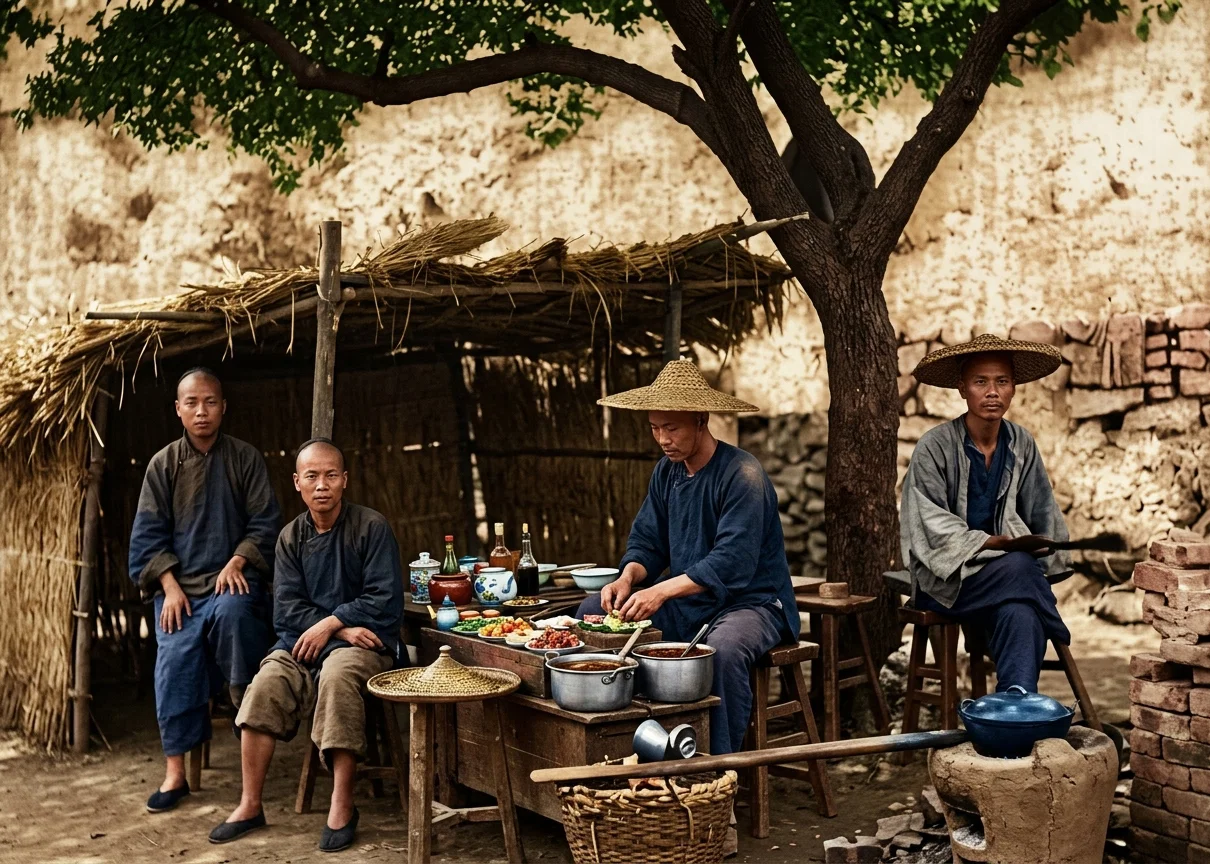
A BOOTH RESTAURANT IN THE STREET
Two days ago we set out in the morning before breakfast for the flower garden, about the length of three city blocks in distance, to get some plants for the small inclosure we call our garden. Passing up the street, the Pearl River, bordered with a deep fringe of house boats along its bank, and its bosom alive with all manner of craft—junks, sampans, fish boats, leper boats, merchantmen, and the largest gunboats of the Chinese southern fleet, from whose flag staffs the great black dragon on folds of yellow silk speaks imperial protection to all,—lay on our left. These sampan people, as that part of the native population which lives in boats is called, are a class by themselves, always full of interest. Each boat is a home complete, supplied with all that is necessary to this mode of life. That small, dirty boat is a local ferry. The woman sits under her broad bamboo hat, one hand on the big oar, waiting for her boat to fill with passengers, when she will take them across the river at the rate of five cash (one-fourth cent gold) per capita.
This boat next the wharf is fairly alive with youngsters climbing over the top, down the sides, and hanging over the deck, the balance of probabilities in favor of a tumble into the water. The tiny maiden, with freshly oiled hair tied with an abundance of pink cord, wears a wooden float dangling on her back, as a precaution in case she should fall overboard, while the wee one of all is fastened into a sort of go-cart, against which he struggles till his spunky cries bring some one to his relief, when he is bound to the back of an older sister or brother, there to join in the general scramble. The wife dips up a bucket of yellow water from the current, and proceeds to wash a dish of rice with one half of it. The other half will be used to boil it in, and this with some green vegetables or a bit of salt fish, with which the father will presently return, will supply a satisfactory breakfast. The chickens, from a coop on the rear of the boat, set up a noisy cackle, thus signifying their willingness to contribute to the family support. In the meantime, as the boat is scrubbed, and the preparations for breakfast go on, the mother as priestess of the family touches fire to a few sticks of incense, and sets them at the bow of the boat, and places another smoking emblem before the wooden idol at the stern.
Presently there is an unexpected stir among the boats, and we hear a panting from behind us, then at a given signal a sedan chair is let down near the wooden pier, and the occupant steps out. A fine-looking specimen of the better class he is,—rather tall, erect, almost commanding in bearing, with well-cut features, clear olive complexion, bright dark eyes, and a heavy, glossy black queue falling down his back. The long, pale-blue silken robe falls down over creamy silk trousers so low as just to clear the feet, which are clad in snowy-white stockings and black satin slippers. Servants bustle about, seemingly anxious to render at least some slight service, if only to lift the silken skirt as he steps from the chair. A bundle of lacquered boxes, camphor-wood chests, bundles tied up in big, bright-colored kerchiefs, and baskets of food, let down near the chair, indicate that he is about to set out on a journey; and now a boat is required to row him to the steamer landing. That one on the outer edge with the decks so freshly scrubbed, the seats covered with fresh, new matting, and the bright interior walls draped with scarlet cotton decorated in gilt figures, is the one that will doubtless be chosen.
A few paces farther on, an old, worn-out house boat rests on the river's bank. The broken hulk can scarcely support the rickety, arched framework, over which is spread the tattered matting roof. Inside is a bunch of straw, over which are thrown the remains of wornout garments, two cracked bowls, a teacup, a pair of chopsticks, a small earthen teapot, a blackened cooking utensil, and a small burnt-clay stove. Here a little, thin, old woman sits all day on her heels, with her long, lean arms hanging over the bony knees. The attitude, together with the almost expressionless eyes, and prominent jaws protruding from between the sunken cheeks, offer a suggestion not pleasant to entertain. This is one of China's homes for the aged, and the sampan people are its principal benefactors.
On that pile of stones under the cool shade of a ban tree a group of sampan girls have gathered to enjoy a rest from the cramp of the boat, and to chat awhile, perhaps about a new bracelet one has bought, or about the gaily bordered suits they are preparing for the coming dragon-boat festival. One rests her head on another's shoulder, and gently strokes her hands, while others entwine their arms in the schoolgirl fashion of more highly-favored lands.
The right side of the street is lined with places of business, most of which have the homes of the occupants either in the rear or overhead, or as is the case in the smaller shops, the place of business is one with the home, and is probably9occupied by several families.
In that section of the street where it is broadened by a turn in the river, mat sheds have been erected in the middle of the street. Some are open booths occupied as restaurants, but by far the greater part of them are closed in all around, leaving only an entrance, through which an almost constant stream of men and boys is passing, and the click, click of metals and the clank, clank of bone, mingled with noisy and angry voices within, tell us these are gambling booths. So early these places are thronged, and what might appear to be the overflow has gathered in groups here and there on pieces of matting spread on the tile pavement, eagerly pursuing this national vice. Here is a stand where men and boys shake dice for the rice-flour pancakes baked by the man at the griddle. Another stand invites passers-by to venture their few remaining cash at a species of wheel-of-fortune, offering prizes of preserved dried fruits or ginger root, while a runner from the lottery down the street cries tickets of fabulous possibilities, loud enough to be heard above all. Across the street, under a mammoth umbrella made of thatched palm leaves for a top and a bamboo pole for a stalk, is a portable lunch counter, where weary toilers may buy a cup of tea, a bowl of rice with relishes unmentionable, and squat anywhere on the ground to eat it.
We were just at the entrance of the garden, where long rows of flowering plants stood waiting in the morning sun. There were the showy dragon-boat flowers, brilliant with scarlet clusters; long ferns, cool palms, the Bak Yuk Lau (Magnolia conspicua), perfuming all the air with the marvelous fragrance of its white waxen buds tucked away under the glossy green leaves; and there, most of all, the long-coveted beautiful white lotus plants, folding and unfolding their ample green leaves to the play of passing breeze, and lifting graceful, nodding heads of snowy white. It was such a delightful prospect in contrast with the street through which we had just passed that our steps began to quicken with anticipation, when a peculiar sound drew our attention to the opposite side of the street. There, on a pile of logs lately drawn up from the river, crouched nine wretched lepers, each with a brown earthen dish with which to solicit cash or food to eke out the existence of the poor decaying bodies that are literally falling to pieces while they stand on their feet. Two were women, seven were men, and none of them advanced in years. Several had lost parts of their feet, and had left only poor stubs on which to hobble about. Others had so little of their hands left that both were required to hold the dish. In other cases the hands remained red and swollen, while part of the face—the nose, an ear, or a lip—was gone. Their soiled and tattered garments were not sufficient to conceal the fact that from the top of their heads to the soles of their feet they are living realities of Isaiah's picture—“wounds, and bruises, and putrifying sores.” Next to impossible to dress the hair, they neglect also the care of the entire body, in order the better to beg.
Perceiving that our attention had been arrested, one reached out his dish, banteringly calling “Cunnshaw.” Sometimes they become really saucy, and seek by thrusting themselves into close proximity to intimidate people into giving large alms.
Only a few steps away at the base of another pile of logs, sat another victim of some fell malady. His emaciated body inclined against the hard wood, and the shrunken limbs stretched out upon the matting bed upon which he sat revealed the feet, thick and swollen. At the side lay a broad-brimmed splint bamboo hat and a brown earthen dish. He said nothing, only looked appealingly from great black eyes set in sunken sockets. What could we do? We did not know the nature of his disease. Perhaps friends had placed him there to receive the benefit of the morning sun. To attempt to do anything might be considered an interference. Remembering repulses we had met on other occasions, we felt compelled to pass on and leave him to his hard lot. But urged by the memory of those eyes, I again passed that way later in the day. Yes, he was still there, and the street was well-nigh deserted, so I passed nearer, and as the pinched face turned upward, I inquired, “Are you ill?”—“Yes, very ill,” he replied in a hollow voice, and then hesitatingly reached out the dish.
Some boiled rice is just what he needs, I thought, and with a promise to bring him something soon, I started for the nearest respectable eating house, feeling this wiser than to bring something prepared at my own home; but no rice could be had at that hour. The only thing available was some good bread. It will satisfy hunger, I thought, so I took a loaf, but I could see a shade of disappointment pass over the pale face as the trembling hand received the gift.
Next day I came again. He was not there, but the piece of matting lying just where it lay before, the battered hat and the empty brown dish gave clue to the sequel. Seeing me pause, the man at the shop across the way came out. “He died last night,” he replied to my inquiry. “I saw you give him the bread; I gave him some tea, but he was too ill to eat,” he said, as with one foot he brushed aside the paper wrapping to show that but a small part of the loaf had been eaten. And thus he died, died a heathen, alone in the street, at night.
China is dark and desolate. The case I have mentioned of a man lying at the roadside for several days, and finally dying there alone, would be an impossibility in a gospel land. And a group of lepers, all in the advanced stages of the disease, begging about the streets, suffering privation and want, and endangering the health of the community, would not be allowed. But the tender, pitying love of Christ, the sympathetic ministration born of his gospel, have been shut out of men's hearts, and much of pride and selfishness has taken their place, and grasping officials, I am told, squeeze the imperial allowance granted for the support of leper villages, till the inhabitants are forced to the city to beg for support.
Your hearts were touched by the appeal Mr. MacWade, the American consul at Canton, made in behalf of the famine-stricken Province of Quangsi. There have been two successive crop failures. Men are selling cattle, houses, and gardens, yea, and wives and children, that they may be able to buy food. Children sell for five cents a pound (Mexican silver), while rice costs thirty cents. Men, women and children are starving by the cities full. Such was the import of the message he sent the American people several weeks ago, and back over the wires came a swift response that meant five thousand dollars U. S. gold, to buy them food. Boat loads of rice are passing up the river to the relief of the suffering people.
But do you not know there is a famine all over the land? Not one province, but an empire of four hundred million souls is involved. Not a famine for bread,—that were sad enough,—but the spiritual starvation, the soul agony, of a great nation “having no hope and without God in the world.”
Canton, China.
Mission Notes
ROAD making is done on the Congo in the African style. As soon as the roadbed is ready, half a hundred elephants are driven over it to and fro, and after a while it is as hard and smooth as if a steam roller had been at work.
Progress of Mission Work in New Guinea
SINCE the martyrdom of James Chalmers in New Guinea, reports have been received of unusual progress in the missionary work. Rev. Mr. Abel, of Kwato, reports that ten men and women have been admitted to the church at Logea, and that twenty-five men and women came from another place for the express purpose of seeking admission to the church.
A Chinese Woman Keeps the Sabbath
AN aged Chinese woman had become a Christian, and wished to keep the Sabbath holy, but could never remember when it came. After much difficulty, she hit upon her own plan. Six chopsticks were laid on a shelf, and each morning when she arose, she took one away. The day when the shelf was bare was the Sabbath, and work was stopped. The next day all six sticks went back again, and so the fourth commandment was kept.
Railway Across the Andes
THE railway across the Andes, between Chile and the Argentine Republic, which was projected twenty years ago, is at last to be completed, the Chilean Congress having recently passed a bill for the purpose. The loftiest part of the pass, which lies not far south of the great Andean giant, Aconcagua, and which has an elevation of thirteen thousand feet, is to be penetrated by a tunnel, which will serve both to avoid snowdrifts and to decrease the maximum elevation of the road.—Selected.
Italy
By Chas. T. Everson
The camp-meeting of the Latin Union Mission Field, of which Italy is a part, was held the latter part of June, in a beautiful orchard in the picturesque city of Lausanne, Switzerland. But I shall not stop to describe the beauties of the place or the excellent meetings that were held there, as some one else has been assigned that task. Still I should not fail to mention the pleasure that we experienced in meeting again on this occasion Dr. Paulson and Elder Irwin, and hearing their stirring messages of God's goodness and power. We were glad of the special interest that Dr. Paulson took in the openings for medical missionary work in Rome. And Elder Irwin's stay with us in “the Eternal City” will be remembered among the bright experiences in our work here. At this camp-meeting we also met for the first time Elder Conradi, who gave us a hearty welcome, and showed himself intensely interested in the progress of the work in Italy, and we have cause to believe that amid his many burdens he will not forget the land of Garibaldi.11
As others will speak of the camp-meeting in general and the resolutions passed there, I shall call attention only to the matters that pertain directly to the Italian field. Therefore I give the resolutions that bear upon the interests of this field, that there may not only be resolutions but also results. The resolutions are as follows:—
“In accordance with the recommendation of the president of the General Conference at the last General Conference, that young people from America be encouraged to come to Italy to fit themselves for work in Italy, and by entering into training together with the young Italian workers become mutually helpful to one another, be it,—
1. “Resolved, That we make a strong effort to secure such suitable young people from America as we have reason to believe will develop into efficient workers for Italy, and invite the same to come to Rome or whatever place may be most suitable, with the view of fitting themselves for workers in the Italian field.
2. “Resolved, That wherever we find suitable young people among the Italians whom we have reason to believe will develop into efficient workers for Italy, we encourage these persons to enter into the same training with the young people from America.
“Whereas, The medical work has proved itself to be an entering wedge in introducing the message in new fields, and,—
“Whereas, In Italy this work has been wholly confined to the Catholic Church, which realizes its value and importance, and,—
“Whereas, Among Protestants we now have the opportunity of being the pioneers in this work in Italy,—
3. “Resolved, That we invite our American brethren to send us a missionary doctor and encourage such nurses to come to Italy as we have reason to believe will be able to make the workers for this needy field.
In a place like Italy where we have so few Sabbath-keepers it is impossible to obtain the necessary material of which to make the workers for this needy field, and therefore we shall need to look to the American young people for the future workers for this country until we are able to develop a membership here from which we can draw. We believe in the policy of using those who are born and brought up in the country, as we are satisfied that with their superior knowledge of the language and customs of the people, they will prove to be a most valuable aid. Yet in the initial stages when such help is wanting, it will be necessary to have workers from America take up the work. And I feel sure that the workers who come from America will prove to be invaluable helpers not only to start the work, but to help push it until the Lord comes. So we desire those upon whose heart the Lord is laying a burden for the lands beyond the seas, to pray and study to know if it is not to the home of the papacy that he wants them to go. And every Italian wherever he may be should be praying and striving to know what duty the Lord wants him to bear with respect to his native land.
That the time has come when medical missionary work should be begun is evident from the last article that I wrote for the REVIEW. I shall not speak further on this subject here, but let our American physicians whom the Lord is impressing to engage more definitely in missionary work, read the article prayerfully, and then try to discover if the Lord is not calling them to take up their work in “the seat of the beast.” Likewise will not our consecrated nurses, whose work is so effective in places of this kind, strive to know if the Lord wants them to come.
This land that has “sat in the region and shadow of death” shall surely see a great light, and that is the light of the third angel's message. But what we do we must do quickly: for there is coming a time of which we read, “The fifth angel poured out his vial upon the seat of the beast; and his kingdom was full of darkness.” We must work while it is day; for the great, eternal night, when no man can work, will soon be ushered in.