WE have just closed our general meeting for the North Central China Mission. It was held at Chowkiakow, Honan, from May 3 to 11. The foreign workers in attendance were Dr. A. C. Selmon, Elder O. A. Hall and his wife, Elder J. J. Westrup, and the writer and his wife. All of these took an active part in the meetings, and the blessing of the Lord was experienced from the beginning. We much appreciated the help given by the visiting brethren.
For the first time in the history of this mission, the Chinese brethren selected their own delegates from the churches in Hupeh and Honan to transact the business of the meeting, and to nominate committees for the ensuing year's work. We are sure that in thus giving our Chinese brethren an active part in the management of the mission, we are securing their hearty cooperation, and are thus strengthening the work. All the committee work passed off harmoniously.
The meetings for believers were held in our own chapel, which was taxed to the utmost to accommodate those present. On the second Sabbath, the attendance at Sabbath-school was nearly two hundred fifty. At the consecration meeting held the first Sabbath, a talk on the judgment was given, after which more than fifty of the church-members and inquirers came forward, weeping bitterly because of their sins, and imploring God for forgiveness.
Meetings were held for the heathen every evening, in a forty-by-sixty-foot tent, which was erected in a large compound a short distance from our chapel. This is the first time that a tent has been used in our mission work in China. All present felt that the meeting was a great12success, and we think that from this time on the tent will be an important factor in carrying the message to the people. Every night there was an attendance of four or five hundred, who listened attentively to the subjects presented. When a call was made for those who wished to learn more of the gospel to come forward, many responded. Meetings are being held for these, and we hope some will give their hearts to the Lord. We believe he has still greater things in store for us.
The superintendent's report of the previous year's work was very encouraging, inasmuch as it showed that marked progress had been made. We now have 104 church-members in the North Central China Mission, with 196 inquirers. Literature sales amounted to $525; the tithe (Chinese only) to $273.10.
We have set apart the noonday hour for prayer, when we specially seek God's blessing to rest upon his work and workers. Our Chinese brethren join us enthusiastically in this plan. Will not our brethren in the home land also enlarge this prayer circle, and pray that "God will sweep back the clouds of evil, and give a few more years of grace in which to work for the Master? Let us cry to God that the angels may hold the four winds till missionaries shall be sent into all parts of the world, and shall proclaim the warning against disobeying the law of Jehovah."
After a special meeting on tithe paying, at which the financial needs of the Lord's work and the responsibility of each child of God doing his part, were clearly shown, over forty families signified their decision to pay a faithful tithe, and announced their willingness to place a tithe box in their homes. We are using tithe boxes in this field, as the cash, which is the common currency here, is altogether too bulky to be placed in tithe envelopes.
A collection was taken up on the last Friday of the meeting, and over one hundred dollars (Mexican) was pledged for the opening up of the work in the city of Yencheng. This is an excellent collection, when one considers the poverty of the people. A motion was passed requesting each Chinese church-member to pay weekly five cents (Mexican) toward the support of the work of God, this being in addition to the tithe.
The importance of warning the people in this division by means of our literature was emphasized, and plans were laid for selling 20,000 copies of our Mandarin Signs of the Times monthly; 10,000 of these will be sold in the province of Hupeh, and 10,000 in Honan. Thus it will be seen that if each paper reaches ten persons, which is not a large family in China, we shall be reaching no less than 200,000 persons monthly with our truth-laden literature.
During the meeting, Sister Hall and my wife held special services for the women. These meetings proved a great blessing to the seventy or eighty women in attendance.
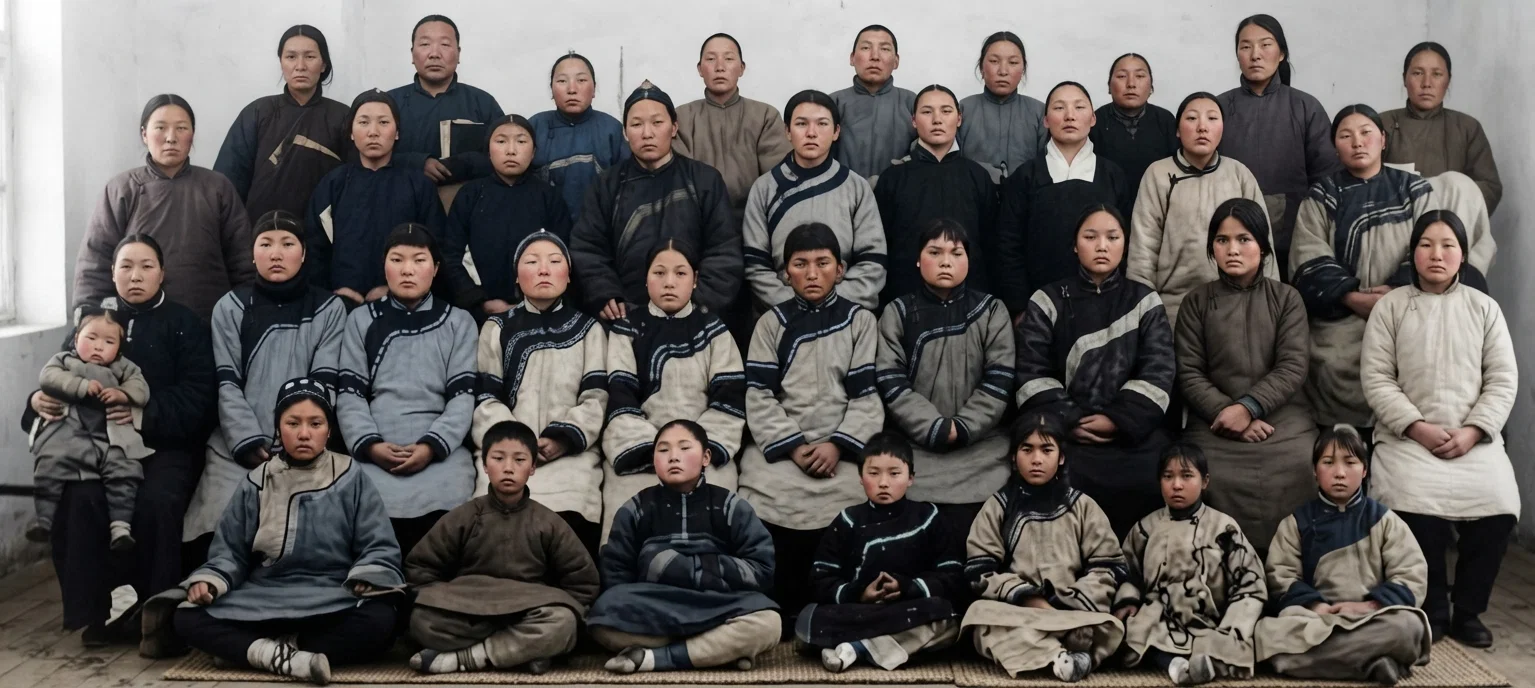
GIRLS' SCHOOL AT CHOWKIAKOW, CHINA
The accompanying cut is a picture of the girls' school which was conducted at the Chowkiakow station during the past year. During the year, ten of the girls in this photo were baptized and admitted into the church.
Near the close of the meeting we were glad to have a visit from Brethren I. H. Evans, R. F. Cottrell, and C. N. Woodward, who came to look over a school site in Honan, and also to help in selecting a site for our central station, which we plan to locate in the near future at Yencheng, on the railway line. These brethren conducted the services on the Sabbath day, which were seasons of blessing to all who were in attendance.
A class was held daily for candidates for baptism, and on the last day of the meeting the writer baptized thirty-two in the baptistery of the chapel,—fifteen men and seventeen women. Of these, only seven had previously been members of other missions. We thank God for this fruitage which we have seen in our work, and ask our friends in the home land to continue to pray for the work in this mission, that the blessing of the Lord may continue to be with us, and that many souls may be added to the church in China this year.
In the British Union
By Louis Richard Conradi
L. R. CONRADI
THE British Union and the North England Conference held their joint session at Birmingham, August 1 to 6. On my way from Friedensau with Elder J. T. Boettcher, I spent a few days in London and Stanborough Park. I had a very interesting interview with Dr. Kilgour, editor for the British Bible Society, and have since received notice that this society is prepared to publish the Gospels for us as soon as the translation is completed.
In Stanborough Park I was much pleased to find the new sanitarium open, in charge of Dr. C. H. Hayton. Although it had been operating only a short time, there were seventeen patients, and everything promises well for the future of the institution.
Arriving at Birmingham August 1, we found a good attendance of our own people. A large hall had been rented in a good part of the city, seating about six hundred persons. On the Sabbath it was well filled by our own people, and during the evening lectures it was crowded. As the weather was cold and rainy, all our people seemed to be well satisfied with the change,—having the meeting in a hall rather than in a tent. In addition to the hall, there were also good dining-rooms, kitchen, etc., which made it possible to provide the people with good food at cheap rates.
All were interested to hear the good news Brother Boettcher brought from Russia, as well as to learn of the general growth in the European Division. On the other hand, we were all happy to hear of the progress of the work in Great Britain.
During the last four years, fourteen American laborers have returned to their homes, so that in reality Great Britain has no more laborers in 1912 than it had in 1907. But the gap has been filled by native workers, who seem to be developing in a strong way. Four or five were able to report at this meeting that they had been out lecturing since New-year's, and that from twenty to forty persons had taken their stand for the truth in each case.
Especially marked was the progress of the British Union District, which has been a separate field since Jan. 1, 1912, and comprises the city of London north of the river Thames, and neighboring counties, including the county of Hertfordshire, in which Watford is located. The net gain of the union for the last quarter was ninety-five, with a number still awaiting baptism.
Our British institutions have also enjoyed a good year, and their reports were very encouraging. A number of students have had remarkable success selling our books and earning scholarships.
Sabbath was a very good day. In the afternoon Brethren D. Armstrong and H. E. De'Ath were ordained to the gospel ministry, and Brother Philipps, who has attended the Livingstone College during the winter, was especially remembered in our prayers, as he leaves with several of our German brethren the last of August to join the workers in British East Africa.
Our people seemed to take a keen interest in the deliberations of the union, and Elder W. J. Fitzgerald was unanimously reelected union president. The sessions of the North England Conference were interesting also, and Elder W. H. Meredith was again unanimously chosen as president.
We Reap What We Sow
By Allen Francis Gage
ALLEN FRANCIS GAGE
WE may mold our lives at will
From childhood's early day,
Our destiny for good or ill;
The while our hearts with rapture thrill
With the music of life's lay.
The hopes of early youth
With eager hands we clasp;
Sometimes the error with the truth
We take to our hearts with little ruth
Of the evil within our grasp.
But in maturer thought,
And in midday's clearer light,
We value less the heritage bought;
We count the chaff as a thing of naught,
Most worthless in our sight.
We seek to undo the wrong,
To purge from the gold the dross,
To remove the discord from the song,
Which will mar the music the whole life
long,
And of the gain make loss.
And if the roots are deep,
As habits of lifetime grow,
We may pray to God as we mourn and
weep,
That nature's lesson we learn to keep,—
We reap what we may sow.
In youth's glad morning light
Then sow but seeds of grain,
That the harvest reaped in life's coming
night
May be but the fruit of seeds of right,
And the sowing be not in vain.
For the reaping will surely come,
In God's own time and way,
When he gathers his saints to the har-
vest home,
And metes to the wicked their final doom,
At the last great judgment day.
Chicago, Ill.
The Home's Responsibility for the Inefficiency of the Boy in Business
By Mrs. Mary H. Moore
MRS. MARY H. MOORE
THIS is an age of research, of prying into the dusty records of the long-forgotten past, or the secret and mysterious causes of the natural phenomena about us. To every effect we must assign a cause, correctly or incorrectly; and when we have thus assigned the cause, fathomed the mystery, or solved the riddle, we carelessly toss the problem by, like a punctured toy balloon, and betake ourselves to fresh inquisitions.
Children and youth have been idle and inefficient for generations, and parents and employers have bemoaned the fact, endeavored by persuasion, instruction, or coercion to secure different conditions, and failing, have endured the situation with what equanimity they could. But now parents and instructors look more deeply into the remote causes, the initial germs of the faults and failures as well as successes and virtues of the rising generation.
Psychology is a favorite study, and child culture a fad. The medical examiner is abroad in the land, and tells us wonderful tales of cures of mental and moral obliquity by the proper sort of medicinal application or surgical operation. The latest experiment is to place deficient children in an atmosphere charged with the proper kind and amount of electricity, and immediately they become studious, wide-awake, and rapid in development.
Meanwhile, the business world is complaining loudly of the inefficiency of the boys of to-day who enter business employments; and since such a large proportion of girls has become wage-earners, complaints are lodged against them, too. But our business to-day is with the boys. Hear the indictment as given by a writer in a recent magazine: "They can neither write neatly, spell correctly, nor cipher accurately; their personal habits are none too admirable, and they have little politeness or respect for their superiors. There is almost universal dissatisfaction with present-day boys."
He also says that it is an almost universal belief that the trouble is not so much with the boy himself as with the system under which he is educated. If this is the truth, it is surely time for a pedagogical house cleaning; for there never was a time when there was more money, brains, and labor expended on education than at the present time.
There are several elements that enter into the cause of this lack of efficiency. Business has broadened, and requires a vast army of boy workers now where before but few were called for. Opportunities for a higher education are greater now than formerly, and attract the boys of high natural ability to seek the learned professions, leaving the lower type of boys to enter commercial pursuits. Commercial positions pay better than trades, and hence many who should be in mechanical trades are in business, and only giving indifferent satisfaction when they could have been successful as mechanics. The trade-union is largely to blame for this, too; for it has limited the taking of apprentices in order to control the supply of workmen. When the demand for boys in business was less, only the best necessarily were employed, leaving the lower type for industrial positions, now considered undesirable, and in which there is an actual scarcity of workmen.
The author of the magazine article referred to remarks that the home is equally responsible with the school. This is no doubt true; we may go a step further, and say that since the home has the child first and longest, it is more responsible than the school.
Let us take a position yet further advanced, and make the assertion still more sweeping, and say that the home is wholly responsible. We may as well shoulder the burden first as last. Heredity and environment are both in the province of the home, and all the influence represented or included in these is exerted in and by the home, by its permission, or because of its deficiencies. Hear the statement again: Wherever or whatever the boy is, in school, in business, in society; whether he is a gentleman or a boor, whether he is capable, energetic, industrious, honest, and upright, or the reverse, the boy is what the home has made him or permitted him to become.
Under the home, and secondary to it, the school has a large share in developing the traits of accuracy, application, initiative, and energy so necessary to the business man of to-day. Most of the value of the various studies our children pursue at school outside of mere reading and writing, lies not in the knowledge they give the pupil, but in the mental and moral discipline which they provide.
Some of the modern methods of instruction are deadening to originality of thought. A public-school teacher of many years' experience once expressed her opinion thus: "The effect of our modern school system is to teach children not to think." A boy in the eighth grade in a Chicago school once said to his teacher, "Please, Miss Curtis, talk this lesson to me; I have read it, but can not understand it." He was a victim of the oral method, and had never learned to read and construe printed language for himself.
The home, we say, is responsible for these things. What is meant by the home? Not the four walls nor the atmosphere merely of the place where the family abide; but we mean the personality of those who make the home,—the parents, and, according to most writers, the mother, since she is by common consent considered the home maker.14
How, then, shall this responsibility be met, and how shall these boys of ours be trained to take their places in the world's work with credit to themselves and satisfaction to their employers? Careful selection of vocation is offered by one writer as an answer to this question. Any one employed in work congenial and suited to his natural gifts can and will do better work than in an unsuitable position. You have all heard the old illustration of square pegs in round holes, and vice versa. Just as such pegs can not fill the holes in which they are placed, so the boy or man in the wrong place can not give satisfaction.
Another suggestion is that the habit of work, faithful, industrious work, must be formed from early childhood. Small duties suited to age and strength should be required of every child, and he should be taught to perform such duties promptly, accurately, and faithfully, without being constantly reminded of them. A certain small boy, whose duty it was to bring in kindling, had a careless way of leaving a few sticks, and saying it was all done. His mother would say, "Johnny, have you brought in all the wood?" "Yes, mother," Johnny would say; the mother would investigate and require Johnny to go back again and again, if necessary, until he could truthfully say, "It is all in now." Who can tell how much that seemingly small matter had to do with the habits of thinking and working that afterward made him a successful business man?
To create a spirit of initiative, allow the boy to meet difficulties unaided, and find a way out by the exercise of his own wits. If he fails, point out to him the cause of failure, and let him try again.
Power to think independently, and to make decisions unaided, is a valuable trait of character, and it should be trained and developed in the home first, and afterward in the school. Responsibility and experience will develop this power.
"Teaching imparts knowledge," some one has said; "but training creates character;" and it is a character of the right sort that we want in our boys and girls. Character is built up of habits; and habits, good or bad, are the resultants of acts repeated until they become involuntary. The habits of accuracy and care so much desired in boys who are in business, and valuable in any situation in life, can come only from a solid foundation of continuous hard work. This does not mean that children should have no play. That would be as wrong as that they should have all play. But it does mean that in the training of every boy in school or at home, there should be certain tasks assigned that must be performed as carefully, promptly, and accurately as he will have to perform his duties when he becomes an employee in a business house. Done well enough should not be accepted. Done right is the only standard.
The end of education is not merely to gain a living, but to give a more abundant life. Parents are not training mere wage-earners, but men to do the world's work.
Home and school must work together to develop power of independent thought and self-reliant initiative. On a certain calendar appears this motto, "Initiative is doing the right thing without being told;" also this one, "Modern business has little use for the man who has to be told the same thing twice."
How many times do you mothers allow yourselves to repeat a command to your boys before it is obeyed? "Johnny, pick up your playthings, so I can sweep," a mother says, and goes about her work.
Johnny hears, but does not heed, as he is too busy with his play. She repeats the command, and again it is disregarded. Finally when the mother comes to sweep the room, the playthings are still there, Johnny is off at play somewhere else, and she picks them up herself. Will Johnny's employer do this way when Johnny is chore boy or office boy? Indeed he will not, and soon Master Johnny has to hunt another job, and mother wonders why Johnny's boss is so hard to please.
The evils set forth in the indictment at the beginning of this article must be corrected both in the home and in the school, or boys will be at a standstill, and the outlook will be dark; for as the writer before quoted aptly says: "The only safe foundation for a strong and prosperous national future is the progressive education of the youth of the present." The habits of respect for superiors, courtesy to inferiors, and politeness to all, are to be secured in the same way by constant vigilance and unceasing labor.
Well may we pause and say, Who is sufficient for these things? There is not an act of a child's life, not a play hour, but has its effect on the man or woman to be. There is not a single command obeyed or disobeyed, not one duty shirked or done perfectly, but is a seed sown for the harvest of the future.
In this field of work as in all others, keeping everlastingly at it brings success; and in no other field is the reward of successful effort so rich and lasting.
As surely as the waters of Niagara, pouring for generations over the rocks, have worn them away, and cut for themselves a passage through that wonderful gorge, so surely the days and weeks and years of faithful, patient, painstaking discipline and training administered by loving parents in a Christian home will, with God's promised blessing, give to the world men and women of power, who will be able to take their places in the foremost ranks of the world's workers.
College View, Nebr.
The Noon-Hour Prayer
By Editor
"Evening, and morning, and at noon, will I pray, and cry aloud: and he shall hear my voice." "And the Lord turned the captivity of Job, when he prayed for his friends."
"PRAYER is not an overcoming of God's reluctance, but a taking hold of his willingness." How ready, then, we should be to claim his promised blessings in behalf of those who crave our help and sympathy, as we bow before the throne of grace! The following requests for prayer have come to us since the last issue of the REVIEW:—
69. A mother in Washington writes asking prayer for her two sons that they may fully consecrate themselves to God, and for herself that her hearing may be restored if it be the Father's will.
70. From the same State (Washington) comes a request for prayer from a sister who has been lame for twenty-four years. She longs to be healed that she may have a part in the work.
71. A burdened sister in Oklahoma asks the prayers of God's people in behalf of her unconverted husband.
72. A sad heart-cry comes from a Louisiana mother whose son is a drunkard. She appeals especially to the mothers in our Noon-Hour Prayer Circle to join her in pleading with God for his salvation.
73. One of our sisters in Ohio who has been unable to walk for eight years desires healing, if it be God's will, so that she may have a part in the canvassing work.
74. The husband of one of our Minnesota sisters, who accepted this truth about two years ago, is being drawn away by worldly influences. She asks prayer in his behalf, and also for herself that she may have strength to stand firmly for the right.
75. A brother in Pennsylvania earnestly requests prayer for the healing of his mother, who has dropsy.
76. From a sister in Quebec comes an urgent call to pray for her niece, a promising girl fifteen years of age. The mother is a praying woman and desires her daughter educated in our schools, but her father is not a Christian. Pray that she may not be led away by the worldly influences which surround her; also pray for the conversion of her father.
77. A Nebraska sister sends a request for prayer that she may be restored to health, and that if it be God's will, her scattered family may be united.
78. A faithful canvasser working in Ohio, desires prayer for the restoration of her eyesight, and also for the conversion of her brothers and sisters.
79. From the same State (Ohio) a sister writes earnestly asking prayer in behalf of her children who do not know the Lord.
80. A burdened mother in Redlands, Cal., requests prayer for her only son. He was reared in a Christian home and educated in our schools, but has never accepted Christ, and has formed the evil habit of cigarette smoking. She earnestly desires his conversion and healing.
81. A brother from the same State (California) whose hearing has become so defective that he is deprived of all church privileges, desires healing. Let us remember him before the throne of grace.
82. A sister in Michigan is afflicted with nervous prostration. She desires prayers for restoration to health.
83. An urgent request for the prayers of God's people comes from a mother eighty-four years old, in behalf of her son who is an invalid and an unbeliever. She desires his healing and conversion.
Christ’s Life and True Manliness
By Thomas Hughes
CHRIST's whole life on earth was the assertion and example of true manliness—the setting forth in living act and word what man is meant to be, and how he should carry himself in this world—one long campaign in which the "temptation" stands out as the first great battle and victory.—Thomas Hughes.
The Missionary and His Home
By Mrs. J. N. Anderson
To a family constituted after God's own order was given the divine commission, "Be fruitful, and multiply, and replenish the earth." This primitive family in Edenic purity, environed with Edenic beauty, was the original unit of society, the basis and model of a righteous social structure intended to multiply, or reproduce after its kind, till the earth should be filled with the dominion of the righteous.
Family life has ever been the nucleus about which the kingdom of God is cultivated. The Christian home is the most permanent institution in society to-day. The decorum of civilized society, the church, the school, and even evangelistic and missionary enterprise, are products of the Christian home. Gospel work in foreign lands begins to-day just as the kingdom of God was founded in the beginning. A Christian family is planted in the mass of perverted humanity. Out from such homes is to proceed the power that leavens the dissolute heathen world. It will touch society at its foundations, and multiply families after its kind.
Whether the heathen come to the missionary's chapel or not, they may be depended upon to come to his home. They may have believed all sorts of stories as to the composition of the foreigner's medicines, or the bewitching influence of his healing arts; they may be convinced that the proposed girls' school is a decoy, a slave catcher's trap; but the very first appearance of the missionary's family is an irresistible attraction.
The strange-looking woman, in her odd clothes; the fair-skinned, blue-eyed baby in her arms; the other children, with their bright faces, fair hair, and live, active motions, stand out in clear relief against the background of uniformly dark-complexioned, dark-eyed, black-haired native people; and at once they become objects of curiosity and interest. The father's manly courtesy as he assists the newly arrived missionary family out of the boats, chairs, mule-carts, or whatever conveyance by which they have traveled, leaves its impress. He, the master of the house, makes himself a servant, and with his own hands ministers to the comfort of all the household. To the heathen this is a surprising course of conduct in one professing to be a teacher, a scholar, and a gentleman.
"Christianity has its sweetest fruits and its most gracious work in the home." This new institution, with its equality of man and woman, with its parental authority modified and sweetened by parental devotion and self-denial, with its reciprocal love and confidence on the part of the children, is a great revelation to the heathen. It commands their respect and wins their confidence. In time the missionary home comes to be to many a Bethlehem — a veritable house of bread.
Whether displayed in the mission house or on itinerating missionary tours, the Christian family is one of the most positive, most potent factors in all permanent missionary work. This truth, once recognized, throws upon the family very definite responsibilities. Each member of the family must yield himself to the carrying out of the missionary purpose. One writer has said, "The walls of the home must at least be translucent, that the light may continually shine through." The natives must be allowed to come into contact with the unvarnished life of the home. Its doors must often be open, its table sometimes spread, and the very inner sanctuary of its worship sometimes unveiled. This duty of social intercourse presents one of the most delicate and typical problems of missionary life. To extend Christian hospitality and cultivate Christian fellowship with a heathen people, and still preserve in the growing family high social and spiritual ideals, is not a light task. The church at home may well concern itself for the spiritual safety of its representatives abroad.
A correlative responsibility rests upon the church at home. It has not merely employed a man, his family following him as an incidental. But into an uncongenial climate and unfavorable soil the church has transplanted a scion as a sample of the best fruits of the Christian faith. It thus accepts the responsibility to provide a dwelling suited to the development and expression of the family life.
The surroundings of a missionary family in a heathen land are not less noxious, and often more miasmic, than the slums of a great Western city. Hideous sins, spurning the cover of night, parade the street with magnificent pomp in open day. The gambling den, the brothel, and the slave dealer go unrebuked. Diseases of the most loathsome character stalk the street unrestricted. On his daily rounds, the missionary may encounter victims of leprosy, cholera, bubonic plague, smallpox, measles, or other diseases in their season. His home should at least be free from these harrowing, menacing intrusions.
One of the essential features of the missionary home is privacy. It must at times be able absolutely to exclude all but the inner circle. The dwelling consecrated to missionary service must be not only Bethlehem to the multitude, but just as truly it should be Bethel — house of God — to its inmates. When self-preservation, either physical or spiritual, requires it, the missionary home should be able to close its gates, and still not suffer from lack of fresh air and purifying sunshine.
To be most effective, missionary homes must be located in populous centers of influence; but in China the streets of such cities are often filthy, always narrow. There is no green grass; there are no shady parks. The hillsides on the outskirts are covered with graves of multiplied generations of the dead, and the gardens on the level ground are cultivated in such a manner as to render them unfit places of resort. Except on rare occasions the family must find its recreation within the limits of its own home.
The missionary's home should afford an opportunity for the Western mode of life, that the children may be reared in the custom and practises of their native soil, and not degenerate into native practises. It is just as essential that the missionary preserve his own family in its native characteristics as that he refrain from alienating his converts from the customs and practises of their native life.
The healthful, comfortable housing of missionary families in a foreign field, on a scale not too far below that maintained by their fellow laborers in the more favorable climate and more sanitary conditions of the home land, and a provision for the support and education of children when they arrive at a proper age to be returned to the home land, are among the most important responsibilities of the church.
Just now at this present stage of our missionary work is the latest moment which we as a people may postpone definite active attention to this important detail of our business; namely, the housing of our missionaries. Already there has been some loss to our work in China by undue wear and tear, preventable sickness, loss of time in the field, and protracted furloughs at home, and in some instances the almost certain permanent abandonment of the missionary life. If all this has involved a considerable expenditure of consecrated means, what has it cost to individual lives in physical suffering, in mental anxiety and distress to their families and fellow16workers, sometimes augmented by the keener pain of disappointment in a career paralyzed in its rising? That there has been so little waste and loss under existing conditions in China is a cause of gratitude to God.
Mrs. J. N. Anderson.
Forgetting
By L. D. Santee
"Forgetting those things which are behind, and reaching forth unto those things which are before." Phil. 3: 13.
SOMETIMES it is good to remember,
Sometimes, better still to forget,
When the shades of a bygone sorrow
Make unavailing regret.
In the peace and calm of the evening,
Who sighs for the heat of the noon?
When the singer has sung and departed,
Who cares to remember the tune?
Why lament for the follies of youth time,
And the sins of our later years,
Filling our bosoms with sadness,
And our eyes with the blur of tears?
Mid the frost and the chill of autumn,
Who sighs for the briers of June?
When the singer has sung and departed,
Who cares to remember the tune?
There's no use in grieving o'er errors
Or sins that we can not undo;
It is wiser by far to forget them,
While the future remaineth to you,
Looking by faith unto Jesus,
For grace to endure and be strong;
Then, when you have sung and departed,
The Master approves of the song.
Moline, Ill.
Virginia Camp-Meeting
By B. G. Wilkinson
THE cause of present truth in the State of Virginia has had a long and checkered career. But we are glad to say that it is still alive, and with the years is gaining ground. Especially during this last year there have been many hopeful signs that the work of the message is taking a new grip.
The Virginia conference, held at the same time as the camp-meeting in Richmond, Va., August 15-25, saw a total number in attendance at both camp-meetings—the white and the colored—of about 225. The business sessions were held principally at the white camp-meeting, and the resolutions taken to the colored camp, where they were deliberated and acted upon.
Many new faces were seen at the meeting, mostly of those who had accepted the truth through the efforts conducted in the city the last year. About fifty were reported as having embraced the truth in Virginia the first six months of 1912. During the same time there was an increase in the tithe of between six and seven hundred dollars over the first six months of last year. And plans are being laid by the conference committee through their force of laborers to push the work forward more vigorously the coming year.
Besides the regular force of union laborers, there were in attendance at the camp-meeting, Elders F. M. Wilcox, H. R. Salisbury, C. M. Snow, W. W. Prescott, and Dr. H. C. Menkel. Not all of these were in attendance all the time, but enough to make their spirit and service felt and appreciated.
The business sessions of the meetings were not only practical, but deeply spiritual. Resolutions were passed in favor of advance moves along all lines, among both the laity and the ministry. The attendance from the outside at the evening meeting was good, promising favorably for the future efforts to be held in the city. Brethren W. J. Stone and J. H. N. Tindall are endeavoring to do their best in making effective the help which comes to public efforts by connecting the medical work with the evangelical. Their work thus far has been blessed of God, and we confidently expect a substantial advancement for the truth in good old Virginia. The work for the colored is not forgotten; there are over 800,000 colored people in this State. The work of the educational, literature, and religious liberty departments is also receiving careful attention.