“ALL the night and nothing taken”—
How shall we let down the net?
All our steadfast hopes are shaken,
Every scheme with failure met;
Though we speak the message clear,
Yet the sinner will not hear.
“All the night and nothing taken,”
And the hours are speeding by;
Is the chosen flock forsaken?
Is no Master standing nigh?
Naught is found among the band
But faint heart and weary hand.
Still, though night may pass in sorrow,
And no guiding star appear,
Sounds the promise for the morrow
From the Master standing near:
“Ye shall find,” then hopeful yet,
At his word we loose the net.
—Dean Alford.
Little Russia
By J. T. BOETTCHER
J. T. BOETTCHER
ACCOMPANIED by Elder John Perk, I have made my first extended visit among the Russian villages of this interesting field.
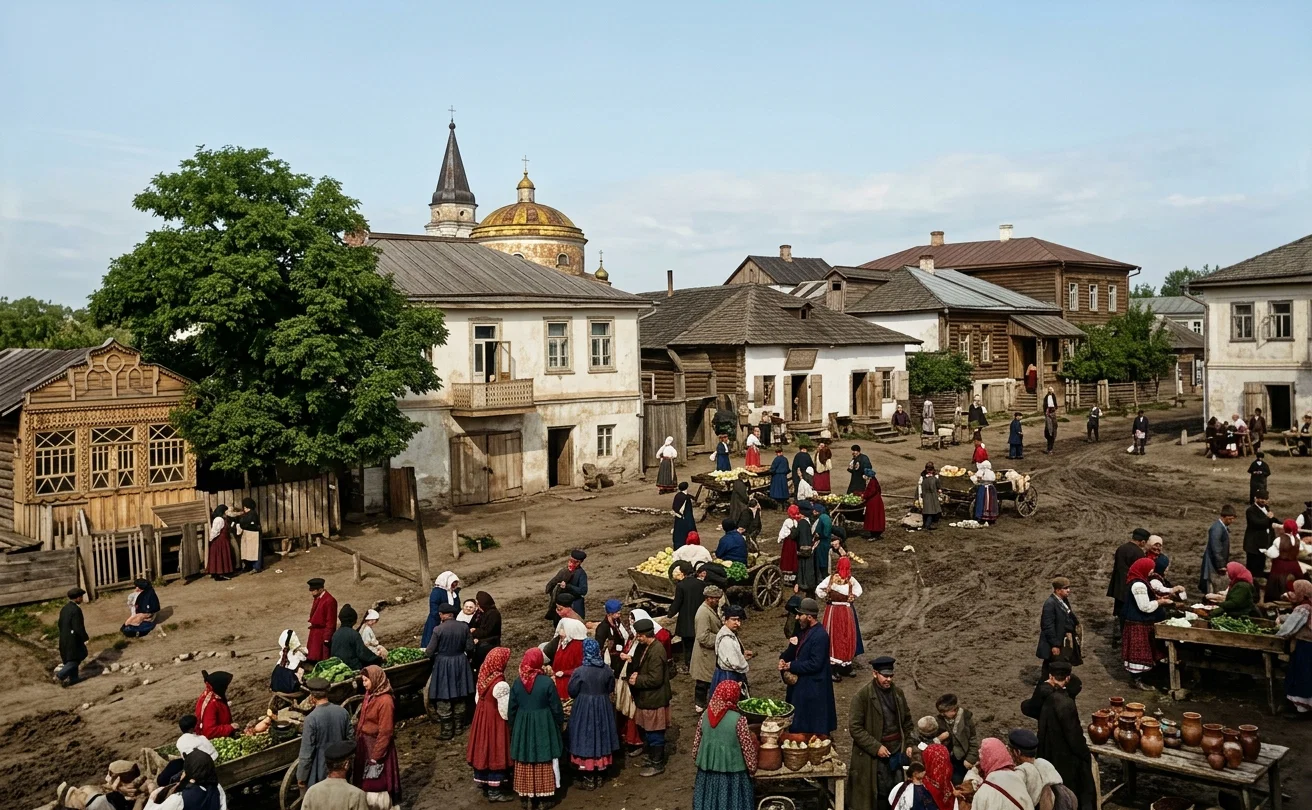
SUNDAY MARKET IN BOGOSLAW, LITTLE RUSSIA
Fifty years ago most of the Little Russians were vassals, and the effects of this kind of slavery still cling to them. They are free, but nothing has been done to better their condition. It is reported that many even wept upon learning of their freedom, as they did not know what to do or how to care for themselves. Is it not the same with Christ’s kingdom? The fact that we are free will not help us unless we know how to accept of the pardon, and grow in grace.
These people are so poor, and lead such miserable lives, that one wonders how they exist at all. They have no beds, and during my whole trip I did not see a single commode or chest of drawers for clothing. A cook-stove they do not know, doing all their cooking in a sort of oven. The utensils used are simply large earthen mugs, which they push into the oven by means of an iron fork. Thus the food is stewed rather than cooked.
In every-day life very little cooking is done, the bill of fare consisting largely of bread and salted cucumbers. Their only table furniture is wooden spoons; grains, potatoes, and all solid foods are taken with the fingers from one common dish.
The family in whose house the meeting is held is generally expected to furnish food to all who attend. Whether the people come from far or near, after the meeting all are invited to eat. The hospitality of the people is exemplary: they give the best they have, and generally enough of it.
The houses have clay floors, which are strewn with cut grass and flowers, or sometimes hay. The walls are very plain, and aside from a picture of the czar, have no decoration. Sometimes, however, a strip of wall-paper is laid lengthwise across the ceiling.
When the house was too small, we held our meetings in the barn. Seats were seldom provided; but if there were any, they were occupied by the men, while the women remained standing, perhaps each one holding a child in her arms. These people are accustomed to stand in a meeting, for in the Russian Orthodox churches there are no chairs.
One is astonished, however, to see with what interest they listen to the preaching of the Word of God. Perhaps this is due to the fact that most of them can neither read nor write. In one small meeting I asked how many could not read, and twenty-five raised their hands.
What can be done to help these poor people? There are very few schools, only now and then one. The children grow up with the cattle, out in the fields. They herd the cows, sheep, geese, and swine, and thus pass away the time. I thought to myself, What a great blessing it would be if one could only go out into the fields and teach these children. But no one is allowed to build schoolhouses, and teach the children. In Africa this can be done, but not here. God himself must work for these poor little ones, and show us the way; for they too must learn of a loving Saviour who died for them.
At one place where we were holding an evening meeting and the young people of the village were present, the police came and drove them all out. They were so frightened that they almost fell over one another as they hurried away. Only our own people were allowed to remain. The meeting had to wait until our passports had been examined, and noted down, and the officer satisfied. But we had already held one meeting in the afternoon of that day, which was attended by so many that neither the house nor the barn would accommodate the13audience, so we held it in the open air under the trees. The people sat down in groups and listened to the Word of God. Had the police appeared then, they would have driven the people away and put us in prison. But our God and Father kept them away. We risk much because we know that it is God’s cause.
In our work here we are often forcibly reminded of the experiences of the early Christians. But God helps us in these experiences. He is strong and mighty, and we fear nothing but sin.
Our people have a very hard time indeed. They are closely watched lest they may hear something new. For instance, Brother Perk had written to one of our churches, telling them of our coming visit. As there is no post-office in the village, all the mail is sent to some place of business. I have seen villages of more than seven thousand inhabitants, without even a mail-box, and miles away from a post-office. Such was the case in this village. In the store where the mail is received, it is read before being delivered. Thus it became known that we were coming, and the police were informed and persecution began. It is not expected nor desired that these people should come in contact with the outer world. I can now understand why it is that our people so often fail to get the papers and other reading-matter sent to them.
A newspaper is unknown in this part of the world. We can hardly understand how difficult it is to get the truth before a people like this. All instruction must be given orally. Yet it is remarkable how well they can repeat what they have heard. One tells another, and in a short time the whole village knows the news. In this way, too, the message of truth goes. What they have understood they remember, and they sit and talk together for hours. They have plenty of time.
We have learned of another village where more than two hundred persons are keeping the Sabbath of the Lord, and we are planning to send a worker to teach them.
The Lord blesses the work of his servants. We have thus far baptized twenty-six, and organized another group of eight, thus taking into the church over thirty new members. The tithes and offerings also are increasing. The work is growing, and Brother Perk is not able to answer all the calls that come for help. Brother and Sister Swiridow are at work in Charkow. Brother Gontar has had to leave Uman because no one would rent him a lodging. Another worker is sick, and a fourth in prison, though by the grace of God the latter’s prison sentence has been somewhat shortened.
During the second quarter, the membership of this field was 605, but for the third quarter it will be about 650.
I am thankful to God for his guidance and protection. We know, too, that we are remembered by those in the home land, at the throne of grace.
Riga. Russia.
East Caribbean Mission
By H. C. J. WALLEKER
H. C. J. WALLEKER
As a result of our meetings held at Fredericksted, St. Croix, we have baptized five and others are interested, who we hope will fully take their stand for the truth. Brother J. J. Smith is located there, and continuing the work. He will also be able from time to time to visit Christiansted. At the latter place we are building a church. The brethren are working hard and sacrificing to get a building of their own. It will be a hard struggle, unless we receive some help, as our brethren there are all very poor. A man works all day in the field for twenty-four cents, and living is very high, so the people can not have much to give. They are doing their best though, and God is blessing them.
Here at St. Thomas we have twenty-one preparing for baptism, and we hope that they may prove faithful.
At Antigua Elder J. H. Matthews has recently baptized eight, and others are interested. There are many places in that island where people are anxious to hear the truth, and a good work is being done.
Brother Philip Giddings, who for some time has been laboring in Guadeloupe, reports that some there have begun to obey all the commandments of God. It is a hard field, as the people are all Catholics or atheists, but the Lord has some honest souls there also. Many of them are willing to stop their work or business at any time of the day to listen to what the Bible says.
Many of the other islands in this field are calling for us to come to them with the truth, and we are trying to push out as fast as we can. The Lord is blessing us, and we praise him for the manifestations of his saving grace.
Java, East Indies
By R. W. Munson
R. W. MUNSON
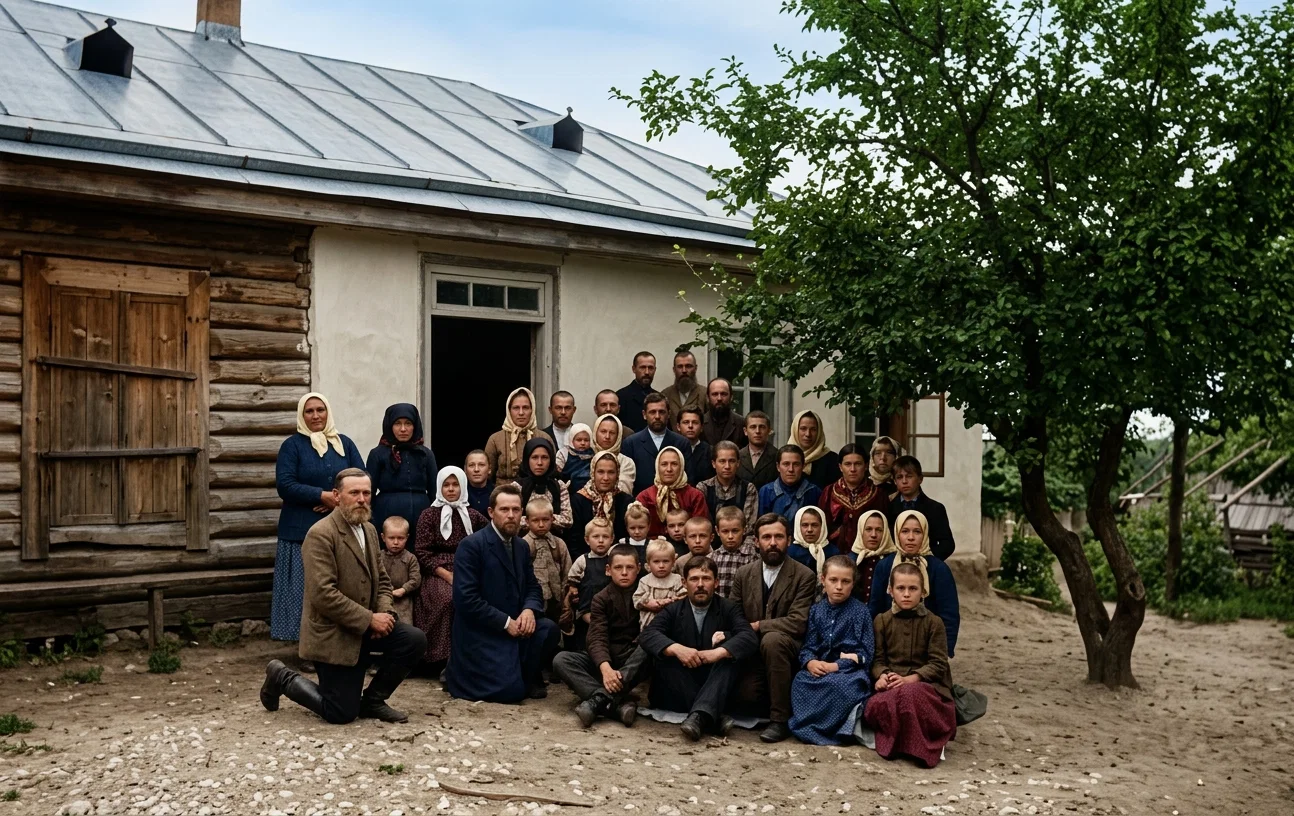
ONE OF OUR CHURCH COMPANIES IN LITTLE RUSSIA (KNEELING AT THE LEFT IS ELDER J. PERK)
There is a bright, intelligent Amboynese gentleman, by the name of Kayulola (Kah-you-ló’-lâ), who is truly interested in the message. The other evening when I called at his house, he asked me to hold a weekly meeting there. He called the next evening, and asked for light on the health-reform question, and particularly with reference to the use of tobacco. When I read the scriptures that bear on that question, he readily assented to the soundness of our position, and means, I think, to give up tobacco. He is a graduate of the government training-school for teachers, and was for a good many years in the government service as a Malay schoolmaster. He is now editor of a Malay newspaper, but also teaches Malay to gentlemen who are passing examination in that language. While he has a very good income, he would gladly be content with far less if he could be entirely engaged in missionary work. He is a high-minded man, whom it is a privilege to know, and is an earnest Christian.
Timotheus, a Javanese Scripture-reader, in the employ of the Roman Catholic Church, heard something about our truth six or seven months ago from some one who had met Mr. Pietersz, twenty miles away in his village, or town. During these last six months Timotheus has come into Batavia, a walk of some five or six hours, no less than five times to try to find Mr. Pietersz, in order to learn more about the truth. On Sabbath the third of June he came in for the sixth time, and succeeded at last in locating the home of Mr. Pietersz. He reached there about six in the morning, having walked a good part of the night. He then waited till one o’clock, in order to meet Mr. Pietersz when he should return from his work, as librarian in the military hospital library. They spent three hours, from one till four, investigating what the Bible says about the Sabbath. Then Timotheus started home, and said he would reach there about nine that night. This was necessary, as the following day was Sunday, and he must be with his flock on that day. But on Monday he returned, after arranging for some one to look after his daily meetings. He came to the mission, and for three days studied the truth with Emmanuel. He told us that the day before he had preached the Sabbath to his people. He had been cautioned not to do this, but he said he could not hide such light, that he must tell it no matter what the consequences might be. I told him that we could not hold out any hope of his being employed by us, for we had no means at our command, which was strictly true. Brother Pietersz also told him that we never employed men who had not shown their faith by their works.
He replied that this was God’s truth, and he was not afraid to trust him for his rice. Surely, said he, God would not leave his children to starve when walking in the path of obedience! May his faith be strong enough to stand the test. He hopes to influence his villagers to accept the message.
There is another village out about half an hour by train where the natives, Mohammedans, are very importunate in asking for a teacher. Formerly Mr. Pietersz used to go out there. We hope to be able by and by to arrange to send him to this village. No teacher is located there by any other church. Doors are opening on every side, and these fine Amboynese men are being prepared of God to carry this message to all parts of the archipelago.
We are full of courage, and have abundant reason to be. We are pleading the promises, and expect to realize just what the early disciples did: “And they went forth, and preached everywhere, the Lord working with them, and confirming the word with signs following.” Mark 16: 20.
Kind Words for Angry Words
“GREATER than keeping silence is the answering of angry words with kind ones. Self-control is magnificent, but forgiveness is divine.”
A Little Talk With Jesus
A LITTLE talk with Jesus, how it smooths the rugged road!
How it seems to help me onward when I faint beneath my load!
When my heart is crushed with sorrow, and my eyes with tears are dim,
There’s naught can yield me comfort like a little talk with him.
I tell him I am weary, and I fain would be at rest;
That I am daily, hourly longing for a home upon his breast;
And he answers me so sweetly, in tones of tenderest love,
“I am coming soon to take thee to my happy home above.”
Ah! this is what I’m wanting, his lovely face to see;
And (I’m not afraid to say it) I know he’s wanting me.
He gave his life a ransom to make me all his own,
And he can’t forget his promise to me, his purchased one.
I can not live without him, nor would I if I could;
He is my daily portion, my medicine, and my food.
He’s altogether lovely, none can with him compare,
The chief among ten thousand, the fairest of the fair.
So I’ll wait a little longer, till his appointed time;
And glory in the knowledge that such a hope is mine;
Then in my Father’s dwelling, where “many mansions be,”
I’ll sweetly talk with Jesus, and he will talk with me.
— Selected.
Who Shall Bear the Burden of Training the Family?
By MRS. J. O. CORLISS
MRS. J. O. CORLISS
WHEN the Lord saw that it was not good for man to be alone, and created a companion for him, Adam said: “This is now bone of my bones, and flesh of my flesh: she shall be called Isha,” which is the Hebrew for woman or wife. Note the closeness of the relationship, “bone of my bones, and flesh of my flesh.” “Therefore shall a man leave his father and his mother, and shall cleave unto his wife: and they shall be one flesh.” Gen. 2:23, 24. The Saviour recognized this unity when he answered the Pharisees who, tempting him, asked, “Is it lawful for a man to put away his wife for every cause? And he answered and said unto them, Have ye not read, that he which made them at the beginning made them male and female?” Then he quoted the text just cited from Gen. 2:24, and added, “Wherefore they are no more twain, but one flesh.” Matt. 19:3-6. Paul also taught this unity, quoting Gen. 2:24 in these words: “For this cause shall a man leave his father and mother, and shall be joined unto his wife, and they two shall be one flesh.” Eph. 5:31.
Paul very explicitly sets forth the duties of those who are thus closely united, and shows how they should regard each other. He uses a very forcible illustration, showing that as Christ is the head of the church, and loved the church, and gave himself for it, that he might sanctify and cleanse it, that he might present it to himself a glorious church, so ought men to love their wives. And as the church is subject to Christ, so ought wives to be subject to their own husbands in everything. Eph. 5:22, 23.
But we hear some wife saying: “I will not be subject to any man. I love to have my own way too well to let a man rule over me.” But listen. Hear Paul still further on this point. “So ought men to love their wives as their own bodies. He that loveth his wife loveth himself. For no man ever yet hated his own flesh; but nourisheth and cherisheth it.” Eph. 5:28, 29. Can not we, as wives, submit to such husbands? Men who love their wives as themselves will not require of them any unjust thing. But that word “submit” means to set in order under; to harken submissively; to obey; that is, simply not to set up the will against that of a godly husband.
To such husbands and wives the command has been given: “Train up a child in the way he should go; and when he is old, he will not depart from it.” Prov. 22:6. This word train is commonly understood in the sense of to teach, and is supposed to include the entire education of the child. But there is a sense in which it may be used which will apply to the child long before it is capable of being taught as the word is generally used. Take for instance the babe in the mother’s arms. It can be trained to go to sleep in a dark room, or in a light one; to fall asleep quietly alone, or to be nursed or rocked to sleep; to take its food at regular intervals, or as it may happen; and a very young child may be trained to cry for what it wants, or to keep quiet till it secures it; and yet it can not understand any teaching concerning which is the proper thing to do. We may, therefore, define teaching as making one to know, and training as making one to do.
At this early age it would seem that the burden of training the child must necessarily fall on the mother, who has almost the constant handling of it. And yet the father may share the responsibility even at this early age of the child.
The father should second the efforts of the mother to train the child. But often parents disagree in regard to the manner of training their children, and talk their differences before them. By so doing the children quickly see that the parents are not united in their work, and this lessens the control of both parents over them. Never should a child get an idea that his parents do not think alike on any subject relating to him. All difference of opinion should be adjusted in the absence of the child, that the influence of both parents may be brought unitedly to bear upon it. It is no uncommon sight to see one parent undertake to correct a child, and the other call it away and protect it from the punishment. In this way the child is made to feel that an injustice was being done to it, and it is ready soon to do again that for which it was about to be corrected. Some mothers throw off the responsibility of training the children by threatening them with: “You must obey me, or I will tell your father.” In other instances the father will let the mother bear all the responsibility by giving the authority into her hands.
We can not think that this is as the Lord designed it should be. The fifth commandment makes it obligatory upon children to obey their parents, both of them. The apostle Paul in writing to the Colossians teaches the children the commandment in these words: “Children, obey your parents [both of them] in all things; for this is well-pleasing unto the Lord.” Col. 3:20.
It is apparent from the commandment itself, “Honor thy father and thy mother,” that the Lord designed parents to share the responsibility in the family; and the Lord never makes mistakes. It is too much to expect the mother of a large family to bear all the burden of directing and controlling the restless and impetuous minds of her children. She needs the influence of the strength and manliness of the father to sustain her, to give force to her efforts. And the father needs the gentle persuasiveness of the mother to make his efforts effectual.
Parents should be anxious to qualify themselves for their important work. They must be united in their methods of training, and study to know the best way. No two children in a family can be trained in just the same way. What will be the most effectual method for one, may prove entirely wrong for another. Each child must be studied, and trained according to its temperament. But obedience is required of the Lord from each child, and it is required of parents to secure it. The Word of God should be the rule in every household. The Lord commanded Israel to make his law the subject of conversation when they sat in the house, and when they walked by the way; when they lay down, and when they arose. Deut. 6:4-9. His Word was not to depart out of the mouth, but was15to be a subject of meditation day and night, in order that they might observe to do all that was written therein; then followed the promise: “Then thou shalt make thy way prosperous, and then thou shalt have good success.” Joshua 1:8. In this way the principles of right may be instilled into the minds of the family, and they will become strong to do them.
But it is not natural to love the Bible and its precious truths, and it is only through the influence of the example and the instruction of the parents to the children from babyhood that they can be taught to love it. No pains should be spared to teach the Bible whenever an opportunity is given; and this work, too, should be shared by the father and mother. Often the mother has cares that hinder her so she can not do the work at the proper time, or in the proper manner, when at the same time the father has moments that he would do well to devote to study with his little ones. His own soul would be fed, the children instructed, and the mother’s responsibilities lightened. Time can be gained for this work if we will take it; but like many other duties the will must be brought into operation in order to accomplish anything. Daily should the Word of God be studied in the family, and the Sabbath-school lessons afford a splendid guide to the mind in this work. Without doubt it is necessary that other important work should be neglected rather than this. The daily routine of domestic life pertains only to our present existence, and only affects the passing moment; but to neglect the study of the Word of God is to neglect the spiritual life, the daily growth of the spiritual body, without which there will be a failure in growing up into our living Head.
The life we now have is given us in which to prepare for the higher and better life, and as mothers we should study both to train and to teach our children from earliest infancy in reference to this fact. “The greatest and best of men have confessed their indebtedness to their mothers; and doubtless not a few have enshrined in their character, and have wrought out in their life, inspirations which had thrilled their mothers’ natures from early girlhood.”
How important it is then that our girls should be carefully trained to lofty thoughts and pure imaginings, that shall in after days reappear in the strongest, fairest characters; and how necessary it is that young women should carefully watch their hearts, restraining what is vain and evil, and ever reaching out after whatsoever things are true, just, pure, lovely, and of good report, not only in outward appearance, but in the inner chambers of the heart; for there the formative influences are ever brooding.
Few of us realize the immense importance attached to the education of our girls. Those who bear the children largely make our times. It is said that “the hand that rocks the cradle rules the world.” Whatever may be the principles of the mother, she will teach them to her sons and daughters, and they in turn will instil them into the hearts of their children, and it is in this way that society is formed, governments controlled, and, most serious of all the consequences, souls are ruined or saved.
But some one may ask: “Who is sufficient for these things?” The answer comes to us in the words of Jesus to the apostle Paul when he besought the Saviour for help: “My grace is sufficient for thee; for my strength is made perfect in weakness.” 2 Cor. 12:9. Also in James we have the promise recorded, “If any of you lack [or want] wisdom, let him ask of God, that giveth to all men liberally, and upbraideth not; and it shall be given him.” James 1:5.
Mothers, it is our privilege to lift up our hearts to God, and in simple, childlike faith claim these promises, and then take the help he has so freely offered.
Mountain View, Cal.
The Boy Problem
By L. M. CROSS
L. M. CROSS
The boy is one of the most wonderful things in the world, and he is one of the least understood of all God's creatures. Even men, who at one time in their existence were boys, do not know how to treat him, or what to do with him.
He was born into this world just as was his father before him. He must tread in the well-beaten paths of his ancestors, and sail on the same stormy waters that his father sailed on. He has inherited the same nature and disposition that his father inherited, and has in him the added virtues and vices that his father created by his own life.
Up to eight years of age he is a veritable interrogation point. Long before that period of his existence he begins asking questions; he wants to know about everything — what is it? and why is it? He is in a strange world, the paths and ways are new to him, and he wants to know about them.
One of his first questions is: “How did I get here?” He asks it of mother and father, and is met with frowns and expostulations for daring to ask such a question. Their repellent manner does not silence his questions, and he is determined to have his answer from some source, he cares not what. His school companions are sought, and he gets the desired information. But, O, how does he get it! In unclean language, made wretchedly filthy by impure lives and thoughts, he is told what God never intended should be regarded as unclean. And thus his whole idea of the sacred relations of home is shamefully distorted. The names father and mother, which should be hallowed with the tenderest and sweetest memories, arouse in his imagination thoughts that are disgusting. Is the picture overdrawn? — You know it is not.
Here is another picture more pleasant to look upon; it is one of a father, with his boy on his knee, telling him sweetly and tenderly the sacred story of birth, of how he grew under his mother's heart, of the sweet, sacrificing suffering of mother; and when the tender truth is told, how he runs into the outstretched arms of mother, and exclaims: “Mother, now I know why I love you so, and why you love me!”
The boy is satisfied because he has heard the truth simply and sweetly, and he has received a lesson that will deepen his affection for his parents, and write the indelible lines of a pure life upon his countenance when he reaches manhood.
The writer never knew that one of the sweetest stories ever told can be made of the story of birth, to even a little child, until he read Dr. Sylvanus Stall's book, “What a Young Boy Ought to Know,” which has taught him, as it has thousands of other parents of a boy, the God-given way of teaching boys.
Love Guiding
By B. A. L. Gregor
I CAN not see, I can not understand,
But yet I trust and feel that love alone
Has guided and is guiding me. His hand
Will never needlessly afflict his own.
So from this single thought I will not
swerve,
That somehow, somewhere, an unlooked-for gain
Of life, of love, of joyous power to serve,
Is coming to me on the wings of pain.
— B. A. L. Gregor.
Wise Words to Parents
BE courteous to your children. A kind manner and gentle tone usually have the desired effect, however obdurate the case, and the children are born imitators. As in water “face answereth face,” so the reflection of our own lives is in those of our children. Make home the most attractive place in the world to them; give them space to play, even if carpets and furniture suffer a little. Certainly order and cleanliness should be a law in every household, but take heed lest your children fear a stain upon clothes or carpet more than one upon their conscience.
Keep near to your children. Do not let them grow away from you. Keep them close in your confidence and affection, so they will confide in, and not be afraid of, you. I know a lad who takes pleasure in giving his mother an account of his doings during the day, whether they be pleasant or otherwise. She laughs with him if they are funny, and gently chides where he is wrong, but in a way that does not make him afraid of her. He will not relate a single instance to his father, because before the story is half through he will begin to scold him for doing so and so. It is plainly seen which can have the most influence with him.
Give your commands in the form of requests whenever it is possible. When a commanding tone seems to be necessary, speak without betraying any excitement, in a low voice, but decidedly, and use as few words as possible.— Selected.
The Captain
By Dorothea Day
OUT of the light that dazzles me,
Bright as the sun from pole to pole,
I thank the God I know to be,
For Christ, the conqueror of my soul.
Since his the sway of circumstance,
I would not wince, nor cry aloud.
Under that rule, which men call chance,
My head, with joy, is humbly bowed.
Beyond this place of sin and tears,
A life with him; and his the aid
That, spite the menace of the years,
Keeps, and will keep me, unafraid.
I have no fear, though strait the gate:
He cleared from punishment the scroll.
Christ is the master of my fate!
Christ is the captain of my soul!
—Dorothea Day, in Sunday School Times.
Southeastern Union Conference
By Carlyle B. Haynes
The first meeting of this conference opened Sunday night, January 8, with a bookmen's convention, which is to occupy two days of the time of the ten-day session. The conference is being held in the church building at Graysville, Tenn.
For ten days preceding the bookmen's convention, a canvassers' institute was in progress for the canvassers in the Cumberland Conference. In addition to the local workers this institute was attended by canvassers from several other States in the union conference. A number of new workers were trained, who will enter the field at the close of the union conference meeting. A good spirit of unity and earnestness prevailed throughout.
The papers in Chattanooga and Knoxville are printing daily reports of the meetings, giving considerable space to the details of each one. A long article appeared in both Chattanooga papers two or three days preceding the opening of the conference, which gave a very full account of the work of Seventh-day Adventists, their growth, and their leading doctrines. This article was prepared by the new Press Bureau of the General Conference, and was sent out from Washington early in the week to every daily paper in the States of Georgia, Florida, the eastern half of Tennessee, and North and South Carolina. We are unable to say at present how extensively it has been used, but we hope that many papers have published it.
Much interest has been manifested by the workers at this conference in the work of the Press Bureau. A class has been formed in newspaper reporting at which daily instruction is being given by the writer in the essentials of writing for the press. We trust that this will result in wide publicity for the principles of the truth throughout the States of this union during the coming year.
During all the meetings held so far, there has been signally manifest a spirit of good fellowship and harmony among all the workers. Several very spiritual meetings have been held, and the influence of the Spirit of God has been felt in a decided way.
Carlyle B. Haynes.
Who Will Help?
By Stephen N. Haskell
SOME of the brethren and sisters interested in helping to pay the heavy debt on the church building in Portland, Maine, have paid for 11,660 of the Missionary number of the Bible Training School, to be sold in the interest of the Portland church.
There is $1,000 of the amount borrowed for the church building that is due at the present time, and the brethren do not have the money to meet the demand. Who will help raise this $1,000 by sending for a quantity of the Missionary Special Bible Training School at once, and selling them?
One sister has already sent in $20 for 200, and a brother has taken 100. You can get a threefold blessing in this work. First, you will receive a blessing in your own soul by helping advance the work of the Lord; second, the Missionary number of the Bible Training School is a message-filled journal, and by placing it in the hands of your neighbors and friends you are giving them the message; third, you will be helping to clear the debt on the church in Portland, the birthplace of this message we love so dearly.
The paper sells for ten cents a copy, and every cent of the money will be applied on the debt of the Portland church. When you send $10 for 100 papers, the entire ten dollars will be paid on the debt, as other individuals have already paid for the papers.
You can sell the papers and receive all of your money back if you wish to do so, or you can use the papers for free distribution. The money is needed at once. If the Lord prompts you to help, send in your order without delay for any quantity that you wish, and the papers will be sent you postpaid. Send the entire price, ten cents a copy. Cash should accompany all orders. Forward all orders direct to the Bible Training School, South Lancaster, Mass.
S. N. HASKELL.
“Pray Ye Therefore”
By Joel C. Rogers
It has been a great pleasure to spend a week with our workers in Paris and in the south of France. Being on the way to meet my wife coming from our Nyassa Mission, I arranged to spend Sabbath at Paris. On arrival I went to the address of the Latin Union, hoping to find Brother L. P. Tieche; but he had changed his office, and was out of the city.
I was about to proceed on my journey, when I found in my note-book the address of Brother Roth’s food store. He directed me to Brother Augsbourger, who is in charge of our Paris mission.
At the Sabbath service, the hall was well filled, over seventy-five being present. They gave the best of attention to my remarks on the progress of the message among the heathen of all lands, based on Isa. 49: 11, 12. A meeting for the youth was held that afternoon, and several adults also attended. The Holy Spirit met with us and impressed our hearts while studying 1 John 2: 12-17, the necessity of complete separation from the world. Several testified of their determination to devote themselves to God’s work. One intelligent young lady had recently separated from her Catholic family to accept the message. Her purpose is to become a missionary, and she is planning to go to one of our schools for preparation.
But it is in the south of France where I am moved to offer up earnestly that harvest petition to the heavenly Husbandman. At Lyons there is a little church of twenty members, and three other persons have just accepted the message. All are working and praying for others.
At Avignon I found Brother Favre and his wife, with no one to help them. This ancient city has never before been entered with this truth. Here, almost under the shadow of the old papal ruins, the message is struggling for a foothold. Five had taken their stand for the truth up to Dec. 7, 1911, when I was there. In the face of bitter opposition they are striving to free themselves from old errors and associations. Deep interest was shown in remarks on Revelation 7 and 14, interpreted by Brother Favre. Both he and his wife are anxiously burdened for souls in this Roman stronghold. Let us join with them in praying for a plentiful harvest.
But at Marseilles my heart was touched more, if possible, than at the other places, by the dearth of laborers. Here were only two workers. This is the great seaport of France, and the second city in population. The boat by which I was to sail to meet my wife at Port Said was two days late, giving me the privilege of spending Sabbath with these workers. Up to this time there have been no resident Sabbath-keepers in Marseilles.17
Nearly all our ministers,—and they in France are few indeed,—as well as the few other workers in France, are those who embraced the truth in the French part of Switzerland, and received training in our Swiss school. France has no school for training our young members for the great French field. Such a school is needed with as little delay as possible. There are many waiting individuals to be gathered out of France and the extensive colonies. Madagascar has not one Adventist missionary. How long must that field wait? Let us sincerely join in the prayer for laborers.
JOEL C. ROGERS.
Port Said, Egypt.
Alabama
By Abbie Cooper
ABOUT fifteen years ago a company of workers left Battle Creek, Mich., to open a school for colored people in Alabama. They settled on a newly cleared piece of pine land, not far from Birmingham. Neat, inexpensive buildings were erected, and a garden and an orchard were started.
Few of the people in the vicinity could read or write, and many were so poor that they lacked proper food and clothing. However, the children and young people were eager to learn to work, and also took kindly to study. They were taught to help with the work of the school, and the older ones learned to give simple treatments. Others met with good success in canvassing.
The school is now being conducted by colored teachers. As a result of the work of this industrial school; a church of nearly fifty members has been organized, and the community is quite prosperous.
ABBIE COOPER.