Your ShelfYour Projects

Signs of the Times, Vol. 37, No. 30.

Fruit-Bearing
Earlier text: Out of Babylon to Zion

A Campaign for Intolerance

THAT is the character of the campaign which is beginning in California. At its head locally is the Rev. G. L. Tufts. Behind him nationally is Dr. Wilbur F. Crafts.
Of course, we would not be understood as charging that this is the purpose of these men. They doubtless believe that their effort if successful will result in good, will be of great benefit to the state and its various communities, in fact, will be the salvation of the state.
There are some things in Mr. Crafts's reform bureau which are worthy objects to work for; namely, temperance, anti-gambling, reform in divorce laws. But another feature which he is putting forth special effort to secure is a legal sabbath in California.
In a recent meeting in San Francisco — July 10, 1910 — Mr. Crafts declared that the two things that helped San Francisco in her efforts to secure the Panama exposition was the prohibition of the prize-fight and of the fight pictures; and now two more things he deems necessary,— liquor must be forbidden on the exposition grounds, and the grounds must be kept closed on Sunday. Mr. Crafts and his associates will labor to this end. No appropriations will be voted by the Federal Congress, if Mr. Crafts can help it, unless with the gift goes the promise that the exposition is to be closed Sunday, the working man's day for seeing.
The California State Capitol at Sacramento
We do not mean by this that state authorities should seek to control or enforce the labor on Sunday of those employees upon the grounds who conscientiously can not work that day; yet we believe that thousands of workmen would spend Sunday to better advantage upon the exposition grounds, limited tho the exhibits might be, than they would elsewhere in drink, in carousing, in senseless, aimless wandering. The fair would at least be educational.
But a Sunday law, as demonstrated by all past history, is a regular Pandora's box of evils if active. However mild its blossoming, it forms a stock on which can be grafted all the evils of church and state. However beneficent may be its authors, it becomes a weapon which bigots and the intolerant-minded will use as an instrument of tyranny against those whom they oppose.
Why Christians, those who believe in Christ, in His power to save and keep from sin, who believe in the Spirit's power to change or restrain the human heart, should turn from these infinite potencies and seek the aid of the state to enforce religious dogmas and institutions, is beyond comprehension. Does it mean that they do not believe in Christ Jesus after all?
Then, too, no service is acceptable to God unless it is willing service. No man is won by compelling him to act contrary to his convictions. No one is made better by compelling him to be a hypocrite. And there are a hundred other inconsistencies.

New Combinations for Sunday Law

[The following from the "Free Labor News Service Syndicate," San Francisco, we print without comment. To the careful observer it speaks for itself.—EDITOR S. OF T.]
The Rev. Charles Stelze reports progress in his great work of merging the labor unions with the Presbyterian Church. Rev. Mr. Stelze's latest is to have a "labor Sunday" on which all pulpits in the Protestant churches will be thrown open to labor leaders to expound their particular labor doctrines.
A pact is being made by which the merger will gain the strength of the Prohibitionists and the labor element will vote with the latter in an attempt to make the state "dry." This step was taken by the Labor Councils of the various cities with a view to wreaking a proper vengeance on the brewers, who refused to come to the aid of the striking hands during the last walk-out at Los Angeles. In connection with the program of the two ministers who have become so distinguished in labor circles, it is proposed to lend all the aid of the labor element, in the next legislature, to the enactment of a Sunday closing law.
The Rev. Stuart Reid is the paramount representative of Mr. Samuel Gompers in California, in charge of the machinists' strike, and the Rev. Stelze is the man who originated the idea of the church and labor merger. Undoubtedly both great bodies will work harmoniously and to the great good of man.

Preparing for War

THE New York "World" and some other journals feel that the question of the future is air-ship and battle-ship. Military officers that witnessed the exhibition of dropping pseudo bombs on pseudo battle-ships believe that there is a factor to deal with that has not been dealt with before. Hiram Maxim declares that a thousand shots might go through an aeroplane without effect, without inflicting upon the pilot or the motor a disabling wound.
"The human spider in his web of bamboo and piano wire, moving at fifty miles an hour, flitting, swooping, rising, veering, constantly altering his course, is a small mark at a thousand feet of altitude. Shrapnel may destroy him, as Mr. Maxim says; but its range is limited, and the man in the aeroplane, while studying to cast his bolt, or after casting it, may rise to 3,000 feet and become almost lost to sight."
There is fearful risk in it, but there has never been any lack of men to take such chances, while a thousand aeroplanes may be built for the fraction of the cost of a super-Dreadnought.
"Give them a gray mist that veils the stars from below while the upper air is clear, and they may swoop so low that the dim bulk of the ship is an easy mark, while the sound of their coming will only approximately show their location."
And the next thing will be great appropriations for building fleets of aeroplanes, to be cast aside in a year or so for useless junk while more expensive ones will be on the tapis.
Just recently in addition to the new British budget, Mr. Lloyd-George made provision for a further increase of $27,500,000 in naval expenditures. He warns the country where it is needed, and he points out that in the last quarter of a century the naval estimates have risen from $65,000,000 in 1886 to $200,000,000 in 1910. That means national bankruptcy, and the great question is which nation will fall first. The New York "World" points out that "Great Britain's case is not different from that of the other great world powers. They have all been seized with the same craze for bloated armaments. The United States, in spite of its exceptionally advantageous position, has fallen a prey to the jingo madness." From $13,000,000 in 1886 naval expenditures have mounted to $136,000,000, or increased tenfold in twenty-five years.
In the years 1907-1909 the seven nations, Great Britain, United States, Germany, France, Russia, Italy, and Japan, provided for the expenditure of $1,634,605,000 on their navies; Great Britain and the United States alone being responsible for more than half that enormous sum.
The same craze possesses the South American nations, Brazil building three big Dreadnoughts; Argentine two 20,000 ton battle-ships and four big cruisers; and now little Chile follows suit with a battle-ship larger than either of her neighbors possesses. "The World" truly says:
"A more ruinous policy or one more contrary to common sense was never conceived by civilized nations, and it is a thousand times ruinous in the light of Curtiss's experiments for 'The World.'"
Yet all this is but the fulfilment of prophecy. Read Joel 3: 9-12.

Persia’s Spheres of Influence and Crisis

Altho Persia is already divided into two "spheres of influence" by Russia and England, Germany has announced its intention of opening it to German capitalists. Germany was unfortunate in being born into the circle of the great nations after the world had been divided among the powers. Hence her industrial expansion will always involve international relations. In the Persian situation as it now stands, one journal has put it, "England and Russia will have to divide their Persian spheres of influence, or Germany will have to abandon her purpose to force open the trade doors of Persia, or make the new East a battle-field." In view of this, the same journal elsewhere says the situation makes certain a desperate crisis in the Orient.
"The Western Watchman," of St. Louis, publishes a column article from London in its issue of June 23 to prove that King Edward VII died a Roman Catholic, shrived by a priest, namely Bernard Vaughan, S. J. The last place the king visited before leaving the continent for England, just before his last illness, was the grotto at Lourdes. It is also said that he wore around his neck a scapular, such as is worn by devout Catholics. A scapular consists of narrow strips of cloth tied with strings, and generally having upon it the figure of a cross, or some other badge. That the king died a Catholic would not surprise us. The defection of the whole royal family does not change God's truth.
Mexico will celebrate the centennial of its struggle for liberty next September. It was in September, 1810, that the Mexican revolution against the Spaniards began. A national centennial commission is arranging a program. The powers will send delegates to the celebration. Certainly the men of to-day need to learn the lesson of past struggles for freedom.
As showing the tendency to extravagance, the increase in Government expenses is worthy of note. In the four fiscal years 1886-1890, during the 49th and 50th congresses, the appropriations amounted to $1,136,454,697.68. During the four fiscal years 1902-1906, under the 57th and 58th congresses, the appropriations were $2,139,006,651.58.
Elwood Haynes announced to the American Chemical Society, which met in San Francisco, the discovery of a new steel substitute, an alloy of cobalt and chromium. It is unoxidizable, and will not rust under any conditions. While costing a little more than steel, it has more utility.
The German kaiser will shortly begin an anti-socialistic sheet with himself as editor. It is reported that Emperor Wilhelm has been studying American journals, and that he intends to introduce a tinge of "yellow" in his paper.
The entertainment that Paris extended to the king and queen of Bulgaria on their recent visit cost the French Government $20,000; that of Roosevelt, $5,000; and that of a Chinese prince and several Moroccan nobles, $5,000.
July 4 to July 28 the British navy engaged in mimic war. The area of the maneuvers was from Gibraltar to the North Sea. The monetary value of the fleet involved is $600,000,000. It is the largest fleet of modern history.
The governor of Missouri has issued a proclamation warning the Negro that he must not gloat over the results of the fight at Reno. Sad that such a thing seems necessary.
According to the St. Louis "Globe-Democrat," men are allowed to smoke in a church at Dayton, Ohio. The same journal says the church may soon be a competitor of the "club."
Six hundred seventy-two boxes of ice-cream cones were seized by a United States marshal at New York. A complaint had been made that they were unfit for human consumption.
According to a newspaper report, 14 divorces were granted in Reno in 1905; 58 in 1906; 82 in 1907; 111, 1908; 146, 1909.
The German astronomer Johann Gottfried Galle died July 10. He was the first astronomer to see Neptune.

The Spiritual Unrest

"The Spiritual Unrest." By Ray Stannard Baker; price $1.35 net. Frederick A. Stokes Company, New York.
Some time ago Prof. William James of Harvard University stated, "A wave of religious activity analogous in some respects to the spread of early Christianity, Buddhism, and Mohammedanism, is passing over our American world." Mr. Baker has been gathering facts bearing on Professor James's statement. He has made what he believes to be an impartial investigation into specific and typical modern religious institutions; as for instance Trinity Church in New York, a noted slum (Continued 3d col., page 12)

Out-of-Doors

"Out-of-Doors, or the Open-Air Spirit in Relation to Modern Life." Price 60 cents. By M. Ellsworth Olsen, Ph.D., with an introduction by Jacob Riis. Pacific Press Publishing Association, Mountain View, Cal.
This beautifully bound little volume with its illuminated cover page, inviting out into the mountains and woods, is packed full of inspiration, of the blessings of out-of-doors, out away from the murk and cark and care of the city, out from the busy, bustling rooms of commerce, out of legislative halls, stuffy offices, dingy workshops, gloomy houses, out into the great open, expansive "out-of-doors." It is to this that the little book invites us. It states what we all know,—that one of the great evils of the present life physically and mentally is "too much house;" too much of indoors, too little fresh air, too little sunshine, and outside the walls which encompass the great part of mankind there is an abundance of life and health and joy awaiting every soul who will drink it in. The book is dedicated to Col. Theodore Roosevelt. The chapter divisions indicate somewhat of the scope of the work: A Sedentary Race, Problem of the Children, The Young Man's Needs, Beauty Culture Out-of-Doors, More Fresh Air and Less Furniture, "Too Much House," Higher Ministry of Field and Wood, Around the Camp-Fire, "The Long Brown Path," Back to Nature and the Soil. It is a splendid little gift book for the weary, languid young man, or the pale, emaciated girl to read and put in practise. In fact it is good for every one.

The Companion Bible, Part I

The Companion Bible, Part I, The Pentateuch, being the authorized version of 1611 with the structures and notes, critical and explanatory and suggestive. Oxford University Press, London, New York, Toronto, and Melbourne.
The object of this work is to publish the English Bible in four instalments, each containing about 400 pages: The Pentateuch, Joshua to Job, Psalms to Malachi, and the New Testament. The aim is to make the Bible self-explanatory, designed for the general use of all English readers. It is not to be considered a new translation nor an amended translation nor a commentary. There are no alterations in the text beyond what can be effected by a variation in the character of the type. All ancient readings and all amended renderings are confined to the margin. There are no minute English or Greek "superior" letters to confuse the text. Distinctions are indicated by type. Pronouns referring to Deity are indicated by capital letters; pronouns emphasized in the original are in special type. Where capital and small letters affect interpretation these are given. Words spoken or cited are placed within quotation marks. There are many other good features which we have not space to mention. Chapters and verses of the Authorized Version are retained, but spaces are introduced to mark them off into paragraphs, so that the advantages of both verse and paragraph division are retained. The marginal notes give all the important readings in the Old Testament according to Ginsburg's Massoretico-Critical Text of the Hebrew Bible. In the New Testament all the important readings will be given according to the great textual critics Griesbach, Lachmann, Tischendorf, Tregelles, Alford, Westcott and Hort, and the Revisers' Greek Text.
Another excellent thing is that no Hebrew or Greek words are brought in with the Hebrew or Greek characters, but all such terms are transliterated. Structures of the books are given, and all their parts, which are the surest thing to their interpretation and the strongest proof of their inspiration. One may not be in concord with all of the appendixes and explanations given, but he will find the work decidedly helpful. The Oxford Press has certainly done an excellent thing in the issuing of the Companion Bible. As a help to the student we gladly commend it.

The Royal Oath Bill

The Royal Oath Bill before the House of Commons, presented in order to take away the offense of so many Roman Catholics, does not demand that the king shall repudiate the Roman Catholic Church, but it does declare that he must be a faithful Protestant and so remain. The paragraph referring to that reads as follows:
"I do solemnly and sincerely, in the presence of God, profess, testify, and declare that I am a faithful member of the Protestant church, as by law established in England, and I shall, according to the true intent of the enactments which secured Protestant succession to the throne of my realm, uphold and maintain the said enactments to the best of my powers and according to law."

Steel Cars

Steel Cars.—There is one thing worthy of notice in a recent wreck on the Southern Pacific. Usually wooden tourist cars have been crushed to pieces; but in this wreck the steel tourist car in the middle of the train left the track, tore through the buffet car, and landed on its side in the ditch; but with every berth in the car occupied, not a single occupant was killed or even seriously injured. All were able to collect their scattered clothing and dress undisturbed by the fear of fire. Travelers ought to be glad that steel is so rapidly replacing wood.

Sunday Laws and Baseball

Great effort is being put forth at the present time in New York and New Jersey and elsewhere to enforce Sunday laws and prevent if possible any more Sunday baseball games. In Patterson, New Jersey, the ministers protested, and called upon the mayor and chief of police to enforce the laws, but the mayor loves baseball. He recently threw the first ball in a Sunday baseball game. The next Sunday he was criticized from the pulpits, but he responded that he enjoyed baseball playing, was glad he went, and would go again if he had the opportunity.

Germany and the Monroe Doctrine

A despatch from Berlin of July 12 makes declaration to the effect that Germany has taken no stand in opposition to the United States and the affairs of Central and South America, and has issued no statement that could be construed into antagonism to what the American Government has done, is doing, or may do in Nicaragua, nor is the Monroe Doctrine flouted by her. The Government at Washington feels no apprehension regarding Germany's attitude.

The Making of Good Roads

The Hon. William Sulzer, congressman from New York, has one laudable object in which all ought to wish him well, and that is the making of good roads. The third National Good Roads Congress was held the last of last month at Niagara Falls, New York. Mr. Sulzer points out some of the great economical advantages which would come from good roads, in a speech in the House of Representatives, June 9, 1910.

Book Notices

(Continued from page 11)
mission, institutional churches, settlement houses, Jewish synagogs, and the Emmanuel Movement. The results of Mr. Baker's investigation first appeared as articles in The American Magazine. The number of letters received at that time led to the placing of the articles in a more permanent form, of which this book is the outcome.
This is certain: Mr. Baker's book shows that there are deep and rapid changes taking place in the religious world. The real question is whether it is for the good or the bad. Is the great spiritual unrest finding the only Source of rest—Christ Jesus? Or is the tremendous outward activity a sign merely of an effort of unrest to find peace? In other words, are the many activities of what is called religious work but so many efforts put forth to purchase pardon and peace? Are they real fruits of the life of Christ within, or are they simply manifestations of human effort to obtain life apart from faith in Christ? That the latter is the case seems evident from an expression which Mr. Baker uses in his summing up when he says, "If it were possible to sum up in a few words the one thing that has most impressed me in visiting churches and talking with church leaders in various parts of the country, I think I should say the utter confusion of counsel among church leaders themselves." Yet he thinks there are real prophets, and declares that the book which has most strongly impressed itself upon the agents of religious activity is "Christianity and the Social Crisis;" but this of itself is not assuring. Where the true reformation lies it will not be found that the one book or books which impresses itself or themselves upon the leaders is a purely human book, but it will be found that it is the Book of books. There are some things helpful and very much that is informing in Mr. Baker's "Spiritual Unrest."
— * —
"Training the Teacher." By A. F. Schauffler, D.D., Antoinette Abernethy Lamoreaux, B.L., Martin G. Brumbaugh, Ph.D., LL.D., Marion Lawrance. With supplementary chapters by Charles A. Oliver and Ira Maurice Price, Ph.D. Paper covers, second edition. Thirty-five cents. Sunday School Times Company, Philadelphia.
This little manual embraces four departments, the Book, the Pupil, the Teacher, and the School. It is intended to be a guide for young teachers. The first department is an analytical résumé of Bible history. It is pleasing to discover that Dr. Schauffler is opposed to Higher Criticism, and tho he is somewhat uncertain of the manner of the ushering in of Christ's kingdom, yet he always tells the reader to go to the law for the verification of what he puts forth. The remaining part of the volume will be very valuable to the Sabbath-school teacher and superintendent, as it includes a sketch of child-psychology, chapters on the training of teachers, and an explanation of the technicalities of Sabbath-school organizations.

Shiloh: the Man of Sorrows

Copyright 1910, Pacific Press Publishing Association
By Mrs. L. D. Avery-Stuttle

Chapter XXII.—Imprisonment of the Baptist

Go with me to the lordly city of Tiberias, upon the western shores of the Galilee. Let us visit the palace of Herod Antipas the tetrarch. He has returned from Bethabara, beyond Jordan, from his conference with the Baptist of the wilderness.
The distance between the two points was long enough to have cooled an ordinary outburst of passion. But the haughty ruler of Galilee felt that his pride had been humbled. That he, Herod Antipas, by whose royal might the beautiful city of Tiberias had been builded in honor of Cæsar — that he had been utterly unable to gain one word of praise from the mouth of the stern Baptizer, or to win one syllable of approval from his lips, was exasperating, and quite without a parallel. But that he, the princely tetrarch, should have been sternly rebuked for leading his dissolute and shameless life, was not to be silently endured.
Still he was unwilling to imprison or to punish the prophet in any way. The craven heart of the tetrarch felt a wholesome fear of the people, and, were the truth really known, he was troubled by an uneasy conscience.
But the inflammable anger, caused by the outraged pride of the worldly prince, required but a touch of flame to kindle, and that touch was supplied at once by the fiery tongue of the irate and unscrupulous Herodias.
Wounded pride, hot indignation, and the desire for revenge, struggled for ascendancy in the depraved and sensual heart of the woman.
"Who am I," she exclaimed bitterly, at the conclusion of the recital of his story by her unlawful spouse, describing his reception by the prophet, "who am I, that I should quietly endure the reproach of this man! And thou, O Antipas, thou art not a
true son of thy father, even of Herod the Great, if thou dost submit to be scorned and insulted by this lawless peace-breaker, clad in his ugly raiment of camel’s hair. Ugh! verily I shall have vengeance! O Antipas! canst thou say thou lovest me, and yet hesitate to punish this lawless son of a priest?"
The beautiful, cruel eyes of the woman were bedewed with tears — but they were the tears of a monster!
"Command me, O Herodias! behold, I am thy slave; for thou dost bind me as with chains of enchantment, with one glance of thy starlit eyes! What wouldst thou that I should do unto him, even unto this Baptizer?"
"Imprison him!" hissed the woman. "Verily, Antipas, thou hast not even the spirit of that weakling Philip, thy brother, if thou failest to imprison this son of an ignorant priest! Why shall he taunt thee concerning the daughter of Aretas, the Arabian? Verily I doubt not he doeth worse than thou, in his scandalous garments. If he hath done no evil, why dwelleth he in the wilderness? why hideth he himself, even from his youth, as I have heard that he hath? Of a truth, this fellow is a companion of robbers!" and a shudder of pretended fear shook the graceful form, as she glanced appealingly at the king.
But sin-hardened as he was, Antipas could scarcely listen to such condemnation, such slander, so unjust, against one whom he knew to be the prophet of the Almighty, one whose life of purity and virtue was never before spoken against.
"How canst thou speak words of such bitterness, O mine enchantress? for of a truth the man hath done me no harm, even if he were emboldened to speak the words of the law unto me. Surely, O my Herodias, thy woman’s heart doth not counsel me to deeds of violence. Verily, I repent even now of mine own anger. Why should I have spoken at all these words concerning this prophet, who is indeed a just man? for of a truth I have caused thee to rise up against him!" and an expression of real regret crossed the dark face of the king.
"O mine Antipas! surely thou art false unto me, and thou lovest me not. Go again even into Arabia, and fetch from thence the daughter of Aretas, the angry emir, thy father-in-law, and let me take my beautiful daughter Salome, who, thou sayest, is the light of thine eyes; behold, I will take her and depart, and go again to Philip; for of a truth thy brother at least sought to please me, and verily he loved me. I will return unto him!"
"Say not so, O my princess! what wilt thou that I should do unto the prophet of the Lord, thine enemy?"
The city of Tiberias on the Sea of Galilee, where Herod’s palace was
"Have I not said unto thee that the man should be imprisoned? And surely, O my Antipas," continued the woman, her cruel eyes wet with false tears, "thou knowest not the pain it giveth me, — for it grieveth me to do harm to any creature; but this man verily belongeth to the horde of robbers who are led by Barabbas, and so, for the good of all the people, he must be safely lodged. Behold, the prison that thou hast already builded even here in Tiberias, waiteth for robbers and malefactors! but if thou lovest me not," and the cruel eyes again shone with tears, "if thou hast no love for me, then let this mine enemy and thine go in peace."
For a moment Herod hesitated. In that moment the fate of the prophet was sealed.
The tetrarch felt a pair of soft, white arms about him, and warm, sensuous, seductive lips pressed close to his. The woman realized that she had triumphed.
"Behold, it shall be even as thou sayest. I will send and fetch the man."
The gloomy fortress at Tiberias has closed its iron doors upon him who was commissioned by the Eternal to prepare the way before the Anointed of God, the Shiloh of Jacob.
To gratify the wicked caprice and revenge of a vile woman, the faithful prophet of the Most High must languish in prison.
Meanwhile, Herodias bides her time. She can afford to wait, now that her victim is in her power; for she is certain of complete revenge.
(To be continued)

THE HOUSE

WE LIVE IN

OR THE MAKING OF THE HUMAN BODY

BY VESTA J. FARNSWORTH

THIS is a book for home reading and it is a great help to mothers in teaching their children how to care for themselves physically. The structure of the human body is set forth in a most interesting and instructive manner, and all its wonders, uses, functions, etc., are told in a most attractive way.
The style of the book is conversational—a mother talking with her children. It makes a splendid birthday gift.
Two hundred and eighteen pages, nearly 150 illustrations, attractive cloth cover.
Price, post-paid, $1.00.
Pacific Press Publishing Assn.
Mountain View, California
Portland, Ore. Calgary, Alberta Kansas City, Mo.

Little Studies on the Prophecies

One each of the following publications with catalog, 20c, post-paid
"We Would See Jesus." B. S. L. 173. A beautiful and powerful arrangement of the scriptures foretelling the soon coming of our Saviour, closing with these eloquent words:
"We must be there; we must have access to that exhaustless fount of vitality, the fruit of the Tree of Life, and never die; we must repose under the shadow of its leaves which are for the service of the nations, and never again grow weary; we must drink from the life-giving fountain, and thirst nevermore; we must bathe in its silvery spray, and be refreshed; . . . we must exchange the toil-worn, dusty girdle of our pilgrimage for the glorious vesture of immortality, and feel that sin and the curse can never more pollute us. O day of rest and triumph and every good, delay not thy dawning! Let the angels at once be sent to gather the elect. Let the promise be fulfilled which bears in its train these matchless glories. 'Even so, come, Lord Jesus.'" Price, $1.00 a hundred.
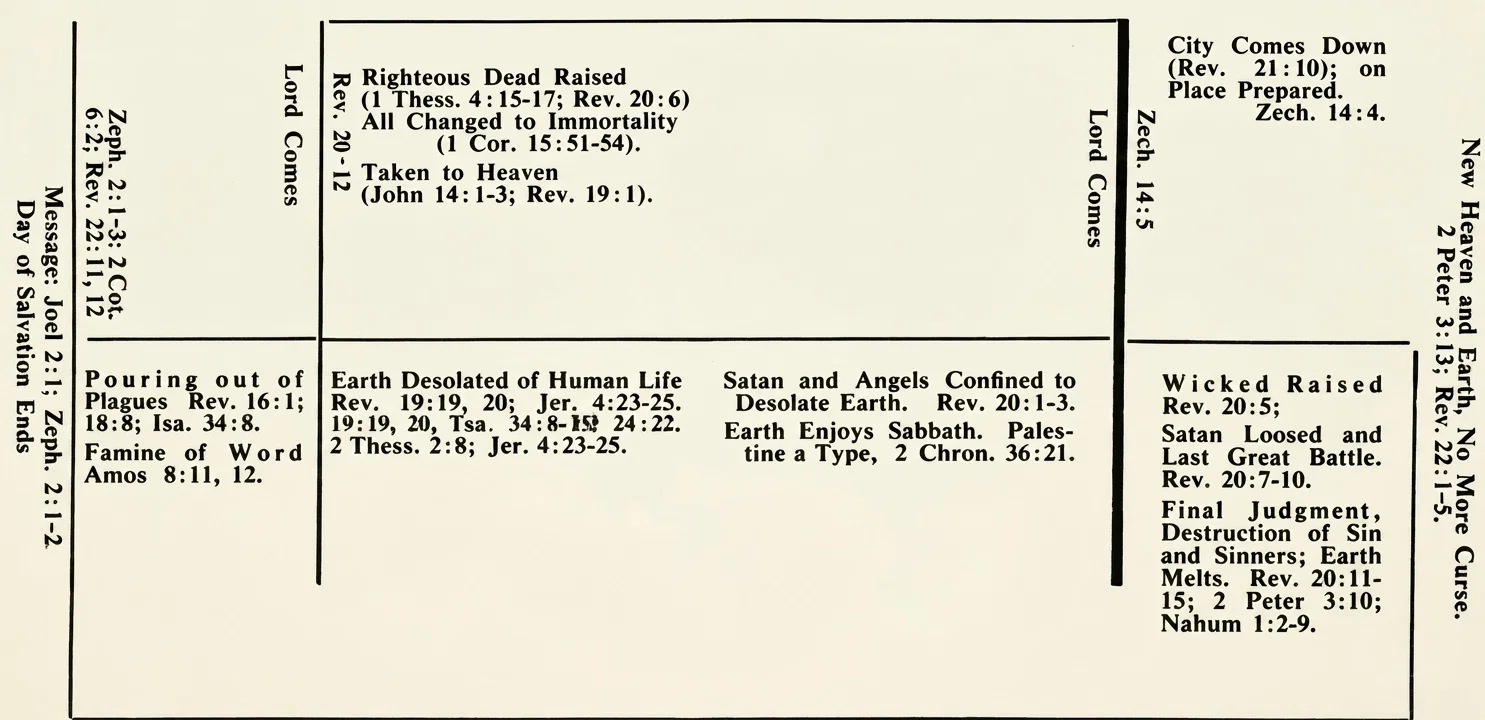
"The Great Day of the Lord." B. S. L. 65. A study of the prophecies referring to "the great day of the Lord," in which its character, length, scope, and relation to man are considered. Price, $2.00 a hundred.
The Millennium—1000 Years The Great Day of the Lord's Wrath
"The Sure Word of Prophecy." B. S. L. 131. This booklet on the prophecies of Daniel contains nearly a hundred pages, and is fully illustrated with charts and diagrams. Here are a few of its chapter titles:
Nebuchadnezzar's Dream, Nebuchadnezzar's Golden Image, Nebuchadnezzar's Proclamation, The Writing on the Wall, The World's History Outlined, Another Line of Prophecy, The Time Explained, Daniel's Last Vision, A Literal Prophecy, The Time of the End. Price, 10 cents.
"Topical Bible Studies." In this 24-page tract you will find grouped the references to scriptures bearing upon such questions as the following: Signs That Christ's Coming Is Near, Inheritance of the Saints, the Millennium, The Law of God, The Sanctuary, God's Covenants, The Destiny of the Wicked, Soul and Spirit, Spiritism, Perpetuity of Spiritual Gifts. A very handy reference tract. Price, $1.50 a hundred.
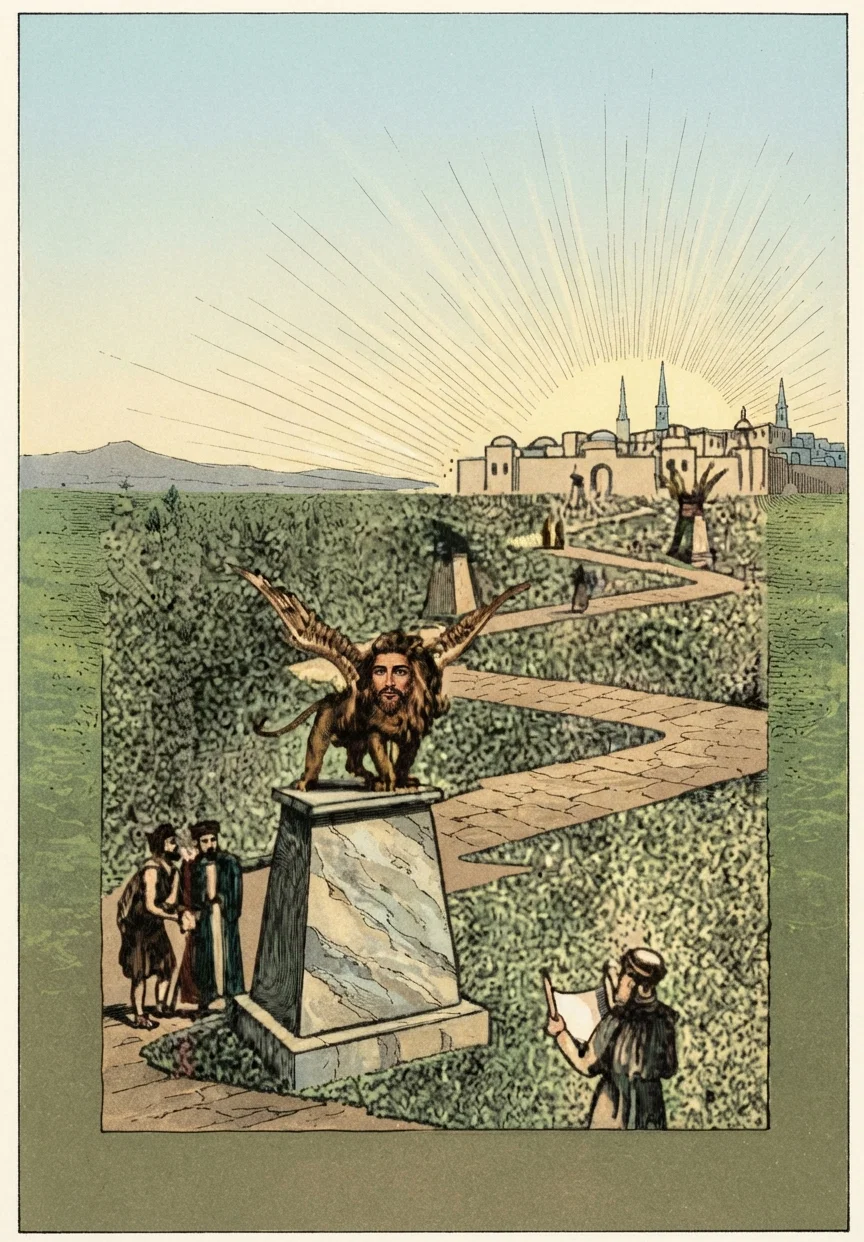
"Waymarks to the Holy City." B. S. L. 189. Over 22,000 of this popular exposition of the seventh chapter of Daniel were called for last year.
Its "waymarks" represent the various kingdoms which have arisen in harmony with divine predictions, and the fact that the heavenly kingdom is about to be ushered in is made very clear. Illustrated. Especially good for general circulation. Price, $1.00 a hundred.
"Gospel Message for To-Day." The three angels' messages are printed in bold type on the cover page of this timely leaflet. Following that under the headings, "The Character of God's Gospel Messages," "How Given," and "The Danger of Rejection," we read:
"God's Messages Are Always Definite.—To Noah God said: 'I do bring a flood of waters upon the earth, to destroy all flesh.'"
"To Nineveh He said: 'Yet forty days and Nineveh shall be overthrown.' . . ."
"God's Messages Are Always Merciful.—'The Lord being merciful unto' Lot and his family, sent them this startling message: 'Escape for thy life; look not behind thee, neither stay thou in all the plain; . . . lest thou be consumed.' . . ."
"God's Messages Are Given through Men.—Noah gave the message of the Deluge. Joseph proclaimed the famine message in Egypt. Moses bore the message of deliverance from Egypt. Nathan carried the Lord's reproof to King David; Himself sent Saul the persecutor to Ananias, a disciple in Damascus, that he might learn his duty as a convert."
"Result of Rejecting God's Messages.—The antediluvians were destroyed in the Deluge. Sodom was destroyed by fire. Pharaoh and his army perished in the sea. 'The wages of sin is death.'"
The study of the messages for this time is then taken up. Price, $1.00 a hundred.
Order through your tract society, or

Pacific Press Publishing Association

Mountain View, Cal. 61 N. Park St., Portland, Ore. 1109 E. 12th St., Kansas City, Mo. Calgary, Alberta, Canada

Fruit Farm for Sale

LOCATED on the south slope of the Ozark Mountains, in the famous fruit belt of Missouri. The orchard of forty (40) acres is just old enough to begin to bear fruit. The peach orchard will yield 2,000 bushels this year. Circumstances of party owning make quick sale imperative, and at about half value. For particulars address James Cochran, 1109 E. 12th St., Kansas City, Mo.
Continue reading: IN THREE DAYS