Your ShelfYour Projects

Review and Herald, Vol. 65, No. 28.

CLOSING LABORS AT FRESNO
Earlier text: CLOSING LABORS AT FRESNO

LIFTED ABOVE OURSELVES.

It is a grand prayer for every one, and worth offering oftentimes, “O Lord lift us above ourselves.” The responsibilities of life are gauged not by what we are, but by what we may become. Every man’s life is a sort of swamp acre. There are stones in it, a hundred loads. There are boulders, of tons’ weight. There is cold and wet soil. It is no approach to life’s work to cut the grass which grows of itself on this acre. Faith and work are to drain this soil, to pick off the stones, to blast the boulders, and to lift the plot up into dryness and fertility. The timid and the lazy say this cannot be done. Improvements are expensive and laborious. There is hardship, and sweat, and toil in them. Those cowardly souls are everywhere. They are busy digging a little hole to hide their own talent because it is not ten. They are coming up every day to difficulties which they count impossibilities. They are groaning life away, with the monotonous cry, “I cannot.” “Others are gifted,” they say, “but we are not.” Gifts carry responsibilities. Let others see to them. We are not eloquent—therefore never a word for Christ. Let others declare the salvation of God. We will hide it in our hearts. If God wants anything done for him which demands nerve, and pluck, and faith, let him raise up more of such men as Harlan Page, who, in common life, would do uncommon things for Christ. But average Christians are exempt. The few are armed men in God’s host. The many are non-combatants.
These words are no exaggeration. Would you prove them, look around in your own church—possibly in your own soul; and when you see the outcome of all this—what a nerveless, flabby, cowardly thing Christian life must be with such conceptions—then open the old Book and find what godliness is. Right through the Old Testament, God-fearing and God-serving are simple assaults upon the impossible. Abraham’s faith finds it so. Moses must march over the sea with his ransomed millions, although the waters are not as yet divided. See the grand old judges and prophets and kings setting up their battering rams in front of impregnable walls. We cannot specify instances. The Bible is one continuous story of faith lifting men above themselves.
The same is true of real Christian life in all ages. Grace is a Hercules, working marvels in infancy, and moving through life amid prodigies of strength. This is true of great lives. It is true of smaller ones. He who doubts this has yet his alphabet to learn. He who has never met what at first he thought an impossibility, has never traveled out of sight of his spiritual nursery. The man who ventures only to the limits of his conscious force has simply gone to the front gate. He who has crossed sea and climbed mountains in his God-serving has all the while been a miracle-worker through the might of grace within him.
Our prayer then and our strain must be, toward a single purpose—to rise above ourselves, above fear and distrust and sensitiveness and conscious inability. There is nothing short of this in a life worth calling Christian. We are in a dungeon. We must throw ourselves against the grating, shouting, “Deliver me from my persecutors; for they are stronger than I. Bring my soul out of prison, that I may praise thy name.” We are like St. Paul, in infirmity and suspense and struggle and want. But we must climb the crumbling cliff, as Paul did, shouting with brave souls, “I take pleasure in infirmities, in reproaches, in necessities, in persecutions, in distresses, for Christ’s sake! for when I am weak, then am I strong.” “I can do all things through Christ, which strengtheneth me.” If we do work in life worth doing at all, we must be lifted above ourselves. They who at last walk the golden streets will have climbed heavenward with many a tug.

THE SOJOURN OF ISRAEL IN EGYPT.

BY ELD. J. N. LOUGHBOROUGH.
I HAVE just read with great interest the remarks of Bro. J. O. Corliss, under the above caption, in the REVIEW of June 12. His explanation of the apparent difficulty concerning the time of Israel's sojourn in Egypt, is made very plain. The thought occurred to me to look at the testimony of Josephus on the subject. This I find to read as follows:—
They left Egypt in the month Xanthicus [which month is called by the Egyptians Pharmuthi, and Nisan by the Hebrews; but the Macedonians call it Xanthicus.—Ant., Book 2, chap. XIV., par. 6], on the fifteenth day of the lunar month; four hundred and thirty years after our forefather Abraham came into Canaan, but two hundred and fifty years only after Jacob removed into Egypt. It was the eightieth year of the age of Moses, and of that of Aaron three more.—Ant., Book 2, chap. XV., par. 2.
I find also a note on the margin of my Bible, which I have taken from some author without giving credit, which reads as follows:—
The Israelites themselves were in Egypt only two hundred and some odd years, but if we begin with the call of Abraham, we have the full time of all their pilgrimage four hundred and thirty years. It should read here [Ex. 12: 40] as in Samaritan copies [all printed ones], and in the Septuagint version of the Pentateuch, "Now the sojourn of the children of Israel, and of their fathers, which they sojourned in the land of Canaan, and in the land of Egypt was four hundred and thirty years."

CRUMBS

BY S. O. JAMES.
We cannot help others until we are first helped, and we cannot be helped unless we rightly relate to God.
Satan will tell the truth now and then, where a lie will not serve his purpose better. He says to the Christian, “You are very weak, and can’t do much if you try ever so hard,” and the effect upon many is just what he intends it to be,—they don’t do anything.
It is a mercy if you can keep your head above water; yet try to rise and swim high.
God is continually giving and forgiving.
You have proved the truth found in Prov. 13:15; will you now, dear Christian, prove Matt. 11:30 and Rom. 8:1?
A purpose, a question, and a prayer, with which to begin each day: I must receive and give more than I did yesterday. By what means can I do this?
Dear Lord, mark out my course to day, And lead me by the hand. O, give me grace for every test; May I not fall, but stand!
Faith does not wait for feeling, but goes to work, and receives a blessing.
Do not pray less, but work somewhat while you pray.
There is no such thing as complete satisfaction to the enlightened soul, while in its efforts to witness for God there is seen so much the semblance of human might. When Jesus said, “Have salt in yourselves,” it was as if he had said, “Establish good habits.” Isaiah meant the same when he wrote, “Learn to do well.”

WHAT A FAULT-FINDER IS GOOD FOR.

In the village of—— lived a man who was a bold leader of all opposition to religion, and always ready to publish abroad the inconsistencies or short-comings of any who were professors of religion. After a time he concluded to remove from the place to a distant part of the country, and meeting the leading minister of the village one day, after the usual salutations, he said, “Well, I suppose you know that I am going to leave town soon, and you will probably be very glad of it.” “Glad of it! Why no,” said the minister, “you are one of our most useful men, and I shall hardly know how to spare you.”
Taken aback by such an unexpected reply, the other immediately asked, “How is that? What do you mean by saying I am useful, or that you will miss me when I am gone?” “Because,” said the minister, “not one of our sheep can get a foot out of the fold, but you bark from one end of the town to the other, and so show yourself one of the most useful watch-dogs that I ever know. I don't know where we shall find any one who can supply your place.” The rebuke struck home, and the fault finder, with a crest-fallen look, went on his way.—Illustrated Christian Weekly.

MISTAKEN KINDNESS.

The danger of false tenderness in the training of children was finely illustrated at one time in the following manner: A person who was greatly interested in entomology secured at great pains a fine specimen of an emperor moth in the larva state. Day by day he watched the little creature, as it wove about itself its cocoon, which is very singular in shape, much resembling a flask. Presently the time drew near for it to emerge from its wrappings, and spread its large wings of exceeding beauty. On reaching the narrow aperture of the neck of the flask, the pity of the person watching it was so awakened, to see the struggle necessary to get through, that he cut the cords, thus making the passage easier. But alas! his false tenderness destroyed all the brilliant colors for which this species of moth is noted. The severe pressure was the very thing needed to cause the flow of fluids which create the marvelous hues. Its wings were small, dull in color, and the whole development was imperfect. How often we see a similar result in the character, when parents, thinking to help a child over some hard place, rob him of the strength of purpose and other qualities essential to the highest attainments in mental and spiritual life.—The Congregationalist.
—The late Dr. Lockhart, of Glasgow, while traveling in Europe, was sojourning at an inn when the Sabbath came round. On entering the public room, ready to set out for church, he found two men preparing for a game of chess. He addressed them to this effect: “Gentlemen, have you locked up your portmanteau carefully?” “No, what! are there thieves in the house?” “I did not say that,” replied the Doctor. “I was only thinking that if the waiter comes in, and finds you making free with the fourth commandment, he may think of making free with the eighth.” Upon this, the men said there must be something in what the Doctor said, and so laid aside their game.

WHAT IS CHARITY?

'T is not to pause, when at the door A shivering brother stands, To ask the cause that made him poor, Or why he help demands.
'T is not to spurn that brother's prayer, For faults he once has known; 'T is not to leave him to despair, And say that "I have done!"
The voice of Charity is kind, She thinketh nothing wrong; To every fault she seemeth blind, Nor vaunteth with her tongue.
In penitence she placeth faith,— Hope smileth at the door,— Believeth first, then softly saith, "Go, brother, sin no more!"
— Golden League.

MRS. SILVERTON'S PRAYER.

Mr. Silverton had always been rather lordly in manner; but fifteen years ago he was full of push, enterprise, and zeal in matters both temporal and spiritual. He was a young husband and a young church member, shrewd and cautious in business affairs, earnest and sincere in religious matters. What wonder that he prospered? Yet, sadly enough, a most ancient and most reliable authority—and we use the superlative advisedly—tells us that those who will be rich fall into a snare. Though some may, through the grace of God, escape comparatively unharmed; yet the kind of snares which spring up by the way, as riches increase, are spread so artfully, the feet slide into them so gradually and easily, that many a man may thank God he has never fallen fatally, through the fascinating, yet dangerous, allurements of prosperity.
During the first five years of his domestic and religious life, Mr. Silverton had been all that could be desired. Then matters began to change, almost imperceptibly at first, but by degrees the change increased. It happened quite often of a morning that urgent business engagements must be met with a promptness which necessitated the omission of the usual morning devotions. Mrs. Silverton regretted this more than she could well express. Her training had been such, that religion seemed bred in the bone,—a part of her very being. At first her remonstrances against this neglect seemed to impress her husband, and he would promise that each time should be the last. But it kept occurring until, when the remonstrance was offered, it became clearly a cause for impatience. So Mrs. Silverton resolved, with a sigh, to say nothing more when the prayers were omitted, but to pray over the matter, which resolve comforted her not a little.
There were other omissions and neglects during the next five years, completing a decade of Mr. Silverton's married and Christian life. It was very seldom now that family prayers were observed, except on the Sabbath, nor were they always then. And the press and urgency of increasing business interests were so fatiguing that it was too difficult a task to arise and dress on the Sabbath in time for divine service. The pastor noted with regret how seldom the once active Christian brother was in his place in the broad aisle, of a Sunday; while he was actually never seen any longer at an evening meeting of prayer. And there was that unapproachable air, which appeared to increase somewhat, rendering it well-nigh impossible to address him on the subject. Besides, he surely understood his duty clearly enough—a man who had acted up to the standard as he had in past times. In the meantime, it was constantly reported, and with sufficient truth, that Mr. Silverton was getting rich. The enlarging business acquaintance this fact involved, with all the politic and impolitic social obligations, rarely left the man an evening to spend with his wife and little family. As for Mrs. Silverton, she prayed on, never doubting that the desired answer would come sometime. Right here the remark becomes pertinent that, no matter how faithfully and untiringly a Christian may pray, it too often happens that answers long delayed, while the anxiety still goes on, will cause the countenance to change, and the once joyous spirits to grow sad and even severe. Mrs. Silverton never for a moment doubted that the Father in heaven heard every prayer she offered in her husband's behalf, and would surely answer them in the best way. Yet the increasing trial and anxiety of his growing indifference and neglect, in various important directions, gradually chased the smiles from her face, and the buoyancy from her spirits.
During the next and third period of five years, Mr. Silverton's tendency to decline in matters most vital of all, became indeed deplorable. As was said at the beginning, he had always possessed a certain lordliness of manner; and as his love for gain and adherence to outside attractions dominated his life more and more, the independent, superior carriage also increased, while, in proportion, the air of dejection about his wife was becoming habitual. It was not strange that this apparent dejection was a source of constant irritation to the man whose conscience must have been ill at ease. But graver faults than any that had gone before were looming threateningly, and it made Mr. Silverton angry and uneasy that his wife was aware of it; that she was aware that vice, in the form of fashionable indulgence, was beginning to add its poisonous influence to failings already sufficiently trying. At this last discovery, Mrs. Silverton conscientiously and lovingly bestirred herself, and tried her best to coax her husband back to the good, safe paths in which he used to delight to walk. But in vain. Her entreaties and wishes were utterly disregarded until, sad as it was, the strains of wifely solicitude developed into an impatience which, strive against as she would, would overcome her now and then. It was so bitterly hard, instead of the old love and cherishing, to be coolly and persistently ignored!
Pity it was, but sharp words became a matter of frequent occurrence. After each season of discord, Mrs. Silverton would fall upon her knees and beg for strength to resist the terrible temptation to reply to taunting, stinging remarks. Sometimes for days together she would set so severe a watch before the door of her lips, that never a word or reply could there be to unkind and uncalled-for words. Then, at an unguarded moment, a quick reply would escape her, and hasty, angry words would result in quick succession. For the lady was proud and high-spirited, and felt resentment, even when she could avoid manifesting the unchristian trait. The year before, on the Fourth of July, Mr. Silverton had made one of a yachting party who had sailed gloriously forth with steady steps and clear eyes in the morning, but had returned ingloriously at night, their steps sadly unsteady, and their eyes piteously blurred. Subsequent holidays, also several anniversary dinners, had been conducive to the same painful result; and now another Fourth was close at hand, and again a party of gentlemen were planning to sail down the harbor, and celebrate Independence Day according to their perverted interpretation of the meaning of the term. As the dreaded day approached, Mrs. Silverton expostulated more vehemently, and spoke her mind more freely, than for a long time before. She received only bitter replies. Stung by her husband's imperious air and words, she replied, as she had several times been betrayed into doing before. A longer controversy than usual followed, at the end of which Mr. Silverton was angry and defiant, and his wife was at once filled with remorse. After a few moments of lonely reflection, Mrs. Silverton arose to go to her room. She thought her husband had gone out, but he had in reality gone on an errand to his room. Hearing his wife approaching, and not wishing to see her again, he stepped into the little dressing-room adjoining, hoping she would soon withdraw, and allow him to escape unseen. Through the nearly closed door he saw her throw herself on her knees, by the side of the bed.
“Humph!” thought Mr. Silverton, “there she goes, praying forever! Now for a tirade! I shall doubtless have all my sins rehearsed in order,—a long, exhaustive catalogue.” But the wife, supposing herself alone and unheard save by the One who is ever present, had, amid sobs and tears, already begun her prayer, speaking aloud as if to relieve her pent sorrow. She was telling her dear Father in heaven that she had sinned again; that she had again been angry and broken his laws; that she had disgraced her most beloved profession, had been resentful and unchristian; that she had said ungentle things to the man she loved so well. She deplored over and again that her influence for good had been overborne and dispelled, through yielding to hurt and desperate feelings. She lamented in pathetic language her weakness and sinfulness in forgetting for a moment that she was the daughter of a King, no matter what words might be addressed to her. At that she choked a little, as if the hurtful remembrance of wounding remarks suddenly overpowered her a moment.
“Humph!” thought Mr. Silverton, thoroughly disconcerted, “not a word about my shortcomings, my sins, my multiplied transgressions. Dear child!” he thought, a sudden pity for the bowed figure involuntarily forcing itself, “she has no need to feel so crushed at that for which she is not to blame. I have been the ungracious cause of it all”—but his wife was going on, her voice growing a little steadier.
She was telling now in slow, distinct accents how dearly she loved the man whose backsliding steps she was powerless to arrest, despite her great hungering desire to do so. She told how much she would willingly sacrifice, what self-denial she would practice, what penance she would perform, if only she could draw him back to habits of rectitude and of fidelity to his God. Then she fell to pleading, as a woman will; begged God to remember his promises and to open the eyes of her dear husband before it might be too late. Finally she came directly to the subject on her heart, that of “the nation's birth-day,” as she called it. She implored that a right sense of the manliness which should attach to such an anniversary might impress itself on her husband's mind, that the true patriotism which made a man upright and vigilant at all times might return to him, that he might “recover his priceless but waning manhood.”
The listener in the dressing-room winced at that. Well as he knew the danger and the facts, he was yet startled at hearing it put in such truthful phrase. “Waning manhood!” he thought in his heart; “is it possible?” But the prayerful tones were urging in plain, unshrinking speech that he might realize the peril of the whirlpool into which he was being drawn; that he might have strength to break away, before getting hopelessly entangled in the coils of the stinging serpent; that he might become true to his soul's best interests, and loyal to his God. The voice sank to a low “amen,” after saying that all was “asked in the name of Jesus.”
As Mrs. Silverton rustled softly from the room, it was her husband's turn to speak audibly, although in low soliloquy. “I don't deserve it!” he muttered. “I am utterly unworthy of it, such affection, such loyalty, such devotion! I expected a hot stream of accusation would be sent up, and judgment invoked. Shows how little men know of a woman's stringent adherence to self-discipline, and her wonderful depths of love and fidelity. It was all her faults, her faithlessness, her sins, that were to be lamented. I was simply to be reclaimed and forgiven. Poor, dear child! What have I said and done to worry and vex her! She, the daughter of a King! No wonder she is troubled and anxious, fearing lest I make the fool and dolt of myself next week that I did last Fourth. Well, well, we'll see.” Then in a troubled voice—“waning manhood, eh? I didn't like that; no, I didn't like the sound of that at all!”
Mr. Silverton passed so noiselessly from the room and from the house that his wife had no suspicion of his being near, or that he had overheard her prayer. When the Fourth of July came, Mr. Silverton, who had been unusually grave and silent for several days, announced to his wife just after breakfast that he wished to have family prayer. She checked the look of surprise she felt starting to her face, but afterward, when he told her soberly and gently that he was about to adopt a new declaration of independence, break away from all engagements and spend the day with his family, she made no attempt to conceal her delight and gratification. It was years before Mr. Silverton confessed to his wife that he had overheard her that sad time when she entered into her holy of holies, the sanctity of her own chamber, where, supposing herself alone with her God, she had so truthfully yet lovingly shown him what and where he was,—he, her erring husband. But she had been content, never caring to question nor to wonder in just what way her Father in heaven, when implored in Jesus's name, had stretched out his merciful, powerful arm, and restored her husband to the heights of all true loyalty.—Mrs. Harriet A. Cheever, in Interior.

THE TRUTH IN OTHER LANDS.

VICTORIA, AUSTRALIA.
Believers in the third angel’s message have never been obliged to defend themselves against the charge of setting time for the Lord to come, and for a good reason. They have believed that before the second advent could take place, according to the prophecy, a message notifying the world that such an event is near, must be heralded to earth’s remotest parts. They have therefore taught the Lord’s coming near conformably as they have seen the fulfillment of prophecy in the spread of the present truth among the various nationalities.
What is termed “present truth” by this people, is the message of Rev. 14:9–12, which warns the world against the worship of the beast and his image, or the reception of his mark, and presents for a relief from that, the commandments of God and the faith of Jesus.
The advocacy of this message began in much feebleness, something over forty years ago, with only two or three persons devoted to its promulgation. It made no great stir at the beginning, and the majority of those who first embraced it, were not widely known. The light, however, was kept constantly burning, and was lifted on high until men of thought were finally attracted toward it.
Reverses were met at almost every step, and many of those who were watching the movement, predicted its early burial. But those who carried the heaviest burdens in the matter were sanguine of success, and confidently affirmed that at no distant day the message would find adherents and champions in all the nations of the world. Some of those who were foremost in the work were called to rest from their labors before the fulfillment of their anticipations; but an unseen power upheld the work, and guided its counsellors in wisdom, until the time came when God, in his providence, would have the nations afar off, listen to the news of his soon-coming kingdom.
But before this could well be brought about, publishing houses must be established, from which the truth could issue in printed form, and silently find its way to men of influence, and stir them up to call for the living teacher. Schools must be established, where men and women could be educated for special lines of work, such as canvassing, colportage work, etc., which would be necessary to be done in starting the work in new fields. There must also be a force of true, devoted souls who would furnish the means to support the missionaries while planting the truth in those far-off countries.
All of these things must needs have been brought about, before introducing the truth in other lands, in order that such work might be a success. Were it undertaken before these preparations had been made, the laborer would soon give up his work for lack of support, which it would not be possible for him to provide while engaged in labor in those fields. Those who think that this work has been a long time in reaching its present state of progress among the various nations, should stop to consider these things, and then ask themselves whether they have done all they might to help push it along farther and faster.
Even now, there seem to be some who do not appreciate the situation. They talk about waiting for the Lord to come, and yet do little or nothing to help spread the message, in order to hasten the event for which they profess to be so anxiously looking. These think more of their own comfort than of the sacrificing toil of the messengers of truth. They have no real anxiety about the condition of the teeming millions who do not know the truth. As it was with Israel of old, when going toward the promised land, so it will be in this work,—the antitype of that—all the half-hearted, complaining ones will drop out by the way.
In order that our people may know more of the countries to which the truth has penetrated, it has been thought best to furnish a series of illustrated articles, giving a description of some of the most important parts of those countries. This will be done, hoping that it will cause our people everywhere to take a deeper interest in the work going on in those fields, and that they will not only pray for the laborers there, but do what they can in a substantial way to help along the work.
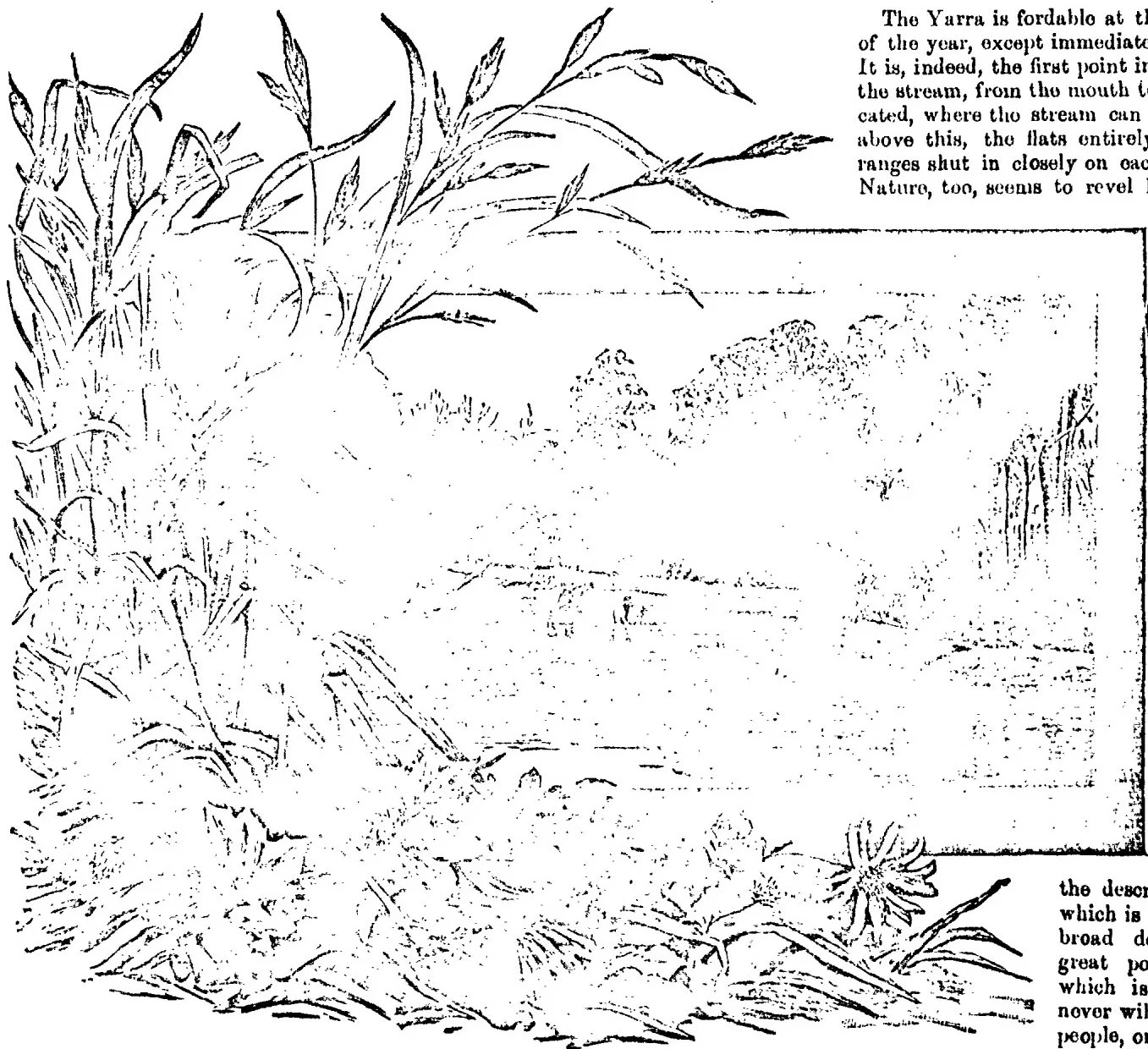
VIEW ON THE YARRA RIVER, VICTORIA, AUSTRALIA.
The accompanying picture presents a view on the Yarra River, in Victoria, Australia. This river takes its rise in the Hume range of mountains, nearly fifty miles northeast of Melbourne, and flows between very steep banks the most of the way to where it discharges its waters into Hobson’s Bay, eight miles south of Melbourne City. That part of the river which flows through the city and its suburbs, has rather an unenviable notoriety, on account of the stench it bears along its course. It is especially so concerning the last eight miles of the stream, after having absorbed the filth of the metropolis, on its way to the sea. But while this is true of the Lower Yarra, it may be said of its higher waters, that they are as free from contamination as almost any other stream of its size. The view presented in the accompanying sketch, is of a point twelve miles above the village of Lilydale, one of the remotest suburbs eastward of the city of Melbourne. At this point, the river runs through a low-lying, flat country, of rich alluvial soil, lightly timbered with gum trees and wattles, the last, a species of what is known in California as acacia trees. This tree produces an amber, liquid gum which the natives call korong. This is prepared for food, by soaking the gum in water until it becomes assimilated with it.
The Yarra is fordable at this place at all times of the year, except immediately after a heavy rain. It is, indeed, the first point in the entire length of the stream, from the mouth to the place here indicated, where the stream can be forded. A little above this, the flats entirely disappear, and the ranges shut in closely on each side of the stream. Nature, too, seems to revel here in a wealth and variety of vegetation which is beyond description. In some parts, however, the ranges present a park-like appearance, where game is found plentifully.
Already numerous villas have been erected in this sylvan-like place, by those who seek a quiet retreat from the noise and dust of a great city; and it will not be long, before the suburbs of Melbourne will include this, one of the most beautiful spots in Victoria. But one cannot judge of all the country by the description of this part, which is like an oasis in the broad desert. There is a great portion of Australia, which is not, and probably never will be, settled by white people, on account of its sterility. Very little of Victoria, however, is of this character.
The colony of Victoria comprises 86,831 square miles, yet it is only about one thirty-fourth part of the entire continent. It is a trifle larger than the two Carolinas, and has a population a little in excess of 1,000,000. More than one third of these reside in Melbourne and its suburbs, constituting it the largest city in the Southern Hemisphere. There are several reasons why so many choose to remain at this point, but space forbids the mention of more than two or three.
First, the laws of the country are not so liberal as those of America in granting a homestead to all who will settle on and improve a tract of land. On the other hand, the government holds on to the most of its land, saying it will not do to part with its capital. It will lease to a man a certain amount of land at so much an acre, provided he improves it each year to a certain extent. But when his lease expires, he must leave the land greatly improved; and if he wishes to continue in the business of farming, must again rent land under the same conditions as before. Under these circumstances, there is not much ambition to settle on new farms.
Then, in the interior it is very dry during the summer months, and one is not always sure of a crop, though he sows and plants. There are very few streams in the country that survive the extreme droughts, consequently irrigation is out of the question. At times, water for household purposes must, in some parts, be brought for miles, and the stock must be driven to and fro each day, to supply their demands. This is very discouraging to the farmer there, as it would be to the farmer in America. The question of procuring water from wells for drinking purposes, is not always a practicable one, as in most parts, at least in Victoria, water thus procured is usually more or less brackish.
Again, very much of the country is better adapted to sheep and cattle raising than to the production of crops. But to engage in this business successfully requires more capital than most men can command. In the city there is more or less work to be obtained by the hour or day, and many prefer to labor where there will be no risks in the way of dry weather, and the loss of stock or crops.
The supply of water for Melbourne is brought by pipes from Yan Yean (a native word meaning boy) Lake, which lies about ten or twelve miles north of the city. It is furnished by the general government, and therefore, if one owns a house on any street along which the water pipes are laid, he must pay his water tax, whether he wishes to use the water or not. This is on the supposition that the house owner will supply himself from his neighbor’s hydrant, if he does not have one of his own, and so use government water anyway.
Every work of any importance in that country is under the control of the government. By this system there is no competition. If one is dissatisfied with the charges, it makes no difference. He can walk, if he chooses, but he can get no reduction in the fare. More than this; if a deficit appears at the end of the year, on account of the railway’s having been managed on a political instead of a commercial basis, the lack must be met by taxation. All railway officials are government officers. Public schools are all controlled by the general government. One who becomes a public school teacher has no choice of the school he prefers to teach. Should he be teaching a school in a pleasant locality, he is liable to be sent to fill a vacancy in some mining or remote district at any time. Should he object to going, the matter is settled by his resignation as a teacher being accepted, and his retirement from the service.
If one wishes to publish a paper regularly, whether a daily, a weekly, or a monthly, the law requires him to furnish two bondsmen, who are property holders, and who become responsible for the publisher, to the amount of $1,500 each. With these, the intending publisher must go before the judge of the district, make affidavit regarding the name and object of his intended publication, and where it is to be published. The paper is then registered, when he receives permission from the court to issue it. This is done to protect the government against treasonable sentiments, and also to provide for recompense in case of actual libel against private individuals. The law goes still further. One cannot even own a printing-press of any description, without notifying the authorities and stating the street and number where it is located, and the purpose to which it is to be put. By violating this provision one lays himself liable to a heavy fine. Then, too, any poster or circular printed and sent out, must bear the imprint of the place from which it was issued. In this way all printed matter is traceable to its origin; and if forbidden sentiments are found, the guilty one is easily located.
To many, these laws may seem quite strange and unnecessary. But still they have a good effect upon the people in some respects. They are led to be more careful in their ways, and more thorough in what they do. There is also noticeable an agreeable absence from the public prints, of sensational headlines, and extravagant statements for the purpose of catching the eye. Everything moves off more soberly in that country than in America; but after one has become accustomed to the ways of the people there, he sees many things that recommend themselves to his judgment.
J. O. Corliss.
Continue reading: MINNESOTA TRACT SOCIETY PROCEEDINGS