HASTENING out on deck for a first view of the South American continent and seeing only a bank of clouds along the horizon, one of our party inquired of a fellow passenger, “What is every one looking at so intently?” “Why,” he exclaimed, “we are looking at the most wonderful coast line in the world! Look up higher.” And there, high in the heavens, the mountain peaks were pointing upward to their Maker, and seemed to bid us learn a lesson from this chance remark. God would have us “look up higher.”
We were delighted to land, but still more delighted to leave the hot, steamy port of La Guaira, which we soon forgot, as we were charmed by the wonderful panorama of mountains and sea while being carried on the little railway up the precipitous face of the mountain. An English author has said that the conductor stands on the last car and whispers his orders to the engineer as the train turns the many curves, but we were too busy trying to see into the bottoms of the ravines beneath us to prove the truth of his assertion. After an enchanting hour we had climbed the thirty-two hundred feet to the top of the pass, and were soon surrounded by the hills that guard the beautiful city of Caracas.
Such delightful air and such beautiful views! It is a pity to leave them and go into the usual home of the city. With an idea of safety and practically no knowledge of sanitation, the houses are built in the manner so common in these countries, the free circulation of air impossible, and scarcely a room where the sun shines even a few minutes during the day. The patios, or inclosed yards, in some of the larger ones are the most pleasant part of the house, being tiled with mosaic and filled with beautiful shrubs and flowers, but the houses themselves are not of costly material, being nearly all of mud. The walls are from one and a half to two feet in thickness, and are plastered. For these houses we must pay from forty to seventy-five dollars a month.
The little company of believers left in this city by Elder F. G. Lane had been without help for over a year; but thanks to the faithfulness of Brother and Sister R. E. Greenidge, our self-supporting medical missionaries here, in calling them together for worship, nearly all were in attendance. It seemed best to spend some time in study with them, for their encouragement, and that they might learn how more clearly to tell their neighbors the important truths they believed. To this end a special meeting was held each Sabbath afternoon, in which old and young took part, some learning how to read aloud in a pleasing way, others to give short Bible studies, and all were free to give friendly, helpful criticism. It was both surprising and gratifying to see how soon many, even young boys of twelve and fourteen years, were able to give “a reason of the hope.”
No effort has been made to interest the public in our meetings, for we must have a secure place upon which to stand before making such an effort. A mother and two daughters had become interested, through our other believers, and with two others desired baptism. After careful preparation in study we met to celebrate this ordinance at dawn on Sunday morning, about six weeks ago. Just as the first rays of the sun were making the mountains and valleys, with their12hurrying clouds of mist, things of magic beauty, these dear ones consecrated their lives to serve Him who rose on the first day of the week, and in whom is our hope of life eternal.
We had planned to begin our literature work with the health book, the Spanish “Practical Guide,” but after five months of waiting for the first order to be filled, it seemed necessary to begin with what we could; so with the blessing of the Lord a beginning has been made on a subscription list for the Senales. There are many difficulties confronting the colporteur here. To do successful work he should possess his own means of conveyance from place to place.
The work itself is passing through most trying times, and will continue to do so until the mission owns its own place in which our believers and interested ones may meet to study the Word. Many landlords refuse to rent to Protestants; and now, having been compelled to take a house in bad repair because it was the only one we could get, and having spent twenty dollars in the most necessary repairs, Brother Greenidge being at an additional personal expense of from twenty-five to thirty dollars to install his bathroom plumbing, we are so soon compelled to vacate the house because our Catholic neighbors object to our presence among them. When they found that such conduct as throwing missiles through the window was not discouraging, they adopted a more certain method—having the landlord expel us.
Now we are all homeless, that is, have only uncertain, temporary quarters. But most of all, we grieve that we have no place where all our believers may meet on the Sabbath. They love the Sabbath services. It is no sacrifice to them to attend meetings. We are praying that God will soon give us a more certain abiding place, for this is not the first time such things have occurred.
Neither can one man develop the growing interest here in Caracas and the colporteur work. Now the church work is neglected, though the members are faithfully doing what they can. May God lay the burden of the waiting souls here heavily upon the hearts of those who should go, and those who should give.
Basutoland, South Africa
By H. C. OLMSTEAD
H. C. OLMSTEAD
HERE where we see so very few European believers, a letter from one of the workers at headquarters is always an encouragement. Satan tries to make us think that all we can accomplish on a mission station is not worth while. The continual round of petty trials and annoyances and discouragements compel us to flee often to our Refuge.
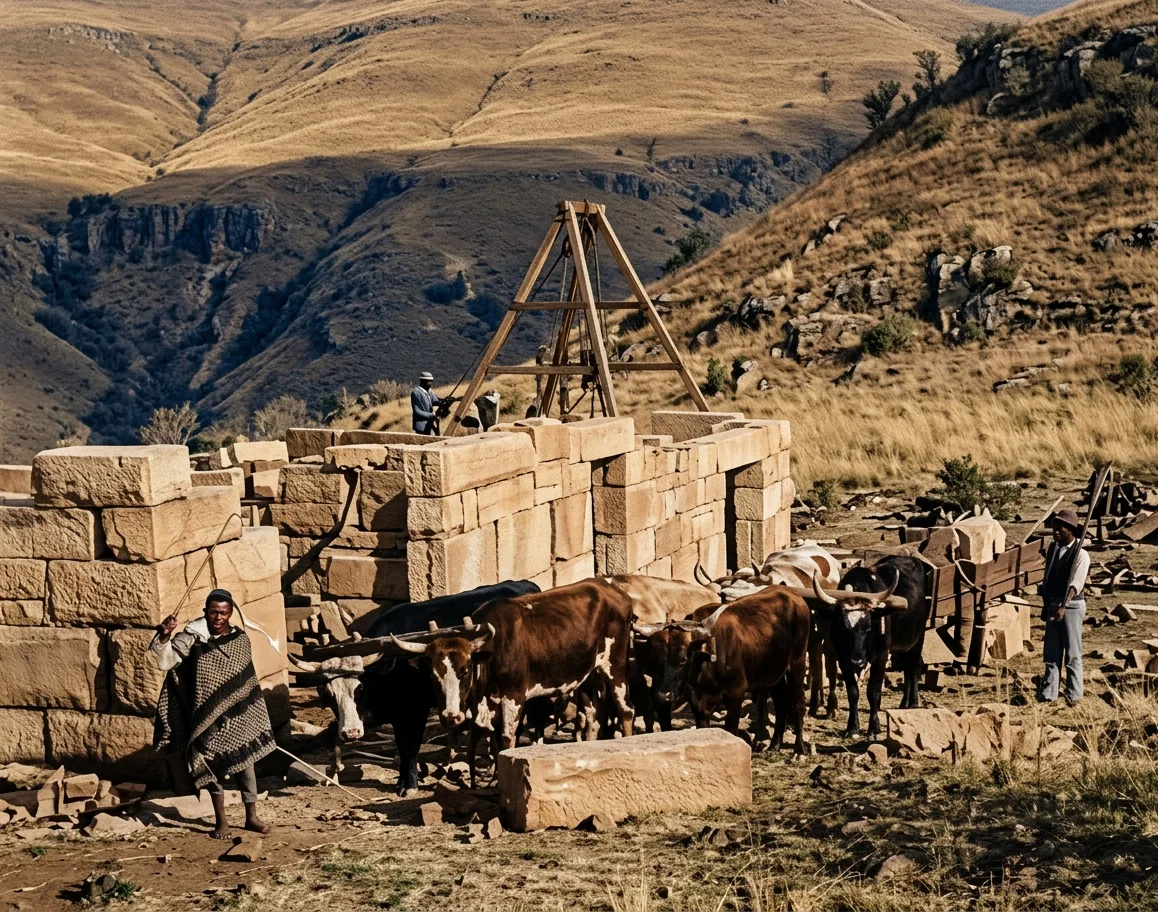
The mission now has over one hundred pear and apple trees of a good variety, over three hundred cherry and nearly three hundred peach trees, also a few pears, apricots, and prunes, making about a thousand fruit trees. Then there are about a thousand each of grapevines and blackberry bushes, as well as red raspberries, loganberries, a few currants, gooseberries, and strawberries.
HAULING STONE FOR THE NEW STABLE AT EMMANUEL MISSION, BASUTOLAND
Last Tuesday I returned from a week's trip into the Orange Free State, where I sold about $55 worth of vines for cash. The severe drought and the war made selling rather slow. This year the mission has sold over $150 worth of vines.
This week we are pushing the work of laying the brick of a native boys' dormitory. Brother Campbell and I do the laying. Owing to the war, I fear we shall have to delay its completion, for we shall have to wait until materials come down to normal prices again.
From forty to eighty persons come each month for treatment for all kinds of ailments, or to have teeth pulled. Many have bad colds or tuberculosis. It is customary to sleep with the head under a blanket the year round; I have never found an exception yet, though there may be some. Our school is in operation as usual.
Basutoland is practically treeless, but its grassy hills furnish pasturage for great numbers of cattle, sheep, goats, and horses belonging to the Basutos.
“What the Department of Agriculture Is Doing for the Housekeeper”
By L. A. HANSEN
L. A. HANSEN
The words used as the heading of this article are the title of Yearbook Separate 621, a pamphlet recently issued by the Department of Agriculture. It reviews the varied activities of the department in things that pertain to home matters. It calls attention to the increasing demand for reliable information regarding cooking, food values, dietetic principles, wearing materials, sanitation, household efficiency, etc.
The interdependence of agricultural interests and home problems, and the fact that agriculture supplies the bulk of raw materials used in the home for food, for clothing, and for household equipment, bring it within the scope of the department to supply all information possible to meet the housewife’s needs and to insure a better utilization of agricultural products in the home. There are a number of bureaus through which the department works to secure its information.
The utilization in the home of agricultural food products has been given special attention through the nutrition investigations of the Office of Experiment Stations the past twenty years. This has included the investigation of the composition and nutritive value of more common foodstuffs; the formulation of dietary standards; the digestibility of foods; the cooking, canning, preserving, and general care and preparation of foods; relative costs of food materials; planning of meals; and various household questions on sanitation, conveniences, and other problems.
The results of the nutrition investigations have been published. About fifty numbers of the Farmers’ Bulletin, besides a number of other publications giving these, are available to those wishing them. That these are in demand is seen in that to date over twelve million copies of the Farmers’ Bulletin containing topics on food and nutrition, have been needed to meet the requests for them.
The Farmers’ Bulletin has covered a great variety of topics, such as food value of milk, sugar, bread, fruits, vegetables, and eggs; bread and bread making; canned fruits, preserves, and jellies; the preparation of vegetables for the table; corn meal and its uses in the diet; Kafir corn and cowpeas and ways of using them; and the care of food in the home.
Other popular publications have dealt with food customs and diet in American homes; green vegetables and their value as foodstuffs; and raisins, figs, and other dried fruits, and their uses in the dietary. Recipes are often included, gathered from many sources, compared, studied, tested, and modified before being published.
A list of choice publications might be given here, but space would not permit a very complete one. Full information can be had by addressing the Department of Agriculture, Washington, D. C., asking for a list of publications on subjects of interest to housekeepers.
Many of the publications referred to contain matter of special interest to those who make healthful living a study. There are also, of course, suggestions regarding the use of things for which the vegetarian or strict health reformer has no use. One must always use care and judgment in what he reads, believes, and practices. The attention and study now being given the various questions that pertain to home and living is productive of much material that makes rational living easier.
Takoma Park, D. C.
When the Wagon Sticks
By Harriet C. Forrest
WHILE I was walking along the street a few days ago, I noticed a three-year-old girl on the edge of a porch, holding despairingly to the tongue of a toy wagon which was stuck halfway up the steps. The child tugged and sobbed; she had encountered her first problem, and was unable to cope with it. I stopped and lifted the wagon a bit. “Now pull!” I said. The problem was solved, and smiles drove away tears.
As I passed on, the thought came to me: “How many of us spend weary efforts and unnecessary hours like the child, making trouble for ourselves to conquer! Little, everyday annoyances are magnified until they assume overwhelming proportions; then we tug and tussle, jerk the toy wagon, and give way to grief.”
I saw a woman who made herself miserable if any other woman received attention. She could be delightfully vivacious until another woman drew a little attention, then she became dumb and13sat apart, sullenly jerking her toy wagon, and wouldn’t try to play fair. I knew a girl who said, “Life is a burden,” because three nights in one week she was minus engagements. She felt it a sure symptom of waning social popularity. Poor little girl! Life is a serious affair when your toy wagon sticks so easily.
Then I met a girl who had cheerfully bumped her wagon over every obstacle; who laughed when she told of missing a penny out of her purse when a penny meant a great deal to her. You see the girl allowed so many pennies a week for her room, so many for food, and so many for stamps to write home to her dear ones. So a penny lost meant one penny short to buy her five cents’ worth of rolls.
While she sat pitying herself, she saw the mischievous penny peering inquisitively at her from under her trunk. Then she laughed, and there was more rejoicing over the one penny that was lost and found than over the other pennies that had never strayed. The same girl showed me a cozy little office furnished with the result of her own earnings and bearing a neat sign: “Miss Blank, Notary Public and Stenographer.”
It had taken many jerks of her wagon, and in the interval she had found time to help other women whose wagons had stuck—help them with tender sympathy, encouraging words, working at night to fix over some out-of-date garment, or making over some of her old clothes into little dresses for the children of a more unfortunate and poorer woman than herself. The charm of it was that the girl never dreamed she was a heroine, for she had jerked her toy wagon only when necessary, and considered it a very ordinary proceeding.
So you see the best way to get your own wagon over an obstacle is to help some one else tug. “Now, PULL!”—Harriet C. Forrest, in Ladies’ Home Journal.
Lessons in the Father’s School
By Maltbie D. Babcock
IN our Father's school are many benches. This life is school time. Whatever the word God writes on the top of your page,—patience, courage, forgiveness, resignation,—copy it over and over until he gives you another word. Never murmur. Do your best to solve your problems. If they are hard, try hard. If you are in the dark, say, “Speak, Lord; for thy servant heareth.” When you feel like complaining, listen. Be still before God. David said, “I was dumb, I opened not my mouth; because thou didst it.” That is better than moaning and lamenting; but let us leap from David to Jesus, and say, “The cup which my Father hath given me, shall I not drink it?” “Father, glorify thy name.” So shall we be made perfect through suffering.—Maltbie D. Babcock, D. D.
Conducted by Mrs. C. C. Lewis, Takoma Park, Washington, D. C
By Mrs. C. C. Lewis
Through the columns of this department, hints will be given on all matters pertaining to the home life. Short articles and letters are solicited from home makers, telling of their everyday experiences,—their joys and sorrows, their failures and successes.
MRS. VINA SHERWOOD-ADAMS
By Mrs. Vina Sherwood-Adams
Our Little Table, and How It Solves Some Home Problems—No. 5
MRS. VINA SHERWOOD-ADAMS
Do not expect perfect work from the children in modeling things with modeline. What to you may seem a very crude object from their hands is to them almost a perfect representation. It is well to begin by forming a ball. This may be done by rolling it either on the molding board or between the palms of the hands. To form the figure of a person, press the ball between the palms into the cylinder shape. A small round ball placed on the top of the cylinder is the head. Smaller cylinders added form the arms. With the modeling tool, which is a pointed stick the size of a small lead pencil, smooth together the parts joined on, also print the eyes, nose, etc. A piece of the substance flattened may be placed around as a garment. Just a repetition on a smaller scale of the dough dolls you mothers sometimes make for your children!
It is better not to allow the children to work too long at a time with the modeline, even if they wish to. The use of it will grow too common, and they may lose their keen interest. Ten minutes for the story and twenty for the hand work is quite long enough for wee folk. Alternate the nature stories mentioned in a previous article, every two days with the Bible story. This gives variety to the hand work.
Now, just a few thoughts regarding story-telling. First, let me state that there are few real story-tellers in the world; so the most of us will have to content ourselves with coming as near to being good story-tellers as possible. There are a few general rules, however, by which we may all improve. A story told to meet the child's comprehension, is quite different from the same story related to an adult. One must cultivate imagination. Children enjoy details. A story should be told in simple, well-chosen language, all the while endeavoring to put oneself in the place of the listening child. “What is worth doing at all is worth doing well,” is just as true of telling a story as of anything else. Therefore a little previous preparation is needed to tell a story successfully. If possible go by yourself and relate the incident aloud. Does your voice sound simple and pleasant and natural? The tone of voice has a wonderful effect on children in listening to a story.
By indulging the imagination I do not mean “coloring” a story with so high a light that it will be untruthful. Bible scenes happened long ago, and the Bible text is often very brief. I have therefore found the books “Patriarchs and Prophets” and “The Desire of Ages” invaluable aids in supplying this needed information. Then it has to be simplified and woven into the story to meet a child's understanding. A study of the geography of the country where the scene you wish to describe occurred, as well as a study of the habits and clothing of the people of those days, aids in the construction of the story. Do not tell the story with a long face and solemn manner, in the old-style Scripture language. Tell it in a happy way, just as if those people in those far-off days were your personal friends. Some of them will be, over in the new earth. The children will catch the spirit and really want to meet those people over there. They will grieve with you over the mistakes of some, and will rejoice with you over the victories of others.
Let me suggest that it is well to eliminate all objectionable scenes, such as the taking of life. For instance, where Moses killed the Egyptian, just state that Moses thought he would save the people from the cruel king in his own way. He did not even ask God how to do this, so he made a great mistake and had to leave all his relatives and friends and flee a long way into a strange country, etc. Very small children rarely comprehend the meaning of death, and if they do catch its meaning it is a nervous shock to them, all unnecessary for a child to experience, and a little child accepts in so real a manner all that you relate.
If you find some difficulty in telling a story connectedly, write it out a few times, until the habit is formed. This will impress the thoughts on your memory and improve the quality of your diction. Occasionally ask a question in your story which cannot be answered by yes or no.
For very small children it is not advisable to begin with Genesis and try to give a connected history throughout the Bible; but as you study the needs of your child, daily select such Bible characters as will meet the present particular need of the little one in strengthening and developing his character. A good story often has a better effect than a lecture or the rod to correct a wrong habit.
Heralds
By EUGENE ROWELL
EUGENE ROWELL
THERE’S a stir among the nations, as of
leaves whirled to their doom
When the blast of coming winter rushes
through the mountain gloom;
There’s the charge of maddened armies
pressing on with frenzied shout,
And the groan of shattered remnants
crawling back from battle’s rout,
At the blowing of the trumpet of the
Lord.
Like legions of Sennacherib when, smit-
ten by the breath
Of the angel of destruction, heathen
hosts lay blank in death,
So the flower and pride of Europe lie in
crimson ruin low,
And her hopeful youth stare silent in a
ghastly burial row,
At the sounding of the trumpet call
of God.
For the Ruler of the ages sends his her-
alds on before,
To cry through war and pestilence that
time shall be no more;
And the crowd and crash of armies in
the battle’s mad affray
Are but his threshing out of wheat and
casting chaff away;
And today blow loud the trumpeters of
God.
Give ear, O lands; and tremble, ye in-
habiters of earth!
Change your comely dress to sackcloth,
and to mourning change your
mirth,
Ere the day of wrath rush on you with
the seven last great woes
In the last of human conflicts with the
last of human foes,
And the bolts of Armageddon come
from God.
Lincoln, Nebr.
The Bible Grows Sweeter
The longer you read the Bible, the more you will like it; it will grow sweeter and sweeter; and the more you get into the spirit of it, the more you will get into the spirit of Christ.—Romaine.
Elder O. A. Olsen
By I. H. Evans
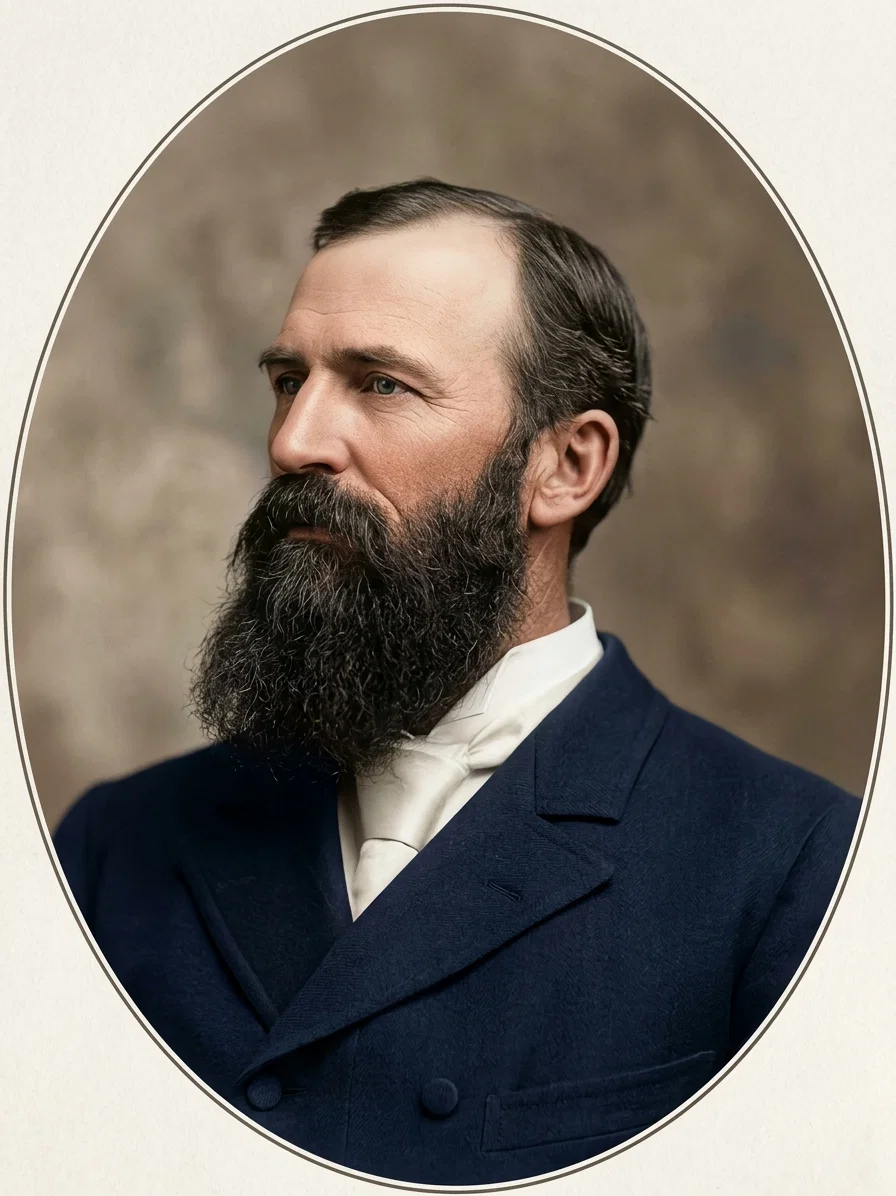
OLE ANDRES OLSEN was born in Skogen, about twenty-eight miles west of Christiania, Norway, July 28, 1845. He died of heart failure, in Hinsdale, Ill., Jan. 29, 1915, at the age of 69 years, 6 months, and 1 day.
Besides his beloved wife, Brother Olsen leaves two sons, Dr. Alfred B. Olsen, superintendent of the Caterham Sanitarium, England, and Dr. Mahlon E. Olsen, professor of English literature in the Washington Missionary College; also three brothers, two sisters, and seven grandchildren.
In 1850 his parents, Andrew and Bertie Olsen, immigrated to America, and settled in Oakland Township, Jefferson Co., Wis.
As a boy our brother helped with the farm work, attending school during the winter months, spending the winters of 1864 and 1869 in the Seventh-day Baptist College in Milton, Wis. In 1876-77 he attended Battle Creek College. Though he finished no regular college course, Elder Olsen was one of those strong, self-made men, who, through reading, travel, and close application to details, make a real success of whatever they undertake.
In 1868 he was united in marriage to Miss Jennie Nelson, at Oakland, Wis. Three children were born to them, one of whom died in early childhood.
When about nine years of age the deceased began keeping the Sabbath with his parents, and was baptized in 1858 by Elder Waterman Phelps. Thus his earliest Christian experience was associated with true Sabbath keeping, and his only church affiliations were with the Seventh-day Adventist people.
In 1869 the Wisconsin Conference of Seventh-day Adventists granted him ministerial license, and for two years he acted as tent master during the summers for Elders Isaac Sanborn and David Downer. In the autumn of 1871 he conducted an evangelical effort among the Scandinavians, this being his first public work unaided by other ministers.
June 2, 1873, Brother Olsen was ordained to the work of the gospel ministry, and continued his work for his countrymen, the Scandinavians.
In 1874 he was elected president of the Wisconsin Conference, and served in this capacity for two years. He was then released to work among the Scandinavians again. Later he twice served the Wisconsin Conference as president, and in 1880 was elected president of the South Dakota Conference, serving two years. Still later, he was president of the Minnesota Conference for two years and of Iowa for one year, when the General Conference sent him to Europe to look after our work in Scandinavia. He continued this work three years, filling the position of president of the Danish, Norwegian, and Swedish Conferences. At the General Conference session held in Minneapolis in the autumn of 1888, Elder Olsen was elected president of the General Conference, which position he filled till February, 1897.
During the period covered by his administration, the work rapidly grew not only in the United States, but in Europe, Africa, Asia, and in many island fields. It was during this time that the denomination entered upon an active campaign to enlarge and strengthen its missionary work in many distant lands.
ELDER O. A. OLSEN
During his presidency of the General Conference, Elder Olsen traveled extensively, both in the homeland and abroad; his administration gave a new impetus to all lines of our denominational work. Under his guidance, the sale and distribution of our denominational literature was greatly extended; the educational work was built up, and a new inspiration seized our people to educate their children and to fit them for service in the Master's work; our evangelical work was emphasized, and many accepted the truth.
When released from the arduous duties of the presidency of the General Conference, Brother Olsen was sent to South Africa to strengthen our work, especially among the native tribes, and to assist in opening new stations. Later the Mission Board called him to Europe to superintend our work in that field. In 1901 the Mission Board appointed him superintendent of our work in the British Isles. He continued president of the British Union Conference for three years, during the same time serving as president of the South England Conference two years.
The General Conference of 1905 sent him to Australia as superintendent of the Australasian field. He served in this capacity for four years, when he was recalled by the General Conference of 1909 and made secretary of the Foreign Department in North America. At the General Conference of 1913 he was elected vice president of the North American Division Conference and secretary of the Foreign Department for the Division Conference, which offices he held till his death.
The many official positions which our brother was called to fill is evidence of the high esteem in which he was held by the people of his choice. In every place of responsibility to which he was called he gave unsparingly of his time and strength. He was a strong leader, a wise counselor, an earnest Christian, a faithful and true friend. I was closely associated with him in work for over twenty-five years, and during this time my confidence in his Christianity remained unshaken, and my admiration for his sterling qualities of heart and mind continually increased.
Le Sage, in speaking of the dead, said truly, “Their deeds alone can praise them;” and what can I add to a life so active, so complete, and so well known as Elder Olsen's?
He loved his Master. He entered into his service with an undivided heart. There was no call to duty to which he did not respond; there was no task to be performed to which he did not cheerfully give his best. Whether in darkened Africa as a pioneer missionary, or filling the highest office in the church to which he belonged, he was ever the same self-sacrificing, zealous, ardent worker.
For nearly thirty years Brother Olsen was one of the ablest leaders of the Adventist people. During his presidency of the General Conference he probably did more to train, instruct, and inspire our ministry than any other man. His voice ever echoed faith, courage, and hope. Again and again in important crises he stood in the forefront and pointed the way to progress and new endeavor. Like the French lad who told Napoleon he could not play a retreat, but he could play a forward march, this brother was never known to throw discouragement upon an advance move. In our church councils we shall greatly miss him, and we know not where to find one to lift the burdens he has carried so faithfully.
He was beloved by all who knew him.15
The poor, the humble, the unfortunate, all sought his counsel in need, and never sought in vain. The aged and the orphan boasted of his friendship. I have heard it said, and I believe it is true, that in all the positions of trust he filled, he never made or knew an enemy. His heart was clean and pure; his tastes were simple; his life was honest, and his speech without guile. He lived and died like an apostle of the early church, anxious only that his Master's name be glorified in his ministry.
We part with him as one of God's chosen men, appointed to a great work, which he has now been called to lay down, that he may rest for a little season, waiting for his Master's return.
The experience of Elder Olsen may be expressed in the farewell words of the aged Gentile apostle to the people he loved:—
“I have fought a good fight, I have finished my course, I have kept the faith: henceforth there is laid up for me a crown of righteousness, which the Lord, the righteous Judge, shall give me at that day: and not to me only, but unto all them also that love his appearing.”
I. H. EVANS.
James Lewis Prescott
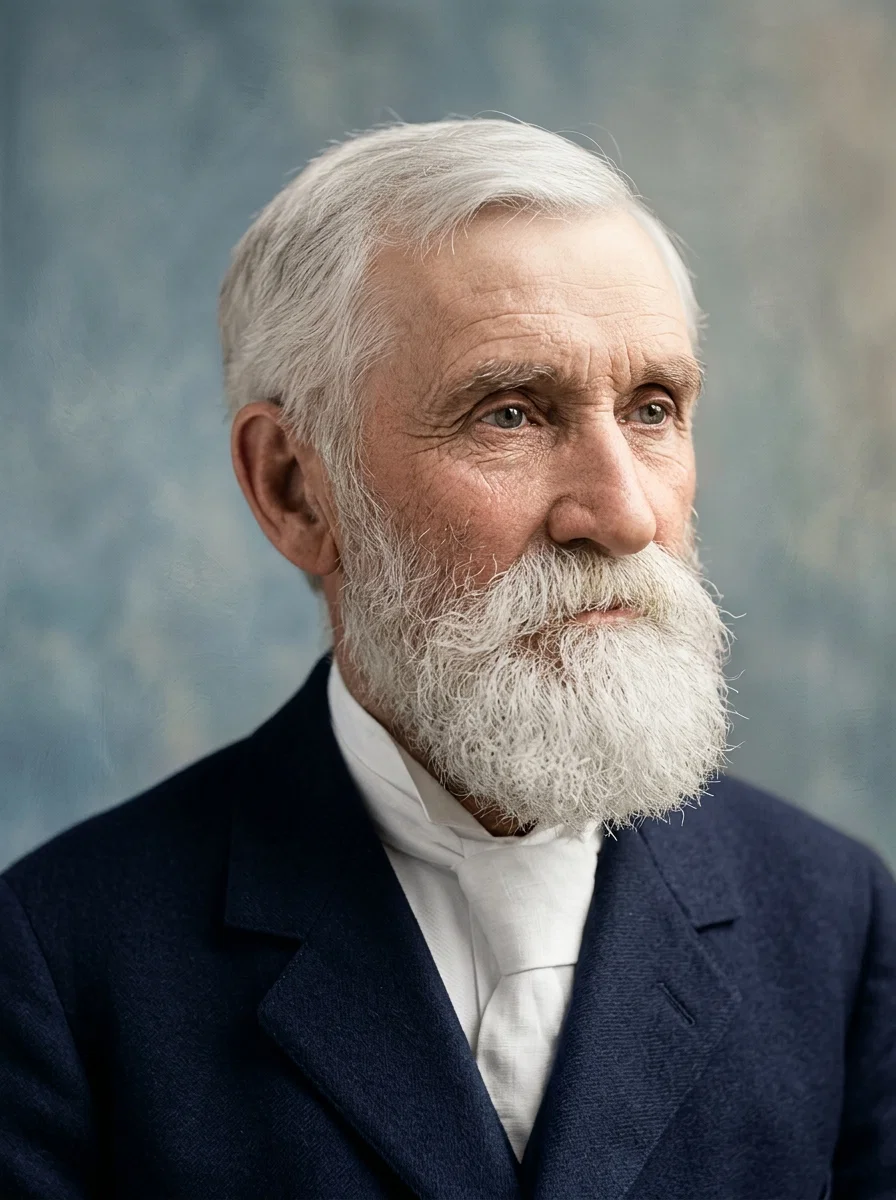
JAMES LEWIS PRESCOTT was born in Epsom, N. H., March 8, 1828, and died in Washington, D. C., Jan. 30, 1915, aged 86 years, 10 months, and 22 days.
The parents of Father Prescott, as he has been known to many, lived on a small farm, and there he spent his early years, receiving his education in the common schools of the town. Dec. 22, 1847, Brother Prescott was married to Harriet M. Tripp, of Epsom, who survives him. Of their nine children, four are now living, and were all present at the funeral.
Brother Prescott's father and mother were religious persons, who trained him up as a Christian lad. He was early converted and became a member of the Baptist Church. He and his father attended the meetings conducted by William Miller in the early forties, and after hearing his exposition of the prophecies concerning the second advent they accepted his views, and were among those who looked for the visible appearing of the Lord, Oct. 22, 1844. The crops in their fields were left unharvested that year till after the passing of this date. Although quite young, Father Prescott experienced the bitterness of the disappointment and of the reproach which followed, but he did not lose confidence in God or his Word. He, with others, waited for an explanation of the disappointment. In the meantime he retained the advent hope, and was in attendance at the camp meeting in Exeter, N. H., where the first public explanation of the subject of the sanctuary in heaven was made, and the nature of the event which was to take place in 1844, according to the prophecy, was explained.
Although Brother Prescott never gave his full time to the gospel ministry, yet he joined with others in conducting public meetings in various places, giving the Biblical reasons for the views which he entertained concerning the second advent.
In 1858, while traveling in Vermont, he stopped with a family of Sabbath keepers, and then for the first time became acquainted with the Scriptural reasons for the observance of the seventh-day Sabbath. Following his life-long principle of obeying the truth as soon as it came to him, he observed the very next Sabbath, and was thus a Sabbath keeper for nearly fifty-seven years.
JAMES LEWIS PRESCOTT
During this time he watched the rise and progress of this second advent movement, and was personally acquainted with many of its leading representatives. Elders J. N. Andrews, J. N. Loughborough, and M. E. Cornell were frequent visitors at his home, and with his cooperation, held services in the towns where he lived.
During his whole life, Father Prescott took an active interest in public affairs; but he gave his most earnest attention and support to the progress of the advent movement, which he had known from its beginning. During his later years, not being able to engage in active business, he spent much time in reading, it being his habit to read the Bible through in course at least once every year.
Brother Prescott's married life covered a period of more than sixty-seven years, his fiftieth wedding anniversary having been celebrated in 1897 in Battle Creek, Mich., and his sixtieth anniversary in 1907 in Washington, D. C. He continued in unusual good health for a man of his years until June, 1914, when he was thrown violently to the ground while leading his horse in the field. While recovering from the injury and shock which he had received, a trouble due to old age came upon him, and he was obliged to undergo a minor operation in the Sanitarium, where he remained several weeks. Returning to his home, he was, by careful nursing, kept in a reasonably comfortable condition, although never able to leave the house and very rarely leaving his room.
During his declining years, and particularly during his prolonged sickness, he was the object of tender solicitude and loving care on the part of both his resident and his nonresident children.
All that willing hands and loving hearts could do in supplying him with material comforts and in ministering to his necessities, was gladly done. The immediate cause of his death was heart failure, due to an abnormal pressure on the heart caused by enlargement of the stomach.
Father Prescott possessed an unwavering faith. He believed the Word of God with childlike simplicity, and acted upon its instructions. For him to see and recognize the right, was to do the right. Affectionate in his family relationships, his long life embraced a large and constantly widening circle of friends. Thousands knew him to respect and love him for his godly life and Christian endeavors. Toward the sick and afflicted his ministry was particularly devoted. Many were the discouraged sufferers he pointed to the Source of hope. Many were raised up from beds of affliction in answer to his fervent prayers.
In the hour of darkness the anchor of his faith held fast. Death to him had no terrors, because he had committed the keeping of his soul to the One who holds the keys of death and of the grave. During his final sickness, both at the Sanitarium and at home, his thoughts were of others and not of himself, thoughts of others' welfare and comfort, of others' salvation, thoughts of love and joy and peace in believing. He looked beyond the tomb, and with no dimming veil to obstruct the trusting faith, grasped the realities of the glory land.
Among the scriptures which he quoted in his closing hours, was the triumphant expression of faith uttered by the apostle Paul as he was about to close his earthly career: “I have fought a good fight, I have finished my course, I have kept the faith: henceforth there is laid up for me a crown of righteousness, which the Lord, the righteous Judge, shall give me at that day: and not to me only, but unto all them also that love his appearing.” These words, we believe, are descriptive of our brother's experience in this life, and prophetic of his reward in the eternal ages.
And so he sleeps. Wearied from the conflict, he lies down to rest awhile till Jesus comes. He rests in the arms of eternal Love. Who would call him back to physical suffering? We grieve, but not in darkness. Hope and faith bridge the gulf which death has caused. Beyond, a little way from this, is the day of glad reunion. For it let us live and labor. May our brother's faith and devotion to God prove incentives by God's grace to bring us to the eternal reward awaiting him and awaiting all who will live godly in Christ Jesus.
Brother Prescott leaves to mourn a wife, a sister, three sons, one daughter, four grandchildren, and eleven great-grandchildren.