Sonnets by Emmanuel Missionary College Literature Class
Sonnets
(By members of the literature class of Emmanuel Missionary College)
Apologia
For me, since long I tired my lagging mind,—
That I from stubborn words a rhyme might make
From deepest chaos proper place to take
Among sufficient number of its kind,—
Since after all my diligence I find
That only vainly did I undertake
The princely art of poetry to fake,
This welcome thought, this solace, I do find:
Not of my own devising was this deed;
I knew that I no latent genius had,
And never thought myself so wise to be;
I only hoped to please her who decreed
I must a sonnet write. My verse is bad,
But she must bear. She put the task on me.
—P. Lamont Thompson.
Night
It is the twilight hour, and falls the night.
The distant, wooded shore now to the eye
Like some faint shadow on the lake doth lie;
All nature whispers, “Peace;” and from our sight
Are veiled the toils of man. The gentle light
Which ruleth all, the star’s soft beam from high,
The murmur of the sea, the wind’s low sigh,
Bid the toiler rest and sorrow take its flight.
O gentle night! thou tellest me a tale
Of love divine; of Him who made us all,—
Of him who fitted nature to our need,
And now doth rule with love which cannot fail.
With reverence, O Holy One, on thee we call;
Teach us, each day, thy voice to know and heed.
—G. H. Straight.
Redemption
O, Saviour, thou didst die for sinful men,—
Didst leave thy home of glory, love, and peace,
That pain and sorrow, strife and death, might cease
Forever from this stricken earth! What can
A loving, compassionate God more offer than
For us he’s given? But do earth’s woes decrease?
Why has his sacrifice not brought release?
One more event completes the heaven-born plan.
Alas! We have been slow to do our part.
But when we’ve done the work Christ gave to men,
He’ll come again; for there’s a city fair
Which he’s prepared, and joys to soothe the smart
Of pain, whose fullness none can tell, or pen
Describe. There’ll be no sin or sorrow there!
—Laura Foster-Rathbun.
Truth
While blinded by the thousand creeds of earth,
Truth came to me in all her lovely grace,
Showed me what is life’s duty to the race,
Retouched my soul; and in place of dearth,
Left me rejoicing in my soul’s new birth;
Let me look long into the pierced Face,
The Sacrifice, which leaves of sin no trace,
And by the price of souls taught me their worth.
So Truth may come to you, and take away
Your burdens one by one, and by the hand
Lead you so gently in the way to go
That you’ll not know why you, so meek, obey.
All-wise, the Father knows and understands;
Oh, trust your God, and thank him that ’tis so!
—Gladys McDill.
To Prayer
If pausing, I reflect on prayer, my heart
Responds in gladness. Though I stand, the soul
Is on its knees. Through prayer doth God console.
Divine communion! God gives strength to start
Confiding thus. From him I ne’er would part.
Triumphant leads he toward salvation’s goal.
With wondrous power, faith’s prayer will move the whole
Of heaven to help. Religion’s life and art
Lie wrapped in prayer. If troubles on me weigh,
Prayer smooths all care as waves do prints in sand.
O prayer, the privilege of Christian’s trust,
Teach me without reserve, in faith, to lay
Myself within God’s friendly, faithful hand,
Conform my life, and all to him intrust.
—Henry T. Elliott.
Reputation Versus Character Before God and Angels
“REPUTATION is what men and women say of us: character is what God and the angels know of us.”
The Stings in Little Things
We call him strong who stands unmoved—
Calm as some tempest-beaten rock—
When some great trouble hurls its shock;
We say of him his strength is proved,
But when the spent storm folds its wings,
How bears he then life's little things?
And I can tread beneath my feet
The hills of passion's heaving sea,
When wind-tossed waves roll stormily;
Yet scarce resist the siren sweet
That at my heart's door softly sings:
“Forget, forget life's little things.”
I can forgive—'tis worth my while—
The treacherous blow, the cruel thrust;
Can bless my foe as Christians must,
When patience smiles her royal smile;
Yet fierce resentment quickly slings
Its shots of ire at little things.
But what is this? Drops make the sea;
And petty cares and small events,
Small causes and small consequents,
Make up the sum for you and me.
Then, on, for strength to meet the stings
That arm the points of little things!
—Selected.
Labor and Its Blessings
By Rosslyn E. Gallion
ROSSLYN E. GALLION
THE Youth’s Companion is authority for the story of the boy who, having worked hard all the evening over the twentieth chapter of the first book of Cæsar, at length closed the book with a slam, declaring to his family, “I think, after all, I won’t go to college.”
“Why not?” asked the father, in surprise, for the great ambition of George’s life had always been to go to college.
“Because the entrance examinations are so hard,” said George. “I’d have to work and worry all the year to pass my preliminaries, and then go at it again harder than ever for the finals. It’s no joke!”
“That’s true,” said his father, gravely, “it isn’t a joke. What will you do instead?”
“Oh, go to work somewhere!” George answered easily, as visions of money in his pockets and care-free evenings without lessons rose up before him.
“Let’s see,” replied his father; “that means getting up one hour earlier every day than you get up now. It means starting in as an errand boy on a par with the boy who was blacking boots last week. It means no more afternoons for play, except, perhaps, once a week in summer. It means doing exactly as you’re told all day long, or else hunting for a new job. It means remaining an errand boy, a porter, or perhaps a clerk at ten dollars a week, unless you work harder than you ever had to work at school. No one makes any advance in business without hard work.”
George sighed dismally. “It’s work, work, everywhere, and I hate work!” he said.
His father turned upon him sharply. “If you forget everything else I have ever told you,” he said, “at least remember what I tell you now: The man who hates work goes through life with a ball and chain dragging after him. He has a curse upon him that blasts his life. The hobos and tramps are haters of work. Sneak thieves and thugs and worse are haters of work. So are most of the men at the bottom of the industrial scale. They hated work, and dodged it, and slighted what they had to do, and did just enough to hold their jobs, and they stay at the bottom, hating work still!”
Suddenly the father’s tone changed. “When we saw the football game at Cambridge last year,” he asked, “do you remember the inscription on the stadium, ‘Dedicated to the joy of manly contest’? Learn that ‘joy of manly contest’ with hard work, my boy! Don’t run away from work, George! Don’t be afraid of it! Meet it bravely, with the joy of manly contest in your heart, and day by day you will find the struggle good, and out of it will come one of the supremely great and enjoyable things of life!”
George sat quiet for a time. Then his jaw closed with a snap. “I’m going to begin right now,” he said, “and I’m going to know what this chapter’s about!”
One of the greatest blessings given to our first parents after the fall, is hidden in the sentence, “In the sweat of thy face shalt thou eat bread, till thou return unto the ground.” “The life of toil and care which was henceforth to be man’s lot was appointed in love. It was a discipline rendered needful by his sin, to place a check upon the indulgence of appetite and passion, to develop habits of self-control. It was a part of God’s great plan for man’s recovery from the ruin and degradation of sin.”
How many sons and daughters of the fall, bowed by the weight of sorrows, brains reeling with recurring thoughts, and hearts well-nigh broken, have thanked God for the blessings of hard toil! A young man who had passed through a series of tragic sorrows touching all that life holds dear, sought solace in the hill country of a western State. Writing home, he said: “There9is something majestic and comforting in these eternal hills. Swinging an ax and heaping up cords of this bull pine, redwood, and manzanita, somehow helps a fellow to forget. When my thoughts begin to run riot, I apply more energy, and make the chips fly faster. My hands are calloused, and my muscles are like ‘steel cables,’ but I’m ready for sleep when night comes, and am up in the morning with the dawn.”
One cannot read the history of Judson of Rangoon, Mackay of Uganda fame, or of Paton in the New Hebrides, without feeling that work is a desirable, needful part of the missionary’s life. It helps to lift up the standard. It crowds out self-pity, and leaves instead a blessed humility and self-forgetfulness. It is a necessary discipline to develop solidity and strength of character. It keeps the mind and heart so full of what is worth while that there is no space for repining. These men spent their lives in patient toil to bring the gospel of peace to sin-darkened lands where the glorious light had never entered. All successful pioneers in the mission fields toiled unceasingly.
But the greatest of all examples is that of the Beloved of heaven, who, in linking himself with the interests and labors of humanity, became the pattern that all who profess his name should follow. Throughout his life on earth he was a constant worker. Being a perfect character, he was perfect as a workman. He expects his children so to use their physical powers as to do the most acceptable service for him. We should give of our best to the One who made it possible for us to hope.
Those of us who enter the vineyard at the eleventh hour may be late, but we mean to do with willing, trusting hearts the work that God appoints. And may it please him to give us a penny, together with those who have borne the burden and heat of the day.
“Success is labor’s prize;
Work is the mother of fame.
And who on a boom shall rise
To the heights of an honored name?
The bee by industry reapeth
The stores which enrich the hives.
All that is thrifty creepeth,
For toil is the law of lives;
And he who reaps without sowing,
A bitter harvest reaps.
The law of gradual growing
Is the law that never sleeps.”
Her Reasons
A GROUP of people were talking about marriage. Most of the group were young—or the story that this article tells could not have been told. But a good many groups consist of young people, and sometimes they talk about marriage, and that is why this story should be told; for it very often happens that in such a group of youth there happens to be one woman—sometimes more—who isn’t quite so young: not old, not even mature, but still not a girl exactly—say thirty-five.
And the young girls in the group fell to teasing the woman of thirty-five about her single state. She was attractive, pretty, in fact; she had charm, they felt that; she played the piano well; she was popular with men, for men sought her, so—
“Why in the world don’t you marry?” asked an eighteen-year-old.
“Didn’t you ever have a chance?” asked Miss Curious, aged seventeen.
And just then the slightest flicker of a shadow crossed the face of the woman who had lived thirty-five years.
“Didn’t you want any of ’em?” persisted another; she was twenty.
“Perhaps she didn’t think they were good enough,” said a pert miss of nineteen. She had a brother—also a suspicion!
And the probing went on—ruthlessly to one who watched it, full of joy to those who were doing the probing. But what of the woman of thirty-five?
She, at a lull, looked at the fresh, pretty faces before her, and then with a gracious smile said:—
“Well, you see I just didn’t, did I? And now, let’s all go over to the tennis courts, and play for an hour.”
And the group went forth, the woman of thirty-five going with them.
Yet the man who remained behind knew what the girls didn’t know. And what did he know?—That only three days before, he had been refused by the woman of thirty-five; and he was the father of two of the girls who had done the probing. And why was he refused?—Because ten years before there had been another. He had asked the same question and had received a different answer; but after six happy months he had fallen ill. For two whole years the woman of thirty-five had nursed him, and then had laid him and her heart away. That was in the past; now there was a tubercular brother whom the woman of thirty-five was maintaining by work which the group knew not of, there was an aged mother who was riding in an automobile because of the daughter, and there was a father shattered in health and spirits by overwork. And somehow or other the woman of thirty-five, even if she could care again, could not ask any man to share this burden with her.
There are some things in life that the young cannot understand, but it is just as well once in a while to put some of them down in print so that they may at least read them, even if some forget them. And one of them is that it isn’t always safe to assume because a woman is not married at thirty-five that she might not have married (the safer assumption is that few women, if any, ever reach the age of thirty when chances have not been theirs); that it is just as well not to ask too many questions of the woman of thirty-five about why she hasn’t married (the safer assumption is that she won’t tell anyway); and that it is always more gracious, more kindly, for youth not to probe into the innermost recesses of an older woman’s heart; for in thousands of women’s hearts lie very beautiful and tender memories—memories which keep the face and spirits young; which make, as the years go by, the finest women that we know, and whose reasons for writing “Miss” instead of “Mrs.” to their names are very precious, too precious to be talked about or explained.
Some girls find this out later. Before they do, let me ask them to take my word for it.—The Ladies’ Home Journal.
Serums Cannot Cure Tuberculosis, Dr. Renon Reports
TUBERCULOSIS cannot be cured by serums, according to the announcement of Dr. Louis Renon, of Paris. He has reached this conclusion after a long series of experiments, by which he is convinced that it must be treated by chemical means. He claims that the addition of certain substances to the body, or the withdrawing of others, will produce a condition that will make the growth of the tubercle bacilli impossible.
Why Christians Were Persecuted in the Roman Empire
THE ancient world, in the time of the Roman Empire, was in many ways extremely corrupt, heartless, and cruel. There were many persons, indeed, who tried to live righteous lives; but even the best of them thought nothing of many customs which would be considered shocking and wicked nowadays. It is hard to believe, for example, that civilized men and women could take delight in watching the death agonies of their fellow men. Yet the great Colosseum at Rome, and the amphitheaters in all the leading cities, were continually thronged with spectators. Here, protected from the sun with awnings, and decked out in splendid robes and glittering jewels, the fashionable men and women of each city looked down from their perfumed, cushioned seats, into the arena, where condemned criminals were torn by leopards, or tigers, or lions, or wild boars; or where perchance trained gladiators fell upon one another in mortal combat. These cruel and terrible exhibitions were what the people of those days called amusements.
Nero even illuminated his own gardens at night with burning Christians, who had been smeared with pitch and chained to stakes. So horrible were these tortures that the people in general began to sympathize with the Christians, in spite of the crimes which they were thought to have committed.
The Unpopularity of the Christians
Into the midst of these practices came the Christians, with their purer and better way of living. They refused to go to these “amusements” at the amphitheaters. They refused to share in the degrading vices which were commonly practiced. As a result, they were unpopular. This unpopularity was greatly increased among those who found that they were losing money because of the new religion. Idol makers, for example, and priests in heathen temples, hated the Christians, because each new convert to Christianity meant so much less revenue for them. There were many persons, however, who were influenced against Christianity through misunderstandings and falsehoods. The Christians were called atheists because they would not worship idols. They were even accused of all kinds of horrible deeds. It was reported that little children were killed and eaten at their meetings. Although these statements were absolutely false, they were believed by many intelligent men.
The Christians and the Roman Government
The Roman government permitted its subjects for the most part to worship whatever gods they pleased. In Rome itself all sorts of foreign religions flourished. One thing only was insisted on: whatever special deity a man might choose to worship, he must also sacrifice to the old Roman gods, who were supposed to protect the Roman Empire. Furthermore, all Roman subjects were required to offer sacrifice, on certain occasions, before the image of the emperor. These laws were readily obeyed by all except the Christians; they alone held aloof and refused to even throw a pinch of incense on the altar in worship of Cæsar. To the Roman officials, this seemed like treason against the government. Furthermore the Christians, as we know, did really believe that Christ was soon to return, and that he would overthrow the Roman Empire and all earthly kingdoms, and establish his own heavenly kingdom. When the Roman rulers heard about this belief, it was natural for them to suspect that the Christians were actually plotting against the government.
Laws Against the Christians
So from the time of Nero, Christianity seems to have been a “forbidden religion” in the eyes of the law. The emperor Trajan, more wise and just than some rulers, gave orders that the Christians were not to be sought out, but that when accused and convicted, they were to be compelled to sacrifice to the gods or else were to be put to death. Under this rule (about A. D. 110) a Christian was left unmolested unless some enemy reported him to the local governor or prefect. They had many enemies, however, and from time to time fierce attacks were made upon them. At no time, and under no circumstances, could they feel secure. Many of them were cruelly tortured and slain. They were torn with iron claws, hung upon crosses, thrown to wild beasts, covered with skins of beasts and torn by dogs, roasted over slow fires. No form of torture was neglected which ingenuity could devise.
Failure of These Laws to Check the Growth of Christianity
In spite of these attacks the number of Christians increased at a remarkable rate. Christianity appealed not merely to the educated, but to the humble and lowly. The Christians were noted for their kindness to the sick and to the poor. Their gospel aroused the consciences of men and offered them forgiveness and a Saviour from sin. One of the most powerful influences in the winning of new converts was the courage and the constancy of the Christians themselves in the face of persecution, and their willingness to die, if need be, for their faith. Thus for every Christian put to death, many more converts would often be won.
The impression made on heathen spectators by the death of the Christians is well brought out by the following description from “Quo Vadis” of a scene in the arena during the persecutions of Nero: “The turn of the Christians was at hand. Since that was a new spectacle for people, and no one knew how the Christians would bear themselves, all waited with a certain curiosity. The disposition of the audience was attentive but unfriendly. Those people who were to appear had burned Rome and its ancient treasures. They had drunk the blood of infants, and poisoned water; they had cursed the whole human race, and had committed the vilest crimes. The harshest punishment did not suffice for their hatred; and if any fear possessed people’s hearts it was this: that the torture of the Christians would not equal the guilt of these ominous criminals. . . .
“Now the prefect gave a sign. The same old man appeared who had called the gladiators to death, and passing with slow step across the arena amid silence, he struck three times again on the door.
“Throughout the amphitheater was heard the deep murmur, ‘The Christians! the Christians!’
“The iron gratings creaked; through the dark opening were heard the usual cries of the scourgers, ‘To the sand,’ and in one moment the arena was filled with crowds of people covered with skins of beasts. All ran quickly, and reaching the middle of the circle, they knelt one by another with raised hands. The11spectators, judging this to be a prayer for pity, and enraged by such cowardice, began to stamp, whistle, throw empty wine vessels, bones from which the flesh had been eaten, and shout, ‘The beasts! the beasts!’ But all at once something unexpected took place. From out the shaggy assembly singing voices were raised, and then sounded that hymn, heard for the first time in a Roman amphitheater, ‘Christus regnat’ (Christ reigns). Astonishment seized the spectators. They saw pale faces, but as it were inspired. All understood that those people were not asking for mercy, and that they seemed not to see the circus, the audience, the senate, or Cæsar. ‘Christus regnat’ rose ever louder, and in the seats far up to the highest, among the rows of spectators, more than one asked himself the question, ‘What is happening, and who is that Christus who reigns in the mouths of those people who are about to die?’”
Final Attempts to Stamp Out Christianity, and Their Failure
Before the time of Decius (A. D. 250) no systematic attempt was made by the government to search out the Christians. During the reign of this emperor, however, there were many great public calamities, as, for example, a widespread pestilence. “The Christians have brought these things on us,” people said, “by their neglect of the gods.” So Decius issued an edict, which was really a declaration of war against the new religion. Christians were now hunted down like murderers, all over the empire. About fifty years later (A. D. 303), after a temporary respite, the emperor Diocletian undertook to carry out the same kind of campaign, with even greater energy. By that time the Christians had begun to have church buildings. These were destroyed. All copies of the New Testament that could be secured were burned. Pastors and church officers were punished with special cruelty. It was a terrible experience for the Christians, but the majority of them proved true. In fact, many who had been lukewarm in their loyalty were awakened to heroism. New converts flocked to the standard of the cross. It is said that a certain actor had been hired to take part in a play which ridiculed and slandered Christianity. He knew these statements were false, however, and when the time came for him to repeat them on the stage, his better nature triumphed. Instead of going on with his part, he came to the front of the stage and declared his belief in Christianity and his purpose to be a Christian. He was immediately seized and put to death. As time went on, the Roman authorities began to realize that it was impossible to destroy a religion which could awaken so dauntless a spirit as this. The persecution of Diocletian was the last of the great Roman persecutions.—“Witnesses for Christ.”
A Financial Fish Story
Young Lionel Hooker had never a cent,
Nor took the least thought in the world of his purse.
He was therefore surprised, when afishing he went,
To encounter such luck as described here in verse.
To begin with, he hauled in some fine silver bass;
Of billfish he took out perhaps half a score.
He landed goldfish in a heap on the grass,
While dollarfish actually littered the shore!
He guessed he had caught them all after awhile;
So under a tree on the old fishing grounds
He gathered them into a glittering pile—
And counted up something like £45.
He stuffed all his pockets as full as he could,
Tied the rest in neat bundles,—his face all agleam,—
Then, before starting home through the shadowy wood,
He deposited them in the bank—of the stream!
—St. Nicholas.
A Suburban Vacation
By Alice L. Griggs
When Marie came back from town that hot July afternoon, after a half day's shopping, her face wore a troubled look.
“I met Annette in Field's store this noon,” she explained to her mother. “That long sickness that she had early in the spring pulled her down terribly. She looks white and thin. It made me feel bad to see her.”
“Is she going away for her vacation?” asked Mrs. Nash, laying down her book and moving over to make room for Marie in the porch swing.
“That's one thing that makes it so hard. Her employers were very nice to her while she was sick, and paid her salary all the time. They don't really feel like giving her a vacation now, but they've promised her a week on pay. Annette says it wouldn't pay her to go away for a week, even if she could afford it, and she can't, because her sickness was so expensive. And she might almost as well be at work in the store that one week as to spend the time in that stuffy little flat.”
“It is hard, very hard!” her mother said, thoughtfully. “I'm thankful, dear, that you're a teacher, with plenty of time to rest up during the summer.”
For a time the two sat silent, swaying gently back and forth in the porch swing. Marie, remembering vividly the glaring, heat-smitten streets of the city, was enjoying the light but refreshing breeze that rustled in the maple tree at one side of the house.
“I'm so glad we live out here, and not in a big, flat building in town,” she said, suddenly, giving utterance to the thought that had been shaping itself in her mind as she watched the swinging tip of the climbing rose and the nodding blossoms of the clematis. “If only Annette—”
She did not finish the sentence aloud, but her thoughts ran on busily along the way that her words had unexpectedly opened up. When she did speak again, it was slowly and thoughtfully.
“Mamma, I've thought of something, but I don't know whether it will be convenient for you. If you think that we can do it, I'll help you all I possibly can. It's just this: Can't we have Annette come out here for the one week of vacation that she is to have, and stay another week after she goes back to work? I'm sure it will do her more good than to stay at home in the flat; perhaps she'll get a little rested. She can have my bed on the sleeping porch; that will be good for her, you know, and I'll take the little blue room.”
“But if she stays the second week, dear, won't it interfere with your getting away to the Dells?”
“It will make but three or four days' difference, and I'd be glad to cut that much off my stay at the Dells if I could only give Annette something like a real vacation.”
“Then you may count on me, dear, for anything you want to plan,” Mrs. Nash said, heartily. “If Annette will come, we will do everything we can to give her a good vacation.”
After some hesitation, Annette accepted the cordial invitation which came to her over the phone that same evening. Her vacation began the following week, and she came out from town Saturday night, tired, white, and hollow-eyed. After a good dinner Marie settled her comfortably in the hammock on the big porch, and went indoors to help her mother with the dishes.
“I'm almost asleep,” Annette murmured, drowsily, when Marie and her mother returned to the porch a little later. “It's so deliciously quiet.” Five minutes12later she was enjoying the most restful sleep that she had had for months.
As Annette herself said laughingly the next morning, she woke up just in time to go to bed, and the effects of the long night's rest in the cool quiet of the sleeping porch showed when she appeared at the breakfast table. In the afternoon the hammock was swung under the maple tree, and again Annette sank quickly into quiet, dreamless sleep. Monday morning she came downstairs with a protest because she had been allowed to sleep until half past eight.
“You slept every minute of it, didn't you?” asked Marie, looking up from the slice of toast that she was browning daintily for her guest.
“I certainly did!” was the laughing answer. “But that's no reason why I should put you to the bother of getting an extra breakfast for me.”
“Lying abed in the morning is my greatest vacation luxury, and I want you to get as much of it as you can. And you're not to worry one bit about my getting the breakfast. It's just good practice for me.”
Annette smiled gratefully. “I can't feel poor when I have such dear, good friends,” she said, softly.
Tuesday afternoon Rose O'Neill came with her horse and surrey. Marie slipped a basket in back of the seat, and the three drove gayly away, as happy as though they were school children again. The road took them through a region of small farms and market gardens and then into a pretty piece of woodland. In a green nook among the trees they hitched the horse, and Marie produced from the basket under the seat some appetizing sandwiches and an interesting book.
Probably Rose O'Neill had mentioned Annette and her suburban vacation to two or three other friends of Marie's, for one day there came an invitation to a long automobile ride in the country; another afternoon the three girls were asked to play tennis on one of the best courts in Ferndale.
“I feel like a society lady,” Annette laughed, as she slipped into the fresh white muslin which her mother had sent out from home especially for a luncheon at the Country Club, about a mile from where Marie lived. “Why, Marie, I've had pleasure enough in this one week to last me for a year!”
A queer, choked feeling came into Marie's throat, as she watched Annette's happy face, in which a single week had made so great a change.
“I am so glad, Annette, that the others helped me to make it pleasant for you. And the best of it is that the pleasure isn't over, even if your vacation is. You've made some good friends in Ferndale, dear, and unless I'm very much mistaken, you'll find them helping you to small bits of vacation all through the year. You see,” laughingly, “you're such a good subject! It's just fun to make a vacation for you because you show the effects so satisfactorily!”—Alice L. Griggs.
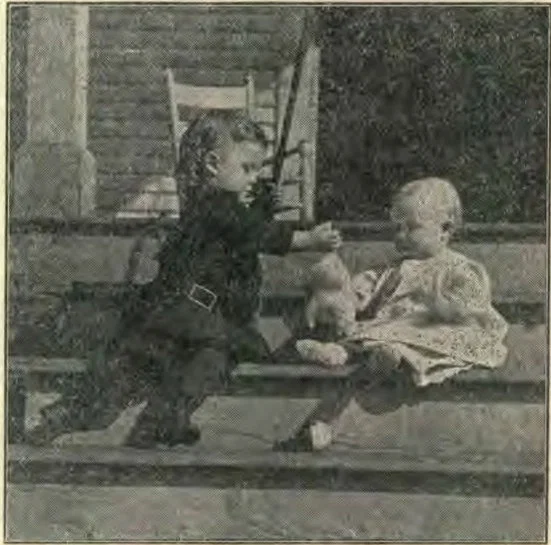
PLAYMATES
The Mainspring of God
It is said that Tennyson was seventeen years in writing “In Memoriam.” He wrote the little song, “Come Into the Garden, Maud,” fifty times before he published it. The wife of a distinguished painter said, “I never saw my husband satisfied with one of his productions.” Thus self-dissatisfaction lies at the root of our noblest achievements. What is true generally is particularly true as a condition of growth in the divine life. Even if we have been kept from outward and disgraceful sin, how frequently we come short of the glory of God. If we do not commit trespass, we are burdened with debt. Never yield to discouragement, never admit that failure is a necessary part of your life, never abandon your quest for the highest. Remember that Christ is just in front. “My soul followeth hard after thee: thy right hand upholdeth me!”—The Christian Herald.
Mission Talk: “Our Work in Burma.” See “Helps on the Mission Studies,” in Gazette; and “An Outline of Mission Fields,” pages 113, 115, 116, 120, 121. (Our Karen mission will be taken up as a separate study next week.)
Reading: “Our Boys in Burma.” Let some one either read or tell in his own words the story of these two boys in our Meiktila school. See Gazette.