Your ShelfYour Projects

Signs of the Times, Vol. 37, No. 34.

Christ Our High Priest
Earlier text: Higher Criticism

Our Bible Reading

Christ and the Sabbath

1. Of what law is the Sabbath a part?
Of the Ten Commandments, or Decalogue. See Ex. 20: 1-17. The fourth precept in that law is regarding the Sabbath.
2. What did the Spirit predict that Christ’s attitude toward the law would be?
“The Lord is well pleased for His righteous-ness’ sake; HE WILL MAGNIFY THE LAW, AND MAKE IT HONORABLE.” Isa. 42: 21.
“Then said I, Lo, I come: in the volume of the book it is written of Me, I DELIGHT to do THY WILL, O My God: yea, THY LAW is within My heart.” Ps. 40: 7, 8.
3. What approval of Christ and what injunction to His people could the Father well give in view of Christ’s attitude toward the law?
“This is My beloved Son, in whom I am WELL PLEASED; HEAR YE HIM.” Matt. 17: 5.
4. What does Christ say of His purpose in coming to the world?
“My meat is to DO THE WILL OF HIM that sent Me, and to finish His work.” John 4: 34.
“For I came down from heaven, NOT to do MINE own will, but the WILL OF HIM THAT SENT ME.” John 6: 38.
5. What did He say regarding His attitude toward the will of God as expressed in His law?
“Think NOT that I am come to DESTROY THE LAW, or the prophets: I am NOT come TO DESTROY, but TO FULFIL. For verily I say unto you, Till heaven and earth pass, one jot or one tittle shall in no wise pass from the law, till all be fulfilled.” Matt. 5: 17, 18.
NOTE: To fulfil a law is to do the law. Our Lord Himself perfectly wrought out what the law demanded. But the doing of a law does not abolish the law; else the law of a state fulfilled by loyal obedience would immediately be abolished, and loyalty would become a menace to the safety of the commonwealth. This would not be even good common sense. The fulfilling of the Lord’s law was the doing of that law, or the translation of that law into character. That law was to remain in every jot and tittle until all should be fulfilled, not only the law but the prophets. Every typical law was a prophecy of Christ—Christ fulfilled that law, but prophecies of the future glory will never be completed.
6. What did Jesus say of those who disregarded the law?
“Whosoever therefore shall BREAK one of these LEAST COMMANDMENTS, and shall teach men so, he shall be called THE LEAST [of no account] in the kingdom of heaven: but whosoever shall do and teach them, the same shall be called great in the kingdom of heaven.” Matt. 5: 19.
“Not every one that saith unto Me, Lord, Lord, shall enter into the kingdom of heaven; but HE THAT DOETH THE WILL OF MY FATHER which is in heaven. Many will say to Me in that day, Lord, Lord, have we not prophesied in Thy name? and in Thy name have cast out devils? and in Thy name done many wonderful works? And then will I profess unto them, I never knew you: depart from Me, ye that work INIQUITY [lawlessness].” Matt. 7: 21-23.
7. In what is summed up the whole work of Christ?
“And thou shalt call His name Jesus: for He shall save His people FROM THEIR SINS.” Matt. 1: 21.
NOTE: “Sin is the transgression of the law.” 1 John 3: 4; Rom. 7: 7. Jesus came to save His people from transgressing the law. It is utterly impossible to save a live man from the transgression of a law except to save him to obedience to the law. There is no other side to the question. He who does not transgress, obeys. Saving from transgression is saving to righteousness, and in righteousness is life. Jesus came not to dishonor the law, not to turn men from it, but so to write it in the hearts of His people that they like Him should delight in it forevermore.

Comprehension and Faith

He that will believe only what he can fully comprehend, must have a very long head, or a very short creed.—C. C. Colton.

Is It God's Will?

Do NOT take even an answer to prayer as significant of God's highest will. Some seeking to know God's way pray and receive an answer to their prayer. They then say, “If God hadn't wanted me to do that thing He would not have answered my prayer.” Some answers God gives to prayers do not indicate His highest will at all. That is no criterion of judgment. It may be permission again. “And He gave them their request; but sent leanness into their soul.” God here answered prayer, altho it was not His highest will. The children of Israel prayed for quails. God answered, but sent leanness into their souls. Sometimes God can only teach us by letting us have our prayers answered. The answer brings the lesson, and it also brings judgment.—C. H. Pridgeon.

The Danger of Uncertain Doctrine

THE man who goes through life with an uncertain doctrine, not knowing what he believes, what a poor, powerless creature he is! He goes around through the world as a man goes down through the street with a poor, wounded arm, forever dodging people he meets on the street for fear they may touch him.—Phillips Brooks.

Turkey: Conditions in the East

By C. Voigt
Last month the newspapers mentioned the dreadful incidents that happened just one year ago, when the fanatic and misguided soldiers of the reactionary party killed their liberal-minded officers, and, under the influence of the ex-sultan, were bent upon destroying even Turkey's slender hopes of a happier future. But after a few days of fearful apprehension, the liberating army finally arrived from Macedonia, and the cause of the Committee for Union and Progress was saved. A foreigner now entering Turkey would hardly realize that it has been only one year since this empire was shaken to its very foundations.
We may ask: Have the many nations of Turkey been more firmly united during the past year than previously? Is there any sign of progress that can be noted as having been made during this period?
In our view of the matter, we are chiefly concerned with the position which the large Mohammedan population assumes towards Christianity. Two important facts should be mentioned,—the efforts of Christian societies to interest the people of the home lands in missions to the Moslems; and the attitude of the latter toward this evangelizing tendency. It is our conviction, that if the message is placed before these multitudes, some of them will see in it the same glorious saving power that we ourselves enjoy, and they will be convinced that Christ really died for them as well as for us. When this is once achieved, we will be able to have not a small number of this nationality waiting for the Saviour, when He appears in the clouds of glory to receive His own to Himself.
The Moslems ever have been and they still are kept back from accepting Christianity by their spiritual as well as by their temporal leaders and rulers. The attitude of the former can be easily explained, for no religion likes to give place to another; and to get an understanding of the efforts of the temporal rulers, we should not forget that Turkey is a Mohammedan state, whose religious chief head—the sheik El Islam—is by virtue of his office the leader of the Mohammedan world, for he is the highest church official. It was he who condemned to death the two Mohammedan priests won to Christianity by the German Orient Mission and baptized in Potsdam last October. Moslem law commends, yea, it even encourages such condemnation of him who will accept Christianity. A Christian may become a Mohammedan, but this fear of death is like an iron chain restraining the Moslem from intimate communion with Christians. This order of things
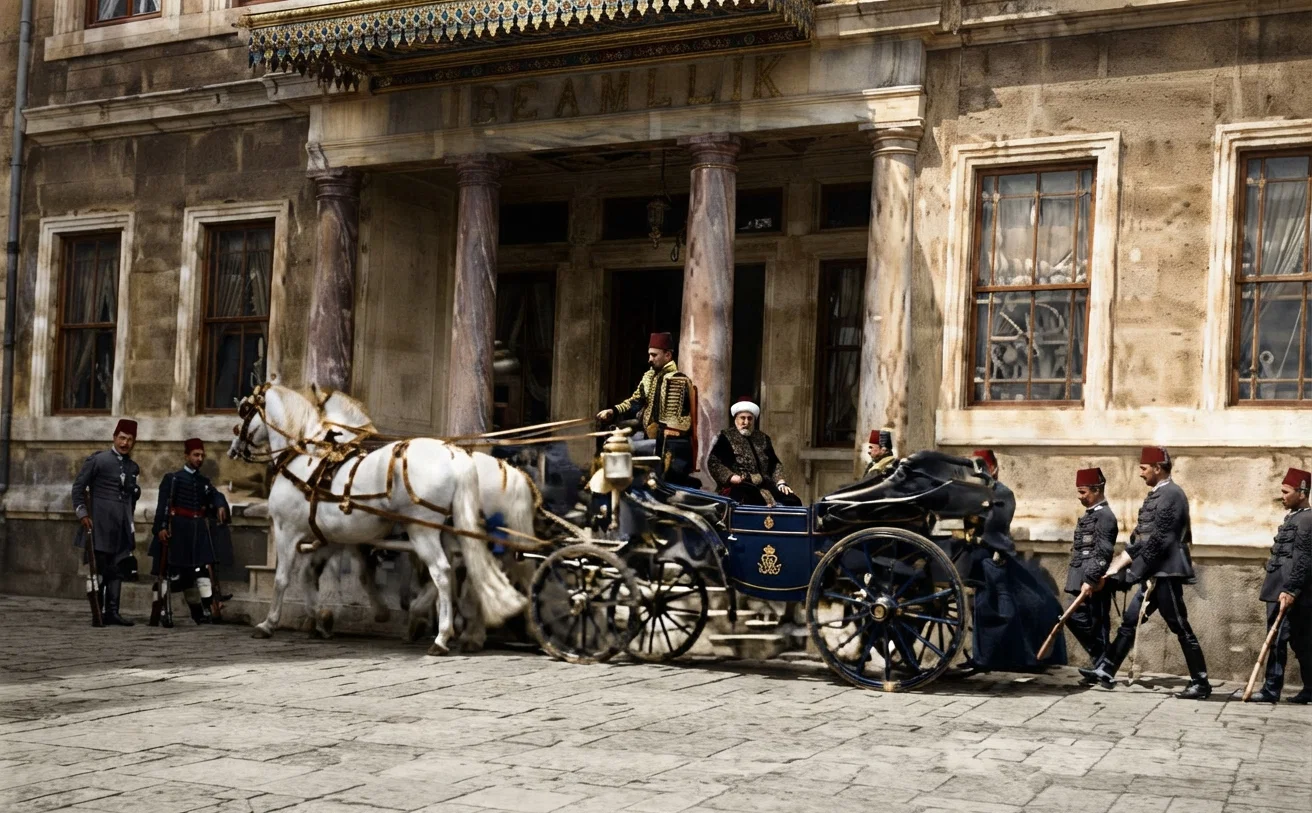
The sultan going to “selam-lik,” the religious service, Friday noon
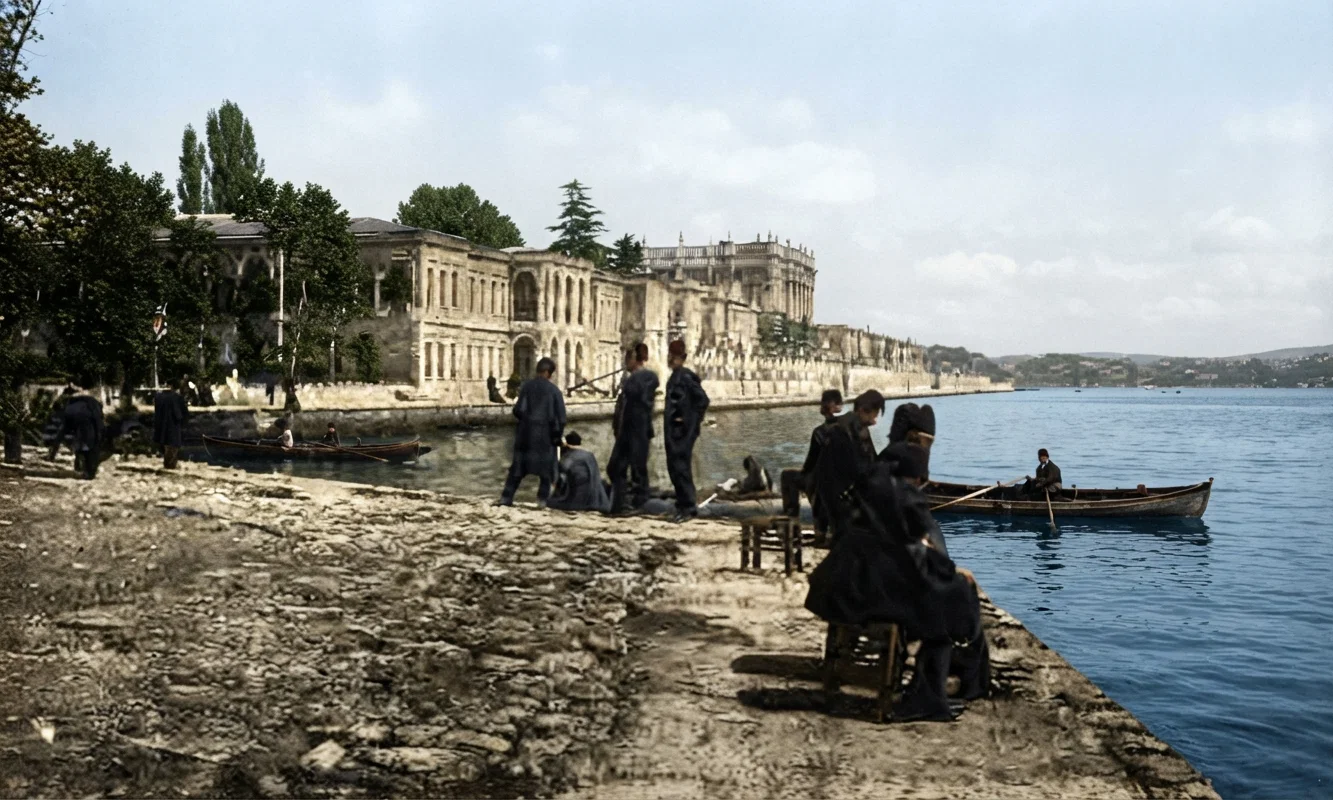
Sultan's palace, seen from Bosporus
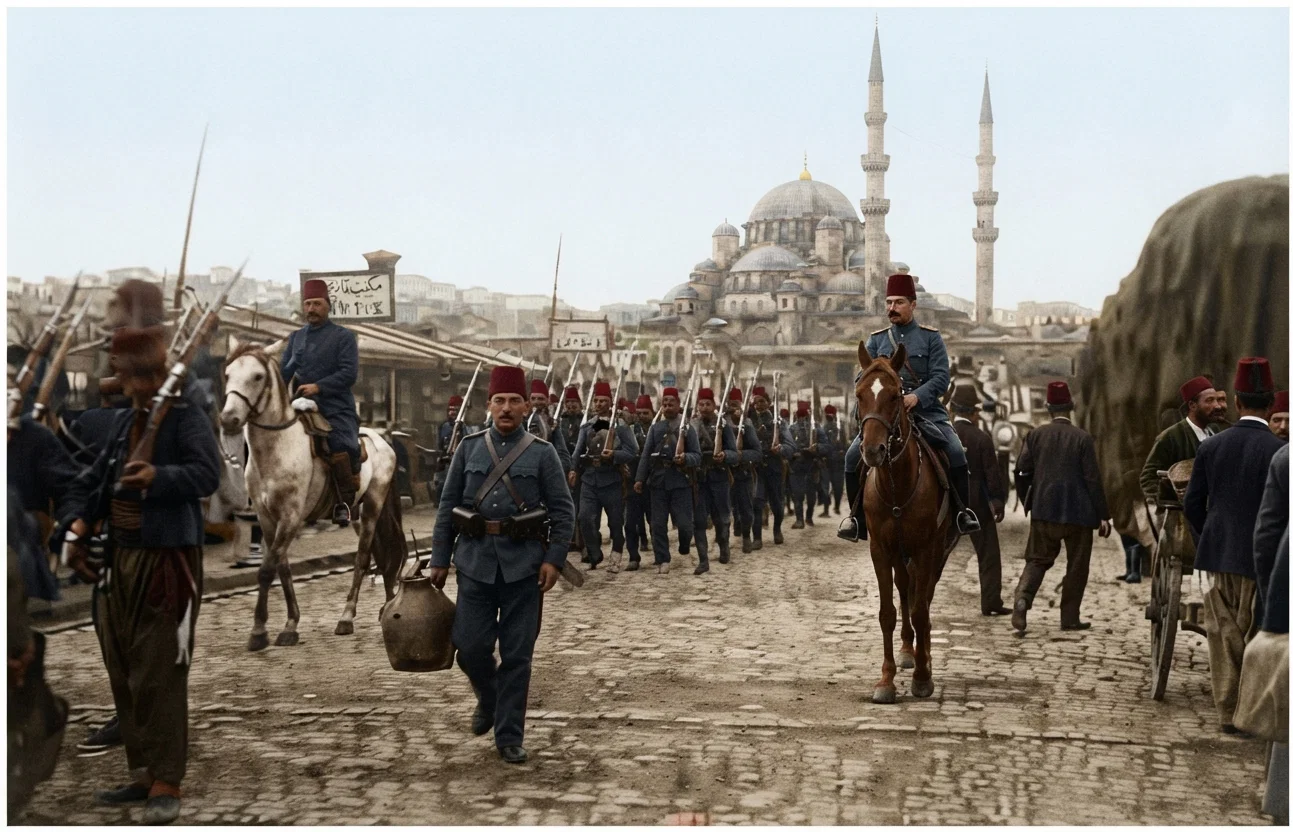
Infantry passing the Nero Bridge

Has Not Been Improved at All

by the new “liberty.” Even the young Turks, altho they may be infidel at heart, outwardly espouse the state religion, because in so doing they win the confidence of the populace, whose faith in Mohammedanism has not thus far been much weakened by these “new times,” and who but a short time back decided to celebrate the birthday of the prophet as a public holiday.
Another fact should not be overlooked. The sultan of Turkey, as calif, stands at the head of the 225,000,000 Moslems in Europe, Asia, and Africa. This gives Turkey an authoritative position among all the Mohammedan nations, so that if Turkey be anywhere assailed, all parts of the Mohammedan world feel the impact, and are ready to react against it. Thus we can readily understand why their leaders, especially in Turkey, are so determined to keep Christianity out, as this is one guarantee to the supremacy that Turkey itself desires ever to hold among all the Moslem peoples.
All have heard of the efforts of the Christians in other countries to win the Armenians to Western Christianity. Much has been done for this people during the last century, especially as to education. They have suffered a great deal at the hands of their Mohammedan neighbors, altho not all of this should be attributed to religious grounds.
However, conditions are now better, and perhaps the Armenians may be the means of Christianity's obtaining a strong hold in the near East. And yet there is one element in the situation that leads to serious thinking—the inroads Socialism is acquiring among these people. The Armenians have their own government for such matters as belong only to themselves, and they form their own separate nation; their constitution is hierarchal, and fierce conflicts between the various sections of the people are inimical to their prestige. They lose their faith when they once accept Socialism, and this is especially true of their youth.
A still closer unity between the clergy and the people is found among the Greeks, who represent the orthodox church. They form a large part of the population, but their moral standing is not especially well regarded. At the present time they have to suffer on account of the situation in Crete, because their Moslem neighbors mix up politics with business in their relation to the other inhabitants of the country. In this question the whole nation stands together as one man for Crete's remaining under Turkish rule at all events. But the Christians on Crete, who exceed the Mohammedans numerically in that island, do not wish to belong to a Moslem state, and it is not possible to tell yet how this affair will turn out.

Troubles of the New Turks

Turkey is also busy in crushing the revolt of Northern Albania, where the people, generally Mohammedans, prefer the methods of the old régime. The government, endeavoring to promote peace and establish order, had no alternative but to declare civil war in that region; and it now seems that, aided by the modern means of warfare, its attempts will be successful, and peace be insured. In this way the new régime is showing that it can, of itself, keep the peace, without the assistance of others. The government is also doing likewise in Arabia, altho this is a harder problem there among the nomad tribes who have never regarded themselves as belonging to Turkey in the true sense of the word. In spite of the fact that many of the high officials are Arabs by birth, there exists a seeming animosity between the Arabs and Turks.
Turkey should perhaps no longer be regarded as the sick man, in the sense of that term as used in the past. It pays one third of its income for the army and navy; and their soldiers, being instructed by able foreign officers, now make a good impression. They are well dressed, and receive their wages regularly. When one meets them returning from their drill grounds, it can only be noticed from the “fez” they wear that they are not Western soldiers. But Turkey has not the means of entire self-support as yet, still needing the assistance of European powers, and it will be a long time before Turkey can fully sustain her government without any outside help. Nevertheless, the time when Abd-ul Hamid was himself a synonym for the term “Turkey—the sick man,” is passed. It is only to be regretted that in endeavoring to develop the army and navy to the greatest possible extent, the general growth of the country is neglected; so that in this respect the past year has shown but little advancement, as leading Turkish newspapers say.
Western ideas are gaining ground in Turkey. The tailors entered upon a strike, and their masters answered by a lock-out. Others struck; the street-car employees struck, and it was necessary for an armed force to protect the cars.
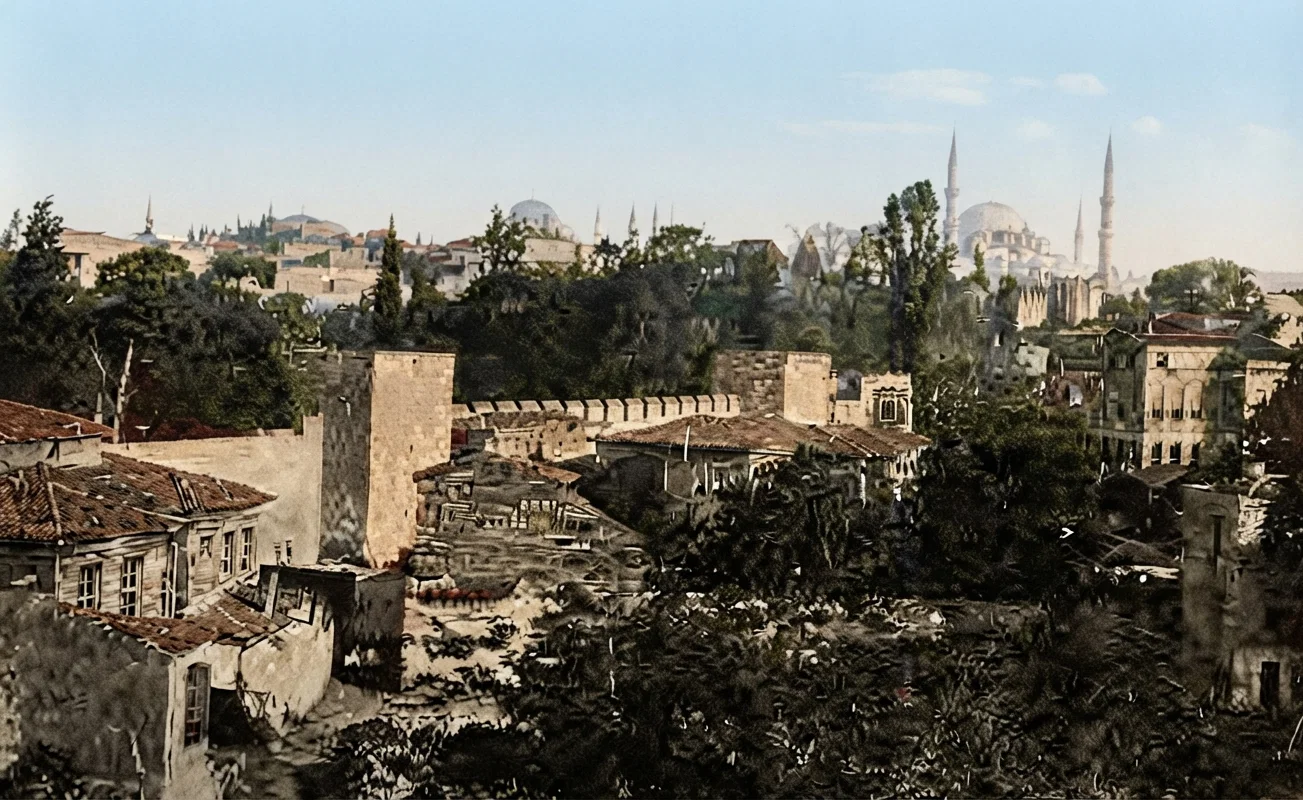
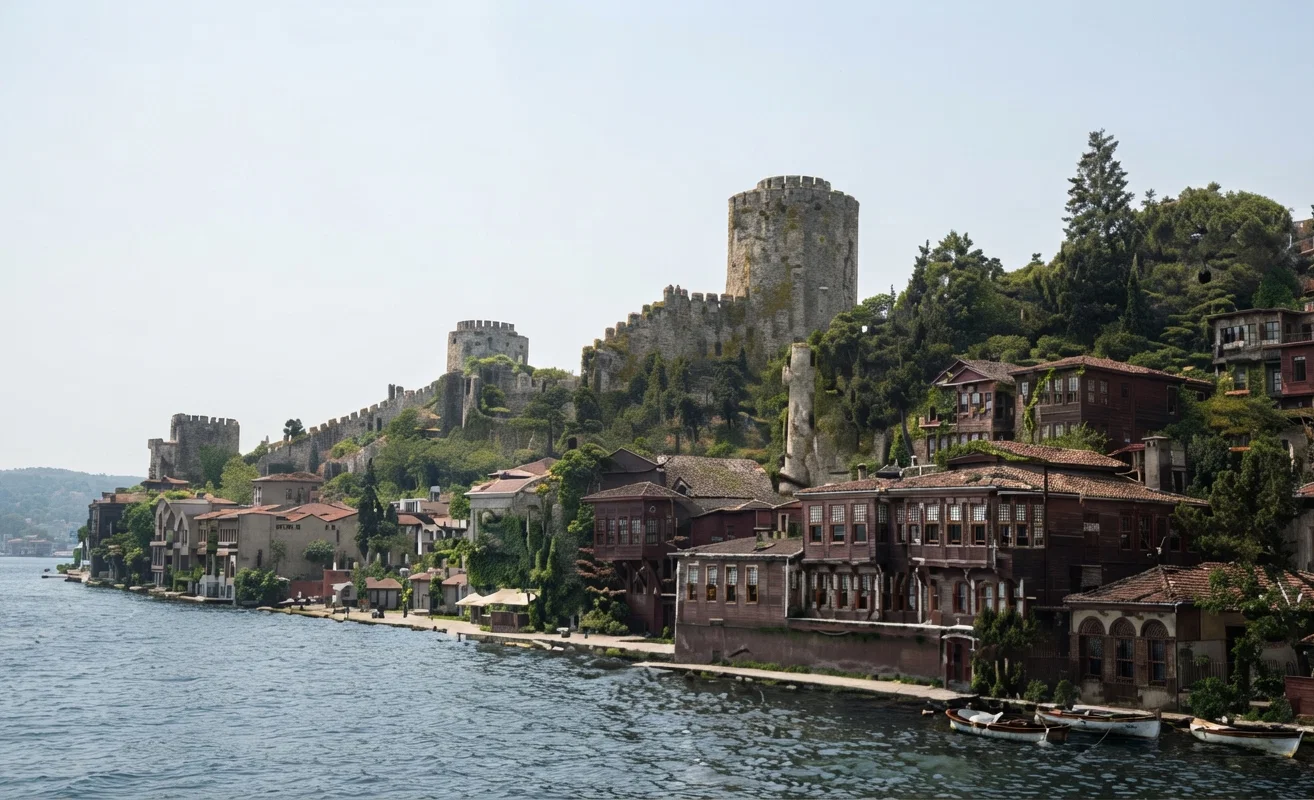
Constantinople. The wall is of the times of the Roman emperors.
“Rumeli Hissar,” the European side of the Bosporus
The pupils of the government high schools for boys struck, because the government did not deal with their instructors according to their wishes. This event caused much sensation. At last, the students of the state medical university went on a strike, which ended in harmony with their wishes.
Martial law still hangs over the capital, and no one is allowed to carry arms. It should be stated again that the government is doing its best to keep the peace among these restless millions, and to maintain order among these very different and conflicting elements. But what will be the state of things to-morrow—that no one can tell.
Constantinople.

Catholic Union Is Union in Catholicism.—

One letter that is said to have aroused much enthusiasm at the late World's Missionary Conference was from the Roman Catholic bishop Bono Melli, of Cremona, Italy. After referring to certain reasons for united efforts in evangelization, he spoke of them as affording “a sound basis for future discussion, tending to promote the union of all believers in Christ.” He showed, however, his only plan of union in his closing words: “May truth be as a shining light, illuminating your consciences and making you all of one heart and one mind. My desire for you is but the echo of Christ’s words which have resounded through the centuries, ‘Let there be one flock and one shepherd.’” But Mgr. Bono Melli’s one flock is the Roman Catholic Church, and the one shepherd is the pope of Rome.

Hypnotism and the Devil

Prof. Edgar Lucien Larkin, in the "Examiner" of August 11, declares of hypnotism: "Mind in one brain can completely displace mind from another brain, take absolute possession, and force another person's body to do what the hypnotizer wills. Control is absolute. Hypnotic science is now being studied in every mentological school in the world." The greatest hypnotizer of all is the devil, and that accounts in part for the many strange cases of insanity and unnatural, abnormal, and horrible crimes. But neither the devil nor his agents can control you if you do not yield passively to his influences. To control man thus, is not of God.

Timber Rats

MR. BURDICK, who lives at this place, has had quite an experience with timber rats, a reddish gray rat, which took up their abode in his old storehouse.
They built their nest on the floor up-stairs. It was three or four feet high, and made out of cornstalks, cobs, husks, bottles, broken dishes, berry crates, berry boxes, pieces of boards, bolts, tops, pieces of iron, cotton, carpet-rags, old clothing, burdock leaves, papers, magazines, planes, whipple-trees, old shoes, and other old rubbish, about a wagon-load in all.
All the cow-peas two girls picked in one afternoon were carried in one night up-stairs and piled in a heap by the rats. They shelled enough peas to fill a number of berry boxes and covered them with cotton. They gathered nearly all the peaches from two cling peach-trees, and piled them on a shelf in the upper part of the smoke-house to dry.
They shelled corn, and piled a peck of it on the mantel-shelf, and covered it with cotton and pea shucks. They covered a barrel of peas with cotton to hide them.
These rats catch chickens, destroy grain, cut and clothing to pieces, and are a general nuisance. They build their nests in old houses, and in caves, and under brush piles in the woods. They are increasing so fast that every one is waging war on them; but it is a continual warfare, for as soon as one family is exterminated another comes and takes possession.
As a general rule you can not catch them in a trap. They cover it three or four inches deep with rubbish. Surely the last-day pests are here.
Hardy, Arkansas. LESLIE LITTELL.

Continuity of the English Church

An Englishman has recently published a book embodying a review of attitudes of various historians toward the English Reformation. The author himself has the opinion, as many Anglicans now have, that the English of to-day is the same church that once was in fellowship with Rome, and is not the product of the Reformation. It seems as if many English ecclesiastics dislike the word “Protestant” in the title “Protestant Episcopal.” The historians Knight, Yonge, Freeman, and Stubbs accept the “continuity” of the English church.

Granular Structure of Electricity

According to newspaper reports, Dr. Millikan, a noted physicist of Chicago University, has found physical verification for the theory that electricity has “definite, granular structure.” He claims to have captured ions, and to have examined them in his laboratory. Such a discovery as this would give us a more definite conception of electricity, but it must be remembered that it throws no light on the ultimate nature of electricity.

Bribery Alleged in Indian Land Sale

D. C. McCurtain, who was Choctaw delegate to Washington, charges a representative of the prospective sellers of many million dollars' worth of the Indian lands with offering a large bribe to him for merely his consenting to 10 per cent attorney's fees.

Showers of Grace

To meet the awful influences of sin, the power of wickedness, the deceptions of the devil, the carnival of lust and crime, God is pouring out from the eternal fountains showers of grace. The refreshing is for you; but you must choose it, and by faith receive it. “I will pour water upon him that is thirsty, and floods upon the dry ground.” Do not die of hunger when faith will unlock God’s never-failing storehouse. Do not die of thirst when “the river of life is full of water.”

Immigration to the United States

There were 1,041,570 immigrants to the United States during the past fiscal year. This is a decrease of 289,584 over the previous year. Italians and Poles headed the list of the immigrants last year with 223,457 and 128,348 persons respectively.

Government Answers to Public Questions

Millions of questions are continually answered by the various bureaus of the Federal Government. The services are free, while Russia has recently for the first time offered to answer her citizens’ questions for a fee. This fee ranges from $1.55 to $2.55, and even higher.

Oxford Expedition to Nubia

An exploring expedition under the auspices of Oxford University will be sent into Nubia next winter. It will be the first of a number of annual expeditions to this region.

The World’s Largest Office Building

The largest office building in the world is the Whitehall Building, New York. The office space is 550,000 square feet, which would equal 5,500 rooms 10 feet square.

New Cable Between England and Germany

A new cable has been laid from England to Germany, by which, it is hoped, telephonic communication may be made between London and Berlin.

Sequoia Tract Given to California University

The largest tract of Sequoia in the state has been given to the University of California. The land covers 320 acres, and is valued at $1,000,000.

Popular Novels and High Prices

Amid all this discussion of high prices, it may be remembered that there is one item that has not as yet soared — popular novels.

Child: the Man of Sorrows

By Mrs. L. D. Avery-Shuttle

Chapter XXVI.—Simon the Leper

LEPROSY—the very word turns the heart sick. It sounds the death knell of joy and hope forever, to him above whose luckless and despairing head it is pronounced. Leprosy; named the “scourge of God.”
The horrible disease is no respecter of persons. It knows no class distinction. It gives no consolations, and none are allowed it. It offers no comfort; it makes no promises; it gives no reprieve. Its awful breath breeds pestilence and decay. Its repulsive lip never seeks nor receives the kiss of love. Its bloated and ghastly form invites not the caress of affection. Its deformed and loathsome fingers are never grasped by the hand of hope.
Furthermore, it receives no bribe; nor may its gruesome approach be stayed by the gold of a Croesus or the gems of Golconda. When once its horrible finger is pointed at its victim, and its gurgling voice says “Come!” it admits of no parley.
It is a living death, and its victim an unburied corpse.
And this gruesome thing has dared approach the pretentious and luxurious home of Simon of Bethany. His life has been one of idleness and dissipation, with no thought or care but for the present, and with no ambition higher than that which promises present enjoyment. Liberal of purse, reckless in manner, fascinating in appearance, unscrupulous and thoroly selfish, Simon of Bethany had never allowed himself to be thwarted in any desire, or to be checked by any spasm of virtue. With him, to will, to desire, was to do, to possess.
He had received the first news of the continued insanity of Magdalene, whom he had so lightly ruined and cast aside like a broken toy, with a careless smile and a curl of the sensual lip. But already the mortal body of Simon of Bethany contained the germs of that awful thing which heeds not prayers or tears, and refuses to relax its horrid grip until it yields its prey to the rapacious maw of its twin brother, Death.
One morning, the young wife Prisca, bride of a few days only, noticed a slight but very peculiar roughness of the skin upon the broad, white brow of her young spouse.
Carelessly, lightly, with no thought of trouble, she called him to her side, and placed her small hand caressingly upon his cheek.
“What aileth thee, Simon? What hast thou upon thy brow? Of a truth I noticed this thing yesterday and the day before.”
“Surely there is naught upon my brow, my Prisca, save thy white hand,” replied the man, with a careless laugh—tho he raised his own hand to his forehead quickly, and the uneasy, shifting light in his eyes told plainer than words could do, that the faint shadow of a terrible fear was entering his heart.
But he must not allow the woman to notice the uneasiness which her words had caused him, and accordingly, with some light remark, he left her presence.
Truth to tell, he had himself noticed a small, white swelling a number of days before; but he had put the horrible thought, that would intrude itself, out of his mind. But now that Prisca had spoken, he determined to examine the lichen himself more carefully. To his horror he found that the scaly white eruption was perceptibly larger than when he had at first noticed it.
But impossible! He would think no more about it. He would treat it as a wild delusion unworthy a second thought. What! he, the care-free, the self-satisfied, the careless man of the world!
To any other man, such horrible visitation might come,—but not to him. He would not, could not abide the thought. The thing was a mere blotch—a scab—that would disappear entirely in a day or so. He would not think of it ever any more. Certainly he would never mention it to Prisca, unless she, indeed, should speak of it again,—which Heaven grant she might never do.
Thus did the uneasy and wretched man seek to hide from his trembling heart its own wild beatings.
One morning shortly thereafter, Simon walked the streets of Bethany. But he sought to avoid his fellow men. He was unnerved and preoccupied. Perhaps it would be better to rub a mollifying ointment upon the eruption, and cover the place with a cloth,—no, no! Why should he call attention to the thing that was robbing his soul of rest!
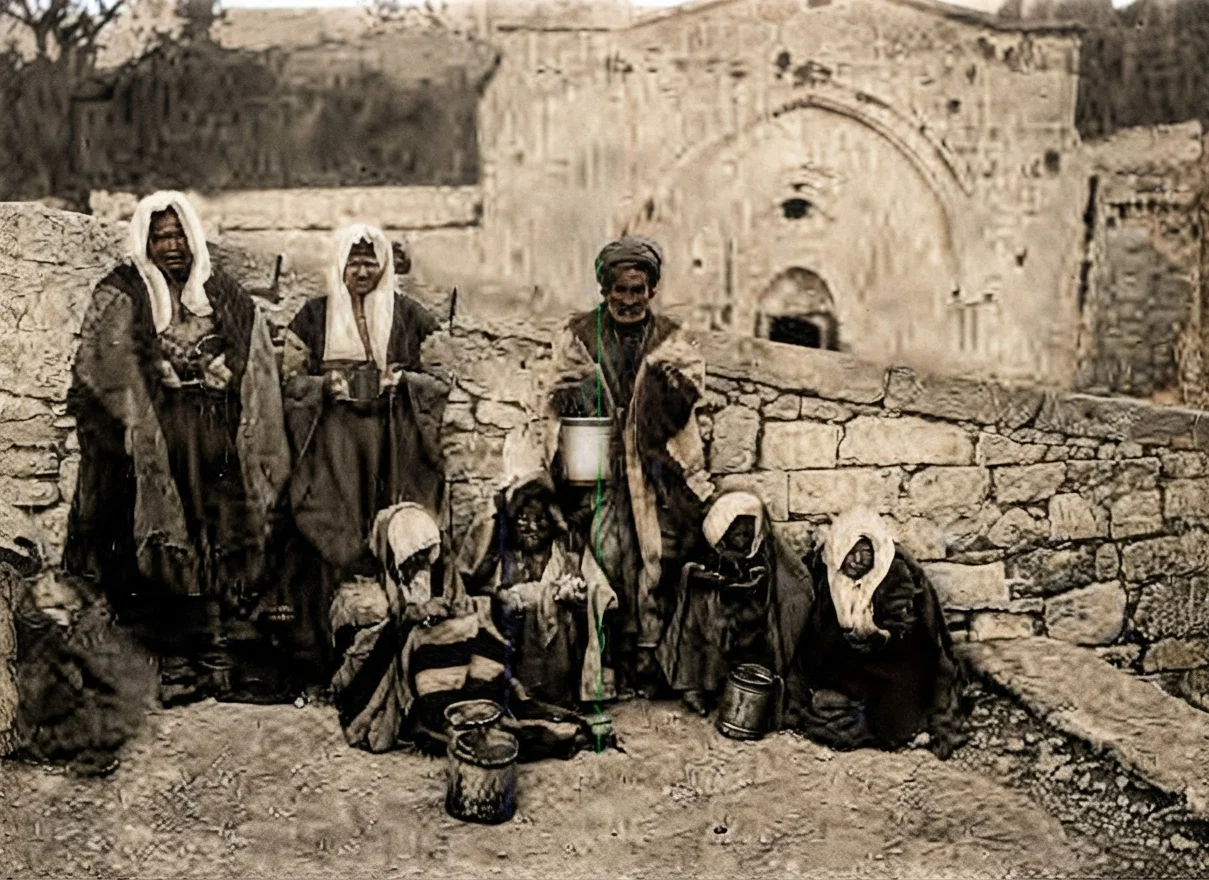
A Group of Lepers in Jerusalem
Once again Prisca had spoken; but he assured her that it was nothing but a slight eruption which would be healed in a few days, and he struggled pitifully to believe his own brave words,—the portions of his eyebrows were already turning white.
The errand which called him upon the street today, was a necessary one, else he would not have ventured to brave the keen eyes of the people.
“Ho, Simon, whither goest thou?”
It was the voice of his friend Machbor the ruler, from Jericho.
“How farest thou, Simon?”
“How art thou, Machbor?” Simon repeated bravely.
At first, Machbor gave him a careless glance; but his keen eyes at once detected the strange white spot upon his forehead—as if the ghastly finger of death had been laid upon it.
One more quick, searching glance from Machbor, which caused the hot blood to mount in a crimson wave to the temples, was enough. Simon turned his face away. He could not endure the look of mingled pity and horror which he read in the face of his friend, as Machbor stammered:
“As the Lord liveth, Simon, thou hast a—a mark upon thy brow—and the mark is white! Surely thou shouldst go at once up to Jerusalem and see the learned physicians; for why shouldst thou visit the priest until thou knowest somewhat for thyself? It may be it is nothing—”
A hunted, desperate look darkened the eyes of Simon as he impatiently interrupted him:
“Why speakest thou thus, O Machbor? for verily, man, thou believest that I am doomed!” and Simon grasped him by the shoulder almost fiercely. “But stay; thou mayest be right. I shall go up to Jerusalem at once, and, my friend,” he continued more calmly, “Go to my house, and speak thou to my wife Prisca, and say unto her that I am called to Jerusalem on a matter of business. Verily, Machbor, thou knowest somewhat of my past life, that it hath been unbecoming a true son of Israel, and I know that this which I now suffer is but the just punishment for my sins. But my heart is tender toward Prisca, my wife. It is best that she know not of this thing that hath befallen me,—tho indeed I saw her weeping but yesterday, and she hath already twice spoken of this thing,” continued Simon, speaking desperately and rapidly, and occasionally raising his hand nervously to his brow.
“I will go now, Machbor. Tell thou Prisca I shall be home to-morrow if naught detain me.”
Machbor bowed sadly; and Simon passed on.
One short month has passed away. In a place appointed for the purpose, in the city of Jerusalem, two men are closeted together. It is a large room devoid of ornamentation, or aught save the most necessary and meager furniture. We know by the dress of one of them, that he is a priest. The face of the other man is so distorted and drawn with anguish, and his fine, broad shoulders are so stooped and bent, that we would scarcely recognize him as the careless, light-hearted Simon of Bethany.
“Do I understand thee, Issachar?” he questions, addressing the priest. “Do I understand thee? Is there now no hope?”
“There is none, O Simon,” replies the priest indifferently; for Issachar has already in his lifetime pronounced the death sentence upon so many wretched creatures, that he has become quite inured to human suffering.
“There is none!” he repeats slowly, again casting his practised eye critically over the disfigured face. “Thou hast already appeared before me twice, and the physicians of the city agree with me that there is no hope. Thou art unclean; and unless the Almighty save thee even as He saved Naaman the Syrian, thou shalt die in thine uncleanness, for the scourge of God hath indeed overtaken and smitten thee. And now, if thou art minded to write unto thy wife, behold, I will copy thy writing and send it unto her at Bethany. For verily thou shalt return thither no more.”
It is an old man, bowed and bent, that sits to write a long, last farewell to his beloved wife and home; for the words of the priest have entered his despairing soul, and have written lines of anguish upon his brow, such as the hand of time alone can never trace, and bowed his broad shoulders with a burden more cruel than that of the passing years. The fingers of a fierce despair clutch at his heart as he writes:
“Prisca, My Beloved Wife:
“Thou knowest by now that the physicians have declared my case hopeless; and now, Issachar, the priest, has but this day added to my utter despair, by confirming the words of the physicians.
“Prisca, until I knew that I should never see thee more, I understood not how I loved thee. Better death than this awful thing which the Almighty hath sent upon me as punishment for my sins,—for even thus saith the priest. There is one, my Prisca, whom thou knowest not,—Magdalene, of Bethany. In the days of my folly, I did her a great wrong. But now am I punished by the stroke of Jehovah.
“I have entreated; I have prayed; I have raved like a man bereft of reason; I have offered my entire fortune to the physicians,—it is vain. Thy tender heart will break,—is breaking now, and thou wilt go to thy grave mourning. But even so they will not that I should look upon thy sweet face.
“But, my Prisca, be comforted. It will not be for long. I have been from thee but a few weeks, and even now thou wouldst scarcely know me.
“I shall dwell among the doomed wretches outside this city; it will be some small comfort to me to know that I am near thee.
“I shall always wear the crimson abba thou gavest me, my wife; and sometimes, when thou comest up to Jerusalem, thou wilt, it may be, take thy way toward the doleful habitation of the lepers, and if thou wilt stand afar off among the hills, and hold in thine hand thy crimson mantle, my gift to thee, then shall I see thee and know thee, for of a truth I shall always wait for thee,—and thou shalt know me also, by mine abba; tho I would not that thou shouldst see my face. Better far that thou rememberest me as upon the happy day when thou gavest it me. But approach not too near, my beloved, for the mournful cry ‘Unclean, unclean,’ will cause thee bitter grief.
“Speak not of me to mine acquaintance. Their words of pity would but cut thee to the heart. But allow Machbor, the ruler from Jericho, to befriend thee, as also Elkanah, thy father. I have none other to whom I may commend thee but unto the God of Israel,—and Him, alas, I know not.
“Thou knowest that I may now no longer be called a Pharisee; but if the doctrine of the Pharisee be true, and if there be forgiveness with Jehovah, we may meet at the resurrection of the dead. If not, I bid thee now an eternal farewell.
“Thou knowest that many men say that the Messiah hath appeared. Even so thinketh my friend Machbor. Even so declared the Baptizer, whom Antipas hath committed to prison. I know not. But I do believe that a great prophet hath arisen, and that if indeed He be the Messiah, He will go up to Jerusalem and reign gloriously; and the bands of the Roman shall be broken. But alas! who shall break the bands of thy wretched spouse,
“SIMON THE LEPER!”
(To be continued)
Continue reading: The Passing of Protestantism