He long has studied all the secret ways
Of nature, and her laboratories yield
To him their subtle powers as God allows.
He is permitted, and the deep dark sea
Lashed to an awful fury is the pipe
That tidal wave and fierce tornado play
To welcome thus their king. The shrieks of men
That in their gallant vessels go ashore
Or founder out at sea make concord sweet
To Satan and his band—“harmonious wo!”
Atlanta hears and Boston and St. John,
And merchants mourn their cargoes or their hulks,
And wives and mothers shudder on their beds
As round their homes the furious tempest roars
What then at sea? and in the awful gulf
O’er which they work? For do thou know, blind bard,
’Tis almost as it were the one mistake
Of thy grand beauteous song that Satan’s throne
And kingdom ’mid the burning penal flames
And torments of a far-off hell are laid?
But as a poet’s thought we will forgive
A fancy suited not to this dull tale.
His chariot is the plague, and oft he rides
Roughshod o’er millions in triumphant march;
His throne, the smoke of war, and for his laws
The doctrines and debasing habits vile
That he has saddled on a captive race.
GEO. E. PRICE.
THE RESPONSIBILITY OF PARENTS.
By Ellen G. White
The training of children is one of the most solemn responsibilities ever committed to mortals. Children are the Lord’s heritage, and he would have them educated to be coworkers with him. He has a special interest in this work; for in children he sees talent and influence, which, when controlled by his Holy Spirit, will become a power for good, and bring glory to his name. Christ died to save children, and he is ready to do a great work for them if parents will coöperate with him by training and educating them according to the instructions he has given. This should be the first work of all parents.
God holds us responsible for every ray of light that he has permitted to shine upon us. We are to reflect this light to others in clear and certain rays. “As many as received him, to them gave he power to become the sons of God.” These are made the depositaries of truth. This truth they hold in trust, and it is their duty to make it known to all, especially to the children. But too often our neglect to fulfil our responsibilities as God requires us to, leaves us in an uncertain position. Few can bear the light of God’s word without a feeling of self-reproach because of a defective performance of duty.
As the child is in habits and manners, so the man will be. What earnest work, then, should be bestowed upon the character building of children! When very young, children are susceptible to divine influences. The Lord takes these children under his special care; and when they are brought up in the nurture and admonition of the Lord, they are a help and not a hindrance to their parents. But too often the indifference of parents leads them to neglect their children; they have little idea of how to train them for the Master.
Those who deal with children need a large supply of the grace of Christ. God would have them dealt with wisely, tenderly, and yet firmly, that their feet may not stray over the boundary, to the side of the enemy. Those parents who realize their God-given responsibility in this matter, will have faith in God, and will work with travail of soul for their children, that their minds, their hands, and their hearts may be consecrated to the service of God.
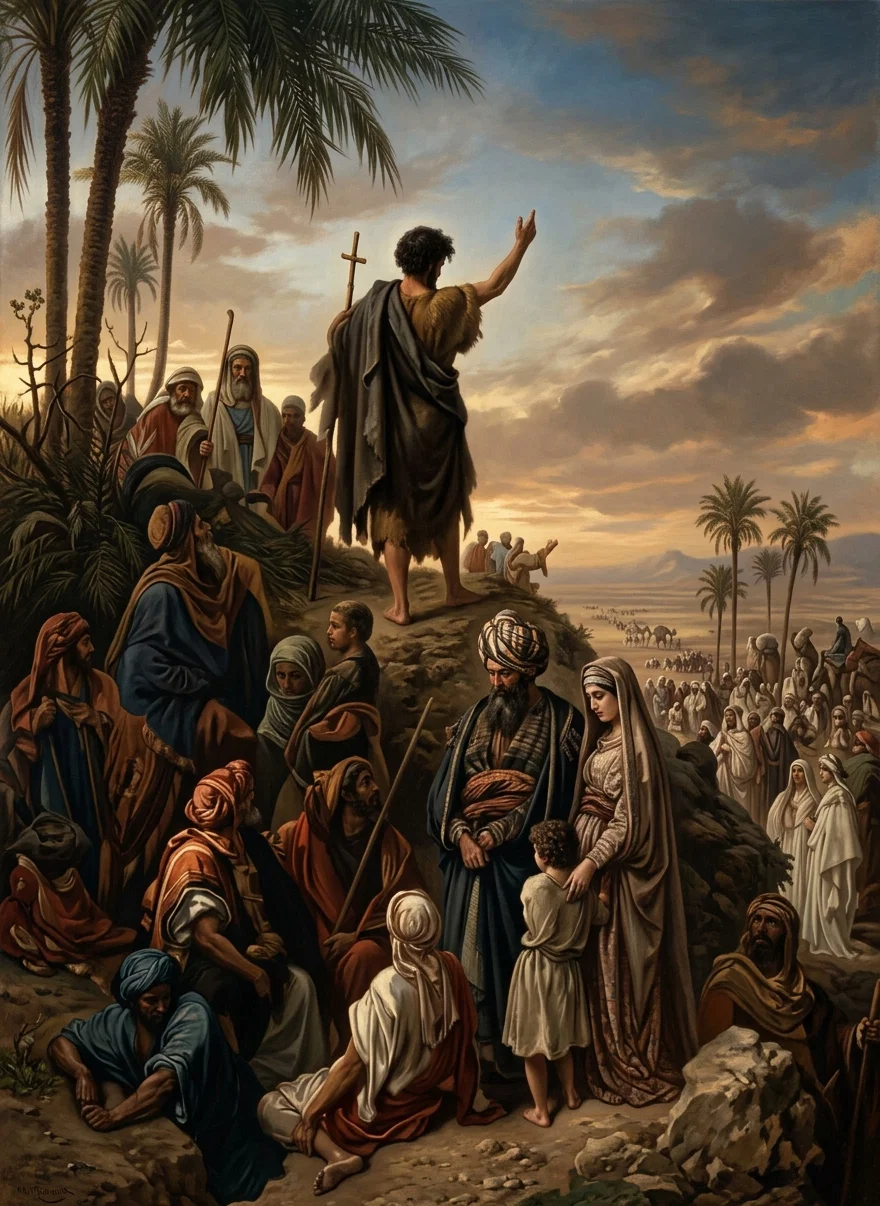
The character and experience of John the Baptist, the forerunner of Christ, should be an encouragement to parents in the training of their children. John did not make his home in the cities and villages. From childhood to youth, and from youth to manhood, he lived in the wilderness. But he did not live thus for any selfish purpose. In his time the Jewish religious teachers had well-nigh lost all spiritual life. Nothing in their teaching stood out clear and convincing. They had so inclosed themselves within themselves, and were regarded as possessing such sanctity, that none of the people disputed what they said or taught.
But the life of John was a special life; and it was the will of God that he should separate from the busy haunts of men, and learn his life lessons from nature and from nature’s God, receiving his impressions from him alone. His work was to prepare the way for the Messiah. He looked upon his mind as belonging to God, and he brought his thoughts into obedience to Christ. He trained his mind to contemplate the great and important truths of the Word of God, and insensibly it broadened and acquired an expansion that enabled him to comprehend spiritual things.
John the Baptist, the Child and Prophet of the Wilderness.
So it will be now. The mind that is given to God, to be molded and fashioned after the divine similitude, will grow in power. As we work in God’s lines, recognizing our accountability to do the work he has given us to do, we continually receive a supply of grace to impart to others.
It is important that the standard God has set for us be not lowered. We feel alarmed at the discrepancy seen between our obligations to God and the manner in which we meet them. But we can not cure this evil by lowering the standard, in order that our deficiencies may pass. With the example of John and of Christ before us, can we do less than elevate the standard of purity and holiness?
God has honored the young. He chose Joseph in his youth to do a special work for his people. He called Samuel, and committed to him a solemn message. By a solemn vow, before his birth, Hannah had given Samuel to the Lord. After his birth, true to her vow, she took him to the tabernacle. “But Samuel ministered before the Lord, being a child, girded with a linen ephod. Moreover his mother made him a little coat, and brought it to him from year to year, when she came up with her husband to offer the yearly sacrifice.” How many prayers the mother stitched into this token of love for her child! Of Samuel it was said, as of John the Baptist and of Christ, “And the child Samuel grew on, and was in favor both with the Lord, and also with men.” From this we see that the Lord watches over children, noting with intense interest the characters which they form.
When parents have the Word of God before them, defining what he approves and what he disapproves, they have no excuse for following a wrong course. But, notwithstanding this, there is a neglect to teach children in the way of the Lord,—a fearful, terrible neglect; and many children are lost to Jesus for want of careful training. Parents have neglected their God-given responsibilities and Satan has taken possession of their children. Under his direction, by their evil communication they corrupt other children. Thus Satan has the children, even of professed Christians, under his control. But still the parents pass on indifferently, as if they were not neglecting one of the most solemn responsibilities ever given to man.
Parents, if you wish the minds of your children to be evil, let them have their own way. There will then be such a development of wrong that the heavenly angels will look down with grief and sadness upon parents and children.
God has given parents a warning in the history of Eli’s family. Eli neglected the duty resting upon him as a parent. He indulged his sons, failing to restrain their wrong habits and practices. “The sons of Eli were sons of Belial; they knew not the Lord.” Yet in spite of this, tho utterly unfitted for the work of God, they served in holy office; and God was dishonored.
Eli remonstrated with his sons, saying: “Nay, my sons; for it is no good report that I hear; ye make the Lord’s people to transgress.” But6he took no decided measures to restrain them, and “they hearkened not unto the voice of their father.” The Lord held Eli responsible for the terrible example set by his sons. He was judge in Israel, but he neglected the duties resting upon him.
God sent a messenger to Eli, to unfold to him what he had done for him by exalting him to the most honorable position in the kingdom, making him priest and judge, and connecting him with himself as the one who was to carry out his mind; the messenger was to tell him also of the punishment to come upon himself and house because of his sin. “Behold, the days come,” he said, “that I will cut off thine arm, and the arm of thy father’s house, that there shall not be an old man in thine house. . . . And this shall be a sign unto thee, that shall come upon thy two sons, on Hophni and Phineas; in one day they shall die both of them.”
The Lord came no more to Eli. By failing to judge his own sons, by neglecting to separate them from the Lord’s service, he dishonored God. The Lord spoke no more to him. Calling the youthful Samuel, he revealed to him what was to come upon Eli.
How much might have been averted had Eli followed the counsel of the Lord, and carefully trained his sons in their childhood and youth! Let parents take this lesson to heart, and instead of allowing their children to indulge and gratify self, educate them to control themselves, and to keep God’s glory in view.
Parents should teach their children to work for Christ; they should school them for actual service. O, that I could make my voice heard and my influence felt nigh and afar off, that parents might realize their responsibility in this matter! Your children are the Lord’s heritage; and he will one day ask of every parent, “Where is the flock that was given thee, thy beautiful flock?”
Parents, take your children with you into your religious exercises. Throw around them the arms of your faith, and consecrate them to Christ. Do not allow anything to cause you to throw off your responsibility to train them aright; do not let any worldly interest induce you to leave them behind. Never let your Christian life isolate them from you. Bring them with you to the Lord; educate their minds to become familiar with divine truth. Let them associate with those that love God. Bring them to the people of God as children whom you are seeking to help to build characters fit for eternity.
Of Abraham the Lord declared, “I know him, that he will command his children and his household after him, and they shall keep the way of the Lord, to do justice and judgment.” Abraham made straight paths for his feet, lest the lame should be turned out of the way. He faithfully discharged his duty, and the Lord blessed him, and made him a blessing. This is the path in which the Lord would have all parents walk. Parents, study this example which has been left on record for you, and strive earnestly to follow it. When you fulfil your God-given duties, as did Abraham, God will commend you in the heavenly courts, as he did Abraham. Mrs. E. G. WHITE.
JEWISH CUSTOMS AND TRADITIONS.
By E. C. Gilbert
(By an Israelite.)
God’s Way of Revelation to Man.
SINCE the advent of sin into this world, it has ever been God’s purpose to reveal himself to every soul as a being of love and infinite kindness, and to woo the children of men from the snares and pitfalls and evil traps which Satan has set to ensnare them. It has been ever his one desire to abide with them, and make the soul the very citadel of his throne, that it might enjoy the true and the only love which he alone can give. But the devil has led men to believe that when the Lord approached them, to impart of his love and kindness, it was rather to pour his wrath and anger upon them, for their destruction. This is true even of our first parent. When the Lord came to man after his disobedience, to call him to himself and pity him in the course he had taken, Adam replied, “I was afraid, and went and hid myself.” Even then the Lord did not manifest the temper which the devil had no doubt told him he would put forth, but gave man the promise of the indwelling “seed” which should bruise the very serpent that sought to steal away man’s affections from his Maker, and cursed the ground on man’s behalf,—that his desires and inclinations should be on things above, and not on things below.
God’s plan was ever the same through the early centuries; but they were few indeed who would give God the privilege of dwelling with them. Occasionally such an one as Enoch was found, but God removed him from this world.
When rabbinism gained the ascendency over the minds of the people, it portrayed God as a character ever lurking to avenge himself upon the children of men, for their transgressions and wrongs committed. And from earliest infancy the child is taught to look upon God as a being who stands at the parapet of heaven, seeking to punish him if he does not do as he says; which means, of course, the God prescribed by themselves.
But what a contrast is this to God’s character as described by himself to ancient Israel: “The Lord, the Lord God, merciful and gracious, long-suffering, and plenteous in mercy.” When these men are asked why there is such a contrast between the Talmud and the Bible of the character of God, the reply is that it will be clearly understood when the blessed Messiah comes. What we know not now, shall then be made plain.
There are many evidences given in the various liturgies and writings of Judaism which indicate that the fruition of their hope from the thralldom of their condition, temporal as well as spiritual, is in the Messiah. The Talmud teaches that when King Messiah shall come, business will be improved; sickness will no longer exist; the Gentile shall no more have sway over the Jew; Jerusalem shall be restored; and the present captivity shall be turned into great rejoicing. As Christians, we know that the Messiah longs to free them from the bondage of sin now, as he always has done, if they will only give him the opportunity. And the way he frees all men from sin now, is the same way that he freed Israel from sin in days gone by.
All spiritual-minded Jews, from the days of Moses even to the present day, know that in the services of the sanctuary which God had erected in the wilderness, there was some deep spiritual truth, which God used to lead the soul to himself. They had been taught from the “fathers” that sacrifice was the means by which the soul was lifted up to its Maker, and found that sweet peace and joy which the abiding presence of God in the heart only could bestow. And no revelation from God could come to man save as it came through the Messiah. This truth is recognized by some of the most able writers among the Jews, tho they deny it means Jesus of Nazareth. Thus an able commentator on Gen. 1:2 tells us that the Spirit of God which brooded over the face of the waters, was the Spirit of the blessed Messiah. Also the exegesis given of Micah 5:2 is that the Messiah dwelt ever with God since the days of eternity. They teach the same thing of Dan. 7:13, and of many other passages, which Christians know refer to the Messiah.
While the rabbis have sought in the abstract to abolish the real presence of God as he has revealed it in his Word, in the concrete they teach it very plainly. Ever since the temple has been abolished, the Jew has been taught that in a certain way he can come to God by performing various duties which are nearly the same as God taught the “fathers” in the sanctuary service; and that if he carried out these rites to the letter, they would be acceptable to God. But we know that God’s ways are not man’s ways, and the only way which God delights in is for man to carry out His wishes.
We now notice how God did seek to reveal himself to Israel anciently, and that through the Messiah, which revelation gave the individual soul the full consciousness of sins forgiven, and that the Spirit of the Lord abode in the heart. This was all found in the direction and the carrying out of God’s will in the services of the ancient sanctuary. The command of God to Moses in regard to that building is as follows:—
“And let them make me a sanctuary, that I may dwell or rest in them. As all I have revealed to thee, the image or likeness of the tabernacle, and image or likeness of all the vessels; and thus shall ye make it.”
This was evidently God’s plan in having this structure built. Not that he wanted to dwell among them in an indifferent manner, but rather abide and rest in them, and make their hearts his abode. He had told them but a short time previous that he intended to make of them a “holy people” and “select nation,” and this could only be accomplished as the presence of God would abide in each individual soul. This is how the apostle Paul understood the intent of the building of the sanctuary; for he quotes from the tabernacle experience, and applies to the work in the human soul. He says, “As it is written, I will dwell in them, and walk in them, and I will be their God, and they shall be my people.” The word translated among in our version should be rendered in, and is so rendered in thousands of places in the Old Testament.
This was God’s plan of revelation to Israel; and the Jews knew full well that the only good that could come to them was that which was brought through the Messiah. They understood that he was of heavenly origin, and at the same time the Son of man. They knew, in part, that God manifested this truth in this way; but in the future God would reveal it in greater effulgence at the personal appearance of the Anointed One. And the only reason that there exists so much prejudice in the mind of the Jew of to-day, and has for many centuries, is because the rulers and leaders have blinded their hearts and darkened their imaginations by the veil of unbelief in the interpretation of the Scriptures. In place of this great(103)truth which God has taught in his Word, they have devised certain inventions, putting upon them a scriptural interpretation, and claiming that they are taught by the Lord. These are all external rites, by which they are led to believe they can secure their salvation as the people did anciently under the sanctuary services.
But the Lord does not look upon outward appearances, as he seeth not as man does. God looks upon the heart, and true worship to him must come from the affections.
While there was nothing in connection with the work or service of the sanctuary that brought salvation to Israel from an external effort, all through its services, and even in the very material itself, the Messianic promises were held in great prominence, and all who would could by faith grasp the promises of God through the blessed Anointed of the Lord.
And God, in the very means used by the Jews of to-day in their worship, is seeking to teach them the great truths of salvation as revealed in the great Sacrifice slain for the sins of the world. In our next we will take up the work of the sanctuary and the building of it. E. C. GILBERT.
Peter’s Sermon and the Three Thousand
THINK of an uneducated fisherman going into the cultured city of Jerusalem, filled with people who were the equal of the bon-ton of Boston, and see what he did. By one sermon 3,000 Jews converted! And now they say it takes 3,000 sermons to convert one Jew.—Moody
OUT OF THEIR SPHERE.
By W. E. Cornell
Lying before me on the table is a copy of the December issue of the Christian Endeavourer, which one would readily recognize by the name as published in the interests of that large and rapidly growing organization, the Christian Endeavorers. Aside from the two editors in chief, there are fifty-two “associate editors,” which compose the editorial staff, among them being such noted people as Francis Murphy, Chas. H. Parkhurst, Fanny Crosby, etc.; and, judging from the crispness of its reading pages, one could not but conclude that it was a worthy exponent of the intelligence, enthusiasm, and aggressiveness generally characteristic of the vast army of young men and women that it represents.
I have no disposition to call in question the motives which actuate these young people in their efforts to do good; indeed, if there are pure motives, high ideals, and unselfish labors of love to be found anywhere in this world, they must be found among those who form this organization. The pledge they take indicates complete consecration, and is as follows:—
Trusting in the Lord Jesus Christ for strength, I promise I will strive to do whatever he would like to have me do.
Now, turning to page 7, in the article “The Appointment and Work of a Christian Citizenship Committee,” this statement is made:—
It [the society] does distinctly mean that every Christian shall demand with all his righteous might that Christ shall rule the caucus and the common council as he does the church.
Is this in accordance with the pledge? Is it just what the Lord Jesus Christ would have “every Christian” do? Is this an element of the religion of Jesus Christ? In short, is it what he taught his disciples to do? Let us look at it a moment. When he was brought before Pilate, and questioned, he said:—
“My kingdom is not of this world; if my kingdom were of this world, then would my servants fight.”
The “caucus and the common council” are distinctively of this world; they constitute the realm in which Cæsar exercises jurisdiction; they were ordained of God for a specific purpose,—for the protection of the rights of the people,—cognizance is taken only of overt acts, and the power behind the throne is physical force. The kingdom of Christ is entirely different; it is spiritual; the motives and intents of the heart are that on which the final reckoning is made; and whether the subjects are loyal or disloyal depends wholly on their own volition. There is no force but that of love recognized. Jesus himself said, “If any man hear my words and believe not, I judge him not.” These two realms are distinct and separate. Christ on one occasion, when his critics were seeking to entangle him, made this point clear when he said, “Render therefore unto Cæsar the things which are Cæsar’s, and unto God the things that are God’s.”
It seems to me that it is as clear as that two and two make four, that if the “caucus and the common council” were ruled in the same manner that Christ does the church, anarchy and confusion would be the result. Notice! Does8the civil law forgive a transgressor and suspend infliction of the penalty simply because he asks to be forgiven?—Never; yet this is what those in the church are enjoined to do—even until seventy times seven.
Now, when these young people assume to place Christ in the “caucus and the common council” as ruler, can they say in truth that they are doing—“whatsoever he would like to have me do”? By the Saviour’s own words, the answer is emphatic, No.
W. E. CORNELL.
Des Moines, Iowa.
A “REASONABLY JUST” SUNDAY LAW.
By W. N. G.
The question of a Sunday law is being considered again in certain quarters, and undoubtedly will not down until a reasonably just law has been placed upon the statute books. There are many people who do not approve of a sabbath law, yet there has not to our knowledge been a tenable argument presented against a law that will cause the people in general to show greater respect for the day. From birth to manhood we were taught by a good mother to not only respect the day, but to honor it as a blessing. In nearly all of the older States there is in force a civil sabbath law, and under such provisions of restraint the day is observed by mercantile firms and nearly all branches of business.—Marysville (Cal.) Democrat.
The foregoing item suggests the quite common error that it is possible to enact “a reasonably just” Sunday law. Most of the court decisions against such laws have been on the ground of unequal, or class, legislation; and most of the judges rendering such decisions have intimated that they would uphold such laws if constructed in a manner that would bear equally upon all. The latter proposition, however, always comes in as a kind of apology for the decision which the court feels compelled in justice to make, or as a balm for the wounded feelings of those who favor such laws. Many of the conscientious people who advocate a Sunday law that will bear with equal pressure upon all classes, do not stop to ponder the fact that such a law is an impossibility. A law that works injustice to a single individual is an unjust law.
There never has been a Sunday law passed in any country or State that was not based upon the supposed religious character of the day. There never has been a Sunday law suggested of which the suggestion did not come from that class of citizens who deem it a religious duty to observe Sunday as a day of worship. The suggestion of a civil rest day, on sanitary or other grounds, has always been a subterfuge by which to secure a legal recognition of Sunday because of its alleged religious character. This is shown in the notable fact that we never hear a suggestion to set apart any other day than Sunday for such a purpose.
The civil government has no power to enforce “respect” for days. In ordinary holidays there is no attempt to enforce respect for them. People do as they please on such days. The editor quoted in the paragraph which we have given, says he was “taught by a good mother to not only respect the day, but to honor it as a blessing.” Well, why does he not follow the teaching of his good mother, and let it rest there? There is nothing in the law of California to hinder him or any one else from doing so. There is no country in the world where men are freer to obey their religious convictions than in the Golden State. Or did his good mother teach him that it was his duty, or the duty of the Legislature, to compel other people to follow her teaching? Many other good mothers have not so taught their children; are their children all to be driven by the Legislature to obey the teachings of this editor’s mother? Was she the only mother who knew how to teach her children?
Again he says: “In nearly all of the older States there is in force a civil sabbath law, and under such provisions of restraint the day is observed by mercantile firms and nearly all branches of business.” Mark it, he says “nearly all branches of business.” Well, the same condition is true in the greater part of California, without any so-called “civil sabbath law.” But, as a matter of fact, there is not a “civil sabbath law” in all the world; for the reason that there could be no such law. “Civil sabbath” is a contradiction of terms, in the modern acceptation of the word “sabbath.” Whatever it may have meant originally, no one in these days pretends to use it as an English word with any other idea than to signify a religious institution. And the language of the editor whom we have quoted shows that he himself so regards it.
Referring to the “civil sabbath” laws of the older States, the editor of the Democrat intimates that he would deem them “reasonably just” laws; yet he shows that not all branches of business are brought under “such provisions of restraint.” And that is the case everywhere where Sunday laws exist. In the city of Baltimore, where the railroads, livery stables, many liquor shops, etc., do business at pleasure on Sunday, a poor crippled man, mending his own shoes in his own back room, is carried off to prison by the vigilant police. In a Georgia town, a school-teacher, engaged in arranging some desks preparatory to beginning school on Monday, is haled away to prison and to trial, while hundreds of other more prominent enterprises are being carried on in full view of the public. Many instances of a like character can be cited in eight or nine of the older States in the execution of their “reasonably just” Sunday laws within the past decade. In fact, this is about the only principle on which the Sunday laws of the older States ever have been enforced, excepting a few political spurts in New York and other cities.
The only reason that religious persecution is not rife in those States is because there is no general attempt to execute the Sunday laws. With the exception of a few gushes of political morality, for political purposes, in some of the cities, the cases of Sunday-law enforcement have been mere outbursts of religious spleen against men and women engaged in legitimate labor for an honest living. And this is the spirit which in the main will be responsible for a general execution of the Sunday laws, when such a time shall come. As they are begotten of a spirit of religious intolerance, they can only be executed under pressure of that spirit. They were an inheritance from the religious tyranny of the Colonies, from which, had the Revolution done its work fully, the States would have been free. But that seed of Church and State union was left, to lie in a measure dormant until the spirit of intolerance should again gain sufficient influence to foster it into action.
No; a Sunday law can not be “reasonably just,” for the reason that it can only be the compulsory observance of a religious institution by the civil law. If one such institution can be thus foisted upon the people, all others may with equal propriety. That the older States have opened the door to such legislation, is no reason why California should do so.
W. N. G.
SIGNS OF THE TIMES IN JAPAN.
The singular and repeated earthquakes in Japan, for instance, fill us with a certain strange awe. Mr. Shue W. Kuroda writes of the late earthquake and tidal wave that so desolated and devastated the northeast as an event surpassing for its terrors any known to Japanese history. On June 15 the sea began to swell and inundated 125 miles of coast-line, 2 miles broad, and to an average depth of 100 feet.9Thousands of inhabitants in a hundred towns were in five minutes swept away. In one town of 6,000 only 4 survive; 40,000 corpses were found on the shore in a few days, dismembered bodies found among the floating débris of houses, and in places thousands more found, after the subsidence, piled up in heaps. The total loss of life is reckoned at 60,000. A war such as was waged with China could have been carried on for half a century and not sacrifice more lives; and even this is but a fraction of the misery wrought, for thousands who survive are wounded, crippled, penniless, and homeless.
There is a religious declension in Japan, which to some of us is more melancholy than the earthquakes. For instance, the Doshisha University, founded by Joseph Neesima, with the aid of the American Board of Foreign Missions, ends the dispute between it and the board by declaring itself independent, the native trustees assuming complete control of the institution. This they legally justify by the fact that, by Japanese law, natives alone can hold real estate, and the foreign missionaries were therefore obliged to select such to represent them. Some such claim of real control was certain to arise sooner or later, but it is melancholy that it should have taken place with so much friction, and still worse that it should have resulted from and exhibit a decided reaction in this institution against evangelical Christianity. The trustees profess their intention to maintain its Christian character, but whether there is sincerity, or, if sincerity, ability to carry out such intention, is doubtful. Nothing but a decided impulse from the Spirit of God, quickening the native churches and pastors, can, in our judgment, save Japanese Christianity from disaster.—Missionary Review.
A Turn in the Tide
By Chas. Morris
CHAPTERS IN THE UNITED STATES HISTORY. NO. 12.
BY PROF. CHAS. MORRIS.
A Turn in the Tide.
(Concluded.)
Change of Feeling between July and December, 1776—Depression in America, Elation in England—Positions and Strength of the Armies—Washington’s Plan—Failure to Combine—The Delaware Crossed—March on Trenton—Surprise and Defeat of the Hessians—March of Cornwallis—Washington’s Counter-march—Victory at Princeton—The Result of the Campaign—Its Influence in America and Europe.
Tidings of the event at Trenton were not long in reaching New York, traveling fast on the principle that “ill news flies apace.” They sadly disturbed the British complacency. It was the reverse of kind for this unquiet rebel, in the midst of winter, to destroy the profound peace into which the army had settled. With all haste preparations were made to punish him for his rudeness, and Lord Cornwallis, giving up a contemplated voyage to Europe, and at the head of 7,000 of the best troops in the army, started at once from New York for the scene of trouble.
Washington had not been idle, meanwhile. He had gathered in additional troops until his army now numbered about 5,000 men. With these he had, after crossing the Delaware with his prisoners, returned to Trenton. As Cornwallis advanced, Washington retired, and quickly put the Assempink Creek between him and his foe. Cornwallis reached the stream with his wearied troops, to find the Americans drawn up in a strong position on the other side. His men had had a long march, night was at hand, his prey lay within striking distance; he decided to wait until next morning, and strike those pestilent rebels when fresh from sleep.
The easy-going Cornwallis did not know the man he had to deal with. Washington was prepared for an attack. When it did not come, and he had a long winter’s night before him in which to act, he decided not to wait on the tardy motions of his powerful foe, but to teach the British commander a new lesson in the art of war. Leaving his fires burning, and men to keep them alive during the night, Washington quietly withdrew his forces, and, taking a roundabout road, marched to Princeton, where lay another detachment of the British army. His purpose was to surprise the rear guard of the British forces, and if possible to capture their stores before Cornwallis could come up.
The march began at midnight, undreamed of by the foe. In addition to the bivouac fires, that brightly burned throughout the night, men were heard digging an entrenchment near the British sentries, and, as day began to dawn, soldiers were seen on guard at the fords and bridges. They were under orders to join their comrades as soon as the foe showed signs of moving. As it was, the plan worked to perfection, only the sound of cannon miles away roused Lord Cornwallis to an appreciation of the fact that Washington had given him the slip, and was now far away and at his old work again.
The road was frozen and the march easy. Just after sunrise, on the morning of January 3, Washington reached Princeton with his army. He found there three British regiments, two of them on the march to Trenton, and at once made a sharp attack. The British, tho taken by surprise, resisted vigorously, and threw the Americans into some confusion; but Washington had come to win, and, by a reckless exposure of his own life, he rallied his men, led them on the foe, and drew victory out of defeat. One British regiment broke through the American ranks, and gained the road to Princeton. The others were driven back toward New Brunswick, losing heavily in prisoners.
Cornwallis meanwhile was hotly in pursuit, fearing to lose the stores he had left at New Brunswick. But when he reached Princeton, the Americans were gone. They were, in fact, pursuing the two retreating British regiments. But the soldiers had been without rest, and almost without food, for thirty-six hours; many of them were barefooted and thinly clothed; they were, in fact, so utterly worn out that the design could not be carried out. After a pause for rest and refreshment, Washington led his army to Morristown, where he established his winter headquarters.
The pursuit of Cornwallis had ceased. Morristown was a strong point for defense, and had a fertile country at its back, whence supplies could be procured. The Americans were not only safe, but in a position of advantage. Cornwallis was obliged to abandon his posts on the Delaware, as the foe was in his rear. Not only this, but he was exposed to every post in New Jersey, and was given no rest by his alert foe, who struck blow after blow, until in the end every post was abandoned except those at New Brunswick and Amboy, and the British were withdrawn to New York. Such was the outcome of that famous Christmas march of 1776.
It is said that Frederick the Great remarked of this campaign that it was the most brilliant that had been seen in the century. With a force much smaller than that of his enemy, Washington had managed to meet him at two points with superior strength, beat him in detail, and in the end to drive him from the State. It was not the act of a soldier alone, but of a statesman as well. It saved the Revolution, which without some such encouragement as this, must soon have come to an end.
If Washington had this end in view, and it is reasonable to conclude that he had, the result fully justified the risk. The Trenton and Princeton campaign radically changed the situation, and put the fainting republic on its feet again. Men everywhere regained their lost courage. Recruits began again to come into the army. Many of the soldiers whose time was up, consented to serve on. Hope succeeded despondency. In a week’s time the whole face of the situation had been changed, and thousands who had fallen into despair, hailed Washington as the saviour of the country, and were once more inspired to do their utmost in the cause of liberty.
Not only in America but in Europe was the effect great. There was no longer talk of the colonists being crushed. The gallant defense they had made won them friends abroad, and the victory at Trenton was almost as important in gaining the favor of Europe for the colonies as it had been in putting new spirit in the colonists themselves. At later periods the tide of affairs ebbed low for America, but never again was the danger of failure and defeat so imminent as it had been in the days before that glorious Christmas morn, and never again did hope of final success die out in the American soul.