Your ShelfYour Projects

Signs of the Times, Vol. 26, No. 34.

THE OPPORTUNITIES OF FAITH
Earlier text: MILITARISM AND PATERNALISM

STATE OF THE ATMOSPHERE AND FEELING.

IT is estimated that the pressure of the atmosphere upon the surface of an ordinary adult's body is not far from fifteen pounds to the square inch, a total of sixteen tons. With the approach of storms the barometer indicates the diminution of the pressure of the air, and this is frequently enough to reduce the pressure upon a person of ordinary size to the amount of one or two tons weight. As this pressure is removed, the flesh expands, and, without knowing the cause, people often experience a "puffy feeling", at such times, especially in the extremities, notably the feet. At such times, if one suffers from corns there is great pain, due to the expansion of the flesh around and under them, while the corn does not expand. Here is both a scientific and pathological explanation of a common experience. Undoubtedly the same cause—accompanied also by electrical changes—produces those muscular pains, sometimes called "pain in the joints," which appear before a storm, and which are attributed to rheumatism. While it may not lessen the pain of your corns, it may be some satisfaction to know that it results from a purely natural process over which you have no control, and for which you are not responsible.—Sabbath Recorder.

"NEVER TOO LATE TO MEND."

"NEVER too late to mend," O, no! Tho life be nearly done, Worn out with sorrow and grief and woe— Still shines the brightening sun, Whose gentle beams will warm thy heart And cheer thee on the way, Making once more thy life a part Of better things to-day.
'Tis true the night will close too soon, The day is almost gone; You've pass'd the heat and glare of noon But heaven may still be won.
And then to earth, "good-by." At last, Welcome the peaceful shore; With joy complete at Jesus' feet, Forever, evermore.
Lakewood, Colo. WM. GUNN.

TREATING DISEASE WITH LIGHT.

DR. FINSEN, of Denmark, has caught the attention of the entire medical world by his new method of treating certain diseases by means of rays of concentrated light. His investigations are supported by state and municipal aid, and are indorsed by the leading physicians and professors of Copenhagen. The arc lights used in the treatment are 40,000 candle-power, about twenty times as strong as the ordinary arc light. Already 350 cases of skin diseases have been successfully treated by Dr. Finsen.
This is the first instance in medicine where light has been successfully employed as a curative agency. After a series of experiments, Dr. Finsen has discovered that the blue, violet, and the ultra-violet rays, when concentrated, become a powerful therapeutic agent, killing bacteria in the skin of a patient in a few seconds. In order not to burn the skin when operating on a patient, it is necessary to cool the light; this is done by a lens that excludes much of the yellow, red, and ultra rays that are heating, but have no bactericidal qualities. In treating skin difficulties sunlight is employed as often as possible, otherwise the medium is an electric arc lamp. Dr. Finsen's method is considered as successful for scarlet fever and smallpox as in skin diseases.—Ledger Monthly.

KEEPING THE HOME HEALTHFUL.

THE heat and moisture of the summer months have a tendency to rust metals, mildew fabrics, and cover all sorts of substances with mold. Fermentation and putrefaction develop rapidly in vegetable and animal substances if they are not carefully watched. Lime and charcoal are two aids toward keeping the house sweet and dry, and the housekeeper should, if possible, provide herself with both of these materials. A barrel each of lime and charcoal in the cellar will tend to keep that part of the house dry and sweet. A bowl of lime in a damp closet will dry and sweeten it. A dish of charcoal in a closet or refrigerator will do much toward making these places sweet. The power of charcoal to absorb odors is much greater directly after it has been burned than when it has been exposed to the air for a length of time. Charcoal may be purified and used again and again by heating it to a red heat. The lime must be kept in a place where there is no chance of its getting wet, and not exposed to air.—Selected.

POISON OAK REMEDIES.

THE following are given in the Examiner as sure cures for poison-oak swellings and eruptions:—
The following is a certain and almost magical cure: Dissolve a piece of unslaked lime, about the size of a hen's egg, in a saucer of water, and apply frequently with a small sponge to the parts affected. I have applied this to a young child's face which was almost a solid scab. Her eyes were swollen shut, and she could not speak intelligibly through the crusts about her lips and mouth.
Oakland.
I have found that soap root is a cure, and it grows where the poison oak flourishes. It is nature's remedy. Dig the root and make a lather and apply with a soft cloth or sponge. Let the lather dry on; it protects the skin from the air, and affords instant relief from the itching and burning, and with continued applications will effect a permanent cure.
East Oakland.

RELIGIONS IN VOGUE IN CHINA.

PROF. JOHN FRYER, of the University of California, who is now in China, contributes an interesting article to Ainslee's Magazine for August, from which we take the following:—
"A serious difficulty the missionary in China has to contend with is the complicated form of the religion of the Chinese. Instead of one system of doctrines and teachings, there are three great and separate religions, dwelling side by side, and with little, if any, friction or want of harmony. Altho radically different in their origin, characteristics, and general aims, each seems to be a complement of the other. A Chinaman may select and follow as much of all three as he pleases, without being inconsistent. The missionary has, therefore, to study all three religions in their history, doctrines, and practical influence upon the heart and every-day life of the people, before he can hope to meet them on their own ground and answer all their objections to Christianity. He has three separate citadels to attack instead of one.
"The writings of Confucius are the source whence the officials and literati derive their theories of government and social duties. The ethics of Confucius pervade and influence every phase of Chinese life. The doctrines taught by their 'most holy sage' are cited as the infallible criterion of uprightness and integrity in public and private life, and were disseminated several centuries before the coming of Christ. They were not original with Confucius, but rather the teachings of the ancient kings and sages, who flourished in the far-off Golden Age of China, when the evils of bad government were unknown, and when the Chinese seem to have recognized and worshiped the true God. Confucius confessed to be only a reformer, a transmitter, and not the author of a new religion. But it is almost impossible to estimate the enormous hold this system, with its time-honored classics, now has upon the educated and thinking men of China. Its teachings are of a high moral order, yet they are as much disregarded in every-day affairs as Christ's teachings are disregarded among ourselves. The Chinese know what is right, but fail utterly to practise it.
"Then there is Taoism, the second form of religious faith and practise, originating with the philosopher Lao-tze, in the century when the Jews returned from Babylon. Its ancient classic, the Tao-teh-king, comes nearer to the philosophy of our Old Testament teachings than any other book in the world. Had this system remained in its original purity, it would have served as an excellent basis for Christianity. Unfortunately, the Taoists went astray, hunting for the philosopher's stone, the elixir of immortality, with other vague conceptions, and then fell into the grossest superstitions and demonolatry. The evil influences of modern Taoism upon Chinese society are tremendous, and it is a greater foe to the Christian missionary than Confucianism.
"These two great religions, Confucianism and Taoism, did not satisfy the longings of the soul of the Chinaman, nor did they afford comfort or solace in the many troubles and sorrows of life. To supply this want, Buddhism came from India some time before the birth of Christ, but it was not till shortly after that event that the Emperor Ming-ti had his wonderful dream, and, as a result, sent messengers to India to invite Buddhist teachers. After experiencing many vicissitudes, Buddhism became firmly established. The worship of Amida Buddha with the Goddess of Mercy became prevalent, while temples and monasteries, priests and nuns, were soon to be found everywhere. The western paradise, the Buddhist hells, the transmigration of souls, the vegetarian diet, the doctrines of Karma and Nirvana, and the worship of the goddess Kwan-yin, who has power to save and to bestow sons upon her votaries, are all so firmly engrafted on the ordinary Chinese mind that it seems impossible that they should be modified, much less effaced by the teachings of Christianity. Yet the missionary is expected to go forward boldly to attack this giant also, in the name of the Lord, and armed only with his sling and his stone.
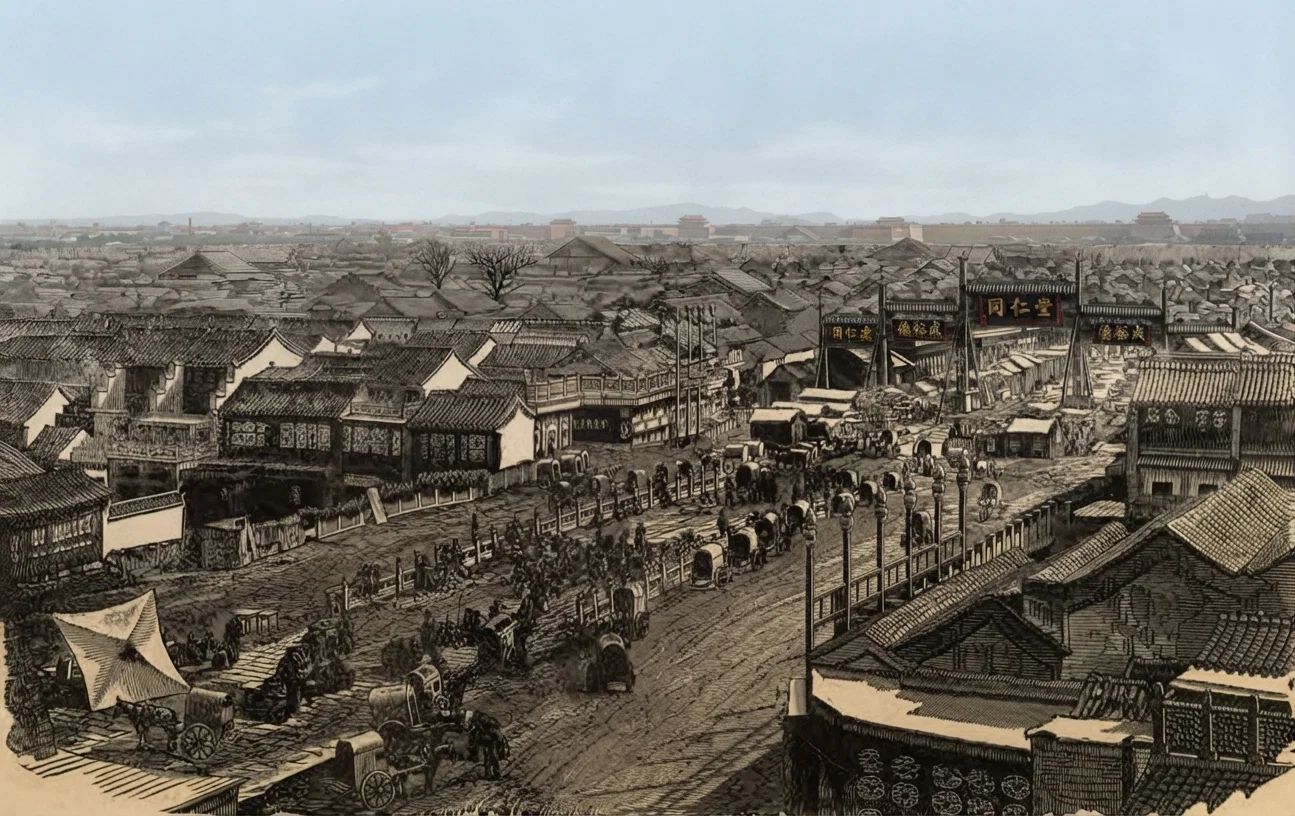
Scene in Peking, China.
"As if all these difficulties were not sufficient, Buddhism had hardly settled down harmoniously with its two sister religions when Mohammedanism entered the empire, pushing its way into imperial notice with great effect, and contesting with its monotheistic doctrines against the corrupt religious practises that had grown up in the other three divisions. It came to stay, in spite of numberless persecutions and rebellions, in which millions of Mohammedans have been put to death. Most of the Moslem Chinese now occupy a very strong position in the whole of Northwest China. Others are scattered over the face of the empire, many of them being rich and enjoying official positions. Altho opposed to the main features of Christianity, the Mohammedan faith is not entirely without its advantages to the work of the Christian missionary. The denunciation of all idolatry, the worship of the true God, the observance of the Mohammedan sabbath, and the teaching of certain theological terms, are all aids to Christian preaching. On the whole, however, most missionaries who have come in contact with Mohammedans would much rather work in places where they are not to be found."

THE CHURCH NOT A PLACE OF REST.

THE church is not a Pullman sleeper, in which one may embark on earth and in due time awake in heaven. It is a place for work which is to result in blessing to the individual and salvation for others. The most useful and successful churches are those in which suitable work is found for each person, and where each is found at his work. Mr. Moody somewhat recently said: "There is a great mistake that a good many people are making at the present time. They have an idea that the church is a place of rest. Instead of going there to work for God, they go there to rest. 'There remaineth a rest for the people of God.' We will rest when we go home. We will have all eternity to rest in. We do not want to talk about rest here. I hope the time will come, and I believe it will come, when they will ask this question of all who are candidates for membership in the church, 'What work do you expect to do?' and if they are going into the church to rest, they will be told that we have enough of such members now; and if we could only get them out, and get some others in who will go to work in earnest, it would be a good thing forall. We should understand that we come into the church to work. All that seems to constitute Christians these days is to unite with the church; and then, after they have joined it, every one in the church must wait on them—the ministers, the laymen, all the members must go and call on them; and if they do not do this they go to some other church—and the quicker they do it the better. 'There remaineth a rest for the people of God.' The idea of our talking about rest here, where Christ has been cast out, where they have taken the life of God's own Son! Why should we want to stay in the enemy's country at rest and peace? As long as it is the enemy's country, let us not dream of rest. We will rest by and by, when Jesus comes. Let us not talk about rest now."
—Lutheran Observer.

Leaning on God’s Security

THERE is no noble height thou canst not climb; All triumphs may be thine in time's futurity, If, whatsoever thy fault, thou dost not faint or halt, But lean upon the staff of God's security. —Ella Wheeler Wilcox.

SANITARIUM COOKING SCHOOL.

THE cooking school of the Sanitarium summer class was a success. The class members desiring the recipes in permanent form, it has been decided to prepare them for publication in the Pacific Health Journal, beginning with the September number and continuing for a number of months, probably not less than six.
These will consist of general directions for healthful cooking, complete menus with carefully-worded instructions for preparing the various dishes, and useful hints which have not before appeared in print, the whole having been prepared by Mrs. Dr. Droll and Mrs. Merrill, both of whom by past experience are well fitted for the work.
Those who are not already subscribers to the Health Journal should send 50 cents for a year's subscription, or 25 cents for six months, and thus secure these valuable articles. Address Pacific Health Journal, St. Helena, Cal.

Education and National Reform

EDUCATION is a power in any land. It has been said by an experienced missionary, concerning the great empire of China, "Win her scholars and you win China." Scholars have a great deal to do with the making of any nation of which they form a part. But it is only education with the religious motive and spirit introduced into it which effectuates any changes for the better in national life. China, for example, will not be won to anything very much better than it is or has at present, until it is won to Christ, and so to civilization in the truest sense.

Children in God's Image

Thy children all—tho hue and form Are varied in Thine own good will— With Thy own holy breathings warm, Are fashioned in Thine image still. —Whittier.

OUR INDIA FAMINE FUND.

OUR second instalment, forwarded to India by telegraph free of charge, through courtesy of the New York Committee of One Hundred, has been receipted for. In response we have the following letter:—
"EDITOR OF THE SIGNS OF THE TIMES, Oakland, Cal.—Dear Sir: The Committee of One Hundred on India Famine Relief has received $1,207.40 from the Seventh-day Adventists, and we are informed that $700 was contributed through the SIGNS OF THE TIMES. Permit me, accordingly, in behalf of the committee, to make special and grateful acknowledgment of the gift. I sincerely wish that through the columns of your paper the committee's thanks might be returned to each one of the donors.
"The $700 will be cabled to India, without expense, on Friday, August 3, and will be promptly transferred to the International Tract Society, care W. A. Spicer, editor of Oriental Watchman, Calcutta.
"As the distribution of relief funds by the International Tract Society is, doubtless, as effective as the distribution by our own committee, the gift of $700 may fairly be thought of as providing the equivalent of a day's food for more than 20,000 hungry persons, including not a few destitute children, or buying 2,100 native blankets for the almost naked, or sufficing to enable nearly 300 impoverished peasant farmers to re-seed their fields. Such are the wonders of relief which may be secured by funds wisely expended in behalf of the famine sufferers.
"The famine distress itself can not radically lessen, until the gathering of India's harvests next October and November. The prospect is that those harvests will be far less abundant than usual. Accordingly, it is to be devoutly hoped that the supply of relief gifts will not be diminished for months to come.
"Again thanking you and the contributors of the $700, I remain yours very sincerely, "L. T. CHAMBERLAIN, "Ex. Chairman N. Y. Com. of One Hundred."
Our readers will remember that the first instalment from our SIGNS fund was $1,000. Brother W. H. Edwards, treasurer of our Foreign Mission Board, notifies us that to this last amount of $700 was added $507.40 from Michigan Sabbath-school Association. This amount added to our $700 makes the $1,207.40 mentioned in the foregoing letter.

OUR WORK AND WORKERS.

Danish and Swedish editions of "The Coming King" are to be ready for delivery September 1.
At the recent camp-meeting held at Blue Lake, Humboldt County, Cal., eleven candidates were baptized.
In connection with meetings held at Middlesex, N. Y., Sister Lulu Wightman reports four converts to the faith.
Five candidates were baptized at Sextonville, Wis., recently, by Brother W. S. Shreve, president of the conference.
Canvassing at Opello, Ark., Brother Lloyd Manfull took orders for "The Desire of Ages" to the value of $250 in less than two weeks. In one day he secured fourteen orders.
A teachers' institute is announced for Anoka, Minn., to begin on the 29th inst. The outlook for church schools in that conference the coming year is said to be very encouraging.
A worker in Iowa writes to the Bulletin concerning the "Independence" issue of the SIGNS: "The paper sells better than I thought it would. I am thankful for these good papers to circulate."
We are informed by Brother Wm. Woodford that twenty-three persons have begun the observance of "the commandments of God and the faith of Jesus" at Juniata, Ala., after a few weeks' meetings recently held at that place.
A letter from Brother F. D. Starr, dated Carleton Place, Ont., July 23, says: "Brother Wm. Spear and myself have just begun tent-meetings at this place. Brethren J. F. Ballenger and Wm. Simpson are holding tent-meetings at Guelph, and Brethren P. M. Howe and E. J. Dryer at Caledon. I recently baptized seven Indians at Southwold, and organized an Indian church there." All the places mentioned in this note are in Ontario.
Of the Manitoba camp-meeting, held at Morden, Brother C. J. Buhalts writes to the Workers' Bulletin: "One large tent was used by the English-speaking brethren, and a smaller one by the Germans, of which nationality there are a large number here. There were about 250 in attendance, some driving 150 miles. There were seven baptized during the meeting. We have eight churches and three unorganized companies in this field. Brother H. J. Dirksen has charge of the German work."
Writing from Trinidad Island, off the coast of Venezuela, to the Dakota Worker, Brother L. M. Crowther says: "We have three churches on the island, Indian Walk, Couva, and Port of Spain. The latter has ninety members. Among all the Sabbath-keepers on the island we have but one white person besides these sent here for the work. We have one church school, but we are in need of four more very soon. . . . La grippe has been quite severe here for a month, and many deaths have occurred. We find, however, that if we can get the patient to get out into the sun, and start a sweat, he is soon well. The fevers that are so common here are of a character that can be avoided, if care be taken to keep in health by keeping the skin and other organs active."
The following report of labor at West Valley, Minn., by Brethren F. Johnson and J. C. Christensen, is from the Minnesota Worker: "Our meeting at this place closed July 22. The Lord's presence has been with us throughout the meeting, and His Spirit has worked upon those in attendance in a marked manner. Brethren from the Foldal church have attended our Sabbath meetings. Thirteen souls are now walking in the light, keeping God's commandments. All of these were Baptists, and the elder of that church is among those now obeying. When we came here, one family of two was keeping the Sabbath and two others were about decided. A Sabbath-school of twelve, children not counted, was organized. At the close of the meetings two young people from Foldal were baptized."

TRACT NEWS

The month of July is not supposed to be one during which people do much serious reading, yet the pamphlets and tracts sold by us have had the largest sale of which we have record. In fact the circulation of our tracts alone has averaged over

73,000 Pages Daily

during the above-mentioned time, while the retail value of our paper-covered books sold during the month has been almost

$1,500.00

All this goes to show that there is a wide-spread interest being taken in literature which shows the significance of passing events.
The titles of some of the best selling tracts and pamphlets might not be out of place in this connection. Here they are:—

Heralds of His Coming

A 24-page number of the Apples of Gold Library is one of them. As its title indicates, it treats upon the signs which show the near coming of our Lord and Saviour Jesus Christ. Its price is 1 1/2¢ each or 98¢ per 100.

Labor and the Money Power

is another treatise which has awakened much interest. It is a 32-page illustrated number of the Bible Students' Library and sells for 2¢ each. It is well worth a careful reading.

Who Changed the Sabbath

has had a very extensive circulation lately, and well does it deserve the recognition it is receiving, as it contains much valuable matter on this great question. It is brief, however—contains but 24 pages—and sells for 1 1/2¢ each.

Marshaling of the Nations

though not a tract, but a ten-cent pamphlet, has had an enormous circulation. The fact that it deals with the prophecies relating to China, and contains five color maps showing the partitioning of the world among the great powers of earth, has placed it in the very front ranks of books called for during the past few weeks.
There are many other things about which we would like to speak, but we can not now. If you are interested, however, and want information about all our tracts, pamphlets and books, send for a copy each of "Silent Messengers" and our "Summer Catalog." Both are free.

PACIFIC PRESS Publishing Co.

OAKLAND, CALIFORNIA 39 Bond Street New York City 18 West Fifth Street, Kansas City, Mo.

LESSON IX.—SABBATH, SEPTEMBER 1, 1900.

DISSIMULATION EXPOSED.

Lesson Scripture, Gal. 2:11-16, R.V.
11 "BUT when Cephas came to Antioch, I resisted him to the 12 face, because he stood condemned. For before that certain came from James, he did eat with the Gentiles; but when they came, he drew back and separated himself, fearing them that 13 were of the circumcision. And the rest of the Jews dissembled 14 likewise with him; insomuch that even Barnabas was carried 14 away with their dissimulation. But when I saw that they walked not uprightly according to the truth of the Gospel, I said unto Cephas before them all, If thou, being a Jew, livest 15 as do the Gentiles, and not as do the Jews, how compellest 15 thou the Gentiles to live as do the Jews? We being Jews by 16 nature, and not sinners of the Gentiles, yet knowing that a man is not justified by the works of the law, save through faith in Jesus Christ, even we believed on Christ Jesus, that we might be justified by faith in Christ, and not by the works of the law; because by the works of the law shall no flesh be justified."
NOTE.—Do not read anything, no matter how good it may be—not the notes in the lesson book—until you have mastered the text for the week. There is where the lesson is.

SUGGESTIVE QUESTIONS.

  1. From what place did Paul and Barnabas go up to Jerusalem to meet the apostles and elders?
  2. Where did they go after the meeting closed?
  3. Who came down to Antioch later?
  4. What did Paul do when Peter came down? Why?
  5. What did Peter do that was blameworthy?
  6. When did he make this change?
  7. Why did he do it?
  8. By what name is such a course called?
  9. Was Peter alone in this action?
  10. How strong was the influence toward this double course?
  11. What did Paul see?
  12. To what were Peter and the rest going contrary?
  13. What did Paul then do?
  14. What question did he put to Peter?
  15. How did he show his inconsistency?
  16. What did Paul say that he and Peter were by birth?
  17. What were they not?
  18. Were they then not sinners by nature?
  19. Of what class of sinners were they by nature?
  20. Is a Jewish sinner better than a Gentile sinner?
  21. Being sinners of the Jews, what had they known?
  22. How is a man not made righteous?
  23. By what, then, is a man justified?
  24. What, therefore, had they done? What for?
  25. By whose faith is it that we are justified?
  26. What can not be done by the works of the law?
  27. Was it wrong for Peter to eat with the Gentiles? Had he ever done the same thing before? On what occasion? What did he himself say when he entered the house of Cornelius? Acts 10:28. What law was there forbidding it? Is it found in the Bible? What, then, did Peter's course at Antioch, in refraining from eating with the Gentiles, indicate? To what did it tend?

NOTES.

1. NOTE that it was "the truth of the Gospel" that was still in question. It was whether a man is saved by his own efforts, or by a power higher and greater than himself.
2. SINNERS of the Jews and sinners of the Gentiles are all alike in God's sight. There is no difference. See Rom. 3:9-19. In fact, the breaking of the commandments of God changes a Jew into a Gentile. Rom. 2:25.
3. THE word "justify" means literally "to make righteous." In the German and Danish the word used in every case where the English has "justified," is the exact translation of the English "made righteous." It would be better if we used that term in the English, because many do not see the full meaning in the word "justify." If we stop to think, however, we can see that a just man is a righteous man. Justitia is the Latin word for "righteousness." To be just is to be righteous. The termination fy is from the Latin word meaning to make, so that the Latin compound is the exact equivalent of the Anglo-Saxon expression.
4. THE law can not make any man righteous; it can only tell us what righteousness is, leaving us to do it in the best way we can. To be made righteous by the works of the law is, therefore, simply to be justified by the works which we ourselves do, since the written law does not do itself. So justification by the works of the law is self-righteousness, which is nothing but sin.
5. GOD has "dealt to every man the measure of faith" (Rom. 12:3); "unto every one of us is given grace according to the measure of the gift of Christ" (Eph. 4:7). The power by which Christ overcame is given to every one. Our part is to keep the faith. 2 Tim. 4:7; Rev. 14:12. Christ alone is righteous; He has overcome the world, and He alone has the power to do it; in Him dwelleth all the fulness of God, because the law was in His heart; He alone has kept and can keep the law to perfection; therefore only by His faith—living faith, that is, His life in us—can we be made and kept righteous.

LESSON X.—SUNDAY, SEPTEMBER 2, 1900

THE SEVENTY SENT FORTH.

Lesson Scripture, Luke 10: 1-11, 17-20, R.V.
1 "Now AFTER these things the Lord appointed seventy others, and sent them two and two before His face into every city and place, whither He Himself was about to come. 2 And He said unto them, The harvest is plenteous, but the laborers are few; pray ye therefore the Lord of the harvest, that He send forth laborers into His harvest. 3 Go your ways; behold, I send you forth as lambs in the midst of wolves. 4 Carry no purse, no wallet, no shoes; and salute no man on the way. 5 And into whatsoever house ye shall enter, first say, Peace be to this house. 6 And if a son of peace be there, your peace shall rest upon him; but if not, it shall turn to you again. 7 And in that same house remain, eating and drinking such things as they give; for the laborer is worthy of his hire. Go not from house to house. 8 And into whatsoever city ye enter, and they receive you, eat such things as are set before you; 9 and heal the sick that are therein, and say unto them, The kingdom of God is come nigh unto you. 10 But into whatsoever city ye shall enter, and they receive you not, go out into the streets thereof and say, 11 Even the dust from your city, that cleaveth to our feet, we do wipe off against you; howbeit know this, that the kingdom of God is come nigh." 17 "And the seventy returned with joy, saying, Lord, even the devils are subject unto us in Thy name. 18 And He said unto them, I beheld Satan fallen as lightning from heaven. 19 Behold, I have given you authority to tread upon serpents and scorpions, and over all the power of the enemy; and nothing shall in anywise hurt you. 20 Howbeit in this rejoice not, that the spirits are subject unto you; but rejoice that your names are written in heaven."
NOTE.—Read Luke 10: 1-24, and commit to memory verses 2-6. It will be well in connection with this lesson to refer to the sending out of the twelve, which will be found in Matt. 9:36 to 10:16; Mark 6:8-11, and Luke 9:1-5. Bear in mind that the fact which Jesus Himself states in John 4:35 is present truth to-day much more emphatically than it was then; that is, the harvest is nearer, and the fields are whiter.
Golden Text: "The harvest truly is great, but the laborers are few." Luke 10:2.

SUGGESTIVE QUESTIONS.

(1) What widening work of the Gospel is brought to view in the first verse of this chapter? How did Christ send these out? To what places did He send them? V. 1. Note 1. (2) What statement did the Saviour make as He sent them forth? What subject of prayer did He then lay before them? V. 2. (3) What did the Saviour tell them in regard to their surroundings as they went forth? V. 3. Note 2. (4) What articles did He say they should not take with them? What prohibition did He give them in regard to those whom they should meet on the way? V. 4. Note 3. (5) What salutation were they directed to give to any house they might enter? V. 5. (6) What would occur if the house were not worthy of the salutation? V. 6. (7) What directions did He give in regard to their place of abode in these different villages? Why was it right that they should do this? What prohibition did He make on this point? V. 7. Note 4. (8) If they were received in a city to which they went, what should they do? V. 8. (9) What work of mercy were they to perform? What gospel message were they to proclaim in such places? V. 9. (10) In the cities where they were not received what were they to do? Nevertheless, what testimony were they to bear? Vs. 10, 11. Note 5. (11) What were the feelings of the seventy as they returned from this work? What did they say in reference to their work? V. 17. (12) What declaration did the Saviour then make in reference to Satan? V. 18. Note 6. (13) What authority did the Saviour give to these disciples? What would be the result to them in a personal way? V. 19. (14) What should this authority not lead them to do? But in what were they to rejoice? V. 20.

NOTES.

1. Appointed seventy others.—The work of Christ was beginning to broaden. He had previously appointed twelve; now He appoints seventy, and sends them out ahead of Him to do earnest work, which He Himself would follow up. The lesson we may draw from this is that wherever He sends out a missionary in His work, Christ will Himself follow up the work. The number was the same as the number of the elders of Israel, and also the members of the Sanhedrin, who should have been doing active work for Christ. By sending these out two and two, Christ had thirty-five different missionary operations going on at the same time. There were many advantages in this two-and-two plan. The testimony of two witnesses is more effective than that of one; each would supplement the work of the other; they would reach different classes of minds; they would aid and encourage one another with plans and suggestions; and each would help to keep aglow the spiritual life of the other.
2. Lambs in the midst of wolves.—They were unarmed, defenseless, and innocent as lambs, and yet they went forth unhurt into the midst of foes wily, cruel, and malicious as wolves. These were the leaders of the Jews, the armed Romans, and a reckless populace. Christ gives no permission for His workers to arm their mission stations or their converts for their defense. The arm of carnal flesh is not recognized by the Saviour as the defensive agent of Gospel workers.
3. Purse.—A small leather bag for carrying money. Wallet.—A leather bag or haversack for carrying provisions when traveling. Nor shoes.—In addition to the sandals they were wearing. They were to take nothing not absolutely necessary for their journey. Salute no man by the way.—"The Jewish salutations, like those common in the Orient to-day, were elaborately formal, and occupied so much time as to be a serious hindrance when there was reason for haste. The lesson to the disciples was that their business was urgent, and that the time was short. The lesson to us is, that we are not to allow the formalities of life to interfere with our Gospel ministry."
4. In the same house remain.—The oriental law of hospitality allows a traveler to stay three days in a house to which he may come for entertainment, without even disclosing his business. The reason why they should remain in one house, and not go from house to house, is obvious to one acquainted with oriental custom. "When a stranger arrives in a village or encampment, the neighbors, one after another, must invite him to eat with them. There is a strict etiquette about it, involving much ostentation and hypocrisy, and a failure in the due observance of this system of hospitality is violently resented, and often leads to alienations and feuds among neighbors."—Land and Book. By remaining at the one house, they would avoid an appearance of conforming to this custom partially, or showing partiality.
5. Even the dust . . . wipe off against you.—A symbolic act, indicating not anger or revenge, but warning. They would clear themselves of all responsibility for the great loss which the inhabitants of such a place would sustain. They would express their sense of the terrible ruin which these people were bringing upon themselves, and show their unwillingness to be partakers in it.
6. I beheld Satan fallen.—In the defeat of the demons over which Christ had given His disciples power, He saw the downfall of the kingdom of Satan and sin. It was a vision of what the Gospel would accomplish in the earth, where Satan had worked so long for the destruction of souls.

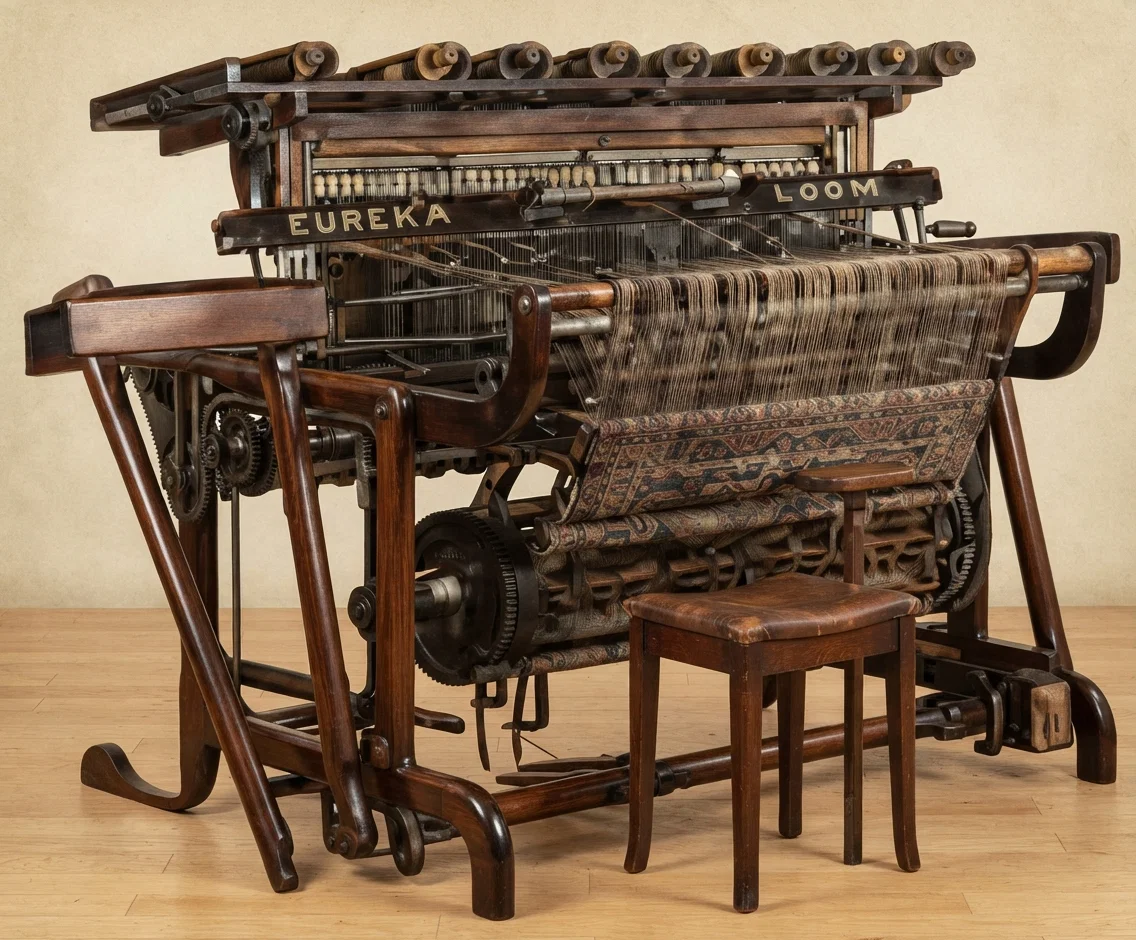
FLY SHUTTLE

The best, handiest, easiest running, cheapest, and most durable

FLY SHUTTLE

GARPET LOOM
In the world,—100 yards a day. Catalogue free.
EUREKA LOOM CO. 5018 Main St., Battle Creek, Mich.
When you write, please mention the SIGNS OF THE TIMES.

Unawares

"YE DID IT UNTO ME." "And He said, 'The sin is pardoned, But the blessing is lost to thee, For, failing to comfort the least of Mine, You have failed to comfort Me.'"
Unawares
Unawares
Such is the closing verse of one of the two poems found in No. 54 of the Apples of Gold Library under the above title. They are very touching and very good. Price, 50c per 100.
PACIFIC PRESS PUBLISHING CO. New York City Oakland, Cal. Kansas City, Mo.

Lady Waiters Wanted

Wanted.—Two S. D. A. lady waiters at the Hygienic Restaurant, 1069 Market Street, San Francisco.
Continue reading: Local Manufacturer's Representative Wanted