The Youth’s Instructor, Vol. 29, No. 42.

PRESIDENT GARFIELD'S MOTHER

The Youth’s Instructor

Oct 19, 1881

S. D. A. Publishing Association · Battle Creek, Mich. · Oct 19, 1881

PRESIDENT GARFIELD'S MOTHER.

Her maiden name was Eliza Ballou. She is a descendant of Maturin Ballou, a Huguenot of France, who was driven from his country upon the revocation of the edict of Nantes.
He joined the colony of Roger Williams, and settled in America. He built a meeting-house at Cumberland, R. I., which is still carefully preserved as a relic of the past, and is known as the Elder Ballou meeting-house. At the time it was built, there were no saw-mills, no nails, and few tools in the country. Its galleries and pews, and even its floors, were hewn out of the solid logs, and put together with wooden pegs.
Abraham Garfield and Eliza Ballou, both emigrants from the State of New York, were married in 1821. They had gone in 1830 to Orange, Cuyahoga County, Ohio, where a year later, their son James was born, being their fourth child. Their log house was built when the heavy forest was but partly cleared away. The fences were not yet made about the fields when the father, in fighting a forest fire that threatened the destruction of their home, over-heated himself, was suddenly chilled, and in a few days died. His last words to his wife, as he looked upon his children, were: “I have planted four saplings in this forest. I must now leave them in your care.”
A happier family never dwelt in a palace than had been in that cabin home. Little James was but eighteen months old when his father died—too young to understand the irreparable loss, or feel the pangs of grief that well-nigh crushed other hearts. The neighbors came—only four or five families in a radius of ten miles—and wept with the widow and the fatherless. With their assistance the lifeless form was enclosed in a rough coffin and buried in a corner of the wheat-field near by—no sermon, no prayer, except the silent prayers that went up from aching hearts. Winter was approaching. Could human experience be more dreary than a woman left a widow, alone with her children in a wilderness swept by wintry storms! The howl of the wolves and the cry of the panthers never sounded so terrible as during those long, desolate winter nights. It seemed to the weary ones that spring would never come again. But at last it did come, and swept away the snow and ice. The dead things of the field and forest returned to life, save only the dead in the corner of the wheat-field; but hope was not revived in the cabin. There was no money in the house; there was a debt on the farm, and the food supply was limited.
Then Eliza Garfield sought the advice of a neighbor, who had been kind in her time of trouble. He advised her to sell the farm, pay off the debt, and return to her friends, believing it to be impossible for her to support herself and children there. Her reply was characteristic:—
“I can never throw myself and children upon the charity of friends. So long as I have health, I believe my Heavenly Father will bless these two hands, and make them able to support my children. My dear husband made this home at the sacrifice of his life, and every log in this cabin is sacred to me now. It seems to me a holy trust, that I must preserve as faithfully as I would guard his grave.”
Her neighbor left her, and she went to the Friend that never fails, and asked God to make the way of duty clear to her; and when she came from her place of prayer, she felt that light and strength had been given to her. She called her eldest son, Thomas, to her, and though he was only a child ten years old, she laid the whole case before him. With the resolute courage of his race, he gladly promised that he would plow and sow, cut wood and milk the cows, if she would only keep the farm. So this brave mother and son commenced their work. She sold part of the farm, and paid every dollar of debt. Thomas procured a horse, plowed, sowed and planted. The mother with her own hands split the rails, and completed the fencing. But the harvest was still far away, and the corn was running low. The mother carefully measured her precious grain, counted the reaping time, and finding it would be exhausted long before that, at their present rate of consumption, she resolved to live on two meals a day herself, that her children might not suffer. Then, as the little store rapidly disappeared, she ate but a single meal herself, concealing her self-denial from her children, until the blessed harvest brought relief. That year it was very abundant, and the wolf of hunger never came so near their door again.
Still there were many years of hardship and self-denial, in which the brave woman had to be father and mother, teacher and preacher to her children. She was the wise and tender friend, guiding them in the right way, and inspiring them to choose the best things in life. She still lives to see her great reward, “and her children rise up and called her blessed.”—Selected.

THE GREAT CATARACT.

MUCH has been written concerning the wonderful Falls of Niagara, but still the subject is not exhausted. Thousands from all parts of the world annually visit the place to witness the rush of waters in the rapids above and below the falls, to watch the volume of water in its awful plunge over the precipice, and to be inspired by the emotions which the scene excites in all who behold it. Many tourists visit the Falls year after year, and spend days and weeks in gazing upon scenes grown familiar by frequent observation, only to more deeply wonder and admire as a more thorough acquaintance gives a better idea of the sublimity of this great marvel of nature.
It has been the privilege of the writer to make three visits to these Falls, and, aside from the curiosity gratified at the first view, the interest has increased at each succeeding visit, for each has revealed new beauties, and given a deeper sense of the awful grandeur of the scene.
There are so many points of interest above, below, and around the Falls that a single visit leaves a confused impression of immensity, from which mental pictures may with difficulty be singled out. Subsequent visits, however, will separate these pictures, and group them in a panorama which will linger long in the memory.
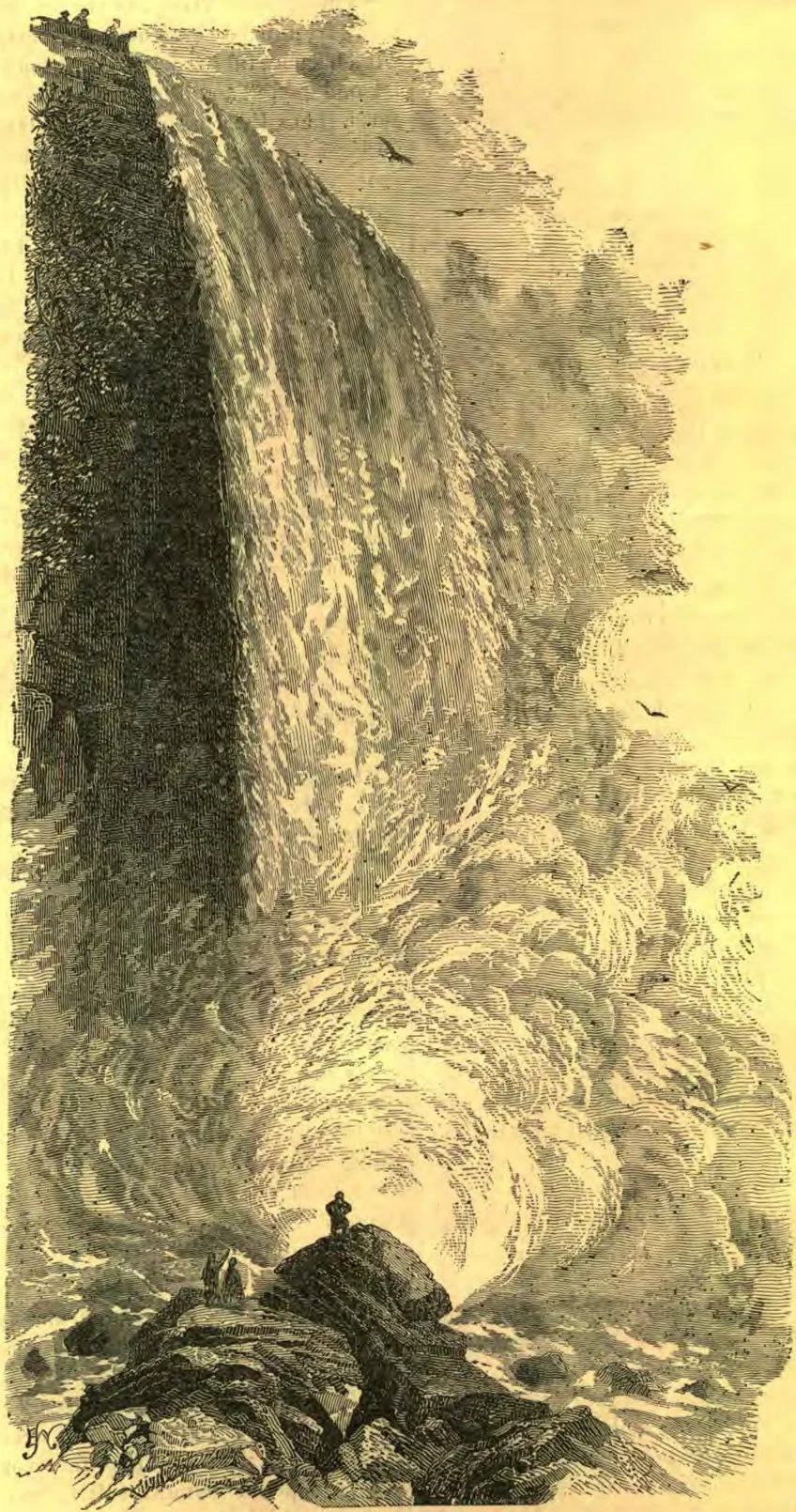
The view presented in our illustration is that of the American Fall as seen from below. Although less comprehensive than many other views, it gives, better perhaps than any other, an idea of height, which can only be had by looking up from a near view at the great volume of descending water. Standing amid the spray which fills the air, nearly deafened by the incessant roar, and with the rushing waters dashing around the rocks at his feet, the observer is overwhelmed with the emotions that fill his soul, as he considers that for centuries the great lakes above have been flowing over the precipice, and still the fountain head is supplied by the mysterious processes of nature.
On the same side of the river, a few rods above, is the celebrated “Cave of the Winds,” into which, clad in waterproof garments, the visitor goes, behind the great sheet of water which pours over the overhanging cliff above. The compression of the atmosphere by the descending waters produces a constant commotion of the elements, so that a stormy tempest reigns perpetually within the cave, while peculiar sounds greet the ear as the concussion of the falling water resounds through the mysterious chamber.
This point is one of the few places in the world from which can be seen the complete, or circular, rainbow. The volumes of spray which continually rise from the river refract the rays of the sun, so that at certain hours of the day this wonderful phenomenon is to be seen in all its beauty, and amply repays the visitor for the inconvenience or discomfort attending the view.
No description can give an adequate conception of Niagara. It must be seen to be appreciated, and such of our readers as cannot visit it may get a faint impression from the engraving given herewith. W. C. GAGE.
NIAGARA. — AMERICAN FALL.

THE FALLS OF NIAGARA.

The thoughts are strange that crowd into my brain, While I look upward to thee. It would seem As if God poured thee from his hollow hand, And hung his bow upon thine awful front, And spoke in that loud voice, which seemed to him Who dwelt in Patmos for his Saviour’s sake, The sound of many waters; and had bade Thy flood to chronicle the ages back, And notch His centuries in the eternal rocks.
Deep calleth unto deep. And what are we, That hear the question of that voice sublime? Oh, what are all the notes that ever rung From war’s vain trumpet, by thy thundering side? Yea, what is all the riot man can make In his short life, to thy unceasing roar? And yet, bold babbler, what art thou to Him Who drowned a world, and heaped the waters far Above its loftiest mountains! A light wave, That breaks, and whispers of its Maker’s might.
—Selected.

SEVENTY-TIMES SEVEN.

“If thy brother trespass against thee seven times a day,” read Daisy Ford from her little “Daily Food” before her on the bureau, as she brushed the snarls from her brown curls.
“If thy brother trespass against thee seven times a day, and seven times turn unto thee, saying, I repent—thou shalt forgive him.”
“Oh, dear!” she exclaimed, in dismay. “Must I forgive Tom seven times every day? I suppose if it says so in the Bible, I must, but he is so aggravating.”
And Daisy put on her collar and blue ribbons with a sigh, and went down to breakfast. Papa and mamma were not down. Tom was over in the bay window trying to teach Rover a new trick.
“Hallo, sis!” he exclaimed, suspending operations at her entrance. “What’s the matter with you? Your face is as long as the moral law with a postscript. Guess we’ll have to liven her up a little, won’t we, Rover? Let’s go for her.”
Now Rover was fresh from a long run in the grass, and it had rained in the night.
“O Tom—don’t! you’ll spoil my clean apron, and I’m all ready for school.”
But she was too late, the dainty white apron was soiled past wearing, and there was nothing left to do but go in search of a fresh one.
“I’m awful sorry. I didn’t mean to do anything only wake you up a little,” shouted Tom after her, as she went up stairs.
“One”—was Daisy’s only reply, softly to herself.
Tom was vexatious enough at any time, but to-day he seemed possessed. He carried her books to school for her, and in some way lost out her paper of examples, so she had those to work over. He tipped his inkstand over her copy-book, which she was keeping so neatly for examination day. He borrowed her knife that Aunt Sue gave her on her birthday, and lost it. He put a live toad in her lunch basket. He broke the handle of her new umbrella, using it, in spite of her entreaties, as a bat.
“Can’t imagine how it happened,” said Tom, “hadn’t the least idea I was using it hard enough to break it.” But it was broken for all that, and Daisy picked up the pieces, saying to herself as she did so, “This makes six times.”
Last, but not least, when she came home from Mamie Granger’s at night, she found him chasing her pet kitten Snowball around the yard, with a tin pan tied to her tail.
“There,” said Daisy, as she set the poor frightened creature at liberty, “It’s been awful hard, but I’m through for one day, at any rate, for this makes seven times I’ve forgiven him.” Half an hour later, as she sat in the sitting-room reading, Tom put his head in at the door.
“I say, Dais, I’m no end sorry, but Snowball ran under the shed—and I tried to catch her—and—she’s in a fit. I shouldn’t much wonder if she was dying. Can you forgive a feller?”
“No, I can’t, and I won’t try to, either, for this is the eighth time to-day—and I almost hate you,” said Daisy, as she brushed past him.
“Come here a moment, Daisy,” called mamma from her room, where she had overheard all. “What do you mean by ‘eight’ times?”
“Why, mamma, you see my verse this morning said I must forgive my brother seven times a day—so I have, but this is the eighth time, and I needn’t, need I?”
“Run and get your Bible,” was mamma’s reply; and Daisy obeyed, with sudden misgivings.
Could it be she had learned the verse wrong?
“Now find Matthew 18:22,” said mamma, “and read it aloud.”
“Jesus said unto him, I say not unto you, Until seven times, but until seventy times seven.”
“O mamma, I can’t do that, anyway.”
“How many times have you done wrong to-day?” asked mamma.
“I don’t know, a good many times, I guess,” Daisy replied wonderingly.
“More than ‘seven’ times?” continued mamma.
“I’m afraid so,” said Daisy, slowly and reluctantly, as the light began to dawn upon her.
“Be ye kind one to another, tender-hearted, forgiving one another, even as God for Christ’s sake hath forgiven you,” whispered mamma softly, leaving her to think it out by herself.
“Oh dear, there’s no end to it if you begin,” she sighed.
“Even as God for Christ’s sake has forgiven you. I—suppose—God always has something to forgive, too.”
By-and-by, after a long time, Daisy got up, and went slowly downstairs to the sitting-room door. At the threshold she paused, irresolute for a few moments, then she went quietly in. Somebody about Tom’s size was all curled up on the lounge, with face buried in the pillows. Daisy went over to him. “I didn’t mean what I said, Tom. I will forgive you, and you know I don’t hate you.”
“You may go out and do anything you’ve a mind to to Rover—choke him or drown him or anything,” said Tom in a shaky voice, from the depths of the pillows.
Rover was Tom’s idol.
“But I don’t want to do anything at all to him,” replied Daisy, smiling through her tears. “I’ll forgive you without; only Tom, won’t you try not to plague me quite so much?” And by this time Daisy’s voice shook, and her eyes overflowed as she thought of poor Snowball.
“You’re a brick, Dais,” said Tom, emerging from his retreat, “and I will try to treat you better.” “I say,” he added, diving once more into the pillows, “you might—have Rover, for your own, you know.”
“No indeed, Tom. I won’t rob you of your pet,” responded Daisy promptly, and giving Tom’s hand at the same time a grateful little squeeze that told him she appreciated his offer though she refused it.
“And you won’t do any more of that horrid counting, will you?” asked Tom presently.
“No,” replied Daisy gravely, “I won’t, because you see God don’t, so I ought not to. I didn’t think of that.”
—Kate Sumner.

AN AUTUMN DAY.

FORESTS gleam with scarlet and gold, The autumn flowers are gay; Nature is in her brightest attire This perfect October day.
Beauty and brightness soon will pass Away from my raptured sight, And dreary days of winter will come, When the world is still and white.
This scene will be a picture fair To come at my fancy’s call; ’Twill brighten the darkest winter days, As it hangs in “mem’ry’s hall.”
—Frances A. Conant.

Christlike Courtesy Toward the Poor and Humble

Do you suppose the Lord Jesus ever turned up his nose at people? Do you think he would like to see it in his children? No, no. He would not grieve a poor little girl; he would not look cold and haughty. He loved poor people. He was kind. The manners he brought from Heaven were gentle, considerate, pleasant; and these are the kind for us to cultivate.

LITTLE BY LITTLE.

A MAN who had very little time for reading or study was asked by a friend how it happened that he knew so much more than other people.
“Oh,” said he, “I never had time to lay in a regular stock of learning, so I save all the bits that come in my way, and they count up in the course of a year.”
One sometimes observes an intelligent boy who is always on the lookout to learn what he can. While waiting in a newspaper office for a package, he will notice how a mailing machine is made to do its work; and if he is sent to the florist’s, he will be able to tell you many things which he noticed there. In these and many other ways such lads are educating themselves.
Not only are all good things secured to us “little by little,” but people accomplish their ruin in the same way. It is by small concessions to evil, and slight indulgences, that the final destruction of life is accomplished.
—Selected.

SCENES IN THE LIFE OF CHRIST.

LESSON 39.—THE SOWER.

One day, as Jesus was teaching, some women who stood by began to talk about what an honor it was to be the mother of such a son; but he said, “Yea, rather, blessed are they that hear the word of God, and keep it.”
At another time his mother and his brothers wanted to come near and speak with him, but could not get through the crowd that was gathered to hear his words, and to see what miracles he might perform. When some one told Jesus of this, he said, “My mother and my brethren are these which hear the word of God and do it.” This shows that we may all be near of kin to Christ, the King of glory, if we will but do his will.
Again, as he was sitting in a boat on the Sea of Galilee, and teaching the multitudes that had gathered on the shore, he told them of a sower who went out to sow his seed; and as he sowed, some fell by the wayside, and was trodden down, and finally eaten up by birds; some fell upon rocky ground; and soon after it sprang up, it withered and died, because it lacked moisture; some fell among thorns, and the thorns, springing up and growing with the grain, choked it, so that no kernels formed in the heads; but some fell upon good ground, where it grew, and yielded abundantly.
When Jesus was alone with his disciples, they asked him what he meant to teach by this parable of the sower. He then explained it to them, saying, “The seed is the word of God. Those by the wayside are they that hear; then cometh the devil, and taketh away the word out of their hearts, lest they should believe and be saved. They on the rock are they which, when they hear, receive the word with joy; and these have no root, which for a while believe, and in time of temptation fall away. And that which fell among thorns are they which, when they have heard, go forth, and are choked with cares and riches and pleasures of this life, and bring no fruit to perfection. But that on the good ground are they which in an honest and good heart, having heard the word, keep it, and bring forth fruit with patience.”

QUESTIONS.

1. On what subject did some women begin to talk one day, as Jesus was teaching? Luke 11: 27.
2. What did Jesus say was more honorable, or blessed? Verse 26.
3. At another time what did his mother and his brothers want to do? Matt. 12: 46.
4. How were they prevented? Luke 8: 19.
5. When Jesus was told of it, what did he say? Verse 21.
6. What does this show?
7. Where was Jesus when he spake the parable of the sower? Mark 4: 1-3.
8. Where were the multitudes who listened to him?
9. In what four different places did the seed fall? Luke 8: 5-8.
10. What became of that which fell by the way-side?
11. What became of that which fell on rocky ground?
12. How many of you have seen grass or grain wither and die where the rock came so near the top of the ground that the moisture was soon dried out of the soil?
13. How did the seed prosper that fell among thorns?
14. Have you ever seen grain choked or shaded till it could not perfect any kernels in the head?
15. How was it with the seed that fell on good ground?
16. When Jesus was alone with his disciples, what did they ask him to do?
17. What did he say the good seed was? Verse 11.
18. What did he say about the way-side hearers?
19. Can you think of any ways that the devil has for stealing the word from the hearts of children?
20. What kind of hearers are represented by the rocky ground?
21. How may such people bear fruit?—By constantly praying to God to refresh their hearts by the influences of his Holy Spirit.
22. What kind of hearers are represented by the thorny ground?
23. What three things are mentioned as answering to the thorns that choke the grain?
24. Are young people apt to be troubled with cares and riches?
25. What, then, is most likely to choke out the word in their hearts?
26. Are not the Christian’s pleasures better than the pleasures of the world?
27. What hearers are represented by the good ground?

NEW TESTAMENT HISTORY.

LESSON 52.—JESUS DEPARTS FROM GALILEE.

“Now the Jews’ feast of tabernacles was at hand. His brethren therefore said unto him, Depart hence, and go into Judea, that thy disciples also may see the works that thou doest. For there is no man that doeth anything in secret, and he himself seeketh to be known openly. If thou do these things, shew thyself to the world. For neither did his brethren believe in him. Then Jesus said unto them, My time is not yet come; but your time is always ready. The world cannot hate you; but me it hateth, because I testify of it, that the works thereof are evil. Go ye up unto this feast; I go not up yet unto this feast; for my time is not yet full come. When he had said these words unto them, he abode still in Galilee. But when his brethren were gone up, then went he also up unto the feast, not openly, but as it were in secret.”
Luke, in speaking of the same journey, gives the following additional incidents:—“And it came to pass, when the time was come that he should be received up, he steadfastly set his face to go to Jerusalem, and sent messengers before his face; and they went, and entered into a village of the Samaritans, to make ready for him. And they did not receive him because his face was as though he would go to Jerusalem. And when his disciples James and John saw this, they said, Lord, wilt thou that we command fire to come down from heaven, and consume them, even as Elias did? But he turned, and rebuked them, and said, Ye know not what manner of spirit ye are of. For the Son of man is not come to destroy men’s lives, but to save them. And they went to another village.”
“And it came to pass, that, as they went in the way, a certain man said unto him, Lord, I will follow thee whithersoever thou goest. And Jesus said unto him, Foxes have holes, and birds of the air have nests; but the Son of man hath not where to lay his head. And he said unto another, Follow me. But he said, Lord, suffer me first to go and bury my father. Jesus said unto him, Let the dead bury their dead; but go thou and preach the kingdom of God. And another also said, Lord, I will follow thee; but first let me go bid them farewell, which are at home at my house. And Jesus said unto him, No man, having put his hand to the plough, and looking back, is fit for the kingdom of God.”
“After these things the Lord appointed other seventy also, and sent them two and two before his face into every city and place, whither he himself would come. Therefore said he unto them, The harvest truly is great, but the laborers are few; pray ye therefore the Lord of the harvest, that he would send forth laborers into the harvest. Go your ways: behold, I send you forth as lambs among wolves. Carry neither purse, nor scrip, nor shoes; and salute no man by the way. And into whatsoever house ye enter, first say, Peace be to this house. And if the son of peace be there, your peace shall rest upon it; if not, it shall turn to you again. And in the same house remain, eating and drinking such things as they give, for the laborer is worthy of his hire. Go not from house to house. And into whatsoever city ye enter, and they receive you, eat such things as are set before you; and heal the sick that are therein, and say unto them, The kingdom of God is come nigh unto you. But into whatsoever city ye enter, and they receive you not, go your ways out into the streets of the same, and say, Even the very dust of your city, which cleaveth on us, we do wipe off against you; notwithstanding be ye sure of this, that the kingdom of God is come nigh unto you.”
“Then began he to upbraid the cities wherein most of his mighty works were done, because they repented not. Woe unto thee, Chorazin! woe unto thee, Bethsaida! for if the mighty works which were done in you, had been done in Tyre and Sidon, they would have repented long ago in sackcloth and ashes. But I say unto you, It shall be more tolerable for Tyre and Sidon at the day of judgment, than for you. And thou, Capernaum, which art exalted unto heaven, shalt be brought down to hell; for if the mighty works which have been done in thee, had been done in Sodom, it would have remained until this day. But I say unto you, That it shall be more tolerable for the land of Sodom in the day of judgment, than for thee.”

QUESTIONS.

1. When the feast of tabernacles drew nigh, what did the brothers of Jesus say to him? John 7: 2, 3.
2. What disciples did they probably mean?—Those that he had formerly made in Judea, and who had not been with him latterly.
3. What reproof did his brothers give him? Verse 4.
4. What was the real cause of their talking in such an unjust and sarcastic manner?
5. What did Jesus say about the time for his leaving Galilee?
6. To what else may he here refer?—He may mean that it was not yet time for him to go to Jerusalem, and put himself in the hands of those who were intent on taking his life.
7. Why did the world hate Jesus?
8. Does it still hate those who do the same work?
9. Does the world here mean all the people in it, or simply those who are determined to seek their pleasure in the world rather than in doing the will of God?
10. What did he finally say about going up to the feast?
11. Tell how and when he went.
12. What is probably meant by his going up secretly?
13. What precaution did Jesus take in regard to a place of entertainment for himself and his disciples? Luke 9: 52.
14. Why were his messengers rejected by the people of a Samaritan village?
15. What did James and John say when they knew this?
16. How did Jesus rebuke them?
17. What did he say of his mission?
18. In leaving this village, and going on to another, how did he fulfill the instructions which he had before given to his disciples?
19. How did Jesus reply to a man who said to him, “I will follow thee whithersoever thou goest”? Luke 9: 57, 58.
20. What did he say to one who made excuse that he must go and bury his father before he could follow his Lord?
21. What is the probable meaning of this remark?—That those who were yet dead in sin,—who had not been awakened by the vivifying influences of the Holy Spirit,—would carefully attend to all such matters as burying the dead.
22. What did Jesus say to the man who wanted to go and bid farewell to his friends before engaging in the service of his Master? Verses 61, 62.
23. What was our Lord’s probable purpose in addressing these men as he did?—He probably meant to test their sincerity and faith.
24. Why was it so important at that particular time that all who wished to be taught by Jesus should follow him immediately? —It was but a little while before Jesus was to be crucified, and was probably the last time he would pass that way.
25. How did Jesus provide for spreading his gospel as far as possible among the people before his death? Luke 10: 1.
26. How did he set forth the condition of the gospel field? Verse 2.
27. What injunction did he lay upon them that it would be well for us to heed?
28. How did he warn them of the reception that they would be likely to meet? Verse 3.
29. What precautions were they to take in order that they might travel with all possible speed? Verse 4.
30. What ceremony were they to observe on entering a house? Verses 5, 6.
31. What instructions were given in regard to receiving the hospitalities of the people?
32. What were they to do for the people?
33. What were they to tell them?
34. What course were they to pursue with the cities that would not receive them?
35. What denunciation did Jesus utter against Chorazin and Bethsaida? Matt. 11: 20.
36. What judgment did he pronounce upon Capernaum?
37. What comparison did he draw between these cities and Tyre and Sidon?
Continue reading: NOTES