The Youth’s Instructor, Vol. 37, No. 13.

DO YOU SEE?

The Youth’s Instructor

Mar 27, 1889

S. D. A. Publishing Association · Battle Creek, Mich. · Mar 27, 1889

DO YOU SEE?

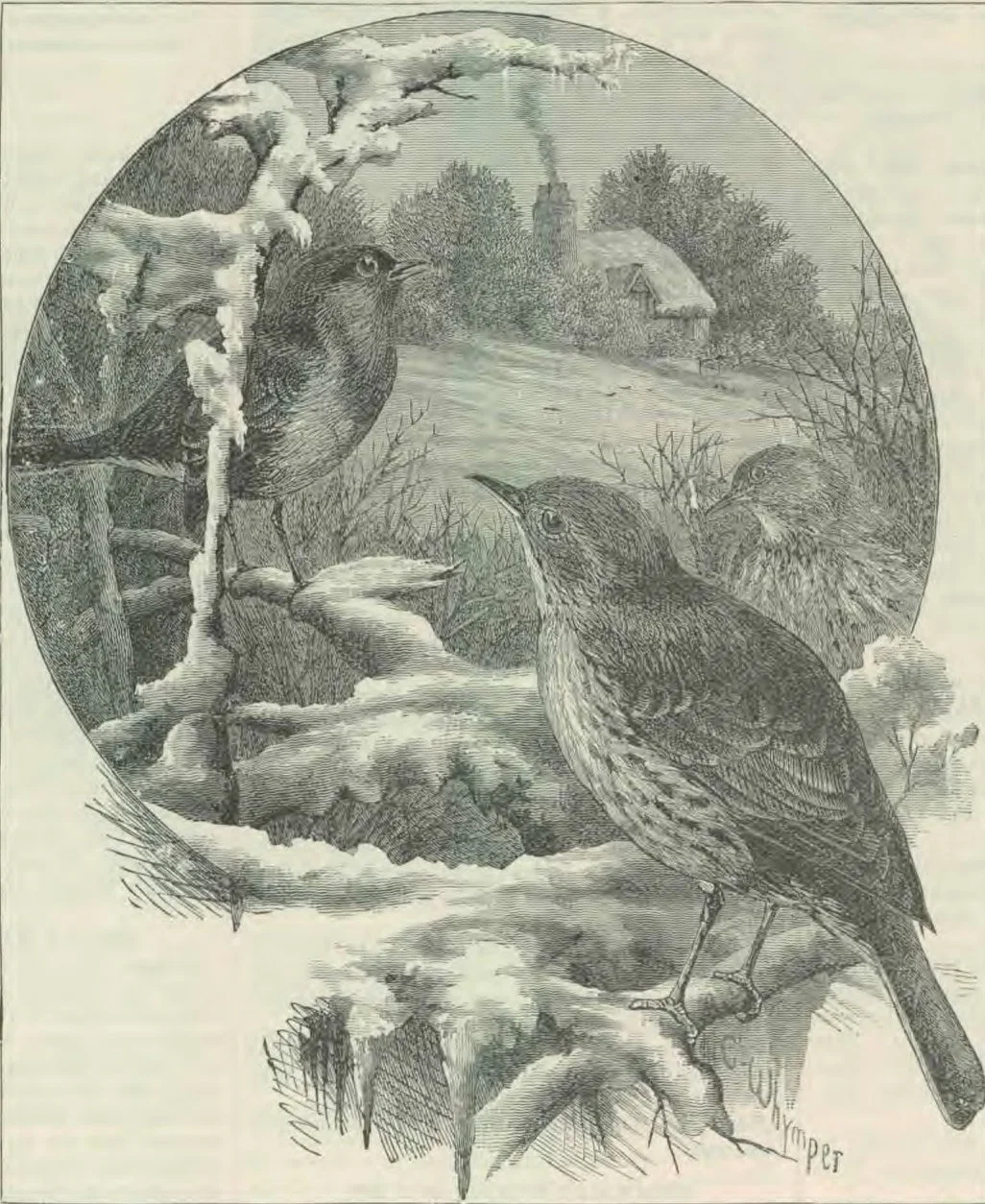
“Were it not for me,” said a chickadee, “Not a single flower on earth would be, For under the earth they soundly sleep, And never venture an upward peep Till they hear from me, Chickadee-dee-dee.”
“I tell Jack Frost when ’tis time to go And carry away his ice and snow, And then I hint to the jolly old sun, ‘A little spring work, sir, should be done;’ And he smiles around on the frozen ground; And I keep up my cheery sound, Till Echo declares, in glee, in glee, ‘’Tis he, ’tis he, the chickadee-dee!’”
“And then I waken the birds of spring: ‘Ho! ho! ’tis time to be on the wing;’ They trill, and twitter, and soar aloft, And I send the winds to whisper soft Down by the little flower-beds, Saying, ‘Come, show your pretty heads; The spring is coming, you see, you see, For so sings he, the chickadee-dee.’”
The sun he smiled, and the early flowers Bloomed to brighten the blithesome hours, And song-birds gathered in bush and tree; But the wind, he laughed right merrily As the saucy mite of a snowbird, he Chirped away, “Do you see, see, see, I did it all. Chickadee-dee-dee.” —Selected.

THE MESSAGE ON THE FAN.

More than fifty years ago a missionary to India was sitting on his veranda, languid with illness and hard work, and longing for the opportunities to preach the gospel which his lack of strength denied him. It was a sunny day, but the veranda was cool and shaded. The air was sweet with the perfume of flowers, and there were curious people, strange sights and sounds enough to have attracted the attention of one not accustomed to life in a heathen city.
But the missionary’s thoughts were busy with a little band of native Christians who were about to gather for instruction from the word of God, and with whom, alas! he could not meet; and then with the crowds of heathen on the streets, thronging the temples and the bazaars.
Day after day he had stood among these crowds, telling them the story of a Saviour’s love, selling or giving them Christian books and parts of the Bible. How much they remembered of what he said, how many had read the little books, he did not know; yet he loved to think that in this way the gospel had found its way to many hearts and homes. But to day all this must be left to other hands. Close beside him was a palm-leaf, large and clumsy, but a comfort in a climate like that of India.
“Its beauty is not in its shape,” thought the missionary, “but I would like to send it on a message. I believe I’ll try an experiment.”
Taking an iron pen, he traced on the broad leaf the story of Christ’s life, of his death for sinners, and his gift of everlasting life.
After the meeting was over, the natives came flocking in to see the teacher. Among them was a new-comer, a stranger who had followed on into the compound, eager to gratify a curiosity which had been awakened by the singing of the hymns. The missionary was too weary to talk, but he gave the fan to the unknown visitor, told him there was a message on it for him, and bade him come the next day for an explanation.
The next day came, but not the native. The missionary gradually regained his strength, spent his life in India, and finally died. But he never heard again from his unknown visitor or the message on the fan. For all he knew to the contrary, the “experiment” was a failure. Yet all the while that message was doing its work.
Not very long ago another missionary in India was surprised by a visitor who came not from curiosity, but with a message from one of the tribes of Central India, where few, if any, missionaries have ever gone. The native was himself the chief of his tribe, and he presented an earnest plea that a teacher might come and live with his people, to teach them the way of life.
And what sort of letter of introduction do you think he brought with him? It was none other than the palm-leaf, on which, so many years before, the missionary had traced the story of Jesus’s love, worn almost to shreds by frequent readings.
“Where did you get this?” inquired the missionary. “The Most Holy sent it to us,” replied the Hindu.
And then followed a story more strange than any romance, how a chief of a neighboring tribe had given it to him with the assurance that he had seen a holy man, who had put the message into his hands; how he had kept it a long time, how the people had given up idol worship, opium chewing and smoking, and in some cases the use of intoxicating drinks, till now they were feeling the necessity of leading a holy life, and a desire to know more of God.
“All the tribes about us,” urged the chief, “beg that some one may come to teach our people about the Lord Jesus Christ, and how we are to love and serve him.” All this blessing came from the missionary’s experiment, the messenger-fan sent out on its mission so long ago. You may have heard the story before, but its meaning is ever new. It is only another version of an older story, written thousands of years ago, which reads: “My word shall not return unto me void, but shall accomplish the thing whereunto I sent it.”—The Gospel in All Lands.

HER PLACE.

“THERE'S no use, Aunt Emma. I can't think of anything that I do well enough to earn a living by it. I surely can't wash, and as surely can't teach school, or tend in a store, and there are more to sew now than are needed. What I shall do is a conundrum over which I've been puzzling these three weeks. I seem to be no nearer its solution, but I'll never give it up. Somewhere in the world there's a place for me, and I'll find it yet!”
From the look of determination on the speaker's face, one might be sure she would make good her words.
“You know you are welcome to stay here, dear, forever if you like. We would all be glad to have you.”
“I know, Aunt Emma; I feel very grateful to you for all your kindness, more grateful than I can express; but you don't need me, and if I staid here, it would be as a dependent upon your charity, and my father's daughter could never fill that position gracefully.”
There was silence for a time, as the two ladies sewed busily, the elder with a steady, restful manner, like one, who, having found her place in life, takes placid content therein; the younger, with rapid, impatient fingers, and a brow clouded by thought.
At length she folded the garment on which she had been working, laid it on the pile beside her, and carried them all to her aunt. That lady said, “Thank you,” and looked at the neatly-mended garments with a most gratified air, saying as she did so:—
“Well, my dear, you needn't feel that you are dependent on me while you mend like that, for you are worth your weight in gold. Two or three of those garments—now as good as new, thanks to your skill—would have gone for rags; for positively I cannot find time to do all of such work that needs to be done, but do what I can, and let the rest go.”
Laura said she was glad she had helped her, and turned to go, with the same preoccupied, thoughtful look. She had taken but a few steps when she paused, turned toward her aunt, and exclaimed:—
“Does every housekeeper have as much mending as you, aunt?”
“Why, yes,” that lady replied, wonderingly; “more usually, and ever so much more where there are children.”
“Then that's my business. I'll go from house to house and mend.”
“What are you talking about, child?”
“I'll show you in a week or two.”
In the Daily Record two days later, there appeared the following:—
“Miss Laura Baldwin, No. 8 B St., will mend and repair neatly at the houses of those who desire her services, for fifteen cents per hour. Telephone connection.”
“The idea took,” as the saying goes, and Laura soon had her hands full, while her aunt comically remarked that the telephone bell rung incessantly. A handsome hand-bag contained an assortment of silks and thread, scissors, thimble, etc., and with this equipment Laura went from place to place, earning a comfortable livelihood.
She made it a rule from the start that not one word of gossip should be told her at any house; and when she went from Mrs. B.'s to Mrs. A.'s, she was “as dumb as an oyster” in response to all inquiries, were they ever so smoothly worded. People soon found this out, and she was welcome wherever she went, keeping all her old friends and making more. So daily she walked her pleasant, independent way. Her bank account grew, and her purse allowed her luxuries for herself and gifts to others, and she laughingly assured her aunt that her place, once found, was vastly comfortable.—The Household.

THE STRAITS OF MACKINAW.

If you will take your geographies and turn to the map of Michigan, you will find there represented “a narrow neck of water connecting two larger bodies,” Lakes Michigan and Huron. This neck of water is called the Strait of Mackinaw.
Look again, and you may find a large island whose name is spelled Bois Blanc, and pronounced Bwa' Blo. Northwest of that island is a much smaller one, the Island of Mackinac.
Long, long ago, so runs a legend of the Ottawa Indians, there lived upon this island a very unfortunate people called “Mi-shi-ne-mac-i-naw-goes,” who were entirely destroyed in a war with the Senecas. They left, however, as a substantial token of their existence, their tribal name, from which the present name of the island and straits was derived.
There is a little village of about five hundred inhabitants, and a historical fort, garrisoned by U. S. troops, upon this island.
On the northern shore of the straits is the thriving city of St. Ignace, and opposite it, on the southern, the village of Mackinaw City, near which lie the ruins of Fort Mackinaw, whose garrison was massacred during the progress of the Conspiracy of Pontiac.
There is not a more delightful region than this in all the State in which to spend the summer months. Its blue waters, dotted with islands, white-winged vessels, and steamers, its varied scenery, and its pure, invigorating air, make it very attractive. Here is the scene of many a thrilling historical incident and beautiful Indian legend, which lends this region a peculiar charm. Thousands of tourists visit this locality every summer.
During western storms, the straits are very dangerous, and wrecks occasionally occur. An extensive commerce is carried on across the straits by means of steamers which connect with railroads at St. Ignace and Mackinaw City. Formerly, the steamers would get ice-bound in the winter for two or three weeks, and all the passengers and merchandise had to cross the straits on the ice with teams. Last fall, however, there was constructed, in Detroit, a huge iron vessel, designed to crush the ice and keep a passage open all winter. This boat is a very odd-looking craft, not exactly handsome, but well adapted to its purpose, running through and crushing the thickest ice with great ease.
The snow gets quite deep here in winter, and the girls and boys go to school on snow-shoes.
There are many other interesting things I should like to tell you about Northern Michigan, but which I must leave till another time.
FRED ALLISON HOWE.

CROMWELL'S COURAGE AS A BOY.

OLIVER CROMWELL, when a boy, was just as full of fun and frolic as boys are nowadays. Once when he had incurred his mother's displeasure by some of his school-boy pranks, she inflicted a severe chastisement, and sent him to bed many hours before dark.
Some time had elapsed, and the boy was still sobbing with pain and anger, when a servant, entering the room on some errand, chanced to say that her mistress had gone to see a sick friend in the village, and expected to shorten her walk by coming home across the pasture-field. As soon as the girl had gone out and closed the door, the boy sprang out of bed, and hurrying on his clothes, left the house without attracting notice. He paused long enough at the tool-house door to seize a light spade, and then set off in the direction from which his mother was expected to return. He had passed over the greater part of the mile when he met his mother. She was much surprised at seeing him, and sharply demanded his excuse for disobedience.
“There—there is a savage bull in the next field,” he exclaimed, still sobbing with excitement. “He was only put there yesterday, and I was afraid you did not know he was there, and would venture into the meadow alone. You see I have come prepared to defend you,” he said, holding up his spade. “I was afraid that your red shawl would anger him, and I slipped out to warn you of the danger.”
“You are a noble boy, Oliver, and I am proud that you are my son,” said his mother.
His loving thoughtfulness and care had touched her deeply, and she allowed the brave lad to escort her across the field where the dangerous beast was grazing.
Great as was his bravery in facing the furious animal, it was not to be compared to his moral courage in at once subduing his resentment toward his mother to go to her assistance.—S. S. Classmate.

“I THINK I HAD BETTER MIND FATHER.”

SCATTERED all over the coal regions are great holes, made by the sinking of the earth after the coal has been taken from the mines. The miners know when there is danger of a cave-in, and if along the public road, some signal is given to travelers.
“These cave-ins generally happen at night, when few persons are passing; but there have been cases in which horses and wagons, and even houses and people, have been buried by the sudden sinking down of the road when it was thought safe to travel over.”
Let me tell the little folks a true incident of how a boy, not very long ago, escaped going down with one of those cave-ins.
A part of the road, between what is called the Logan Colliery, in Schuylkill County, Pennsylvania, and a town two miles distant, had been condemned, and a fence was put up to separate it from a new road which had to be made. This new road ran for some distance close by the old one, and then branched off, making the distance much longer from the town to the colliery. But, as the condemned road was nearest, the miners for some months continued to go over it, to and from their work.
One evening a miner living at Logan’s Colliery, sent his son Willie to the town on an errand.
“It will be after nightfall, son,” said his father, “before you get home; on no condition return on the condemned road.”
On his way to the town, it being yet light, Willie ran quickly over the dangerous pathway; and having done his errand, he started for home. He was tired, for he had been working all day, and when he reached the fence that separated the safe from the unsafe road, he stopped, and, as he afterward told it, thus reasoned with himself:—
“I am tired, and if I take this short cut, I will soon be home. I believe I will risk it. But father said, ‘Do not return over it.’ I can’t see any danger; the men go over it every day, and it was safe two hours ago—but father told me not to return over it—and—I think I had better mind father.”
So he jogged along on the side of the fence where the earth was firm. The stars shone brightly, and he could plainly see his way. When he got to the middle of the fence, he felt the ground shake, and, to his horror, saw the condemned road disappearing from his sight.
He stood still for a moment, awe-stricken at the escape he had made; for had he not obeyed his father, he must have gone down with the sinking earth and been buried alive.
When he got a little over his fright, he hastened to the house of the watchman, and, pale and trembling, gave notice of the danger, and also told of his own narrow escape from a frightful death.
To children who obey their parents in the Lord, has been given the promise, “That it may be well with thee, and thou mayest live long on the earth.”
How true Willie found this promise!—Lutheran Observer.

COME OUT OF THE PAST.

COME out of the past, it is gloomy with shadows; Come into the sunlight and cheer of to-day! See, here are fresh flowers a-bloom in life's meadows; Why cling to dead hope-buds laid thick with decay?
You cannot restore by your grief and regretting, What slips from your grasp down the pathway of years; Though you weep and lament till your life's sun is setting, The past will be deaf to your passionate tears.
Come out of the past! the present is teeming With work to be done; the world's needs are vast; They wait at your door,—be doing, not dreaming. Shirk not to-day's duty, come out of the past! —Emma C. Dowd.

CHAINS

I ONCE knew a boy whom I loved dearly. His eyes were clear and bright, and his cheek was ruddy with health. It filled me with delight to see his fair young face, and to meet the loving glance of his frank eyes.
But a change, subtle and almost indefinable, came over him. His eyes no longer met mine with candor, but seemed to evade me, as if they had something to conceal. I was troubled, for I knew that all was not right. Gradually his complexion took a sallow, lifeless hue, and his mouth and teeth were often discolored.
Finally I learned that he was using tobacco, and then the truth burst upon me clear as noonday. Here was an explanation of the altered demeanor, the sallow complexion, and, alas, the changed character. He had fastened a chain about his neck, to drag him down from all things high and noble. He had opened the way for one vice, and others were sure to follow. He had yielded to an enemy that would stupefy his brain and crush all good impulses. He has brought heartache to those who love him best. He is young, and may yet reform. But how much easier it would have been for him never to have begun this vile habit!
He who indulges in the use of tobacco and kindred evils, finally becomes a slave to the power of habit, and, worst of all, forges his own fetters. With every indulgence, he adds another link to the chain which degrades him. Keep your young minds clear and your eyes bright. Do not make your mouths pits of corruption. Be men, not slaves. VIOLA E. SMITH.

Andrew Marvel and the Bribe.

Andrew Marvel, a poet of some little fame, was chosen as a member of Parliament for the borough of Hull, in the reign of Charles II. He was a man of integrity and spirit, and such persons seem to have been rare in that reign. The Government, wishing to bring over to their side so important a person, and believing that a man of no fortune could readily be bought, sent the lord treasurer, who had been his school-fellow, to see Marvel. Danby, at parting, slipped into his hand an order for £1,000, and then went to his carriage. Marvel called the treasurer back to the garret, and then summoned Jack, his servant-boy.
“Jack, what had I for dinner yesterday?”
“Don’t you know, sir? The little shoulder of mutton you ordered me to bring you from the market.”
“Quite right, child; and what have I for to-day?”
“Don’t you know, sir, that you bid me lay by the blade-bone to boil?”
“’Tis so; very right, child; go away.” Then, turning to the astonished treasurer, he said: “My lord, do you hear that? Andrew Marvel’s dinner is provided. There is your piece of paper; I want it not. The ministry must seek other men for their purpose; I am not one.”
Marvel’s upright conduct made him very obnoxious to those in power, and at his death there was some suspicion that he had been poisoned.—Sel.

HOW A PONY HELPED FLY A KITE.

Hal and Johnny were making a kite. When it was done, they said, “Now we must go and fly it.” So off they started.
Hal went first, carrying the kite; and Johnny ran along behind, holding the end of the kite’s tail in one hand, and the ball of twine in the other. After a short walk, they spied an open lot all fenced round, and Johnny said, “Here is a good chance, Hal.”
“Yes,” said Hal, “but there is a pony in there.”
“No matter; he will not care,” answered Johnny.
“Well, we will try it,” replied Hal; and the two little boys pushed the kite carefully under the fence, and then crawled through themselves.
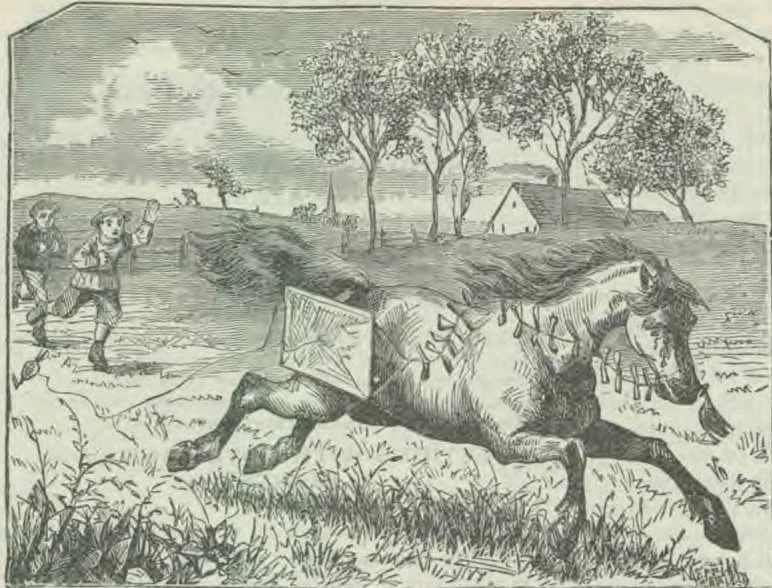
The pony was quietly feeding in a far-off corner. But he was young and frisky; and when the boys began to shout and run, trying to get their kite up, pony thought it meant fun. He pricked up his ears, and began to trot toward the party.
The children were so busy that they did not notice the horse. Hal was running with the string, and calling out to Johnny, who was holding the kite, “Let go! let go, Jack!”
Suddenly the pony sprung into a gallop, and in a moment was between the two boys, with the tail of the kite caught in his mouth, and twisted about his head.
When Johnny saw the pony coming so fast, he began to run away, and Hal dropped the string, and did the same. The pony, when he found he had hold of such a queer thing, was so frightened that he ran faster than either of them. The kite dangled at his heels as he cantered, adding terror at every step; and the ball of twine, unwinding far behind, was bobbing up and down.
Soon pony came to the fence, which he cleared with one bound. Here the cord snapped, leaving the ball on the other side, while the frantic horse rushed on through the street. The little horse never tried to fly a kite before, and it was not strange that he made funny work of it.
On and on he ran, the kite’s tail so twisted around him that he could not shake it off, and the kite, torn to bits in the race, still thumping against his heels. By and by the poor creature got so out of breath that he could not run any more. A kind man went up gently, and patted him. Then he stood still while his good friend unwound the string, and put on a bridle.
Hal and Johnny, all out of breath too, soon came up, only to find their kite a perfect wreck.
Pony was led back to his pasture as gentle as a lamb; and Hal and Johnny went to work to make a new kite. But both of them thought pony was not much help in kite-flying. This is a true story.—The Nursery.

GOOSE-GIRLS

“You are a little goose, Lottie, just as I said down at the brook.”
“I shall tell mamma what you call me, Eddie Sizer; you know she don’t allow you to call names.”
“Well, here she comes; tell her quick,” said Eddie.
“What is it now, children?” said mamma, coming into the room; “teasing again? How much nicer it is to live happily together.”
“I didn’t mean anything bad, mamma; I just called her a little goose because she was afraid to ride on my raft. I only meant that she was a little coward,” said Eddie.
“The teacher said to-day that to call a person a goose was to call him foolish, a simpleton,” said Lottie. “Everybody says Jim Perkins is a simpleton, and is foolish, because he don’t know anything. I don’t like to be called that.”
“I didn’t think about Jim Perkins,” said Eddie; “of course I wouldn’t call my sister anything like him.”
“Well, Lottie, if Eddie had called you a coward instead of a goose, I suspect you would not have cared very much. But I am glad you felt timid about getting onto the raft; for I am fearful myself that it will sometime sink, and give you more of a ducking than either of you would care for. But how would you like to be called ‘goose-girl,’ as girls in Europe are sometimes called?” asked mamma.
“O mamma, please tell us all about them,” chimed in both of the children.
“Well, let me see how I will begin. You, Lottie and Eddie, write with a steel pen, but do you know that it is only about a hundred years since this kind of pen was invented? Before that time, for some 1,300 long years, people used quill pens, which were made mostly from the quills of the goose. And now, in some of the most important European countries, steel pens are not very often used, the goose-quill pen being liked better.
“It takes a great many quills to make pens for all the people who use this kind of pen, and there are only four or five quills in each wing of a goose that are nice for pens; so should you ever travel through some parts of England, France, and Germany, you need not be surprised at seeing great flocks of geese. Sometimes one man will own as many as a thousand.
“The geese have to be driven to water and to pasture regularly, the same as sheep. They are divided up into flocks, several of which are placed under the care of a person who will look after them real well to keep their feathers in good condition; for it is on this that their sale depends. The man who has charge of geese is called a ‘goose-herd.’
“It is quite common to give the care of these flocks to girls, who make it their summer’s business. In the morning, before it is fairly light, they may be seen driving their flocks to pleasant pastures. And probably the most difficult part of their task is driving the geese to and from the meadows; for it is their nature to stretch out their long necks to cackle and hiss at every passer-by, and while they are doing this they cannot be made to go very fast. It is said that geese will travel only about a mile an hour.
“The ‘goose-girls’ take their work with them, and to the few cents they earn in caring for the geese, they add other pennies earned by sewing, knitting, etc., while serving as goose-girls. They lead very happy lives in the open air with their cackling broods.
“It don’t seem so very bad to be called goose, after all, does it, mamma?” said Lottie.
“It most always saves trouble, though, to call persons and things by their right names,” said mamma.
M. J. C.

ON DUTY.

Uncle Alex came out on the back piazza with his newspaper, and was just going to seat himself in one of the arm-chairs, when a very large spider, weaving its web among the vines, attracted his attention. He went closer to look at it, and presently called to Neddie, who was playing in the yard, “Neddie, come and see this huge spider.”
“I can’t come now, Uncle Alex,” replied Neddie; “I’m on duty.”
Uncle Alex stopped looking at the spider, and looked at Neddie. He had a paper soldier cap on, and, carrying his toy gun, was gravely pacing up and down before his tent, which was pitched on the grass under the big cherry-tree. Will Ramsey and two or three other boys were in the adjoining meadow, galloping around on sticks, and flourishing wooden swords. There was probably a battle going on, though the cows, chewing their cud under the trees, didn’t seem frightened a bit.
“What are you doing?” asked Uncle Alex.
“I’m a sentinel keeping guard,” said Neddie.
“Can’t you come over here just a minute, if I watch the tent?”
“No, indeed,” answered Neddie, decidedly. “Soldiers mustn’t go away a second when they’re on duty.”
“Well, well,” said Uncle Alex, seeming quite amused, as he sat down to his paper.
Towards the close of the afternoon, when the tent was deserted, and the boys were playing something else at the other side of the house, Neddie’s mother came out onto the porch from the kitchen, carrying a small basket. She looked hastily around, and then called, “Neddie! Neddie! where are you?”
“Here, mamma!” he shouted, bounding around the corner of the house and up the steps.
“I want you to go over to the store and get me two pounds of sugar and half a pound of raisins,” said his mother, adding, as she gave him the basket and some money, “Now don’t be gone long. I’m making something good for supper, and want these things as soon as possible.”
About ten minutes after Neddie had gone, Uncle Alex started to the post-office. When he reached the little brook that had to be crossed to get to the village, he saw Neddie standing on the bridge, throwing pebbles into the water.
“Hallo!” he said, “I thought you were on duty.”
“No, sir,” replied the boy, looking up in surprise; “we’re not playing soldier now. Mamma sent me on an errand.”
“Did she send you here to throw pebbles into the brook?”
“No, sir; she sent me to the store for something.”
“I thought I heard her giving you a commission which was to be executed with promptness and dispatch, and knowing you to be such a soldierly little fellow, who could not be tempted away from duty a moment, I wondered, rather, to see you standing here,” and Uncle Alex knit his brows as though he was trying to study the matter out.
Neddie, with a puzzled expression, looked steadily into his uncle’s face for a moment or two, and then turning toward the village, was off like a flash.
Uncle Alex was standing on the post-office steps reading a letter, when he happened to see Neddie come out of the grocery store with his basket, and walk rapidly homeward. Some little boys on the other side of the street also spied him, and, running over, surrounded him, evidently wanting him to stop with them a little while. But Neddie kept on his way. He realized that he was on duty.—Sunshine.

A CHILD'S MISTAKE.

Said a dear little girl, and I heard her myself, As she reached for a book on the very top shelf: “How I wish I might live like the birds and the flowers, With nothing to do through the beautiful hours; Or else like the sun that has only to shine, Or dance with the shadows that hide in the vine! But no! I must study from morning to night. Long sums I must add; there are copies to write; To school I must go, and for, oh, such a time! It's just like a terrible mountain to climb. Dear! dear!” and the child, with a pitiful frown And a heart-piercing cry, to her grammar sat down.
Then flashed a fair sunbeam full into her face, As if challenging frowns in so lovely a place. “Why, darling,” it laughed, all a-quiver with glee, “If you want to see work, you must travel with me. I never am idle the swift-rolling day, But I go to my tasks in the spirit of play; And wherever I'm ordered, there straightway I fly; Cheer up, little maid!” said this voice from the sky.
There was heard a quick flurry of wings overhead From an army of birds; and, as southward they sped, Came, clear as a bugle, the leader bird's song: “You are wrong, little lady! I'm sorry you're wrong! And I can't stop to tell you,” he sang as he flew, “But no one is happy with nothing to do!”
And the flowers? A rose, peeping in at the pane, Breathed gently this message: “In sunlight and rain, We children of earth, dear to all who behold, Wear meekly our splendors of crimson or gold. And, born in the purple, we royally spend Our fragrance in blessing, until our lives end. We seem to be idle, I grant, but you know There's never a flower that has not to grow; And growing, dear child, means aspiring, see, As I, when I whisper so softly to thee.”
She picked up the book; it had dropped from her hand; “At least,” said our pet, “I can this understand: God gives all his creatures some duty each day, And mine is, perhaps, just to trust and obey. I'll not think of the mountain before me to climb, But cheerfully mount it, one step at a time.” —M. E. Sangster, in S. S. Times.
Continue reading: HALF AN APPLE