RIO GRANDE.—We had a good meeting at Taquari, in Rio Grande, attended by over fifty of our brethren. It was held September 9-13. The brethren were greatly benefited. Two were baptized. The preaching was all in German, and was translated into Portuguese. While at the meeting, a telegram reached us bringing the news of the death of one of our promising young men in Rio de Janeiro. He had been selling our papers there, and died of yellow fever. The conference will feel his loss very much. We rejoice to read the good reports of the work at home. May the Lord guide all to a speedy victory.
J. W. WESTPHAL
St. Thomas and St. Vincent
By Mrs. A. J. Haysmer
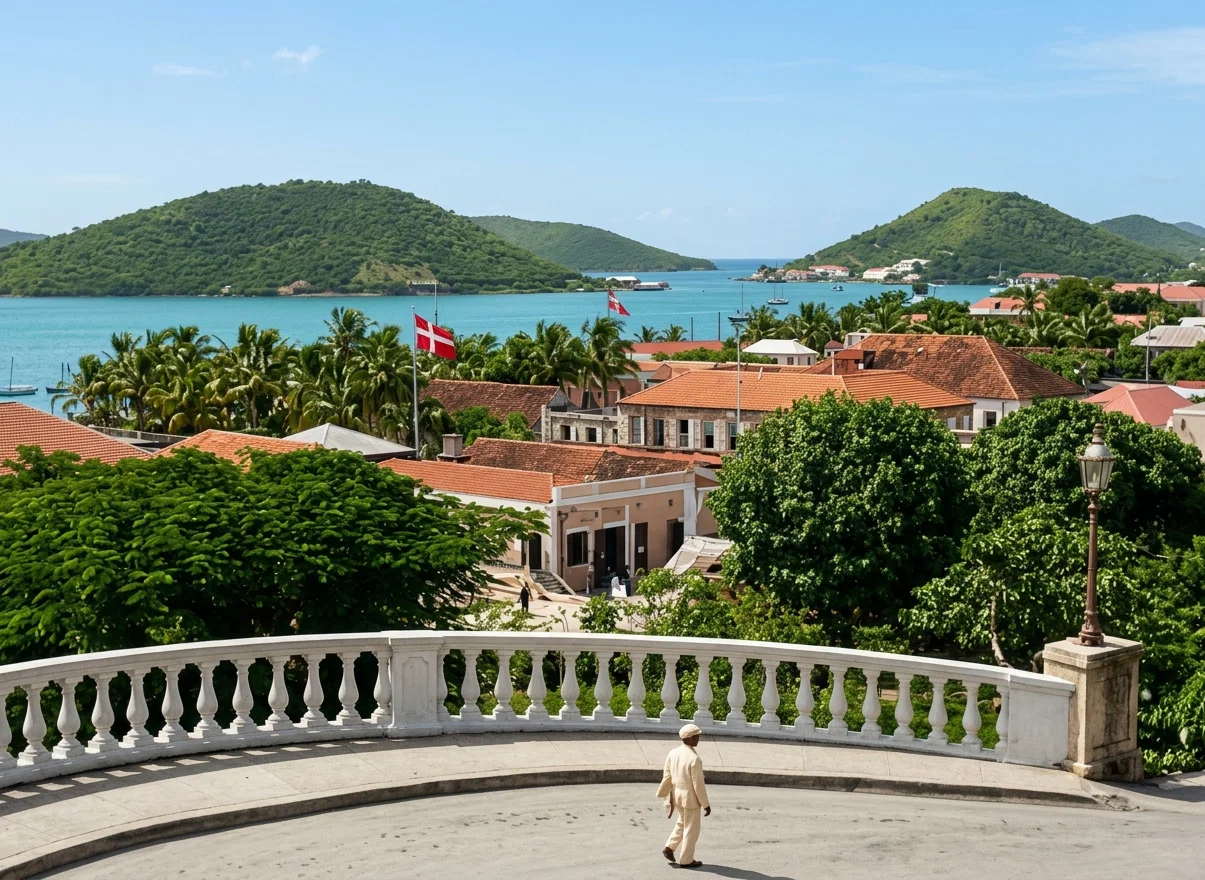
IN December of 1900 we landed on the island of St. Thomas, Danish West Indies. Meetings were immediately begun, and a church of twenty-four members has been organized.
As this place is at one side of Mr. Haysmer's work, it was decided for us to return to Barbados. Accordingly, Brother Palmquist moved back to St. Thomas, to look after the work there. Our things were all packed to ship to Barbados, when word came that smallpox had broken out there again. Had the word come a few hours later, our goods would have been shipped, and we do not know when we would have got them, as all the islands are quarantined against Barbados. We are grateful that the Lord intervened.
It was then decided that I should come to St. Vincent, to assist my father, Elder Van Deusen, for the present.
On my way I stopped a few hours at Antigua. I found the work progressing on their new church. They will have a fine place when it is completed.
VIEW IN ST. THOMAS
I also stopped at Dominica, and had the pleasure of making the acquaintance of two sisters, who are trying to hold up the banner there. This is a very pretty island. Immense quantities of lime juice are exported.
At St. Lucia I left the ship to wait for a direct boat to St. Vincent. I arrived there Friday morning, and remained until Monday night. While I was there, three meetings were conducted with the little company, and I had the privilege of helping Sister Simmons hold two meetings on board a transport ship carrying two hundred and sixteen Boer prisoners home to Africa from Bermuda.
It was the first time I had ever had anything to do with meetings on shipboard, and I shrank very much at first. But when I considered that these men, as well as all the English soldiers, had not heard of this message, I asked the Lord to give me something that would benefit them. The majority could understand English. I presented in a simple manner the coming of the Lord, and urged them to get ready for it. Tears were in the eyes of many as they grasped my hand at the close of the service and thanked me. How I longed for tracts to give them on these precious themes! But I did not have more than ten that I could get. I took a few names to whom we will send reading.
As they told me how they had left father, mother, brothers, and sisters, or wife and children, and had been taken prisoners, but were on their way to their homes, which were now desolate, I pointed them forward to a time when, if faithful, such things will never occur.
St. Lucia is a splendid place for ship work. If a good man were located there, we cannot tell how much good could be accomplished. This would not show so much in this world, but eternity would reveal the results.
We have had a number of eruptions lately from the volcano here on St. Vincent. In fact, it is not quiet very much of the time. But the damage is slight, as the people have all left that part of the island. The first time I saw one of its eruptions, it was at night, and the most we could see at this distance was the lightning. Two weeks ago another eruption occurred just before sundown, and the rays of the setting sun on the white steam clouds were a grand spectacle.
We have begun holding open-air meetings, and the people attend them well, from three to four hundred being present. We trust by this means to find some who would not otherwise learn of the truth.
We are of good courage to press onward. We see much that might be done, but we cannot reach out into all the places at present. May the time soon come when we can.
MRS. A. J. HAYSMER.
S. G. HUNTINGTON
By S. G. Huntington
Dedication
ON Sunday, November 2, at 3 P. M., a most pleasant dedicatory service was held at London, Ontario. For some time past the company of believers at this place have been contemplating the erection or the purchase of a house of worship. A few weeks ago the opportunity to purchase presented itself, and was duly taken advantage of at a most reasonable consideration. The building is located17on the corner of Osborn and Oxford Streets, in a very desirable part of the city. It is a frame structure, with auditorium, library, three side rooms, which may be opened up into the main room, and a large gallery. It is also well lighted, heated with hot air, and seated with chairs. In every way the house, which was previously owned by the Presbyterians, is modern, and well represents the cause to which it has been so recently set apart.
The report of the building committee showed that, including cash and pledges, the house stood free from debt. The ministers present at the dedication were Elder J. W. Collie, who delivered the address, Elder Eugene Leland, who had charge of the music, and the writer. The attendance, while not so large as was expected, was good, and the services very appropriate and interesting throughout. May the Lord abundantly bless the London church in its new home, and add such to its ranks as shall be saved.
S. G. HUNTINGTON
H. F. KETRING
By H. F. Ketring
Chile
THERE are a few Sabbath keepers at the mines in the interior, and I have recently visited them, more thoroughly to instruct them in the truth. They work in the copper mines, and I had a new experience in Chilean life. They are very poor, and their houses are made of sticks, with gunny sacks nailed over them. Everything is very expensive. A miner earns three dollars a day, Chilean money; but water, which is distilled from sea water, and transported into the interior, costs twenty-five cents a bucketful, eggs are twenty-five cents apiece, wood for cooking is twenty cents for a piece thirty inches long and as thick as one's wrist, and other things are in proportion. The hills and mountains are absolutely bare, without even a shrub. Notwithstanding, they treated me the best they possibly could, and I enjoyed my stay among them very much indeed.
While waiting at the port for my boat on returning home, I held Bible readings with a native family. The mother knew something about the truth, and she and a young native lady have decided to obey the Lord. These people are quick to decide one way or the other, and many of them are very firm when they decide for the truth. While the minds of these poor people, as in all the rest of the priest-ridden countries, are dwarfed and blunted, God, by his Spirit, can illuminate them; and they seem to shine the brighter for having been so darkened.
Later: I am now in the vicinity of the school land in southern Chile, where we will locate. On my way here I stopped a day to visit a brother. A native Catholic lady came in to study the Bible. She was thoroughly instructed in Catholicism, but seemed to be seeking the truth. I permitted her to suggest the points that she wished to study. One after another the doctrines of Catholicism were dwelt upon. At first she was very firm in their favor. But as the Word of God proved each one to be false, she expressed herself as thoroughly convinced. She then desired to know the most important thing to do, and as I showed these things to her, she rejoiced in the light. We studied until after eleven o'clock, and had prayers, and retired. The next day she desired to know if it would be in harmony with God's will for her to pray for the conversion of her brother. Of course I answered. Yes, and explained to her the nature of prayer. She desired baptism, but as I had to leave that morning, I promised to baptize her upon my return. The Spirit of the Lord was indeed present to impress truth upon this heart. To God be all the praise. He is greatly blessing me in acquiring the language, so that in a simple way it is almost as easy to teach in Spanish as in English. Pray that our God may direct us in fishing for men, as the Saviour directed the disciples.
H. F. KETRING
British Central Africa
By Mrs. Thomas Branch
CHOLO.—In company with our co-laborers, Brother Joseph Booth, his wife and little daughter, we sailed from Southampton on the “R. M. S. Saxon,” June 28, 1902, for our future field of labor in British Central Africa.
We sailed over a smooth sea for sixteen days, and arrived at Cape Town, South Africa. There we were met by Elders Reaser and Hyatt, who gave us a hearty welcome, and made our two days’ stay a very pleasant one. Cape Town is a beautiful place, with a large number of natives. A vast amount of missionary work needs to be done there.
Our next stop was at Durban, Natal, where we stayed for a week. While here, we had the pleasure of attending two services of the Zulus. Although they have not the light of the third angel’s message, their devotion, according to their light, is marvelous. No work is being done for the natives.
During our long and interesting journey we had varied experiences, some of them being very pleasant. We trust that all were profitable; we endeavored to make them stepping-stones to the kingdom, remembering that it is written, “In your patience possess ye your souls.”
At Chinde, East Africa, situated at the mouth of the Zambesi River, we were detained nine days by the British consul, because we were educated Afro-American missionaries. Brother Booth remained three days with us, working zealously to get the detention removed, but without success. Then he proceeded to Cholo to take possession of the mission. After the expiration of nine days we were permitted to proceed up the river. We left Chinde on the 14th of August, and arrived in Cholo on the 29th.
We were glad to reach our destination, where we were heartily received by Brother Booth and the natives, who were out to meet us in large numbers. Cholo is a beautiful place, situated among the mountains, three thousand feet above sea level. Many beautiful trees, flowers, and fruits cover the plains and mountains. Yet the marks of sin are visible everywhere.
This is indeed a needy field. It is the duty of Christian mothers to teach these heathen mothers what home is, and what are the duties thereof. They seem anxious and willing to learn. It needs only the wisdom and love of God in the heart to begin with them.
We have a flourishing school of about forty, some of whom are women and children, but the greater number are young men.
We are all in good health and of good courage. Our desire is to work until He comes whose right it is to reign.
Mrs. THOMAS BRANCH.
A Trip on the Cutter “Pitcairn”
By G. F. Jones
THIS is not the brigantine “Pitcairn,” but the “Pitcairn” of Pitcairn Island, recently bought for the Pitcairn people by the British government, in order to help them get rid of their produce and to enable them to connect with the mail at Mangareva, three hundred miles distant.
We sailed from Papeete, Tahiti, June 1, a bright, sunny morning. We expected to make a fine-weather voyage, if not a short one, on our trip to Pitcairn Island. When night came, we had to battle earnestly against head winds, and seas and currents which kept us in sight of Tahiti for three days. Our crew consisted of five men and the daughter of one of the crew,—six in all. We were cramped for room, as the boat accommodates only two; every day brought new difficulties. I have sailed many years all the world over in various ships, but I never before experienced such a trying and uncomfortable time. It seemed at times as if Satan had entire control of the sea, the wind, and the weather. It was our lot to encounter storms, high seas, and head winds for thirty days. Heavy rains, as well as taking seas on board, kept our clothing wet through for two weeks. Our teeth fairly chattered, and our limbs ached, and coughs and colds were prevalent. For more than two weeks, our meals consisted of dry sea biscuits for breakfast, and the same for supper. Most of us were troubled with salt-water boils. These are very painful, and generally come on the joints. I had a bad one on my knee, which compelled me to crawl about on my hands; indeed, one trouble after another kept coming, but through it all we sang praises to God night and morning. We understood well that these trials were permitted to test our faith in him, and that in his own good time he would deliver us out of all our distresses. His promise, “I will never leave thee, nor forsake thee,” was bright before us all the time. The good Lord filled us with courage and hope, took away all fear, and kept us cheerful in spite of our distresses. We were drawn very close to him; and while our provisions were running short, and the water had turned bad, there was joy in looking forward to our deliverance. Once we came within fifty miles of seeing Pitcairn Island, then we used up about all we had, expecting to arrive there in the morning; but a head wind set in, and drove us away near a dangerous reef, where we were tossed about in a storm for a week. This was followed by a calm, which drifted us away still farther; but the end of all this came at last, and a fair wind and a beautiful morning brought us to Pitcairn. Here a lifeboat came off loaded with our dear brethren from the island. O what a happy morning that was! They loaded our deck with the juiciest fruits I ever tasted.
Our experiences strongly reminded us of the fact that each of us is on a voyage to the heavenly Canaan, and that all that the elements of this world can do to hinder us on the voyage, only serves to let us know “what a Friend we have in Jesus.” We shall some day end our weary journey, and land on the “evergreen shore.”
“In that pure home of tearless joy
Earth’s parted friends shall meet,
With smiles of love that never fade,
And blessedness complete.
There, there adieus are sounds unknown;
Death frowns not on that scene,
But life and glorious beauty shine,
Untroubled and serene.”
G. F. JONES.
Louisiana
By S. B. Horton
THE work of spreading the message in this State has been steadily progressing. Four years ago there were two organized churches, one or two unorganized companies, and a number of isolated Sabbath keepers, most of whom were holding forth the word of truth to the best of their ability under circumstances calculated to try their faith.
Since then four churches have been organized, and additions in numbers as well as spiritual growth have been evidenced. Church schools have been founded, which have proved a great blessing to our work. The book work has prospered. A vegetarian restaurant is being operated in New Orleans, and we hope to see the medical missionary work develop to a proportion commensurate with the demands and opportunities. We have not the means with which to push the work in New Orleans, and therefore will be glad for any assistance which may come to us from friends who may be interested to see the work prosper in large cities. Some have assisted, but we need much more.
Recently we have been privileged to see the Lord work in a marvelous way. I pitched a tent in Laurents, a small village on Lake Arthur about twenty miles from Welsh, beginning meetings October 21. There has been a good attendance of both Catholics and Protestants. Sabbath, November 1, we organized a Sabbath school. Sixteen adults have already accepted the Sabbath, among whom is a Methodist minister and his family. It gave us all joy to hear his testimony on the night that he yielded to the truth. He admitted having opposed the work of Seventh-day Adventists at every opportunity afforded, but from henceforth he purposed to keep the Sabbath of the Lord. November 6 the subject considered was the “change of the Sabbath.” The meeting lasted until about ten o’clock, and others decided to follow the great Sabbath keeper, the Lord of the Sabbath, and not the lord of the Sunday institution. Land has been offered for a meeting house, and we believe that a good church will be organized at this place.
A word about “Christ’s Object Lessons:” we have been somewhat tardy in making a general campaign. But the Lord is blessing in this work. Nearly the whole quota has been taken by the churches, and we expect that by January 1 the whole quota will be in the hands of purchasers.
I shall be glad to correspond with any who may desire to come to this State, as well as with those who may wish to assist18us in our work in New Orleans. My permanent address is 305 St. Charles St., New Orleans, La. S. B. HORTON.
Report of College View (Neb.) Missionary Society for 1902
By M. I. Reeder
At our business meeting last January it was announced that our missionary society was dead. It had literally wasted away. For months the meetings had been poorly attended, and for two months discontinued altogether. The society had died insolvent, leaving a debt of $85.13.
Taking the status of the society meetings as an index to the missionary spirit among us, it was unanimously voted to attempt nothing in the way of public meetings, at the church, at least for a time.
But having no missionary meetings to attend, and no missionary work to do, we had a little more time for thought,—perhaps for prayer, which, as the sequel will show, was not unimproved.
At our next officers’ meeting it was decided to subscribe for fifty copies of The Signs of the Times, with which to begin work. This was done, and one sister took charge of the mailing, inviting her immediate neighbors to assist in wrapping and addressing the papers, the corresponding being done, for the most part, by those furnishing the names.
Then Professor Fulton, principal of the Argentina school, and one of our Union College boys, wrote to Brother and Sister Westphal of the needs of their school. As Brother and Sister Westphal had spent several years in that country, the letter touched a very responsive chord in their hearts. Small donations of money from the brethren began to come in, and the sisters began to sort their “quilt pieces” and “rug rags” and look over their dishes, but in each instance found that a little of this color was lacking, or more of that texture was needed, or perhaps a piece of the set of dishes selected was gone, but another sister had a broken set just like hers, and erelong the whole village was busy making up deficiencies.
In most of the districts the sisters met in small groups each week, sometimes as many as twenty-five of them at one place, and busily manufactured into quilts, rugs, curtains, etc., the materials collected, until two good-sized boxes were well filled. Eighteen sheets and as many pillowcases, towels and tea-towels, twenty-four quilts, twelve rugs, five pillows, five tablecloths, two bedspreads, dishes, pictures, mottoes, and many other smaller but not less useful articles found a place in these boxes. Thirty-eight dollars was also contributed. The Mission Board kindly forwarded the goods for us, and the appreciative letters received from Argentina gave a new zest to our work for the future.
A two-hundred-pound box of clothing and bedding was sent to the Life Boat Mission, and a sixty-pound box to private treatment rooms in the South. Two brethren gave forty dollars to assist the work in the South and toward a tent for Brother Boettcher’s use in Germany. Twenty of our number have each pledged ten cents a month for a year to advance the Woman’s Work in India, and one sister gives two per cent of her earnings for the same purpose; thus far her donations have been $9.70.
The Young People’s Society has two branch Sabbath schools in the city, with a fair attendance and good interest. They are distributing thirty packages of tracts each week. They have obtained seventy-nine subscriptions for The Life Boat in the village. These papers are gathered up from month to month, and used in their prison work. This part of their work is not so well systematized as they hope to have it soon.
Last quarter we subscribed for fifty copies of The Signs, fifty of the Hausfreund, and twenty of our Swedish paper. Ten copies of the German paper go to South America, the German brethren making special donations for this, as do the young people for their work.
We now have a missionary meeting each Tuesday afternoon at the church. While some wrap and address the papers, others mend old garments or make new ones to be distributed wherever most needed. Through the summer we closed our meetings with a study of the Forward Movement lessons, conducted by one of the sanitarium physicians. We are now beginning the field studies as found in the REVIEW.
Our fall campaign began with a box of bedding to the new treatment rooms at Wichita, Kan., a box of secondhand clothing to the Life Boat Mission, and a box of literature for a needy field in the West. This last was collected principally by the children, who take quite an interest in this kind of work.
During the month of October came added incentives to work, and our Dorcas society has received liberal donations of vegetables, fruits (fresh, dried, and canned), grains, groceries, etc., together with $8.81, to be used where needed most. We have made eight comforters and many other articles of bedding, besides doing considerable repairing. We now have five comforters ready to tie, and material nearly ready for several yards of carpet and rugs. We are preparing a box for the Huntsville school, in which we shall place some of these articles.
One of our sisters, while visiting in Dakota this summer, spoke of the work we are doing. As a result we have received many donations for our work, and others in our own State have caught the same spirit from hearing some of the appreciative letters we have received, and ask to be allowed to place their offerings with ours as we send them out.
Our church has not neglected the work with “Christ’s Object Lessons,” though we are not yet ready to sing the jubilee. Most of our resident members have disposed of their quota, or at least paid for the books, and we are by no means discouraged as to the ultimate results.
During this time our debt has steadily decreased until little more than a tenth of it remains unpaid, and we confidently expect to have a small amount to our account at the beginning of the new year. And so while planning to make the most of what comes to us, and to keep our fingers busy with their homely craft, our hearts are reverently lifted in the prayer,—
Lord, grant us eyes to see and ears to hear,
And souls to love, and minds to understand,
And steadfast faces toward the holy land,
And confidence of hope, and filial fear,
And citizenship where thy saints appear.
Mrs. M. I. REEDER,
Librarian.
Medical Missionary Work in the South
By B. E. Loveland
DURING the months of August, September, and October it has been my privilege to visit several places in Kentucky, Tennessee, and Mississippi, and to call on many of our people in their homes. As opportunity offered, we have had studies on the subject of medical missionary work. At Lexington, Ky., and Hatley, Miss., we were able to spend considerable time in this way, as I stayed five weeks at Lexington and three at Hatley. I also visited Graysville, Tenn., and Georgetown, Ky., and attended camp meetings at Cleveland, Tenn., and Quitman, Miss. At the latter we were able to have several studies, and the interest was good in all branches of our work. I shall now spend some time at my home, in Fayetteville, Tenn., where there will doubtless be many opportunities for advancing the cause of truth.
I find medical missionaries working in19every place. When a truth is accepted and built into the character, it will certainly work out and influence others. A former patient at the Sanitarium, speaking of work which she had done, said: “I did not want to do it, but I had to.” But shall we not, each one in his place, be both willing and progressive medical missionaries?
Every worker is bound to be a medical missionary, for it is all one work. Even the physician is able to help people only as he succeeds in opening the way for life from God to reach them. More of his life means better living, and the great question of “how to live” means how not to die; that is, salvation. In fact, the whole thing is the simple gospel (Rom. 1:16), and work for body and soul is so inseparably connected that we may speak of it as all the same work.
To be progressive missionaries we should not be satisfied to carry on one or two truths; but whenever we need more knowledge on any point, we should definitely seek for it and find it. In this way we shall become better and better qualified, and our scope of usefulness will steadily increase.
How to live is best taught by living; and as truth is thus woven into our character, we become more and more fitted for eternity; for truth is eternal.
As we study the living temple, we clearly see the things which belong to the invisible part of God’s universe. “Because that which may be known of God is manifest” in us. Rom. 1:19, 20. Natural law exists, because God always does things in the best way for us; and as we seek his way and not our own, we open the door and let him into every part of our body temple. His way (character) becomes a part of us, and we are transformed into his image.
B. E. LOVELAND.
The Dying Christ Reveals the Living God
“It is the dying Christ that reveals the living God.”
Treatment Rooms in Jaffa
By Mrs. S. Horner
THERE is plenty of work here, as elsewhere, and I am joyful that some are willing to prepare themselves for this field. There are calls from every part. We have bath rooms at Jaffa, and a large number of patients are treated every day, with good results in almost every case. The patients come from all the classes represented here. There are sometimes more seeking help than we can treat in a day, as my husband and I are the only workers here. We are very much in need of a trained nurse, for help in the bath room and in visiting patients at their homes. We should do some Bible work also, but we can seldom spare the time.
We are planning to accommodate some patients in our home, as they frequently come from the farther colonies, and would like to stay for treatment. The population of Jaffa is about fifty thousand. There are a number of European people here, besides English, Americans, and Jews. Some of the Arabs are quite well civilized; but the lower and middle classes can hardly read, especially the women and girls. There is much freedom for a physician, as the government is interested in the good done for the people. Once the pharmacist accused Mr. Horner before the pasha. He sent for him, but as Mr. Horner did not have time to go, the pasha came to the bath room. Before he left, he laid his hand on Mr. Horner's shoulder, and said, “You are just the man I want here,” and wished him success in his work, and told him that if anybody ever undertook to hinder his work, to come to him and report it.
The climate is not considered unhealthful, yet there are some cases of malaria and yellow fever. But if a person lives carefully, he can get along very well. The people here suffer from disease quite largely because of the manner in which they live.
Our work during the last year has been self-supporting, but we have been very busy. Fruit and vegetables are cheap, also some articles that are raised in this country. If a person spends twenty-five cents a day, he can live well. There is plenty of room for medical missionary work. Pray for us, dear brethren and sisters, that our work may be prospered.
Mrs. S. HORNER.
A Word of Explanation
By E. J. Van Horn
THE past few months I have been on a farm, hoping fully to recover from a disturbance in my nervous system. For ten years I have been troubled more or less with a jarring or pounding in my spine. This was caused by a drayman's letting a box of about thirty or forty pounds fall on my back while I was near the wagon, moving a tub of dishes. I was crushed to the ground, and so disabled that I could not walk for three weeks.
After taking treatment at the Sanitarium for five or six months, I was able to resume my work, but I still suffered with my spine; and as I grew older, it seemed to get worse. Last fall I was advised by several eminent doctors to retire from my mental work, and take absolute rest. During a tent meeting or a revival service lasting four or five weeks, I have found it almost impossible to get sufficient sleep to enable me to carry on my work.
Now, because I am not actively engaged in the work, many of my brethren and sisters are inquiring if I am discouraged. To all who may be thinking or asking such questions, I will say that my courage in the dear Lord is good, and my faith grows brighter, and the third angel's message is plainer, than when I first believed. I know that the third angel's message is present truth for the world to-day, and I hope soon to gather sufficient strength to enter into the great battle to help rescue many precious souls for God. I am glad to receive your kind letters, and thank you for them, and to you all, I say, Be of good cheer, Read John 16:33; 1 Cor. 15:58. E. J. VAN HORN.
General Notes
FOUR have been baptized in Kingstown, St. Vincent, during the last month.
FROM Port of Spain, Trinidad, Elder Haysmer writes: “The work is onward. On the day of my arrival here eight were baptized, and others will be baptized next week.”
BROTHER H. C. GOODRICH writes from Belize, British Honduras: “The interest in the mission is still good. The missionary spirit is growing, especially among the new members. Three are to be baptized next Sabbath.”
ELDER G. W. REASER writes from Johannesburg that the tithe is coming in well from the Transvaal field. He calls earnestly for another worker, and says that if the increase in funds continues, they will probably be able to support one or more workers themselves during 1903.
BROTHER J. E. FULTON reports that “a native Fijian has begun to preach the Sabbath truth in the Fiji Islands, though he never met any of our missionaries. He accepted the Sabbath through reading a portion of a torn tract, and quite a number have become Sabbath keepers by reading the native literature.”
BROTHER N. Z. TOWN writes from Buenos Ayres that Brother Ernst, who has been canvassing for El Faro, has demonstrated that yearly subscriptions can be taken with success. He is now securing from five to seven subscriptions each day; and they expect that when he goes into the country, he will be able to do even better, as he is now working in a suburb of the capital.
A LETTER received from Miss Cora Blodgett, written from London, England, reports the safe arrival of the missionary party in that city. She says they are all of good courage, and thankful for the privilege of a part in this great work. She reports the young people who have recently gone to London to connect with the school, as doing nicely, and glad to be there. She expected to sail for Natal, November 15.
MISS ELLEN BURRILL writes from Union College, Kenilworth, South Africa, that the workers in the school are of good courage. A change has recently been made in the college faculty. Mr. Charles H. Hayton is the principal, Mrs. F. L. Mead the matron, and Miss Commin has charge of the small boys. Miss Burrill is the preceptress. Besides these, there are two young men from the Colony teaching in the school—Mr. W. H. Haupt and Mr. A. J. Commin. Sister Burrill says: “I am daily more and more thankful that I can labor anywhere for my Master. It is a wonderful thing to be a laborer together with him. If all we receive from our labors were the joy we have day by day, I am sure we are well repaid. But when I think of the eternal life beyond, I feel to labor with renewed energy, that I may be ‘accounted worthy.’”
SINCE the close of the Erin, Tenn., camp meeting, several who had not before taken their stand have expressed an intention to join the company of those keeping God’s commandments.
BRETHREN R. R. KENNEDY and R. B. Thurber, who have been conducting a tent effort at Coal Grove, Ohio, report that several who have attended the meetings have begun the observance of the Sabbath, and have expressed an intention to obey all the truth.
A PROFITABLE canvassers’ institute closed the middle of September, in San Fernando, Trinidad. Thirty-six persons were in attendance. Of these, eighteen have gone out into the work. The territory has been divided into seven districts, with an agent in charge of each district.