The Youth’s Instructor, Vol. L., No. 51

New-Year Gifts

The Youth’s Instructor

December 25, 1902

Review and Herald Publishing Company · Battle Creek, Michigan · December 25, 1902

New-Year Gifts

“What dost thou bring, O bright New Year! What dost thou bring for me? Spring, with her blossoms sweet and dear, The song bird and the bee?”
“Yes,—and the Autumn, brown and sere, Follows the Spring. But know I bring a smile for every tear,— A balm for every woe.”
“What dost thou bring, O glad New Year! What dost thou bring for me? Summer, with skies so blue and clear, And breezes sweet and free?”
“Yes! And though Winter, dark and drear, Follows with sleet and snow, Still I bring hope for every fear, For every cloud a bow.”
ELIZABETH ROSSER.

New-Year Reflections

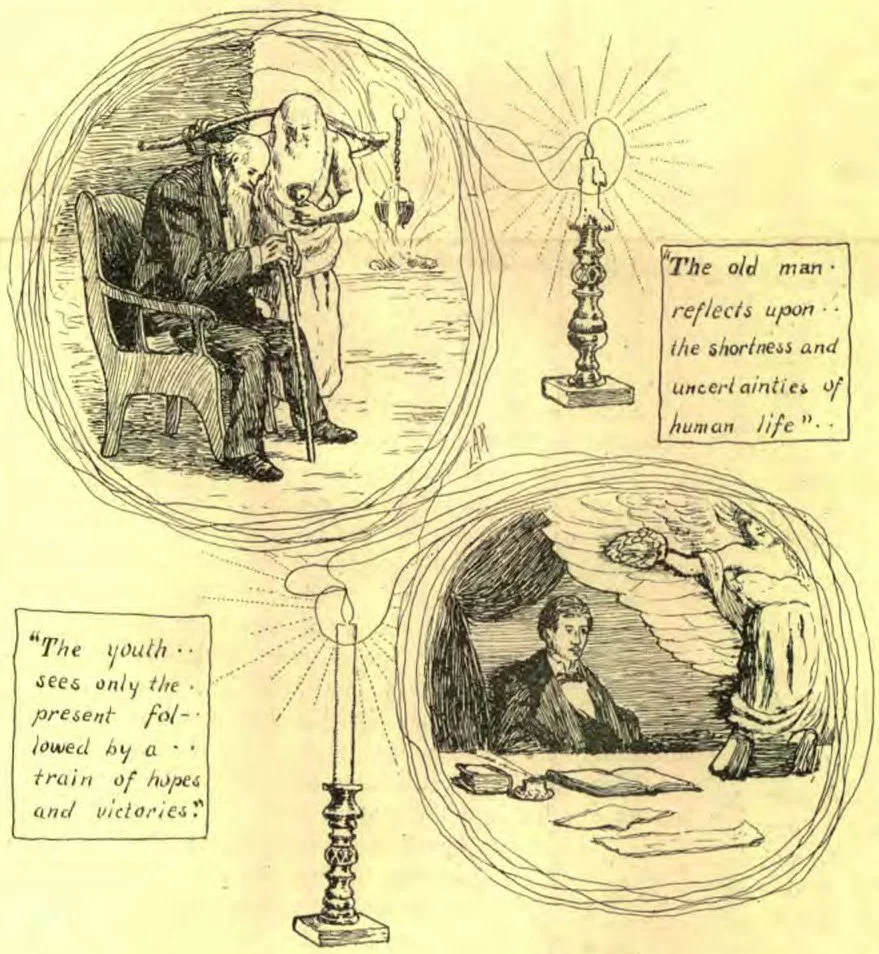
THE old man's tottering steps have brought him near the close of his journey. Around and behind him are the memorials of past associations. Above and before him are the visions of future glory and blessedness. The youth sees only the present, followed by a train of hopes and plans, associations, battles, and victories. The old man reflects upon the shortness and uncertainties of human life. He realizes that life has been to him less than it might have been. Time has been misspent, opportunities unimproved, talents unused, and plans have proved fruitless. He can not retrace his steps; indeed, he would not if he could. Once over the journey of life is enough for the weary traveler. At the end it is sweet to lay down the burdens at the Master's feet. There the aged pilgrim leaves his unfulfilled hopes, his mistakes and failures, with the plea that God knows all about it. “He knoweth our frame; he remembereth that we are dust.”
It is not surprising that the youth, with life all before him, should have different dreams on New-year's night. He laughs a hearty, “Good-by, old fellow! you have lived long enough. Thanks for your favors,” to the year that has brought him increased strength and enlarged opportunities. But he does not cling to the hand that is already cold, and has no more to give. For him the newcomer has far more chances. Each year that lies between him and the attainment of his earthly ideal seems long; and each is more welcome because it brings him nearer the triumph of his career. He has not yet learned that he is chasing a shadow.
This picture presents only the superficial view of life. Age does not affect its real aspects. From first to last, life is a constant struggle for victory. Life is a development, a growth; the goal is perfection We speak of the ripeness of old age, but the ripeness of this life is only the germ of the life everlasting. The children of God do not grow old; life, eternal life, is always before them. The narrow valley that divides this world from that which is to come is bridged by sleep so sound that it seems but a moment. Finally, at the coming of Christ, their borders touch, and we who are alive and remain step over.
The journey of life is quickly done, the brief tale is soon told. The grand object before us is to secure eternal life, for His sake who has so loved us. Faithfulness is the secret of success, and usefulness is the standard. The briefest life is long enough to win success. The longest life does not contain an hour to spare. God designs that every year shall bring us into higher paths and better living. There are no years that belong to Satan or the world. Each year spent for God marks a stage on the road to everlasting life. At its close we find an eminence from which we pause a moment to look back over the path we have trodden. The sight of our wandering steps may give us grief, but over all glows the golden brightness of the goodness of God. We also turn to look ahead. There are valleys and hills whose depths and steeps are yet unknown, but over the whole way is written, “I will never leave thee.”
If our years bear a record of faithfulness and usefulness, we may relinquish them with joy. We may welcome each coming year with increasing gladness, because as we go on, our light increases, our joy grows deeper. The infirmities of age need bring no fear, and even death itself wear no terror; for beyond them are Home and Father.
G. C. TENNEY.

Does It Pay?

Everything has influence, but nothing so powerful as a Christian. Every look he gives, every word he utters, every attitude he assumes, is not without its effect. He is a kind of magnetic battery, charged with moral energies, the unconscious influence of which aids to mold the character and shape the destiny of others. By virtue of his profession he stands in the world as a representative of the principles of heaven,—an ambassador for God,—and as such his daily life is either an honor or a reproach to the King whom he serves.
Margaret is a cultured, unassuming young lady of the church. Several years ago she was elected teacher of music in the city schools. A congenial home was found in a society family. Cards were the rage of the season, but this young woman always refused the invitation to play. One evening the hostess called at her room, and said, “Now, Miss E—, we want your company at the card table.”
“Sit down a moment,” responded the young woman, “and let me explain. I can not play—and I dare not. I have no time for it, and if I had, I could not conscientiously play cards. Moreover, if I did, my parents would be greatly pained.”
Two years have since passed, and not a game has been played in that home. That is not all. The other day, while waiting for a train, a young man stepped up to this lady, and said, “Pardon me, but I would like to speak a few words to you. For two years I have noticed your life in the schoolroom. You never said a word to me on religion, but the silent influence of your life has changed me from my boisterous ways to be a Christian. I am going to prepare for the ministry.”
Does it pay, young people? What pay?—To live a consistent Christian life? Ask that skeptical friend of Fenelon to whom not a religious solicitation had been extended, yet who left his home, saying, “If I stay here much longer, I shall be a Christian in spite of myself.” Of course it pays. Of Wilberforce it was said that the difference between him and his fellow Christians consisted in the exhibition he made of his religion. Not what we say, but how we live, is what tells. Actions speak louder than words—remember that! By living an exemplary life, we increase the general atmosphere of purity, “which acts upon society with irresistible force.”
Dr. Johnson said of Edmund Burke, “No one could be under the same umbrella for a few moments, and not feel that he was with the greatest man in England.” “No man can be truly great,” said another, “without a divine influence.” Do we, young people, want it? Does it pay to have it?—Of course it does. To be able to have it said that our noble living was the means of winning another boy or girl to Christ, is worth more than to be president of the United States. Let us, then, in the words of the poet pray:—
“More like Jesus would I be, Let my Saviour dwell in me; Fill my soul with peace and love, Make me gentle as a dove; More like Jesus, while I go, Pilgrim in this world below; Poor in spirit would I be,— Let my Saviour dwell in me.”
WILLIAM P. PEARCE.

The Self-Sacrificing Member

“Isn’t your sister here?” was asked of a young woman at a concert, one evening.
“No, only one of us could come,” was the reply, “and I couldn’t bear to miss it, and Mary said she didn’t care anything about it, so I came.”
“Mary is always the one who stays at home,” commented one acquaintance to another, “and Mary is the one who goes without, if there can’t be new clothes all round. She is the self-sacrificing member of that family. There’s almost always one in every household; don’t you think so?”
“Yes,” was the reply, after a moment’s consideration; “always in large families, and usually in small ones. Just think over the families that we both know. At the Blacks’, it is Sarah to whom the younger children always go for help or comfort. If Mrs. Black doesn’t feel like getting up in the morning, she knows that Sarah will see that breakfast is served on time, that the children will be started off to school in good season, and that the household machinery will be running smoothly whenever she may come down. And yet Helen is only two years younger, and there is no reason why she shouldn’t do her share.”
“And at the Browns’,” interrupted her friend, “it is Edward who gives up his wishes and plans in order that his sisters may be happy, and they seem to do so little for him! Then there’s Mrs. White, who is in danger of forgetting that she has any rights or preferences, so anxious is she that everything should go just as Mr. White wishes it.”
“But at the Snows’ it’s just the reverse,” returned the first speaker. “Mr. Snow is the unselfish one there. He always forgets himself in planning for his wife’s comfort and pleasure, and he never allows her to do a thing for herself that he can do for her. But, naturally, we have thought of the most extreme cases first, and I can think of some households where the giving up seems to be quite evenly distributed; yet I do believe there are more families with a self-sacrificing member than there ought to be. It is usually the mother or eldest daughter, but not always, for Mr. Snow and Edward Brown are not the only unselfish men.” Then, after a pause, she added: “I never thought of it before, but I’m afraid our family has a self-sacrificing member, and I am not the one, either; but, now that my eyes are opened, I shall insist on taking my turn at it.”
What a new order of things there would be if we all could have our eyes opened, and insist upon taking our share of the family burdens and sacrifices. Half of the selfish people in the world wouldn’t be so if they could see themselves as they really are; but they have been so accustomed to having the best of everything given to them, that they have come to take it as a right, and believe that their unselfish friends have no preferences.
“Evil is wrought by want of thought, As well as want of heart.” — Selected.

The Barberry Family

This is a rather small family, and contains but few plants of any special importance. There are two, however, which for various reasons are of considerable interest, and these we will here describe.
All the plants belonging to the family are either shrubs or herbs with alternate or radical leaves, and for the most part with perfect flowers, all the different parts, as calyx, corolla, stamens, and pistils, being present. The blossoms appear in spring or summer, and the fruit usually consists of from one to three carpels or simple pistils, though occasionally there are more. Most of the species are natives of cool climates. The scientific name of the family is Berberidaceae.
Berberis vulgaris
Berberis vulgaris
The Common Barberry (Berberis vulgaris) is of special interest because of the part it acts in the development and spread of the red and black rust affecting wheat and other grains.
The leaves, which are obovate, with sharp spines all along the margins, occur in clusters in the axils of large, usually three-forked, straight spines. Though apparently simple, botanists consider them compound leaves with one leaflet, because of the joint which is found in the petiole of each leaf.
The yellow, ill-smelling blossoms are produced in drooping racemes from the axils of the leaves. Each has six sepals, six petals, and six stamens. The stamens ordinarily recline upon the petals, but when touched at the base by a bee or other insect in search of honey secreted by the glands at the base of the petals, they straighten up quickly so as to come into contact with the pistil, and some of the pollen falls from the anthers upon the stigma. In this way the fertilization of the young ovules in the ovary is provided for, and after fertilization takes place, they rapidly develop into the mature seeds.
Fruit of Berberis vulgaris
The flowers are followed by clusters of oblong, red, sour berries, each containing two or three seeds. The berries are edible, and sometimes used for food, though the plant is cultivated more for ornament than for the food value of the berries. There are several varieties of the common Barberry cultivated for ornament, the fruits being of various colors, and the foliage sometimes purple.
It is a rather dangerous plant to cultivate, however, as it is now known to be a prominent factor in the spread of the red and black rust of wheat, oats, and other grains, as well as various species of grasses.
The rust appears in the spring upon the leaves of the Barberry, there developing microscopic spores of a yellowish color, which are carried away by the winds. Later in the season the rust appears upon the leaves, and soon afterward upon the stems, of wheat, oats, etc., forming pale yellowish or whitish spots. After a few days, long lines of spores of an orange-red color break through the epidermis. Still later in the season there is produced a third kind of spores, which appear in long black lines, sometimes upon the leaves, but more often upon the stems.
Podophyllum peltatum......
Ordinarily the first stage of the rust can develop only upon the Barberry leaves, so that if the farm and surrounding country are kept free from Barberries, the rust is not likely to occur. Rusts are interesting plants to study, and we will perhaps give a more detailed description of them at another time.
The other member of the Barberry family which we will mention is the May Apple or Mandrake (Podophyllum peltatum), a common plant of rich, moist woods, and often found in meadows.
It spreads by means of rhizomes (underground stems), which sometimes attain a length of twelve feet or more. Each year a bud develops from the growing end of the rhizome, and sends up a stem bearing the leaves and a single flower. The plant usually grows from twelve to eighteen inches high.
The leaves are large, and parted into from five to nine lobes, with each lobe drooping more or less, thus giving the leaf somewhat of a resemblance to an umbrella, both when folded and when expanded.
Some of the plants are without flowers, and such have only one leaf, while those that bloom always have two leaves, which are attached opposite each other at the apex of the stem, with the solitary flower borne upon a drooping stalk between them.
The calyx consists of six sepals of a greenish color, but these drop off during the unfolding of the flower, so that the calyx is seldom found after the flowers are fully opened. The corolla is of a creamy white color, consisting of from six to nine rather large, thick petals. The flowers open in May, which fact has given to the plant the name of May Apple.
The fruit is yellow when ripe, which is some time in August, and about the size of a plum. It has a sweetish taste, which is pleasing to some persons, and it is sometimes eaten, though it is likely to leave unpleasant after-effects except when taken only in small quantities. On account of its shape and color the fruit is in some places known as “wild lemon.”
The rhizomes and leaves are poisonous, and largely used in medicine.

Questions

What are the general characteristics of the Barberry family? Why is the common Barberry of special interest? What peculiarity is exhibited by the stamens? Describe the fruit of the common Barberry. Why is it a dangerous plant to cultivate? Where is the May Apple, or Mandrake, most likely to be found? Describe the leaves and the flower. What is the size, color, and nature of the fruit? B. E. CRAWFORD.

Unselfishness and the Path to Happiness

EVEN in ordinary life the unselfish people are the happiest—those who work to make others happy and who forget themselves. The dissatisfied people are those who are seeking happiness for themselves.—Selected.

The Story of Our Matabele Mission

The Ranks Broken
The close of the year 1897 had in store a rare treat for our isolated workers in Matabeleland. On the last day of the old year, Elder O. A. Olsen arrived in Buluwayo, Dr. Kate Lindsay having preceded him about one week. Their visit was highly appreciated. The experiences of the two preceding years had been most trying, and the counsel and encouragement of these faithful workers was a source of real benefit. But this visit was doubly precious, for the blessings received strengthened them for the far more severe ordeal that awaited them only a few weeks in the future.
A few words from Brother Olsen’s letters tell better than we can his delight in visiting this, our first mission among people who had never even heard of God:—
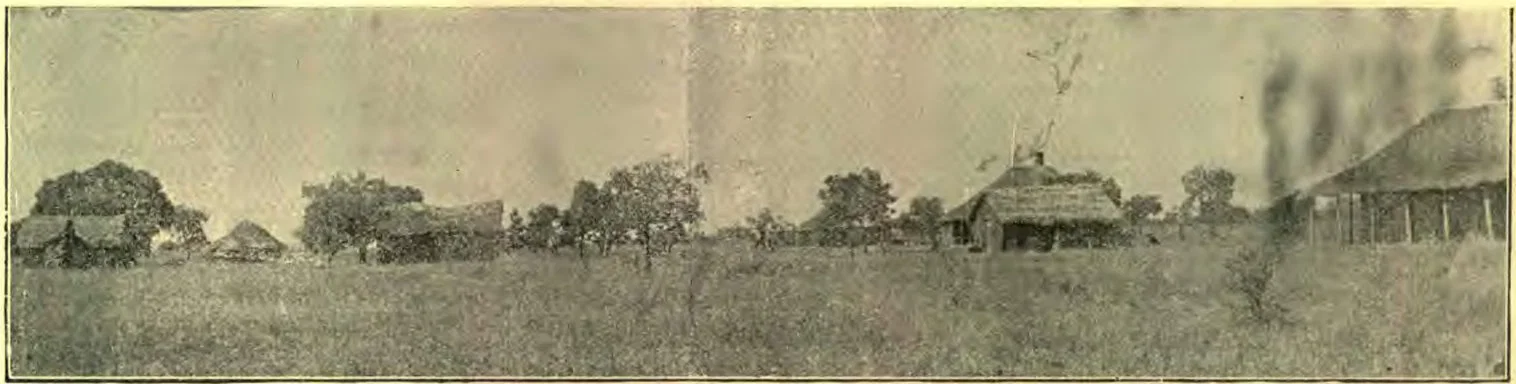
“The next morning after we arrived was Sabbath, and the first day of the new year. It was a lovely morning. All nature seemed to be dressed in holiday attire. The mission presents the appearance of a little village. At present the outlook is encouraging, but the wear and anxiety incident to the experiences through which our workers have just passed are plainly visible in the countenances of those who have stood so faithfully at their post of duty.
“The coming of Brother and Sister Armitage was very timely in every way. Not only did they help lighten the burdens that were resting so heavily on the workers at the farm, but the second day after their arrival, Brother Armitage began the building work. At the time of my visit, with the help of others he had put up three brick dwellings twenty-five by thirty-six feet in size, with verandas surrounding them on all sides. These are not especially for beauty, but for the purpose of protecting the buildings, and for comfort. The bricks used for the houses were sun-dried, and had been prepared before Brother Armitage’s arrival. The houses were roofed with thatch, and the floors were of earth, a very little above the level of the ground outside.
“I would that I could take every Sabbath keeper to the place, that all might see for themselves the needs of the situation. Sister Anderson related a very touching incident. One day while she was writing at the table, one of the little boys they have taken into their family left his playmates, came to the table, and asked to whom she was writing. She replied, ‘To our friends in America.’ He inquired if it was to the people who had sent the missionaries over there. She told him it was. Then the little fellow, who was only about four years old, and not very large, spoke up and said, ‘I wish you would say to them for me that they must send more missionaries over here to teach the people about God. My mother knows nothing about the true God, and I want them to send a missionary to teach her about God and the right way to live.’ Some time after this, the same boy received the information that his mother was dead. This brought him great sorrow. Day after day he would come to Sister Anderson and talk about his mother, who died without learning about the true God, and so must be lost. This was the cause of his anxiety,—not the bare fact that his mother was dead, but that she died without knowing God, and so would not have a part in the first resurrection. Sister Anderson tried to comfort his sorrowing heart the best she could by telling him that God knew all about it, and we could trust the matter entirely with him. After a time the boy felt reconciled.
“I mention this incident to show how quickly even these children grasp the truths of the gospel. There are about thirty children connected with the mission at the present time, and all these are eager to become missionaries to their own people. Indeed, they are so already; for on several occasions I noticed them communicating to the older natives the things that they were learning.
“I remained eight days at the mission, including two Sabbaths. During this time four meetings were held with the natives, and a portion of each day was spent with the workers, seeking the Lord, studying his word, and counseling over his work. We enjoyed much of the Lord’s blessing in these gatherings.”
The early days of 1898, which had dawned so auspiciously, were soon to be darkened by a sorrow heretofore unknown in the history of our mission. Death invaded the ranks, and one by one our workers were laid away, until six graves marked the resting-places of those of whom Jesus instructed John to write, “Blessed are the dead which die in the Lord from henceforth: Yea, saith the Spirit, that they may rest from their labors; and their works do follow them.”
MATABELE MISSION VILLAGE IN 1899
Dr. Carmichael first succumbed to the fever on February 28. On March 7 Brother Tripp and Brother Sparrows’s little daughter were laid to rest. Less than a month later, George Tripp, the only child of Brother Tripp, died, and on April 27 the native teacher. Mrs. Armitage was taken ill, and died on May 1 in Kimberly, while on her way to the Cape, whither her husband was taking her in the hope of saving her life. Only the coming of the Master to gather his jewels from every corner of the earth, even from dark Matabeleland, will reveal how abundantly the seed sown by these faithful hands, even in death itself, has resulted in a glorious harvest of souls from the Dark Continent.
ESTELLA HOUSER.

The Weekly Study

Paul the Chief of Apostolic Missionaries

(December 28 to January 3)
THE outlines suggested for these studies may appear very similar, but the subject-matter itself has every variety. The lives of men of olden time show us who live in these stirring days that God honors devotion to every-day duties. The most inspiring of missionary biographies is that of the apostle Paul, written by Inspiration.
We can take but the opening of the story in this study. Notice how especially Paul's life is set forth as having lessons for us in these days of missionary enterprise. Here is an outline, which may be helpful:—
An Example for Us.—1 Tim. 1:12-16; Acts 9:15, 16.
Eventful Times.—The preaching of Jesus, the crucifixion (though Paul could not have been present), Pentecost, and the witnessing of the apostles, as recorded in the first five chapters of Acts, must have commanded the attention of the thoughtful.
Much good must come from the study, even though the leader or leaders may feel that they can present it but simply. The more simply it is given, the better. Make the studies personal to our own needs and work. Talk it over for personal profit,—how the chief of sinners found the very chiefest of Saviours. Notice also that the message in Paul's day was based on fulfilling prophecy just as in our day. Witnesses were needed then. So are they needed now, to tell the definite message that the end is at hand.
The conversion of Paul is, of course, the central theme of this study. Notice that the Lord knew that in the house of Judas, in Straight Street, Damascus, a sinner was praying for forgiveness. Paul had often “said” prayers; now he was praying.
It would be appropriate to have some one give a short Bible reading on conversion. An experience meeting might well follow the reading.
It was the custom among the Jews to teach every boy a trade. So Paul had been taught tentmaking. Not a thing that our young people learn how to do at home will come amiss in the mission fields. Making tents of rough goats’ hair was not a pleasant occupation, though a useful one.
Here is a statement concerning Stephen’s trial: “His face was calm, and shone with an angelic light. The infuriated priests and the excited mob had no terrors for him. The scene about him faded from his vision; the gates of heaven were ajar, and Stephen, looking in, saw the glory of the courts of God, and Christ, as if just risen from his throne, standing ready to sustain his servant.”—“Sketches from the Life of Paul,” Mrs. E. G. White. W. A. S.

Missionary Lives

“We all should be missionaries wherever we go. Not all missions are to foreign lands. Everywhere we go, people should get a little gospel of love from us, if not in words, certainly in deeds and in influence. There is a legend of Jesus which says that as he walked away from his grave, on the morning of his resurrection, sweet flowers grew in the path behind him. The legend is true in a spiritual sense — wherever his footsteps have pressed the earth, all these nineteen centuries, flowers have sprung up,— flowers of love, of kindness, of gentleness, of thoughtfulness.”

His Gifts

A ROSE is but a rose, I know, And withers in a day; but O, The wealth of love it took to grow!
The lark is but a bird, and dies While bravely singing to the skies, But He who made its wings, how wise!
The rainbow is a thing of air, Soon vanishing; but O, how rare His promises who drew it there!
— Selected.

Questions Often Asked

Listening to Sermons and Lectures

“I AM not able to think about what the preacher is saying. My mind wanders, and sometimes I get scarcely an idea from a whole sermon. Of course when the speaker is witty, I get along much better. What would you do in such a case?” “JENNIE R.”
One young woman cured herself of “mind-wandering” by taking a note-book and pencil to church, and forcing herself to write out an intelligent outline of what she heard. The very necessity of writing an outline of what the speaker said, kept her attention on the sermon. By and by she did not need the note-book in meeting, but compelled herself to write an outline after reaching home. She has practised this system two or three years now, and can often repeat word for word what a speaker says.

Reading and Memory

“How can one learn to remember what he reads? Often I read two or three pages of history; and, if I am not particularly interested, or if something else is worrying me, I can hardly tell what I have been reading about. “HEALDSBURG.”
In answer to this question, so often heard in different forms, I can not do better than give you Henry Ward Beecher’s little story of Dr. Macaulay. Mr. Beecher says:—
“Dr. Macaulay, who used to preach in New York, told me that when he was a boy at college, he began to read enthusiastically, but that at the foot of every page he read he stopped, and obliged himself to give an account of what he had read on that page. At first he had to read it three or four times before he got his mind firmly fixed. But he rigorously compelled himself to conform to the process, until now he says after he has read a book through once, he can almost recite it from beginning to end.”
“It is a great deal of work to write out an analysis, or skeleton, of a book after you have read it; but this is the way the Pitts, the Disraelis, the Websters, the Lincolns, and the Clays are made.”—Marden.

Are Novels Harmful?

“Do you think a good piece of moral fiction once in a while can injure any one? “A FRIEND.”
No doubt there have been times when such writing was helpful. However, ninety-five out of every hundred persons who read fiction do so simply for the mental intoxication it affords. Their eye is ever out for some “Delicious Love,” “A Knight of the Twentieth Century,” or some such draught of bookish wine. Such reading is destructive to the best ends of life. It not only consumes time that should be put to better use, but it weakens the brain.
Of course novels are attractive. They play on the emotions and feelings as skillfully as a musician touches the keys of his instrument. With their sinuous fingers they toy with our very heart-strings. It is just here that their evil lies. They have the power of fascinating, and, in varying degrees, of making devotees of men and women. To the degree that they take such hold upon us, to just that degree the practical side of life loses its grasp and interest.
Dime novels are bad for boys, silly love stories for girls. They are unreal, impractical, and they destroy a relish for the every-day duties of every-day life. The same is true of all fiction which one reads in that eager, devouring haste which neither thinks, reasons, nor weighs, but sweeps on from flood to flood of feeling as fast as the eye can run. Such reading soon supplants a love for substantial books; and what is more, it trains the mind in habits that are destructive to memory and to original thought. EDISON DRIVER.
Continue reading: Wings and Feathers