The Youth’s Instructor, Vol. 50, No. 51.

New-Year Gifts
Earlier text: New-Year Gifts

Wings and Feathers

For nearly fifty years the ostrich has been brought under domestication, and the tame bird is a very different creature from its wild brother. Now, instead of disappearing over the limitless horizon, it is quietly walking up and down the veldt in Africa in multiplied thousands, domesticated as the common poultry of the farmyard, and furnishing to British and Boer capitalists an ostrich-feather product valued at nearly ten million dollars every year. Within the last twenty years the southern part of the United States has proved a suitable habitat for the domesticated African ostrich, and now California leads among all the southern States in furnishing American ostrich feathers to the commonwealth. Large ostrich farms are established at various places in California and Arizona. While at their initiation the objects of their founders were merely to attract sight-seers, yet in consequence of the natural increase of the ostriches, a resultant trade in ostrich-feathers has sprung up, which plainly foretells a great industry, which will occupy the attention of financiers, and give employment to thousands of the residents on the Pacific Slope.
An ostrich has to be maintained four years before it arrives at adult age, and yields the beautiful feathers so much sought after. Until that age the annual yield is not very valuable. The expense of keeping ostriches is trifling; they eat much that is rejected by cattle. In California the pressed grapes from wineries, the refuse from olive-oil factories, second-class oranges, and common beets are fed to them. On this miscellaneous mixture does the ostrich thrive. It has been discovered, however, by the practical ostrich farmer, that the better the quality of material furnished them, the more successful are they in laying fertile eggs, which, in due course of time, become valued members of the ostrich population. A full-grown male ostrich will yield about forty dollars’ worth of feathers annually; and the average life of these birds is sixty years.
About as much value in labor as the crude product is added before the prepared feathers are ready for the use of the consumer. Girls are employed at the California ostrich farms to make up these feathers into articles of trade. The hen ostrich does not yield such large and beautiful feathers as the male, but all ostrich-feathers serve some purpose in the manufactured product, and are therefore of value. The ostrich tip of to-day consists of several pieces of feathers, those underneath being the inferior. At one institution for the edification of visitors to Southern California a vast amount of manufactured ostrich-feather merchandise is on view; this is sold to the procession of tourists who annually haunt the Pacific watering-places, and enables them to carry away a suitable souvenir of the Golden State. All this is useful in advertising to the American public the existence of the American ostrich, and heralding the immense supply of ostrich feathers that will at some future day be reaped from the backs of numberless flocks of ostriches.
Of all occupations, except, perhaps, the care of cattle upon the plains of Texas, the raising of ostriches, so far as easy employment is concerned, takes the lead. A little of the common food named furnished night and morning, with plenty of water, is sufficient for their economical maintenance; and two acres of barren ground will furnish a park for fifty ostriches. The fences built and incubators furnished, nothing remains to do but to await the arrival of young birds. These appear in multitudes in July and February, each nest containing from seven to fifteen. The young ostriches require some special care; in California they are protected from the chilly nights by being placed in boxes heated by lamps; the everlasting California sunshine gives them most satisfactory environment in the daytime. In California these creatures grow with marvelous rapidity, attaining a height of seven feet within as many months. A disease known as yellow-liver, which frequently takes off thousands of the young birds in Africa, has so far been unknown in the American ostrich farms. Beautiful as the full-grown birds are, the ostrich chicks, with their curious tiger-striped necks, excite more admiration. These little creatures are quite handy, and if kept upon green food, generally arrive safely at years of maturity.
While a great industry will at some future time be established in the land resulting from the feather supply of an immense ostrich population, the present receipts from the visitors to view these strange creatures is no small item; indeed, one farm in California receives upward of fifteen thousand dollars a year by the exhibition. As the ostriches multiply, this revenue will unquestionably decrease; in South Africa it would be thought absurd to pay to see ostriches when one can not ride many miles on the railway without observing them. One farm alone in South Africa contains about ten thousand birds. And yet these miniature ostrich farms of California form, to the natural historian and the thoughtful observer, a very interesting exhibit. E. H. Rydall

Homeward Bound

I’m bound for the heavenly city, The city of ancient renown, Where angels bright, In robes of white, Wear each a golden crown.
I’m bound for the city of Zion, The city of peace and joy, Where faces glow, Where tears ne’er flow, And naught comes to annoy.
I’m bound for the city of God, The city of love and light, Where we shall sing Praise to our King— That beautiful city bright.
I’m bound for the capital city, The city of Christ our Lord; Where pearly gates Our entrance wait, And his love will peace afford.
I’m bound for the heavenly mansions That Jesus has gone to prepare. O haste the time That joy is mine, And I his glory share!
WINNIFRED LUCILE HOLMDEN.

New-Year Resolutions

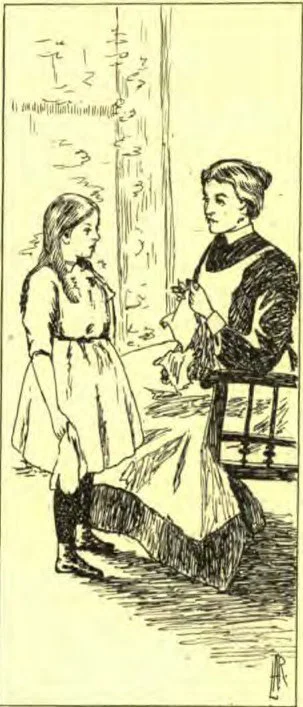
Thirty-first day of December was nearly gone, and the winter sky was not more cloudy than the face of little Mabel Anson, as she and her mother sat sewing by the sitting-room window. Her mother glanced at her now and then, to see if there were not some signs of better nature, but did not speak for some time. At last she said:—
“Have you no happy thoughts with which to meet the New Year, little daughter?”
“That’s just what I am thinking about, mama. You know I have made such beautiful resolutions every New Year for a long time, and then I have gone and broken every one of them right away.”
“‘Try, try, again,’” said mama, smiling.
“No; I don’t think I shall ever make any more; I’m too discouraged;” and rising, she put away her work, and went to the door to meet papa.
After supper he had to know the cause of the unwontedly sober looks.
“It’s about New-year resolutions, papa. You know I always break them,” said Mabel.
“Such as what, for instance, Puss?” asked papa.
“Oh, you know; like getting up promptly, putting on lost buttons, and always looking pleasant, and such things as that.”
“I see,” said papa, gravely. “How many times have you made and broken these excellent resolutions?”
“Why, I’ve resolved the same things for three years, and I have forgotten every one of them in less than a week; and I’m not going to try any more,” she said.
“Well, I think I’d try one time more,” said papa, persuasively; but she only shook her head as she said “Good night,” and went up-stairs. And when she fell asleep, she hadn’t formed one resolution for the morrow.
But it seemed to her she had not been sleeping long when she heard a curious clatter and jangle, and, looking down toward the foot of her bed, she saw a strange row of visitors.
First in the row stood the Rising Bell, and to her surprise it said, in a ringing tone, “Friends, this little girl is discouraged over making New-year resolutions. That is a sad state of affairs; for no one can improve without a firm resolve to do so: and we all know that she has plenty of room for improvement.” The Rising Bell paused impressively, and then continued: “I would propose, therefore, that on behalf of Mabel Anson, we ourselves make suitable resolutions for the New Year.”
“Agreed! agreed!” cried all the others, and the Rising Bell resumed:—
“Then, if I may do so without seeming officious, I will make the first resolution, in view of the fact that I shall be the first to be put to the test;” and again all the others said, “Agreed.”
“Then I would like to submit to your judgment this form of resolution:— “Resolved, That I will every morning waken, and cause to rise, Mabel Anson, at that hour when her mother shall see fit to ring me.”
“Good! good!” said all the other members of the row, who seemed to be in a most agreeable humor.
“And we,” said the Comb and Brush, “will see to it that her hair is neat and tidy when she goes down to breakfast.”
Next to them stood the Button-box, and in a clinking, rattling voice, Mabel heard from its depths: “With the help of our good friend, Needle-and-Thread, we are resolved that there shall be no buttons missing from her garments, and especially from her shoes, during the coming year.”
This resolution was so loudly applauded that Mabel would have hidden her face under the covers, if she had not been anxious to hear the next resolution, which came from a row of little Ornaments that stood generally on the mantel, but were now gathered with the curious company at the foot of the bed.
“Whereas,” said they, “it is Mabel’s duty to dust the parlor, we are resolved that she shall move us and dust under and behind us.”
“And I,” said the Rug beside her bed, “resolve that she shall shake me, out-of-doors, and sweep under me, daily.”
There were also a Plate and Cup and Saucer in the row who said: “We are delegates from the china-closet, and in behalf of the rest of the china, we resolve that we will no more retire to our shelves, after the little girl has wiped us, with tears on our faces, as we have so often done in the past.”
Then the Mirror spoke up in its bright way: “I think I have suffered more than any of you; for no matter what angry, sulky, or scowling visage Mabel was pleased to present before me, I was obliged to reflect it. Now I am resolved that, for the coming year, I will reflect for her only a pleasant face.”
And the Clock, who was last of them all, said, “I resolve to send her smiling to bed, on the stroke of nine.”
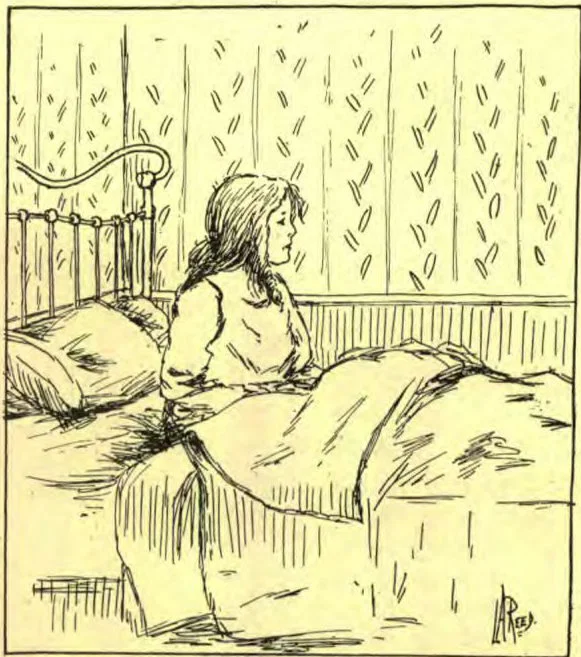
Just then the Rising Bell began to speak again, and his tones grew louder and louder, until Mabel sat up, and rubbed her eyes as she looked at the foot of the bed. There was no one there, and at last she realized that she had been dreaming, and the bell was calling, “Get up! Get up!”
“And I will get up,” said she, laughing, “and you will all just see if I won’t make you keep your resolutions, even if I can’t keep my own.”
AUNT BETTY.
“HAVE YOU NO HAPPY THOUGHTS?”

A Water-Baby

THE Caddis Worm had never seen his mother. Where she was, or what she looked like, he didn’t know. Not that he ever asked any questions. Little folks who live in ponds and streams learn to keep out of the way, and say nothing. It wouldn’t be safe for them to talk too much, or they might be eaten up by some hungry creature fond of children. It frightened the Caddis Worm even to see a fish go swimming by, because he knew that fishes swallowed babies like himself.
He and a great many brothers and sisters were hatched at the same time from eggs that had been left on the floating leaf of a water-plant. They knew, without being told, that they must make little houses for themselves to live in.
One little brother was a slow-poke, though, and, while he was wasting his time, along came a pollywog, and down went the little brother right into the pollywog’s stomach. Another little brother was making fun of one of the sisters, when along came a minnow, and down went that little brother.
“MABEL SAT UP”
“MABEL SAT UP”
It is hard to tell what might have become of the Caddis Worm if he had not been wiser than the little brothers. He built his house before he ate breakfast. This house, or case, was long, and round as the Caddis Worm’s body. It was made of tiny stones and grains of sand fastened together with sticky silk, which the strange baby knew how to spin, though no one had taught him.
Inside the house he was safe and happy. He could crawl about the bottom of the pond or go swimming, house and all. When he was hungry, he fed on water-plants. His head was tough and horny, and the wisest fish would never dream that inside that long, round house was anything good to eat.
So the Caddis Worm lived for many months, changing his clothes when they were so tight he wasn’t comfortable, and couldn’t breathe easily through his sides. Nobody knew just how many new suits he had while he was in the curious house, but surely he was contented, and enjoyed his life.
It isn’t probable that he ever tried to find his mother, and, if he had, it would have done him no good, for she was not in the pond. When the mother was a baby, she had lived in the pond, just as her children did; but that was long before, and, when the Caddis Worm lived in his little house, his mother was a caddis fly in the deep shade of the woods near the pond. She had four wings, that could be folded closely together, and long feelers, called antennae, just above her mouth.
Boys who well knew the Caddis Worms almost never saw their mother, because she used to hide in the daytime, and fly at night. They might not have known who she was if they had seen her.
There came a time when the Caddis Worm felt that he must take a nap. He wanted to go to sleep without being disturbed, so he closed his back door and his front door with curtains of silk netting, which he spun just as he had spun the silk with which he had glued his house together. Then he changed his clothes, and slept, nobody knows how long.
When he awoke, he felt as if he couldn’t breathe. For the first time in his life he needed air. He worked his way through the silk curtain at his front door, and got to the top of the water as quickly as he could. Then he jerked off his old coat, leaving it in the water, while he spread the wings that had been hidden beneath it,—wings he didn’t know he had until he tried to use them,—and flew upward through the air, no longer a water-baby, but a caddis fly.—Selected.

A Smile

A FAMILY of children who had been taught to be kind to all animals were unconsciously annoying a small turtle the other day by stopping it with sticks in whichever direction it tried to run, and confining it in such close quarters that at length it pretended to be dead, and in dismay Katharine ran for her mother.
“We didn’t strike it,” she said. “We didn’t do anything to dead it; it deaded itself.”
“But you must have been treating it unkindly,” said the gentle mother. “See how closely the poor thing hides its head and tail and feet inside its little house. See here, now,” and lifting the little creature by its shell with her thumb and finger, she touched it gently with the fingers of her other hand.
Soon one foot came out, then another, then the head, and the bright little eyes looked from one to another. Soon all the feet and the slim tail were in full view, and still holding it, the warm fingers touched each tiny foot and stroked the head and neck.
The turtle so evidently enjoyed the caress that the little girl cried, in delight: “O Mama Phelps, see him smile! I never will tease any little creature again. I didn’t know they ’preciated being good to.”—Annie A. Preston.

Grandma’s Picket-Guard

Grandma Wilkins was very sick. The doctor said she must be kept quiet, and everybody went about on tiptoe and spoke in low tones. Winfred looked very sad. He crept softly into the darkened room, and laid some flowers on grandma’s pillow; but she was too sick to look at them. Soon after he heard his mother say to Kate, the cook:—
“We must keep the door-bell from ringing, if possible.”
“I can do something for grandma,” thought the little boy.
So he sat on the front step, and soon a woman with a book in her hand came to the door.
“Grandma is very sick,” said Winfred. “Nobody must ring the bell.”
The lady smiled, but went away. Soon a man with a satchel came.
“Grandma is sick, and mama doesn’t want anything at all,” said the boy.
All day long people came. It seemed to Winfred that almost everybody had something to sell; but he kept guard, and the bell was silent. Kate called him to lunch, but Winfred would not go.
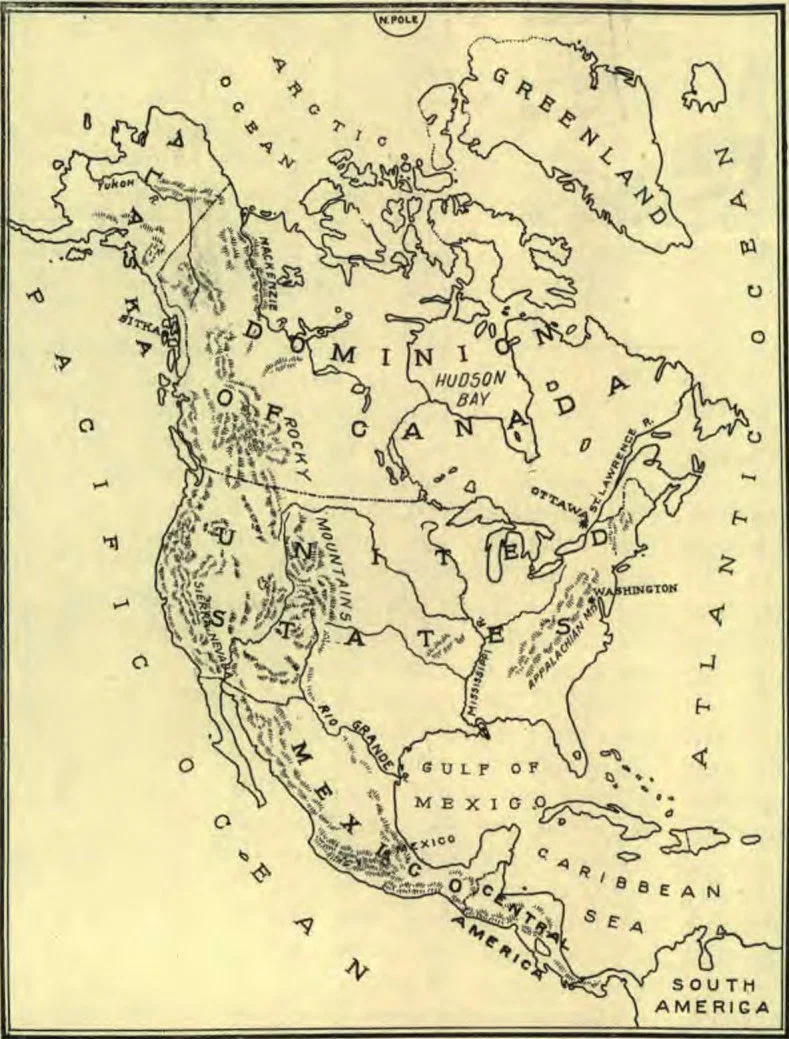
FOR MAP STUDY, SEE PAGE 7
“Just bring me a sandwich or something, and I’ll eat it here,” he said.
At last the doctor came again. When he came back, he smiled down upon Winfred, and said: “Well, little picket-guard, your grandma is going to get well, and you have helped to bring about that happy result. You will make a good soldier.”
Then his mother came out and took him in her arms and kissed him.
“I am quite proud of my brave, unselfish little son,” she said. “Now come and have some dinner, and then you may go and see grandma.”
When Winfred went in on tiptoe, his grandma thanked him with a kiss, and he was a very happy little boy that night.—Selected.

First Lessons in Geography

Lesson XVIII

“All things are full of labor; man can not utter it: the eye is not satisfied with seeing, nor the ear filled with hearing.”
Even the sea is full of labor. As the cold winds from the poles blow toward the equator, they naturally cause the water to move in the same direction. Then, too, water is much heavier just before it gets cold enough to freeze. This causes it to begin to flow toward the equator, just as the heavy milk in a separator flows to the outside while the lighter cream flows to the top and middle. This cold water forms into broad streams, or currents, which flow slowly toward the equator, for the same reason that the trade-winds blow southwest. As the heavy cold water gets farther south, it gradually sinks to the bottom of the ocean. This heavy cold water crowding toward the equator causes the warm water to rise and flow back toward the poles. The influence of the counter trade-winds, and of their continually getting ahead of the slower moving earth as they get nearer the poles, causes the warm ocean currents to flow northeast or southeast. Wherever ocean currents strike continents or large islands, their direction is often changed, though they always flow as nearly in the directions given as they can.
Ocean currents flowing near the land have a great effect on climate. Wherever a warm current strikes a cold current, it produces a great deal of fog. This is the reason there is always so much fog along the northeast coast of North America.
Ocean currents are from fifty miles to two or three hundred miles wide, and are very deep, though they probably do not reach to the bottom of the ocean.
By the winds and the ocean currents, God has arranged the earth so that it will not get colder and colder at the poles and hotter at the equator. So we see that God loves men, and has provided the way for them to enjoy as much of his blessing as is for their good. Even the cold, which came as a result of sin, is now a blessing; for it kills many injurious insects, destroys the germs of disease, and invigorates man.
REVIEW.—What causes ocean currents? In what direction do the cold currents flow? What becomes of the cold currents? In what direction do warm currents flow? How wide are ocean currents?

Lesson XIX

As has been stated in a previous lesson, by far the greater part of the water has been on the surface of the earth since the flood. The sun’s rays carry vast quantities of moisture into the air. As we have learned, the earth is much colder in some places than in others, and this causes the winds to blow. Cold air does not hold so much moisture as warm air; and as the vapor begins to cool, clouds form. These are carried about by the currents of air. It is at God’s command that clouds arise; for he says, “Sing praise upon the harp unto our God: who covereth the heaven with clouds, who prepareth rain for the earth.”
When a cool wind strikes a cloud, the water is condensed, and falls to the ground in the form of Rain. If a wind that is very cold strikes a warm cloud suddenly, the vapor is frozen, and Snow is formed. If it cools more slowly, and yet goes below the freezing-point, we have Hail. Sometimes a rain freezes about the time it reaches the earth, and we call it a Sleet.
If a cloud is so low that it touches the ground, it forms a Fog. In some places where a cold ocean current meets a warmer one, there are fogs all the time.
Warm air holds much more water than cold air, and for this reason a cool wind causes clouds nearer the ground in the summer than in the winter. In winter the clouds almost always float very high.
Rain and snow, sleet and hail, are caused by the unequal temperature of the earth, which has resulted from the tipping of its axis at the time of the flood. While they are the result of sin, God has so overruled as to make them blessings to mankind.
When the sun shines on a cloud while the rain is falling, a rainbow is usually formed. This bow is God’s emblem to us that he will never destroy the earth any more by a flood of waters.
When rain or snow falls on the earth, much of it soaks into the ground. That which falls on the high ground soaks through the soil until it reaches some low place, where it runs out as a spring. Springs are never on the tops of high hills or mountains. God “sendeth the springs into the valleys which run among the hills.” The water from a number of these springs gathers into little rivulets, or brooks, and these, running together, form creeks. By and by the creeks run into each other, and form rivers. A number of rivers generally unite, and form a large river. A river of this kind, with all its branches, is called a River System. Since the flood, there have been a number of large river systems to carry off the water from the rains and snow that fall on the surface of the earth, as well as that which has its source in the springs.
REVIEW.—Where does the rain come from? Who commands the moisture to be drawn up into the clouds? What causes dew or frost?—When the moisture in the air cools on the surface of the earth, it forms dew, and if this dew freezes, it forms frost. What causes rain? snow? sleet? hail? What causes springs? Where do we find them? Describe a river system, and tell how it is formed.

MAP STUDY ON THE WESTERN CONTINENT

Where is North America? What four countries in North America? What four large rivers? In what direction does each flow? What five large lakes in North America? What river flows from these lakes to the ocean? What ocean north of North America? What ocean east of North America? What ocean west of North America? What large gulf south of North America? What large bay in the northern part of North America? What mountains in the eastern part of North America? What mountains in the western part of North America? What is the capital of British America? What is the capital of the United States? What is the capital of Mexico? What do we mean by the capital of a country? (The teacher should answer this question.) When we enter the new earth, what city will be its capital?—The new Jerusalem, which is now in heaven.
FLOYD BRALLIAR.

THE INTERMEDIATE LESSON

I—Message to Pharaoh; Plague of Blood
(January 3)
LESSON SCRIPTURE: Exodus 7.
MEMORY VERSE: “This Moses whom they refused, saying, Who made thee a ruler and a judge? the same did God send to be a ruler and a deliverer by the hand of the angel which appeared to him in the bush.” Acts 7:35.
Aaron went out to meet Moses in the wilderness, and together the brothers returned to Goshen, where they told the elders the glad tidings of deliverance.
In their bondage, the Israelites had to some extent lost the knowledge of God’s law. The Sabbath especially had been disregarded, and the oppression of the taskmasters made its observance almost impossible. But this message revived hope in their hearts, and the fact that Pharaoh complained because Moses and Aaron made the people rest from their labors shows that they had begun to make some effort to restore it.
Moses and Aaron now went in to Pharaoh (chapter 5), and delivered the message the Lord had sent. But Pharaoh said, “Who is the Lord, that I should obey his voice to let Israel go? I know not the Lord, neither will I let Israel go.” He accused Moses and Aaron of already having caused the people to rest from their burdens, and issued orders that very day making their lot more difficult to bear. This discouraged the people; and although they had been confident that the Lord was going to deliver them, they began to lose their courage, and upbraided Moses and Aaron.
Moses went before God, and pleaded earnestly for his people. The same assuring promise was given that had sustained Abraham and Isaac and Jacob. See chapter 6:1–8.
Then the Lord told Moses that he and Aaron should go in before Pharaoh, and speak as he directed, but that Pharaoh would not hearken unto them until he had multiplied his signs and wonders before him. These very signs and wonders were to let the Egyptians know that he was the Lord, and that he would deliver his people.
Moses was eighty years old at this time, and Aaron his brother was three years older. When they went in before Pharaoh, he demanded a miracle in proof of their authority to ask for the release of the Israelites. The Lord had told them what to do in case Pharaoh made this request. So Aaron cast down his rod, and it became a serpent. The wise men and sorcerers of the kingdom did the same, but Aaron’s rod swallowed up their rods. The serpent was the symbol of royal and divine power on the diadem of every Pharaoh, and the destruction of their rods by Aaron’s was a sign of victory over the king and gods of Egypt. Pharaoh’s heart was hardened so that he did not see in the miracle any power superior to that of his magicians and sorcerers.
Rain seldom falls in the land of Egypt, and nearly all the water that the Egyptians had came from the Nile, which at certain seasons of the year overflows its banks, and waters all the surrounding country. Instead of looking to the “Fountain of living waters,” from whom comes all the water in the world, the Egyptians worshiped the Nile, the channel through which it came to them. Even the fish in the river were revered as objects of worship. Pharaoh was accustomed to go to the river-bank every morning to worship, so the Lord told Moses and Aaron to meet him there, and again make their request. They were to tell him that if he refused to hearken to the voice of the Lord, not only the water in the river, but the supply which was in their houses, with what had been reserved in cisterns, should also be turned into blood. Aaron stretched forth his rod upon the waters of Egypt, and all the water in the land became blood, and the fishes that were in the river died. This was a strong evidence to Pharaoh that his gods were not able to deliver him out of the power of the God of Israel. Although the Lord was giving him an opportunity to repent, Pharaoh hardened his heart, and would not heed the voice of God. And Pharaoh turned and went into the house. We sometimes feel that Pharaoh and his servants were greater sinners than men are to-day, because they would not heed the direct call of God. But there is just as much danger of our hearts being hardened if we fail to heed the voice that prompts us to do right.
All the Egyptians digged round about the river for water to drink, for they could not drink of the water of the river. For seven days this plague continued.

Questions

1. To whom did Moses and Aaron first carry the good news of deliverance? How did the people receive it?
2. What reform did they attempt? Give some reasons for their nonobservance of the Sabbath.
3. When Moses and Aaron went in to Pharaoh, what question did he ask? Of what did he accuse Moses and Aaron?
4. What did he mean when he said they made the people rest from their burdens?
5. As a result of this interview, how did Pharaoh treat the Hebrews? When they complained, what did he reply? Why did he think they were idle?
6. How did the children of Israel feel toward Moses and Aaron?
7. What did Moses do? What response did the Lord make to Moses? What assuring promise did he give to his servants? How old were Moses and Aaron at this time?
8. What evidence did Moses and Aaron give Pharaoh to show that their mission was of the Lord?
9. What did Pharaoh’s wise men do? What effect did all this have on the king?
10. Where did the Lord then tell Moses and Aaron to go? When Pharaoh again refused, what were they to do?
11. What was the first plague? How long did it last? What did the Lord design to teach the Egyptians from this plague? How did it affect Pharaoh?

I — The Greatness of Jehovah

  • (January 3)*
LESSON SCRIPTURE: Psalm 104:1–12.
MEMORY VERSE: Ps. 104:1, 2.
Bless Jehovah, O my soul. O Jehovah my God, thou art very great; Thou art clothed with honor and majesty: Who coverest thyself with light as with a garment; Who stretchest out the heavens like a curtain; Who layeth the beams of his chambers in the waters; Who maketh the clouds his chariot; Who walketh upon the wings of the wind; Who maketh winds his messengers; Flames of fire his ministers; Who laid the foundations of the earth, That it should not be moved forever. Thou coveredst it with the deep as with a vesture; The waters stood above the mountains. At thy rebuke they fled; At the voice of thy thunder they hasted away. (The mountains rose, the valleys sank down) Unto the place which thou hadst founded for them. Thou hast set a bound that they may not pass over; That they turn not again to cover the earth. He sendeth forth springs into the valleys: They run among the mountains; They give drink to every beast of the field; The wild asses quench their thirst. By them the birds of the heavens have their habitation; They sing among the branches.

Questions

1. With what exhortation does this psalm open?
2. What reference is made to the greatness of our God?
3. With what has Jehovah clothed himself?
4. What serves as a robe for him?
5. How were Adam and Eve clothed in the garden of Eden? (“The sinless pair wore no artificial garments; they were clothed with a covering of light and glory, such as the angels wear. So long as they lived in obedience to God, this robe of light continued to enshroud them.” — “Patriarchs and Prophets,” page 45.)
6. Like what has he made the heavens? See also Isa. 40:22.
7. What assuring promise is made to God’s people in Isa. 51:11, 12?
8. On what manifested power of God is this promise based?
9. What use does Jehovah make of the clouds?
10. Mention instances where the clouds serve as his chariots. Acts 1:9; Matt. 24:31.
11. What composes these clouds? Matt. 25:31; 2 Thess. 1:7, 8; Ps. 68:17.
12. How are the angels described in verse 4?
13. What is the work of these angels?
14. Who laid the foundations of the earth mentioned in verse 5? Heb. 1:10.
15. To what time do verses 6 and 7 refer? See Gen. 1:9. At what other time were the mountains covered with water?
16. In each case what caused the waters to recede?
17. How is the course of the waters described?
18. What holds them in bounds?
19. How does the Lord cause them to flow forth?
20. What need of the animal kingdom is thus supplied?
NOTE.—The lessons this quarter will cover only a few verses of Scripture each week. Will it not be possible to commit these, so that at the close of the quarter you will be able to repeat the four psalms? Two verses each day will accomplish this. Make it a part of your study to memorize the Lesson Scripture.
Continue reading: SOLID THROUGH TRAINS OF