[By Homer C. Stuntz, D. D., in Christian Advocate.]
Four American missionary societies have opened work in the Philippines. These are (named in the order of occupancy) Methodists, Presbyterians, Baptists, and United Brethren. Altogether their working force consists of sixteen American missionaries. Of these only three were proficient in Spanish before appointment, and none, of course, had any knowledge of local vernaculars, in which we must preach for the evangelization of this generation.
Manila Bay,
By the allotment of territory to each mission, which was suggested by the recently formed Evangelical Union of all Protestant forces at work in the islands, these sixteen men are occupying Luzon, and parts of Negros and Panay Islands only. A policy of comparative concentration has been forced upon the representatives of these societies by the paucity of workers and the multiplicity of tongues. The Presbyterians, contrary to their policy in other fields, are holding the longest line. Their seven men are distributed all the way from Manila to Iloilo (pronounced Ee-lo-ee-lo), a distance of about 300 miles, the latter city being in quite another vernacular field. The Baptists are with them in the islands of Panay and Negros. The latter are not at present seeking territory elsewhere. The United Brethren have the “Ilocano country,” the long, narrow coast-strip in northern Luzon, from the Gulf of Lingayen to the northernmost limit of the island. We Methodists share the city and province of Manila with our Presbyterian brethren, and have as our peculiar field that portion of the island of Luzon contained in the provinces of Bulacan, Pampanga, Tarlac, Nueva Ecija, Pangasinan, Bataan, and Zambales. This gives the Presbyterians four languages, the Methodists three, the Baptists two, and the United Brethren one with which to deal in all their missionary operations. The Methodist territory is the most compact, and most easily covered from the natural center at Manila. It is traversed through its entire length by the only railway in the islands—a railway so poorly equipped, and bearing so many marks of the recent war that it is but a sorry excuse of a road. Still it is better and somewhat more rapid than locomotion by caribou carts. The Presbyterians have decidedly the advantage, in the fact that more than 1,000,000 people in their field speak the chief language of the islands—the Tagalo.
Out of a thousand perplexing difficulties which confront us, four stand out clear and stubborn:—
1. The pre-occupation of the public mind owing to political and military conditions. It requires but slight exercise of the imaginative faculty to enable one who has never visited the archipelago to recognize that the Filipino has had plenty of new material for thought since that May morning upon which Spain’s submarine fleet received such a substantial reinforcement here in the bay! Events have crowded fast on the heels of other and equally disturbing events. Raided first by Americans, and then by Filipinos, having municipal government set up in his native city, with at least the germ of popular government in the heart of it, with the sore question as to the return of “los Frailles” to their posts throughout the islands discussed at every village gathering as well as in the various papers—all these matters have pre-occupied the public mind. And they will so pre-occupy it for many months to come.
2. The sleepless hostility of Catholicism. Not a move do we make that is not opposed. Accustomed for three centuries to absolute rule, the powers of the church are bitter in their resentment against Protestant effort. If we try to rent a building, and the friars hear of it, all the machinery of the church is set in motion to head us off. If we attempt to purchase land, their rage knows no bounds, and they will defeat us if possible. It is almost impossible to get on at all in such transactions if we appear in them. Our own mission was prevented from securing the best building in the city for use as a temporary place of worship by the English-speaking congregation until we build the permanent church, by pressure brought to bear upon the owner, a fanatical Spanish supporter of the church. There are over 1,200 friars congregated in Manila. They are in comparative idleness. Our Brother Nicholas Zamora says that they do nothing but “eat and say mass;” but they are plotting by day and by night to outwit the government by holding their ill-gotten properties, and to retard the movement toward Protestantism as much as lies in their power. They have issued nearly twenty tracts in Spanish and Tagalo since New Year’s. They publish a daily paper, the chief business of which seems to be to ridicule and belittle the work we are doing. This hostility will continue. It will be restrained by no such safeguards as exist at home. It is only a question as to what they dare to do. The will is present, and Jesuits have not usually been at a loss for means.
3. The multiplicity of languages. There are at least sixty languages in the group of islands making up the archipelago. Language areas are small. In the Cagayan valley, in northern Luzon, I am told that there are seven languages in actual use between the mouth and source. Nearly every little stream that puts into the main channel has its own speech along the length of its valley. This hinders the Protestant movement sorely. When a missionary has toiled as long and as faithfully to acquire a vernacular as he would toil to master the Hindustani or Bengali language, he has access to less than one-fiftieth of the people that even the Bengali would give him. All literature must be translated and printed in these different tongues, and the expense of these translations and publications appals one. We are robbed of the esprit du corps which exists where large bodies of people with similar ideals and similar enthusiasms meet and work side by side.
4. The pitiful smallness of the force with which the work must be done. I took lunch on a small gunboat in Cavite Harbor recently. It is a 1,200-ton vessel, with a crew of about 150 men, and eight commissioned officers of the navy are doing duty on that one tiny craft! The share of each seemed to me almost microscopic. If the society would undertake to equip the Philippine Mission in half that proportion, I should have at least twenty-five new missionaries by Christmas! We have appealed for at least four to be here by that time at the latest, and we hope that this very modest request will be granted. We shall then have nine men to evangelize 2,000,000 people!
But there are manifold encouragements. There is an eagerness to hear the Gospel that is almost past belief. The people crowd upon us. Our own church has the largest total of visible results so far, there being 1,100 probationary members in the city and vicinity of Manila already. These are largely from among the poorer people. “Not many noble, ‘not many mighty,’” are successfully “‘called’” so far. Many of the “noble” would join us at once, if we were satisfied with hatred of the friars as both a sufficient body of doctrine and religious experience. But these people are all self-respecting, industrious men and women, with trades and occupations from which they support themselves. Many are fishermen, whose labors supply the city markets with delicious and wholesome food. Several are printers. Some are gardeners; some are merchants. All are employed in one way or another, and want nothing in the way of financial aid of any sort. They have raised the money and erected two modest little chapels, in which they worship God after the dictates of their own conscience. Plans are on foot to erect at least three more in the near future. They are inexpensive affairs, costing from $25 to $50 each. Built of bamboo for framework, and nipa palm for roof, they are commodious and clean.
In the city of Hagonoy, in the Province of Bulacan, a small congregation, handed over to us by our Presbyterian brethren when the division of territory was made, raised funds and bought a suitable building13for a chapel and came to the city for us to send some one as pastor. We did not know that they even contemplated so bold a stroke until it was done.
At a suburban town north of Manila—Malabon—a number of the leading citizens furnish the theater free for a Protestant service every Sunday, and they are there in force, sitting in a body behind the preacher with notebooks and Spanish and Tagalo Bibles in hand drinking in the message. So far we have not made any call for converts at this place, but will do so soon.
In a neighboring village a gentleman, the presidente of his “barrio” or ward of the town, asked our Brother Goodell to hold a service there on a recent Sunday. He took his band of workers from the earlier theater service and held a meeting in the home and yard of the presidente, and was invited to return. On the next Sunday he found that the man had actually built a neat hall for the services during the week, and it was placed at our disposal for meetings as long as we care to use it. Already several have found Christ at this place, and the germ of a church can be seen.
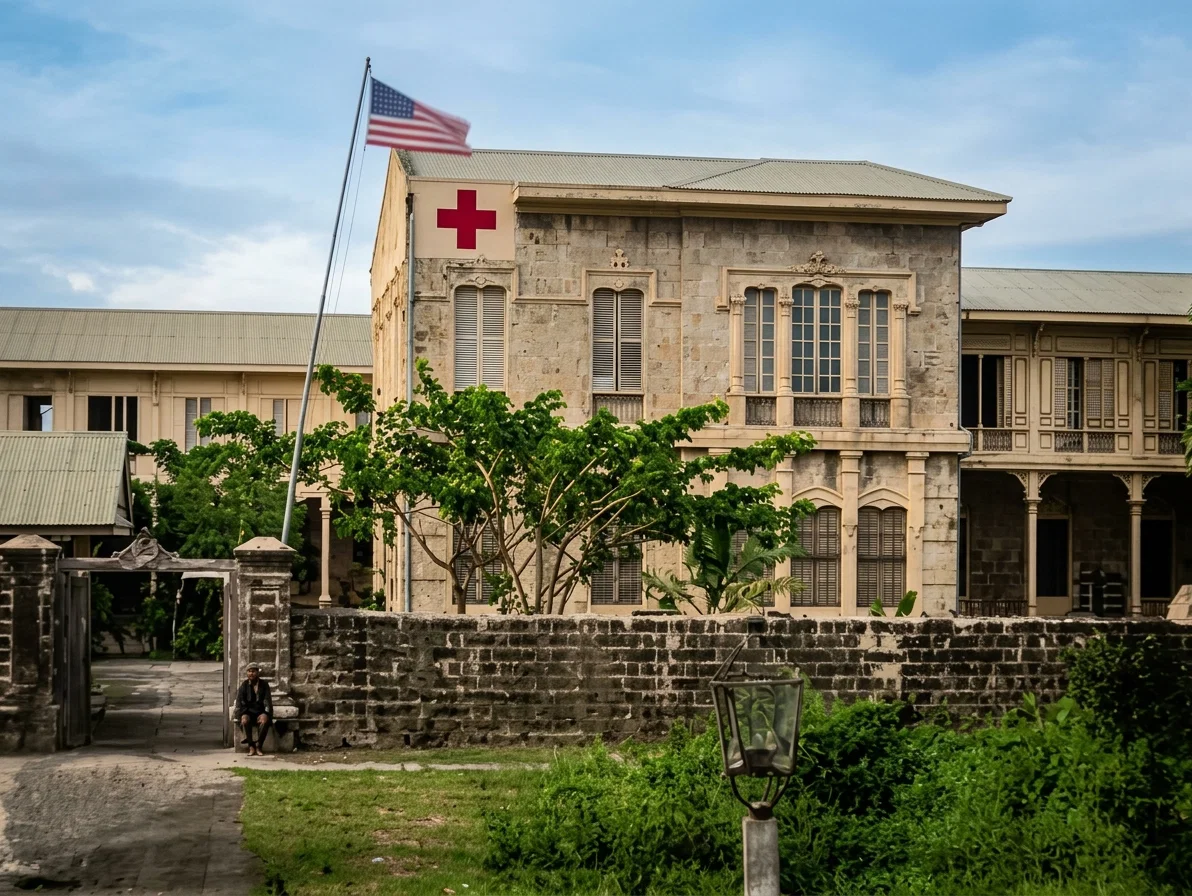
Red Cross Building, Manila.
Since writing the above, I have had an interview with Señor Pantaleon Sembrano, a resident of the Province of Tarlac with whom I made a tour of northern Luzon recently. He reports wide and effectual doors at the places visited by himself and our Brother Martin, of Dagupan. At all the chief cities of that part of the province services have been arranged for, and the leading men have agreed to support a native preacher, if we can send them one. Sambrano has been baptized. I think he is converted, and he is certainly full of a self-sacrificing zeal for the spread of the Gospel. He and his brother and his brother-in-law are holding Sunday-schools in their homes in three separate cities, and their homes are open to the Methodist itinerant. On a recent Friday I received a deputation from the Province of Bataan. They want services there in four neighboring cities. We shall go out shortly and leave a native preacher on the “Bataan circuit,” if we can spare them a man in whose judgment and ability we have confidence. But the laborers are so few, and the fields are so white!
Manila, Philippine Islands.
DARKNESS AND LIGHT.
By F. L. Harkness
Out in the darkness the heathen are dying—
Dying for want of the light ye can give;
Waken, O Christians! and hark to their crying,
Lead them to Jesus, and so shall they live.
What, shall they perish because ye are sleeping?
Whose is the blame if they die in their sin?
Why will ye turn a deaf ear to their weeping?
Go to the outcasts and welcome them in.
Helpless and hopeless they grope in their blindness,
Weary of evil, yet knowing no good,
No one to comfort, nor show them a kindness,
Starving for want of the Heavenly Food.
Wherefore, then, harden your hearts unto pity?
Cast out each hindrance that lies in the way.
Go, then, or send, to each desolate city,
Preach them the Gospel, and teach them to pray.
Then when the Saviour returns in His glory,
You will He claim as His helpers on earth;
Small are your lives, but the Lord knows their story;
He will accept them and double their worth.
Life is no longer a thing to be wasted:
Are we not gifted with body and soul?
Thine are they, Lord, and when once we have tasted
Work in Thy service, our hearts shall be whole.
—F. L. Harkness, in the C. M. S. Gleaner.
OUR WORK AND WORKERS.
The baptism of three candidates at Glenville, Cal., is reported by Brother A. S. Kellogg.
The new church recently organized on the Oneida Reservation, Wis., has twenty-three members.
It is estimated that about thirty-five church-schools will be in operation this fall in California.
Our Sanitarium and bakery at Des Moines, Iowa, have united in arranging a nice exhibit at the State Fair. They have a booth in the Exposition Building, where all the cereal and nut foods, also health literature, are on display and for sale.
At Paterson, N. J., August 17, two candidates were baptized by Brother C. H. Keslake.
Fifteen converts are the visible results of labor the past summer at Capay, Cal., by Brother F. D. Gauterau and others.
Brother J. E. Jayne, president of Atlantic Conference, has moved his headquarters to Paterson, N. J., 165 Godwin Street.
Brother A. T. Jones arrived in this city August 27, after an absence from the State of about two months, during which time he attended important teachers’ institutes at Berrien Springs, Mich., Keene, Texas, and Walla Walla, Wash.
At Guerneville, Cal., Brethren H. F. Courter and Denton Sees report that seven adults have accepted the Sabbath of the Lord.
Brother A. R. Ogden, reporting to the Kansas Worker, notes the addition of six members to the church at Wichita and six at Ellsworth.
Prof. E. J. Hibbard, formerly president of Walla Walla College, has accepted a call to teach the Biblical classes in Healdsburg (Cal.) College.
The lot and material for building a new house of worship at Shelton, Wash., has been purchased, and the work is progressing. Brethren F. M. Burg and Geo. E. Squire are laboring there.
From the Atlantic News we learn that over two hundred persons are keeping the Sabbath of the Lord as a result of tent-meetings held in Trenton, N. J., begun July 7 by Brother E. E. Franke.
A new post-office has been established at St. Helena Sanitarium, Napa County, Cal. The name of the office is Sanitarium, and Brother L. M. Bowen is post-master. The sanitarium itself is enjoying the largest patronage in the history of its business.
The sisters in the Southwestern Union Conference have decided to support a worker among the zenanas of India. The sisters of not only every union conference, but of nearly every State conference, might do the same, and still the work would only be started.
Brother H. W. Decker reports to the Visitor that the recent camp-meeting at Coquille, Oregon, was a decided success. Brother C. N. Martin, of California, and J. C. Bunch remained to continue the work. The Coos County church was disbanded, and two churches were organized in its stead—one at Coquille, the other at Gravel Ford.
The Atlantic Conference has purchased the Fischer Kindergarten Home, in Paterson, N. J., which was formerly conducted by Brother and Sister John Fischer. The Atlantic News has been removed to the home, and will hereafter be published there. It has also been decided to issue a monthly paper entitled Our Little Ones, “devoted especially to the care, education, and development of needy, orphaned, abandoned, cruelly-treated, and neglected children.” Within the past three years the home has sheltered over five hundred little ones. At no time during the past year have there been less than twenty-five at one time, and sometimes there have been over seventy. The work was started by the Christian Help Band of the Paterson church. The address is Children’s Home, 472 Union Avenue, Paterson, N. J.
The following officers were elected by Kansas Conference, at the late session held at Burlington, Kansas: President, E. T. Russell; vice-president, C. A. Beeson; treasurer, T. J. Eagle. Secretary and treasurer of the Tract and Missionary Department, R. M. Rockey; State agent, W. F. Surber. Other secretaries were chosen by the Conference Committee.
Writing to the Bulletin (Des Moines, Iowa) from Guadalajara, State of Jalisco, Mexico, Brother D. D. Fitch says that the sanitarium there is enjoying much better patronage than a year ago. He says, “Take it all around, there is no place for comfort like the State of Jalisco. It rains as often as desirable, and the average summer temperature is about 86°. Really we have neither hot nor cold weather.”
A letter from Sister Mary B. Hansen of Copenhagen, Denmark, in the Des Moines, Iowa, Bulletin, gives this item of special interest: “Our people had a splendid opportunity to let the light on health reform shine while the Peace Congress was in session at Frederikshavn recently. All the delegates were invited to visit our sanitarium and partake of a peace breakfast. There were about one hundred and fifty of them, all of the better class of people,—senators, lawyers, college professors,—all learned men. The breakfast was enjoyed to the utmost, and many words of praise were spoken. They were surprised that such a bountiful meal could be prepared without bloodshed. A call was made by many of them for some one to teach healthful cookery.”
Our Alaska workers, Brethren T. H. Watson and A. M. Dart, have settled for a time—the former on Douglas Island, in Douglas City, and the latter in Juneau. There is a three-mile channel between these places, but the close proximity enables them to work together as occasion may require, and thus be a mutual help. The wives of these brethren work together at times in selling papers and other missionary work. The field is a peculiarly difficult one, inasmuch as the white population are there for the one purpose of making a fortune as quickly as possible and returning to their homes. But, as has been previously reported, papers and books sell well. So the truth disseminated in this form may bring results at a later day and in a different field. It appears to be a good country for sowing, at least. Brother Watson asks for clean copies of the SIGNS, or other S.D.A. reading matter for missionary work. Address, post-paid, T. H. Watson, Douglas City, Douglas Island, Alaska.
From our laborers in the various fields we frequently get items of interest about the country as well as about the work. A recent number of the Southern Review contains a letter from Brother N. W. Allee, President of Dakota Conference, to Brother C. P. Bollman, of Nashville, Tenn., from which we clip the following:—
I have had some very blessed experiences in the work since coming to this field. I have traveled many miles by team over these vast treeless prairies, laboring among those who can not understand the English language, my speaking being done through an interpreter. The experiences are quite different here from those in the South. Traveling for many days in the newly settled portions of the country, it seems strange not to see a tree or even a twig of timber growing. One sees many houses, barns, school-houses, and churches built of sod. One place where I was visiting, the ground freezes five or six feet deep in winter time. That is in North Dakota. Fortunately there are coal mines there, and fuel is cheap, one to three dollars per ton. Wheat, oats, and flax are the principal crops. Many of the farmers have from 200 to 500 acres in grain. The weather has been unusually warm this summer here. We have suffered more from heat than in the South. We are well and of good courage.
PERIODICALS WANTED.
Good, clean copies of the SIGNS for missionary work. Address post-paid, Alex Ritchie, 865 Fifth Street, Milwaukee, Wis.
ANY S. D. A. literature, in any quantity, for ship-missionary work. Send clean copies, post-paid, to C. G. Marchus, 1219 Buchanan Street, San Francisco, Cal.
NOTICE
By Editor
MANY new subscriptions are being received each day, to commence with the series of articles on Modern Spiritism which commenced Sept. 4.
In anticipation of this demand we have on hand an extra supply of the papers containing these first three articles.
It is a grand opportunity to warn your friends of this great delusion. PUBLISHERS.
LESSON XIII.—SEPTEMBER 28.—THE EXECUTION OF THE JUDGMENT.
[Note to the Student.—These lessons are not designed to be exhaustive, but suggestive. In references to the “Desire of Ages,” in the lessons, the subscription edition is referred to. Those who have only the trade edition will find the matter in chapters 1, 4, 11, 27, 71, 77, 78; also read “Patriarchs and Prophets,” chapters 5 and 30. “Christ Our Advocate,” Bible Students’ Library No. 129 (price, 10 cents), and “Looking unto Jesus” (price, $1.00) will be found a great help. The SIGNS OF THE TIMES will have an article on the subject of each lesson this quarter by J. O. Corliss. Read these articles in connection with the study of the lesson. We have not space to print all the scriptures. Let the student study them carefully from the Bible. Those printed are from the Revised Version.]
SUGGESTIVE QUESTIONS.
1. Into whose hands will the judgment of the wicked be given?
“And judgment was given to the saints of the Most High; and the time came that the saints possessed the kingdom.” Dan. 7:22. (Rev. 20:4.)
2. What experiences will have fitted them for this work?
“And Jesus said unto them, Verily I say unto you, that ye which have followed Me, in the regeneration when the Son of man shall sit on the throne of His glory, ye also shall sit upon twelve thrones, judging the twelve tribes of Israel.” Matt. 19:28. (Luke 22:28-30.) Note .
3. Who will be judged by them?
“Know ye not that the saints shall judge the world? and if the world is judged by you, are ye unworthy to judge the smallest matters? Know ye not that we shall judge angels? how much more, things that pertain to this life?” 1 Cor. 6:2, 3.
4. What will enable the righteous to judge understandingly?
“Wherefore judge nothing before the time, until the Lord come, who will both bring to light the hidden things of darkness, and make manifest the counsels of the hearts; and then shall each man have his praise from God.” 1 Cor. 4:5. (Rev. 20:12.) Note .
5. What takes place at the close of the investigative judgment of the wicked?
“And His feet shall stand in that day upon the mount of Olives, which is before Jerusalem on the east, and the mount of Olives shall cleave in the midst thereof toward the east and toward the west, and there shall be a very great valley; and half of the mountain shall remove toward the north, and half of it toward the south. And ye shall flee by the valley of My mountains; for the valley of the mountains shall reach unto Azel: yea, ye shall flee, like as ye fled from before the earthquake in the days of Uzziah king of Judah: and the Lord my God shall come, and all the holy ones with Thee.” Zech. 14:4, 5.
“And I saw the holy city, New Jerusalem, coming down out of heaven from God, made ready as a bride adorned for her husband.” Rev. 21:2. (Rev. 20:5, 7, 8.) Note .
6. For what purpose do Christ and His saints come at this time?
“And to these also Enoch, the seventh from Adam, prophesied, saying, Behold, the Lord came with ten thousands of His holy ones, to execute judgment upon all, and to convict all the ungodly of all their works of ungodliness which they have ungodly wrought, and of all the hard things which ungodly sinners have spoken against Him.” Jude 14, 15.
7. What weapons are used in their punishment?
“Let the saints exult in glory; let them sing for joy upon their beds. Let the high praises of God be in their mouth, and a two-edged sword in their hand; to execute vengeance upon the nations, and punishments upon the peoples; to bind their kings with chains, and their nobles with fetters of iron; to execute upon them the judgment written: this honor have all His saints. Praise ye the Lord.” Ps. 149:5-9. (Rev. 19:13-15.)
8. What is this sharp two-edged sword?
“For the Word of God is living, and active, and sharper than any two-edged sword, and piercing even to the dividing of soul and spirit, of both joints and marrow, and quick to discern the thoughts and intents of the heart.” Heb. 4:12.
9. To what is God’s Word further compared?
“Is not My Word like as fire? saith the Lord; and like a hammer that breaketh the rock in pieces?” Jer. 23:29.
“And the house of Jacob shall be a fire, and the house of Joseph a flame, and the house of Esau for stubble, and they shall burn among them, and devour them; and there shall not be any remaining to the house of Esau; for the Lord hath spoken it.” Obadiah 18.
12. Where do the wicked go, and for what purpose, which brings them in contact with this fire?
“And they went up over the breadth of the earth, and compassed the camp of the saints about, and the beloved city; and fire came down out of heaven, and devoured them.” Rev. 20:9. Note .
13. How does the fire of the Lord’s presence affect the earth?
“A fire goeth before Him, and burneth up His adversaries round about. His lightnings lightened the world; the earth saw, and trembled. The hills melted like wax at the presence of the Lord, at the presence of the Lord of the whole earth.” Ps. 97:3-5. (Micah 1:3, 4; Nahum 1:5.)
14. Why can not the earth bear the glory of the presence of the Lord?
“The earth also is polluted under the inhabitants thereof; because they have transgressed the laws, changed the ordinance, broken the everlasting covenant. Therefore hath the curse devoured the earth, and they that dwell therein are found guilty; therefore the inhabitants of the earth are burned, and few men left.” Isa. 24:5, 6. (Micah 1:4, 5.)
15. Will it ever recover from the curse thus placed upon it?
“For the earnest expectation of the creation waiteth for the revealing of the sons of God. For the creation was subjected to vanity, not of its own will, but by reason of Him who subjected it, in hope that the creation itself also shall be delivered from the bondage of corruption into the liberty of the glory of the children of God. For we know that the whole creation groaneth and travaileth in pain together until now. And not only so, but ourselves also, which have the firstfruits of the Spirit, even we ourselves groan within ourselves, waiting for our adoption, to wit, the redemption of our body.” Rom. 8:19-23. (2 Peter 3:13.) Note .
16. By what will this little earth then be honored?
“And there shall be no more curse: and the throne of God and of the Lamb shall be therein; and His servants shall do Him service, and they shall see His face; and His name shall be on their foreheads.” Rev. 22:3, 4. (Rev. 21:3.)
NOTES.
Read “Great Controversy,” ch. 42; “Early Writings,” pp. 151-154.
29 “Who hath woe? who hath sorrow? who hath contentions?
Who hath complaining? who hath wounds without cause?
Who hath redness of eyes?
30 They that tarry long at the wine;
They that go to seek out mixed wine.
31 Look not thou upon the wine when it is red,
When it giveth its color in the cup,
When it goeth down smoothly:
32 At the last it biteth like a serpent,
And stingeth like an adder.
33 Thine eyes shall behold strange things,
And thine heart shall utter froward things.
34 Yea, thou shalt be as he that lieth down in the midst of the sea,
Or as he that lieth upon the top of a mast.
35 They have stricken me, shalt thou say, and I was not hurt;
They have beaten me, and I felt it not:
When shall I awake? I will seek it yet again.”
Golden Text.—“Wine is a mocker, strong drink is raging; and whosoever is deceived thereby is not wise.” Prov. 20:1.
SUGGESTIVE QUESTIONS.
(1) What pointed questions are asked at the beginning of this lesson? Verse 29. Note 1. (2) What is the inspired reply? Verse 30. Note 2. (3) What warning is given in regard to abstinence from intoxicating wine? Verse 31. Note 3. (4) What fearful result is pointed out? Verse 32. (5) What is the effect upon the morals of those who thus indulge? Verse 33. Note 4. (6) With what dangerous position is such an indulgence compared? Verse 34. Note 5. (7) To what extreme of unconsciousness may the drunkard be led? Yet what is his first inclination on awaking from his stupor? Verse 35. Note 6.
NOTES.
1. “Oh!” and “Alas!”—In the margin of the Revised Version these interjections take the place, respectively, of the words “woe” and “sorrow.” With this variation the text would read, “Who hath, oh! who hath, alas! who hath contentions?” etc. The Spirit seems to have contemplated the condition with a horror that words could hardly express.
2. The prolonged debauch causes a loss of desire for anything but that which keeps up the intoxication. As that wears away, the terrible reaction in the system brings on a most debilitating condition, a feeling of unfitness for duty, and a remorse that, in the absence of genuine will power, is unendurable. But the longer the strain of intoxication is continued, the more difficult it is to keep up the tension which the drinker desires; hence the resort to a variety of liquors, because a mixture will arouse the benumbed nervous system to enforced action, when that which produced the first sensation would be slow to act, often being repulsive. So they that “tarry long at the wine,” that “seek out [margin, “try”] mixed wine,” add sorrow to sorrow, suffering to suffering, and woe to woe.
3. The danger lurking in the fermented wine, the “manufactured” article, is here emphasized. We see a strong contrast between this and the wine used by Christ when He instituted the Lord’s Supper—that being at the Passover time, when no leaven—fermentation, decay—of any kind was permitted to be even in the houses of the people. Ex. 12:15, 19; 13:7. For it “goeth down smoothly,” as in the R.V., the margin, as also the Common Version, has “moved itself aright.” Inasmuch as this is a condition that is pointed to as dangerous, we know that it is unnatural to the pure juice of the grape in its primitive state.
4. The delusion of intoxication is here tersely expressed. The victim is unable to see things in their true light, even material objects are not properly discerned. Therefore the heart, or mind, is confused; and as “out of the abundance of the heart the mouth speaketh,” the utterance will be according to the foolish or confused condition of the mind.
5. On verse 34, Adam Clarke says: “He is utterly regardless of life; which is expressed very forcibly by one in a state of intoxication ascending the shrouds, clasping the mast-head, and there falling asleep; whence, in a few minutes, he must either fall down upon the deck and be dashed to pieces, or fall into the sea and be drowned.”
6. The intoxicated man may receive much abuse and hardly be conscious of it at the time. He may fall and receive injury, yet not feel the effect at the time. But when he awakes, or becomes sober enough to realize his condition, he will instinctively seek relief in a return to the intoxicating beverage. Such is the tendency of indulgence in strong drink. (See also article entitled “Satan’s Favorite Medium,” on page 7 of this paper.)
Chicago in LESS than 3 Days
From San Francisco at 10 a. m.
CHICAGO, UNION PACIFIC & NORTHWESTERN LINE
DOUBLE Drawing-room Sleeping Cars, Buffet, Smoking, and Library Cars, with barber. Dining Cars—meals a la carte. Daily Tourist Car Service and Personally Conducted Excursions every Week from San Francisco at 6 p. m. The best of everything.
R. R. RITCHIE
617 MARKET ST. — PALACE HOTEL
GEN. AGENT PACIFIC COAST — SAN FRANCISCO
OR S. P. COMPANY'S AGENT
Individual Communion Outfits.
Send for free catalogue and list of users.
SANITARY COMMUNION OUTFIT CO., Dept. 95, Rochester, N. Y.